- Overview
- Department of Developmental Services
- CalWORKs
- Food Assistance
- Aging-Related Issues
- Child Welfare
- Immigration and Equity-Related Budget Actions
LAO Contact
- Ginni Bella Navarre
- Deputy Legislative Analyst: Human Services and Governance
- Angela Short
- Child Welfare
- Ryan Woolsey
- CalWORKs
- Food Assistance
- Juwan Trotter
- Aging-Related Issues
- Immigration and Equity-Related Budget Actions
- Karina Hendren
- Department of Developmental Services

October 8, 2026
The 2026-27 California Spending Plan
Human Services
Food Assistance
CalFresh and California Food Assistance Program (CFAP)
CalFresh is California’s version of the federal Supplemental Nutrition Assistance Program (SNAP), which provides federally funded monthly food assistance to about 3 million qualifying low-income households. CFAP provides equivalent state-funded food assistance to about 50,000 legally present noncitizens who do not qualify for SNAP because of their immigration status.
Spending Plan Reflects Significant Adjustments Related to H.R. 1. As shown in Figure 1, the spending plan assumes that combined benefits in CalFresh and CFAP will fall by $833 million in 2026-27 compared to the prior year, mostly due to enrollment reductions. At the same time, the spending plan includes an increase of $253 million for program administration. These changes are primarily driven by H.R. 1, also known as the One Big Beautiful Bill Act. See The 2026-27 Budget: Food Assistance Programs and The 2026-27 Budget: County Administration and H.R. 1 Implementation for more detailed information on H.R. 1 provisions that affect CalFresh and CFAP.
Figure 1
CalFresh and CFAP May Revision Budget Summary
(Dollars in Millions)
|
2025‑26 |
2026‑27 |
Change From 2025‑26 to 2026‑27 |
||
|
Amount |
Percent |
|||
|
CalFresh Households |
3,156,385 |
2,957,775 |
‑198,610 |
‑6% |
|
CFAP Individuals |
55,247 |
46,228 |
‑9,019 |
‑16 |
|
Benefits |
||||
|
CalFresh benefitsa |
$12,426 |
$11,610 |
‑$817 |
‑7% |
|
CFAP benefitsb |
114 |
98 |
‑16 |
‑14 |
|
Subtotals |
($12,540) |
($11,707) |
(‑$833) |
(‑7%) |
|
Administration |
||||
|
Federal sharec |
$1,262 |
$865 |
‑$396 |
‑31% |
|
State share |
1,016 |
1,457 |
440 |
43 |
|
County shared |
399 |
607 |
209 |
52 |
|
Subtotals |
($2,677) |
($2,929) |
($253) |
(9%) |
|
Totals |
$15,217 |
$14,637 |
‑$580 |
‑4% |
|
aCalFresh Benefits are 100 percent federally funded. SUN Bucks benefits are excluded from this figure. bCFAP benefits are 100 percent General Fund. CFAP benefits also include replacement benefits. cAssumes that federal funds are reduced by $53 million in 2025‑26 and $44 million in 2026‑27 due to possible application of a funding cap by federal administrators. The costs that would otherwise be covered by these federal funds are shifted to the state and counties. dCounty expenditures in 2026‑27 will likely be less than the amount shown due to budget legislation that reduces counties’ mandatory share of costs by $252 million. |
||||
|
CFAP = California Food Assistance Program. |
||||
H.R. 1 Benefit Impacts
H.R. 1 Expected to Result in Reduced Enrollment and Benefits. The Governor’s January budget proposal included initial projections for the impact of H.R. 1 on benefits and enrollment. The spending plan reflects updated projections. The impacts of H.R. 1 are uncertain, and projections will continue to be refined over time as implementation progresses. Based on assumptions as of June 2026, the major adjustments related to food assistance benefits are summarized in Figure 2 and include:
$544 million in reduced benefits due to some current CalFresh recipients not meeting H.R. 1’s expanded work requirement for able-bodied adults without dependents. The expanded work requirement took effect in June 2026, with the first discontinuances and benefit reductions for those who are not exempt and do not meet the requirement starting in October 2026.
$59 million in reduced benefits due to restrictions on eligibility for certain legally present noncitizens. The more restrictive eligibility rules took effect in April 2026.
$360 million in reduced benefits due to limitations on the use of the Statewide Utility Assistance Subsidy (SUAS) to maximize monthly food assistance benefit amounts. Changes to SUAS took effect in November 2025.
Figure 2
Estimated H.R. 1 Enrollment and
Benefit Impacts in CalFresh and CFAP
|
ABAWD Work Requirement |
|
|
Individuals at risk of being discontinued |
562,000 |
|
Lost benefits in 2026‑27 |
$544 million |
|
Noncitizen Eligibility Change |
|
|
Individuals to be discontinued |
34,000 |
|
Lost benefits in 2026‑27 |
$59 million |
|
SUAS Restriction |
|
|
Housholds with reduced benefits |
451,400 |
|
Lost benefits in 2026‑27 |
$360 million |
|
Note: Individuals and households may be impacted by more than one H.R. 1 policy. These estimates reflect assumptions as of June 2026. |
|
|
CFAP = California Food Assistance Program; ABAWD = able‑bodied adults without dependents; and SUAS = State Utility Assistance Subsidy. |
|
H.R. 1 Administration Impacts
H.R. 1 Affects Administration Costs in Multiple Ways. H.R. 1 is expected to reduce enrollment (leading to lower administrative costs) but also imposes significant new requirements on administrators, most notably those related to verifying whether recipients are compliant with (or exempt from) the expanded work requirement. H.R. 1 also reduces the federal share of cost for administration, shifting expenses to the state and counties. Figure 3 summarizes the various H.R. 1 impacts on CalFresh and CFAP administration.
Figure 3
Estimated H.R. 1 Impacts on CalFresh and CFAP Administration
2026‑27 (In Millions)
|
Total |
Federal |
General Fund |
County |
|
|
ABAWD work requirement |
||||
|
Baseline administration and automation costsa |
$66.2 |
$20.5 |
$32.1 |
$13.6 |
|
Caseload impact |
‑60.4 |
‑18.7 |
‑29.3 |
‑12.4 |
|
One‑time administration augmentationb |
460.0 |
142.8 |
223.0 |
94.2 |
|
Subtotal |
($465.8) |
($144.6) |
($225.8) |
($95.4) |
|
Noncitizen Eligibility Change |
‑$2.4 |
‑$0.8 |
‑$1.1 |
‑$0.5 |
|
SUAS Restriction |
‑$28.0 |
‑$8.7 |
‑$13.6 |
‑$5.7 |
|
Total Administrative Cost Changes |
$435.4 |
$135.1 |
$211.1 |
$89.2 |
|
Reduced Federal Share of Costc |
‑$13.8 |
‑$523.4 |
$344.9 |
$164.8 |
|
aExcludes oral notice of work rules. bFunding is available to be spent through June 2029. cEstimated H.R. 1 administrative impacts related to the ABAWD work requirement, noncitizen eligibility change, and SUAS restriction already reflect the reduced federal share of cost. Those impacts are also reflected in this line, resulting in overlap. |
||||
|
Note: These estimates reflect assumptions as of June 2026. |
||||
|
CFAP = California Food Assistance Program; ABAWD = able‑bodied adults without dependents; and SUAS = State Utility Assistance Subsidy. |
||||
Spending Plan Provides Funding for County Implementation of Expanded Work Requirement. The Governor’s January budget proposal identified baseline adjustments to county administration funding related to new activities under H.R. 1 and anticipated caseload reductions. The spending plan provides an additional one-time augmentation of $223 million from the General Fund (an estimated $460 million after including federal and county funds). These funds are provided on a one-time basis and are available through June 2029. The increased funds are intended to support county implementation of the expanded work requirement until implementation is complete and the state can reevaluate what funding level is appropriate going forward.
Provides for Additional Performance Monitoring of CalFresh Administration. The spending plan includes $1.7 million from the General Fund on an ongoing basis ($2.3 million in 2026-27 with federal funds included) and related budget legislation to expand performance monitoring of county administration. This expanded performance monitoring will focus on access, timeliness, and accuracy and is intended to facilitate technical assistance for counties and to inform the public about service delivery in CalFresh. Improving payment accuracy is a key priority for the state. Under a provision of H.R. 1, the state will become liable for share of CalFresh benefit costs totaling as much as $2 billion annually beginning October 2027 if it does not significantly reduce its payment error rate.
Adjusts for Reduced Federal Share of Administration Costs. H.R. 1 reduces the federal government’s share of SNAP administrative costs from 50 percent to 25 percent starting October 2026. This increases the combined state and county share of costs to 75 percent. The spending plan reflects increased state costs of $345 million and increased county costs of $165 million in 2026-27 due to this change. Ongoing, this change results in increased annual costs of about $460 million for the state and $220 million for counties.
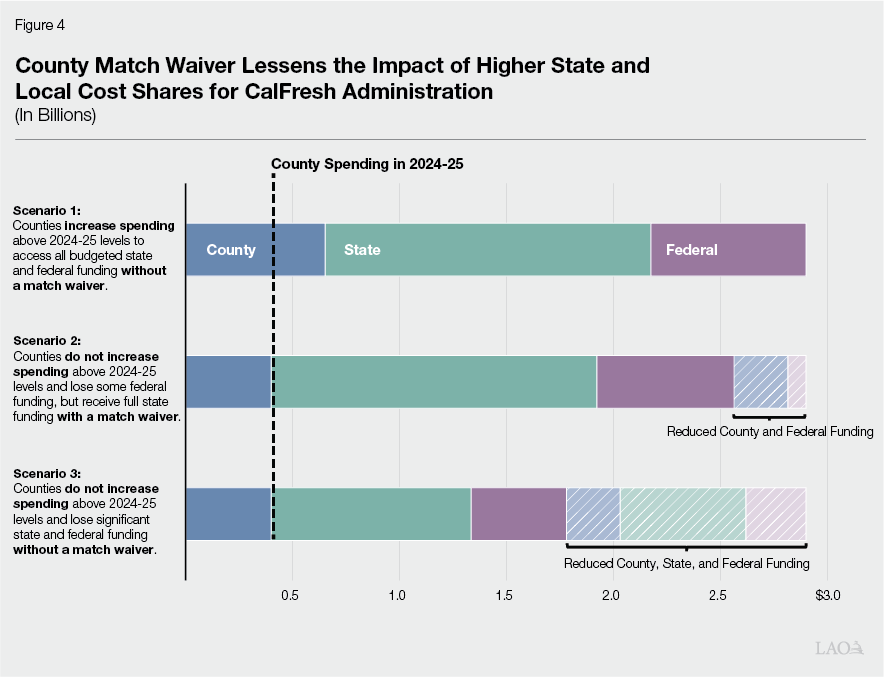
Partially Relieves Counties of Matching Requirement. Under current law, counties are required to cover a share of their CalFresh administration costs (15 percent prior to H.R. 1, increasing to 22.5 percent beginning October 2026). Counties typically receive the corresponding state and federal administration dollars as they make expenditures toward the county share, up to limits set in the state budget. This means that county spending directly determines how much state and federal funding is available for CalFresh administration. For example, every dollar a county spends after October 2026 draws down an additional $2.33 from the state and $1.11 from the federal government. Conversely, for every dollar a county does not spend (for example if county funding is insufficient after other local spending priorities to draw down the full amount of state and federal funding identified in the state budget), it loses $3.44 in state and federal funding. In this way, if county spending does not meet the higher level required by H.R. 1, the reduction in spending on CalFresh administration is far greater than just the unspent county funds.
In response to concerns about these fiscal pressures, budget legislation allows each county to access the full amount of General Fund set aside in the budget for CalFresh administration (along with federal funds) without paying the typical county share, so long as the county’s expenditures reach at least what it spent in 2024-25. Figure 4 illustrates what total funding for CalFresh administration would be under three scenarios: (1) counties collectively increase their spending consistent with the higher H.R. 1 cost share, resulting in no reduction in total funding; (2) counties maintain spending at 2024-25 levels but are able to access the full General Fund appropriation using the match waiver; and (3) counties maintain spending at 2024-25 levels but do not have the match waiver. With the match waiver, the overall reduction in funding is limited to unspent county funds and a relatively small amount of federal matching funds. In 2026-27, this match waiver allows counties to collectively reduce their expenditures by up to an estimated $252 million without losing access to the General Fund allocation. The match waiver is available through the end of 2028-29.
Provides Funding for CalFresh Outreach. The spending plan provides $14 million from the General Fund for CalFresh outreach activities. This funding is intended to replace federal funding for outreach that community-based organizations will lose because of the reduction in the federal share of CalFresh administration from 50 percent to 25 percent.
Provides Funding for Additional California Department of Social Services (CDSS) Oversight. The spending plan includes $12 million from the General Fund ($16 million when federal funds are included) for the first year of two-year, limited-term, state-level resources to oversee H.R. 1 implementation and address other federal compliance issues in CalFresh and other programs administered by CDSS, as well as to backfill lost federal funds for CalFresh administration at the state level. Roughly half of the $12 million General Fund is related to backfilling lost federal administrative funds for existing operations rather than creating new capacity.
Potential Cap on Federal Administrative Funding Creates Uncertainty. Federal funding for CalFresh administration is typically understood to be uncapped, with the federal government covering 50 percent of costs (or 25 percent beginning October 2026). However, in practice, the federal government sets a “target” for each state’s administrative spending within a year. This practice appears to have evolved as a budgeting and planning tool for the federal government, but it can have concrete impacts for the state and counties. The state reached the target in 2025-26, requiring CDSS to request an adjustment to the target. The state is expected to reach the target again in 2026-27. The federal government ultimately approved an increase for 2025-26, but approval of a similar increase in 2026-27 is uncertain. In response to this uncertainty, the spending plan includes $31 million from the General Fund and $13 million from counties in 2026-27 to backfill federal funding estimated to be over the target.
Other CDSS-Administered Food Assistance
Spending Plan Includes $1.6 Billion in Mostly Federal Funding for Other Food Assistance Programs. Funding amounts and a short description for these programs are summarized in Figure 5. Major updates in funding compared to the prior year are described below.
Figure 5
Funding for Other CDSS‑Administered and Federal Food Assistance Programs
(In Millions)
|
Program |
Description |
Total |
Federal |
State |
|
SUN Bucksa |
Provides food benefits during the summer months to school‑aged children qualified for free or reduced‑price meals. |
$715.4 |
$678.9 |
$36.5 |
|
CACFPb |
Reimburses some operators of child care centers, day care homes, and adult day care centers for food served. |
686.7 |
677.6 |
9.1 |
|
TEFAP and Emergency Food For Familiesc |
Distributes domestically grown foods to food banks and emergency feeding organizations. Emergency Food for Families supplements TEFAP funds. |
21.8 |
21.1 |
0.7 |
|
Commodity Supplemental Food Program |
Provides supplemental food to low‑income persons 60 years of age or older through various local agencies that determine eligibility and provide nutrition education. |
11.5 |
11.5 |
— |
|
SNB and TNB Programs |
Provide monthly supplemental or transitional benefits to households that saw a decrease in CalFresh benefits when SSI/SSP recipients became newly eligible for CalFresh in 2019. |
18.1 |
— |
18.1 |
|
WINS |
Provides a supplemental $10 food benefit to families who are receiving CalFresh or CFAP, but not receiving CalWORKs assistance, and who are working 20 to 35 hours per week, depending on family composition. |
17.5 |
— |
17.5 |
|
CalFresh Minimum Benefit Pilot |
Provides eligible CalFresh recipients with a minimum monthly benefit of $60 for 12 months. |
8.9 |
— |
8.9 |
|
CalFresh Fruit and Vegetable Pilot Extension |
Provides a dollar‑for dollar match up to $60 per month when CalFresh households purchase fresh fruits or vegetables at select farmers’ markets and grocery stores. |
20.0 |
— |
20.0 |
|
CalFresh Safe Drinking Water Pilot |
Provides a monthly $50 benefit for access to safe drinking water to CalFresh recipinets in parts of Kern County with failed water systems. |
0.7 |
— |
0.7 |
|
Diaper and Wipe Distribution |
Provides funding for 11 food banks to distribute diapers and wipes to low‑income families. |
16.5 |
— |
16.5 |
|
CalFood |
Provides additional funding or food banks for the purchase and storage of food grown or produced in California. |
118.0 |
— |
118.0 |
|
TNAP |
Provides grants to eligible tribes and tribal organizations to address food insecurity and inequities between CalFresh benefits and the Food Distribution Program for Indian Reservations. |
4.7 |
— |
4.7 |
|
Pass‑through funding |
Various one‑time allocations to organizations throughout the state related to food assistance. |
16.8 |
— |
16.8 |
|
Totals |
$1,656.6 |
$1,389.1 |
$267.5 |
|
|
aSUN Bucks (formerly Summer EBT program) benefits funding is 100 percent federal. Outreach, administration, and automation funding is 50 percent federal and 50 percent General Fund. bCACFP is federally funded. The state funding is provided through Proposition 98 and non‑Proposition 98 General Fund. cTEFAP is 100 percent federally funded. Emergency Food for Families funding is 100 percent state tax revenue collections. |
||||
|
CDSS = California Department of Social Services; CACFP = Child and Adult Care Food Program; EBT = Electronic Benefit Transfer; TEFAP = The Emergency Food Assistance Program; TNAP = Tribal Nutrition Assistance Program; SNB = Supplemental Nutrition Benefit Program; TNB = Transitional Nutrition Benefit Program; SSI/SSP = Supplemental Security Income/State Supplementary Payment; and WINS = Work Incentive Nutritional Supplement. |
||||
Provides $110 Million One-Time Augmentation for CalFood. In recent years, the ongoing baseline state funding for CalFood has been $8 million General Fund. However, the program has also received several one-time augmentations in recent years, including $112 million in 2022-23, $52 million in 2023-24, and $72 million in 2025-26. The spending plan provides an additional $110 million on a one-time basis in 2026-27 to help address increased demand for food bank assistance due to expected disenrollment from CalFresh and CFAP because of H.R. 1. This brings total funding for CalFood in 2026-27 to $118 million.
Provides $16.5 Million for Diaper and Wipe Distribution. This funding will be distributed to selected food banks to supply diapers and wipes for low-income families with infants and toddlers. The 2026-27 funding follows several years of one-time allocations for this purpose.
Funds Extension of Fruit and Vegetable Electronic Benefit Transfer Pilot. The pilot provides a dollar-for-dollar match up to $60 per month on CalFresh benefits used to purchase California-grown fresh fruits and vegetables from several grocery stores and farmers markets selected to participate. The pilot was first implemented in 2023 with an appropriation of $9.8 million General Fund. An additional $9.9 million was provided in the 2023-24 Budget Act and $10 million was provided in the 2024-25 Budget Act. The spending plan provides $20 million General Fund in 2026-27 to extend the pilot. Pilot operations, which have paused after previously approved funding was exhausted, are expected to resume later in 2026.
Allocates Funding to Selected Community-Based Food Assistance Organizations. The spending plan allocates $16.8 million General Fund on a one-time basis for several community-based organizations focused on food assistance.