
February 23, 2026
The 2026-27 Budget
California Department of
Corrections and Rehabilitation
- Overview
- General Fund Condition
- State Prison and Parole Population and Other Biannual Adjustments
- Prison Closure
- Structural Shortfall and Funding for Separating Employee Leave Cashouts
- Establishment of the Second California Prison Receivership
- Tele‑Mental Health
- Parole Community Rehabilitation Programs
- California Sex Offender Management Board and The State Authorized Risk Assessment Tools for Sex Offenders Review Committee
- Appendix
Summary
In this brief, we assess and make recommendations on several California Department of Corrections and Rehabilitation (CDCR) budget proposals. Below, we provide a summary of our major recommendations. (A figure summarizing all of our recommendations is in the appendix of this brief.)
Prison Closure. We find that the state could close an additional prison within the next few years and still retain a significant buffer to manage unexpected population increases. This could save around $150 million annually in operational costs and avoid the need for infrastructure projects at the closed prison. Accordingly, we recommend that the Legislature direct CDCR to begin planning to do so. To avoid funding infrastructure projects at a prison that is closed shortly after, we recommend the Legislature reject infrastructure proposals for the Correctional Training Facility in Soledad (as it appears to be a strong candidate for closure) unless the administration identifies a different candidate. In addition, because there are indications the administration has begun deactivating portions of prisons and has declined to provide information to our office about this potential change, we recommend requiring CDCR to report in budget hearings about its deactivation activities and enacting statute requiring legislative notification when the department implements capacity reductions going forward.
Establishment of the Second California Prison Receivership. In September 2025, a federal court in the Coleman v. Newsom case appointed a Receiver to take over the management and operation of the state’s prison mental health system and approved the Receiver’s action plan to improve care. The Governor proposes—in consultation with the mental health Receiver—$33.9 million ongoing to implement a portion of the action plan. These funds would come from fines collected from the state for failing to comply with court orders to reduce mental health vacancies. We recommend that, despite the appointment of the Receiver, the Legislature continue to exercise oversight over the delivery of prison mental health, track progress towards exiting the mental health Receivership, direct CDCR to take additional steps to address mental health vacancies (such as increasing the use of tele‑mental health), and monitor the impact of the recent salary increases for CDCR mental health staff implemented by the Receiver. Finally, we recommend approving the Governor’s proposal to implement the action plan.
Tele‑Mental Health. The Governor proposes to redirect 100 on‑site mental health providers at various prisons to remote staff and includes $8.9 million in the budget year growing to $12.8 million by 2028‑29 and ongoing to add support staff—including on‑site medical assistants who help facilitate appointments—and equipment for the conversion. Given the urgency the state is in to fill prison mental health positions—and that tele‑mental health positions appear to be easier to fill—we recommend approving portions of the proposal. However, we recommend reducing the request and CDCR’s baseline budget for tele‑mental health medical assistants to account for the time when they are not directly supporting appointments. We also recommend taking steps to increase the use of tele‑mental health to the maximum levels allowed, including allowing remote providers to work from out of state, expanding licensing exemptions so that licensed out‑of‑state mental health providers no longer need a California license to work at CDCR, and pairing these changes with more recruitment from out of state. Finally, we recommend the Legislature monitor whether on‑site providers need a pay differential to encourage them to remain in positions that cannot be done remotely.
Overview
Roles and Responsibilities. CDCR is responsible for the incarceration of certain adults convicted of felonies, including the provision of rehabilitation programs, vocational training, education, and health care services. As of January 14, 2026, CDCR was responsible for incarcerating about 90,300 people. Most of these people are housed in the state’s 31 prisons. The department also supervises and treats about 33,600 adults on parole and is responsible for the apprehension of those who commit parole violations.
Operational Spending Proposed for 2026‑27. As shown in Figure 1, the Governor’s January budget proposes a total of $14.1 billion to operate CDCR in 2026‑27, mostly from the General Fund. The proposed spending level reflects a decrease of $258 million (2 percent) from the revised 2025‑26 level. This decrease primarily reflects the planned closure of the California Rehabilitation Center (CRC) in Norco and estimated savings that the department expects to achieve through identification of operational efficiencies. These decreases are partially offset by various proposed augmentations, such as dedicated funding to pay for leave cashouts when employees separate from state service (discussed in greater detail later in this brief) and increased debt service costs. The proposed $258 million decrease does not reflect increases in employee compensation costs in 2026‑27 because they are accounted for elsewhere in the budget. The proposed budget would provide CDCR with a total of 58,100 positions in 2026‑27, a decrease of 549 (1 percent) from the revised 2025‑26 level.
Figure 1
Total Expenditures for Operation of CDCR
(Dollars in Millions)
|
2024‑25 |
2025‑26 |
2026‑27 |
Change From 2025‑26 |
||
|
Amount |
Percent |
||||
|
Adult Institutions |
$12,306 |
$12,893 |
$12,779 |
‑$114 |
‑1% |
|
Adult Parole |
657 |
753 |
725 |
‑29 |
‑4 |
|
Administration |
789 |
687 |
571 |
‑117 |
‑17 |
|
Board of Parole Hearings |
71 |
74 |
75 |
1 |
2 |
|
Totals |
$13,823 |
$14,407 |
$14,149 |
‑$258 |
‑2% |
|
aDoes not reflect increases in employee compensation costs in 2026‑27 because they are accounted for elsewhere in the budget. |
|||||
|
CDCR = California Department of Corrections and Rehabilitation. |
|||||
Capital Outlay Spending Proposed for 2026‑27. The Governor’s budget proposes total expenditures of $9.2 million General Fund for capital outlay projects in 2026‑27. This amount includes (1) $6.6 million to construct a potable water treatment system at the California Health Care Facility in Stockton, (2) $1.6 million for the working drawings phase of a project to construct new groundwater wells to supply Central California Women’s Facility and Valley State Prison in Chowchilla, and (3) $1.1 million for the preliminary plans phase of a project to construct new groundwater wells to supply Correctional Training Facility (CTF) in Soledad (discussed in ‘the “Prison Closure” section of this brief).
General Fund Condition
State Faces Serious Budget Challenges… As discussed in The 2026‑27 Budget: Overview of the Governor’s Budget, the administration’s revenue estimates over the budget window are $42 billion higher than previous budget act assumptions and almost $30 billion higher than our November 2025 estimates. Even with the higher revenues, the administration estimates a roughly $3 billion deficit for 2026‑27, growing to a $27 billion deficit in 2027‑28. The administration’s higher revenue estimates are mainly driven by strong stock market performance. However, certain factors signal the stock market might be approaching a peak. If a stock market downturn occurs, income tax revenues would fall considerably, and the misalignment between state revenues and proposed spending would widen.
…Necessitating a High Bar for New General Fund Spending. This means the state lacks the necessary revenues to sustain current expenditure levels. As such, any proposals that require new General Fund support—especially on an ongoing basis—require greater scrutiny and must meet a higher bar for approval as it would require General Fund solutions elsewhere in the budget. In this fiscal context, we encourage the Legislature to limit new spending to such things as: activities addressing immediate health and safety issues, workload the department has little ability to avoid, or actions that could reduce future costs.
Administration’s Proposals Largely Meet This Threshold, but We Identify Various Ways to Reduce CDCR Costs. The administration’s proposals for CDCR largely meet the high bar for new spending. For example, the budget includes $23 million General Fund to support modifications to comply with the Americans with Disability Act (ADA) at various prisons. Addressing ADA issues is necessary, both for the safety of the prison population and to comply with federal law. However, we do make recommendations to modify several Governor’s proposals, including in ways that would reduce their cost. For example, in the “Tele‑Mental Health” section of this brief, we recommend the Legislature direct CDCR to reduce the number of medical assistants it is requesting as part of a proposed expansion of tele‑mental health services. This is because fewer of these staff are needed to carry out the tasks CDCR is requesting them for. We also identify steps the Legislature could take outside of modifying proposals to reduce CDCR costs—most notably, by closing an additional prison as described in the “Prison Closure” section of this brief. Taking these and other steps to reduce CDCR costs is critical given the serious budget difficulties facing the state.
State Prison and Parole Population and Other Biannual Adjustments
Background
Adjustments Proposed Biannually Based on Projected Population Changes and Other Factors. As part of the Governor’s January budget proposals each year, the administration requests adjustments to CDCR’s budget based on projected changes in the prison and parole populations in the current and budget years. The adjustments are made both on the overall population and various subpopulations (such as people housed in reentry facilities and people on parole who have sex offense convictions). In addition, some adjustments include factors other than population trends, such as inflation adjustments. The administration then modifies both types of adjustments based on updated information each spring as part of the May Revision.
Governor’s Proposal
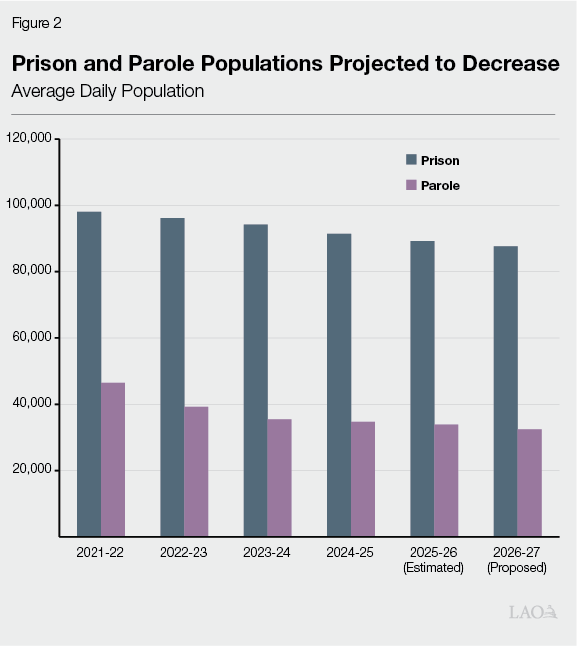
Prison and Parole Populations Projected to Decrease in 2026‑27. As shown in Figure 2, the average daily prison population is projected to be 87,600 in 2026‑27, a decrease of about 1,500 people (2 percent) from the estimated current‑year level. The average daily parole population is projected to be 32,400 in 2026‑27, a decrease of 1,400 people (4 percent) from the estimated current‑year level. The projected decrease in the prison population is primarily due to the estimated impact of various sentencing changes enacted in recent years. The projected decrease in the parole population is primarily due to fewer people entering parole as a result of the declining prison population.
Estimated Population Impact of Proposition 36 Reduced. The department’s overall population projections reflect its estimated impact of Proposition 36 (2024), which went into effect on December 18, 2024. The measure increased penalties for various theft and drug crimes, making some people eligible for a prison sentence. For example, it made theft of $950 or less a felony instead of a misdemeanor if a person has certain past theft convictions. Additionally, it allows people who possess specific illegal drugs (such as fentanyl) to be charged with a “treatment‑mandated felony” instead of a misdemeanor if they have certain past drug convictions. Those who decline or do not complete treatment can be convicted of a felony. As shown in Figure 3, CDCR estimates that Proposition 36 will cause the average daily prison population to be 562 people (or 0.6 percent) higher than otherwise in 2025‑26 and 978 people (or 1.1 percent) higher in 2026‑27. The department’s estimates of the impact of the measure on the prison population have come down by about 70 percent compared to what was estimated at the 2025‑26 May Revision. This is largely due to the availability of six months of actual data to inform the current estimates. The department also updated its estimates of the impact on the parole population. It now estimates that Proposition 36 will reduce the parole population by about 1 percent in the near term because it will lengthen some people’s prison terms, thereby delaying their release to parole.
Figure 3
CDCR Proposition 36 Population Impact Estimates
|
Prison Population |
Parole Population |
||||||
|
Estimate as |
Estimate as |
Change |
Estimate as |
Estimate as |
Change |
||
|
2025‑26 |
1,878 |
562 |
‑1,316 |
5 |
‑126 |
‑131 |
|
|
2026‑27 |
3,522 |
978 |
‑2,544 |
63 |
‑248 |
‑311 |
|
|
CDCR = California Department of Corrections and Rehabilitation. |
|||||||
Net Decreases in Current‑ and Budget‑Year Funding Adjustments. Relative to what was assumed in the 2025‑26 Budget Act, the Governor’s budget reflects net decreases in baseline spending for both the current year ($6.6 million) and the budget year ($31 million). This reflects lower costs due to updated prison population estimates, offset partially by higher costs related to such things as pharmaceutical purchases and conversion of certain housing units to accommodate populations that require higher staffing levels.
Assessment
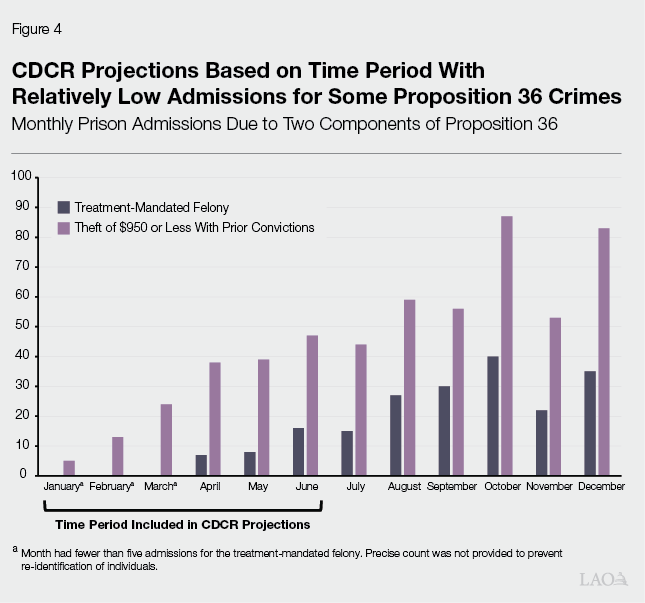
Estimate of Proposition 36 Prison Population Impact May Be Slightly Low. The department did not provide detailed backup showing its methodology to estimate the impact of Proposition 36 on the prison population. However, based on discussions with the department, it is our understanding that CDCR used actual admissions data—and in some instances, reviewed individual case files—through June 30, 2025 to identify the number of people who were committed to CDCR due to Proposition 36. (This June 30 cut‑off date is a standard feature of CDCR’s fall population projection process.) The department then assumed that this rate of admissions observed in the first six months of Proposition 36 implementation would remain constant. This assumption is not unreasonable. However, data provided by CDCR to the Committee on the Revision of the Penal Code and the California Policy Lab suggest the assumption that the rate of Proposition 36 admissions to prison will remain constant could be incorrect. As shown in Figure 4, admissions for two key components of Proposition 36—treatment‑mandated felonies and theft of $950 or less with prior convictions—were higher in the second half of 2025 than the first half the year—the time period CDCR based its projection on.
Prison Population Currently Trending Slightly Higher Than Projections. Over the first half of 2025‑26, the actual prison population has been trending slightly higher than CDCR’s projections. Specifically, on September 30, 2025, the actual prison population was about 900 people higher (1 percent) than the department projected and about 1,200 higher (1.3 percent) than projected by December 31, 2025. This could be a sign that the impact of Proposition 36 on the prison population is indeed slightly underestimated. However, other factors could also contribute. For example, some large counties had new district attorneys take office in late 2024 and early 2025 who may have subsequently changed policies or practices that impact how often their staff seek prison sentences. Given the recency of such changes, CDCR’s population projection methodology, which is based largely on the number of prison admissions in recent years, may not yet have fully detected such new trends.
Recommendation
Withhold Recommendation Until May Revision. We withhold recommendation on the administration’s overall biannual adjustments until the May Revision. We will continue to monitor CDCR’s populations and the other factors affecting the proposed adjustments and advise the Legislature based on the updated information available at the May Revision, including the administration’s revised population projections.
Prison Closure
Background
State Currently Operating 31 Prisons. As of January 14, 2026, about 87,200 people (97 percent) out of the total 90,300‑person population were housed in one of CDCR’s 31 prisons. (The remaining people are housed in various specialized facilities outside of prisons, such as conservation camps and community reentry facilities.) Prisons are typically composed of multiple facilities (often referred to as “yards”) where people live in housing units, recreate, and access certain services (such as dental care). CDCR typically clusters people with similar needs (such as the amount of security they require) in the same yard. Accordingly, prisons differ in their ability to meet specific needs based on the types of yards they are composed of. In addition, some prisons—due to either their location, infrastructure, or both—can fill relatively unique roles within the system. For example, some prisons have infrastructure that allow them to provide certain specialized health care services—such as inpatient psychiatric care—not widely available throughout the prison system.
Many Prisons Have Significant Infrastructure Needs. As of December 2025, CDCR identified 46 deferred maintenance or capital outlay projects across 25 prisons at an estimated total cost of $2.5 billion that are expected to be needed over the next ten years. The majority of the projects are focused on issues related to safety (such as replacement of fire alarm systems) and critical infrastructure (such as kitchen renovations). None of the projects are intended to add capacity. Notably, this estimate does not include costs of projects that are expected to be needed to add air cooling systems to prisons. This is because the administration is currently in the process of piloting options for doing so. However, our rough estimates suggest that the one‑time installation costs to cool facilities statewide could total in the low billions of dollars. (For more information on the department’s air cooling pilot program, please see the “Air Cooling Pilot Program” section of our brief The 2025‑26 Budget: California Department of Corrections and Rehabilitation.) As such, it is possible that the total cost of infrastructure projects that will be needed at prisons over the next ten years could reach into the several billion dollar range—or around a couple hundred million dollars per prison on average.
Prisons Subject to Court‑Ordered Population Limit. The state’s prisons are subject to a federal court order related to prison overcrowding that limits the total number of people they can house to 137.5 percent of their collective design capacity. Design capacity generally refers to the number of beds CDCR would operate if it housed only one person per cell and did not use bunk beds in dormitories. Currently, this means that the state is prohibited from housing more than a total of about 98,500 people in its prisons. It also means that when prisons are closed or yards are deactivated, this population limit is decreased by 137.5 percent of the design capacity of the affected prison or yard.
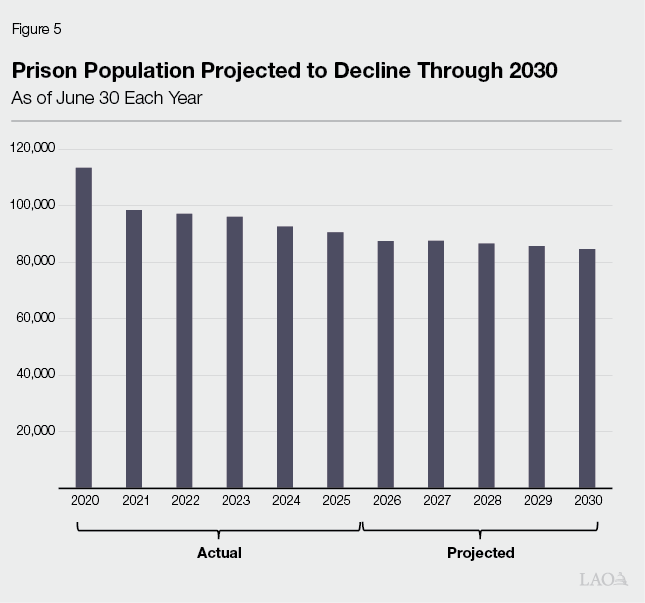
Prison Population Decline Allowing for Capacity Reductions. As shown in Figure 5, the overall prison population has declined significantly in recent years and is expected to remain low through June 2030. The dramatic decline that occurred between 2020 and 2021 was primarily the result of temporary measures—such as the delay of intake from county jails—intended to reduce the spread of COVID‑19. After these temporary measures ended, the population remained low and continued to decline primarily due to the impact of various sentencing changes enacted in recent years. This decline has allowed the state to reduce prison capacity. In 2021, CDCR completed a multiyear drawdown of people housed in contractor‑operated prisons. Additionally, since 2021, the administration has deactivated:
- Three state‑owned prisons: Deuel Vocational Institution (DVI) in Tracy, California Correctional Center in Susanville, and Chuckawalla Valley State Prison in Blythe.
- The California City Correctional Facility, a leased prison that was operated by CDCR staff.
- 13 yards and 46 housing units at various prisons.
These reductions to state‑operated prison capacity have resulted in around $1 billion in General Fund savings annually. It has also allowed the state to avoid funding infrastructure repairs that would otherwise have been needed to continue operating these facilities. For example, with the closure of DVI in Tracy, the state was able to avoid a water‑treatment project—estimated in 2018 to cost $32 million—that would have been necessary to comply with drinking water standards. The administration currently plans to close California Rehabilitation Center (CRC) in Norco by October 2026.
CDCR Appears to Be Moving Toward Deactivating Additional Yards… Stakeholders began reporting in January 2026 that CDCR has made internal announcements to staff and the incarcerated population that the department intends to deactivate yards at California State Prison Solano (SOL) in Vacaville and Avenal State Prison (ASP) this spring. We asked CDCR whether these reports were accurate. The department indicated that yards at these two prisons have been discussed for deactivation but that the Governor’s budget does not reflect their deactivation.
…But Has Declined to Share Current Status Until May. When explicitly asked for the current status of these yards—regardless of what was reflected in the Governor’s budget—the administration declined to answer. For example, the administration did not confirm or deny whether notifications have gone out to staff and the incarcerated population—or if any other concrete steps have been taken—to begin deactivating these yards. Instead, the administration indicates that because any yard deactivations that occur this spring would be reflected as current‑year adjustments in the May Revision, these possible yard closures at SOL and ASP constitute proposals and therefore are subject to confidentiality until the release of the May Revision.
Governor’s Proposal
Adjust CDCR Funding to Account for Planned Closure of CRC. To reflect the planned closure of CRC by October 2026, the Governor’s budget reflects a General Fund reduction of $91 million and 522 positions in 2026‑27 (increasing to $138 million and 778 positions annually beginning in 2027‑28).
Make Infrastructure Modifications at Various Prisons. The Governor proposes several one‑time General Fund augmentations in 2026‑27 to support infrastructure projects at various prisons. These are as follows:
Modifications at Various Prisons to Comply With ADA Requirements ($23 Million). The Governor proposes $23 million to make accessibility improvements—such as installation of grab bars and shower seat fixtures—at eight prisons: California Institution for Men in Chino; California Institution for Women in Corona; California Medical Facility in Vacaville; Mule Creek State Prison in Ione; Pleasant Valley State Prison in Coalinga; Richard J. Donovan Correctional Facility in San Diego; SOL; and Valley State Prison (VSP) in Chowchilla.
Audio Video Surveillance Systems (AVSS) at Correctional Training Facility (CTF) in Soledad and California Men’s Colony (CMC) in San Luis Obispo ($10 Million). The Governor proposes $10 million to complete a multiyear rollout of AVSS systems at all prisons, except CRC as it is scheduled to close. (AVSS systems are intended to help provide objective evidence related to allegations of staff misconduct in addition to other operational benefits.) Funding for the final phase of the rollout, which included ten prisons, was authorized by the 2023‑24 budget package. However, due to cost escalation, the department reports that it does not have sufficient funds to complete the rollout at the two remaining prisons, CTF and CMC. Specifically, CDCR estimates that it will cost about $10 million per prison, or a total of $20 million. However, it only has about $10 million in previously authorized funds remaining. Accordingly, the department would need an additional $10 million to complete the installation at these two prisons.
Three Capital Outlay Projects Related to Prison Water Supply ($9.2 Million). The Governor proposes a total of $9.2 million for capital outlay projects: (1) $6.6 million to construct a potable water treatment system at the California Health Care Facility in Stockton, (2) $1.6 million for the working drawings phase of a project to construct new groundwater wells to supply Central California Women’s Facility and VSP, and (3) $1.1 million for the preliminary plans phase of a project to construct new groundwater wells to supply CTF.
Assessment
No Concerns With Adjustments Related to Planned Closure of CRC. We have no concerns with the proposal to reflect savings associated with the planned closure of CRC by October 2026.
State Could Close Additional Prison and Retain Significant Buffer to Manage Unexpected Population Increases. As shown in Figure 5, CDCR projects that the overall prison population will continue to decline through June 30, 2030. Under the administration’s projections, we estimate that by 2030, CDCR will have several thousand empty beds in operation. This estimate reflects the closure of CRC and assumes that yards at SOL and ASP are deactivated. As discussed in the “State Prison and Parole Population and Other Biannual Adjustments” section of this brief, the overall prison population is currently trending slightly higher than CDCR’s projections. This suggests that the current population projections may be slightly low. However, even if we assume that the population is a couple thousand people higher in 2030 than the administration currently projects, the state could still close a prison of average size and retain about 2,500 empty beds in operation. (When CDCR’s population was significantly higher—and therefore much closer to the court‑ordered population limit—CDCR typically aimed to house about 2,500 people fewer than the population limit as a “buffer” against unexpected population increases.) Moreover, CDCR has several thousand beds inside deactivated housing units or yards that are located inside operational prisons. These beds provide additional buffer against unexpected population increases as a portion of them could be reactivated relatively quickly to provide additional capacity or housing flexibility if needed.
Prison Closure Would Create Significant Savings. Reducing the number of empty beds in operation by closing an additional prison would allow for significant savings. Specifically, we estimate that the state would save around $150 million annually in operational costs. (These savings would be partially offset, perhaps by a couple tens of millions of dollars annually, by increased cost pressures due to the reduction in salary savings that results from prison closures. For more information on the relationship between prison closures and salary savings, please see “Structural Shortfall and Funding for Separating Employee Leave Cashouts” section of this brief.) In addition, closing a prison would avoid the need to fund infrastructure projects at the prison that is closed—potentially avoiding hundreds of millions of dollars in one‑time costs.
CTF Strong Candidate for Closure, Other Prisons With Proposed Infrastructure Projects Less So. We find CTF to be a strong candidate for closure for four primary reasons. First, unlike many prisons, it does not fulfill a unique function within the prison system—such as providing specialized health care services—that would be difficult or costly to relocate. Second, it does not have modern housing facilities, which are generally considered safer and more flexible to house a wide range of populations as they offer greater visibility for officers. Third, CTF is not designated as an Intermediate Health Care institution (generally meaning that it is not located near hospitals in the community where people could be transported to receive specialty care) nor is it designated to house people receiving higher levels of mental health care. Fourth, CTF has particularly high identified infrastructure needs. Specifically, the administration estimates that within the next ten years, the prison will require kitchen replacements at an estimated cost of $296 million and a fire alarm system replacement at an estimated cost of $83 million. The other prisons where the administration currently proposes infrastructure projects are not as strong of candidates for closure when evaluated under these same criteria.
Not Cost‑Effective to Start Projects at Prisons That Could Be Closed. Infrastructure projects can take a few years to complete. For example, the administration expects that the proposed well project at CTF would not be completed until February 2030. Likewise, the AVSS project at CTF would not be complete until June 2027. If CTF were closed around the same time, the state would have experienced little or no benefit from money spent on these projects.
No Concerns With Remaining Projects. We find that the Governor’s proposed infrastructure projects at the remaining prisons are reasonable. Each of the projects address health and safety concerns that should not be deferred.
Administration’s Lack of Transparency on Current‑Year Changes Limits Legislative Oversight and Hinders Budget Deliberations. As previously discussed, there are some indications that CDCR has begun the process of deactivating yards at SOL and ASP. However, it declined to directly answer our questions about whether this was true—instead alluding to potential updates that could be provided at the May Revision. In our view, this lack of transparency presents two major problems. First, it limits the Legislature’s ability to provide oversight over a significant operational change that deviates from the budget plan that was enacted for the 2025‑26 fiscal year. Under the administration’s approach of waiting until May to update the Legislature, it is possible that the yards are deactivated before the Legislature is ever notified of the change. Second, the administration’s approach limits important information that is relevant for ongoing legislative deliberations on the 2026‑27 budget. For example, deactivation of yards impacts how many full prisons could potentially be closed in future years without having to reactivate capacity at other prisons. This is relevant and critical context for budget deliberations around prison infrastructure and the state’s out‑year fiscal capacity. We note that this is not the first time this has occurred. The administration similarly refused to provide information about the actual operational status of its prisons in fall of 2024 when various stakeholders began reporting that CDCR was in the process of deactivating yards and making other operational changes, such as reducing evening recreational time and modifying standardized security staffing.
Recommendations
Approve Adjustments Related to CRC Closure. We recommend the Legislature approve the proposed adjustments related to the planned closure of CRC. These adjustments will help align the CDCR budget with the reduced prison capacity, as well as help reduce ongoing state General Fund costs.
Direct CDCR to Close Another Prison. We recommend that the Legislature direct CDCR to begin planning to close another prison in 2027‑28 or as soon as logistically possible. This would help align the state’s prison capacity with the projected prison population and help reduce ongoing state General Fund costs.
Do Not Approve CTF Infrastructure Proposals Unless CDCR Identifies a Different Prison for Closure. Even if the Legislature chooses not to direct CDCR to close a prison as part of this year’s budget process, the Legislature or administration may choose to do so in future years given the declining prison population and the fiscal difficulties facing the state. CTF would be a strong candidate for such a closure. Accordingly, we recommend that the Legislature reject the proposals to fund preliminary plans for a well project and to install AVSS at CTF unless the administration identifies a different prison for closure. Otherwise, the state risks funding CTF projects that ultimately provide little or no benefit if the prison is closed in the coming years.
Approve Remaining Infrastructure Proposals. As discussed in the “General Fund Condition” section of this brief, the state’s budget condition necessitates that any new General Fund spending must meet a very high bar for approval. Because the infrastructure projects at the remaining prisons address health and safety concerns, we find they meet this bar and recommend approving them.
Direct CDCR to Report in Hearings on Status of Yard Closures and Require Notification of Future Capacity Reductions. In order for the Legislature to provide effective oversight of CDCR and make informed decisions about the funding it provides to CDCR in the budget, it needs timely access to information about critical current‑year operational changes, such as planned yard deactivations. Accordingly, we recommend that the Legislature direct CDCR to report in hearings on any steps it has taken to date—such as formally notifying staff or the incarcerated population—to implement yard deactivations. Providing this information as soon as possible, rather than waiting until May, is critical as it is relevant to 2026‑27 budget deliberations that occur throughout the spring and waiting until May substantially reduces the window of time for the Legislature to consider the budgetary implications of these changes before its June 15 constitutional deadline for passing a budget. Additionally, since it appears the lack of timely information for the Legislature is becoming a more consistent problem, we recommend that the Legislature pass statute directing CDCR to report to the relevant fiscal committees of both houses and the Legislative Analyst’s Office when it implements a capacity reduction going forward. This will ensure that the Legislature is aware of any future capacity reductions in a timely manner.
Structural Shortfall and Funding for Separating Employee Leave Cashouts
Background
Vacant Positions Create Salary Savings. Under state budgeting practices, departments are budgeted assuming that all of their authorized positions are filled. However, in practice, some amount of authorized positions are vacant at any given time. This is because it takes time to fill newly authorized positions and there is often a lag between the time that one person leaves an existing position and another person is hired as a replacement. This means that departments are budgeted to pay for a larger number of positions than are actually filled at a given time, which generates savings in departments’ budgets. This accrued savings is referred to as “salary savings.”
Departments Typically Use Salary Savings to Pay Certain Costs That Are Not Formally Budgeted. Under state budgeting practices, departments are not formally budgeted for certain costs and, as a result, are expected to absorb them within existing resources. For example, when an employee separates from state service, they receive a payment for any unused leave that is considered “compensable”—primarily, vacation and annual leave. Departments are typically expected to pay for these separating employee leave cashouts using salary savings. In addition, the state typically does not provide systematic, regular adjustments to state department budgets to reflect the rising costs of doing business including rising rent or fuel costs or growth in overtime costs due to salary increases. Departments have had to find ways to pay for these rising costs, often using salary savings.
Recent Conditions Have Reduced CDCR Vacancies… As shown in Figure 6, the percent of positions that are vacant—referred to as the vacancy rate—has decreased for both custody staff and other non‑health care staff. The department indicates that this decline is primarily caused by the following factors:
- Deactivation of Prison Facilities Due to Population Decline. As discussed in the “Prison Closure” section of this brief, in response to a declining prison population, the state has closed four prisons and deactivated portions of several other prisons in recent years. This decreases vacancies in two ways. First, vacant positions at the closed facility are generally eliminated. Second, staff at closing facilities are given opportunities to fill vacancies at the other remaining facilities.
- Elimination of Certain Vacant Positions as a Part of Statewide Efficiency Exercises. The 2024‑25 budget package included Control Section 4.12, which established a statewide administrative exercise led by the Department of Finance to identify vacant positions and related funding for elimination. As a result, CDCR’s budget was reduced by about $14 million ongoing.
Figure 6
CDCR Vacancy Rate Has Decreased for Non‑Health Care Staff
|
Fiscal Year |
Health Care |
Custody |
Non‑Custody |
|||||
|
Positions |
Vacancy Rate |
Positions |
Vacancy Rate |
Positions |
Vacancy Rate |
|||
|
2022‑23 |
18,215 |
25% |
38,072 |
18% |
9,267 |
19% |
||
|
2023‑24 |
18,232 |
27 |
36,098 |
12 |
8,028 |
12 |
||
|
2024‑25 |
18,083 |
25 |
34,719 |
8 |
7,849 |
7 |
||
|
CDCR = California Department of Corrections and Rehabilitation. |
||||||||
…Causing a Structural Shortfall in CDCR’s Budget. The decline in CDCR’s vacancy rate has reduced the department’s salary savings. However, the costs, which the department has traditionally absorbed using salary savings, such as separating employee leave cashouts, have not been commensurately reduced. This has left a structural shortfall in some items of appropriation within CDCR’s budget. (This structural shortfall is in addition to an unallocated $125 million General Fund reduction in 2025‑26, growing to $375 million in 2027‑28 and ongoing, that the administration is expecting to achieve through operational efficiencies identified with the help of a contractor. To the extent these efficiencies do not materialize, the structural shortfall in CDCR’s budget would become worse. We are reviewing information provided by the administration on the status of this work and will communicate our findings to the Legislature.)
Administration Has Responded Through a Combination of Actions. The administration has responded to this shortfall in CDCR’s budget through a combination of actions:
- Reducing Costs. CDCR indicates that it is attempting to achieve temporary cost savings through a variety of actions, including limiting travel, training, and overtime where possible, as well as not filling vacant positions as fast as it otherwise would. These actions “free up” resources that can be used to address the shortfall.
- Seeking a Current‑Year Augmentation. On May 19, 2025, the administration notified the Legislature that CDCR was projected to exceed its 2024‑25 budget by about $358 million and requested reappropriations of previously unspent funds from prior years to address this shortfall. Given that the notification came late in the fiscal year, the Legislature had little choice but to provide the reappropriations. (These prior‑year funds were unspent due to savings associated with various factors, including vacant positions, population reductions, and prison facility deactivations.)
- Seeking Augmentations Through the Budget Process. In recent years, the Governor has proposed and the Legislature has approved several augmentations to provide funding for cost drivers that CDCR has traditionally absorbed, often through salary savings. For example, the 2024‑25 Budget Act provided $23.1 million General Fund (increasing to $46.2 million annually beginning in 2025‑26) to pay for increased utility costs. In addition, the 2025‑26 Budget Act provided $31.4 million General Fund in 2025‑26 and ongoing to accommodate growth in food costs.
Governor’s Proposal
Provide $106 Million General Fund to Pay for Separating Employee Leave Cashouts and Fire Watch Costs. The Governor proposes $91 million General Fund in 2026‑27 and ongoing to pay for the compensable leave cashed out by separating employees. CDCR reports that from 2020‑21 to 2024‑25, it paid about $130 million annually on average in these payments. Accordingly, the proposal would provide dedicated funding for a portion of the department’s expected annual costs of these payments. The department would continue to absorb the remainder. The Governor separately proposes $15.2 million one‑time General Fund in 2026‑27 to support costs associated with employees conducting fire watch at various prisons while they lack adequate fire alarms, which is another non‑discretionary cost that CDCR has traditionally absorbed using salary savings.
Assessment
Some of Proposed Funding Is Reasonable… As discussed in the “General Fund Condition” section of this brief, proposals that require new General Fund support must meet a higher bar for approval as they necessitate reduced General Fund spending elsewhere. Given the structural shortfall in CDCR’s budget, we find the proposed funding for separating employee leave cashouts to be reasonable in the near term as this is an unavoidable expense. Similarly, the one‑time funding for fire watch, an important safety function, is reasonable.
…But Unclear if Ongoing Funding Is Needed for Separating Employee Leave Cashouts. It is unclear if the currently low vacancy rate causing CDCR’s structural shortfall is an ongoing condition. It is possible that after the department is no longer deactivating facilities in close succession, CDCR’s vacancy rate will increase to historical levels. If this occurs, CDCR could have sufficient salary savings to pay these costs without the proposed dedicated funding.
Existence of Structural Shortfall Raises Broader Concerns. The department did not provide a detailed accounting of its structural shortfall. Moreover, the department’s actual costs in a given year are influenced by various factors—some of which are outside of its control, such as trends in prison admissions—making precise cost projection difficult. Accordingly, it is possible that a shortfall still exists in the current and/or budget year despite previous and proposed augmentations intended to help close it. This raises two concerns:
- Undermines Budget Transparency. As previously discussed, CDCR has approached the shortfall, in part, by attempting to manage to its budget. This means that the department is either not doing or delaying activities that it is budgeted to do in order to free up funding to address the shortfall. However, because these decisions are typically internal to the administration and made after the budget is enacted, it is difficult for the Legislature to know what activities are affected and what programmatic implications that may have. This is problematic as CDCR might chose to not implement or delay activities that are a legislative priority.
- Department Could Still Overrun Its Budget. Without full information about the size of the shortfall and the activities that the administration is undertaking to attempt to close it, it is difficult to assess the likelihood of whether CDCR will again need a current‑year augmentation at the end of the fiscal year. This is particularly problematic as the fiscal difficulties facing the state mean that such augmentations come at the cost of other General Fund priorities.
Recommendations
Approve Fire Watch Funding. We recommend the Legislature approve the one‑time $15.2 million General Fund proposed for fire watch. Given the important safety function these funds support and CDCR’s inability to address these costs due to the structural shortfall, this proposal meets the high bar for additional General Fund spending that we think needs to be applied when assessing proposals, as discussed in the “General Fund Condition” section of this brief.
Approve Funding for Separating Employee Leave Cashouts on a Limited‑Term Basis. Given that CDCR’s need for the $91 million for separating employee leave cashout payments may not be ongoing, we recommend providing the funding only on a three‑year, limited‑term basis. This will provide an opportunity for the Legislature to reassess the department’s vacancy rate and funding need in the future. If the Legislature directs CDCR to close an additional prison, as we recommend in the “Prison Closure” section of this brief, it could be reasonable to approve this funding on a longer‑term basis, such as for five years. This is because a further prison closure could keep vacancy rates low for a longer period of time.
Require Administration to Report by January 10, 2029 to Inform Future Funding Decisions. We recommend the Legislature require CDCR to provide it with key information to inform its deliberations about whether the $91 million for separating employee leave cashout payments will be needed in 2029‑30 and ongoing. Specifically, we recommend that the Legislature adopt budget bill language requiring CDCR to report by January 10, 2029 the following data for 2026‑27 and 2027‑28 for each collective bargaining unit representing its employees: (1) the number of hours and associated dollar value of compensable leave cashed out by existing employees through leave buy‑back programs (programs in which the state offers to pay employees for their compensable leave before they separate from state service), (2) the number of hours and associated dollar value of leave cashout payments made to separating employees, (3) average compensable leave balances, (4) numbers of vacant and filled positions, and (5) projections of changes in the number of vacant and filled positions. In addition, the report should include discussion of whether, and if so why, the administration believes additional years of dedicated funding for these payments are needed. This would inform the 2029‑30 budget process when the dedicated funding for separating employee leave cashout payments would expire under our recommendation. If the Legislature chooses to provide the funding for a limited period that is longer than three years, then it could set the due date for this report such that the report would be available to inform budget deliberations prior to the expiration of the funding.
Exercise Oversight of Structural Shortfall. We recommend that the Legislature direct the department to report in spring budget hearings on what specific steps it is taking in the current year and is considering or planning to take in the budget year to free up funding to address the shortfall, the size of the shortfall, and what unbudgeted costs currently makeup the shortfall. In responding, the department should discuss the programmatic implications of any steps it is taking to address the shortfall as well as the expected budgetary savings attributable to them. This would allow the Legislature to ensure any actions CDCR is taking are consistent with its priorities and to assess whether it will need to take further actions to address a shortfall.
Establishment of the Second California Prison Receivership
Background
Overview of CDCR Mental Health
CDCR Provides Outpatient and Inpatient Mental Health Services to About Two Out of Five People in Prison. Nearly 35,000 people in prison have a diagnosed mental health need—representing about two out of five people in prison. Most people in prison with a mental health need can be treated in an outpatient setting, meaning they live in a prison housing unit and receive regular mental health treatment but do not require 24‑hour care. However, under certain circumstances, some people may require more intensive treatment provided in an inpatient bed. These inpatient beds are located at certain prisons and provide intensive 24‑hour care with the goal of preparing a patient to return to an outpatient housing unit.
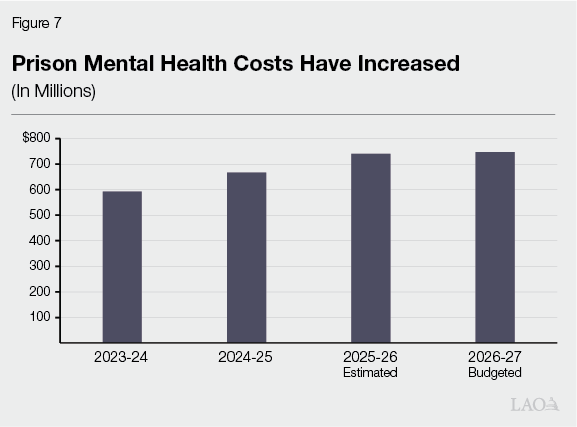
CDCR Spends Over $700 Million on Mental Health Care Annually. The Governor’s budget proposes to spend $746 million for mental health‑related expenses. This reflects a $6 million increase (nearly 1 percent) from the revised 2025‑26 level. While this is a modest increase, Figure 7 shows that costs for mental health have increased by over $100 million since 2023‑24.
Coleman Court Monitoring Prison Mental Health Care Since 1990
Federal Court Found State Provided Inadequate Prison Mental Health Care. In 1990, a lawsuit, later renamed Coleman v. Newsom, was filed in federal court alleging that the state violated the Eighth Amendment of the U.S. Constitution prohibiting cruel and unusual punishment by providing inadequate mental health care in the state’s prisons. After finding the state in violation, the court appointed a Special Master in 1995 to monitor the state’s progress. The court and the Special Master oversaw the state’s efforts to fully implement the court‑ordered remedies necessary to bring the delivery of prison mental health care into compliance.
State Has Struggled to Comply With Court Orders. Although there has been progress in some areas in the delivery of mental health services, the state remains out of compliance with various court‑ordered remedies. As a result, the Coleman court has found the state in contempt for failing to address these deficiencies. For example, in June 2024, the Coleman court found CDCR to be in contempt of the court’s orders and began levying fines related to mental health staffing vacancies, which we discuss next. The court has indicated that the state also needs to make various other improvements, including in the following key areas: (1) ensuring people with a mental health need are receiving services in a timely manner, (2) fully implementing all portions of CDCR’s suicide prevention plan, and (3) finalizing the Continuous Quality Improvement Tool (CQIT), which is an information technology (IT) system that will be used to detect quality of care issues.
Coleman Court Collected $155 Million in Fines Related to Mental Health Staffing. Beginning in April 2023, fines accrued for each of five key classifications (psychiatrists, psychologists, clinical social workers, recreational therapists, and medical assistants) that did not achieve a 90 percent fill rate. As of January 2026, the court has collected $155 million in fines which were deposited into a special deposit fund. The collection of additional fines has been paused due to the establishment of the mental health Receivership in September 2025, which we discuss next. About $33 million of the fines already collected have been spent and the remainder will stay in the special deposit fund to be used by the Receiver.
Mental Health Receivership Established in 2025
Court Appoints Mental Health Receiver to Take Control of the Delivery of Mental Health Services. The establishment of a Receivership is a legal remedy in lawsuits seeking to reform jails and prisons. Courts appoint a Receiver in order to place a neutral expert in control of some aspect of prison or jail operations. Effective September 1, 2025, the federal court suspended the authority of the Secretary of CDCR over prison mental health care and appointed a federal Receiver to take over the direct management and operation of the state’s prison mental health system. As a result of this appointment, CDCR now has two active Receivers. California’s prison medical system has been under direct management of a Receiver appointed by a federal court since 2006 because the state was found to be providing unconstitutional levels of care in a case now referred to as Plata v. Newsom. (For more on the medical Receiver, please see Overview and Update on the Prison Receivership.)
Receiver Has Greater Authority Than Special Master. The establishment of the mental health Receivership led to the dissolution of the Special Master. The Receiver differs from the Special Master in that a Receiver has direct executive authority and acts in place of the Secretary of CDCR in regard to the management of prison mental health. For example, where the Special Master provided reports to the court on vacancies and made recommendations to address them, the Receiver can directly hire CDCR healthcare staff, set the mental health budget, and create internal policies and goals to improve care. In addition, the Receiver has the authority to seek waivers through the court of any state or contractual requirements that are impeding progress. Receiverships are typically used as a last resort by courts because high thresholds must be met for them to be established, such as demonstrating that there is a grave and immediate harm to the plaintiffs, that the use of less extreme remedies have been exhausted, and that a Receiver is the least intrusive means necessary to correct the violations. A Special Master does not require the same level of rigor for appointment. This is because the department maintains its direct executive authority and a Special Master, lacking the authority to make changes, primarily monitors compliance activities. As such, Special Masters must rely on the department and court to make changes when they discover problems with compliance. In practice, this means that changes under Special Master monitoring can take longer than under a Receivership as a Receiver can directly implement changes.
Mental Health Receiver’s Action Plan Estimated to Cost $41 Million Annually and Take Five to Seven Years to Execute. When the Coleman court appointed the mental health Receiver, it also approved the Receiver’s action plan. The Receiver’s action plan lays out six primary goals, each with its own set of objectives and actions intended to address the outstanding deficiencies. Figure 8 shows the goals and accompanying selected actions. The Receiver’s initial estimated cost to begin implementing the action plan is $41.4 million annually. The main drivers of these costs are (1) salary increases for mental health staff ($25.3 million), (2) establishing the Office of the Receiver ($8.2 million), and (3) creating resource teams to support staff working in inpatient units ($6.7 million). To achieve the goals and implement all actions of the plan, the Receiver estimates it will take five to seven years.
Figure 8
Receiver’s Action Plan Outlines Goals and Actions to Improve Mental Health Care
|
Goal 1 |
Improve Mental Health Care Delivery Through Culture Change and Effective Management |
|
Selected Actions |
|
|
Goal 2 |
Achieve and Retain a Qualified Mental Health Workforce |
|
Selected Actions |
|
|
Goal 3 |
Provide Adequate Care at Every Level and Treat Each Patient at the Appropriate Level of Care |
|
Selected Actions |
|
|
Goal 4 |
Fully Implement a Suicide Prevention Program |
|
Selected Actions |
|
|
Goal 5 |
Complete Development and Implementation of a Quality Assurance Program |
|
Selected Actions |
|
|
Goal 6 |
Create Mechanisms to Demonstrate Remedies |
|
Selected Actions |
|
|
CDCR = California Department of Corrections and Rehabilitation. |
|
Governor’s Proposals
$33.9 Million Ongoing to Implement Portions of Receiver’s Action Plan. The Governor proposes—in consultation with the mental health Receiver—to implement a portion of the Receiver’s action plan using $33.9 million. This includes ongoing funding for: (1) salary increases ($25.3 million) of mental health positions, (2) to establish the Office of the Receiver ($8.2 million) and (3) other consulting‑related expenses ($356,000). However, it excludes funding to create the resource teams that would support staff working in inpatient units. The administration indicated that the Office of the Receiver will come forward with future proposals to implement other portions of the plan—including resource teams—as needed. Consistent with court‑ordered plans, the funding will be provided from the fines deposited from the General Fund in prior years into the special deposit fund. As such, there is no additional General Fund impact in the budget year.
Assessment
Receivership Has Important Implications for Prison Mental Health System
Mental Health Receivership Reduces but Does Not Eliminate State Control of Prison Mental Health Care. The establishment of the Receivership will result in a significant loss of autonomy for the state in the delivery of prison mental health care. Despite this, the Legislature will still retain the ability to review and approve or reject Receiver mental health system budget proposals, pass legislation mandating CDCR to take specific actions, and conduct oversight of the system. While the Receiver has the authority to ask the court to overrule such legislative actions, the Coleman court has directed the Receiver to work in a manner consistent with California state laws, regulations, and contracts. Notably, the medical Receiver appointed to oversee CDCR medical care in the Plata v. Newsom case has worked collaboratively with the state and has involved the Legislature in the decision‑making process, especially when developing the medical care budget.
Exiting the Mental Health Receivership Is Important. Retaining state control by exiting the Receivership is important for several reasons. First, the existence of the Receivership indicates that the state continues to not be compliant with the requirement to provide a constitutional level of care. This means the state, to effectively uphold the rights of people in prison, must also improve care to the point of being able to exit the Receivership. Second, the state cannot have full autonomy over prison mental health care until it is able to exit the Receivership. Finally, a Receiver can increase state costs. At a minimum, the state will continue to incur the cost to maintain the Office of the Receiver—currently $8.2 million annually—until the state exits Receivership. It is likely, however, that the Receiver could increase spending by considerably more, a key consideration given the multiyear deficits facing the state. For example, under the medical Receiver in the Plata court case, state spending on prison medical care has more than doubled since the first year of the Receivership (after accounting for inflation)—reaching $3.1 billion in 2025‑26.
Receiver’s Plans to Address Three Key Areas Appear to Be Reasonable Starting Point for Moving the State Toward Compliance. The Receiver’s action plan appears to be a reasonable start to begin moving the state in the direction of compliance. This is because it contains actions in the three key areas that the state remains out of compliance in:
- Improving Recruitment and Retention. The state’s inability to fill vacancies was a strong contributor to the appointment of the mental health Receiver. Recognizing this importance, the Receiver’s action plan “places significant emphasis on building and retaining a mental health workforce because it is a foundational element to providing constitutionally adequate mental health care.” This suggests that addressing mental health vacancies will be essential to ending the Receivership and returning authority back to the state. As discussed in our recent report Addressing Chronic Vacancies in Prison Mental Health Care, CDCR and the Receiver’s proposals to address this issue have strengths, but additional steps could be taken. For more on this see the box below.
- Completion of CQIT. CDCR has made significant progress in developing the CQIT. As such, the Receiver has noted that it is in its final stages of implementation. Given that CQIT is intended to facilitate self‑monitoring—an important step to demonstrating compliance with constitutional care—ensuring its completion and that agreed upon metrics are captured is critical. The Receiver’s proposed actions to recommend final indicators and thresholds, as well as developing a process to demonstrate CDCR has implemented the remedy, are reasonable steps.
- Implementation of Suicide Prevention Plan. CDCR’s implementation of the suicide prevention program continues to be a challenge because CDCR has not been able to demonstrate compliance with all portions of the plan. In addition, it is not clear what barriers exist to implementing the plan. As such, we find that the Receiver’s approach of creating goals for specific areas that are out of compliance and identifying the root causes of why certain portions of the suicide prevention plan have not been implemented are a reasonable start to resolving the outstanding issues.
Summary of Addressing Chronic Vacancies in Prison Mental Health Care
Continued State Effort to Address Vacancies Is Critical. Despite the Receivership created in the Coleman v. Newsom case, the Legislature will retain the ability to approve, reject, or modify the Receiver’s budget proposals, pass legislation mandating the California Department of Corrections and Rehabilitation (CDCR) to take specific actions, and conduct oversight of the system. Additionally, chronic mental health vacancies likely affect mental health outcomes and addressing them will be essential to returning authority back to the state. Accordingly, it is critical for the state to continue to take action to reduce mental health vacancies.
Recommend Legislature Take Various Steps to Reduce Chronic Vacancies. To address chronic mental health staffing vacancies, we recommend the Legislature take the following the steps:
Assess Effectiveness of Other Steps Before Considering Across‑the‑Board Pay Increases. For various reasons, including that current CDCR compensation appears to meet or exceed market rates and factors outside of compensation likely play a major role in the state’s ability to staff mental health positions, we do not find across‑the‑board compensation increases to be a cost‑effective strategy, though more targeted increases could be appropriate.
Eliminate the Requirement for Licensed Out‑of‑State Providers to Get California Licenses. This would allow CDCR to benefit from recruiting from a wider pool of applicants. We also recommend directing CDCR to recruit more from out of state.
Increase Use of CDCR Tele‑Mental Health to Maximum Court‑Approved Levels. The Coleman court allows up to half of providers to patients not in inpatient beds to provide services through tele‑mental health. Even under a proposed expansion, however, only about 30 percent of providers will be remote. Further expanding tele‑mental health could attract qualified professionals who might not otherwise want to work in a prison setting, as well as allow the state to recruit from areas where there are more providers available.
Ask Court to Allow Tele‑Mental Health Providers to Work From Out of State. This would open up a potentially large pool of new applicants who are interested in working for CDCR but would prefer not to move from their current location.
Require CDCR Report on the Feasibility of Concentrating Mental Health Population in Prisons That Are Easier to Staff. Concentrating the mental health population could have various benefits, such as making it easier to recruit staff located in areas with a wider pool of applicants and reducing the need for staff at locations with large vacancies. However, this could prove logistically difficult. Having a report that explores the feasibility and costs of this option would better position the state and the Legislature to know what the challenges of such an approach are.
Direct CDCR to Align Inpatient Capacity With Actual Need. CDCR is operating hundreds more inpatient beds than the amount projected to be necessary. This increases costs and the number of positions it needs to fill unnecessarily. We recommend directing CDCR to request the Receiver to allow it to operate only the inpatient beds projected to be necessary.
Taken together, these steps will help the state better recruit and retain mental health staff, reduce the state’s reliance on expensive contracted staff, meet its constitutional requirements, lead to more effective care, and help return the mental health system to state control.
Prison Costs Could Increase Beyond What Is Proposed in the Action Plan. Costs in mental health will increase under the Receivership and could increase beyond the $33.9 million proposed in the Governor’s budget. However, it is less clear what the magnitude of those increases will be. Given that the Governor’s proposal only includes a portion of the action plan’s costs, it is possible more proposals will be submitted in the future. For example, it seems likely that additional funding for resource teams could be requested. In addition, as the Receiver becomes more familiar with CDCR operations and the mental health delivery system, the Receiver could identify new deficiencies and implement significant changes to address those. These changes could require significant resources. For example, the Receiver has indicated the adequacy of mental health treatment and office space will be evaluated at all prisons. If new construction projects are proposed after the evaluation is complete, this could increase costs substantially beyond what is proposed in the action plan. For example, to address deficient medical facilities, the medical Receiver ordered the construction of 31 healthcare facility improvement projects that have totaled over $1.5 billion. Given that the state is facing multiyear budget deficits, these newly incurred costs would exacerbate the budget problem.
Mental Health Receivership Could Last Longer Than Estimated. The Coleman court has discretion on deciding how the state can exit the mental health Receivership. Although the action plan estimates the Receiver will take five to seven years to achieve compliance, it could extend longer than estimated. This is because the Coleman case has already spanned several decades, which indicates the issues remaining are complex and may not be resolved as quickly as expected. The Receiver acknowledges that the time line is ambitious. The medical Receivership has been in place for nearly 20 years, despite indications over that time period that it might be coming to an end. For example, 14 years ago, the Plata court, noting improvements in care, ordered the development of a plan for transitioning the responsibility back to the state. Whether the mental health Receivership will follow a similar trajectory depends on various factors such as collaboration between CDCR and Receiver staff, how quickly remedies can be implemented, how effective the Receiver’s strategies are, and whether the court or Receiver find new problems.
CDCR Compensation Increases Could Impact Recruitment in Other Departments. We find that the CDCR compensation increases in the action plan could affect other state departments who also hire mental health staff. For example, potential providers seeking work at the Department of State Hospitals (DSH) may be incentivized by the salary increases at CDCR to apply to CDCR rather than DSH, particularly in cases where DSH facilities are nearby prisons. As a result, this may create recruitment and retention challenges for other departments that also hire mental health providers. To address these issues, other department may seek similar compensation increases to ensure their pay remains competitive with CDCR.
Governor’s Proposal Reasonable
As discussed above, the Receiver’s action plan was approved by the court when appointing the Receiver and appears to be a reasonable start to addressing the key areas of noncompliance. Given that the Governor’s proposal closely aligns with the Receiver’s action plan, we also find the proposal to be reasonable. Although the proposed funding has no budget‑year impact since it will be funded by the fines in the special deposit fund—we expect the funds to be depleted by 2030‑31, which would then require ongoing General Fund. There could also be impacts to the General Fund from future bargaining agreements that incorporate these salary increases. Those impacts are currently unknown.
Recommendations
Legislative Oversight
To end the Receivership, the state needs to demonstrate that the deficiencies identified by the court have been sustainably addressed. Although the Receiver has put forth an action plan to bring the state into compliance, legislative oversight could be instrumental in facilitating the state’s exit from the Receivership. Below, we provide several recommendations that could allow the Legislature to help the state regain control of the delivery of prison mental health care.
Continue to Exercise Oversight Over the Delivery of Prison Mental Health. We recommend the Legislature continue to exercise oversight of the delivery of prison mental health care. This includes applying its standard budgetary processes to carefully review and act upon each budget proposal submitted on behalf of the mental health Receiver. In exercising its oversight over the prison mental health budget, the Legislature should look for ways to achieve the Receiver’s goals cost‑effectively, particularly in light of the multiyear deficits facing the state. This would ensure that the additional resources dedicated to prison mental health are being allocated both in ways that control costs and that can be maintained over the long run. Also, the Legislature could request periodic updates from the mental health Receiver and CDCR at budget hearings on various issues such as instances where state law is being waived by the Coleman court or challenges to implementing the action plan. The Legislature could then consider changes to state law to address these issues.
Track Progress Towards Exiting Mental Health Receivership. We recommend the Legislature track how effective CDCR and the Receiver are at meeting the goals and implementing the action plan. In particular, the Legislature will want to monitor progress on the implementation of CQIT, the suicide prevention plan, efforts to reduce mental health vacancies, and any newly identified substantive deficiencies. Conducting oversight to ensure these parts of the plan are being implemented in a timely and effective manner will be important to reaching a constitutional level of care. The Legislature could do so by requesting annual updates on the progress made through reports and in budget hearings. The Legislature can encourage progress toward achieving compliance in other ways, such as by considering the issue in confirmation hearings for CDCR staff involved in mental health care. Taking these steps would add additional oversight to the court’s existing monitoring, which will increase accountability and further encourage actions toward a swift resolution.
Direct CDCR to Take Additional Steps to Address Mental Health Vacancies. In addition, to the Receiver’s action plan, we recommend several additional actions in our report Addressing Chronic Vacancies in Prison Mental Health Care. Specifically, we recommend the Legislature:
- Assess the effectiveness of the Receiver and CDCR’s ongoing steps to address vacancies before considering across‑the‑board pay increases.
- Eliminate the requirement for licensed out‑of‑state providers to get California licenses.
- Increase use of CDCR tele‑mental health to maximum court‑approved levels.
- Ask the court to allow tele‑mental health providers to work from out of state.
- Require CDCR report on the feasibility of concentrating the mental health population in prisons that are easier to staff.
- Direct CDCR to continue to seek further alignment of its inpatient bed capacity with its projected need for such beds.
- Require CDCR to regularly adjust inpatient bed capacity.
Taken together, these steps will help the state better recruit and retain mental health staff. This, in turn, could reduce the use of costly contract staff and will allow the state to better meet its constitutional requirements, lead to more effective care, and help return the mental health system to state control.
Monitor Impact of Salary Increases. We recommend monitoring the overall impact of salary increases both in CDCR and other state departments. For example, this can be done by having the administration track how effective the department was at recruiting and retaining mental health staff before and after the salary increases took effect. It would also be helpful to know whether any of the newly recruited CDCR mental health staff declined offers from other state departments or did not apply to other state departments because of their lower pay. If this is not the case for many new CDCR employees, it suggests the impact of the salary increases is minimal on other state departments. This would also imply the state may not need to make further changes to those department’s salaries. If many new CDCR employees declined offers from or decided not to apply to other state departments due to lower pay, then increases in salaries for affected departments could be considered. However, in the context of the multiyear deficits facing the state, any increased spending would have to come at the cost of other General Fund priorities.
Approve Governor’s Proposal
As discussed above, we recommend that the Legislature continue to apply its standard budgetary processes to carefully review and act upon each budget request submitted on behalf of the mental health Receiver—including this proposal and future proposals. Given that the proposal is reasonable, we recommend approving it. Although this will not require additional expenditures from the General Fund in the budget year, this will likely create future General Fund commitments when the mental health deposit funds are depleted.
Tele‑Mental Health
Background
CDCR Struggles to Fill Mental Health Positions. CDCR has frequently encountered difficulty filling mental health positions. As mentioned in the “Establishment of the Second California Prison Receivership” section of this brief, CDCR is under federal court order in the Coleman v. Newsom case to reduce mental health vacancies. Specifically, the department must reduce vacancies below 10 percent in five key classifications: psychiatrists, psychologists, licensed clinical social workers, recreational therapists, and medical assistants. As of June 2025, the vacancy rate for these five classifications taken together was at 43 percent.
Various Factors Make Filling Mental Health Positions Difficult. A wide variety of factors can make it difficult to hire and retain mental health staff at prisons, including challenging working conditions and a limited pool of providers. Based on discussions with CDCR staff, mental health professionals may not want to work at a prison for various reasons. Staff have cited concerns about safety, air conditioning and heat, lack of privacy, and dilapidated or limited offices and treatment space, as well as a rigorous work schedule with few flexibilities. Moreover, most prisons are in areas where providers are limited. For example, the California Department of Health Care Access and Information in 2022 estimated that there would be a shortage of psychiatrists and behavioral health providers in all 58 California counties by 2025, with 27 prisons located in counties experiencing high or severe shortages.
CDCR Uses Tele‑Mental Health Services as a Supplement to On‑Site Providers. To supplement the services offered to incarcerated patients when on‑site providers are limited, CDCR uses tele‑mental health which can replace an in‑person visit. CDCR hires full‑time tele‑mental health staff in several classifications, including psychiatrists, psychologists, and social workers. These staff have the option to either commute to offices—some of which are outside of prisons—or work from home if they are able to ensure patient privacy. CDCR provides tele‑mental health services via live video by using specialized equipment. During a tele‑mental health visit in prison, an incarcerated patient is escorted to a medical room within the prison where they communicate via audio and video with the mental health provider over a secure network. A medical assistant at the prison can perform tasks that require a physical presence, such as adjusting the equipment or measuring the patient’s blood pressure and other vital signs while the provider interacts with the patient remotely. Under Coleman court oversight, there are limits on where tele‑mental health can be deployed. For example, the court only allows up to 50 percent of outpatient providers—those serving patients with the lowest mental health needs—to be remote, and those providers must be located within California. The court prohibits the use tele‑mental health by inpatient providers—those serving patients with the highest mental health needs.
Existing Telehealth Resources Total $115.7 Million. In 2025‑26, CDCR is budgeted for $115.7 million from the General Fund for tele‑mental health costs. This includes 311.5 providers (psychiatrists, psychologists, and social workers), along with 234 medical assistants and supervisory staff. CDCR reported that, as of September 2025, nearly one‑quarter of all of its mental health providers were remote.
Governor’s Proposal
Redirect 100 On‑Site Providers to Tele‑Mental Health. The Governor proposes to redirect 100 on‑site providers at various prisons to become remote staff. The positions consist of psychiatrists, social workers, and psychologists. CDCR indicates that the redirected positions will still serve the prisons they were redirected from. Because the department already has funding for the on‑site positions that will be converted, no additional funding is needed for this aspect of the proposal.
Add Support Staff and Equipment to Expand Tele‑Mental Health. The Governor’s proposal includes $8.9 million General Fund in the budget year, growing to $13.5 million in 2027‑28 and declining to $12.8 million in 2028‑29 and ongoing to add support staff and equipment to facilitate the conversion of the on‑site positions. This includes:
- $4.8 million for 50 medical assistants in 2026‑27—a one‑to‑one ratio of provider to medical assistant—who will be at the prisons setting up equipment and observing patients during tele‑mental health appointments. With the addition of 50 more medical assistants in 2027‑28, this increases to $9.2 million before declining to $8.9 million in 2028‑29 and ongoing.
- $3.5 million for ten supervisory staff in 2026‑27 (who will help oversee the remote staff), six IT staff (who will set up and maintain equipment), two human resource staff (who will focus on mental health staff recruitment), and one manager (who will oversee the program). This decreases to $3.4 million in 2027‑28 and ongoing.
- $674,000 for equipment and software in 2026‑27. This increases to $893,000 in 2027‑28 before decreasing to $442,000 in 2028‑29 and ongoing.
Assessment
Expansion of Tele‑Mental Health Is One Strategy That Could Help Alleviate Staffing Challenges. In our report Addressing Chronic Vacancies in Prison Mental Health Care, we find that the expansion of tele‑mental health is a promising strategy to address vacancies. Tele‑mental health could be a particularly useful tool for providing services at hard‑to‑staff prisons. This is because it helps address some of the key issues that create recruitment and retention difficulties. Specifically, tele‑mental health can:
- Mitigate Concerns About Challenging Working Conditions at Prisons. Because providers delivering tele‑mental health services do not have to be physically present at a prison, this means that some of the concerns that accompany being on‑site are mitigated. For example, people working remotely likely do not face the same level of safety concerns, can have more privacy, and do not need to work in dilapidated facilities that may lack air conditioning.
- Increase Pool of Providers. Tele‑mental health has the potential to increase the pool of providers that serve these institutions because they can be hired and work from anywhere in the state. For example, CDCR can recruit tele‑mental health staff from areas of the state where it is easier to recruit due to the availability of providers—such as the Bay Area—and have them serve at remote prisons where such providers are more scarce—such as North Kern State Prison in Delano.
Other Options Could Augment Ability of Tele‑Mental Health to Help Address Staffing Challenges by Increasing Pool of Providers. As discussed in Addressing Chronic Vacancies in Prison Mental Health, we find that two other options could increase the impact of tele‑mental health and expand the pool of mental health providers that CDCR can draw from.
- Allowing Tele‑Mental Health Staff to Work Outside of California. Tele‑mental health staff are currently required to provide services from California by the Coleman court. This unnecessarily limits the pool of potential applicants to people living or willing to relocate to California. If the state and court allowed tele‑mental health providers to work outside of California, it could likely attract a much larger pool of qualified providers. Moreover, California often pays mental health professionals more than other states. If people in other states were allowed to provide tele‑mental health services in California prisons, the state might be able to attract qualified candidates living in lower‑cost‑of‑living areas with higher pay, while still allowing them to maintain their residency in other states.
- Adding More Licensing Exemptions for Those Who Work at Prisons. Currently, providers with out‑of‑state licenses are required to obtain a California license to work in CDCR, though some may use their out‑of‑state license on a temporary basis. Removing this requirement could further augment the recruitment of out‑of‑state tele‑mental health providers (and in‑person providers as well). Notably, CDCR and the California Department of Human Resources would retain their current roles in identifying qualified recruits and providing the necessary training and supervision to ensure people are performing their duties adequately. This would help to ensure that the quality of care is maintained.
State Could Go Further in Expanding Tele‑mental Health Than Proposed. Based on our estimate, the Governor’s proposal would increase the rate of remote providers to roughly 30 percent of all outpatient providers—below the 50 percent threshold allowed by the court. This suggests that the state has room to further expand tele‑mental health beyond the level proposed.
Unclear Whether CDCR Strategically Deploying Tele‑Mental Health. The Governor’s proposal provides few details that make it difficult to assess whether CDCR is proposing to deploy the requested resources strategically. For example, at the time of publication, CDCR did not specify which prisons the staff will be redirected from or which caseloads will be served by tele‑mental health. Moreover, it is not clear why those prisons and caseloads were selected, how long the redirected positions have been vacant, or the rate of remote workers at the prisons that staff would be redirected from. As such, it is unclear whether CDCR is targeting tele‑mental health services to the prisons with the greatest needs that are the most challenging to staff.
Medical Assistant Positions Not Fully Justified. We find that the justification for the 100 additional medical assistants to support remote providers is lacking. Although the request is based on previous tele‑mental health expansions in which each tele‑mental health provider is paired with one medical assistant, it is not clear that this is necessary. This is because tele‑mental health providers are not always providing tele‑mental health care and therefore do not always need the help of a medical assistant. For example, mental health providers are required to spend some of their time taking clinical notes. In discussions with the department, they indicate that medical assistants can be redirected for other tasks at those times. However, the department did not provide data demonstrating that there is unaddressed workload that medical assistants would be needed for. This suggests that the one‑to‑one ratios are likely overbudgeting the tele‑mental health program.
Tele‑Mental Health Expansion Could Undermine Recruitment and Retention of On‑Site Providers. Because tele‑mental health could mitigate concerns about challenging working conditions at prisons, it could become more attractive for on‑site providers to make the switch. To the extent on‑site providers switch to remote work, CDCR would lose needed on‑site providers. Additionally, because tele‑mental health providers can only serve people in outpatient settings, further tele‑mental health expansions could result in remaining on‑site providers having more of the most challenging patients to treat—those in the inpatient settings—potentially resulting in reduced job satisfaction for these providers.
Recommendations
In our report, Addressing Chronic Vacancies in Prison Mental Health Care, we recommend expanding existing efforts in tele‑mental health in various ways. As such, our recommendations in this section build on our analysis from that report. Below, we discuss additional steps for legislative consideration that could help reduce vacancies among mental health providers and make progress towards improving mental health outcomes.
Approve Funding for Supervisory and Human Resources Staff, as Well as Equipment and Software. As discussed in the “General Fund Condition” section of this brief, the state’s budget condition necessitates that any new General Fund spending must meet a very high bar for approval. We find that the equipment and support staff requested for the program meet this threshold and recommend approving as it could help the state comply with the Coleman court’s order to reduce vacancies and improve care.
Direct CDCR to Modify Request and Tele‑Mental Health Budget to Account for True Need for Medical Assistants. We recommend directing CDCR to present a revised proposal for medical assistants at the May Revision that reduces both the request and the baseline budget for medical assistants in the tele‑mental health program to account for the time when they are not directly supporting appointments. This would reduce the cost of the proposal and generate state savings—an important consideration given the fiscal difficulties facing the state. Moreover, it would reduce the number of medical assistant positions the department must fill, which would make it easier for the department to comply with the Coleman court’s orders to keep medical assistant vacancy rates low.
Increase Use of CDCR Tele‑Mental Health to Maximum Court‑Approved Levels. We recommend directing CDCR to increase the use of tele‑mental health up to the maximum levels approved by the court. This could attract qualified professionals who might not otherwise want to work in a prison setting, as well as allow the state to recruit from areas where there are more providers available. We also recommend directing CDCR to do this in a strategic manner. One way to implement the expansion would be to assign tele‑mental health services to those with the lowest mental health need in an outpatient setting before moving to those in the outpatient setting with greater mental health needs. CDCR could also identify prisons that face the greatest staffing challenges and utilize a greater share of remote providers at those facilities. The cost of such changes would be unlikely to exceed $30 million ongoing in addition to the funding necessary to support the expansion proposed by the Governor. These costs would come primarily from buying equipment and having sufficient support staff. We find that this additional spending meets the high bar necessary for new General Fund spending given the Coleman court’s orders to reduce vacancies and the potential expansion has to improve care. Moreover, some of these additional costs could be offset by savings from our recommendation to reduce the ratio of medical assistants to providers.
Take Steps to Augment Impact of Tele‑Mental Health Expansion. Given the urgency the state is in to fill prison mental health positions, we recommend directing CDCR to request that the Coleman court allow remote providers to work from out of state. Additionally, we recommend expanding licensing exemptions so that all licensed out‑of‑state mental health providers no longer need to acquire a California license to work at CDCR. We also recommend pairing these changes with more recruitment from out of state. Taken together, these changes would enhance the impact of the tele‑mental health expansion we recommend. The fiscal cost of these changes would be minimal and likely absorbable, depending on how CDCR pursues greater out‑of‑state recruitment.
Monitor Recruitment and Retention of On‑Site Staff and Consider Targeted Pay Differentials as Needed. We recommend the Legislature monitor the effects that the expansion of tele‑mental health has on on‑site staff. This can be done through budget hearings in the upcoming year, if tele‑mental health is expanded in the 2026‑27 budget. At such hearings, the Legislature can hear from Receiver staff, CDCR human resources staff, tele‑mental health staff, and on‑site staff, as well as union members representing mental health providers, on what effects tele‑mental health expansion has had on the ground. If the expansion of tele‑mental health begins to undermine the recruitment and retention of on‑site staff, the Legislature could then consider different options for addressing that challenge, such as providing pay differentials for those who work on‑site.
Parole Community Rehabilitation Programs
Background
Certain People Released From Prison Are Supervised by CDCR on Parole. When people are released from prison, they are generally supervised in the community—usually between one to two years. While some of these people are supervised by county probation departments, people convicted of a serious or violent offense are generally supervised by state parole agents. Alongside supervision, the state provides people on parole with access to a variety of rehabilitation services in order to successfully reintegrate them into the community. As noted in the “State Prison and Parole Population and Other Biannual Adjustments” section of this brief, CDCR projects there to be an average daily population of about 32,400 people on parole in 2026‑27.
CDCR Uses Contracts to Provide Rehabilitation Services to People on Parole. CDCR funds a number of different rehabilitation programs for people on parole throughout the state. These services are generally provided by contractors. Programs are structured as either residential programs that provide housing—typically paired with other services—or as programs that participants attend during the day. These programs can last for months. For example, many programs last up to 180 days (6 months) but can be extended for an additional 185 days. Within these programs, people can receive various services such as substance use disorder treatment, case management, sex offender treatment, and employment assistance. The revised 2025‑26 budget includes $270.1 million total funds for these programs, including $225.8 million from the General Fund. Below, we provide details on some of the programs offered to people on parole.
Day Reporting Centers (DRCs) and Community‑Based Coalitions (CBCs) Connect People to Various Services. DRCs and CBCs offer a “one‑stop shop” for people on parole to be connected to various nonresidential services, some of which are offered on‑site. The programs generally focus on addressing factors that might contribute to future criminal activity such as anger management, but also have a limited ability to connect people with transitional housing. CBCs are modeled after DRCs but participants can be in the program for up to one year, whereas DRCs allow people to participate up to 180 days with an option to extend for an additional 185 days. CDCR has authority to operate 18 DRCs throughout California that serve over 6,000 people each year. The 10 CBCs are in Northern California and serve over 1,200 people each year.
Long‑Term Offender Reentry and Recovery (LTORR) Provides Housing and Services. LTORR programs are substance‑free, residential programs that provides housing, meals, and various services. The services generally focus on the needs of people that have served long prison sentences such as employment and computer‑supported literacy. There are 14 LTORR programs throughout California that serve over 1,800 people each year.
Ventura Training Center (VTC) Program Provides Firefighter Training. As part of the 2018‑19 budget, the state funded the conversion of the Ventura conservation camp in Camarillo into a new residential center—called VTC—co‑managed by the California Conservation Corps, the California Department of Forestry and Fire Protection, and CDCR. The program offers a firefighter training and certification program for people on parole so that at the end of the 18‑month program, participants are fully trained firefighters eligible to be hired by firefighting agencies. VTC is designed to serve 80 people at a time and CDCR reports that 210 paroled people have completed training with more than half of those graduates being employed full‑time with state, local, and federal firefighting agencies.
State Has Started Providing Cost‑of‑Living Increases for Some Providers. As discussed in our publications The 2023‑24 Budget: Considering Inflation’s Effects on State Programs and the “Parole Community Rehabilitation Programs” section in The 2025‑26 Budget: California Department o Corrections and Rehabilitation, inflation can erode the quantity and quality of state services, such as service obtained through contracts. For example, CDCR has indicated that in recent years there has been a lack of providers willing to bid on expired CDCR contracts because contract rates did not have cost‑of‑living increases built into them, meaning they have not kept up with increased costs resulting from inflation. To address this, the 2024‑25 and 2025‑26 budgets provided several parole rehabilitation programs whose contracts were set to expire with General Fund increases that combined to $47.5 million in 2025‑26 and an ongoing 2 percent annual cost‑of‑living increase thereafter. This funding provided cost‑of‑living increases specifically to 7 DRCs and 12 LTORR programs, as well as other programs.
Governor’s Proposal
Build in Inflation Adjustments to Parole Rehabilitation Program Funding. The Governor’s budget proposes $5.3 million General Fund in 2026‑27, $11.4 million in 2027‑28, $12.4 million in 2028‑29, $13.3 million in 2029‑30, $14.3 million in 2030‑31, and ongoing increases annually thereafter to reduce the impact of inflation on parole rehabilitation programs. This consists of (1) a roughly 30 percent one‑time, catch‑up adjustment and (2) an ongoing 2 percent annual cost‑of‑living increase for 11 DRCs, 3 LTORR programs, 10 CBCs, and VTC. This third phase of funding would cover all remaining parole rehabilitation contracts that previously did not receive funding. The one‑time, catch‑up adjustment is calculated based on when the service was first provided in each county and the cost‑of‑living increases that have occurred in that area since. The administration is proposing this catch‑up adjustment because the department has not increased funding in previous years for these contracts and is concerned that it will not receive any bidders on these contracts as previously happened at two locations with expired contracts.
Assessment
Inflation Increases Appear Reasonable for Parole Rehabilitation Programs. As mentioned in the “General Fund Condition” section of this brief, the state’s budget condition necessitates that any new General Fund spending meet a high bar for approval. We find that cost‑of‑living increases for parole rehabilitation programs meet this high bar for two key reasons. First, without the increases there could be disruptions to the state’s ability to maintain its existing service levels for its core rehabilitation programs. Because costs have increased due to inflation in recent years, it is plausible that providers are less willing to extend their existing contracts. In addition, other providers that don’t already offer these services (1) may be less willing to do so, (2) would do so by providing lower‑quality services, or (3) would provide services to fewer people. This trend would make it difficult for CDCR to find quality providers and ensure people on parole receive rehabilitation programming. Previously, CDCR reported it was not successful in obtaining bids for DRC and LTORR contracts that had been set to expire at the end of 2023‑24, which were advertised at the same or similar rates to the prior contracts for these services. The department reported that the 2024‑25 and 2025‑26 funding increases appear to have increased the number of bids submitted for these services. Second, failing to provide these services could have long‑term adverse fiscal implications for the state if more people return to prison as a result of not having their rehabilitative needs addressed.
Parole Rehabilitation Programs Have Not Been Evaluated for Cost‑Effectiveness. Ensuring that programs are cost‑effective helps ensure that the state is allocating its limited resources for rehabilitation programs in a manner that has the maximum effect on people successfully completing their parole terms and not committing additional crime. Accordingly, to the extent that the state is not allocating its resources to the most cost‑effective programs, it is potentially allowing more crime to occur than would otherwise be the case. Although some metrics exist about participants, the department generally lacks robust evaluations of the actual cost‑effectiveness of its parole rehabilitation programs. This makes it difficult for the department to determine which programs are cost‑effective, whether there are potential obstacles or challenges preventing them from operating cost‑effectively, and whether some are more cost‑effective than others. As such, it is difficult for the Legislature to assess which programs are the most successful at reducing recidivism and to target funding towards those programs.
Recommendations
Require Evaluation of All Parole Programs. Given that parole programs have not been evaluated for cost‑effectiveness, we recommend that the Legislature direct CDCR to partner with external researchers to do so. Such an evaluation could result in modest one‑time costs to CDCR that would likely be absorbable, though the Legislature could work with the department to determine whether dedicated funding is necessary. We think that the modest costs to the state would be justified, as the evaluation would allow the Legislature to determine whether all parole programs—totaling over roughly $270 million in annual spending—merit continued support or need to be restructured to be effective. We recommend this evaluation be provided to the Legislature no later than January 10, 2030 to provide the external evaluator time to complete the review.
Consider Funding on Limited‑Term Basis Pending Results of Evaluation. To maintain these programs in operation while the evaluation is being carried out, we recommend the Legislature consider providing three years of the proposed increases in funding. In addition, if the Legislature approves this funding on a limited‑term basis, we recommend converting prior‑year commitments to limited term as well to maintain consistency across the programs. This would allow the Legislature to review the evaluation as part of its deliberations during the 2030‑31 budget process, at which point it could consider whether to provide ongoing funding for these programs.
California Sex Offender Management Board and The State Authorized Risk Assessment Tools for Sex Offenders Review Committee
Background
California Sex Offender Management Board (CASOMB) Oversees Treatment of People With Sex Offenses. CASOMB is responsible for developing statewide standards for the assessment, treatment, and management of individuals convicted of sex offenses, as well as addressing issues related to their community management. In its role, the board certifies treatment providers and monitors their compliance with evidence‑based practices. To receive certification, which must be periodically renewed, providers must pay an application fee not to exceed $180 and be approved by CASOMB. CASOMB is under the jurisdiction of CDCR and composed of 19 members including the Secretary of CDCR, as well as several legislative and gubernatorial appointees.
State Authorized Risk Assessment Tools for Sex Offenders (SARATSO) Review Committee Oversees Risk Assessment Tools. Risk assessments use information about a person, such as their age, gender, and past criminal history, to identify their risk of committing future crime. Risk assessments can be used by courts and public safety agencies, such as probation and parole, to determine what level of supervision or rehabilitative support would be appropriate. The SARATSO Review Committee is responsible for selecting, maintaining, and updating the risk assessment tools used by state and local agencies to determine the risk level of people with previous sex offenses. The committee also certifies and trains people to score and interpret the results of the assessment. Trainings are offered year‑round throughout the state at no cost or for a fee depending on the type of training. The SARATSO Review Committee is supported by CDCR staff and composed of four members including representatives from CDCR, state hospitals, and the Attorney General, as well as a representative from the Chief Probation Officers of California.
Agencies Funded by General Fund, Fees and Grants. The revised 2025‑26 budget for both CASOMB and the SARATSO Review Committee is $1.4 million—$1 million from the General Fund and $406,000 from special deposit funds. The special deposit fund revenues for CASOMB and the SARATSO Review Committee are from fees (such as certification and training fees) and grants.
CASOMB Fees Have Been Capped Since 2010. CASOMB fees assessed to people delivering sex offender treatment services were established in 2010 and were capped by state law at $180 per application. CASOMB uses the cap to set fee rates for different providers. For example, agencies with 10 or fewer clients are assessed a $90 fee, those with more than 10 clients but fewer than 40 are assessed a $120 fee, and agencies with 40 or more clients are assessed a $180 fee. In addition, providers renewing their certifications are generally assessed a lower fee ranging between $50 and $100, depending on how many clients they serve.
Governor’s Proposal
Funding to Support Budget Operations and Technology Maintenance. The Governor proposes $450,000 ongoing General Fund beginning in 2026‑27 to support both agencies. It includes $300,000 for expenses related to both agencies’ responsibilities, such as traveling to deliver trainings, reserving venues, and auditing providers. It also includes $150,000 for the maintenance and operation of a recently developed IT project that centralized the data from both agencies for processing applications and payments, tracking certifications and trainings, and complaints against providers. The administration indicates that these funds are necessary as the existing fees are no longer keeping up with the agencies’ rising costs.
Assessment
Proposed Funding Would Maintain Service Levels… The proposed funding would allow both agencies to maintain their existing service levels. According to both agencies, their service levels are beginning to be impacted because their existing funding is not keeping up with their ongoing operations. For example, CASOMB reports funding shortfalls could affect the time it takes to process applications, monitor and audit providers, and close complaints. In addition, the SARATSO Review Committee reports that it has had to reduce trainings offered—which affects the number of people who can conduct and interpret risk assessments for people with sex offenses.
…But New IT Project Could Lead to Efficiencies… The recently developed IT project is expected to centralize and streamline the agencies’ use of information. This could result in improvements in processing certifications, monitoring compliance, and tracking trainings completed. As such, it is possible that the agencies will be able to do more than with their prior software or be able to do it at a lower cost.
…And the Administration Has Not Explored Changes to Fee Structure. Based on conversations with the administration, CASOMB and the SARATSO Review Committee have not recently explored an alternative fee structure that could further offset the General Fund costs.
Recommendations
Approve One‑Time Funding and Direct Agencies to Provide a New Funding Plan. We recommend approving the requested resources on a one‑time basis because this funding will maintain service levels. In addition, we recommend directing the agencies to provide a new funding plan by January 10, 2027 describing how they could restructure their operations and fees to (1) avoid the need for the requested $450,000 General Fund on an ongoing basis, (2) require less than their current baseline General Fund budget of $1 million, and (3) require no General Fund support. The plan should consider fee increases (including raising fees above the statutory cap) and ways to increase grant revenue, as well as effects on service levels and broader outcomes, if any, under each of these scenarios. This would better position the Legislature to weigh the trade‑offs of providing ongoing General Fund support for these agencies as it deliberates the 2027‑28 budget, when the requested funding would expire under our recommendation.
Appendix
Appendix Figure 1
Summary of LAO Recommendations
|
Issue |
Governor’s Proposal |
LAO Recommendation |
|
State Prison and Parole Population and Other Biannual Adjustments |
Projects, in 2026‑27, a prison population of 87,600 (a 2 percent decrease from the estimated current‑year level) and a parole population of 32,400 (a 4 percent decrease from the estimated current‑year level). |
Withhold recommendation until the May Revision. We will monitor the California Department of Corrections and Rehabilitation’s (CDCR’s) populations and the other factors affecting the proposal and advise the Legislature based on the updated information at the May Revision, including revised CDCR population projections. |
|
Prison Closure |
$91 million General Fund reduction in 2026‑27 ($138 million in 2027‑28 and ongoing) to reflect the planned closure of the California Rehabilitation Center (CRC) in Norco by October 2026. Several one‑time General Fund augmentations in 2026‑27 to support infrastructure projects at various prisons. |
Approve CRC closure adjustments. Direct CDCR to begin planning to close another prison to help align capacity and the projected prison population and reduce General Fund costs. Reject infrastructure proposals at the Correctional Training Facility in Soledad to avoid infrastructure spending at a prison that is a strong closure candidate unless a different candidate is identified. Require CDCR to report in budget hearings about its deactivation activities and enact statute requiring notification of future capacity reductions due to indications CDCR has begun deactivating portions of prisons and has declined to provide information about this. |
|
Structural Shortfall and Funding for Separating Employee Leave Cashouts |
$91 million ongoing General Fund to pay for employee leave cashouts. CDCR has historically funded these payments and other costs through vacant position savings. However, recent conditions (such as prison closures) have reduced the amount of vacant positions, creating a structural shortfall. |
Provide $91 million on a three‑year, limited‑term basis as CDCR’s need for leave cashout funding may be limited term. Adopt budget bill language requiring CDCR to report certain data related to leave cashouts to inform future decisions. Exercise oversight of structural shortfall by directing CDCR to report in budget hearings on what steps it is taking to address it. |
|
Establishment of the Second California Prison Receivership |
$33.9 million ongoing from Coleman contempt fines to implement a portion of the newly appointed Receiver’s action plan. Funds support salary increases of mental health positions, establishment of the Office of the Receiver, and other consulting expenses. |
Recommend continued oversight of prison mental health, tracking progress towards exiting the mental health Receivership, directing CDCR to take additional steps to address mental health vacancies, and monitoring the impact of salary increases. Approve funding to implement the action plan. |
|
Tele‑Mental Health |
$8.9 million General Fund in 2026‑27 (growing to $12.8 million by 2028‑29 and ongoing) to redirect 100 on‑site mental health providers at various prisons to remote staff and add support staff—including on‑site medical assistants who facilitate appointments—and equipment to implement the conversion. |
Approve portions of the proposal as it may help fill vacant mental health positions. Reduce the request and CDCR’s baseline budget for tele‑mental health medical assistants to account for the time when they are not directly supporting appointments. Take steps to increase tele‑mental health to the maximum levels allowed, including allowing remote providers to work from out of state, allowing licensed out‑of‑state providers to work at CDCR without a California license, and recruiting more from out of state. Monitor whether on‑site providers need a pay differential to encourage them to remain on‑site. |
|
Parole Community Rehabilitation Programs |
$5.3 million General Fund in 2026‑27 (generally increasing annually thereafter) for various parole rehabilitation programs. |
Direct CDCR to evaluate all parole rehabilitation programs to determine whether they merit continued support or need to be restructured to be effective. Consider providing funding on a limited‑term basis and converting prior‑year commitments to limited term as well to maintain consistency across the programs. |
|
California Sex Offender Management Board and the State Authorized Risk Assessment Tools for Sex Offenders Review Committee |
$450,000 ongoing General Fund to support two agencies that oversee various aspects of the supervision and treatment of people with sex offenses. |
Approve on a one‑time basis to maintain service levels. Direct the agencies to provide a new funding plan describing how they could restructure their operations and fees to (1) avoid the need for the requested funding an on ongoing basis, (2) require less than their current baseline General Fund budget of $1 million, and (3) require no General Fund support. |