LAO Contacts
- Edgar Cabral
- Deputy Legislative Analyst: K-12 Education
- Michael Alferes
- Community Schools, Necessary Small Schools, Dual Enrollment
- Sara Cortez
- Differentiated Assistance, Science Performance Tasks, Kitchen Infrastructure
- Dylan Hawksworth-Lutzow
- Expanded Learning Opportunities Program, Teacher Residency, Reading Difficulties Screening

February 19, 2026
The 2026‑27 Budget
K‑12 Proposals
- Overview
- Community Schools
- Expanded Learning Opportunities Program
- Necessary Small Schools
- Differentiated Assistance
- Science Performance Tasks
- Teacher Residency Grant Program
- Dual Enrollment
- Kitchen Infrastructure and Training
- Reading Difficulties Screening
- Summary of LAO Recommendations
Summary
This brief provides our assessment and makes recommendations related to nine of the Governor’s K‑12 education budget proposals. Below, we provide a summary of our major recommendations. (A figure summarizing our recommendations for all proposals is at the end of this brief.)
Community Schools. The Governor’s budget proposes $1 billion ongoing Proposition 98 General Fund to support the community schools model. In addition to providing ongoing funding for about 2,500 schools that have already received one‑time community schools funding, about 3,700 new schools would be eligible for funding on an annual basis. Although the community schools model has been shown to have a variety of benefits for students, we have concerns about funding the model at such a large scale and establishing a new ongoing categorical program restricted for specific purposes. For these reasons, we recommend providing one‑time funding for additional rounds of community schools implementation grants. If the Legislature is interested in adopting the proposal as ongoing, we recommend several modifications to the Governor’s proposal.
Expanded Learning Opportunities Program. The Governor proposes $62.4 million ongoing Proposition 98 General Fund to set a minimum “Tier 2” rate at $1,800 per English learner or low‑income student, more than $200 higher than the 2024‑25 and 2025‑26 rates. If funds within the program are available, the rate could exceed $1,800. Although setting a minimum Tier 2 rate would eliminate much of the uncertainty districts face, allowing the rate to fluctuate above that level would provide increases that are not tied to program costs. In addition, we see no clear rationale for increasing the Tier 2 rate above the current levels. We recommend establishing a fixed Tier 2 rate at current Tier 2 levels.
Necessary Small Schools. The Governor’s budget proposes $30.7 million ongoing Proposition 98 General Fund to apply a 20 percent increase for necessary small schools—additional funding provided for geographically isolated schools. The Governor’s proposal has some merit given it would target districts that likely face greater cost pressures from operating very small schools in geographically isolated parts of the state. However, the proposed 20 percent increase is not aligned with any particular assessment of cost and results in a significant difference in per‑student funding rates between schools above or below the upper thresholds of eligibility. If the Legislature is interested in adopting the proposal, it could consider providing a different level of funding based on its priorities. We also recommend modifying the proposal to avoid large differences in funding above and below the eligibility thresholds.
Differentiated Assistance. Under current law, local education agencies are identified for additional support, known as differentiated assistance, based on certain performance criteria. The Governor proposes an additional $13 million ongoing Proposition 98 General Fund to adopt a new formula for differentiated assistance and expand the intended use of these funds. The Governor also proposes changes to the timing and frequency of differentiated assistance. These changes are premature given they are intended to align with forthcoming updates to the performance criteria that must be adopted by July 15, 2026. We recommend rejecting these proposals, as they need to be evaluated in tandem with the updated performance criteria.
Overview
Budget Contains Nearly $9.7 Billion in New K‑12 Education Spending Proposals. Proposition 98 (1988) establishes a minimum funding requirement for schools and community colleges, commonly known as the minimum guarantee. The administration estimates that the guarantee has increased by nearly $21.7 billion compared with the June 2025 budget level. About half of this increase is attributable to 2026‑27, with smaller portions attributable to 2024‑25 and 2025‑26. The increase is primarily due to the administration’s higher General Fund revenue estimates. As Figure 1 shows, the Governor’s budget allocates $9.7 billion of the increase for new school spending—more than $5.9 billion for one‑time activities and $3.7 billion for ongoing augmentations. (The rest of the increase—$12 billion—is unavailable for several reasons, including the Governor’s proposal to delay some of the associated funding and deposits into the Proposition 98 Reserve.)
Figure 1
Governor’s Budget Has $9.7 Billion in School
Spending Proposals
(In Millions)
|
Ongoing |
|
|
Local Control Funding Formula COLA (2.41 percent) |
$1,893 |
|
Community schools |
1,000 |
|
Special Education |
509 |
|
COLA for select categorical programs (2.41 percent)a |
230 |
|
Expanded Learning Opportunities Program |
62 |
|
Necessary Small Schools |
31 |
|
COE funding to support districts and charter schools |
13 |
|
Charter School Facility Grant Program |
7 |
|
FCMAT salary adjustment |
1 |
|
California School Information Services |
1 |
|
Science performance tasks |
1b |
|
K‑12 High Speed Network |
1 |
|
Subtotal |
($3,749) |
|
One Time |
|
|
Discretionary block grant |
$2,796 |
|
Deferral paydown |
1,875 |
|
Learning Recovery Emergency Block Grant |
757 |
|
Teacher Residency Grant Program |
250 |
|
Dual enrollment |
100 |
|
Kitchen infrastructure and training |
100 |
|
Reading difficulties screening |
40 |
|
Wildfire‑related support for schools |
23 |
|
Subtotal |
($5,941) |
|
Total Proposals |
$9,690 |
|
aApplies to Special Education, State Preschool, Child Nutrition, Equity Multiplier, K‑12 Mandates Block Grant, Charter School Facility Grant Program, Foster Youth Services Coordinating Program, Adults in Correctional Facilities, American Indian Education Centers, Child and Adult Care Food Program, and American Indian Early Childhood Education. bReflects $890,000 ongoing, beginning in 2025‑26. |
|
|
COLA = cost‑of‑living adjustment; COE = county office of education; and FCMAT = Fiscal Crisis Management Assistance Team. |
|
Recommend the Legislature Build the School Budget Cautiously. In an earlier brief, The 2026‑27 Budget: Proposition 98 Guarantee and K‑12 Spending Plan, we analyzed the overall structure of the Governor’s plan and provided our assessment and recommendations. In that brief, we highlight that the Governor’s budget is based on revenue estimates that do not account for the current elevated risk of a stock market downturn. A significant downturn could reduce state revenues by tens of billions of dollars, and the Proposition 98 guarantee would decline about 40 cents for each $1 of lower revenue. We recommend the Legislature prepare for this possibility by being cautious about new spending commitments; building reserves and other tools to protect existing school programs; and identifying proposals it would be willing to delay, reduce, or reject if a decline occurs. We also recommend the Legislature set aside a significant portion of the new funding available in 2026‑27 for one‑time activities rather than ongoing increases. Taking these steps would help the Legislature protect its core priorities and maintain its chosen spending level over time.
Previous Brief Analyzed a Few Major K‑12 Proposals. In addition to analyzing the broader school spending plan, our previous brief also provided our assessment and recommendations for a few major proposals. We recommend prioritizing the proposed statutory cost‑of‑living adjustment (COLA) over other ongoing spending and funding the statutory COLA rate unless revenue estimates decline significantly by May, as these funds would help districts address the cost increases they face. In addition, we recommend the Legislature adopt the administration’s proposed increase for special education to address statewide increases in special education costs. (However, we recommend using a lower estimate of costs.) We also recommend the Legislature adopt the Governor’s three major one‑time proposals: funding the discretionary block grant ($2.8 billion), eliminating the existing payment deferrals ($1.9 billion), and restoring funding for the Learning Recovery Emergency Block Grant ($757 million). These proposals are reasonable approaches to address district costs and ease future budget pressures for schools and the state. Regarding the discretionary block grant, the Legislature could provide a different level of funding based on revised estimates of the guarantee.
This Brief Analyzes Other K‑12 Proposals. In this brief, we provide our analysis and recommendations related to nine other K‑12 proposals—five proposals for additional ongoing funding and four one‑time proposals. (We have no major concerns with the remaining spending proposals.) A figure summarizing our recommendations is at the end of this brief. On the “EdBudget” section of our website, we also post numerous tables with additional budget information.
Community Schools
Background
Community Schools Model Is a Strategy for Improving Student Outcomes and Well Being. The community schools model is intended to improve student outcomes by addressing many of the factors outside of the classroom that can have impacts on student engagement and learning. Compared to traditional public schools, community schools are more likely to proactively communicate with families and create opportunities for feedback, which can help schools better understand the academic and socioemotional needs of their students. In addition, community schools engage with other community‑based organizations and public agencies to identify services available to support students. The specific programs and changes that schools make as a result of implementing the model vary depending on the needs of students and resources available in the local community. For example, schools that identify high levels of anxiety among their student population may partner with a county agency or a local community organization to provide counseling services for students at the school site. Schools often rely on a coordinator that leads the efforts to implement the community schools model.
State Has Provided $4.1 Billion in One‑Time Funding for Implementation of Community Schools Model. Since 2021‑22, the state has provided $4.1 billion in one‑time Proposition 98 General Fund for the California Community Schools Partnership Program (CCSPP), a competitive grant program that supports the establishment and expansion of the community schools model. Out of the $4.1 billion provided, the state set aside $3.9 billion for schools to plan and implement the community schools model (Figure 2). To receive funding, local education agencies (LEAs)—school districts, county offices of education (COEs), and charter schools—applied for funding on behalf of eligible school sites. LEAs are able to retain the lesser of $500,000 or 10 percent of their total allocation to build capacity for supporting community schools across the LEA. The state also set aside $282 million for support and technical assistance. This included $140 million to provide grants up to $500,000 annually for COEs to support the coordination of services across grantees within their county, as well as $142 million for a statewide system of technical assistance. Under current law, all CCSPP funds are to be allocated by 2031‑32.
Figure 2
Community School Grant Types
(In Millions)
|
Grant Type |
Purpose |
Annual Grant |
Total |
|
Planning |
For schools to develop plans for implementing the community schools model. |
Up to $200,000 for two years. |
$83 |
|
Implementation |
For new and existing community schools to implement the community schools model. |
Up to $500,000 for five years. |
3,299a |
|
Extension |
To extend implementation for two years, beginning in 2027‑28. |
Up to $100,000 for two years. |
485 |
|
Total |
$3,867 |
||
|
aIncludes $204 million initially set aside for planning grants that were used for implementation grants. |
|||
State’s System of Technical Assistance Includes Nine COEs. The state’s system of technical assistance is composed of a lead technical assistance center, known as the State Transformational Assistance Center (S‑TAC), and eight Regional Technical Assistance Centers (R‑TACs). The S‑TAC is currently led by the Sacramento COE, in partnership with the University of California, Los Angeles Center for Community Schooling; Californians for Justice; and the National Education Association. The eight R‑TACs consist of the COEs from Fresno, Los Angeles, Monterey, Sacramento, San Bernardino, San Diego, Santa Clara, and Shasta. R‑TACs are tasked with providing a variety of supports to community schools, including professional development, models of practice, coaching, and related supports for implementing the community schools model. The S‑TAC and R‑TAC work closely with the California Department of Education (CDE) for implementation and evaluation of the program.
State Adopted a Community Schools Framework in 2022. To support implementation, the state adopted a Community Schools Framework in 2022 that outlines various aspects of the community schools model. For example, it specifies the community schools model has four pillars consistent with research: (1) integrated student support, such as on‑site mental and physical health care; (2) family and community engagement; (3) collaborative leadership and practice; and (4) extended learning time and opportunities, such as after school care and summer programs. Additionally, the framework specifies key roles that LEAs and the state have in supporting the community schools model. For example, the framework specifies that LEAs have a key role in developing partnerships with external organizations on behalf of their school sites and building systems to support continuous improvement of the community schools model. The framework also includes four best practices associated with successful community schools implementation:
- Community Asset Mapping and Gap Analysis. Engaging with school and community members to identify existing gaps in program services and resources, and engaging with educational partners to identify programs, services, or other resources within the local community that can support students.
- Community Schools Coordinator. Having a coordinator that is responsible for overall implementation of the community schools model at the school site.
- School‑Based and LEA‑Based Advisory Councils. Designing shared decision‑making models at the school site and at the LEA that engage students, staff, families, and community members.
- Integrating and Aligning With Other Relevant Programs. Ensuring schools provide services that align with and can help coordinate and extend state, school, and district initiatives
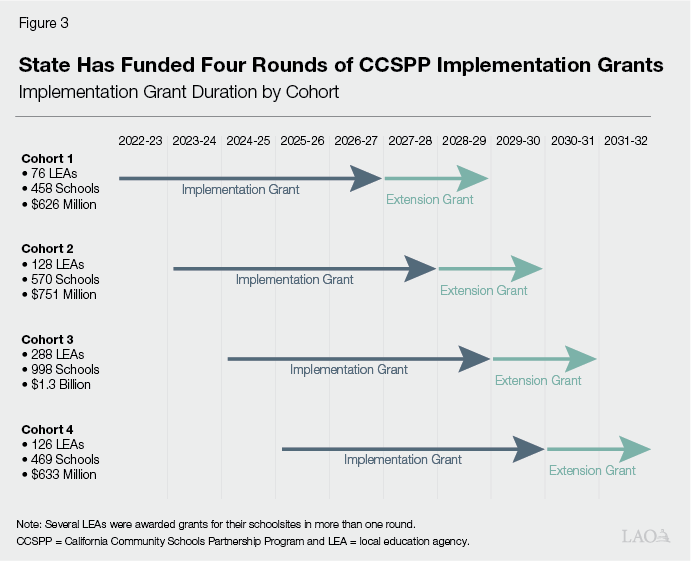
Roughly 2,500 Schools Have Received Funding Across Four Cohorts. To date, the state has awarded implementation grants to about 2,500 schools across roughly 560 school districts, COEs, and charter schools. LEAs were eligible to apply for schools that have either (1) a student body where 50 percent or more of their enrolled students are English learners, low income, or foster youth (EL/LI), or (2) higher than the state average rate of any of the following: dropouts, suspensions and expulsions, child homelessness, foster youth, or justice‑involved youth. Statute gives priority to schools with an EL/LI percentage of more than 80 percent. As Figure 3 shows, the funding was awarded across four cohorts of grantees, from 2022‑23 through 2025‑26. Grantees receive funding annually for a five‑year period. Implementation grant amounts range from $75,000 to $500,000 annually based on school size. Grantees can use funding for a variety of purposes, including for coordination of services (such as hiring a community schools coordinator), providing direct services to students and families, and providing training and support to staff on how to align services with the community schools framework. At the end of the five‑year implementation period, schools could apply to receive extension grants of up to $100,000 for an additional two years. Cohort 1 will be in the final year of the implementation grant period in 2026‑27, and can apply for extension grants for 2027‑28 and 2028‑29. CCSPP is set to sunset at the end of 2031‑32 when Cohort 4 will be at the end of the two‑year extension grant period.
Grantees Have Several Reporting Requirements. As part of the competitive grant process, applicants are required to submit a variety of information, including an implementation plan, a proposed budget for how funds will be used, and various supplemental information demonstrating alignment with the community schools model (such as evidence of having conducted a community asset mapping and needs assessment, a shared decision‑making council, and having agreements with external service providers). Additionally, applicants must submit detailed data regarding student outcomes (such as school attendance rates, test scores, and suspension rates), disaggregated by student subgroup. As a condition of receiving CCSPP funding, grantees are required to publicly present information on their community school plans at school site and local governing board meetings, as well as post information on their websites. The state requires annual updates as described below.
- Annual Expenditure Reports. School sites are required to develop plans for how they will spend community schools funding. This information is aggregated at the LEA level, and the LEA must also document how it used any community schools funding for administrative costs.
- Implementation Plan Updates. As part of the initial application, each school must have a plan for how they will implement the community schools model in alignment with all of the key aspects of the state’s community schools framework. They must include school goals, activities to achieve these goals, and how progress on goals will be measured. The plans also must specify how a community school coordinator will work on executing the community schools model. Each year, the implementation plan is updated based on any changes in goals or services provided.
- Annual Progress Reports. Grantees are required to submit student outcome data on an annual basis for evaluating progress made toward improving student outcomes and other goals set in the original implementation plan. These reports provide an opportunity for the school to assess the effectiveness of the services and supports that are being implemented.
- Sustainability Plans. Beginning in year two of the implementation grant cycle, grantees are required to submit plans annually on how they will sustain the community schools model. This includes how practices will be sustained (such as partnerships and shared leadership and decision‑making structures), how student supports will be sustained, and potential funding sources that could be leveraged when grant funding expires.
At the end of the implementation grant period, grantees are required to provide CDE with a comprehensive report showing expenditure data and progress on meeting specified goals.
State Requires Annual Formative Evaluations of CCSPP. Statute requires CDE to submit annual formative evaluations of CCSPP beginning December 31, 2023, and to submit a final comprehensive report by December 31, 2031. To date, CDE has submitted three reports to the Legislature. These reports provided summaries of CCSPP implementation, including trends in student outcomes and system‑level implementation patterns based on data submitted in annual progress reports and expenditure plans.
Governor’s Proposal
Provides $1 Billion Ongoing Funding for Community Schools. The Governor’s budget provides $1 billion ongoing Proposition 98 General Fund for a new program to support the community schools model. To be eligible to receive funding, schools must (1) enroll more than ten students, (2) have a student body where 65 percent or more of their enrolled students are EL/LI, and (3) must not be a nonclassroom‑based charter school. In addition, current CCSPP grantees that do not meet these criteria would be eligible. Annual grant amounts vary depending on school size and range from $75,000 to $400,000 (Figure 4). The administration estimates that, in addition to schools that have already received one‑time community schools funding, about 3,700 new schools would be eligible for funding. Initially, ongoing funding for current community school grantees would be reduced by the amount of one‑time funding they are currently receiving. Beginning in 2027‑28, the $1 billion ongoing allocation would receive an annual cost‑of‑living adjustment (COLA).
Figure 4
Proposed Grant Amounts
Vary by School Size
|
Enrollment |
Annual Grant |
|
10‑24 |
$75,000 |
|
25‑150 |
115,000 |
|
151‑400 |
190,000 |
|
401‑1,000 |
230,000 |
|
1,001‑2,000 |
305,000 |
|
2,001 or more |
400,000 |
Schools Must Opt Into Funding. To receive funding in 2026‑27, LEAs with eligible schools are required to notify CDE by November 1, 2026 that they intend to receive funding. As with the one‑time grants, LEAs would be allowed to keep the lesser of $500,000 or 10 percent of the total allocation for their eligible community schools to support coordination activities across school sites. For LEAs with eligible school sites that do not opt in by November 1, 2026, trailer legislation specifies that LEAs will have the opportunity to submit a request to be considered for funding during regular intervals. CDE, in collaboration with the S‑TAC and R‑TACs, would determine the deadlines and timing of the intervals for subsequent requests for funding.
Provides $10 Million Annually for Statewide System of Technical Assistance. The Governor’s proposal would set aside $10 million of the $1 billion for technical assistance centers, including $2 million for the S‑TAC. Trailer legislation provides CDE discretion to determine contract terms, including duration, for each technical assistance center, subject to approval by the State Board of Education. The administration has indicated their intent is that any current S‑TAC or R‑TAC that applies and receives funding would receive this funding in addition to their contracted amounts from one‑time community schools funding.
Requirements for New Grantees Begin in 2029‑30. LEAs receiving funding would be required to annually report and publicly present their community school plans. For new community schools grantees, the administration indicates annual reporting requirements would begin in 2029‑30, when they will be required to submit an implementation plan by December 31, 2029. Current implementation grantees would satisfy their reporting requirement through their annual progress reports under the existing one‑time program. In addition, current and future grant recipients would be required to submit an annual self‑certification beginning in 2029‑30, indicating they are continuing to implement the community schools model in alignment with the state’s community schools framework. The self‑certification is to be developed by the S‑TAC.
Establishes an Accreditation Process Beginning in 2033‑34. Beginning in 2033‑34, schools receiving community schools funding must successfully complete an accreditation process every seven years. The accreditation process would be managed by the technical assistance centers and CDE.
Frees Up Current Funding for Extension Grants. Trailer legislation proposes to free up the $485 million allocated in prior budgets that is set aside for the two‑year extension grants. Current community schools grantees would no longer be required to submit requests for extensions. Instead, they would begin receiving ongoing funding at the new proposed rates after their implementation period is over. Trailer legislation specifies that this freed up funding could be used to provide grants to new community schools. The administration indicates it plans to modify this part of the proposal in the May Revision and may allow funds to be used for a broader set of activities related to community schools.
Assessment
Effects of Community Schools Model
Research Finds Benefits to Community Schools Model. Several formal evaluations of community schools nationally tend to find positive results for student and school outcomes, such as higher attendance and graduation rates, narrower academic achievement gaps as measured by standardized tests, and decreases in instances of disciplinary incidents. Consistent with the previous studies, the Learning Policy Institute recently released a report assessing student outcomes of Cohort 1 of community schools grantees. The report found that schools in this initial cohort showed gains in student outcomes, particularly in reduced chronic absenteeism rates and suspension rates, compared with similar schools that did not receive funding. For example, the evaluation found that Cohort 1 grantees declines in chronic absenteeism rates that were 30 percent (about 1.5 percentage points) greater than the declines for similar schools that did not receive community schools funding. Additionally, suspension rates for Cohort 1 grantees declined by 15 percent more (0.52 percentage points) than similar schools. The improvement in student outcomes was reported across student subgroups, however, the improvements were shown to be most significant for Black students, English learners, and socioeconomically disadvantaged students.
Unclear if Future Cohorts Would Have Similarly Strong Gains. The preliminary results suggest implementation of the model has had positive outcomes for students. However, it is not clear if the state should expect to see similarly strong gains for subsequent cohorts. Cohort 1 grant recipients may have been more likely to have experience with the community schools model than those in subsequent cohorts, and therefore may have been better positioned to successfully implement the model. For example, they may have been using the funds to expand programming in an existing community school or part of an LEA that was expanding the community schools model to new school sites. Eligible LEAs that had less experience may have opted to instead to apply for planning grants, or to apply in subsequent rounds of funding. The state will have more information available regarding the effects of implementing the model as data become available for future cohorts.
Many Schools Report Key Changes in Practices. Information gathered by CDE from annual progress reports demonstrate that many schools in the first cohort of grantees made key changes through implementing the community schools model. One key change cited by many schools was increased collaborative leadership and practices. For example, many schools reported increased engagement from students, families, and school staff as a result of seeking more feedback from families and community partners. Schools reported they made changes in their practices to respond to this feedback. Many schools also have reported establishing shared leadership structures so that decisions can be made with input from administrators, staff, students, parents, and community partners. These changes helped inform the community schools implementation plan. Another key change was better integration of supports and services through various funding streams and programs. Having more frequent communication among school staff and with community partners can help schools to more effectively use their existing resources. For example, improved coordination between instruction during the school day and after school programs can help schools more effectively support student academic success and well‑being. In addition, grantees have leveraged multiple funding sources (such as expanded learning funds, federal funding, and Medi‑Cal reimbursements) to provide more wraparound services, such as behavioral health and counseling, academic supports, and nutritional services. Additional services are sometimes supported by district general purpose funds or through community partnerships. Some schools also reported making changes in their curriculum so that instruction better reflects the culture, experiences, and interests of students.
Model Can Be Challenging to Initiate and Sustain. Although adopting a community schools model can lead to improved outcomes, particularly for disadvantaged students with the greatest needs, successful adoption requires fundamental changes that can be complicated for LEAs to implement. School staff often do not have the skills or experience to implement key aspects of the community schools model, such as improving community engagement and building partnerships with other local organizations. For example, the 2025 annual formative evaluation cites the lack of staff training as a key challenge to implementing the community schools model. It also cited several other challenges, including organizational silos within the LEA and resistance among staff to changing long‑held processes and procedures. Another key challenge reported was limited ongoing resources. Community schools typically require a variety of longer‑term funding streams to expand the services provided to students and families. LEAs can generate additional funding by building the capacity to be reimbursed for certain health and behavioral health services (funded by Medi‑Cal or private insurance), or by seeking philanthropic funds. These funds, however, typically are not sufficient to sustain all of the LEA’s community schools activities. LEAs also may need to redirect existing funding, such as Local Control Funding Formula (LCFF) or expanded learning funds, for activities that can be integrated with community schools grants.
State Has Robust System of Technical Assistance. Given that implementing the community schools model can be challenging, the state set aside a substantial portion of funding for technical assistance. The state has a comprehensive approach to monitoring progress and support schools statewide. At the state‑level, the S‑TAC and CDE develop frameworks and implementation rubrics to support implementation and capacity building. Additionally, the S‑TAC and CDE help construct data systems to help LEAs with the collection and analysis of data for monitoring progress and continuous improvement. The R‑TACs have provided a wide range of technical assistance to schools, including assisting in conducting asset mapping and community needs assessments and offering communities of practice, where groups of schools implementing the model can share best practices. R‑TACs also support LEAs in building capacity in a variety of areas that support implementation of the community schools model, such as making governance changes, developing external partnerships, collaborating with other public agencies, and identifying ongoing funding streams to sustain the model.
Establishing a New Ongoing Categorial Program
Disadvantages to Creating a New Ongoing Categorical Program. In 2013, the state created LCFF and eliminated dozens of programs that provided funding for restricted or targeted purposes, also known as categorical programs. These changes were made with the goal of streamlining state funding and providing funding more equitably across LEAs. In addition, these changes were intended to give LEAs more discretion over spending decisions, recognizing that local decision makers are better positioned to understand the specific needs of their students. Although categorical programs are typically created to support activities that the state determines to be a high priority, they have some key drawbacks in comparison to LCFF:
- Less Flexibility. Categorical programs typically come with new spending requirements that limit an LEA’s flexibility in deciding how to best use its funding. In the case of this proposal, school districts must implement the community schools framework and maintain accreditation or risk losing funding. During times when school districts have constrained budgets and need to reduce programs, this may result in LEAs prioritizing community schools spending and making reductions in other areas (such as math tutoring), even if they believe these other activities would be more beneficial for students.
- Presumes Best Practices Can Be Scaled. Many categorical programs were created to encourage statewide adoption of best practices found to be effective. However, implementing best practices does not necessarily result in the same type of strong improvements when scaled at a state level. In some cases, LEAs do not have the expertise to effectively implement these best practices, and the state does not have the capacity or expertise to support schools to ensure effective implementation. In addition, state‑required activities may be seen with skepticism and may not have sufficient local buy‑in for the practices to be implemented effectively. In the case of the Governor’s proposal, many of the 3,700 newly eligible schools may not have the expertise or local buy‑in to effectively implement the community schools model and, as we discuss later, the state may not have the capacity to provide support to such a large number of schools. Despite these challenges, however, many schools are likely to opt into the program to maximize the amount of funding they receive from the state, particularly since schools have no requirements as a condition of receiving the funding until 2029‑30.
- More Administratively Burdensome. Categorical programs typically have greater administrative burden because school staff must comply with additional reporting requirements and become familiar with the program rules. In the case of this proposal, LEAs would be required to comply with annual reporting requirements and meet the necessary requirements for accreditation.
- Can Result in Similar LEAs Being Treated Differently. Prior to LCFF, the allocation formulas for numerous programs were based on historical factors that no longer had relevance. Over time, this led to variation in funding across districts with no underlying rationale. The Governor’s proposal uses clear objective criteria to determine eligibility (a school’s EL/LI percentage). However, the Governor’s proposal allows recipients of one‑time community schools funding to be eligible for ongoing funding, even if they do not meet the other eligibility criteria. This element of the proposal would result in similar schools being treated differently by the program.
In our view, unless the state has a compelling reason to the contrary, the state should allocate ongoing funding through LCFF so that LEAs have greater flexibility to allocate their funding to address their student needs.
Additional Ongoing Spending Can Create Fiscal Pressure for State. As we discuss in the “Overview” section of this report, we recommend the Legislature be cautious about new spending commitments in order to provide a cushion in case the state faces a decline in revenues. By creating a new $1 billion ongoing program that would increase annually by the COLA, the Governor’s proposal would somewhat increase the likelihood that the state may not be able to fund its K‑12 commitments if the state were to experience a revenue downturn.
Community Schools Funding Was Expected to Be Temporary. The state provided CCSPP grants with the expectation that the grants would serve as start‑up funding to implement the community schools model. Grantees were expected to identify ongoing funding streams—either existing school funds, such as LCFF, or new revenue streams—that could be used to sustain the community schools model after one‑time grant funds expire. Additionally, each cohort receives a lower grant amount in their fifth year of implementation to encourage grantees to begin relying on other funding sources to sustain their programs. The phasing out of targeted funding also provides LEAs with an opportunity to build strong local buy‑in to help ensure their community will support the model over the long run. (In some cases, LEAs may decide the model was not a good fit for their specific schools.) Building this local buy‑in is important for the long‑term success of the community schools model and can help support other key efforts, such as identifying other sources of funding that can sustain the model. Providing ongoing funding may dampen efforts for LEAs to build this strong local buy‑in. In addition, some schools that would receive funding under the Governor’s proposal may have been able to sustain their programs without new ongoing funding.
Design and Scope of Proposed New Program
New Grantees Would Have Few Requirements Until 2029‑30. Under the state’s one‑time community schools grants, applicants were required to submit implementation plans and provide supporting materials demonstrating a commitment to the community schools framework. Those that received grants are required to comply with a variety of annual reporting requirements. In contrast, under the Governor’s proposal for ongoing funding, new recipients would have no substantive requirements until 2029‑30—three years after initially receiving funding. (The only requirement would be to notify CDE by November 1, 2026 that they intend to receive funding.) Based on our conversations with individuals involved with implementing the community schools model, the requirements for one‑time grantees helped LEAs begin to identify their community needs, identify key challenges, and access support from COEs and R‑TACs when needed. Without any specific planning expectations for the first three years of funding, new grantees may not be as successful in establishing their programs as prior recipients.
Unclear How Frequently Schools Would Be Able to Opt Into Program in Future. Under the Governor’s proposal, LEAs must decide by November 1, 2026 if they want to participate in the program for 2026‑27. Those that choose not to participate could opt into the program in the future, at “regular intervals” determined by CDE and the technical assistance centers. This lack of detail creates significant uncertainty for LEAs, particularly for those that may want to stagger implementation of the community schools model at their eligible school sites. The lack of clarity could encourage LEAs to opt into the program right away, even if they are not prepared to begin implementing the model. Moreover, if the state does not allow LEAs to opt in for many years, some eligible schools may be locked out of the program for a long period of time.
Significant Influx of New Grantees Raises Concerns With Capacity for Support. Through CCSPP, the state’s system of technical assistance has provided support to about 2,500 schools over four cohorts. The Governor’s proposal would essentially create a fifth cohort of grantees that could be as large as 3,700 schools in 2026‑27. This would be more than triple the number of grantees than in any of the previous cohorts. Many of these grantees also would be less familiar with the community models model and may not have begun the planning process. With such a large increase in new grantees, we think it is unlikely the state’s system of technical assistance would have the capacity to fully support the new grantees.
Proposed Accreditation Process Lacks Detail. Under the Governor’s proposal, the state’s main tool for ensuring community school funds are spent effectively is through an accreditation process. This approach could have some benefits. An accreditation process could be designed to focus on implementation practices, rather than more bureaucratic compliance reporting. Making funding contingent on accreditation also could create a strong incentive for schools to effectively implement the community schools model. The administration’s proposed trailer legislation, however, has little detail regarding the accreditation process or how the process will be determined. Broad discretion is given to the S‑TAC, R‑TACs, and CDE to develop the accreditation process, with no time line for when the process must be adopted and shared with LEAs. The proposal also does not specify how costs for accreditation would be covered. Without such detail, it is not possible to determine whether this would be an effective approach for ensuring accountability or whether the funding available is sufficient to cover the associated costs.
$1 Billion Is More Than Necessary Initially, but May Not Be Sufficient Over Long Term. The administration estimates the cost of providing grants to new community schools would be $800 million initially, assuming every eligible school receives funding in the budget year. During the first few years of implementation, the cost would be less than $1 billion because many of the current grantees still have one‑time implementation funds available from prior‑year allocations. Trailer legislation allows any unallocated funding to be rolled over across fiscal years, which will likely result in hundreds of millions of dollars of surplus funding being available for the program in the initial years. In addition, the $485 million freed up from the set‑aside for extension grants will result in additional funding that could be used for a one‑time purpose. However, as current community schools grantees exhaust their available one‑time funds, ongoing costs would begin to increase. By 2030‑31, when all current grantees would have exhausted their one‑time funding, assuming community school grant rates receive COLA, we estimate ongoing costs for funding all eligible schools would be a few hundred million dollars higher than the funding provided under the proposal.
Recommendations
Recommend Continuing With One‑Time Funding Approach. Although the community schools model has been shown to have a variety of benefits for students, we have concerns about funding the model at such a large scale. The model can be challenging to implement and requires strong local support to be successful. In addition, we have broader concerns about establishing a new ongoing categorical program restricted for specific purposes. For these reasons, we recommend the Legislature continue funding community schools implementation with one‑time grants. This would allow additional schools to receive start‑up funding from the state to implement the community schools model, while leaving the decisions about whether to provide ongoing financial support for sustaining the model to LEAs if they find there are adequate benefits for their students. The Legislature could provide the $1 billion in 2026‑27 as one‑time funding for additional rounds of community schools implementation grants under the current CCSPP application and reporting requirements. Based on the awards granted to date through CCSPP, we estimate the state could support roughly 700 additional schools with this amount. The state likely would see demand from schools for additional one‑time funding. According to CDE, 238 LEAs applied for funding from Cohort 4 and passed the initial application screening, but were not awarded grants due to limited funds. Continuing with the state’s one‑time funding approach would give the state more control over the number of new grantees, which would help ensure sufficient capacity exists to support schools implementing the model. This approach would also avoid some of the pitfalls of creating a new ongoing program.
Consider Funding Technical Assistance Over Longer Period. Under the state’s one‑time funding approach, technical assistance funding is available over the same period that schools receive grants for implementation. Given the importance of technical assistance in implementing the community schools model, the Legislature may want to consider funding technical assistance over a longer period of time, so that LEAs have access to support in future years. For example, the state could set aside additional funding to support schools beyond the initial implementation period. Moving forward, the state could consider whether it may be reasonable to provide ongoing funding for this purpose and integrate these activities into the broader state system of support that funds regional support through COEs and establishes leads for certain issues, such as addressing achievement gaps and improving literacy instruction. This would provide a baseline level of support for community schools implementation in the longer term, even if the state does not provide funding for community schools annually.
If Providing Ongoing Funding, Recommend Several Modifications to Proposal. If the Legislature is interested in providing ongoing funding for community schools, we recommend the Legislature make several modifications to the Governor’s proposal.
- Prior to Accreditation Process, Align Requirements for New Grantees With Current CCSPP Guidelines. While the state is developing the accreditation process for community schools, we recommend setting annual planning and reporting requirements for LEAs, consistent with the current requirements for CCSPP Cohort 4. This would encourage schools receiving funding to begin planning and accessing technical support earlier in the process. After implementation of the accreditation process, some CCSPP requirements—such as expenditure reports and sustainability plans—may become duplicative or unnecessary.
- Phase in Eligibility Over Time. To ensure the state has capacity to support new community schools, we recommend initially targeting a narrower scope of schools and then expanding eligibility over multiple years. For example, the state could begin by only allowing schools with an EL/LI percentage that is 85 percent or greater to be eligible in 2026‑27, then expand to all schools with 65 percent EL/LI or higher over multiple years. This would allow for smaller cohorts and more time for the state to absorb the influx of new grantees.
- Set Clear Guidelines for When Eligible Schools Can Opt in Moving Forward. For schools that choose not to initially opt into the program, we recommend specifying the interval in which they could begin participating in the program (currently not defined in the Governor’s proposal). We think allowing schools to opt in on an annual basis is reasonable, as it would ensure that schools do not opt in just to avoid potentially being locked out of the program for a long period of time. In addition, clear expectations would help LEAs develop multiyear plans to expand the community schools model in their eligible schools.
- Begin Accreditation Process Earlier for Current Grantees. To make implementation of accreditation more manageable for the state, we recommend staggering the accreditation process based on when schools initially received community schools funding. For example, the Legislature could begin the accreditation process for the first cohort of grantees in 2029‑30—seven years after receiving their initial CCSPP grants. This would provide all schools with the same amount of time to establish their programs before having to meet accreditation requirements. Starting the process earlier with more experienced schools also would give the state time to apply the accreditation standards to a smaller cohort of schools and determine if changes are needed.
- Set More Specific Time Lines Around Accreditation Process. In addition to setting an earlier date for when accreditation would begin, we recommend establishing time lines for key milestones associated with the development of the accreditation process. We recommend the Legislature require CDE and the S‑TAC to submit a status update on the accreditation process that includes draft guidelines and estimated costs. We also recommend the Legislature require adoption of the accreditation process several months before schools begin going through accreditation. For example, the Legislature could require a status update by January 2028 and adoption of the process by January 2029, with the goal of beginning accreditation activities in 2029‑30. Receiving a status update would give the Legislature an opportunity to determine whether the proposed guidelines provide sufficient accountability for schools and whether existing funding is sufficient to support accreditation costs. This also would allow schools to develop a better understanding of what they must do to meet accreditation standards.
- Assess Funding Level for Technical Assistance Centers. The Legislature may want to assess whether the proposed funding level for technical assistance is sufficient given the increased number of schools that will be supported on an ongoing basis. The specific level of funding would depend on several factors, including the number of new schools expected to receive funding annually and the amount of support R‑TACs and the S‑TAC are expected to provide to new grantees.
- Require Unspent Funding to Revert Back to the State. We recommend requiring unallocated funding from community schools grants to revert back to the state at the end of each fiscal year. We also recommend reverting the $485 million currently set aside for extension grants. This would provide the Legislature an opportunity to determine—through the annual budget process—how these excess funds can be allocated to best achieve the state’s educational goals. If the Legislature finds that additional one‑time funding to support community schools is a high priority at that time, it could provide a specific appropriation accordingly.
Expanded Learning Opportunities Program
Background
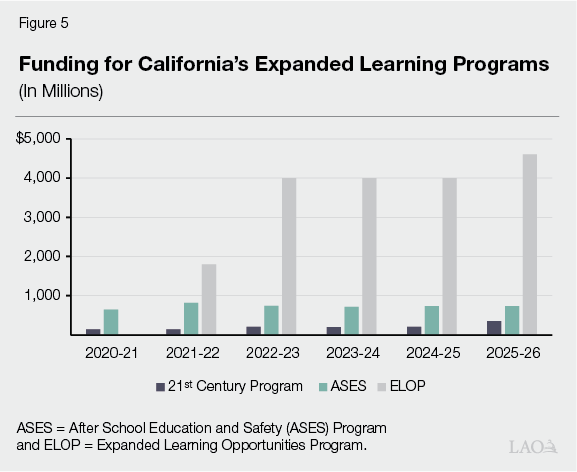
State Has Three Expanded Learning Programs. The state has three expanded learning programs that provide students with academic and enrichment activities outside of normal school hours. Two of these programs, the After School Education and Safety (ASES) program and 21st Century Community Learning Centers (21st Century program), are longstanding. In 2002, voters approved Proposition 49, which requires the state to provide at least $550 million annually to the ASES program. The 21st Century program is primarily federally funded. In 2021‑22, the state created the Expanded Learning Opportunities Program (ELOP) with plans to ramp up funding through 2025‑26. This program now represents the vast majority of funding schools receive for expanded learning (Figure 5).
ELOP Funds Allocated Through a Two‑Tiered Funding Structure. As Figure 6 shows, the ELOP implementing legislation established two funding rates that account for TK‑6 attendance and vary based on the proportion of a school district or charter school’s students who are English learners or from low‑income families (EL/LI). (Throughout this section, we use the term “districts” to refer to school districts and charter schools.) Beginning in 2025‑26, districts with a student body that is 55 percent or more EL/LI receive a rate per EL/LI student ($2,750) that is set in statute. We refer to these as the Tier 1 rates. For other districts, statute specifies the rate will vary based on the amount of funding remaining after accounting for Tier 1 allotments. (These are known as Tier 2 rates.) From 2022‑23 through 2024‑25, the state appropriation remained at $4 billion annually, while the Tier 1 rate and overall Tier 1 TK‑6 attendance increased. As a result, funding available for Tier 2 rates decreased. In 2025‑26, the state increased funding to $4.6 billion and made several programmatic changes. One goal of the funding increase was to ensure that 2025‑26 Tier 2 rates would be no less than $1,579 per EL/LI student. (The funding increases also covered the costs of lowering the Tier 1 threshold and increasing minimum grant amounts.)
Figure 6
ELOP Funding Tiers and Rates Over Time
|
Tier 1 EL/LI |
Tier 1 Rate Per |
Tier 2 Rate Per |
|
|
2021‑22 |
80% |
$1,170 |
$672 |
|
2022‑23 |
75 |
2,500 |
2,054 |
|
2023‑24 |
75 |
2,750 |
1,803 |
|
2024‑25 |
75 |
2,750 |
1,579 |
|
2025‑26 |
55 |
2,750 |
1,579 |
|
ELOP = Expanded Learning Opportunities Program and EL/LI = English learner or low income. |
|||
ELOP Tiers Have Different Programmatic Requirements. Under ELOP, all programs are required to provide at least nine hours per day of combined in‑person instructional time and expanded learning opportunities during the school year and for 30 days during the summer. Tier 1 districts, however, are subject to higher requirements. Specifically, these programs must offer the program to all TK through grade 6 students in classroom‑based settings and provide access to all students whose parent or guardian requests their placement in a program. By contrast, Tier 2 districts are only required to provide access to EL/LI students who are interested in the program. Tier 2 districts can opt to serve non‑EL/LI students and may choose to cover the additional costs above their apportionment by assessing family fees.
State to Begin Collecting Expanded Learning Participation Data This Year. Historically, the state generally has not collected participation data for ELOP. Chapter 1003 of 2024 (AB 1113, McCarthy) requires districts to collect enrollment data for their expanded learning programs through the state’s longitudinal data system, starting with the 2025‑26 school year. This will provide the state with information on participation by district, as well as the demographics of participating students.
Governor’s Proposal
Sets Minimum Tier 2 Rate of $1,800 per EL/LI Student. The Governor proposes to set a minimum Tier 2 rate of $1,800 per EL/LI student, while the Tier 1 rate would remain at $2,750 per EL/LI student. The budget includes an associated ongoing $62.4 million Proposition 98 General Fund increase to fund the higher Tier 2 rates. If additional funding is available within the ELOP appropriation, the funding would be allocated to increase Tier 2 rates above $1,800.
Assessment
Proposed $62.4 Million Is a Reasonable Estimate of Cost to Implement the Proposal. Based on 2024‑25 attendance—the data used to calculate 2025‑26 allocations—the proposed $62.4 million in additional funding would allow for increasing the Tier 2 rates. By the spring, the state will have preliminary 2025‑26 attendance data that it can use to update this estimate.
Providing Greater Certainty for Tier 2 Rate Would Be Beneficial for Districts. The current Tier 2 ELOP rate is effectively determined by whatever ELOP funding is left over after Tier 1 districts have been funded. This has resulted in significant variability of rates. Between 2022‑23 and 2024‑25, the Tier 2 rate decreased 23 percent (from $2,054 to $1,579). This variability makes it difficult for districts to make long‑term decisions about staffing levels and programming. By setting a minimum rate amount, the Governor’s proposal would provide more predictable funding that would make planning easier for Tier 2 districts.
Proposed Rate Increase Not Tied to Program Costs. The proposed Tier 2 rate of $1,800 would be more than $200 higher than the rate provided in 2024‑25 and 2025‑26. Given the state funded at the lower rate the past two years, we see no clear rationale for providing a rate increase. The state has added no new program requirements in 2026‑27 that would require higher levels of funding. Moreover, as we discuss in a previous report, existing ELOP rates are likely providing districts with more funding per participating student than required to meet program requirements. The state will be in a better position to assess the level of funding provided for ELOP by next year, when expanded learning participation data for 2025‑26 becomes publicly available.
No Clear Rationale for Allowing Rate to Exceed Proposed Minimum. In our view, the administration has not presented a compelling case for allowing the Tier 2 rate to exceed the minimum amount proposed. First, this approach would create funding uncertainty for the districts—a problem that the administration is trying to address with this proposal. Notably, the Department of Finance projects the state will experience a 2.8 percent decline in public school enrollment between 2026‑27 and 2029‑30. This decrease in enrollment likely will free up funding within the ELOP appropriation over the next several years to increase the Tier 2 rate. These rate increases would solely be based on available program funds, and as such would create instability for districts. Second, as discussed above, these increases also would not be tied to the costs required to operate expanded learning programs.
Recommendation
Establish Fixed Tier 2 Rate. To provide greater predictability for districts, we recommend setting a specific rate for Tier 2 districts in statute. This certainty would help districts make longer term program decisions. We think the current Tier 2 rate of $1,579 is likely sufficient to meet current ELOP program requirements, but the Legislature could provide a higher rate if it would like to fund additional programs and services. Rather than automatically allocating excess funding within ELOP to Tier 2 districts, we recommend the excess funds revert back to the state. If the Legislature is interested in increasing Tier 1 or Tier 2 rates in the future, we recommend those increases be based on an analysis of program costs that take into consideration the number of students participating in expanded learning programs and the programmatic requirements set in statute.
Necessary Small Schools
Background
Most School District Funding Is Allocated Through the Local Control Funding Formula (LCFF). The LCFF is the primary source of funding for school districts. The formula provides a base amount for each student in four grade spans (transitional kindergarten through grade 3, and grades 4‑6, 7‑8, and 9‑12), plus additional funding for low‑income students and English learners. For funding purposes, the state credits school districts with the greater of their average daily attendance (ADA) in the current year, prior year, or rolling average from the three prior years. Schools pay for most of their general operating expenses (including employee salaries and benefits, supplies, and student services) using these funds. In 2024‑25, the state spent more than $54 billion on LCFF base funding for school districts—an average of about $11,200 per student.
State Has Alternative Base LCFF Calculation for Necessary Small Schools. The Necessary Small Schools program provides an alternative LCFF base grant for the ADA in small schools (96 or less ADA for an elementary school and 286 or less ADA for a high school) within small school districts (generally districts with less than 2,500 ADA). To be classified as a necessary small school, schools also must demonstrate that (1) students who attend the school would otherwise be required to travel relatively long distances from their home to attend school, or (2) geographic or other conditions (such as annual snowfall) make busing students an unusual hardship. In 2024‑25, the state provided $147 million for this purpose—an average of about $16,800 per student for the roughly 8,700 students attending necessary small schools.
Necessary Small School Funding Is Based on ADA and Staffing Levels. The Necessary Small Schools allocation uses funding bands based on either a school’s ADA or its staffing levels, whichever provides the lesser amount. The number of full‑time teachers is used for elementary schools that serve students in grades K‑8, while the number of full‑time equivalent certificated employees is used for high schools. (See Figure 7 and Figure 8, respectively.) Districts receive funding for their necessary small schools in place of LCFF base grants, but they receive LCFF base grant funding for all other schools in the district. As with the LCFF base grant, each necessary small school is credited with the greater of their ADA in the current year, prior year, or rolling average of their three prior years. Necessary Small School funding levels are also annually adjusted by the statutory cost‑of‑living adjustment (COLA). School districts receive supplemental and concentration grant funding for necessary small schools in the same way as the rest of their ADA.
Figure 7
Funding Bands for Necessary Small
Elementary Schools
2025‑26 Rates
|
Number of |
Average Daily |
Funding |
|
1 |
1 to 24 |
$277,457 |
|
2 |
25 to 48 |
549,072 |
|
3 |
49 to 72 |
820,926 |
|
4 |
73 to 96 |
1,092,539 |
Figure 8
Funding Bands for Necessary Small High Schools
2025‑26 Rates
|
Number of Certificated |
Average Daily |
Funding |
|
1‑3 |
1 to 19 |
Up to $740,514a |
|
4 |
20 to 38 |
907,196 |
|
5 |
39 to 57 |
1,073,880 |
|
6 |
58 to 71 |
1,240,562 |
|
7 |
72 to 86 |
1,407,246 |
|
8 |
87 to 100 |
1,573,928 |
|
9 |
101 to 114 |
1,740,612 |
|
10 |
115 to 129 |
1,907,294 |
|
11 |
130 to 143 |
2,073,978 |
|
12 |
144 to 171 |
2,240,662 |
|
13 |
172 to 210 |
2,682,875 |
|
14 |
211 to 248 |
3,167,262 |
|
15 |
249 to 286 |
3,651,657 |
|
aFunding for schools between 1‑19 ADA depends entirely on their number of certificated staff. Specifically, schools receive $233,818 if they have one certificated employee, $333,366 for two, and $740,514 for three. |
||
|
ADA = average daily attendance. |
||
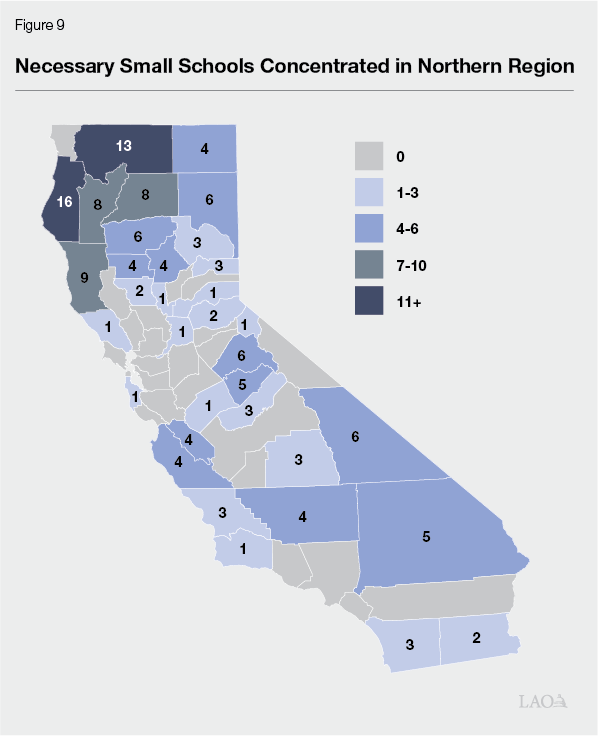
Necessary Small Schools Are Concentrated in Northern Region of the State. In 2024‑25, the state provided additional funding for 144 necessary small schools across 108 districts, including 79 elementary schools and 65 high schools. Of the 108 districts with a necessary small school, 38 districts (35 percent) are comprised entirely of necessary small schools (including 35 districts comprised of a single necessary small school). For districts that receive Necessary Small Schools funding, the combined ADA from their necessary small schools represents roughly 20 percent of their total ADA. As Figure 9 shows, necessary small schools are primarily located in more rural counties, particularly in the northern part of the state.
One‑Fifth of Districts Below 2,500 ADA Have a Necessary Small School. Of the state’s 937 school districts, 551 (59 percent) have less than 2,500 ADA. Roughly one‑fifth of these districts had at least one necessary small school (Figure 10). Furthermore, Figure 10 shows that the vast majority of districts with necessary small schools have less than 500 ADA (77 percent).
Figure 10
One‑Fifth of Small School Districts Have a
Necessary Small School
2024‑25
|
Average Daily |
Districts with Necessary |
Total School |
Percentage of |
|
Less than 500 |
83 |
316 |
26% |
|
501‑1,000 |
12 |
86 |
14 |
|
1,001‑1,500 |
6 |
58 |
10 |
|
1,501‑2,000 |
6 |
48 |
13 |
|
2,001‑2,500 |
— |
43 |
— |
|
Totals |
107a |
551 |
19% |
|
aDoes not include one district that has more than 2,500 units of average daily attendance and receives necessary small schools funding for one of their school sites due to extreme geographic isolation. |
|||
Governor’s Proposal
Provides a 20 Percent Increase to Necessary Small Schools Funding. The Governor’s budget proposes $30.7 million ongoing Proposition 98 General Fund to apply a 20 percent increase to each necessary small school funding band. This is in addition to a 2.41 percent COLA for the rates, equaling roughly $3.6 million. The administration has indicated that this proposal is intended to help necessary small schools maintain instructional programming amidst various fiscal challenges. The administration cites several fiscal challenges, including cost increases that have outpaced inflation, higher per‑student costs, less flexibility to distribute fixed expenses across their student body compared to larger districts, and less flexibility to absorb declines in enrollment compared to larger districts.
Assessment
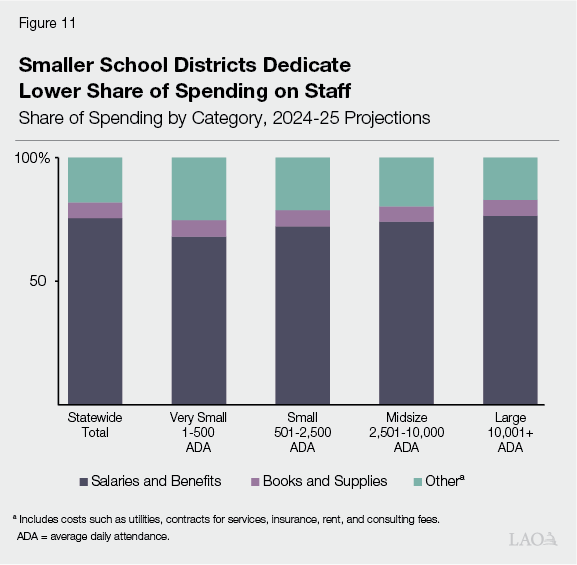
Small School Districts Have Different Spending Patterns. As Figure 11 shows, preliminary 2024‑25 budget data show that very small (less than 500 ADA) and small (between 501 and 2,500 ADA) school districts dedicated a lower share of spending on staffing and a higher proportion on other costs, such as utilities, contracts for services, insurance, rent, and consulting fees. In particular, very small school districts were projecting to spend 25 percent of their budget on these other costs, significantly higher than the statewide average of 18 percent. Due to the lower share of spending on staffing overall, small school districts tend to have more limited educational options for students. A small high school, for example, typically offers a more limited number of course options than a larger comprehensive high school.
Small School Districts May Be More Affected by Recent Cost Pressures. School districts across the state have reported increasing cost pressures in many parts of their budgets, such as special education, employee benefits, and utilities. Additionally, the majority of districts in the state have been experiencing declines in student enrollment, with statewide enrollment declining by roughly 7.3 percent from 2019‑20 through 2024‑25. The decreased funding levels due to declining enrollment place additional fiscal pressure on school districts, often resulting in districts needing to downsize programs or close school sites. Some of these cost pressures may be more acute for small school districts in rural areas. Although small and very small districts have experienced smaller enrollment declines than the state average—4.5 percent for small districts and 3.8 percent for very small districts—accommodating declining enrollment may be more challenging for some of these districts. For example, in our conversations with small school districts, school leaders indicated that closing school sites in response to declining enrollment wasn’t always a viable solution due to the geographical isolation of some schools. Additionally, very small districts may have acute challenges reducing programs as they already dedicate a larger share of their spending on fixed costs compared to larger districts. One indicator of a school district’s fiscal health is the change in its reserve levels over time, with larger increases suggesting stronger fiscal health. While statewide school district reserve levels as a share of expenditures have increased by 8 percentage points since 2019‑20, reserves for very small districts have remained flat over the same period. (Statewide district reserve levels have increased in part due to one‑time funding the state has provided that is to be spent over a multiyear period.) This suggests very small school districts may be experiencing greater fiscal pressures than school districts statewide. Reserves for small districts increased somewhat, but at a lower rate than the state average.
Governor’s Proposal Increases Funding for Only a Portion of Small and Very Small Districts. Although recent cost pressures may be more acute for small and very small school districts, the Governor’s proposal would provide funding to only a subset of these schools (about one‑quarter of school districts under 500 ADA). Districts with necessary small schools have similar cost structures to that of very small districts overall. They have a similar share of their budget that is dedicated to other costs (24 percent) and also have had little growth in their reserve levels since 2019‑20 (growth of 1 percentage point, compared with no growth for very small districts).
No Specific Rationale for Level of Proposed Increase. Although the administration cited a variety of cost pressures as the reason for providing an increase in Necessary Small Schools funding, the proposed 20 percent increase is not tied to any particular assessment of higher cost pressures.
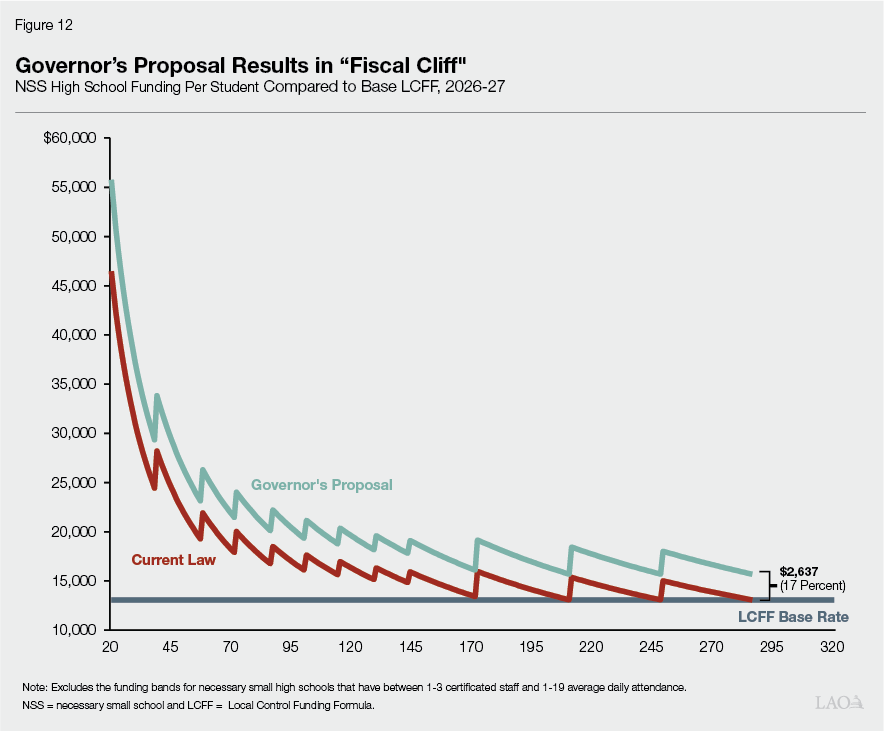
Augmentation Results in “Fiscal Cliff” at End of Funding Bands. The existing funding bands for necessary small schools provide greater per‑pupil funding for the smallest schools, with per‑pupil funding decreasing in each subsequent funding band. This means that per‑pupil funding for schools right above or below the existing thresholds (96 ADA for elementary schools and 286 ADA for high schools) do not result in substantially different rates. However, the Governor’s proposed 20 percent augmentation results in a large difference between schools above or below the threshold for the highest funding bands. Figure 12 shows the fiscal effects for necessary small high schools. Under the Governor’s proposal, a necessary small high school with 286 ADA would generate roughly $2,637 more per student than a school with 287 ADA. (Under current law, the difference would be $22 per student.) This would create a significant fluctuation in funding if schools have ADA that is at or near the threshold of the highest funding band.
Issues for Consideration
Proposal Is a Simple Way to Target Some Small Districts Within Existing Funding Structure. The Governor’s proposal has some merit given it would target districts that likely face greater cost pressures from operating very small schools in geographically isolated parts of the state. If the Legislature is interested in increasing funding for small school districts, increasing Necessary Small School funding is a simple way to do so under the current LCFF structure. Given the proposed 20 percent increase is not aligned with any particular assessment of costs, the Legislature could consider providing a different level of funding based on its priorities. The Legislature may also wish to weigh this proposal against its other education priorities, such as providing funding increases that more broadly benefit schools statewide or proposals that help build budget resiliency.
Legislature Could Consider Alternative Approaches That Target Small School Districts. As mentioned above, one‑fifth of the smallest school districts in the state have a necessary small school and would receive additional funding under this proposal. If the Legislature is interested in providing funding in a way that benefits small school districts more broadly, it could consider exploring other options. For example, the Legislature could explore options for modifying LCFF or creating an LCFF add‑on that accounts for the density of districts’ student populations. These options, however, could be more complex to design and would require additional analysis to ensure they are aligned with a district’s cost structure. In addition, these options likely would result in significantly higher costs compared to the Governor’s proposal.
If Adopting, Legislature May Want to Consider Addressing “Fiscal Cliff” Issue. If the Legislature is interested in adopting the Governor’s proposal, we recommend it modify the proposal to avoid large differences in funding above and below the ADA thresholds. One option is to add a new funding band or extend the range of the final funding band to increase the ADA threshold. This would allow for a more gradual reduction in per‑pupil funding until, as ADA approaches the new threshold, schools shift to the regular LCFF base rates. By increasing the ADA threshold, however, this approach would have higher state costs than the Governor’s proposal. Alternatively, the Legislature could modify rates in a way that minimizes the fiscal cliff and has similar costs to the Governor’s proposal. Implementing this option would require larger increases to the lower funding bands (for schools with lower ADA) and smaller increases to the highest funding bands, with minimal increases for those closest to the threshold.
Differentiated Assistance
Background
State Uses Various Indicators to Understand Student Outcomes. The state uses multiple indicators and a variety of data sources to assess the student outcomes of local education agencies (LEAs)—school districts, county offices of education (COEs), and charter schools—as well as individual schools. For example, to understand student achievement, the state uses standardized test results in English, math, and—for English learners—progress in developing English proficiency. In addition to tracking outcomes related to standardized tests, the state also uses indicators in other areas, such as student engagement and school climate. For example, to understand student engagement, the state uses high school graduation and chronic absenteeism rates.
State Displays School Performance Through California School Dashboard. The state publicly displays achievement on these indicators on a website known as the California School Dashboard. Performance is shown for the state, each LEA, and each school. In addition, performance for the state, each LEA, and each school is disaggregated by up to 14 student subgroups (Figure 13). The dashboard was first made available in fall 2017 and is updated annually. (The state suspended annual updates in 2020 and 2021 given some of this data was not collected during the COVID‑19 pandemic.)
Figure 13
Student Subgroups for Which
Outcome Data Is Reported
|
Racial Subgroups |
|
American Indian or Alaska Native |
|
Asian |
|
Black |
|
Filipino |
|
Hispanic or Latino |
|
Native Hawaiian or Pacific Islander |
|
Two or more races |
|
White |
|
Other Subgroups |
|
English learners |
|
Foster youth |
|
Homeless youth |
|
Long‑term English learners |
|
Socioeconomically disadvantaged |
|
Students with disabilities |
Dashboard Uses Five Performance Levels. For each performance indicator shown by LEA, school, or subgroup, the state assigns one of five performance levels. Performance levels are based on a combination of overall status and change in the measure over the past year.
Dashboard Used to Identify LEAs in Need of “Differentiated Assistance.” LEAs are identified for differentiated assistance annually based on the performance of their student subgroups—also known as the performance criteria. Certain requirements of the performance criteria are set in statute, with the State Board of Education (SBE) responsible for deciding the specific details for implementation. Under current law, a school district or COE enters differentiated assistance based on low performance of a student subgroup in two or more areas. SBE determines the performance level threshold that determines eligibility for differentiated assistance. This is similar for charter schools, except they must meet the performance criteria for two consecutive years to enter differentiated assistance. In 2025, 553 LEAs were eligible for differentiated assistance. When a school district or charter school is identified, it receives assistance from its COE for two years. (Identified COEs receive assistance from a state agency or another COE.) As part of differentiated assistance, the COE is to support the district or charter school to build their capacity to implement actions that address student needs. The specific support may vary, but actions can include helping a district identify the primary causes of its performance issues or securing an expert to assist in a specific area.
State Provides Ongoing Funding to Support Differentiated Assistance. The state provides COEs with additional funding to cover the costs associated with their differentiated assistance activities. This funding is provided through a formula that consists of a base amount of $300,000 for each COE, plus additional funding based on the number of districts and charters in the county in need of differentiated assistance. (The amount per district varies based on the district’s size.) The 2025‑26 Budget Act provided COEs $119 million for this purpose.
SBE Required to Make Changes to Performance Criteria. Trailer legislation included in the 2025‑26 budget package requires SBE to update the performance criteria by July 15, 2026. This update will change how LEAs are identified for differentiated assistance.
Governor’s Proposal
Changes Differentiated Assistance Funding Formula. The Governor’s budget provides an additional $13 million ongoing Proposition 98 General Fund to adopt a new formula for differentiated assistance. This would bring total differentiated assistance funding to $132 million. The new formula would increase the base amount for each COE from $300,000 to $500,000. The remainder of funds would be based on the number of students within the county rather than the number of districts and size of districts identified. The Governor’s budget also proposes to expand the intended use of these funds. The funding is intended to fund targeted assistance to those LEAs identified for differentiated assistance, as well as universal support to all LEAs for improving student outcomes.
Changes Frequency of LEA Identification for Differentiated Assistance. Trailer bill language accompanying the proposal specifies that LEAs will be identified for differentiated assistance once every three years. Once identified, the LEA would receive assistance from their COE for a minimum of three years. Currently, LEAs are identified annually and receive assistance for a minimum of two years.
Removes Statute for Existing Performance Criteria. The proposed trailer bill language removes statute that requires LEAs to be identified for differentiated assistance based on the performance of their student subgroups. This would provide SBE with broad flexibility to establish new performance criteria for differentiated assistance. In addition, the proposed trailer bill language allows SBE to adopt unique performance criteria for charter schools, school districts, and COEs. Currently, the statutory performance criteria are the same for all LEAs, with the exception that charters schools need to meet the criteria for two consecutive years.
Assessment
Making Changes to Formula and Differentiated Assistance Is Premature. As mentioned above, recently enacted state law directs SBE to update the performance criteria used to identify schools for differentiated assistance. These updates have not been made yet and, as a result, the Legislature has no sense of how many LEAs will be identified for assistance in the future. The number of LEAs identified for assistance is a key driver of the costs COEs will incur to provide differentiated assistance. Without this information, the Legislature is unable to assess whether the Governor’s proposed funding changes align with the associated costs in future years. Similarly, although the proposed changes to the timing and frequency of differentiated assistance could be reasonable, these also need to be evaluated in tandem with the updated performance criteria. For example, analyzing the merits of providing differentiated assistance for a longer period of time would depend upon the selectivity of the new criteria. This way decisions can be made with a full understanding of who is and is not receiving differentiated assistance.
Removing Performance Criteria From State Law Limits Input From Legislature. The proposed changes to state law give SBE significantly more autonomy to determine performance criteria in the future. Currently, state law specifies certain requirements of the performance criteria, while giving SBE flexibility in the implementation details. The proposed trailer bill removes these requirements from statute, giving SBE authority to change its approach over time without legislative input.
Recommendation
Revisit Funding Formula and Changes to Differentiated Assistance When Administration Can Provide More Information About Performance Criteria. Given the new SBE performance criteria have yet to be developed, we recommend rejecting the proposed funding and programmatic changes to differentiated assistance. The Legislature could revisit these issues as part of the 2027‑28 budget process, after the performance criteria have been adopted by SBE. If the performance criteria are finalized early and the administration can provide additional details this spring on how the changes would affect COE workload, the Legislature could consider this proposal in May.
Maintain Legislative Role in System of Support Criteria. We recommend rejecting the proposed changes to statute that give SBE more autonomy to determine the performance criteria. Although changes to state law may ultimately be necessary to align with the new performance criteria, these changes can be adopted after SBE has adopted new criteria in July. Furthermore, we recommend the Legislature continue to include language in state law that sets key requirements for the performance criteria. This would ensure that major changes to the performance criteria cannot be implemented in the future without input from the Legislature.
Science Performance Tasks
Background
State Assesses Students in Science. In 2013, California adopted the nationally developed Next Generation Science Standards as the foundation for what students should know and be able to do in science. As a condition of receiving federal education funding, states are required to assess students in science at least once in elementary, middle, and high school. In California, students take the California Science Test to fulfill this requirement in fifth grade, eighth grade, and once in high school. The state contracts with an external entity to develop assessments and necessary materials.
School Districts Determine How Schools Will Teach Standards. To support school districts in teaching the content standards, the state adopts curriculum frameworks that provide specific guidance on how to teach each content standard in a given subject and grade. The state also adopts instructional materials for kindergarten through eighth grade and provides a list of the adopted programs. However, the specific curricula and daily lesson planning is determined by school district administrators and teachers.
State Provided One‑Time Funding to Create a Science Performance Task Resource for Teachers. The 2024‑25 budget package included $7 million one‑time Proposition 98 General Fund for the Los Angeles County Office of Education to contract with at least one nonprofit organization to develop a statewide repository of science performance tasks science teachers could use in their classroom instruction. Performance tasks are student activities intended to measure capabilities and depth of conceptual understanding in the science standards. These funds created the Authentic Tasks for Learning and Assessment in Science (ATLAS) website, which was made public January 1, 2026. The website provides free and searchable access to performance tasks for kindergarten through 12th grade. These performance tasks are intended to be used by teachers throughout the year to understand how well students are meeting content standards. In its first month, the website had 4,200 active users and 480 registered users. (An active user is defined as someone that visited at least two pages of the website or stayed on the site longer than ten seconds.)
Governor’s Proposal
Funds Science Performance Tasks on an Ongoing Basis. The Governor’s budget provides $890,000 ongoing starting in 2025‑26 to maintain science performance task efforts. These funds are intended to support maintenance activities including creating new performance tasks, engaging teachers, and providing professional development for teachers.
Assessment
Too Early to Assess Demand for Initiative. Given the resources on the ATLAS website have only been publicly available since the beginning of the calendar year, it is too early to know if they are helpful for science teachers and provide significant statewide benefit. Since the specific instructional programs used in the classroom are primarily determined by school districts, the usefulness of the performance tasks will depend upon how well they can be integrated into district‑established curricula. In its first month of availability, the ATLAS website had 480 registered users. We anticipate the number of registered users will grow as outreach activities and professional development is conducted. However, assuming the website continues to see a similar increase in users in future months, only a small proportion of science teachers would be registered users by the end of 2027.
Recommendation
Recommend Rejecting Ongoing Funding. Given the limited information about the usefulness of the ATLAS website, we recommend rejecting ongoing funding for the proposal this year. The Legislature could consider ongoing funding needs for this program in a future year after it has a better sense of the overall demand. If the Legislature is interested in continuing to fund the development and dissemination of science resources in this budget, we recommend funds be provided on a limited‑term basis. For example, the state could provide $890,000 annually for the next three years. This would give the Legislature more time to determine whether funding the activities of this initiative serves a compelling statewide interest. If the state provides any funding, we recommend requiring the Los Angeles County Office of Education to report to the state key information about ATLAS usage, such as how many of the state’s educators are using the website, and feedback from educators regarding the usefulness of the website’s resources.
Teacher Residency Grant Program
Background
California Has Long‑Standing Teacher Shortages in Certain Subjects and Schools. Historically, many schools have had challenges in filling their teaching positions with appropriately credentialed teachers, particularly in special education, math, and science. When schools are unable to hire fully credentialed teachers, they hire teachers on waivers or emergency permits who do not have the required teaching credential and subject matter expertise. Despite some recent increases in the number of newly awarded credentials, overall shortages persist. In particular, the state has persistent shortages in special education. From 2019‑20 through 2023‑24, the state authorized more waivers and emergency permits for individuals to fill special education teacher roles (24,565) than new special education teacher credentials (17,963). In addition, the state historically has had higher proportions of teachers on waivers and emergency permits in schools with higher proportions of English learners and low‑income (EL/LI) students. For example, according to the Learning Policy Institute, schools with the highest share of EL/LI students had twice as many math teachers on waivers or emergency permits (23 percent) than schools with the lowest EL/LI shares (11 percent) in 2022‑23.
State Has Provided $655 Million Over Last Eight Years for Teacher Residency Grants. Over the last decade, the state has provided $2.1 billion in one‑time funding to address teacher shortages. One of the largest programs is the Teacher Residency Grant Program, which provides grants to local education agencies (LEAs) to support teacher residents as they earn their teaching credential and work in the LEA. (Residents are teacher credential candidates who teach with a mentor teacher while completing the required coursework and teaching assessments.) The program has received $655 million one‑time Proposition 98 General Fund since 2018‑19, most recently receiving $70 million in the 2025‑26 budget. The Commission on Teacher Credentialing (CTC) provides LEAs with $40,000 per resident to partner with institutions of higher education, provide mentorship, and award stipends to support residents in obtaining their teaching credentials. Of the $40,000, a minimum of $20,000 must be provided to the resident as a stipend. Operating LEAs can use some or all of the remaining funds to cover the costs of the residency or to provide higher stipend amounts. (We discuss other state teacher recruitment and retention spending, such as the Golden State Teacher Grant Program, in The 2025‑26 Budget: Educator Workforce.)
Teacher Residency Grant Program Has Expanded Over Time. The Teacher Residency Grant Program originally provided support to prospective teachers seeking credentials in special education and science, technology, engineering, and math. The 2022‑23 budget package expanded the program to support all teacher credential types as well as individuals seeking a credential in school counseling. The state also has increased the per‑resident grant amount from $20,000 to $40,000. The most recent data available shows 1,178 residents completed the program between 2019‑20 and 2022‑23, with another 1,150 enrolled in the 2023‑24 cohort. Of the completers, approximately 80 percent were hired as teachers in the LEA where they completed their residency. State law requires CTC to commission a report evaluating the effectiveness of the residency program in recruiting, developing support systems for, and retaining teachers. The report is due to the Legislature by December 1, 2029.
Governor’s Proposal
Provides $250 Million One‑Time Proposition 98 General Fund for Teacher Residency Grant Program. The Governor’s budget provides additional one‑time funding for the Teacher Residency Grant Program. The funding must be committed by June 30, 2030. No changes to the program structure are proposed.
Assessment
Proposed Funding Level Likely Would Last Through 2029‑30. Based on the most recent information available, $78 million is currently available from previous rounds of residency grant funding. This includes the $70 million authorized in the 2025‑26 budget, as well as $7.7 million remaining from the 2021‑22 appropriation. Based on the amount of funding CTC has awarded in recent years, most of the funding currently available likely will be awarded in 2025‑26. The funding proposed in the 2026‑27 budget likely would be sufficient to fund grantees over the next three years.
Residency Programs Have Several Benefits… Residency programs have three distinct benefits. First, research evaluating teacher residency programs notes that teachers who complete a residency feel more prepared to be teachers and are more likely to stay in the teaching profession for a longer period of time. Second, residency programs offer the LEAs operating them flexibility to address their specific teacher shortages. LEAs can admit teacher candidates into their program that match their specific staffing needs. (Other state teacher recruitment and retention programs address broader statewide needs, but do not provide as much flexibility to focus on an LEA’s specific needs.) Third, residency programs offer stipends that supplement a teacher candidate’s financial aid package, which could attract teacher candidates who might not otherwise enroll in a teacher preparation program due to the cost and difficulty earning income while securing a credential.
…But Can Be Challenging to Establish. Residency programs can be difficult to launch as they require establishing a partnership with an institution of higher education and an available pool of bachelor’s degree holders interested in being teachers. Due to this challenge, residency programs are disproportionally found in larger urban areas of the state. For example, as of 2022‑23, only one program (Humboldt County) exists in the northern, rural part of the state. Larger districts and charter schools have more teachers who can serve as mentors as well as higher volumes of staff openings. Larger cohorts of residents also mean that any costs associated with running the program can be spread across a greater number of grants.
More Information on Program Effectiveness Available in Coming Years. Early reporting on the effectiveness of the Teacher Residency Grant Program has focused on the number of programs and teacher candidates that have participated in these programs. The CTC report due December 1, 2029 may provide additional insights into other aspects of the program. The report may include information regarding resident persistence in the teaching profession relative to other teachers and the degree to which residency programs reduce teacher shortages in the districts operating them.
Recommendations
Fund Proposal if Aligned With Legislative Priorities. If the Legislature would like to provide funding to address teacher shortages in the 2026‑27 budget, we recommend adopting this proposal. Funding the program has the potential to increase teacher retention and reduce teacher shortages for LEAs that receive grant funds (primarily larger urban districts). Alternatively, the Legislature could reject the proposal if it was interested in funding other priorities or is concerned that the program is not likely to address shortages in smaller, rural districts. In this case, the Legislature also could wait for the forthcoming evaluation of program effectiveness to determine whether to provide additional funding in future years.
Dual Enrollment
Background
Dual Enrollment Allows High School Students to Take College Level Courses. Credit from these college‑level classes may count toward both a high school diploma and a college degree. By graduating high school having already earned college credits, students can save money and accelerate progress toward a postsecondary degree or certificate. Dual enrollment has various models. California’s two most widely used models are traditional dual enrollment and College and Career Access Pathways (CCAP). Traditional dual enrollment typically consists of individual high school students taking college‑level courses on a community college campus. CCAP, on the other hand, allows cohorts of high school students to take college‑level classes on a high school campus. Under both dual enrollment models, the school district the student attends and the community college are typically able to claim apportionment funding for the time that students are taking the community college courses.
Legislature Authorized CCAP in 2015. Chapter 618 of 2015 (AB 288, Holden) created CCAP. Unlike traditional dual enrollment, CCAP allows cohorts of high school students to take college‑level classes on a high school campus. Community colleges may still claim apportionment funding for such instruction. Unlike traditional dual enrollment, CCAP students only need to attend their high school classes for 180 minutes (three hours) for school districts to generate attendance‑based funding. Chapter 618 prohibits students in a CCAP program from being charged enrollment fees or fees for textbooks and other instructional materials. To form a CCAP program, school and community college districts must agree to a memorandum of understanding (MOU). These MOUs contain information such as the courses to be offered; the number of students to be enrolled; and which partner (the school or community college district, or both) is to cover program costs, including the cost of providing instructional materials.
Middle College and Early College (MCEC) High Schools Also Focus on Dual Enrollment. In addition to traditional dual enrollment and CCAP, the state authorizes “middle college high schools” and “early college high schools” (MCEC high schools) to serve as specialized programs focused on dual enrollment. Middle college high schools are a partnership between a school district or charter school and a community college to operate a high school on a community college campus. The state provides $1.8 million in ongoing funding to support these programs. Early college high schools are partnerships between public schools and a community college, California State University, or University of California campus that allow students to earn a diploma and up to two years of college credit in four years or less. Both programs are targeted to students who are at risk of dropping out of high school.
In 2022‑23, State Provided $200 Million One‑Time Funding for Certain Dual Enrollment Programs. The 2022‑23 budget package provided $200 million for dual enrollment programs through a competitive grant process administered by the California Department of Education (CDE). Statute requires half of the funding to be provided in $100,000 grants per school site to establish or expand CCAP programs, while the other half of the funding was to be used to provide $250,000 grants per school site to start up or expand MCEC high schools. Statute also specifies that priority is to be given to local education agencies (LEAs) where at least half of their student population consists of English learners or low‑income students, as well as LEAs that have a higher than the state average rate of high school dropouts, suspensions or expulsions, child homelessness, foster youth, or justice‑involved youth. CDE has made funding available through three application rounds, beginning in 2023‑24. To date, CDE has fully allocated the funding set aside for CCAP grants, while $33 million remains from funds set aside for MCEC high schools. CDE has indicated it will be opening another round of funding for MCEC high schools in 2026‑27. Any uncommitted funding after this fourth round of applications will revert back to the state after June 30, 2027.
Governor’s Proposal
Provides $100 Million One‑Time Funding for Dual Enrollment. The Governor’s budget proposes $100 million one‑time Proposition 98 General Fund to provide additional grants for expansion of CCAP or MCEC high schools. Unlike the funding provided in 2022‑23, there is no specific funding amount required to be set aside for CCAP or MCEC high schools. When LEAs apply for funding, they will indicate for which program they are seeking additional grant funding. This funding must be committed by June 30, 2029.
Assessment
No Clear Fiscal Barriers to Implementing Dual Enrollment. Research suggests that dual enrollment can be an effective model for improving college preparation. Moreover, the state supports an extensive amount of dual enrollment through several program models. In proposing additional one‑time funding for dual enrollment, however, the administration fails to identify how additional funding might help remove barriers to implementing dual enrollment programs. In the case of CCAP, it is not clear that funding barriers exist at all. From 2020‑21 through 2023‑24, full‑time equivalent enrollment in CCAP programs has grown from about 13,100 to over 24,000 (82 percent). Moreover, rather than posing fiscal barriers, funding policies for CCAP and MCEC high schools can work to the benefit of schools and colleges. When dually enrolled students take college courses in place of their regular high school coursework, schools can receive attendance‑based funding even though they may only be providing three hours (rather than the standard six hours) of instruction per day. The state has also made legislative changes over the years to support expansion of CCAP. Most recently, Chapter 789 of 2024 (SB 1244, Newman) allowed community college districts to establish partnerships with school districts outside their service area.
LEAs Can Use Proposed Discretionary Block Grant Funding for Same Purposes. As described in our recent publication The 2026‑27 Budget: Proposition 98 Guarantee and K‑12 Spending Plan, the Governor’s budget provides $2.8 billion in one‑time funding for a discretionary block grant that would be allocated based on average daily attendance. The grant would not have specific spending requirements, but trailer legislation suggests several potential uses, including dual enrollment programs. To the extent that one‑time funding would help support the expansion of dual enrollment programs, LEAs could use the funding from the discretionary block grant to cover these costs.
Recommendation
Recommend Rejecting Proposal. Given the proposed funding would provide one‑time funding for ongoing activities and would not address any barriers to expanding dual enrollment, we recommend the Legislature reject the proposal. LEAs interested in using one‑time funding to expand dual enrollment programs could use funding from the proposed discretionary block grant for the same activities.
Kitchen Infrastructure and Training
Background
State Created Grant Program to Support Universal School Meals in California. Trailer legislation related to the 2021‑22 budget package required that, beginning in 2022‑23, all public schools provide one free breakfast and one free lunch per school day to any student requesting a meal. To support schools in meeting the universal school meals requirements, the 2021‑22 budget package provided $150 million one‑time Proposition 98 General Fund to create the Kitchen Infrastructure and Training (KIT) grant. In subsequent state budget packages, two more rounds of KIT funding were provided, for a total of $905 million (Figure 14).
Figure 14
State Has Funded Three Rounds of Kitchen Infrastructure and Training Grants
|
Amount |
Distribution |
Status |
Deadline for |
|
|
Round 1: 2021‑22 |
$150 |
Formula |
Distributed to 941 local education agencies (LEAs) that opted in. |
June 30, 2025 |
|
Round 2: 2022‑23 |
600 |
Formula |
Distributed to 1,010 LEAs that opted into program. |
June 30, 2026 |
|
Round 3: 2025‑26 |
155 |
Competitive |
LEAs submitted applications for funds January 2026. |
June 30, 2028 |
|
Total |
$905 |
Allowable Uses of Grant Have Changed With Each Round of Funding. In the first round of KIT funding, local education agencies (LEAs) could use $120 million for kitchen infrastructure and equipment such as cooking equipment, service equipment, and refrigeration. This first round also set aside $30 million for training food service staff. For the second round of grants, LEAs could use $350 million of these funds for all the same purposes as the first round (including training). In addition, funds could be used for staff costs associated with certain activities such as procuring locally and sustainably grown food. The remaining $250 million from round 2 can be used for the same activities, but funds must be used to increase capacity for freshly prepared on‑site meals, rather than more broadly to implement universal school meals. The third round allows for all the same allowable uses as the first two rounds, but also allows funds to be used to purchase certain ingredients, such as California‑grown produce. The third round also sets aside $10 million for recruitment and retention activities such as one‑time bonuses.
Governor’s Proposal
Funds Fourth Round of KIT Funds. The Governor’s budget provides $100 million one‑time Proposition 98 General Fund for grants to support kitchen equipment, infrastructure, training, and the continued implementation of universal school meals. The allowable uses would be similar to previous rounds of funding, but LEAs could also use funds to implement strategies to provide food assistance to students who may be experiencing food insecurity. Funds would be distributed competitively using criteria to be developed by the California Department of Education (CDE). In awarding funds, CDE is to prioritize LEAs that participate in certain provisions of the federal nutrition programs (generally available to LEAs with relatively high shares of students eligible for free and reduced‑price meals). CDE is also to prioritize LEAs that were not awarded the third round of KIT funds and LEAs that have committed at least 65 percent of their second round of KIT funds. Funds would be available until June 30, 2029.
Assessment
School Nutrition Programs Are Still Spending Previous Rounds of KIT Funds. The KIT grants provide a wide range of allowable uses. Based on our conversations with CDE, the first round of KIT funds supported a variety of project types, including large kitchen remodels. Funds also supported equipment purchases such as refrigerators, freezers, ovens and stoves. The state, however, has no information for the second and third rounds of KIT funds. For the second round of funding, LEAs must commit funds and report on how they were used by June 30, 2026. The third round of funding will likely be disbursed this spring and must be committed by June 30, 2028.
Limited Information About the Impact of Earlier Funding. Given the wide array of allowable uses and limited information on how funds have been spent, it is difficult to know the degree to which KIT funds have helped LEAs make progress in accomplishing key nutrition priorities, such as supporting the implementation of universal school meals. Furthermore, aside from requiring funds to be spent in the broad categories of allowable uses, these funds were largely provided without specific outcome expectations. The Legislature will have additional information on the second and third rounds after funds are committed and LEAs report how funds were used.
Recommendation
Recommend Rejecting Fourth Round of KIT Funds. Given that the second round of funds are still being spent and the third round of funds are still being awarded, we recommend the Legislature reject the fourth round of KIT funds. The Legislature could consider providing additional funding in the future, when it has additional information on how the second and third round of funds were spent. If the Legislature provides funding in the future, we recommend funds be restricted for specific goals set by the Legislature, and that data is collected to measure progress toward achieving these goals.
Reading Difficulties Screening
Background
State Law Requires Screening for Reading Difficulties in Grades K‑2. Chapter 48 of 2023 (SB 114, Committee on Budget and Fiscal Review) requires that schools administer screenings for reading difficulties to students in kindergarten through second grade starting in 2025‑26. (Transitional kindergarten students are not required to be screened.) These screenings must be completed using a state‑approved instrument. The 2023‑24 budget set aside $1 million one‑time Proposition 98 General Fund to fund a panel of experts that would select appropriate screening tools. In December 2024, the panel ultimately approved four screening instruments that local education agencies (LEAs) are authorized to use. In addition to requiring annual screenings, Chapter 48 requires schools to provide students identified as being at risk of having reading difficulties with targeted supports and services, such as one‑on‑one or small‑group tutoring, early reading interventions, or further diagnostic assessments.
State Has Provided $65 Million Over Last Two Years to Support Screener Administration. The 2024‑25 budget provided $25 million in one‑time Proposition 98 General Fund to support training for educators to administer screenings to students. The 2025‑26 budget provided $40 million in one‑time Proposition 98 General Fund to cover costs associated with the first year of administering the screener. This includes the costs of providing targeted supports to students identified through the screener. Funding was allocated to LEAs based on their share of statewide enrollment in kindergarten through second grade.
Governor’s Proposal
Provides $40 Million One‑Time Funding for Reading Difficulties Screening. The Governor proposes $40 million one‑time Proposition 98 General Fund to cover costs associated with administering the screener in 2026‑27, similar to the funds provided last year. As with the amount provided in 2025‑26, funding would be allocated to LEAs based on their share of statewide enrollment in kindergarten through second grade.
Assessment
Cost of Administering Screenings Likely Lower in Second Year. The administration’s proposal to provide $40 million for this purpose in 2025‑26 was based on its estimate that costs would be about $825 per classroom for training, materials, and other costs. We thought this was a reasonable estimate of the average costs to implement the screening requirements in the first year. In the second year of implementation, however, administrative costs are likely lower. In particular, LEAs will have lower training costs after already providing training to staff members in the previous year. Additionally, the actual costs of obtaining and administering the screener will vary based on key decisions LEAs make. For example, LEAs could reduce their costs by choosing to use one of the two approved screening instruments that are available free of charge.
Cost of Targeted Support Is Unknown. In addition to the costs of administering the screener, LEAs must provide targeted support to students identified by the screener as having reading difficulties. The costs for LEAs will depend on the specific services provided and are currently unknown.
Recommendations
Reject Funding for Reading Difficulties Screener. Given the costs associated with administering the screener in 2026‑27 will likely be lower than in prior years, and the costs associated with providing targeted support to students identified as having reading difficulties are unknown, we recommend the Legislature reject the proposal to provide specific funding for this purpose. As we discuss in our recent report, The 2026‑27 Budget: Proposition 98 Guarantee and K‑12 Spending Plan, the Governor’s budget proposes $2.8 billion in one‑time funding for a discretionary block grant. If the Legislature is interested in providing additional funding to cover some of the costs associated with the reading difficulties screening, it could redirect the funds in this proposal to the discretionary block grant. This would give LEAs the flexibility to use the funds for reading difficulties screening or any other priority.
Summary of LAO Recommendations
Figure 15
Summary of LAO Recommendations
|
Issue |
Governor’s Proposal |
LAO Recommendation |
|
Community Schools |
$1 billion ongoing for a new program to support the community schools model. In addition to providing ongoing funding for about 2,500 schools that have already received one‑time community schools funding, about 3,700 new schools would be eligible for funding on an annual basis. Sets aside $10 million for a statewide system of technical assistance and includes a variety of reporting requirements for schools receiving funding, including an accreditation process that would begin in 2033‑34 and every seven years thereafter. |
Although the community schools model has been shown to have a variety of benefits for students, we have concerns about funding the model at such a large scale and establishing a new ongoing categorical program restricted for specific purposes. We recommend providing one‑time funding for additional rounds of community schools implementation grants. We also recommend the Legislature consider funding technical assistance over a longer period. If the Legislature is interested in adopting the proposal as ongoing, we recommend several modifications to the Governor’s proposal. |
|
Expanded Learning Opportunities Program |
$62.4 million ongoing to set the minimum Tier 2 rate to $1,800 per English learner or low‑income student. The Tier 2 rate could increase up to a maximum of $2,750 based on available program funds. |
Although setting a minimum Tier 2 rate would eliminate much of the uncertainty districts face, allowing the rate to fluctuate above that level creates instability and would provide increases that are not tied to program costs. We recommend establishing a fixed Tier 2 rate at current Tier 2 levels. Additionally, we recommend that any future rate increases take into consideration program participation rates and requirements set in law. |
|
Necessary Small Schools |
$30.7 million ongoing to apply a 20 percent increase for necessary small school funding. |
Proposal has some merit given it would target districts that likely face greater cost pressures from operating very small schools in geographically isolated parts of the state. If the Legislature is interested in adopting the proposal, it could consider providing a different level of funding based on its priorities. Additionally, if adopting proposal, we recommend modifying to avoid large differences in funding above and below the thresholds for necessary small school eligibility. |
|
Differentiated Assistance |
$13 million ongoing to adopt a new formula for differentiated assistance. The Governor also proposes to identify local education agencies for differentiated assistance once every three years, rather than once a year, and to extend the time they receive differentiated assistance to a minimum of three years. |
Changes are premature given the forthcoming updates to the criteria for receiving differentiated assistance. We recommend rejecting these proposals given they need to be evaluated in tandem with the updated performance criteria. The Legislature could revisit these issues after the performance criteria is adopted. |
|
Science Performance Tasks |
$890,000 ongoing starting in 2025‑26 to conduct maintenance activities for the newly created statewide performance task repository science teachers could use in their classroom instruction. Funds are intended to create new performance tasks, engage teachers, and provide professional development for teachers. |
It is too early to know if the new resources are helpful and provide significant statewide benefit given they have only been publicly available since January 2026. We recommend rejecting ongoing funding for the proposal this year and assessing funding needs for this program in a future year. |
|
Teacher Residency Grant Program |
$250 million one‑time funding for the Teacher Residency Grant Program. |
We recommend adopting this proposal if the Legislature would like to provide funding to address teacher shortages in 2026‑27. Funding the program has the potential to increase teacher retention and reduce teacher shortages for districts that receive grant funds. (Primarily larger urban districts.) |
|
Dual Enrollment |
$100 million one‑time funding to provide additional grants for expansion of dual enrollment models. Funding is available to be allocated until June 30, 2029. |
Reject one‑time funding given the proposal would not address any barriers to expanding dual enrollment programs. Local education agencies interested in using one‑time funding to expand dual enrollment programs could use funding from the proposed discretionary block grant for the same activities. |
|
Kitchen Infrastructure and Training |
$100 million one‑time funding for grants to support kitchen equipment, infrastructure, training, and the continued implementation of universal school meals. |
Given that the second round of funds ($600 million) are still being spent and the third round of funds ($155 million) are still being awarded, we recommend rejecting the proposal. |
|
Reading Difficulties Screening |
$40 million one‑time funding to cover costs associated with administering the screener in 2026‑27. |
Recommend rejecting proposed increase. The costs associated with administering the screener in 2026‑27 will likely be lower than in prior years, and the costs associated with providing targeted support to students identified as having reading difficulties are unknown. The Legislature could redirect the funds in this proposal to the discretionary block grant. |