Paul Steenhausen

September 18, 2026
The 2026-27 California Spending Plan
Housing, Homelessness, and Local Government
Budget Contains Various Fiscal and Policy Changes. The 2026-27 budget package contains a number of major actions pertaining to agency reorganization, housing, homelessness, local government, and other actions, as described below.
Agency Reorganization
Recap of the Recent Reorganization. Last year, the Legislature approved the Governor’s plan to (1) split the Business, Consumer Services, and Housing (BCSH) Agency into two agencies—the California Housing and Homelessness Agency (CHHA) and the Business and Consumer Services Agency; (2) shift the California Interagency Council on Homelessness (Cal ICH) as an office within BCSH to being its own entity under CHHA; and (3) create a Housing Development and Finance Committee (HDFC), which is envisioned as a “one-stop shop” of state affordable housing programs for developers. Last year’s budget also approved funding and positions to begin standing up the new agencies and HDFC. (Please see this link for a summary of the resources approved as part of last year’s budget.) The reorganization went into effect on July 1, 2026.
Transfers Resources Among State Housing and Homelessness Entities. The 2026-27 budget package makes a few changes to funding and staffing levels approved as part of last year’s reorganization, primarily by reallocating existing program resources among entities. This includes:
Transferring a total of three positions and $682,000 ongoing General Fund from Cal ICH to CHHA and the Department of Housing and Community Development (HCD).
Transferring 14 positions and $1.5 million ongoing General Fund from HCD to HDFC.
Adding one authorized position (Chief Deputy Director) at HDFC, with no associated funding.
Expands Governance Structure of HDFC. Under last year’s reorganization plan, the executive committee of HDFC was to be made up of three members (all voting): the CHHA Secretary, the Director of HCD, and the Executive Director of the California Housing Finance Agency (CalHFA). The 2026-27 budget package instead creates an eight-member executive committee, with five as voting members and three as nonvoting members. The budget trailer bill adds the State Treasurer and Controller as voting members and specifies that the Senate, Assembly, and Department of Finance each are to appoint a nonvoting member. The trailer bill also requires the HDFC executive committee to report annually to the Joint Legislative Budget Committee on its activities beginning in April 2027 through April 2029.
Streamlining the State’s Affordable Housing Funding System
Recent State Commitment to Simplifying Fragmented Process. In California, funding for and administration of state affordable rental housing programs has long been scattered throughout several entities—including under two separate constitutional officers (the Governor and State Treasurer). Programs under the Governor generally provide low-interest, long-term loans for developers, while the State Treasurer allocates a certain type of bond (known as “private activity bonds”) as well as federal tax credits, which are the foundation of virtually all affordable housing projects. In recent years, the Legislature and Governor have been attempting to create a more coordinated funding system, including through the creation of HDFC. Broadly, the 2026-27 budget package seeks to better align and coordinate resources and allocations across state affordable housing programs, as described below.
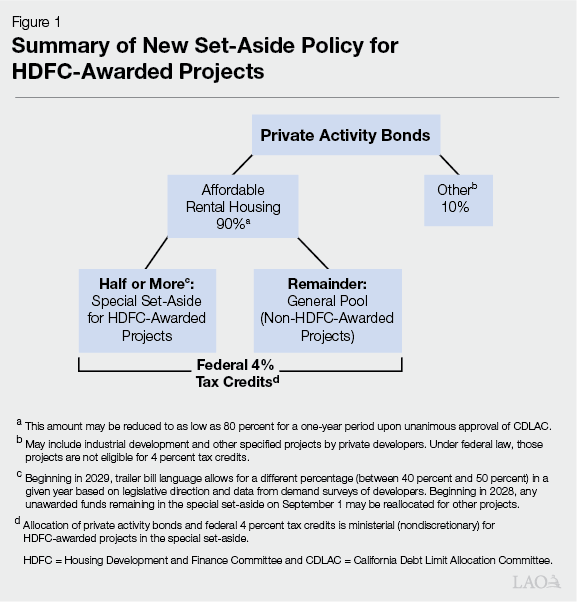
Creates New Funding Set-Aside for HDFC-Awarded Projects. First, trailer bill language specifies a minimum amount of private activity bonds that the California Debt Limit Allocation Committee (CDLAC) must allocate to affordable housing projects each year between 2027 through 2037. (Historically, CDLAC, which is within the State Treasurer’s Office, has decided on its own how much to dedicate for that purpose.) Second, beginning in January 2027, CDLAC must reserve at least half of those affordable-housing private activity bonds for HDFC-awarded projects (with flexibility for the Legislature to specify a lower set-aside amount beginning in 2029). In so doing, projects receiving HDFC funding will automatically receive federal tax credits from the Tax Credit Allocation Committee (TCAC), another entity under the State Treasurer. Figure 1 summarizes the new policy for the private activity bonds and tax credit set-aside. The intent of these changes is to create a more seamless and efficient funding system for developers seeking to build affordable housing in the state.
Separates Affordable Housing and Sustainable Communities (AHSC) Into Two Discrete Programs. In a further effort to streamline the state’s affordable housing funding system, the budget package places responsibility for the administration of AHSC’s affordable housing component with HDFC. The Strategic Growth Council retains authority to administer the sustainable communities (transportation and agricultural land conservation) component. In addition, trailer bill language specifies that the affordable housing component is to focus on “infill” housing developments (such as projects on vacant land within an urban area). The trailer bill language further specifies that of the up to $800 million continuously appropriated from the Greenhouse Gas Reduction Fund (GGRF) for AHSC, up to $560 million is designated for the affordable housing component. Under new regulations adopted by the California Air Resources Board, however, it is likely that revenues to GGRF will be insufficient to fully meet these funding levels. For example, as of August 2026, the Department of Finance estimates that the affordable housing component will receive only $132 million from GGRF in 2026-27. (The actual amount will depend on cap-and-invest auction revenues in 2026-27.) Please see The 2026-27 California Spending Plan: Natural Resources and Environmental Protection and Greenhouse Gas Reduction Fund: Updates and Key Issues for Legislative Consideration for more information on the new regulations and implications for program funding.
Housing-Related Budget Actions
Funding for Affordable Housing. The 2026-27 budget provides $200 million one-time General Fund to HDFC for the Multifamily Housing Program (MHP), the state’s flagship affordable housing program. Of this amount, 10 percent is set aside for California tribes. MHP provides low-interest (0.42 percent) loans to developers for the construction and rehabilitation of rental housing for lower-income households. Over the past several years, MHP has been funded by a combination of one-time General Fund appropriations and general obligation bonds.
Another Round of State Low-Income Housing Tax Credits. The budget authorizes $500 million for the state’s Low-Income Housing Tax Credit (LIHTC) program. (This amount is in addition to about $135 million in statutorily required state tax credits for the program in 2026-27.) 2026-27 is the eighth consecutive year the Legislature has authorized a discretionary, $500 million tax credit. The state LIHTC program, which is administered by TCAC, is used by developers to help finance the construction of affordable rental housing. (As noted above, TCAC also allocates federal tax credits on behalf of the state.) The approved state tax credits do not result in any budgetary costs in 2026-27 because the credits will be claimed on future tax returns.
New Disaster Rebuilding Program. The 2026-27 budget establishes the Disaster Rebuilding Assistance Program. The program is intended to expand homeowners’ access to construction and renovation financing for properties damaged or destroyed by wildfires or other disasters. The budget creates a Disaster Rebuilding Fund, consisting of $56 million one-time General Fund and $44 million in National Mortgage Settlement funds. CalHFA, the administrator of the program, is to adopt guidelines for eligibility criteria (such as income limits for homeowners participating in the program), lender qualifications, and other program standards and requirements. The budget package contains certain notification and reporting requirements for CalHFA, including an initial evaluation of the program due to the Legislature by January 2027.
Development Impact Fees Policies. Local governments often impose one-time charges on new development to fund public infrastructure such as transportation improvements, parks, and utilities (including water and sewer systems). The 2026-27 budget package adopts policies intended to encourage cities and counties to waive or reduce development impact fees on state-funded affordable housing projects. (Other local governments, such as school districts and special districts, are not included in these new policies.) First, beginning in 2027-28, if a city or county is a lead applicant for an affordable housing project and proposes to levy a development impact fee, the awarding state entity (such as HDFC) must reduce any state award for that applicant by the same amount of that development impact charge. In cases in which the city or county is not the lead applicant but agrees to waive or reduce the development impact fee (or provide certain other types of “in-kind” local contributions to the project), the budget package authorizes the awarding state entity to give those projects priority ranking for state funding.
Housing Bond. Though not technically part of the budget package, in June 2026, the Legislature placed a statewide housing bond on the November 2026 ballot. If approved by voters, the bond would provide a total of $11.25 billion for veterans and affordable housing.
Other Spending Actions. The budget provides other funding to HCD and TCAC for various purposes, including:
A total of about $95 million one-time General Fund for more than three dozen housing (and homelessness-related) purposes. Generally, HCD is to pass through these funds to the local governments, nonprofit organizations, and other entities specified in budget bill language.
A total of $4.7 million General Fund ($4.2 million ongoing, $0.5 million one time) and 16 positions for HCD to implement recent legislation pertaining to transit-oriented development, adaptive reuse, housing elements, and other purposes.
A total of $1.9 million ongoing (Tax Credit Allocation Fee Account and Occupancy Compliance Monitoring Account) and ten positions for TCAC’s development and compliance sections.
Homelessness-Related Budget Actions
More Funding for Homeless Housing, Assistance, and Prevention (HHAP) Program… Last year’s budget provided $500 million one-time General Fund for a seventh round of HHAP in 2026-27. The 2026-27 budget adds $390 million one-time General Fund to HHAP, bringing total funding for the seventh round to $890 million.
…Along With New Accountability Requirements for Grantees. Last year’s budget specified that the 2026-27 allocation was contingent on the enactment of legislation aimed at enhancing accountability requirements for grantees. In fulfillment of that requirement, the 2026-27 budget package modifies several aspects of HHAP accountability and administration. These include:
A new local matching requirement for all cities (and the counties in which those cities are located) receiving HHAP funds.
Obtaining a prohousing designation within a specified time line (also applying to all cities receiving HHAP funds and the counties in which those cities are located).
Adoption of local policies for addressing encampments that are consistent with Cal ICH guidance.
The budget also reduces some administrative workload for grantees by allowing them to submit fiscal reports to HCD on quarterly basis, rather than monthly.
Civil Rights Department (CRD)
Provides Funding to Implement Enacted Legislation. The 2026-27 budget provides a total of $5.8 million General Fund and 39 positions for CRD to implement recent legislation. These 39 positions represent an 11 percent increase over 2025-26 staffing levels. The resources are provided to assist CRD in complying with and enforcing various new state requirements, including family medical leave, bereavement leave, and employment discrimination law pertaining to cannabis use. Nine of the 39 positions are to staff a new statutorily required Bureau for Descendants of American Slavery within CRD.
Makes Wait-Time Initiative a Permanent Program. Past state budgets have provided one-time funds to CRD for the Investigation, Enforcement, and Conciliation Enforcement initiative, which seeks to reduce wait times between intake of complaints and investigative appointments and to increase the number of successful settlements by investigators. The 2026-27 budget provides $838,000 General Fund each year in 2026-27, 2027-28, and 2028-29 and six positions to continue the program. Though the funding is for three years, CRD is expected to fund the program’s six positions on an ongoing basis using existing resources.
Local Government
Provides a Mix of Full and Partial Backfills to Counties Related to Vehicle License Fee Shortfall. The 2026-27 Budget Act provides a total General Fund backfill of $80 million to three counties (Alpine, Mono, and San Mateo). This backfill is related to a shortfall in a complex funding mechanism the state adopted in 2004 to compensate local governments for reductions in their vehicle license fee revenue. The amounts for Alpine ($181,000) and Mono ($2.8 million) represent a full backfill for those counties in 2024-25. (Backfill funding is provided two years in arrears.) The backfill amount provided to San Mateo ($77 million) represents about 65 percent of the county’s reported $119 million shortfall for 2024-25.
Funds Prior-Year Costs, Removes Future Costs for Property Tax-Related Mandate. The Commission on State Mandates recently determined that Los Angeles County incurred reimbursable costs from processing certain property tax-related requests from homeowners and printing a statutorily required disclosure on property tax bills. The Commission determined the county incurred between $27,000 to $34,000 in back-year processing costs (incurred between 2022 and 2024) and about $8,000 in ongoing costs thereafter. The ongoing costs are from the requirement for the county to print certain information on property tax bills. (As we discussed in The 2026-27 Budget: State Mandate—Disclosure Requirements and Deferral of Property Taxation, though, the information required to be printed is no longer up-to-date or relevant.) The 2026-27 budget provides $27,000 one-time General Fund to reimburse the county for its prior-year costs. To eliminate the ongoing costs, the budget package repeals the requirement for the county to print the outdated information on property tax bills.