Mark Newton

October 19, 2026
The 2026-27 California Spending Plan
Health
- Overview
- Medi-Cal
- State Hospitals
- Public Health
- Health Care Access and Information
- Covered California
- Cross-Cutting Issues
- Appendix
This post summarizes the state’s 2026-27 spending package for health. It is part of our Spending Plan series. In this post, we provide an overview of the state’s health spending package, then cover spending for Medi-Cal, the State Hospitals, Public Health, Health Care Access and Information, Health and Human Services Agency, and Covered California. Appendix tables at the end of this post summarize the major spending actions and budget solutions in the health budget.
Overview
General Fund Spending on Health Programs Declines Modestly, on Net. As Figure 1 shows, the spending plan provides $52 billion General Fund for health departments in 2026-27, a decrease of $1.6 billion (3 percent) relative to the revised 2025-26 level. This decrease is driven primarily by Medi-Cal, which is administered by the Department of Health Care Services (DHCS) and accounts for over 90 percent of General Fund spending across health departments. As discussed further below, the relatively modest change in net spending reflects both General Fund budget solutions (mostly in Medi-Cal) as well as some augmentations.
Figure 1
Health Departments—Spending Trends
General Fund (Dollars in Millions)
|
2024‑25 |
2025‑26 |
2026‑27 E |
Change From 2025‑26 |
||
|
Amount |
Percent |
||||
|
Health Care Services |
|||||
|
Medi‑Cal |
$37,936 |
$48,621 |
$46,895 |
‑$1,726 |
‑3.5% |
|
State operations |
410 |
387 |
409 |
23 |
5.8 |
|
Other |
320 |
349 |
378 |
29 |
8.3 |
|
Totals |
$38,665 |
$49,357 |
$47,682 |
‑$1,674 |
‑3.4% |
|
Other Departments |
|||||
|
State Hospitals |
$2,794 |
$2,878 |
$2,973 |
$95 |
3.3% |
|
Public Health |
890 |
837 |
773 |
‑64 |
‑7.7 |
|
Health Care Access and Information |
339 |
406 |
457 |
51 |
12.6 |
|
Health and Human Services Agency |
278 |
269 |
281 |
12 |
4.5 |
|
Emergency Medical Services Authority |
35 |
39 |
35 |
‑4 |
‑10.3 |
|
California Health Benefit Exchange |
14 |
20 |
0 |
‑20 |
‑100.0 |
|
Totals |
$4,350 |
$4,449 |
$4,519 |
$70 |
1.6% |
|
Grand Totals |
$43,015 |
$53,806 |
$52,202 |
‑$1,604 |
‑3.0% |
|
Note: Reflects estimates pursuant to the Three‑Way Deal in June. Excludes additional amounts appropriated in August amendments. |
|||||
Spending Plan Includes Both Budget Solutions… For the fourth consecutive year, the spending plan features significant health budget solutions. These solutions total nearly $3 billion in General Fund savings in 2026-27, with amounts rising to over $5 billion in subsequent years. Nearly all of the savings in 2026-27 involve a specific tax on health plans known as the managed care organization (MCO) tax. The savings in later years come primarily from the MCO tax and from policy choices that reduce full-scope Medi-Cal coverage for certain individuals with unsatisfactory immigration status (UIS). Appendix Figure 1 summarizes the health-related budget solutions.
…And New Spending. In contrast to recent years, this year’s spending plan also includes significant new spending for health programs. Most of the spending is one time, totaling over $2 billion in 2026-27. The largest spending items relate to delays in previously enacted Medi-Cal budget solutions, including certain provider payment reductions and the elimination of dental benefits for adults with UIS, as well as one-time grants to public hospitals. Appendix Figure 2 summarizes the new spending commitments in the enacted budget.
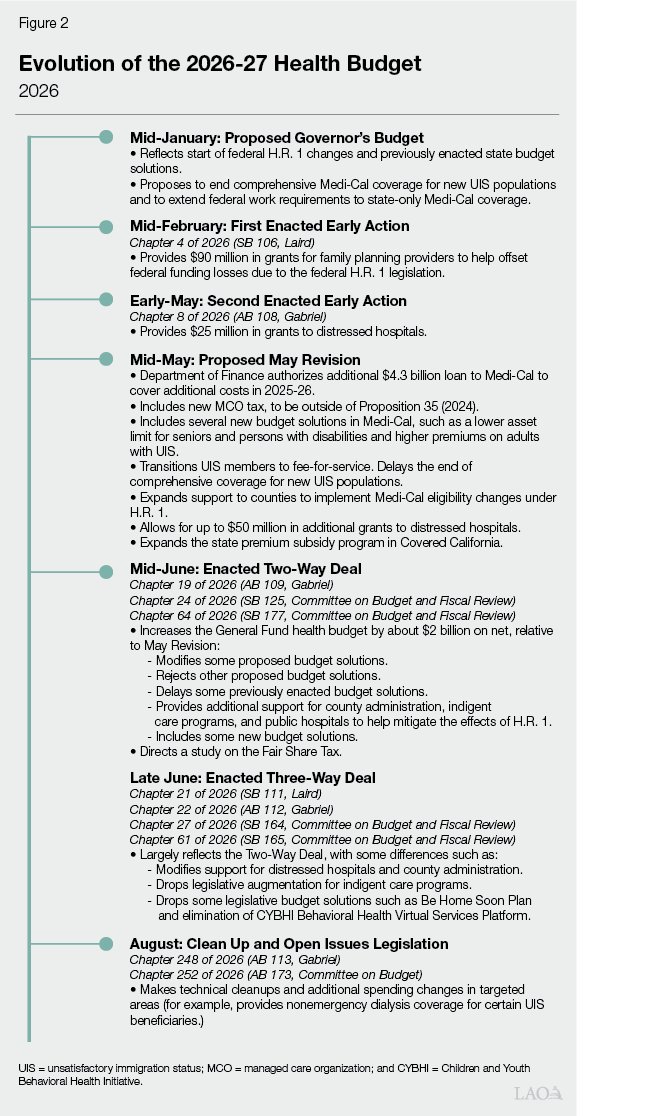
Health Budget Evolved Over Time. As Figure 2 shows, the final health budget reflects many changes made over the course of the budget process. The Governor’s proposed budget in January incorporated initial estimates of the fiscal impacts of H.R. 1 and proposed new Medi-Cal budget solutions, which primarily affected individuals with UIS. The May Revision included additional solutions, such as a new MCO tax and a stricter asset limit for seniors and persons with disabilities, while also adding funding for distressed hospitals and county administration of H.R. 1 eligibility changes. The Legislature’s two-party agreement then expanded support for hospitals and counties, rejected some of the Governor’s proposed budget solutions, and delayed some previously enacted solutions. Much of the legislative package was ultimately adopted in the enacted budget.
Medi-Cal
This section describes the major actions and adjustments in Medi-Cal in the budget package. It first provides an overview of Medi-Cal spending and then discusses major changes related to H.R. 1, the MCO tax, other budget solutions, and various other actions.
Overview
Total Medi-Cal Spending Grows, While General Fund Spending Declines Slightly. As Figure 3 shows, the 2026-27 budget includes about $220 billion across all fund sources for Medi-Cal, an increase of $25 billion (13 percent) from the revised 2025-26 level. This increase reflects higher federal and other non-General Fund spending. General Fund spending, by contrast, decreases slightly by $1.7 billion. Much of the relative growth in federal and other state funds is from larger provider payments supported by provider taxes. As discussed below, budget solutions and other factors serve to offset continued spending growth in Medi-Cal driven by core spending on services to beneficiaries.
Figure 3
Medi‑Cal Budget
(Dollars in Billions)
|
2025‑26 |
2026‑27 |
Change From Revised 2025‑26 |
|||
|
Adopted |
Revised |
Amount |
Percent |
||
|
Total Spendinga,b |
$196.7 |
$194.4 |
$219.7 |
$25.3 |
13.0% |
|
By Fund Source |
|||||
|
Federal funds |
$119.7 |
$117.0 |
$133.5 |
$16.6 |
14.2% |
|
General Fund |
44.9 |
48.6 |
46.9 |
‑1.7 |
‑3.5 |
|
Other funds |
32.1 |
28.8 |
39.2 |
10.4 |
36.2 |
|
By Program |
|||||
|
Managed care |
$100.4 |
$98.2 |
$113.7 |
$15.6 |
15.9% |
|
Fee‑for‑service |
45.6 |
40.1 |
46.1 |
6.0 |
15.0 |
|
Other programs |
43.3 |
48.6 |
50.8 |
2.2 |
4.5 |
|
Local administration |
7.5 |
7.5 |
9.0 |
1.5 |
20.1 |
|
aConsists of Department of Health Care Services local assistance expenditures only. Excludes billions of dollars in state and local expenditures that are used to draw down federal Medicaid funds but are not directly tracked in Medi‑Cal budget estimates. bReflects estimates pursuant to the three‑way deal in June. Excludes additional amounts appropriated in August amendments. |
|||||
Budget Solutions and Other Factors Help Drive Down General Fund Spending. General Fund spending on the Medi-Cal base (core, ongoing services for beneficiaries) continues to grow in 2026-27 across delivery systems including managed care and fee-for-service. However, this growth is more than offset by several factors, including new and previously enacted budget solutions and additional revenues from the MCO tax. As we explain below, some program changes associated with H.R. 1 also reduce General Fund spending in 2026-27 and beyond.
Recent Medi-Cal Budgets Have Seen Revisions to General Fund Spending. Although the budget assumes General Fund spending will decline from the revised 2025-26 level to 2026-27, recent experience suggests that Medi-Cal estimates can change significantly over the course of a fiscal year. In some previous years, General Fund spending has been revised downward after budget enactment. In each of the past two years, however, it has been revised upward. For example, General Fund spending for 2025-26 was adopted at $44.9 billion but is now estimated at $48.6 billion. This revision reflects a mix of factors, such as a delay in federal approval of the state’s 2025 version of the Hospital Quality Assurance Fee and higher-than-expected per-enrollee costs.
H.R. 1 Response
Implements New Community Engagement Requirements and More Frequent Redeterminations. Beginning January 2027, H.R. 1 generally requires able-bodied adults between ages 19 and 64 (mostly childless adults) to work, study, or volunteer at least 80 hours per month or meet an income threshold unless they qualify for certain exemptions. H.R. 1 also requires eligibility for these individuals to be redetermined every six months rather than every year. Though not required under H.R. 1, budget-related legislation (Chapter 27 of 2026 [SB 164, Committee on Budget and Fiscal Review]) extends these requirements to individuals with UIS who receive comprehensive Medi-Cal coverage through state-only funding. In total, the administration estimates that these changes in 2026-27 will result in disenrollment of about 43,000 individuals (1.3 million by 2029-30) and reduce General Fund spending by $90.3 million ($3 billion by 2029-30).
Phases Out Comprehensive Coverage for Certain Immigrant Groups. Beginning October 2026, H.R. 1 eliminates federal funding for comprehensive Medicaid coverage for certain qualified noncitizens, including refugees and asylees. The administration estimates that about 150,000 individuals will be affected by the loss of federal funds. The enacted budget provides state-funded comprehensive coverage for this population through June 2027, at an estimated General Fund cost of $365 million in 2026-27. Beginning July 2027, this population would transition to more limited Medi-Cal coverage restricted to emergency and pregnancy-related services. The transition avoids an estimated ongoing cost of $980 million General Fund to continue providing comprehensive coverage with state-only funds.
Increases County Administration Funding to Implement H.R. 1. The budget provides a one-time augmentation of $197 million General Fund ($709 million total funds) for the additional county workload associated with administering Medi-Cal eligibility changes required under H.R. 1. This amount includes $32 million General Fund available over two years for a cost-of-doing-business adjustment.
MCO Tax
Adopts New Tax… The MCO tax is a tax on health plans (such as Kaiser Permanente and Anthem Blue Cross) that helps fund the Medi-Cal program. The current version of the tax, which is based on the number of each plan’s enrollees, is set to expire at the end of 2026. Trailer bill legislation in this year’s budget (Chapter 24 of 2026 [SB 125, Committee on Budget and Fiscal Review]) establishes a new MCO tax from 2027 through 2029. The tax must also receive federal approval to go into effect.
…With Three Key Differences. Like the current tax, this new tax will be based on enrollment. There are three key differences, however:
Equal Tax Rate on Medi-Cal and Private Enrollment. The current MCO tax charges a much higher rate on plans’ monthly Medi-Cal enrollment ($274 in 2026) than their private enrollment ($2.25 in 2026). By contrast, the new MCO tax will charge the same tax rate on both Medi-Cal and private enrollment ($8.85 each year, on average). The trailer bill legislation allows the administration to adjust the tax rate, within certain limits. This new structure is intended to align with federal rule changes under the recent H.R. 1 legislation.
No Tiers—Unless the Administration Chooses to Adopt Them. The current MCO tax only charges a health plan’s monthly enrollment within a certain range (1.3 million to 4 million member months). Enrollment levels above or below this range have a $0 tax rate. These ranges are known as tax tiers. The new MCO tax, by contrast, applies one tax rate to all enrollees. That said, the trailer bill legislation allows the administration to establish tiers in the new tax, so long as the average tax rate ($8.85) remains the same across all enrollees.
Most Funds Help Offset General Fund Spending. Historically, the state has used MCO tax funds to help pay for existing program services, thereby helping to offset spending from the state’s General Fund. Under the current tax, however, the state began allocating a portion of funds to support mostly limited-term augmentations to Medi-Cal, such as provider rate increases. In recent years, these provider rate increases have been pursuant to Proposition 35 (2024), a voter-approved initiative around the MCO tax. The new tax beginning in 2027, however, returns to the state’s more historical approach, generally using all of the funds to help offset General Fund spending. (A portion of funds—around $300 million annually—will support ongoing rate increases to certain Medi-Cal providers that began in 2024.) As such, the spending plan assumes the tax is not subject to Proposition 35’s rules. (The nearby box provides more detail on the new tax’s relationship to Proposition 35.)
How Does the Spending Plan Implement Proposition 35 (2024)?
Assumes Federal Approval Submission Has Two Components. According to the administration, its managed care organization (MCO) tax submission to the federal government will have two components. The first component will be similar to the current MCO tax that expires at the end of 2026. This component, like the current tax, will not comply with new federal rules under the recent H.R. 1 legislation. The second component—which the spending assumes will receive federal approval—will reflect the new MCO tax enacted by this year’s trailer bill legislation.
Assumes Proposition 35 Cannot Be Implemented. Proposition 35 makes the MCO tax permanent in state law and sets rules about how to spend the funds. One provision in the measure directs the state to seek federal approval for a tax that uses “models and methodologies” that are “substantially similar” to the current tax. The administration states the first component of its MCO tax submission implements this requirement. It also states the second component is in addition to what Proposition 35 requires, such that it is therefore not subject to the measure’s provisions. Because the spending plan assumes the first component is rejected by the federal government, but the second component approved, the overall effect will be an MCO tax that does not implement Proposition 35’s requirements.
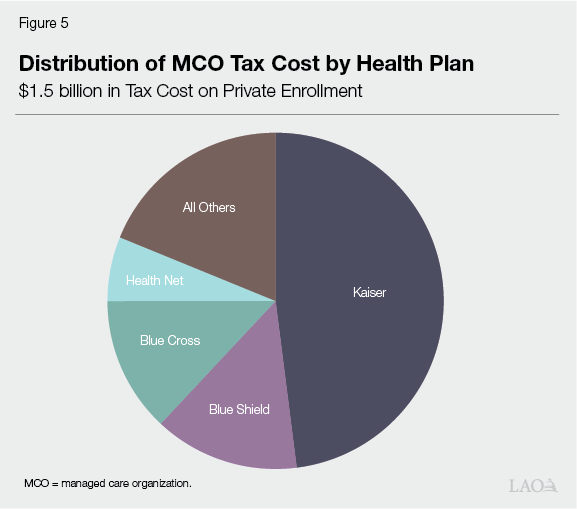
Raises Billions of Dollars for Medi-Cal, With a Majority From Private Enrollment. As Figure 4 shows, the new tax is expected to raise $2.3 billion in net revenue—less than one-third of the amount generated by the current MCO tax. Whereas the current MCO tax generates most revenue from the tax on Medi-Cal enrollment, a larger portion of the new MCO tax revenue will come from the tax on private enrollment. Importantly, the tax on Medi-Cal enrollment results in more federal funding to the state, while the tax on private enrollment falls directly on health plans and their consumers. (This post describes this relationship in greater detail.) As Figure 5 shows, of the nearly 50 health plans subject to the tax, more than 80 percent of the tax on private enrollment falls on just four of them.
Figure 4
MCO Tax Net Revenue
Annual Net Revenue (In Millions)
|
Current Tax (2026) |
New Tax (2027‑2029) |
|
|
From Medi‑Cal Enrollment |
||
|
Gross revenue |
$12,673 |
$1,294 |
|
Less state funds to help health plans cover the cost of taxa |
‑5,069 |
‑517 |
|
Totals |
$7,604 |
$776 |
|
From Private Enrollment |
||
|
Total revenue |
$35 |
$1,537 |
|
Total Net Revenue |
$7,639 |
$2,313 |
|
aFederal funds cover the remaining cost. Assumes the federal share of cost is 60 percent. Health plans only receive funds to cover the cost of the tax on Medi‑Cal enrollment. |
||
|
MCO = managed care organization. |
||
Provides Sizable Budget Solution. The new MCO tax is key component of the state budget’s package of budget solutions. It provides savings of $575 million 2026-27, with savings rising to $2.3 billion in subsequent years. (The lower level of savings in 2026-27 reflects the tax’s start halfway through the fiscal year, as well as Medi-Cal’s cash basis for budgeting.)
Includes Other Fund Shift Budget Solutions in Existing MCO Tax. The spending plan also shifts certain funds within the current MCO tax to help support existing Medi-Cal costs. This includes $1.9 billion over two years to help cover base provider rate cost growth since 2024. It also includes redirecting Proposition 35’s behavioral health allocation to help pay for certain recent initiatives, such as the transitional rent community support and mobile crisis. To date, the administration has not provided complete back up of the revised Proposition 35 spending plan.
Other Budget Solutions
Reduces Asset Limit for Seniors and Persons With Disabilities. The 2025-26 spending plan reinstated the verification of assets, commonly referred to as an asset test, to determine Medi-Cal eligibility for seniors and persons with disabilities. (The asset test is in addition to Medi-Cal’s income eligibility requirements that also must be met.) Under the 2025-26 spending plan, seniors and persons with disabilities need to verify that their countable assets do not exceed $130,000 per individual and $195,000 per couple. This year’s spending plan reduces the allowable amount of countable assets to $21,000 per individual and $31,000 per couple beginning July 1, 2027. This budget solution provides General Fund savings of $236 million in 2027-28 and $257 million in 2028-29 and ongoing. Budget-related legislation also directs DHCS to publish the number of Medi-Cal enrollees who lose eligibility due to the asset limit each quarter.
Increases Premium for Adults With UIS to Maintain Full-Scope Medi-Cal Coverage. The 2025-26 spending plan included a $30 monthly premium for UIS adults (aged 19 to 59) who remain enrolled in comprehensive Medi-Cal beginning in July 2027. This year’s spending plan requires the administration to set the level of the monthly premium between $30 and $50 a month in the 2027-28 May Revision. An increase in the premium to $50 a month is estimated to result in approximately $427 million General Fund savings in 2027-28, decreasing to $314 million in General Fund savings by 2029-30.
Changes Eligibility and Benefit Rules for California Advancing and Innovating Medi-Cal (CalAIM). The spending plan includes changes to eligibility criteria, service definitions, utilization management criteria, and payments for Enhanced Care Management and Community Supports benefits under CalAIM. This budget solution is estimated to save approximately $68 million General Fund in 2026-27, with savings rising to $197 million in 2029-30 and ongoing.
Redirects Use of Managed Care Plan Remittance Funds. Federal rules cap Medi-Cal managed care plan administrative spending at 15 percent of their funds. Any spending above this share must be remitted back to the federal government and the state. Prior to this year’s spending plan, the state share of remittance funds supplemented funds for Medi-Cal physician and dentist loan repayments. This year’s spending plan redirects these funds directly into the General Fund. The spending plan assumes this action results in $25 million ongoing General Fund savings beginning in 2027-28.
Other Actions
Transitions UIS Individuals to Fee-for-Service Delivery System. Pursuant to budget-related legislation, the state will transition all services for people with UIS out of the managed care delivery system and into fee-for-service beginning January 2027. The action implements recent federal guidance limiting states’ ability to pay for emergency Medicaid to people with UIS using their managed care systems. As nearly all Medi-Cal populations are enrolled in managed care, this action will make the UIS population the primary group served in the fee-for-service delivery system. The administration estimates that the transition will result in net General Fund savings of $525 million in 2026-27 and $1.3 billion ongoing, due to factors such as lower utilization of certain services and the elimination of certain administrative costs for this population.
Provides One-Time Grants to Public Hospitals. The spending plan provides $250 million one-time General Fund in 2026-27 for grants to county and University of California hospitals (also known as designated public hospitals). Budget bill language specifies that the methodology to distribute the grants will be developed in consultation with the hospitals. It also declares that the grants shall not technically count as Medi-Cal payments or supplant existing state funds.
Establishes State-Only Coverage for Maintenance Dialysis. Kidney dialysis has long been covered for people with UIS as part of their emergency Medi-Cal coverage. According to DHCS, however, recent private communications from the federal government indicate that maintenance dialysis (scheduled, ongoing dialysis at a clinic) will no longer qualify as an emergency procedure eligible to receive federal financial participation. Instead, federal funding will only be available for dialysis provided on an emergency basis. To ensure people with UIS can still access services, August legislation (Chapter 525 of 2026 [AB 173, Committee on Budget]) establishes state-only coverage for maintenance dialysis beginning October 2026. The late-session budget package provides $8 million for this coverage in 2026-27 from the Health Care Affordability Reserve Fund (HCARF), with the administration estimating costs of $37 million annually in 2027-28 and 2028-29.
Funds Expected Federal Repayments. The spending plan includes $30 million one-time General Fund in 2026-27 for anticipated repayments to the federal government. The repayments are expected because the state paid for services to certain entities (such as Planned Parenthood) that were temporarily prohibited from receiving federal funds under the recent H.R. 1 legislation.
Delays Implementation of Clinic Payment Budget Solution by One Year. As a budget solution, the 2025-26 spending plan changed the way that Medi-Cal pays safety net clinics (Federally Qualified Health Centers and Rural Health Clinics) for state-only-funded services to individuals with UIS. While the 2025-26 spending plan directed this change to go into effect beginning July 2026, this year’s spending plan delays implementation until July 2027. The one-year delay of the budget solution increases General Fund spending by about $1 billion in 2026-27.
Delays Implementation of Dental Budget Solutions by One Year. As a budget solution, the 2025-26 spending plan eliminated supplemental payments for specific dental services and eliminated dental coverage for UIS adults enrolled in Medi-Cal. While the 2025-26 spending plan directed these changes to go into effect beginning July 2026, this year’s spending plan delays implementation until July 2027. The one-year delay increases General Fund spending in 2026-27 by $258 million for dental supplemental payments and by $361 million for dental coverage for UIS adults.
Renews CalAIM Waiver, With Additional Benefits. In May 2026, DHCS submitted its application to amend and renew its Section 1115 waiver for CalAIM. A part of this waiver included two new benefits: (1) BridgeCare Pilot and (2) Employment Supports. The spending plan authorizes DHCS to implement these new benefits pursuant to federal approval of the waiver. The BridgeCare Pilot program is a series of services to provide targeted Home and Community-Based Services and caregiver supports to older adults with Medicare who are between 138 percent and 220 percent of the federal poverty level. The pilot is an opt-in program, and participating entities will be responsible for some share of nonfederal costs (to be determined based on participant income levels). The estimated cost for the BridgeCare Pilot is $4 million state and local funds ($8 million total funds) beginning January 2027, increasing to $7.6 million state and local funds ($15.3 million total funds) in 2031. Employment Supports are pre-employment and employment sustaining services intended to assist Medi-Cal members subject to new community engagement requirements. The estimated cost for Employment Supports is $136 million General Fund ($272 million total funds) beginning January 2027, increasing to $362 million General Fund ($724 million total funds) in 2031.
Augments Funding for Certain Long-Term Services and Supports. The spending plan provides additional resources for certain types of long-term services and supports focused on older adults and people with disabilities. Specifically, the spending plan provides $7.7 million General Fund for Congregate Living Health Facilities and $30 million General Fund for private duty nursing in 2026-27. The spending plan also allocates $1.5 million General Fund to DHCS for administrative resources to help the department address the waiting list for the Home- and Community-Based Alternatives waiver. Additionally, the spending plan provides $900,000 General Fund for DHCS and the Department of Aging to study access to community-based adult services (CBAS) and present options to the Legislature on preventing CBAS center closures.
Targets One-Time Funds for Specified Entities. This year’s Medi-Cal budget also includes targeted, one-time General Fund amounts to specified entities. As shown in Figure 6, the funding totals $46 million in 2026-27 and spans across different entities and purposes.
Figure 6
Entities Receiving One‑Time Support in Medi‑Cal
One‑time General Fund in 2026‑27 (In Millions)
|
Entity |
Purpose |
Amount |
|
Martin Lurther King Jr. Community Hospital |
Operations |
$8.0 |
|
Yoruk Tribe of California |
Alcove site |
7.1 |
|
Westminster Free Clinic |
Infrastructure development |
6.0 |
|
San Gabriel Valley Chinatown Service Center |
Behavioral health services and workforce development |
3.5 |
|
Kern County |
Mobile dental unit at Kern Medical |
2.0 |
|
Santa Clara Valley Healthcare |
Equipment for behavioral health treatment |
2.0 |
|
Santa Barbara County |
Mobile dental vehicle |
1.3 |
|
Loma Linda Children’s Hospital |
Resiliency Institute for Childhood Adversity |
1.0 |
|
Los Angeles County |
Mobile respiratory illness clinics |
1.0 |
|
Planned Parenthood California Central Coast |
Certain postpartum programs |
1.0 |
|
Luminarias Institute |
Behavioral Health Capacity Preservation Program |
0.5 |
|
Shatterproof |
Atlas treatment platform |
0.5 |
|
Watsonville Community Hospitals |
Hospital upgrades |
0.3 |
|
United Way Capital Region |
Concern existing Sacramento site into permanent center |
0.3 |
|
Kern County |
Cancer prevention and care |
0.1 |
|
Totals |
$34.6 |
State Hospitals
Increases General Fund Spending. Under the spending plan, General Fund spending for the Department of State Hospitals is $2.9 billion in 2026-27, an increase of $95 million (about 3 percent) from the revised 2025-26 expenditure estimate. This increase reflects higher operating costs across the departments, continued development of its Electronic Health Records Systems (EHR), and reductions to the state’s efforts to address the Incompetent-to-Stand-Trial (IST) waitlist.
Continues Implementation of EHR System Across State Hospitals. The spending plan includes $27.6 million General Fund in 2026-27 and a reappropriation of $6.3 million from 2025-26 to continue the development of the EHR System. The funding will support EHR System rollout at the Coalinga State Hospital as well as implementation planning for the Metropolitan and Patton State Hospitals. The EHR System project has been a multiyear project to move the department from manual, paper-based charting of patient’s health records to a more modern, electronic system. Since the department began project in 2020-21, it has appropriated $132 million through 2025-26. The department plans to complete the transition to EHR at all five state hospitals by July 2028.
Reflects One-Time Reduction of IST Solutions Funding. The spending plan includes a one-time General Fund reduction of $102 million in 2026-27 to the department’s IST Solutions funding package. The reduction is primarily due to updated phased-in activations of diversion and community-based restoration projects as well as lower-than-projected patient levels.
Public Health
Reflects Increase in Overall Spending, With Reduction in One-Time General Fund Spending. Under the spending plan, total funding for the California Department of Public Health (CDPH) is $5.5 billion in 2026-27, an increase of $353 million (about 7 percent) from the revised 2025-26 expenditure estimate. However, net General Fund spending decreased from $837 million to $773 million (about 8 percent) in 2026-27, primarily due to the end of temporary funding, partially offset by one-time supplemental funding for public health information technology (IT) systems, as discussed below.
Provides Support for Public Health IT Systems. The spending plan includes one-time $96 million General Fund ($113 million total funds) support for a number of public health IT systems in 2026-27, including the state’s vaccine management system, public health laboratory reporting system, disease investigation and contact tracing system, and immunization registry. The 2022-23 spending plan established funding and position authority to maintain and implement a dozen IT systems involved in—or developed specifically for—the state’s COVID-19 response. CDPH has worked to adapt a number of these systems for other public health purposes, such as laboratory reporting of other infectious diseases or vaccine management for non-COVID-19 vaccines. As the state works to develop an overarching public health IT strategy, the department is renewing short-term maintenance and operations contracts to maintain current system capabilities.
Increases Support for AIDS Drug Assistance Program (ADAP). The spending plan also includes $135 million in ADAP expenditures in 2026-27, $135 million in 2027-28, $127 million in 2028-29, and $130 million in 2029-30. The funds are a part of a four-year spending plan that authorizes CDPH to expend funds on specified programs to support individuals living with or at risk of contracting AIDS.
Health Care Access and Information
Provides Substantial One-Time General Fund. In 2026-27, the spending plan provides $474 million General Fund ($1.3 billion total funds) for the Department of Health Care Access and Information (HCAI). Most of the General Fund amount (86 percent) is new limited-term spending. We estimate the remaining ongoing portion reflects a slight increase (1 percent) over the revised 2025-26 level due to technical adjustments. The spending plan also includes additional new spending in 2025-26 enacted as early action. Below, we describe the key areas of new limited-term spending.
Hospitals
Provides Distressed Hospital Grant Funding in Early Action… As part of early action legislation (Chapter 8 of 2026 [AB 108, Gabriel]), the spending plan allows HCAI to spend up to $25 million General Fund in 2025-26 on grants to hospitals facing financial distress. The grant initiative is distinct from the previous Distressed Hospital Loan Program in several respects, most notably in that grant recipients do not have to repay the money. Related budget bill language specifies that hospitals must be public or nonprofit to qualify for grants, as well as meet certain financial criteria (such as having less than ten days cash on hand). HCAI can include additional criteria too, in consultation with the Department of Finance. In late May, HCAI announced that it allocated $25 million to four hospitals, including some previous recipients of the Distressed Hospital Loan Program.
…And in Final Budget Package. The three-way deal includes an additional $85.5 million in 2026-27 for distressed hospital grants, with the Department of Finance authorized to increase the amount by up to $50 million. (The spending plan includes another $4.5 million to HCAI to administer the program.) Like the early action funds, this program is limited to public and private nonprofit hospitals facing financial distress. As Figure 7 shows, however, there are some new parameters. For example, hospitals must submit a plan to regain financial viability as a condition of receiving the 2026-27 funds.
Figure 7
Key Parameters for Distressed Hospital Financial Assistance Programs
Statutory Parameters
|
Loan Program |
Grants |
Grants |
|
|
Must be a public or private nonprofit hospital |
✓ |
✓ |
✓ |
|
Cannot be a member of a larger hospital system |
✓ |
||
|
Must demonstrate best efforts to exhaust other options |
✓ |
||
|
Must submit plan to regain financial viability |
✓ |
✓ |
|
|
Must serve a minimum level of uninsured or publicly‑covered patients |
✓ |
✓ |
|
|
Cannot have more than a specified amount of cash on hand |
✓ |
||
|
Note: Only reflects parameters described in statute. Department of Health Care Access and Information included other parameters to score eligible applicants and issue awards. |
|||
Creates New Health Care Access Stability Unit at HCAI. The spending plan provides $10 million one time in 2026-27 to establish a new unit at HCAI focused on providing statewide strategic support on hospital financing issues. Budget bill language specifies the unit is to assess hospitals’ importance to their communities, assist in maintaining critical services if a hospital becomes distressed, and provide technical assistance to distressed hospitals. The funds are available to spend until the end of the 2029-30 fiscal year.
Reproductive Health
Provides Support in Early Action. This year’s early action legislation (Chapter 4 of 2026 [SB 106, Laird]) includes $90 million one-time General Fund in 2025-26 for community clinics that provide family planning services. The funds are to support lost federal funding to these clinics as a result of H.R. 1, which placed a one-year ban on federal funding for family planning providers that also provide abortion services. Up to $1.5 million of this amount can support HCAI’s associated administrative costs.
Includes Three Other Augmentations in Final Budget Package. The final budget package reflected in the three-way deal includes three other augmentations for reproductive health:
Uncompensated Care Program. The Uncompensated Care Fund (also known in statute as the California Reproductive Health Equity Program) provides grants to abortion providers that serve uninsured patients with incomes below 400 percent of the federal poverty level. Established by policy legislation (Chapter 562 of 2022 [AB 2134, Weber]), the 2022-23 spending plan originally provided $40 million one-time General Fund to initiate the program. This year’s spending plan includes an additional $30 million one-time General Fund (including $3 million for state operations). This year’s health trailer bill legislation allows gender-affirming care providers to also access the funds.
Gender-Affirming Care Support. The spending plan includes $26 million over three years ($10 million in 2026-27 and $8 million in each of the subsequent two years) for nonprofit providers of gender-affirming care. (These amounts include support for state operations.) August budget bill legislation provides another $10 million one-time General Fund in 2026-27 (including $1 million for state operations) for care specifically for children and youth.
Abortion Practical Support Fund. The Abortion Practical Support Fund supports financial assistance to people seeking abortion services. These supports include travel, lodging, and food, among other areas. HCAI awards grants to nonprofit entities, which in turn are responsible for providing the supports. The 2022-23 spending plan provided $20 million one-time General Fund for this initiative. This year’s spending plan includes another $10 million one-time General Fund in 2026-27.
Workforce
Expands Support for Promotoras. The spending plan provides $15 million one-time General Fund in 2026-27 (including $750,000 for state operations) for promotora workforce and training programs. Promotoras, like community health workers, promote health care education and advocacy among populations historically marginalized from the health care system. The state had previously tasked HCAI to develop a statewide certificate for community health workers as part of the 2022-23 spending plan, but the associated funds were later eliminated as a budget solution. A subsequent HCAI report identified potential strategies to support the community health workforce, including grants for workforce development. The budget, however, does not specify whether this year’s one-time funding will align with the report’s recommendations.
Creates New Physician-Related Initiative. The spending plan provides $5 million one-time General Fund for a new Physician Access Workforce Program. More than half of the funds ($3 million) are targeted to the Central Coast region, supporting (1) a California Polytechnic State University, San Luis Obispo study of physician workforce needs, including for a new medical school and for residency programs; and (2) hiring and retention of behavioral health providers at the Transitions of Mental Health Association of San Luis Obispo. Most of the remaining funds ($1.9 million) support a new statewide medical school loan repayment program for physicians working in high-need and high-cost-of-living areas. A small portion of funds ($100,000) are for state operations.
Supports Longstanding Private Medical School. The spending plan provides $5 million one-time General Fund for the Charles R. Drew University of Medicine and Science (Drew University). For several decades, the state has supported joint medical school and residency programming between Drew University and the University of California. The budget does not specify how this year’s additional one-time funding through HCAI will be used.
Supports Other Medical-Related Activities. August session budget bill language provides $5 million one-time General Fund in 2026-27 for three additional activities: (1) development of a new medical school at the University of the Pacific ($2 million), (2) renovations and upgrades at the San Francisco Campus for Jewish Living ($2 million), and (3) improvements to Long Beach city’s West Health Facility.
Other
Implements First Round of Federal Rural Health Transformation Program. Among other provisions, the federal H.R. 1 legislation provides $50 billion over five years ($10 billion each year) in grants to states to improve rural health care access, quality, and outcomes. HCAI will implement California’s allocated funds, which total $234 million in the first round (with subsequent amounts to be determined over the remaining four years). According to HCAI, the funds will support regional care collaboratives, workforce development initiatives, and technology initiatives.
Creates New CalRx Initiatives. The spending plan provides $15.5 million one-time General Fund in 2026-27 (including $775,000 for state operations) to develop low-cost epinephrine pens and tuberculosis drugs. It also provides $2 million one-time General Fund in 2026-27 (including $100,000 for state operations) to develop low-cost glucagon-like peptide-1 (GLP-1) agonists. These funds expand the scope of HCAI’s CalRx program, which aims to promote lower-cost generic versions of drugs. HCAI’s existing initiatives have focused on developing biosimilar insulin products and generic Naloxone nasal sprays. (The spending plan also reappropriates $18.4 million in unspent funds for the insulin initiative.)
Continues Implementing Diaper Access Initiative. Last year’s spending plan adopted a two-year initiative to provide families with newborn babies a three-month supply of free diapers. This year’s spending plan includes the second year of funding in 2026-27 ($12.5 million). Previously, HCAI had estimated covering up to half of all births in the state in 2026-27. The spending plan does not include any ongoing funding to sustain this initiative after 2026-27.
Covered California
Increases Premium Subsidies for Enrollees. Enhanced federal premium tax credits, which reduced premiums for many Covered California enrollees and extended subsidies to higher-income households, expired at the end of 2025. To help mitigate this loss of federal funding, the budget provides an additional $110 million annually from HCARF for premium subsidies in 2026-27 and beyond, bringing the total state spending on premium subsidies to $300 million. The HCARF is supported by revenues from the state’s individual mandate penalty. According to the administration, the augmentation will expand eligibility for the state premium subsidy from 165 percent of the federal poverty level to 200 percent beginning in the 2027 coverage year, making more than 200,000 individuals newly eligible.
Uses HCARF for Other Costs. In addition to increasing state premium subsidies, the budget includes additional HCARF spending in two other areas. First, the budget provides an annual $13.4 million augmentation for the Gender Affirming Care Program, which reimburses health plans in the marketplace for covering state-mandated gender-affirming care benefits that, as of June 2025, are no longer treated by Centers for Medicare and Medicaid Service as essential health benefits. The augmentation is intended to align funding with updated cost estimates from health plans. Second, the budget shifts funding for the One-Dollar Premium Subsidy Program from the General Fund to HCARF, resulting in ongoing General Fund savings of about $20 million annually. This program pays health plans for the $1 monthly premium that enrollees would otherwise pay, due to federal law governing coverage of certain abortion services.
Cross-Cutting Issues
Requires Coverage of Menopause-Related Services. This year’s health trailer bill requires Medi-Cal, private health plans, and private insurance to cover certain treatments for menopausal symptoms. These treatments include hormone therapy, low-dose antidepressants, anticonvulsants, medication to prevent or treat osteoporosis, and certain nonhormonal medications. The spending plan also supports certain other menopause-related activities, including $3.4 million one-time General Fund in 2026-27 to the University of California for a public awareness campaign.
Adopts Minimum Expenditure Levels for County Behavioral Health Funding. This year’s health trailer bill legislation requires DHCS to establish a minimum spending level for county Behavioral Health Services Act (BHSA) funds. The new requirement implements recommendations from a BHSA-mandated task force (the Revenue Stability Workgroup) around allowable reserves and revenue volatility. The language tasks DHCS with developing the specific requirement in consultation with counties and to base the requirement on the prior three years of BHSA revenue. The language also allows counties to access their BHSA fund reserves in certain instances, such as when available funding falls below the required spending minimum.
Appendix
Appendix Figure 1
Health Budget Solutions
General Fund (In Millions)
|
Solution |
Type |
2025‑26 |
2026‑27 |
2027‑28 |
2028‑29 |
2029‑30 |
|
Health Care Access and Information |
||||||
|
Behavioral Health Services Fund offsets |
Fund shift |
— |
$43 |
$25 |
$25 |
$25 |
|
Health Care Services |
||||||
|
Managed Care Organization Tax/Proposition 35 |
||||||
|
Renewed tax (beginning January 2027) |
New revenue |
— |
$575 |
$2,300 |
$2,300 |
$1,725 |
|
Shift of funds for provider payment increases |
Fund shift |
— |
1,742 |
150 |
— |
— |
|
Shift of funds for behavioral health |
Fund shift |
$105 |
283 |
— |
— |
— |
|
Benefit Reductions |
||||||
|
Work requirements and six‑month renewals for adults with UIS |
Reduction |
— |
60 |
1,200 |
1,800 |
2,000 |
|
End of comprehensive coverage for certain groups |
Reduction |
— |
— |
920 |
950 |
979 |
|
Stricter asset limit for seniors and disabled adults |
Reduction |
— |
— |
236 |
257 |
257 |
|
Restructured Enhanced Care Management benefit |
Reduction |
— |
41 |
99 |
99 |
146 |
|
Restructured Community Supports services |
Reduction |
— |
27 |
59 |
51 |
51 |
|
Other Offsets |
||||||
|
Behavioral Health Services Fund offsets |
Fund shift |
— |
102 |
30 |
30 |
30 |
|
Medical loss ratio remittance redirection |
Fund shift |
— |
— |
25 |
25 |
25 |
|
Opioid Settlement Fund offsets |
Fund shift |
— |
35 |
— |
— |
— |
|
Public Health |
||||||
|
Behavioral Health Services Fund offsets |
Fund shift |
— |
$67 |
$108 |
$108 |
$108 |
|
Health Benefit Exchange |
||||||
|
One‑Dollar Premium Subsidy Program |
Fund shift |
— |
$20 |
$20 |
$20 |
$20 |
|
Totals |
$105 |
$2,996 |
$5,173 |
$5,666 |
$5,367 |
|
|
Reduction |
— |
$128 |
$2,514 |
$3,157 |
$3,433 |
|
|
New revenue |
— |
575 |
2,300 |
2,300 |
1,725 |
|
|
Fund shift |
$105 |
2,293 |
359 |
209 |
209 |
|
|
Note: All actions enacted in Two‑Way Deal (Chapter 19 of 2026 [AB 109, Gabriel]). |
||||||
|
UIS = unsatisfactory immigration status. |
||||||
Appendix Figure 2
Report Wide Health Budget New Spending Actions
General Fund (In Millions)
|
Item |
Legislation |
2025‑26 |
2026‑27 |
2027‑28 |
2028‑29 |
2029‑30 |
|
Health Care Access and Information |
||||||
|
Hospitals |
||||||
|
Grants for distressed hospitalsa |
Three‑Way Dealb |
— |
$90 |
— |
— |
— |
|
Grants for highly distressed hospitals |
May Early Action |
$25 |
— |
— |
— |
— |
|
Health Care Access Stability Unit |
Two‑Way Deal |
— |
10 |
— |
— |
— |
|
Reproductive Health |
||||||
|
Support for family planning providers |
February Early Action |
$90 |
— |
— |
— |
— |
|
Uncompensated Care Program |
Two‑Way Deal |
— |
30 |
— |
— |
— |
|
Gender affirming care provider stabilization |
Three‑Way Deal |
— |
10 |
$8 |
$8 |
— |
|
Gender affirming care for children and youth |
August Amendments |
— |
10 |
— |
— |
— |
|
Abortion Practical Support Fund |
Two‑Way Deal |
— |
10 |
— |
— |
— |
|
Workforce |
||||||
|
Promotora workforce training |
Three‑Way Deal |
— |
$15 |
— |
— |
— |
|
Charles R. Drew University of Medicine and Science |
Two‑Way Deal |
— |
5 |
— |
— |
— |
|
Physician Access Workforce initiative |
Three‑Way Deal |
— |
5 |
— |
— |
— |
|
Other medical‑related activities |
August Amendments |
— |
5 |
— |
— |
— |
|
CalRx |
||||||
|
Insulin reappropriation |
Two‑Way Deal |
— |
$18 |
— |
— |
— |
|
Epinephrine pens and tuberculosis drugs |
Three‑Way Deal |
— |
16 |
— |
— |
— |
|
Glucagon‑Like Peptide‑1 (GLP‑1) agonists |
August Amendments |
— |
2 |
— |
— |
— |
|
Health Care Services (Medi‑Cal) |
||||||
|
Provider Payments |
||||||
|
Safety net clinics (delayed reduction) |
Two‑Way Deal |
— |
$1,011 |
— |
— |
— |
|
Dental providers (delayed reduction) |
Two‑Way Deal |
— |
258 |
$28 |
— |
— |
|
Public hospitals |
Two‑Way Deal |
— |
250 |
— |
— |
— |
|
Private duty nursing |
Three‑Way Deal |
— |
30 |
— |
— |
— |
|
Congregate living health facilities |
Two‑Way Deal |
— |
8 |
— |
— |
— |
|
Other |
||||||
|
Dental benefits for adults with unsatisfactory immigration status |
Two‑Way Deal |
— |
$361 |
— |
— |
— |
|
Support for specified entities |
August Amendments |
— |
35 |
— |
— |
— |
|
Support for specified local behavioral health programs |
Three‑Way Deal |
— |
12 |
— |
— |
— |
|
Home and Community‑Based Alternatives waiver administration |
Two‑Way Deal |
— |
2 |
— |
— |
— |
|
Health Care Services (Other) |
||||||
|
Proposition 36 funding package |
Two‑Way Deal |
— |
$20 |
— |
— |
— |
|
Children and Youth Behavioral Health Initiative implementation |
Two‑Way Deal |
— |
2 |
— |
— |
— |
|
Public Health |
||||||
|
Sickle cell centers |
Two‑Way Deal |
— |
$6 |
$6 |
$6 |
$6 |
|
LGBTQ+ community centers |
Two‑Way Deal |
— |
10 |
— |
— |
— |
|
Advisory council for physical fitness and mental well‑being |
Three‑Way Deal |
— |
7 |
— |
— |
— |
|
Public Health Network Information Exchange |
August Amendments |
— |
5 |
— |
— |
— |
|
Amyotrophic Lateral Sclerosis (ALS) wrap around services |
Two‑Way Deal |
— |
4 |
— |
— |
— |
|
Youth Sports for All Act |
August Amendments |
— |
4 |
— |
— |
— |
|
Support for specified entities |
August Amendments |
— |
3 |
— |
— |
— |
|
Substance use disorder treatment awareness |
Two‑Way Deal |
— |
3 |
— |
— |
— |
|
Women’s health outcomes |
August Amendments |
— |
3 |
— |
— |
— |
|
Naloxone Distribution Project |
August Amendments |
— |
1 |
— |
— |
— |
|
Healthy foods |
Three‑Way Deal |
— |
1 |
— |
— |
— |
|
Emergency Medical Services Authority |
||||||
|
Administrative resources |
Two‑Way Deal |
— |
$1 |
$1 |
$1 |
$1 |
|
Totals |
$115 |
$2,262 |
$44 |
$15 |
$7 |
|
|
February Early Action |
$90 |
— |
— |
— |
— |
|
|
May Early Action |
25 |
— |
— |
— |
— |
|
|
Two‑Way Deal |
— |
$2,009 |
$36 |
$7 |
$7 |
|
|
Three‑Way Deal |
— |
96 |
8 |
8 |
— |
|
|
August Amendments |
— |
68 |
— |
— |
— |
|
|
aThe budget authorizes the Department of Finance to add up to $50 million in 2026‑27 to the appropriation. bInitially created in two‑way deal but substantially amended in three‑way deal. |
||||||
|
Three‑Way Deal = Chapter 21 of 2026 (SB 111, Laird); May Early Action = Chapter 8 of 2026 (AB 108, Gabriel); Two‑Way Deal = Chapter 19 of 2026 (AB 109, Gabriel); February Early Action = Chapter 4 of 2026 (SB 106, Laird); and August Amendments = Chapter 248 of 2026 (AB 113, Gabriel). |
||||||