Edgar Cabral

October 9, 2026
The 2026-27 California Spending Plan
Proposition 98 and K-12 Education
Proposition 98 Guarantee
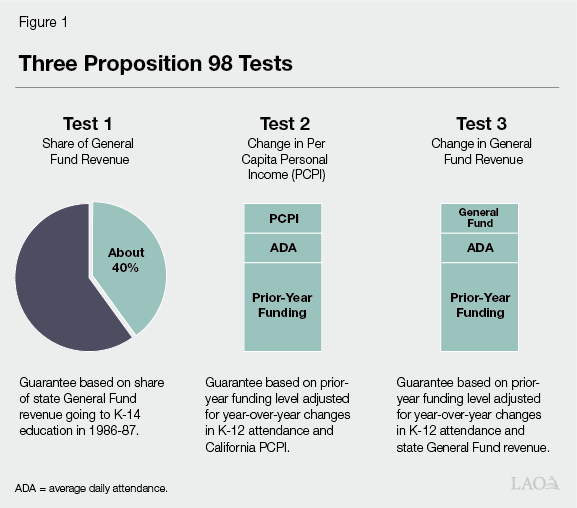
Proposition 98 Establishes Minimum Funding Level for Schools and Community Colleges. This funding requirement is commonly known as the minimum guarantee. The state calculates the guarantee by comparing three main formulas or “tests” (Figure 1). Each test takes into account certain inputs, such as state General Fund revenue, per capita personal income, and student attendance. The Legislature can suspend the formulas with a two-thirds vote of each house. Suspension creates an obligation known as “maintenance factor,” which the state pays when revenues are relatively strong. If the guarantee rises after the budget is enacted, the state must “settle up” by appropriating additional funding attributable to that year. The state meets the guarantee through a combination of state General Fund and local property tax revenue.
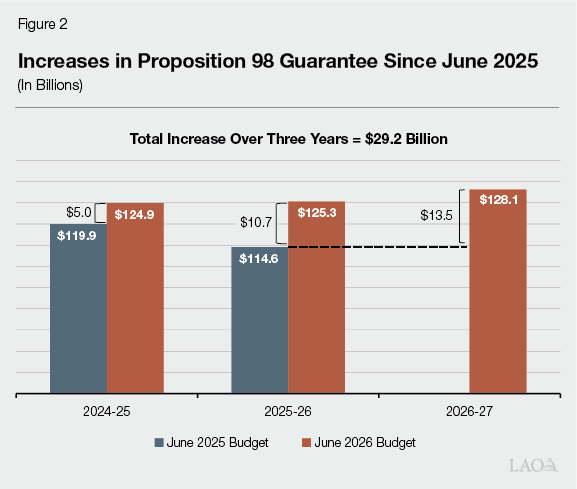
Estimates of the Guarantee Up More Than $29 Billion Over Three Years. Compared with the June 2025 estimates, the guarantee is up $5 billion (4.2 percent) in 2024-25 and $10.7 billion (9.3 percent) in 2025-26 (Figure 2). These increases reflect higher General Fund revenue estimates. For 2024-25, the guarantee calculation includes an $8.3 billion maintenance factor payment ($2.9 billion more than the June 2025 estimate). This payment eliminates the obligation the state created when it suspended the guarantee in 2023-24. For 2026-27, the budget estimates the guarantee is $128.1 billion, an increase of $13.5 billion (11.8 percent) from the 2025-26 enacted budget level. This increase mainly reflects higher General Fund revenue, though growth in local property tax revenue also contributes. Test 1 is the applicable test for all three years.
Budget Adjusts Guarantee for Shift of State Preschool. For the past several years, the state has funded State Preschool providers with different revenue sources. Whereas school districts and other educational agencies received Proposition 98 funding, other agencies (primarily community-based organizations) received non-Proposition 98 General Fund. The budget makes Proposition 98 the funding source for all providers beginning in 2026-27. In tandem with this shift, the budget increases the minimum share of state revenue for Proposition 98 from 39.3 percent to 39.6 percent. (This percentage increase equates to $813 million in 2026-27.) This “rebenching” of the guarantee helps avoid unintended reductions in funding for other school programs.
Budget Updates Two Other Previous Adjustments. In addition to State Preschool, the budget updates a few prior adjustments to the guarantee. The largest adjustment involves the expansion of transitional kindergarten (TK). The budget includes a $1.9 billion ongoing increase to the 2025-26 guarantee for the additional four-year olds attending school under this expansion—$220 million less than the state estimated in June 2025. This reduction reflects new data showing fewer new students than the state previously assumed. Two smaller one-time adjustments are associated with the January 2025 fires in Los Angeles County. Specifically, the budget includes a $32 million increase in the 2024-25 guarantee and a $66 million increase in the 2025-26 guarantee to offset reductions in school property tax revenue associated with the fires. These increases are roughly half the June 2025 estimates for each of those years and reflect updated information from the county assessor.
Delays Cost Recognition for Proposition 98 Maneuver. The June 2024 budget set school and community college funding $6.2 billion above the guarantee in 2022-23. It also included a new fiscal maneuver that accrued the cost to future years. Previous legislation required the state to recognize the cost in installments of $500 million per year, beginning in 2027-28. The budget delays the first installment to 2028-29. The change has no direct effect on schools and community colleges because the installments are accounting entries—not additional payments to districts—and paid from the non-Proposition 98 side of the budget.
K-14 Spending Architecture
Deposits $9.2 Billion Into Proposition 98 Reserve. The Proposition 98 Reserve is a statewide reserve account for schools and community colleges. Constitutional formulas determine how much the state must deposit or withdraw each year. Due to significantly higher estimates of capital gains revenue, the state must deposit $8.7 billion into this reserve across 2024-25 and 2025-26. (The 2025-26 budget package assumed a zero balance at the end of 2025-26.) The budget also includes a $500 million discretionary deposit in 2025-26. These deposits bring the total balance to $9.2 billion.
Delays $3.9 Billion Settle-Up Payment. Whereas the budget includes a significantly higher estimate of the Proposition 98 guarantee in 2025-26, it funds only a portion of that increase. Specifically, the budget provides $121.3 billion in funding—$3.9 billion less than the revised estimate of the guarantee. This difference provides temporary General Fund savings for the state but creates a settle-up obligation the state must address in the future (assuming no decrease in the estimate of the guarantee). Trailer legislation specifies that if May 2027 revenue estimates for 2025-26 through 2027-28 exceed current projections, one-third of the available funding—after accounting for increases in Proposition 98 and other formula-driven requirements—would be dedicated to this obligation. It also designates this funding for discretionary Proposition 98 Reserve deposits. The state would address any remaining settle-up obligation through future legislation or, in the absence of additional legislation, through a payment schedule developed by the Director of the Department of Finance. The budget also pays a prior $1.9 billion obligation related to 2024-25.
Eliminates $2.3 Billion in Payment Deferrals. The budget allocates $1.9 billion for schools and $408 million for community colleges to eliminate the payment deferrals included in the June 2025 budget. Beginning in 2026-27, the state will make all payments on the regular monthly schedule.
Shifts $211 Million From Schools to Community Colleges. The state typically divides Proposition 98 funding between schools and community colleges using an uncodified methodology known as “the split.” This methodology allocates 89.07 percent of available funding to schools and 10.93 percent to community colleges, with certain programs excluded from the calculation. The June 2025 budget created a new exclusion related to TK, which shifted funding from community colleges to schools ($208 million in 2025-26 and $241 million in 2026-27). The June 2026 budget maintains this exclusion but shifts $211 million in the other direction by modifying the percentages in 2026-27. Specifically, it decreases the school share to 88.9 percent and increases the community college share to 11.1 percent.
K-12 Education
Overall K-12 Proposition 98 Funding Increases by $15 Billion. Compared with the June 2025 budget, overall funding for schools—excluding reserve deposits, the unpaid settle-up obligation, and community college allocations—is up $15 billion over the 2024-25 through 2026-27 period. In addition, $3.2 billion in existing funds are freed up by other adjustments, including the expiration of prior one-time spending and declines in attendance-driven programs. Accounting for all these changes, $18.2 billion is available for new school spending (Figure 3). The budget uses this funding to provide the statutory cost-of-living adjustment (COLA), additional augmentations for the Local Control Funding Formula (LCFF) and special education, a large one-time discretionary grant, ongoing grants for community schools, and numerous other one-time and ongoing activities. The remainder of this section describes these actions in detail.
Figure 3
K‑12 Proposition 98 Spending Changes in 2026‑27 Budget Package
2024‑25 Through 2026‑27, Includes Reappropriated Funds (In Millions)
|
Ongoing |
|
|
Special education base rate |
$2,357 |
|
LCFF COLA (2.87 percent) |
2,230 |
|
LCFF increase above COLA (1.44 percent)a |
1,134 |
|
Community schools |
1,000 |
|
Shift of all State Preschool programs into Proposition 98 |
813b |
|
COLA for select categorical programsc |
215 |
|
Expanded Learning Opportunities Program |
66 |
|
Special education extraordinary cost pools |
40 |
|
Special education low incidence disabilities |
40 |
|
State Preschool professional development days |
34 |
|
State Preschool cost of care plus increase |
33d |
|
Necessary Small Schools |
31 |
|
State Preschool Quality Rating and Improvement System |
20 |
|
Special education programs shifted from federal to state funding |
16 |
|
COE funding to support school districts and charter schools |
11 |
|
Other |
12 |
|
Subtotal |
($8,052) |
|
One Time |
|
|
Discretionary block grant |
$5,034 |
|
Deferral paydown |
1,875 |
|
Learning Recovery Emergency Block Grant |
757 |
|
Teacher recruitment and retention |
708 |
|
Kitchen infrastructure and training |
500 |
|
Literacy coaches |
350 |
|
Universal Pre‑Kindergarten Planning and Implementation Grant |
250 |
|
Students experiencing homelessness |
116 |
|
Dual Enrollment |
100 |
|
California’s New Americans in Schools |
100 |
|
Community schools |
84 |
|
Dream Resource Center Grant Program |
75 |
|
Mathematics Professional Learning Partnership |
50 |
|
Literacy Screener Professional Development |
40 |
|
Supporting Inclusive Practices Project |
30 |
|
Inclusive college technical assistance center |
25 |
|
Wildfire‑related support for schools |
23 |
|
21st Century California School Leadership Academy |
15 |
|
Holocaust and Genocide Education Grant Program |
10 |
|
Alternate pathways to diplomas |
10 |
|
Other |
5 |
|
Subtotal |
($10,157) |
|
Total |
$18,210 |
|
aThis increase applies to all K‑12 local education agencies. It is intended in part to support the cost of implementing a new paid pregnancy disability leave requirement. bThe budget increases the Proposition 98 minimum guarantee by this amount. cApplies to Special Education, Child Nutrition, Equity Multiplier, K‑12 Mandates Block Grant, Charter School Facility Grant Program, Foster Youth Services Coordinating Program, Adults in Correctional Facilities, American Indian Education Centers, and American Indian Early Childhood Education. dReflects Proposition 98 costs for local education agencies. Increase for other providers reflected in $813 million shifted into the guarantee. |
|
|
LCFF = Local Control Funding Formula; COLA = cost‑of‑living adjustment; and COE = county office of education. |
|
Ongoing Proposition 98 Spending Changes
Provides 4.31 Percent Increase to LCFF Rates. The budget provides $3.3 billion to increase LCFF rates by 4.31 percent. This includes $2.2 billion to cover the cost of a statutorily required 2.87 percent COLA, plus an additional $1.1 billion to increase rates beyond the COLA. The budget plan specifies that the increase above the statutory COLA is intended in part to support the cost of implementing a new paid pregnancy disability leave requirement. We describe this requirement in greater detail in the “Other Actions” section.
Increases Special Education Base Rates. The budget provides $2.4 billion to bring the special education base rate to $1,340 per student. This increase is $396 per student (42 percent) beyond the COLA-adjusted rate.
Establishes Ongoing Community Schools Grant Program. The budget provides $1 billion ongoing for a new program to support the community schools model. (Since 2021-22, the state has provided $4.1 billion in one-time funding for implementation of the community schools model.) The vast majority of this funding ($990 million) is to provide annual grants to school sites that enroll more than ten students and have a student body where 65 percent or more of their enrolled students are English learners or are low income. (Grantees of the existing one-time community schools program that do not meet these criteria are also eligible.) Annual grant amounts range between $75,000 and $400,000 per school and vary by school size. Beginning in 2027-28, these grant amounts are to be adjusted annually by the K-12 COLA. The funding is provided to local education agencies (LEAs)—school districts, county offices of education (COEs), and charter schools—which can set aside 10 percent of the total allocation to their eligible school sites each year to support implementation. To receive funding in 2026-27, LEAs with eligible school sites must opt into the program by November 1, 2026. In future years, LEAs may opt in by June 30 each year to begin to receive funding the following fiscal year. Figure 4 describes the requirements of the program in more detail.
Figure 4
Overview of Ongoing Community School Program Requirements
|
Requirement |
Description |
|
Opt‑In |
|
|
|
|
Planning Period (Up to Two Years) |
|
|
Implementation Period (Ongoing) |
|
|
|
|
|
|
|
|
Establishes Ongoing System of Community School Technical Assistance. Of the $1 billion ongoing appropriation for community schools, $10 million is set aside for at least one COE to oversee technical assistance for grantees and, beginning in 2031-32, to cover costs related to the ongoing certification process. At least $2 million of this amount is to be set aside for a COE to serve as the statewide technical assistance center. Trailer legislation specifies the Legislature’s intent to provide $20 million annually beginning in 2030-31 for COEs to support community school implementation in their county. (COEs are funded through 2029-30 for this purpose under the one-time grant.) The budget package also provides $84 million in reappropriated Proposition 98 funds for various activities that support community school implementation (Figure 5).
Figure 5
Budget Package Includes $84 Million One‑Time to Support Community School Implementation
(In Millions)
|
Purpose |
Description |
Funding |
|
Secondary Community School Redesign |
The California Collaborative for Educational Excellence is to provide grants that support secondary community school redesign. |
$50 |
|
Statewide Technical Assistance Center (S‑TAC) |
Funding to increase the existing S‑TAC contract amount to $5 million annually through June 30, 2031. This funding is to be used to support statewide expansion of community school grantees, evaluate the technical assistance structure, and integrate the community schools model and supports into the statewide system of support. |
15 |
|
Certification Process |
The S‑TAC must develop and implement the school site certification process adopted by the State Board of Education. The S‑TAC must pilot the certification process by 2028‑29 and fully implement the process by October 30, 2031. |
10 |
|
Behavioral Health Services |
Funding to continue an initiative led by the San Bernardino county office of education aimed at increasing the integration of behavioral health services in schools. (Previously funded by California Youth Behavioral Health Initiative.) |
6 |
|
Study on Long‑Term Program Structure |
The S‑TAC must conduct or commission a study by January 1, 2028 to inform the long‑term technical assistance, reporting, accountability, and certification process for the community schools grant program. By June 30, 2028, the S‑TAC must make recommendations based on the study to the State Board of Education. |
3 |
Provides Statutory 2.87 Percent COLA for Categorical Programs. The budget provides $215 million to cover a 2.87 percent COLA for several categorical programs. Of this amount, $170 million (almost 80 percent) is for special education.
Makes Various Changes to State Preschool Funding. The budget reduces funding for State Preschool by $190 million ongoing. This reduction reflects the estimate of out-of-contract State Preschool funds that would otherwise go unused. The budget also sets aside $115 million of existing State Preschool funds to increase contracts for growth in the number of three-year old children served in State Preschool. The budget provides several additional increases related to State Preschool, including $34 million to increase the number of professional development days and $20 million to increase funding for the Quality Rating Improvement System. In addition to funding augmentations, trailer legislation makes changes to State Preschool eligibility and prioritization. More details on State Preschool changes are included in the post The 2026-27 California Spending Plan: Child Care and Preschool.
Increases Funding for Special Education Low Incidence Fund and Extraordinary Cost Pools. The budget provides a $40 million ongoing augmentation (for a total of $178 million) for students with low incidence disabilities. The fund provides additional special education funding based on the number of students who have hearing, visual, and/or orthopedic impairments. The budget also provides a $40 million ongoing augmentation (for a total of $60 million) for extraordinary cost pools that cover costs associated with high-cost mental health and nonpublic school placements.
Sets a Minimum Tier 2 Rate for the Expanded Learning Opportunities Program (ELOP). The budget provides a $62.4 million ongoing increase to set a minimum “Tier 2” rate at $1,800 per English learner, low-income student, or foster youth (EL/LI)—more than $200 higher than the 2024-25 and 2025-26 rates. (The Tier 2 rate is provided to LEAs with a student body that is less than 55 percent EL/LI.) This increase brings total ongoing funding for ELOP to $4.67 billion. If funds within the program are available after allocating funding based on the statutory rates, the California Department of Education (CDE) must increase the Tier 2 rate above $1,800, but cannot exceed the Tier 1 rate of $2,750.
Increases Necessary Small Schools Funding by 20 Percent. The budget provides $30.7 million ongoing to apply a 20 percent increase to funding levels for necessary small schools—small schools located in geographically isolated parts of the state. This is in addition to a 2.41 percent COLA for the rates, equaling roughly $3.6 million.
Changes Differentiated Assistance Formula. The budget provides an additional $11 million and modifies the formula that allocates funding to COEs to support school districts and charter schools identified for differentiated assistance—which is additional support for districts that do not meet certain student performance criteria. This brings the total differentiated assistance funding to $130 million. The new formula increases the base amount for each COE from $300,000 to $500,000. The remainder of funds are allocated based on the number of students within the county rather than the number and size of districts and charter schools identified for differentiated assistance. Trailer legislation also expands the intended use of these funds. Whereas funding was previously intended to support LEAs identified for differentiated assistance, funding may now also be used to provide universal support to all LEAs to improve student outcomes. In addition to the funding changes, trailer legislation makes various changes related to differentiated assistance, including the frequency in which LEAs will be identified. LEAs will be identified for support once every three years rather than once a year.
Other Ongoing Changes. The budget package includes several other changes to ongoing Proposition 98 spending.
Online Educational Resources. The California Online Media Program for Access and Student Success provides K-12 schools and local libraries free access to an online database of research materials. Funding for the program is provided to the Riverside COE, which then passes through the funding to the State Library. In recent years, the state has provided $5.5 million ongoing for this purpose. The budget provides $5.5 million for 2026-27 but specifies that funding will only be provided on a one-time basis. In addition, the budget requires two sets of reports related to these funds, which must be submitted to CDE, the Director of Finance, and the fiscal committees of the Legislature by November 15, 2026. The Riverside COE must report on how much funding was spent, carried over, or reimbursed to the State Library, as well as the amount of funds allocated to each contractor. The State Library must report planning activities for the use of funds, how vendors were selected, outreach efforts, and efforts the State Library made to collaborate with other agencies to provide access to high-quality online instructional materials.
Multitudes Screener. The budget provides $5 million on an ongoing basis for the University of California, San Francisco Dyslexia Center to provide continued support for the Multitudes Screener, including regular updates to the screener and translation into additional languages. The Multitudes Screener is one of four approved literacy screeners in kindergarten through grade 2. The funding provided in the budget package is contingent upon the screener remaining free to schools.
Menstrual Products Mandate. The budget provides $1.7 million ongoing to increase the K-12 Mandates Block Grant for the cost of expanded requirements to stock menstrual products in public school restrooms added by Chapter 664 of 2021 (AB 367, Garcia). Chapter 664 requires all schools serving students in grades 6 through 12 to stock menstrual products in every female restroom, all-gender restroom, and at least one male restroom.
Fiscal Crisis and Management Assistance Team (FCMAT). The budget provides a $1 million increase for FCMAT’s core operations and an additional $737,000 for the division (known as California School Information Services) that supports the state’s longitudinal student data system. These augmentations are primarily for salary-related increases and additional workload. For FCMAT’s core operations, the funding also supports additional full-time staff to complete work previously performed by retired annuitants.
Museum of Tolerance. The budget provides an additional $1 million for the Museum of Tolerance, bringing ongoing funding to a total of $4 million. The funding is intended to support statewide professional development and anti-bias training for teachers.
California Educators Together. The budget provides $600,000 ongoing for a COE to maintain an online repository of professional development resources for LEAs. The repository is to include resources that improve collaboration among teachers, strengthen instructional practices, and provide guidance toward establishing safeguards for technology in schools.
K-12 High Speed Network (HSN). The budget provides an additional $629,000 ongoing to support K-12 HSN operations. This brings total Proposition 98 funding for the HSN to $11.1 million.
School Accounting System. The budget provides $220,000 for the school accounting system known as the Standardized Account Code Structure, bringing the total appropriation to $4.1 million. The increase will support additional staffing costs associated with the system’s web-based portal.
Science Performance Tasks. In 2024-25, the state provided $7 million in one-time funding for the Los Angeles COE to contract with one or more nonprofit organizations to develop a statewide repository of science performance tasks that science teachers could use in their classroom instruction. The budget provides $890,000 ongoing starting in 2025-26 for the Los Angeles COE to maintain these efforts. These funds are intended to support maintenance activities including creating new performance tasks, engaging teachers, and providing professional development for teachers.
One-Time Proposition 98 Spending
Funds Discretionary Block Grant. The budget provides $5 billion for the Student Support and Professional Development Discretionary Block Grant. LEAs may use these funds for any local purpose, but trailer legislation encourages them to prioritize professional development, teacher retention and recruitment, community schools, career education, and deferred maintenance. The state will distribute funds based on average daily attendance (estimated at $932 per student). LEAs must spend their funds before June 30, 2032 and submit an expenditure report by September 30, 2032. As a condition of receiving funds, an LEA experiencing declining enrollment or projecting future declines must hold a hearing on its plans to address the decline. Trailer legislation also counts these funds toward any unreimbursed mandate claims a district previously submitted. (This funding is in addition to a similar $1.7 billion block grant included in the June 2025 budget.)
Funds Learning Recovery Emergency Block Grant (LREBG). The June 2022 budget provided $7.9 billion for the LREBG to support learning recovery and the social and emotional well-being of students and staff. The June 2023 budget reduced this amount by $1.1 billion but indicated the state would make up the reduction over time. The state began restoring the grant with a $379 million allocation in 2025-26. The budget completes this restoration by providing another $757 million in 2026-27. LEAs will receive funding based primarily on their enrollment of EL/LI students, consistent with the original allocation formula. Before spending these funds, LEAs must conduct a needs assessment, solicit community feedback, and explain how research or other evidence supports their local plans.
Funds Several Teacher Recruitment and Retention Programs. As Figure 6 shows, the budget package includes $708 million one-time Proposition 98 General Fund for teacher recruitment and retention programs. This includes the following:
Student Teacher Stipend Program. The budget provides $408 million to modify and extend the Student Teacher Stipend Program established in 2025-26. The program will provide up to $125 million in grants to LEAs annually (up from $100 million). These grants will provide $10,000 to teachers who complete their required 500 hours of student teaching. Additionally, the program is also expanded to provide additional $5,000 grants to prospective teachers who commit to teaching in math, science, technology, bilingual education, or special education, allowing individual candidates to receive up to $15,000. Intent language in trailer legislation states that grant sizes will increase in future years for teachers who commit to teaching in priority schools, subject to an appropriation. The deadline for committing program funds is extended from June 30, 2030 to June 30, 2032.
Teacher Residency Grant Program. The budget provides $250 million to extend the Teacher Residency Grant Program until June 30, 2030. This brings total funding provided for the program since 2018-19 to $905 million. Additionally, the package includes $30 million to extend support for the Statewide Residency Technical Assistance Center (SRTAC) until 2034. In addition to supporting local residency programs, the SRTAC also would be required to support LEAs participating in the National Board for Professional Teaching Standards Certification Incentive Program. By December 31, 2034, the Commission on Teacher Credentialing (CTC) will submit a report to the Governor and the policy and fiscal committees of the Legislature on the impact of the statewide technical assistance center in providing technical assistance to LEAs and other partners.
Pathways to Bilingual Teaching. The budget package includes $10 million to establish the Pathways to Bilingual Teaching Program. Beginning January 1, 2027, the CTC is to provide grants of up to $600,000 to consortia of LEAs partnered with institutions of higher education to promote bilingual pathways. Allowable uses include providing teacher, administrator, and faculty release time or stipends to design the pathway; creating or redesigning courses for candidates in a pathway to bilingual teaching; and designing appropriate recruitment, guidance, and support strategies for candidates participating in the pathway. The funding must be committed by June 30, 2032, and recipients are required to provide the commission with outcome data for five years after receiving a grant. Recipients must also report their plan for recruiting candidates into their programs, a plan to coordinate with other sources of support for teacher candidates, and a plan for how to sustain the program after funding expires. The CTC will report annually to the Legislature on grant recipient progress until funds are fully expended.
Classified School Employee Teacher Credentialing Program. The budget provides $10 million to extend funding for the Classified School Employee Teacher Credentialling Program until June 30, 2028. The program provides grants to LEAs to support classified school employees pursuing teaching credentials. Teacher candidates can receive up to $4,800 a year for up to five years through this program. The CTC shall give priority to LEAs that have not previously received program funding and have a higher share of EL/LI students than other applicants. Since 2016-17, the state has provided $180 million in one-time funding for the program.
Figure 6
Budget Package Funds Several Teacher Recruitment and Retention Programs
One‑Time Funding Unless Otherwise Noted (In Millions)
|
Program |
Amount |
|
Proposition 98 General Fund |
|
|
Student Teacher Stipend Program |
$408 |
|
Teacher Residency Grant Program |
250 |
|
Statewide Residency Technical Assistance Center |
30 |
|
Pathways to Bilingual Teaching Program |
10 |
|
Classified School Employee Teacher Credentialing Program |
10 |
|
Subtotal |
($708) |
|
Federal Funding |
|
|
Golden State Teacher Grant Programa |
$17.8 |
|
Total |
$726 |
|
aIncludes $16.2 million ongoing and $1.6 million one time. |
|
Extends Existing Literacy Coaches and Reading Specialists Grant Program Awards. The budget provides $350 million to extend the Literacy Coach and Reading Specialist grants awarded in 2022-23, 2023-24, and 2025-26. The new funding will go to previously awarded grantees, extending funding for literacy coaches through June 30, 2031. This allocation brings the total funding for program to more than $1 billion. Awardees must submit an additional report to the department on or before June 30, 2031 on how funds were used to employ literacy coaches and reading specialists, how funds were used to develop and expand literacy programs, how expenditures impacted student achievement, and how the LEA plans to continue to fund literacy coaches and specialists past the award period.
Funds Kitchen Infrastructure and Training Grant. The budget provides $500 million for grants to fund kitchen equipment and infrastructure, training for nutrition staff, and the continued implementation of universal school meals. LEAs can use funds for a variety of uses related to providing school meals, including kitchen upgrades, cooking equipment, refrigeration, staffing, training, or procurement of specific foods. LEAs can also use funds to implement strategies to provide food assistance to students who may be experiencing food insecurity and to establish food pantries. In distributing funds, CDE is to develop criteria which provides a base amount to each eligible LEA and prioritizes LEAs that were not awarded the third round of kitchen infrastructure and training funds (provided in the 2025-26 budget). Funds are available until June 30, 2030.
Funds Pre-Kindergarten Planning and Implementation Grants. The budget package provides $200 million for grants that can be used for State Preschool or TK expansion costs, such as hiring, recruitment, professional development, classroom materials, and supplies. Funds must be spent by June 30, 2032. LEAs with up to 500 kindergarteners are to receive a $25,000 base grant and LEAs with more than 500 kindergartners are to receive a $50,000 base grant. COEs are to receive $15,000 for every LEA in their county that operates a kindergarten program. Of the remaining funds, 60 percent will be distributed based on an LEA’s proportional share of kindergarten enrollment and 40 percent will be distributed based on an LEA’s share of students who are EL/LI. The state provided $200 million in 2021-22 and $300 million in 2022-23 for similar purposes.
Funds Additional Dual Enrollment Grants. The budget provides $100 million to provide grants for expansion of College and Career Access Pathways (CCAP) or Middle College and Early College high schools (MCEC). (The 2022-23 budget package provided $200 million for this purpose.) Trailer legislation specifies that funding is available until June 30, 2032. CDE must submit reports to the Legislature by June 30, 2027 and June 30, 2030. Trailer legislation also makes several changes to the program rules compared with previous grants
Funding Set Aside. Unlike the previous grant, the funding is not required to be split evenly between CCAP and MCEC.
Eligibility. Makes regional occupational centers or programs eligible for funding. Additionally, allows LEAs to apply for expansion grants for existing MCEC programs, not just for new programs.
Priority Criteria. Requires CDE to prioritize funding for LEAs that currently do not have a CCAP agreement or have not already received funding from the grant program.
Renewal Grants. Allows for prior grantees to receive renewal grants provided they completed their grant cycle and completed all requirements.
Grant Amounts. Increases grant amounts by $50,000 for LEAs that serve justice-involved students in county facilities.
Maintenance of Effort. Requires grantees to develop a three-year plan to maintain dual enrollment opportunities after their grant period expires.
Expands the Mathematics Professional Learning Partnership. The budget provides $50 million for the Kern County Superintendent of Schools to expand the Mathematics Professional Learning Partnership, bringing total one-time funding for the partnership to $100 million. The funds are intended to support collaborations with the California Mathematics Project, the Rural Math Collaborative, and other partners to provide training and support mathematics coaching. These collaborations will train coaches who can be deployed to LEAs with the highest need. The Kern County Superintendent of Schools will submit a revised expenditure plan to the Department of Finance by October 1, 2026 for approval. (An initial expenditure plan was required to be submitted to the Department of Finance by January 31, 2026.)
Establishes California’s New Americans in Schools (CalNAS) Program. The budget provides $100 million for CDE, in consultation with the Department of Social Services, to establish a new program for newcomer pupils, English learners, and immigrant families. Funding is to be allocated through a competitive grant program that prioritizes grants to LEAs with higher proportions of newcomer students, socioeconomically disadvantaged students, and English learners. Funding for this program is available until June 30, 2032. Funds may be used for a variety of activities, including professional development for supporting immigrant students and families, academic support, social support services, and contracting with immigration legal services providers. Trailer legislation specifies that $10 million of the total allocation is to be set aside for CDE to select one or more LEAs to provide statewide technical assistance. (Up to $1 million of this amount may be used to subcontract with nonprofit entities to support implementation of services.) The technical assistance provider must submit a report to the state every two years through January 20, 2033. The report must summarize services provided by grantees and academic outcomes of the students served.
Provides Funding for Dream Resource Centers. Dream Resource Centers provide students, especially those from undocumented and immigrant backgrounds, with resources such as financial aid assistance and access to social services and immigration legal services. The budget provides $75 million for the Dream Resource Center Grant Program, initially authorized by Chapter 424 of 2023 (AB 278, Reyes). The competitive grant program will be administered by CDE through June 30, 2030. Funding is intended primarily to establish new Dream Resource Centers at high schools, although CDE can award up to 5 percent of the funding to expand existing Dream Resource Centers. Trailer legislation requires grants to be awarded using a tiered point system that prioritizes LEAs based on several criteria, including the number of school sites establishing a new Dream Resource Center; whether the schools are located in an underserved area; and the number of students who are newcomer students, English learners, or low income. Trailer legislation also specifies that CDE has discretion to determine the data and information that grantees will be required to submit as part of the grant program. CDE is required to report to the Legislature on December 30 of 2028, 2030, and 2032. The reports are required to detail best practices, barriers or constraints, and outcomes of funded Dream Resource Centers.
Supplements Federal Funding for Students Experiencing Homelessness. The budget provides $116 million to supplement funding from the federal Education for Homeless Children and Youths program. Funding shall be allocated by CDE as three-year competitive grants to increase identification and provide direct services to students experiencing homelessness. Trailer legislation requires CDE to prioritize grants for districts that are not currently receiving funding from the existing federal program. Grantees would be required to annually report how funds were used and the outcomes of students receiving services, as well as a submit a final report describing how the increased services will be sustained and integrated into their program after the grant expires.
Provides Grants for Preschool Planning. The budget provides $50 million to award grants for LEAs to plan for expanding preschool options for three- and four-year olds through a mixed delivery system. Funds can be used for a variety of purposes including assessing parental preferences for preschool and engaging in community-level coordination to implement preschool options. State funds are available until June 30, 2032 and require a one-to-one match. The state provided $18.3 million non-Proposition 98 General Fund over three years ($54.9 million total) for similar purposes starting in 2022-23.
Provides Additional Support for Reading Difficulties Screener Implementation. The budget provides $40 million for LEAs that administer reading difficulties screenings, based on their share of K-2 students in the state. Since 2024-25, the state has provided a total of $105 million in one-time funding to support the implementation of the screeners and provide services to students identified with reading difficulties. Additionally, budget trailer legislation includes new requirements for how LEAs administer screeners for the purposes of identifying students at risk of reading difficulties. LEAs must consider whether students have received appropriate instruction to support an assessment. The department will develop and disseminate guidance by January 31, 2027, which is to include factors that may be considered in determining whether a pupil has received sufficient instruction in foundational reading skills to support a valid assessment. In addition, trailer legislation requires that, for the purposes of identifying students at risk of reading difficulties, LEAs screen kindergarteners on the 91st school day or later. The changes in trailer legislation continue to allow LEAs to administer the screener for diagnostic purposes at any time.
Funds Inclusive College Programs. The budget provides $25 million for the California Center for Inclusive College to award funds to institutions of higher education that are implementing new inclusive college programs, or are maintaining or expanding existing inclusive college programs. Before funds are spent, the Department of Finance is to approve a plan submitted by the California Center for Inclusive College detailing how funds will be awarded. The plan is due by December 1, 2026.
Expands Support for the 21st Century California School Leadership Academy. The budget provides $15 million to support the 21st Century California School Leadership Academy, which provides professional development for school administrators. The funds will be used to continue to provide professional learning for existing administrators, and to expand the program to provide training for educators pursuing an administrative services credential. Funds must be committed by June 30, 2031. These funds are in addition to the $11.4 million in ongoing federal funds the program already receives.
Provides Funding Relief for Los Angeles Fires. The budget provides $23 million to assist LEAs affected by the Eaton and Palisades fires in January 2025. Most of this amount is to provide eight charter schools with relief payments equal to 30 percent of their LCFF allocations prior to the fires, but the budget also reserves $4 million for the Pasadena Unified School District.
Extends Support for Supporting Inclusive Practices. The budget provides $30 million for El Dorado COE to provide technical assistance and grants to LEAs. Funds are intended to support implementation of evidence-based practices that increase inclusion of children with disabilities in general education settings. El Dorado COE must annually provide an expenditure plan and a report detailing how funds were used. The report is to include a summary of outcome data and recommendations for improving state-level activities to support greater inclusion. Funds are available until June 30, 2032. The 2021-22 budget package provided $15 million for these purposes.
Funds Technical Assistance for Alternate Pathways. The budget provides $10 million for the Sacramento COE to develop resources and support implementation of alternate pathways to a high school diploma for students with disabilities. Funding is available until June 30, 2031.
Establishes The Holocaust and Genocide Education Program. The budget provides $10 million for the Holocaust and Genocide Education Program, which will provide grants to support professional development, the acquisition of instructional materials, and the facilitation of events related to Holocaust and genocide education. Funding will be allocated to the Marin COE, which will pass through funds to the California Teacher’s Collaborative for Holocaust and Genocide Education to administer the program. Up to 3 percent of the funds may be used by the Marin COE for administrative costs. The California Teachers Collaborative for Holocaust and Genocide Education shall provide annual written reports as determined by CDE to the department and the Legislature.
Funds the Creation of a Transcript Review Platform. The budget provides $5 million for a COE to create a transcript review platform for CTC by July 1, 2027. This platform is intended to facilitate verifying the subject matter competency of teacher candidates through college coursework. The ongoing costs of maintaining the platform and reviewing the transcripts of teacher candidates will be funded through an increase in teacher credential renewal fees from $100 to $125 beginning July 1, 2026. (Teachers pay these fees every five years.) The CTC shall report to the Legislature on the implementation of the service and any recommended statutory changes by January 1, 2029.
Inglewood Unified Oversight. The budget provides $400,000 to reimburse FCMAT for conducting comprehensive reviews of the Inglewood Unified School District. (Inglewood Unified became insolvent and entered receivership in 2012.) During these reviews, FCMAT analyzes the district’s progress, areas for improvement, and readiness to regain local authority.
Non-Proposition 98 Spending
Provides a Mix of Ongoing and One-Time Federal Funding for the Golden State Teacher Grant (GSTG) Program. The budget provides $16 million in ongoing federal Individuals with Disabilities Education Act (IDEA) funding for GSTG. These funds are restricted to providing grants of up to $20,000 to special education teacher candidates who commit to working in priority schools for four years. (The most recent rounds of funding for this program, including the $50 million in the 2025-26 budget package, have not been restricted to specific subject areas and have offered grants of up to $10,000 for teacher candidates who commit to two years of service.) To free up ongoing federal funding for this purpose, the budget shifts funding for two special education programs—Family Empowerment Centers and the Focused Monitoring and Supporting Inclusive Practices Grant—from federal IDEA to Proposition 98 General Fund. In addition, the budget includes $1.7 million in one-time Title II, Part A funding for the program. These funds are available to provide grants of up to $10,000 to teacher candidates in high-need subjects (such as math and science) and require two years of service. The budget also includes $10 million one-time non-Proposition 98 General Fund to provide new awards to teacher candidates in high-need subjects in 2027-28. These allocations bring total GSTG funding to $594.3 million since 2020-21.
Provides One-Time Funding for Save the Children. The budget provides $5 million one-time non-Proposition 98 General Fund for the Save the Children organization to operate after school education and safety programs in rural school districts. Since 2023-24, the state has provided a total of $18 million for this purpose.
Supports New and Ongoing Workload at CDE. The budget provides CDE with an additional $18 million ($16 million non-Proposition 98 General Fund, $1.4 million federal funds, and $690,000 special fund) to accommodate new workload. Notable augmentations include $5 million for legal costs and $4 million for maintenance related staffing for the State Special Schools. This table describes the new workload and funding in more detail.
Provides Reimbursement for Meals During Short Intersessional Periods. The budget provides $15 million one-time non-Proposition 98 General Fund for CDE to administer a grant program that provides children at least one free meal per day during intercessional periods less than ten days. LEAs may opt into the program if they are located in low-income areas that meet eligibility for the federal Summer Food Service Program and offer meals to any child in the community.
Expands CTC State Operations Funding. As Figure 7 shows, the budget provides CTC with an additional $4.4 million non-Proposition 98 General Fund and $2.4 million Teacher Credential Fund to fund 38 new positions. These positions include staffing for two recently enacted bills. The funding also supports work on the new teacher transcript review platform as well as additional positions to address workload increases for CTC’s existing responsibilities.
Figure 7
Budget Package Funds Several New CTC Positions
(In Millions)
|
Positions |
Amount |
|
|
General Fund |
||
|
Safe learning environmentsa |
11 |
$1.6 |
|
Licensure enforcement |
11 |
1.5 |
|
Educator misconduct legal workload |
4 |
0.8 |
|
Out‑of‑state pupil personnel credentialsb |
2 |
0.3 |
|
Grant programs support |
1 |
0.2 |
|
Subtotals |
(29) |
($4.4) |
|
Teacher Credentials Fund |
||
|
Teacher transcript review |
7 |
$2.0 |
|
Assignment monitoring |
1 |
0.2 |
|
Fiscal and business services |
1 |
0.2 |
|
Subtotals |
(9) |
($2.4) |
|
Totals |
38 |
$6.7 |
|
aChapter 460 of 2026 (SB 848, Pérez). bChapter 375 of 2026 (AB 606, Quirk‑Silva). |
||
|
CTC = Commission on Teacher Credentialing. |
||
Continues the California STEM Teacher Recruitment Grant Program. The budget provides $3 million one-time non-Proposition 98 General Fund to continue this grant program for three additional years. The funds are provided to the Office of Public School Construction, which must allocate the funds to EnCorps Inc. Up to $150,000 may be used by the Office of Public School Construction to cover costs of administering this program. The state provided $3 million in one-time funding for this purpose in both 2021-22 and 2025-26.
Other Actions
Establishes Paid Pregnancy Disability Leave. Beginning January 1, 2027, all LEAs must provide up to 14 weeks of paid pregnancy leave at full pay to all employees who are absent from duty because of pregnancy, miscarriage, childbirth, and recovery from those conditions. (Federal and state laws currently require LEAs to provide some pregnancy leave with partial pay, while additional leave benefits may be negotiated locally.) Trailer legislation specifies that this pregnancy disability leave shall not be deducted from other leaves of absences that employees have available to them. Additionally, throughout the duration of pregnancy disability leave, LEAs must maintain group health coverage for the employee and continue any required retirement fund contributions. Trailer legislation directs LEAs to cover the costs of complying with this requirement from the LCFF increases above the statutory COLA (discussed earlier in this post).
Establishes a New Appointed Commissioner to Lead CDE. In tandem with the budget, the Legislature adopted Chapter 66 of 2026 (AB 181, Alvarez) to establish the role of an education commissioner, appointed by the Governor and confirmed by the Senate. Effective January 1, 2027, management of CDE will shift from the Superintendent of Public Instruction (SPI) to the commissioner. The SPI will be responsible for representing the public, fostering coordination, and evaluating programs as the head of a new Office of the Superintendent. This new office will have 11 staff. Chapter 66 also makes changes to the State Board of Education membership effective January 15, 2027. The SPI will become a voting member of the board, replacing a Governor-appointed voting member. The board will also increase from 11 to 13 voting members to accommodate two legislative appointees. One new member is to be appointed by the President pro Tempore of the Senate and the other by the Speaker of the Assembly. Finally, Chapter 66 requires the new commissioner to submit a report by October 1, 2027 that makes additional recommendations to streamline state governance. Prior to submitting this report, the commissioner must submit an interim report by June 30, 2027 that describes the process the commissioner used to gather input.
Makes Changes to Dual Enrollment. The budget package includes several statutory changes related to dual enrollment programs:
Regional Occupational Centers or Programs. Authorizes regional occupational centers or programs to enter CCAP agreements with community colleges.
Instructional Minutes for CCAP. Reduces the minimum amount of high school instruction for students enrolled in credit-bearing dual enrollment courses provided through CCAP agreements from 240 minutes to 180 minutes per day. This change aligns the minimum daily instructional minute requirement for students participating in CCAP with the requirements for students enrolled at an MCEC program.
Dual Credit. Requires dual enrollment courses offered through a local agreement between an LEA and an institution of higher education to be deemed dual credit courses. These courses are authorized to be counted on students’ official high school transcripts and official transcripts of the participating institution of higher education.
Changes Prioritization for 21st Century Community Learning Center (21st Century Program) Funding. The 21st Century program is a federally funded, state administered program that issues grants to LEAs to provide before and after school services to students in TK-12th grade. Budget trailer legislation requires the state to prioritize 21st Century funding for schools not receiving ELOP funding. (ELOP is provided to LEAs based on their TK-6th grade attendance, but funding can be used for any grade level.) Trailer legislation also requires giving priority to community schools grantees. These changes are intended to shift new rounds of 21st Century funding toward middle school and high school students, particularly those operating community schools.
Modifies Computer Science Supplementary Authorization Grant Rules. The 2021-22 budget provided $15 million one-time Proposition 98 funding to provide grants to current teachers pursuing a supplemental authorization in computer science. The budget increases the maximum grant award per teacher from $2,500 to $6,000; reduces the local match requirement from one-to-one to one-to-three; and extends the deadline for committing funds by four years, to June 30, 2030.