Drew Soderborg

September 25, 2026
The 2026-27 California Spending Plan
Judiciary and Criminal Justice
The 2026-27 budget provides $19 billion from the General Fund for judicial and criminal justice programs, including support for program operations and capital outlay projects, as shown in Figure 1. This is an increase of $677 million, or 4 percent, above the revised 2025-26 level. This increase is largely due to the increased General Fund support provided to the judicial branch, which we describe in greater detail below.
Figure 1
Judicial and Criminal Justice Budget Summary
General Fund (Dollars in Millions)
|
2024‑25 |
2025‑26 |
2026‑27 |
Change From 2025‑26 |
||
|
Amount |
Percent |
||||
|
Department of Corrections and Rehabilitation |
$13,504 |
$14,197 |
$14,198 |
$1 |
— |
|
Judicial branch |
2,903 |
3,126 |
3,832 |
706 |
23% |
|
Department of Justice |
482 |
538 |
519 |
‑20 |
‑4 |
|
Board of State and Community Corrections |
313 |
192 |
170 |
‑22 |
‑11 |
|
Other departmentsa |
169 |
222 |
233 |
11 |
5 |
|
Totals, All Departments |
$17,371 |
$18,276 |
$18,952 |
$677 |
4% |
|
aIncludes Office of the Inspector General, Commission on Judicial Performance, Victim Compensation Board, Commission on Peace Officer Standards and Training, Office of the State Public Defender, funds provided for trial court security, and debt service on general obligation bonds. |
|||||
|
Note: Details may not total due to rounding. |
|||||
California Department of Corrections and Rehabilitation
The budget provides $14.6 billion (mostly from the General Fund) for the California Department of Corrections and Rehabilitation (CDCR). This is a net decrease of $100 million (less than 1 percent) from the revised 2025-26 level. This decrease reflects various reductions, such as the previously authorized closure of the California Rehabilitation Center (CRC) in Norco and caseload adjustments associated with a projected decline in the prison population. The decrease is partially offset by various funding increases, such as to pay for increased workers’ compensation costs and leave cashed out by separating employees, as well as changes associated with the establishment of the mental health Receivership. (The net decrease in spending does not reflect growth in employee compensation costs in 2026-27 because such costs are accounted for elsewhere in the budget.) We identify some of the major actions taken in the 2026-27 budget process below.
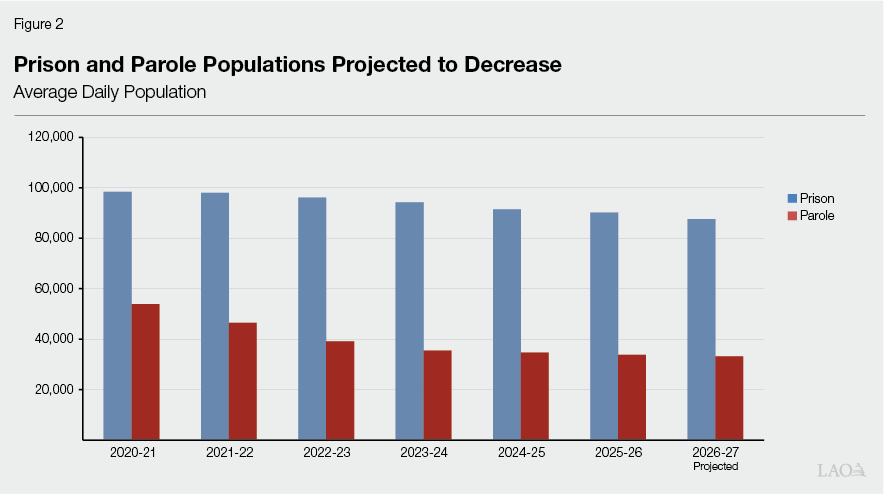
Adult Correctional Population. Figure 2 shows the recent and projected changes in the prison and parole populations. As shown in the figure, the prison population is projected to decrease by about 2,600 (3 percent) from 90,200 in 2025-26 to 87,600 in 2026-27. The parole population is projected to decrease by about 600 (2 percent) from 33,700 in 2025-26 to 33,100 in 2026-27.
Medical Care. The budget includes various General Fund adjustments related to medical care beginning in 2026-27. Some of the major augmentations include:
$28.8 million ongoing to purchase pharmaceuticals and to reflect that pharmaceutical rebates will be lower than anticipated in 2026-27 under the existing pharmaceutical rebate contract.
$21.6 million ongoing to provide contract medical services.
$14.6 million in 2026-27 (decreasing to $12.2 million in 2027-28 and ongoing) for medical supplies, such as durable medical equipment.
$8.9 million ongoing to add nursing positions through the population budget adjustment process at prisons with higher volumes of medical-related incidents, including nurses at prison reception centers.
$2.2 million in 2026-27 (increasing to $4.5 million ongoing in 2028-29) to add artificial intelligence functionality to the electronic health records system that will support medical records documentation. The budget includes provisional language requiring CDCR to provide quarterly progress updates on this project.
In addition, the budget package includes a net-zero adjustment to reflect updated estimates of federal reimbursement in the implementation of the California Advancing and Innovating Medi-Cal Justice-Involved initiative within CDCR. This net-zero change results from an $11.8 million reimbursement authority increase in 2026-27 (decreasing to $7.2 million in 2027-28 and ongoing) offset by a corresponding reduction in General Fund support.
Mental Health Care. In September 2025, a federal court in the Coleman v. Newsom case appointed a mental health Receiver to take over the management and operation of the state’s prison mental health system. The court also approved the Receiver’s action plan to improve care. The budget includes various augmentations related to the Receiver’s action plan and the delivery of prison mental health care. These include:
$25.3 million annually in 2026-27 and 2027-28 from the Mental Health Staffing Special Deposit Fund (MHSSDF) to support court-approved bonus payments to civil service mental health staff. (The MHSSDF was established to receive fines charged to the state for not filling mental health positions to court-ordered levels.) In 2028-29 and ongoing, funding for the bonuses will shift to the General Fund when the MHSSDF is expected to be largely depleted.
$21.1 million in 2026-27 from various fund sources (including $15 million MHSSDF, $5.2 million General Fund, and $1 million Behavioral Health Services Act [BHSA]) to establish the Office of the Mental Health Receiver and implement the Receiver’s action plan. General Fund support would generally increase annually to $14.9 million by 2029-30 and ongoing, replacing funding from both the BHSA and MHSSDF. This funding would provide the office with managerial, administrative, and human resources positions, as well as office space and equipment.
$8.9 million General Fund in 2026-27 (generally increasing to $12.8 million in 2028-29 and ongoing) to add support staff and equipment for tele-mental health services. This includes converting various on-site positions to tele-mental health positions. The budget also includes provisional language that requires CDCR to submit a report on the impact of expanding tele-mental health in prisons.
$7.4 million ongoing General Fund to create mental health crisis intervention teams at three prisons, which would seek to improve responses to people having a mental health crisis.
$4.9 million in 2026-27 ($8.6 million in 2027-28 and ongoing) to fund mental health resource teams at three prisons in 2026-27 and three additional prisons beginning in 2027-28. This includes $3.6 million General Fund in 2026-27 (increasing to $7.3 million by 2027-28 and ongoing) and $1.2 million BHSA in 2026-27 and ongoing.
Rehabilitation-Related Funding. The budget provides various General Fund augmentations related to rehabilitation. Some of the major augmentations include:
$20 million one time to continue the Rehabilitative Investment Grants for Healing and Transformation program that expands capacity of community-based organizations that provide in-prison programming.
$5.3 million in 2026-27 (increasing annually to $14.3 million in 2030-31 and ongoing) to reduce the impact of inflation on parole rehabilitation programs.
$7.9 million in 2026-27 (decreasing to $5 million in 2027-28 and ongoing) for various in-prison programs provided by the Anti-Recidivism Coalition. This includes $5 million ongoing for Hope and Redemption teams, which provide in-prison programming aimed at changing behaviors, and $2.9 million one time to support ranch operations, sound studio capital projects, and the Hollywood cinema production program.
$4 million one time to support trauma recovery and training at women’s prisons.
In addition, the budget reallocates $9.7 million in 2026-27 ($12.6 million ongoing) in baseline General Fund staffing resources to reactivate a previously deactivated portion of Corcoran State Prison as single-celled honor housing. These resources were freed up by deactivating portions of Avenal State Prison and California State Prison, Solano (SOL) in Vacaville. The budget package also provides $27.6 million General Fund in 2027-28 ($55.2 million in 2028-29 and ongoing) for parole substance use disorder treatment through Specialized Treatment for Optimized Programming (STOP). This adjustment offsets a past reduction in General Fund support made on the expectation that STOP network providers would draw down additional federal reimbursement for these services, which did not occur.
General Fund Solutions. The budget package reflects an unallocated General Fund reduction of $75 million in 2027-28 ($150 million in 2028-29 and ongoing) to help address the state’s budget problem. In addition, the budget reflects updated savings estimates from a previously authorized contract with the Boston Consulting Group (BCG) to identify operational efficiencies. Specifically, the budget package assumes CDCR will save $42.8 million General Fund in 2026-27 (growing to $116.2 million by 2029-30). These savings will be achieved by (1) eliminating positions that CDCR believes are no longer needed, (2) modifying existing contracts with the California Correctional Training and Rehabilitation Authority, and (3) more efficiency managing workers’ compensation claims. To help achieve these savings, the budget includes $7.2 million from the General Fund in 2026-27 (generally decreasing to $5.6 million in 2030-31 and ongoing) for CDCR to more efficiently process workers’ compensation claims. In addition, the budget package assumes that an additional $100 million in ongoing General Fund savings will be achieved with yet-to-be-determined efficiencies beginning in 2027-28 and ongoing through the work with BCG. Finally, the budget includes a $91 million reduction in 2026-27 (growing to $138 million in 2027-28 and ongoing) to reflect the previously authorized closure of CRC by October 2026.
Other Budget Adjustments. Other major General Fund adjustments include:
$100 million one time in 2026-27 to pay for increased workers’ compensation costs.
$91 million ongoing to pay for the compensable leave cashed out by separating employees.
$15.2 million one time in 2026-27 to support costs associated with employees conducting fire watch at various prisons while they lack adequate fire alarms.
$10.9 million ongoing to pay for increased food costs, primarily associated with implementation of Chapter 576 of 2022 (AB 778, Eduardo Garcia), which requires state institutions to ensure that at least 60 percent of the agricultural food products they purchase are grown or produced in California.
$5.2 million in 2026-27 ($2.6 million ongoing) to implement a payroll system needed to increase pay for incarcerated firefighters to the federal minimum wage. Also includes $10.6 million in reimbursement authority for CDCR to receive funding from the California Department of Forestry and Fire Protection, which pays wages for incarcerated firefighters while they are deployed to a fire.
In addition, the budget package includes a $99.3 million reappropriation of unspent General Fund resources from the 2023-24 budget to 2025-26 to pay for deficits in CDCR’s general security and medical care programs. According to the administration, these deficits are primarily due to spending on lump sum retirement payouts, workers’ compensation, security staff overtime, and contract specialty medical services.
Facilities. The budget provides two one-time General Fund augmentations in 2026-27 for facility repair and improvement projects. Specifically, this includes $23.1 million to support modifications to comply with the Americans with Disabilities Act—such as installation of grab bars and shower seat fixtures—at several prisons. It also includes $10 million to install Audio Video Surveillance Systems at Correctional Training Facility (CTF) in Soledad and California Men’s Colony in San Luis Obispo.
The budget provides $9.2 million General Fund for the following capital outlay projects:
$6.6 million to construct a potable water treatment system at the California Health Care Facility in Stockton.
$1.6 million for the working drawings phase of a project to construct new groundwater wells to supply Central California Women’s Facility and Valley State Prison in Chowchilla.
$1.1 million for the preliminary plans phase of a project to construct new groundwater wells to supply CTF.
In addition, the budget package reappropriates a total of $33 million General Fund to complete ongoing fire alarm replacement projects at SOL, California Substance Abuse Treatment Facility in Corcoran, Mule Creek State Prison in Ione, and Richard J. Donovan Correctional Facility in San Diego.
Judicial Branch
The budget provides $6 billion for the judicial branch in 2026-27—an increase of $635 million (12 percent) from the revised 2025-26 level. This includes $3.8 billion from the General Fund and $499 million from the counties, with most of the remaining balance from fine, penalty, and court fee revenues. The General Fund amount is an increase of $706 million (23 percent) from the revised 2025-26 level. This increase is largely due to augmentations related to court facilities and operational costs. We identify some of the major actions taken in the 2026-27 budget process below.
State Courts. The budget includes a few augmentations for the state courts, which consist of the Supreme Court and the Courts of Appeal. This includes $11 million ongoing General Fund to provide a $25 per hour rate increase for appointed counsel in the Supreme Court Capital Court-Appointed Counsel and the Courts of Appeal Court-Appointed Counsel programs. It also includes $3.9 million Appellate Court Trust Fund in 2026-27 ($4.9 million General Fund in 2027-28 and ongoing) to address workload in the Court of Appeals. This would replace and supplement limited-term funding included in the 2023-24 budget for similar purposes.
Baseline Support for Trial Court Operations. The budget includes a $70 million ongoing General Fund augmentation in baseline support for trial court operations. The budget package also provides $23.9 million ongoing General Fund to address increased trial court employee health benefits and retirement costs.
New Funding for Recently Enacted Programs. The budget provides $30 million one-time General Fund to support trial court costs related to Proposition 36 (2024). This includes $10 million for trial courts to address increased workload and expand or establish collaborative courts. It also includes $20 million for the Pretrial Services Program, which temporarily offsets an ongoing $20 million reduction in funding for the program made in the 2025-26 budget. (The budget separately includes $20 million one-time General Fund for the Department of Health Care Services to provide grants to county behavioral health departments for Proposition 36-related treatment costs.) The budget also includes $3.5 million one-time General Fund to establish a Community Assistance, Recovery and Empowerment (CARE) Court Referral and Petition Pipeline in order to increase CARE Act referrals.
New Judgeships. The budget includes $1.5 million General Fund in 2026-27 (increasing annually to $26.3 million by 2031-32 and ongoing) to support the creation of 13 new judgeships over a five-year period. Specifically, this funding would support three judgeships for a portion of 2026-27 with additional judgeships being added annually until all 13 have been established by 2030-31. As discussed below, the budget also provides facility modification funding to accommodate the new judgeships. (Additional funding outside of the judicial branch budget is provided for county sheriff departments to fund the bailiffs that provide security for the new judgeships.)
Remote Hearings. The budget package includes budget trailer legislation extending the authorization for the use of remote hearings from January 1, 2027 to January 1, 2032. The legislation likewise extends the annual requirement for trial courts to report on the impact of remote hearing technology and issues affecting remote hearings.
Other Augmentations. The budget includes a number of additional augmentations, including the following:
$24 million one-time General Fund for the Equal Access Fund program, which provides grants to legal services providers (such as Legal Aid) to support legal services or assistance to low-income or self-represented people.
$20 million one-time General Fund for the Court Appointed Special Advocates program, which connects children with volunteers appointed to act in their best interest in court.
$20 million annually in 2026-27 and 2027-28 from the Trial Court Trust Fund to address rising court interpreter costs and support language access and interpreter services in all case types in the trial courts. The budget also includes provisional language requiring Judicial Council to provide information annually for two years related to court interpreters, including utilization rates, unmet needs, as well as cost-containment and recruitment efforts.
$6 million one-time General Fund for the Access to Justice Commission, which works to find ways to improve access to civil justice for low- and moderate-income people.
Facilities. The budget includes a total of $1.7 billion in one-time lease revenue bond authority and $62.1 million one-time General Fund to support various phases of 13 capital outlay projects, as shown in Figure 3. Additionally, the budget includes language specifying the Legislature may authorize up to $1.3 billion in additional funding in 2027-28 for judicial branch capital outlay projects.
Figure 3
Budget Includes Funding for 13 Judicial Branch Capital Outlay Projects
(Dollars in Thousands)
|
Project |
Amount Approved |
Phase(s) |
Fund Source |
|
Kern County: New East County Courthouse |
$64,014 |
D |
Lease Revenue Bond Authority |
|
6,408 |
S, A, PC |
General Fund |
|
|
Kings County: One New Shelled Courtroom for One New Judgeship |
$7,618 |
C |
General Fund |
|
Lake County: Clearlake Courthouse Renovation |
$21,845 |
C |
Lease Revenue Bond Authority |
|
2,712 |
PP, WD |
General Fund |
|
|
Los Angeles County: New Santa Clarita Courthouse |
$627,033 |
D |
Lease Revenue Bond Authority |
|
12,460 |
PC |
General Fund |
|
|
Los Angeles County: Spring Street Courthouse—Chatsworth Buildout |
$6,276 |
PP, WD |
General Fund |
|
Nevada County: New Nevada City Courthouse |
$195,583 |
D |
Lease Revenue Bond Authority |
|
1,491 |
PC |
General Fund |
|
|
Placer County: Tahoe Courthouse Renovation |
$17,540 |
D |
Lease Revenue Bond Authority |
|
6,439 |
S, A, PC |
General Fund |
|
|
Plumas County: New Quincy Courthouse |
$69,598 |
D |
Lease Revenue Bond Authority |
|
2,276 |
PC |
General Fund |
|
|
San Joaquin County: New Tracy Courthouse |
$65,854 |
D |
Lease Revenue Bond Authority |
|
3,503 |
PC |
General Fund |
|
|
San Joaquin County: One New Shelled Courtroom for One New Judgeship |
$6,420 |
WD, C |
General Fund |
|
San Luis Obispo County: New San Luis Obispo Courthouse |
$320,265 |
D |
Lease Revenue Bond Authority |
|
Solano County: New Solano Hall of Justice (Fairfield) |
$316,779 |
D |
Lease Revenue Bond Authority |
|
Sutter County: One New Shelled Courtroom for One New Judgeship |
$6,521 |
C |
General Fund |
|
A = Acquisition; C = Construction; D = Design‑Build; PC = Performance Criteria; PP = Preliminary Plans; S = Study; and WD = Working Drawings. |
|||
The budget also provides a number of augmentations related to judicial branch facility maintenance and modification projects. This includes the following:
$151 million one-time General Fund for deferred maintenance projects. Of this amount, $1 million is provided specifically for deferred maintenance and other extensive repairs at the Compton Courthouse.
$98.4 million General Fund in 2026-27 (declining annually to $15.9 million in 2031-32 and ongoing) for facility modification projects to accommodate the creation of 13 new judgeships.
$36 million General Fund and $3.6 million State Court Facilities Construction Fund (SCFCF) in 2026-27 ($35 million General Fund and $3.5 million SCFCF in 2027-28) to support the Orange Central Justice Center facility modification project.
Additionally, the budget includes a $31 million General Fund backfill for the SCFCF in 2026-27. This backfill provides the fund with sufficient revenues to support its existing debt service, facility modification, and other facility-related expenditures. The budget package also delays from July 2026 to July 2029 the requirement for court users to be provided with lactation rooms in any courthouse in which a lactation room is provided for court employees.
Finally, the budget reappropriates $130.7 million General Fund approved for various capital outlay, facility modification, and deferred maintenance projects, generally due to project delays. Accordingly, the budget also includes provisional language requiring the Judicial Council and the Department of Finance to provide a roadmap for accelerating and streamlining courthouse construction projects by January 10, 2027.
Department of Justice
The budget provides $1.4 billion for the Department of Justice (DOJ) in 2026-27—an increase of $21 million (2 percent) from the revised 2025-26 level. This amount includes $519 million from the General Fund—a net decrease of $20 million (4 percent) from the revised 2025-26 amount. This net decrease in General Fund support is the result of the expiration of limited-term funding provided in prior years. (These figures do not reflect changes in employee compensation costs in 2026-27 because such costs are accounted for elsewhere in the budget.) We identify some of the major actions taken in the 2026-27 budget process below.
Firearm Regulation. The budget includes the following notable augmentations related to the regulation of firearms:
$11.2 million one-time General Fund for the Firearm Information Technology System Modernization Project, which seeks to consolidate and modernize 17 different firearms information technology systems.
$8 million General Fund annually for three years to support firearm-related workload. This offsets a corresponding reduction in expenditures from the Dealers’ Record of Sale Special Account made to help the fund avoid insolvency. The budget also includes provisional language requiring DOJ to provide a framework for determining how firearm and ammunition workload should be funded on an ongoing basis no later than January 10, 2027.
$1.2 million General Fund in 2026-27 ($259,000 in 2027-28 and ongoing) to support the implementation of Chapter 591 of 2025 (SB 704, Arreguín), which increases the regulation of firearm barrels.
Federal Government Litigation. The budget includes an augmentation of $10 million General Fund in 2025-26, increasing to $14.2 million in 2026-27, and declining to $10 million in 2027-28 and 2028-29, to support litigation against the federal government. (The $10 million provided in 2025-26 is reallocated from funding approved in 2024-25 for similar purposes.) This brings total DOJ resources for this work to $26.7 million General Fund in 2025-26, $30.5 million in 2026-27, and $26.4 million in 2027-28 and 2028-29. The budget also eliminates $13.9 million ongoing General Fund approved in prior budgets, bringing funding for this workload to $2.5 million in 2029-30 and ongoing. (Separately, the budget reappropriates $3.2 million from 2024-25 also to address actions taken by the federal government. However, the Department of Finance may use this funding to augment any state agency’s budget, subject to ten-day Joint Legislative Budget Committee notification.)
Other Legal Workload. The budget provides various other augmentations for DOJ legal workload, including the following:
$14.3 million in 2026-27, declining annually to $10.5 million in 2029-30 (split evenly between the Unfair Competition Law Fund and the Attorney General Antitrust Account), to support additional resources for anti-trust related work on a four-year, limited-term basis.
$10.7 million ongoing from the Legal Services Revolving Fund to address increases in legal workload from state agencies that use DOJ legal services.
$3.9 million General Fund annually for three years to support increased resentencing hearings due to Chapter 551 of 2021 (SB 775, Becker), which expanded resentencing relief for certain persons convicted of attempted murder and manslaughter.
Other Augmentations. The budget provides various other augmentations for DOJ, including $16.2 million in ongoing federal fund authority to allow the Bureau of Medi-Cal Fraud and Elder Abuse to accept additional federal grant funds. It also includes $4.3 million Fingerprint Fees Account in 2026-27 (generally declining to $1.1 million in 2028-29 and ongoing) to support the modernization of the DOJ fingerprint system.
Other Criminal Justice Programs
Board of State and Community Corrections (BSCC). The budget provides $15 million ongoing General Fund for the Missing and Murdered Indigenous People Grant Program. In addition, the budget provides $19 million one-time General Fund in 2026-27 for BSCC to distribute to certain community-based organizations. This includes the following:
$6 million for the Sister Warriors Freedom Coalition for efforts to reduce sexual abuse, retaliation, and violence in women’s prisons.
$5.5 million for Uncommon Law to implement its Home After Harm program in women’s prisons, which provides trauma-informed parole hearing preparation services.
$3 million for the Broken by Violence program for community-based gun violence prevention strategies.