Florence Bouvet

May 12, 2026
The 2026-27 Budget
Nonresident Tuition Rates at UC
Summary
Brief Analyzes Nonresident Supplemental Tuition Rates at the University of California (UC). In addition to the tuition charges other undergraduates pay at UC, nonresident students pay nonresident supplemental tuition (NRST). UC charges the same NRST rate across all nine of its general campuses. In response to legislative interest, we analyzed whether opportunities exist to raise additional NRST revenue. In particular, we focused on opportunities for raising NRST revenue at UC’s three highest‑demand campuses—UC Berkeley, UC Los Angeles (UCLA), and UC San Diego (UCSD).
Several Findings Indicate Higher NRST Rates Could Be Warranted. As a university system, UC is unusual in charging the same NRST rate across all its campuses. Other major public university systems charge more at their flagship campus. For example, in 2025‑26, nonresident rates at the flagship University of Michigan, Ann Arbor campus are more than 4.5 times higher than at the Flint campus. Demand from nonresident students also is notably stronger at UC Berkeley, UCLA, and UCSD than at the other UC campuses. These three campuses receive more nonresident applications than the remaining six UC campuses combined, have the lowest admission rates, and enroll the highest shares of nonresident undergraduates. In addition, our UC‑specific research, together with national research on selective universities, indicates that aggregate nonresident enrollment does not decline as NRST rates increase. One reason this might be the case is that families could view a higher sticker price as an indicator of higher quality. Another reason could be that demand for selective universities is so strong and admission rates so low that many families are willing to pay higher NRST rates to secure a coveted enrollment spot.
Recommend Piloting Higher NRST Rates at Highest‑Demand Campuses. If the Legislature wanted to pursue higher NRST rates, we recommend a four‑year pilot involving UC Berkeley, UCLA, and UCSD. We recommend beginning the pilot in 2027‑28, as UC already has published its NRST rates for 2026‑27. If UC were to raise the NRST rate for 2027‑28 by $6,000 at UC Berkeley, UCLA, and UCSD, compared to an increase of $2,000 at the other UC campuses, we estimate an additional $20 million in NRST revenue would be generated (ramping up to $80 million in year four). This additional revenue could be used to supplement core funds at UC or offset state General Fund in response to a state budget deficit or competing state budget priorities. While the pilot is in place, we recommend UC collect and report data on the impacts of the higher NRST rates at the three selected campuses, including impacts on the composition of the undergraduate nonresident student body.
Introduction
Brief Focuses on Undergraduate Nonresident Supplemental Tuition Rates. In addition to the mandatory tuition and fees paid by all students at the University of California (UC), undergraduate students from other states and countries pay nonresident supplemental tuition (NRST). In a recent legislative budget hearing, some members expressed interest in learning what the impact might be of raising NRST rates at the Berkeley, Los Angeles, and San Diego campuses—UC campuses where student demand is particularly high. Members are particularly interested in learning whether additional NRST revenue could be generated in place of state General Fund. In this brief, we first provide background on nonresident enrollment, tuition, and NRST policies at UC. We then examine various related factors, including nonresident tuition rates at other universities, the enrollment patterns of nonresident students, and the price sensitivity of these students. We end by providing a couple of recommendations and sharing a list of other research articles on this topic.
Background
Highest‑Demand UC Campuses Enroll Highest Shares of Nonresident Undergraduates. As Figure 1 shows, the share of nonresident undergraduates at UC systemwide in 2010 (before the Great Recession) was about 6 percent, with domestic nonresidents and international students enrolling in even shares. In response to the Great Recession, the three highest‑demand UC campuses began enrolling much higher shares of nonresident students (given these students pay much higher tuition rates), with those shares increasing two‑ to three‑fold from 2010 to 2015. Following this rise, the Board of Regents in 2017 and the state in 2021 adopted policies to limit nonresident enrollment at UC. State law includes legislative intent that nonresident students comprise no more than 18 percent of total undergraduate enrollment at each UC campus. The three UC campuses above that cap were granted the next few years to gradually reduce their nonresident enrollment. From 2022‑23 through 2024‑25, the shares of nonresident enrollment at UC Berkeley, UC Los Angeles (UCLA), and UC San Diego (UCSD) declined steadily, before leveling off somewhat in 2025‑26, with their nonresident shares now ranging from 19 percent to 20 percent.
Figure 1
Currently, About One in Five Undergraduates Are Nonresidents at Highest‑Demand Campuses
Nonresident Students as a Share of Undergraduate Enrollment, Fall Headcount
|
2010 |
2015 |
2025 |
|||||||||
|
Nonresident domestic |
International |
Total |
Nonresident domestic |
International |
Total |
Nonresident domestic |
International |
Total |
|||
|
Systemwide |
3.0% |
3.0% |
5.9% |
5.4% |
10.0% |
15.4% |
7.1% |
8.4% |
15.5% |
||
|
Berkeley |
6.4 |
6.2 |
12.7 |
12.3 |
12.1 |
24.4 |
9.9 |
9.6 |
19.5 |
||
|
Los Angeles |
5.9 |
5.6 |
11.5 |
10.5 |
12.5 |
23.0 |
11.2 |
7.7 |
18.9 |
||
|
San Diego |
2.4 |
3.7 |
6.1 |
4.7 |
16.1 |
20.9 |
8.7 |
11.6 |
20.3 |
||
Under Current UC Policy, NRST Rates Increase Each Year. The Board of Regents sets UC’s tuition policies. (Both state law and the Regents also have policies establishing residency requirements.) UC’s current tuition policy—the “Tuition Stability Plan”—took effect in 2022‑23 and has been subsequently revised and extended through July 2033. Under this policy, tuition and NRST rates generally increase annually for new undergraduate cohorts, while continuing undergraduates pay a fixed rate for up to six academic years. Annual tuition increases for undergraduates are typically tied to a three‑year rolling average of changes in the California Consumer Price Index and are capped at 5 percent. The Regents may increase NRST by a higher percentage. For example, in 2024‑25, systemwide tuition increased by 3.5 percent, whereas NRST increased by 10 percent.
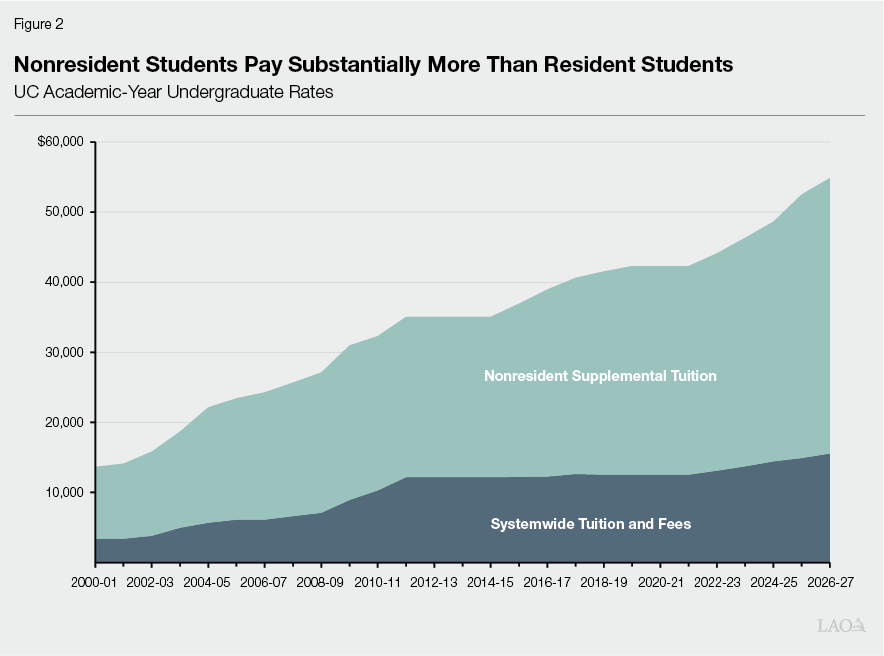
Undergraduate NRST Rate Is the Same Across All UC Campuses. To date, the Regents have set undergraduate tuition and fee rates that do not vary by campus. (Campuses have discretion to set campus‑specific fees, but these fees tend to comprise a somewhat small share of total tuition and fee rates.) The Regents have set the 2026‑27 systemwide undergraduate tuition and fee rate at $15,588 for resident students and $54,848 for nonresident students (of which $39,270 is the NRST rate). All of these rates are 4.4 percent higher than the previous year. In 2026‑27, the total undergraduate nonresident rate is about 3.5 times higher than the resident rate. Since 2000, the total undergraduate nonresident rate has been as low as 3 times more and as high as 4.2 times more than the resident rate (Figure 2).
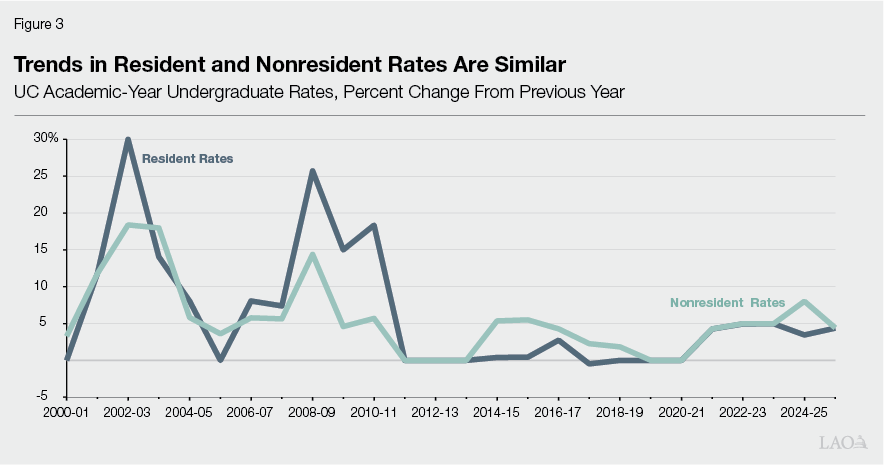
Undergraduate Resident and NRST Rates Have Similar Historical Trends. Since 2000‑01, on an average annual basis, resident rates have increased by 6 percent, whereas nonresident rates have increased by 5.4 percent. As Figure 3 shows, the most notable difference between the trends is that resident rates were somewhat more volatile than nonresident rates over the first half of the period. The larger percent increases in resident rates prior to 2012 reflect the fiscal effects of two major economic downturns—the dot‑com bust (2001‑02) and the Great Recession (2008‑09). During those downtowns, state funding for UC declined, and resident rates increased more significantly than nonresident rates. Over the second half of the period—a period generally of economic expansion—both resident and nonresident rates increased more slowly, with nonresident rates tending to outpace resident rates.
Analysis
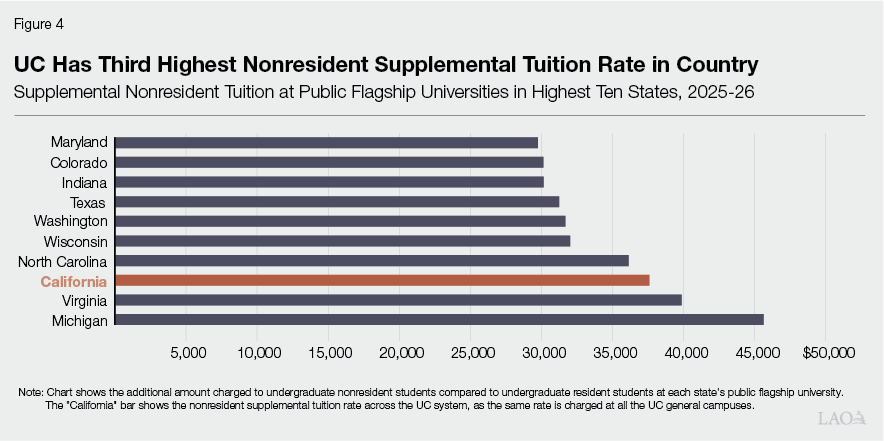
UC’s Nonresident Tuition Rates Rank Third Highest Among Public Flagship Universities. UC’s practice of charging nonresident students more than resident students is common across the country, with all public university systems in the country charging nonresident students higher rates—typically much higher rates—than resident students. For comparison purposes, Figure 4 focuses on public flagship campuses in each state. As Figure 4 shows, UC charged nonresident students about $38,000 more than resident students in 2025‑26—ranking it third highest in the country. Only the University of Virginia, Charlottesville (charging about $40,000 more) and University of Michigan, Ann Arbor (charging about $46,000 more) have larger differences between what they charge nonresident and resident students. Nationally, the average difference between the two rates in 2025‑26 was about $24,000. The smallest difference was about $4,000 at the University of South Dakota.
Public Flagship Campuses Commonly Charge Higher Nonresident Rates. While UC sets a uniform undergraduate nonresident rate across its nine general campuses, flagship campuses in other public university systems typically charge higher nonresident rates than other campuses within the same system. For example, in 2025‑26, nonresident rates at the flagship University of Michigan, Ann Arbor campus are more than 4.5 times higher than the nonresident rates at the Flint campus. Similarly, nonresident rates at the flagship University of Wisconsin, Madison campus are more than double the nonresident rates at the Milwaukee and Eau Claire campuses.
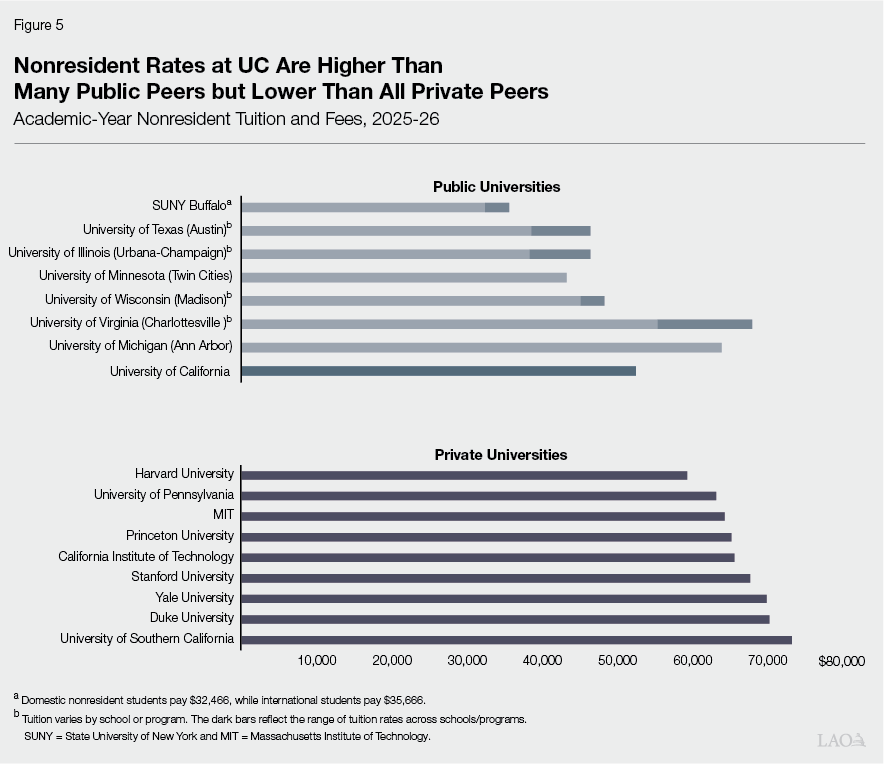
UC’s Nonresident Tuition Rates Are Lower Than Private Peer Universities. Rather than comparing itself to only public flagship universities, UC typically prefers to compare itself to a set of more selective public and private universities. As Figure 5 shows, UC’s nonresident rates are higher than most of the identified public peer universities but lower than all identified private peer universities. In 2025‑26, UC’s total nonresident rate was about $53,000, compared to an average of $45,000 at public peer universities and $67,000 at private peer universities.
Net Price, However, Tends to Be Lower at Private Peer Universities Than at UC. Although research generally finds that published tuition rates (sticker price) are an important factor affecting students’ enrollment decisions, we also examine net price (that is, the total cost of college attendance after accounting for financial aid). While private peer universities charge higher tuition rates than UC, they offer more financial aid, such that they have notably lower net prices. The net price paid by undergraduates at private peer universities averages about $23,000 for the academic year. (Unfortunately, the available data is not broken down for resident, domestic nonresident, and international students.) By comparison, the net price paid by nonresident undergraduates at UC averages nearly $68,000 for the academic year. Though the net price is lower at private peer universities, these universities generally have very low admission rates (3 percent to 6 percent), meaning many nonresident students might turn to other higher‑cost university alternatives.
Enrollment Demand of Nonresident Students Varies Significantly Across UC Campuses. Despite net price being higher at UC for many nonresident students, a large number of nonresident students (nearly 75,000) continue to apply. Moreover, the number of nonresident applicants at UC’s three highest‑demand campuses is higher than the remaining six UC campuses combined. As Figure 6 shows, the three highest‑demand campuses also had much lower admission rates for nonresident students than the other UC campuses (based on fall 2025 data). UC Berkeley and UCLA, for example, admitted less than 10 percent of nonresident applicants, compared to UC Davis admitting nearly 60 percent of nonresident applicants. The three highest‑demand campuses also have the highest nonresident yield rates. Among UC campuses, Berkeley has the highest yield rate among nonresidents—meaning a relatively high share of nonresident admits go on to enroll at the Berkeley campus.
Figure 6
Highest‑Demand Campuses Have Lower Admit Rates and Higher Yield Rates
Freshmen, Fall 2025
|
Applications |
Admit Rate |
Yield Ratea |
||||||
|
Residents |
Nonresidents |
Residents |
Nonresidents |
Residents |
Nonresidents |
|||
|
Systemwideb |
130,896 |
74,493 |
77% |
65% |
42% |
22% |
||
|
Berkeley |
72,685 |
54,145 |
14 |
8 |
51 |
38 |
||
|
Los Angeles |
89,350 |
55,710 |
10 |
9 |
58 |
31 |
||
|
San Diego |
87,574 |
49,153 |
25 |
34 |
25 |
14 |
||
|
Davis |
68,959 |
34,029 |
37 |
59 |
21 |
7 |
||
|
Irvine |
86,250 |
37,973 |
22 |
44 |
26 |
9 |
||
|
Merced |
43,040 |
6,326 |
96 |
81 |
5 |
1 |
||
|
Riverside |
61,333 |
9,530 |
87 |
84 |
12 |
4 |
||
|
Santa Barbara |
74,659 |
35,514 |
32 |
51 |
16 |
7 |
||
|
Santa Cruz |
52,605 |
13,788 |
71 |
78 |
11 |
4 |
||
|
aThe “yield rate” is the share of admitted students that enrolls at the university. bReflects number of unique individuals. (Some individuals apply to more than one UC campus.) |
||||||||
Highest‑Demand UC Campuses Compete With Private Peers for Nonresident Students. Figure 7 shows that, for admitted domestic nonresident students, selective private universities (those that admit 50 percent or less of their applicants) are the most common destination, followed by the UC campus that admitted them. International students, however, are more likely to choose the UC campus over a selective private university—especially at Berkeley and UCLA. (Remaining nonresident students typically enroll at different public universities within the U.S. or remain abroad.)
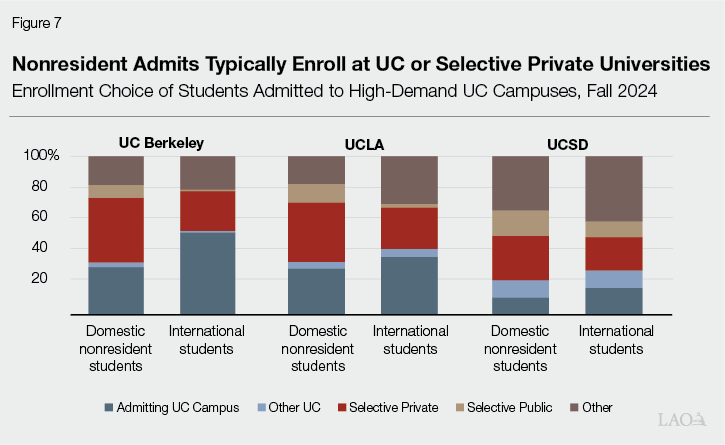
Past Research Finds Nonresident Enrollment Levels Do Not Decline as Nonresident Tuition Rates Rise. Existing academic research (a selection of which is listed at the end of this brief) finds that higher nonresident tuition rates are not associated with a decline in the share of nonresident undergraduate students at public universities in the country. That is, higher tuition rates do not appear to deter nonresident undergraduate students from enrolling. One reason this might be the case is that families could view a higher sticker price as an indicator of higher quality, which in turn could strengthen rather than weaken demand. Another reason this might be the case is student demand for selective universities is already so strong and admit rates so low, with many families willing to pay a higher rate to gain a coveted spot at one of UC’s high‑demand campuses.
Recent Trends Also Suggest Higher Tuition Rates Do Not Dampen Aggregate Nonresident Demand at UC. Between fall 2010 and fall 2025, applications from nonresident students more than quadrupled at UC Berkeley and UCLA, while increasing six‑fold at UCSD. These large increases came even as NRST and total nonresident charges rose. (Total nonresident charges rose 58 percent in unadjusted terms and by 4 percent after adjusting for inflation.) Our own econometric analysis also finds that a higher NRST rate is not correlated with nonresident enrollment declines at UC. (We examined UC undergraduate enrollment and tuition data from 1994 to 2024, while controlling for certain factors, such as financial aid, the admission rate, and the average tuition charges at peer universities.) This UC‑specific finding is consistent with broader past research that also has found nonresident enrollment levels are not price sensitive. Though not price sensitive in the aggregate, we recognize some nonresident students could be deterred by a higher tuition rate. In the aggregate, however, such a student likely is being replaced by another nonresident student willing to pay the higher price, reflecting the large pool of nonresident applicants.
A Benefit of Differential Tuition Rates Is Generating More Tuition Revenue. Rather than having a uniform NRST rate that applies to all UC campuses, the Regents could charge different NRST rates at one or more UC campuses. Differential tuition rates could be structured in such a way that UC raises more total tuition revenue. In turn, UC could use this additional tuition revenue for its core operations—to cover basic cost increases or enhance or expand programs. Alternatively, the state could reduce state funding for UC, such that UC’s core funding increases the same level as it would have without the new differential tuition rates. Under either scenario, the main benefit is raising more UC tuition revenue and doing so from nonresident students.
A Concern of Differential NRST Rates Is Their Potential Impact on Nonresident Students. Setting higher undergraduate NRST rates at certain UC campuses could impact the composition of the nonresident undergraduate student body at those campuses. For example, higher NRST rates would raise the cost for many nonresident students, which could shift enrollment toward wealthier applicants.
Recommendations
Recommend Piloting Higher NRST Rate at the Three Highest‑Demand Campuses. We recommend the Legislature request UC to pilot an increase to the NRST rate for new nonresident undergraduate cohorts at UC Berkeley, UCLA, and UCSD. Though Berkeley and UCLA are notably more selective than UCSD among nonresident students, we encourage the Legislature to include UCSD in the pilot, as it could help inform the possibility for further differentiating NRST rates (for example, subsequently applying a higher rate to the Irvine campus). Though the pilot could begin as early as 2026‑27, we recommend beginning it in 2027‑28 given UC already has published its 2026‑27 rates. We recommend running the pilot for four years, such that the impact on four cohorts of students can be examined. (We recognize that another option is to have different NRST rates for each UC campus based on its selectivity, but we think beginning with a two‑tier rate structure—a higher rate at the most selective UC campuses and a lower rate at the other UC campuses—makes for a reasonable, somewhat simpler pilot.)
Pilot Would Raise Tens of Millions of Dollars Over Next Few Years. If the Legislature decides to implement the two‑tier pilot, one option would be requesting UC to raise the NRST rate for 2027‑28 by roughly $6,000 at UC Berkeley, UCLA, and UCSD, compared to an increase of roughly about $2,000 at the other UC campuses. (These rates are 15 percent higher and 5 percent higher, respectively, than the 2026‑27 NRST rate.) Based on recent enrollment patterns, this increase would generate roughly $20 million in additional revenue in 2027‑28. As new cohorts are added over the next three years, the amount of additional revenue generated would ramp up—reaching about $80 million by year four. This additional revenue could be used to supplement core funds at UC or replace state General Fund in response to a state budget deficit or competing state budget priorities. (We note that a differential tuition policy could be enacted regardless of what the Legislature decides on UC’s nonresident enrollment levels. Whether the Legislature decides to lower, maintain, or raise nonresident enrollment levels at some or all UC campuses, differential tuition rates still could be structured in a way that generates more revenue compared to uniform tuition rates.)
Recommend UC Report Certain Data About Impacts of the Pilot. While the differential tuition pilot is in place, we recommend the Legislature have UC collect and report data on the impacts of the higher rates at the three selected campuses. In particular, we recommend UC collect the data to determine whether the higher NRST rates dampen enrollment demand among nonresident students, lower yield rates, or raise the household income levels of nonresident students. UC also could leverage survey data it already collects from students who decline a UC admission offer. That existing survey asks students to report the primary reason for declining UC admission (with one response option being “financial reasons”). Additionally, that survey asks students to report where they decided to enroll instead of UC. Upon completion of the four‑year pilot, UC could summarize key lessons learned and identify potential future modifications to the NRST rate structure.
References
Adkisson, R. V. & Peach, J. T. (2008). “Non‑resident Enrollment and Non‑resident Tuition at Land Grant Colleges and Universities.” Education Economics, 16(1): 75‑88.
Curs, B. R., & Jaquette, O. (2017). “Crowded Out? The Effect of Nonresident Enrollment on Resident Access to Public Research Universities.” Educational Evaluation and Policy Analysis, 39(4): 644‑669.
Horner, O. G., Williams‑Wyche, S., & Marsicano, C. (2023). “Out‑of‑State Tuition Premiums at Public Four‑Year Institutions: Trends and Impacts.” Midwestern Higher Education Compact.
Leslie, L. L. & Brinkman, P. T. (1988). The Economic Value of Higher Education. American Council on Education/Macmillan Series on Higher Education. Macmillan Publishing, 866 Third Avenue, New York, NY 10022.
Levine, P. B., Ma, J., & Russell, L. C. (2023). “Do College Applicants Respond to Changes in Sticker Prices Even When They Don’t Matter?” Education Finance and Policy, 18(3), 365‑394.
Millea, M. & Orozco‑Aleman, S. (2017). “Estimating Tuition Elasticities of Resident and Non‑resident Enrollments at South‑Eastern Public Universities.” Applied Economics, 49(21): 2027‑2040.
Mixon Jr, F. G. & Hsing, Y. (1994). “The Determinants of Out‑of‑State Enrollments in Higher Education: A Tobit Analysis.” Economics of Education Review, 13(4): 329‑335.
Noorbakhsh, A. & Culp, D. (2002). “The Demand for Higher Education: Pennsylvania’s Nonresident Tuition Experience.” Economics of Education Review, 21(3): 277‑286.
Rizzo, M. J. & Ehrenberg, R. G. (2004). “Resident and Nonresident Tuition and Enrollment at Flagship State Universities.” In C. M. Hoxby (Ed.), College Choices: The Economics of Where to Go, When to Go, and How to Pay For It (pp. 303‑354). University of Chicago Press/National Bureau of Economic Research.