Natalie Gonzalez

March 25, 2026
The 2026-27 Budget
California Education Learning Lab
Summary
Created in 2018, the California Education Learning Lab (Learning Lab) provides competitive grants to faculty teams, generally including faculty from at least two of the three public higher education segments. The grants support innovation and improvement in lower-division courses, with an emphasis on science, technology, engineering, and mathematics (STEM) courses. The 2025-26 state budget agreement indicated intent to end this program in 2026-27. The Governor’s budget proposes providing $4 million ongoing General Fund to retain Learning Lab. Although Learning Lab grants have had a positive impact for some faculty and students in certain courses at some campuses, we recommend rejecting the Governor’s proposal. Learning Lab projects are challenging to scale, duplicate professional development efforts at the public higher education segments, and are not as broad or integrated as those segments’ efforts. Additionally, faculty can apply for similar grants offered by federal, philanthropic, and corporate sources.
Introduction
In this post, we first provide background on Learning Lab. We then discuss the Governor’s proposal to continue the program, assess the proposal, and provide an associated recommendation.
Background
Learning Lab Is Intended to Support Teaching and Learning. In 2018, the state established Learning Lab. The purpose of Learning Lab is to improve learning outcomes and help close equity gaps, particularly in STEM, at California’s public higher education segments. To this end, Learning Lab awards competitive grants to intersegmental faculty teams at the University of California (UC), California State University (CSU), and California Community Colleges (CCC). Faculty teams test ways to improve learning outcomes in college-level lower division courses, including by using adaptive learning technology. Beyond awarding grants, Learning Lab undertakes various other activities, including hosting webinars and podcasts, curating a public resource library, and facilitating higher education convenings.
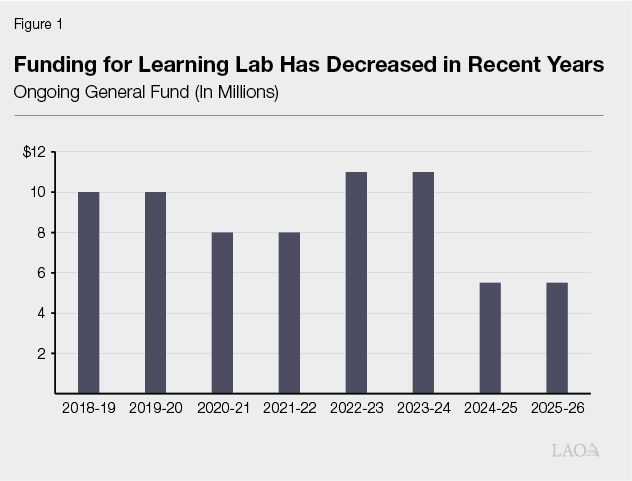
Learning Lab’s Funding Has Been Reduced Over Time. When originally created, Learning Lab was placed in the Governor’s Office of Planning and Research (OPR). The 2018-19 budget provided OPR with $10 million ongoing General Fund for Learning Lab. As Figure 1 shows, Learning Lab’s ongoing funding has fluctuated somewhat over time. In 2024-25, the state reduced Learning Lab’s ongoing General Fund to $5.5 million. Additionally, in 2024-25, the state restructured OPR and split it into two new offices: the Governor’s Office of Service and Community Engagement and the Office of Land Use and Climate Innovation (LCI). As part of this restructuring, Learning Lab became part of LCI. In 2025-26, the state maintained $5.5 million General Fund for Learning Lab but indicated intent to end the program in 2026-27. Beyond state support, Learning Lab has received a total of about $400,000 in one-time funding from philanthropic organizations (used mostly for convenings and faculty development).
Most of Learning Lab’s Funding Is for Grants. From its inception through January 2026, Learning Lab has awarded 120 grants totaling $56 million. Grants are awarded through a competitive review process with a focus on merit, statewide relevance, and potential impact. The average award is $465,000. The grant duration varies from eight months to five years with most grants lasting two to three years.
Grants Support Faculty Time for Innovation. Grants are awarded to UC, CSU, and CCC faculty. Most grants require faculty from at least two campuses across at least two segments to collaborate. Grant funding primarily supports faculty time to work on innovative projects that leverage technology to improve learning outcomes, primarily in STEM courses. Examples of projects include creating an artificial intelligence (AI)-assisted technology platform for undergraduate chemistry students, developing professional development tools for data science faculty, and redesigning an introductory calculus course to improve pass rates. All funded projects are required to make open educational resources that are shared on Learning Lab’s public resource library.
Learning Lab Contracts With Foundation. In 2020, Learning Lab entered into an agreement with the Foundation for California Community Colleges (the Foundation) for certain administrative services and staffing support. Currently, Learning Lab has five program staff employed by the Foundation. In 2024-25, Learning Lab used about 15 percent of its state General Fund support to cover associated Foundation costs. In addition, Learning Lab has one program director employed by LCI. About 10 percent of program funding is used by LCI for related program administration including for various operating expenses, such as special projects and travel.
Program Staff Are Mainly Responsible for Grant Management. The Learning Lab program director and Foundation staff manage grants and work with grantees throughout the grant process. This work includes developing requests for proposals, evaluating project proposals, executing grant agreements, monitoring project progress, and closing out grants upon their expiration. Program staff also coordinate special initiatives and activities such as hosting intersegmental meetings, overseeing the public resource library, and writing annual reports. (Under statute, Learning Lab is required to submit an annual report to the Legislature on its grant awards.)
Learning Lab Is in Midst of Conducting New Grant Round. Learning Lab plans to issue another round of grants using its 2025-26 funding. Learning Lab indicates these grants will operate through June 2028 and will focus on semiconductor design, public interest technology, quantum science, and agriculture technology. Apart from this grant round, Learning Lab had begun analyzing how to ramp down its activities consistent with last year’s agreement to stop funding the program beginning in 2026-27.
Governor’s Proposal
Governor Proposes Retaining Learning Lab and Shifting to Government Operations Agency (GovOps). Counter to last year’s budget agreement, the Governor proposes $4 million ongoing General Fund in 2026-27 to retain Learning Lab. (This is $1.5 million less than Learning Lab received in 2025-26.) The administration has indicated that its reason for proposing to retain the program is because it provides tailored grant opportunities to stimulate faculty-led innovations in areas aligned with state priorities. The Governor also proposes to shift Learning Lab from LCI to GovOps. Although GovOps has no particular expertise in education matters, the administration indicates it might make a better place for Learning Lab than LCI because of its emphasis on interagency collaboration and technology. Additionally, GovOps oversees other programs involving higher education, including the California Education Interagency Council and the Cradle-to-Career Data System. Under the Governor’s proposal, Learning Lab indicates GovOps would support the one program director formerly under LCI and the Foundation would continue to provide the remaining program staff.
Assessment
Learning Lab Benefits Some Faculty and Students. Learning Lab grants have provided professional development opportunities for some faculty at each of the three public higher education segments. Learning Lab also recently launched its public resource library that some faculty might find useful in improving their courses. Learning Lab grants, in turn, have helped improve some student learning outcomes and narrowed equity gaps in certain courses at certain campuses. For example, some Learning Lab projects have resulted in higher pass rates for certain STEM courses while other projects have been linked to improving students’ motivation and sense of belonging.
Projects Are Challenging to Scale. Each Learning Lab grant focuses on a specific project at a few campuses. For example, faculty from one UC campus and one CSU campus may be awarded a Learning Lab grant to improve calculus pass rates by making the curriculum more engaging for students. No avenue is in place, however, to scale these efforts. Notably, across higher education, faculty are given broad discretion in selecting the curriculum and methods they use for any given course. This creates a fundamental barrier to scaling specific course curricula or implementing redesigned pedagogies, as faculty are not required to adopt them.
There Are Opportunities to Achieve Same Objectives Within Each Segment. UC, CSU, and CCC also are focused on improving learning outcomes for students. One way they routinely do this is by providing opportunities for faculty professional development. A few of these existing opportunities are:
UC faculty have access to teaching and learning centers where they receive support related to course redesign and creating more inclusive pedagogy to improve student outcomes, including in STEM courses. For example, UC Los Angeles’s Center for Education Innovation & Learning in the Sciences hosts a fellows program for faculty interested in redesigning their physical sciences courses to reduce equity gaps.
CSU has grant programs that support innovative education and faculty development to improve courses. For example, CSU’s Artificial Intelligence Educational Innovations Challenge supports faculty-led projects that test new teaching methods that incorporate AI, including projects focused on STEM courses. Additionally, as part of its Graduation Initiative 2025 (GI 2025), CSU campuses have worked to redesign courses and provide faculty development to build pedagogies that emphasize active learning to improve student outcomes, especially for underrepresented minority and first-generation students. As part of this initiative, CSU has held systemwide convenings for faculty and administrators to share best practices.
CCC faculty receive a certain number of flex days so they can take time outside of teaching to pursue professional development activities, including developing new course designs, tools, and materials. Additionally, the state provides CCC with funding for various categorical programs (such as the Student Equity and Achievement Program) that focus on improving student outcomes and closing equity gaps.
Segments’ Efforts Are Likely to Yield Broader and More Integrated Results. Learning Lab considers one of its key benefits that it fosters intersegmental collaboration across California’s public higher education system. Learning Lab projects, however, are limited to a few faculty at a few campuses. By comparison, the segments participate in larger-scale intersegmental projects. For example, all three segments participate in the Transfer Alignment Project to coordinate lower-division curriculum and streamline transfer pathways. Even the segment-specific work being done to improve learning outcomes is likely to have broader and more integrated results than Learning Lab’s projects. This is because work being done within a segment is more likely to affect an entire department, campus, or even the whole segment (through initiatives like CSU’s GI 2025). Moreover, each of the segments is required to track its learning outcomes, including its equity gaps. Furthermore, the community college formula for allocating state funding takes into account the outcomes of low-income students, such that colleges have a fiscal incentive to improve the outcomes of these students. These more fundamental accountability and fiscal provisions likely translate into the segments’ efforts having a more pervasive impact than Learning Lab.
Faculty Can Access Similar Funding Through Federal Grants. UC, CSU, and CCC faculty also can apply for federal grants that fund similar work to Learning Lab. For example, the National Science Foundation has provided grants to all three segments that focus on improving undergraduate STEM learning outcomes. Moreover, some federal grants provide opportunities for intersegmental collaboration. For example, CSU and CCC faculty have partnered on different grant projects administered by the U.S. Department of Education that aim to improve graduation rates and close equity gaps for STEM students. Similarly, UC Berkeley is receiving federal grant funding to work with community colleges to better serve transfer students in computer science and other related fields of study.
Recommendation
Recommend Rejecting Governor’s Proposal. We recommend rejecting the Governor’s proposal to retain Learning Lab. Though we recognize the benefits Learning Lab provides to some faculty and students, its grant-funded projects are challenging to scale and duplicate professional development opportunities at UC, CSU, and CCC. In addition, other similar grant opportunities exist that do not require state funding. Relative to the Governor’s budget, this recommendation results in $4 million ongoing General Fund savings. By reducing ongoing spending, this recommendation helps the state address its projected out-year deficits. As a final note, if the Legislature wanted to prioritize certain types of intersegmental efforts, it could direct the recently created California Education Interagency Council (which has representatives from each of the three segments as well as other workforce training providers) to look for these opportunities using federal, philanthropic, or corporate dollars. Those other fund sources traditionally have supported some efforts in this area and potentially could yield more than the small amount the state has been providing to Learning Lab.