Lisa Qing

March 25, 2026
The 2026-27 Budget
Bureau for Private Postsecondary Education
Summary
The Bureau for Private Postsecondary Education (BPPE) regulates private postsecondary institutions in California. Like other regulatory agencies, BPPE charges fees to the entities it oversees and deposits the revenues into a special fund that supports its operations. BPPE’s special fund has a longstanding structural deficit, with expenditures exceeding revenues annually since 2014-15. The Governor’s budget provides $10 million one-time General Fund for BPPE. The appropriation is intended to mitigate BPPE’s structural deficit by allowing it to repay a recent special fund loan it received to cover litigation costs. We recommend rejecting the proposal, as the existing special fund loan addresses BPPE’s near-term costs and shifting those costs to the General Fund would come at the expense of supporting other core state programs or building fiscal resiliency. We further recommend the Legislature address BPPE’s underlying structural deficit during the sunset review process this spring. As part of the sunset review, the state could approve fee increases to ensure the regulatory agency can cover its costs and be fiscally solvent in the years to come.
Introduction
Post Focuses on BPPE. In this post, we begin by providing background on BPPE and its budget. We then describe the Governor’s proposal to provide $10 million one-time General Fund for BPPE in 2025-26, assess that proposal, and make an associated recommendation.
Background
BPPE Regulates Private Postsecondary Institutions. BPPE is one of many regulatory agencies within the Department of Consumer Affairs (DCA). BPPE’s main responsibilities include licensing private postsecondary institutions to operate in California, monitoring their business practices, and resolving student complaints. Currently, it oversees more than 1,500 private postsecondary campuses located throughout the state.
BPPE’s Operations Are Supported by a Special Fund. BPPE deposits revenue into the Private Postsecondary Education Administration Fund (BPPE Fund). Like other regulatory agencies, BPPE receives revenue from various fees paid by the entities it oversees. The largest of these fees is an annual licensing fee, which accounts for more than 90 percent of the revenue in the BPPE Fund. This annual fee is currently set at 0.55 percent of each campus’s total revenue from California students, with a minimum fee of $2,500 and a maximum fee of $60,000 per campus. BPPE also charges several smaller fees, including fees for institutions to apply for, renew, or make changes to their licenses. The Legislature sets BPPE’s fees in statute. The last time the Legislature adjusted these fees was during BPPE’s 2016 sunset review, when it changed the structure of the annual licensing fee, among other changes. Those changes were fully implemented by July 1, 2018. Since then, revenues in the BPPE Fund have been roughly flat in unadjusted dollars. Adjusting for inflation, revenues were 18 percent lower in 2024-25 than in 2018-19.
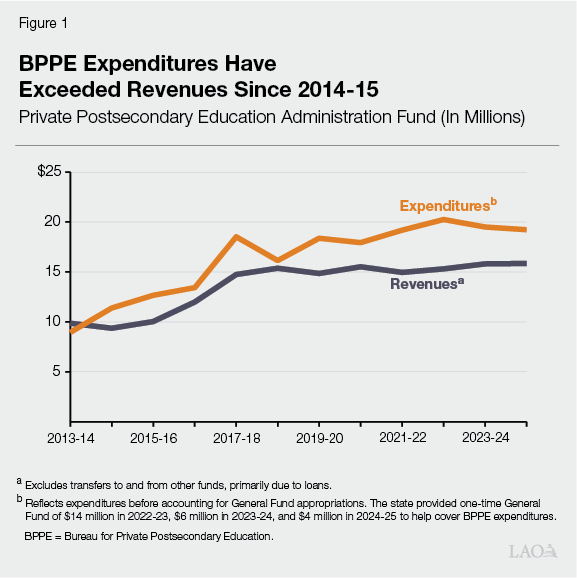
BPPE Fund Has a Structural Deficit. As Figure 1 shows, expenditures from the BPPE Fund have exceeded revenues annually beginning in 2014-15. This trend is counter to the typical expectation that regulatory agencies’ fees cover their costs. As a result of BPPE’s structural deficit, the state has taken several actions to keep the BPPE Fund solvent in recent years. Most notably, in 2021-22, DCA issued a $12 million loan to the BPPE Fund from the Bureau of Automotive Repair’s Vehicle Inspection and Repair Fund. (Control Section 14.00 of the annual budget act authorizes DCA to issue loans between the special funds it oversees.) The 2022-23 budget then provided BPPE with $24 million one-time General Fund over three years to repay this loan and cover its operational costs while BPPE developed a proposal for a new fee structure. BPPE submitted a report to the Legislature in February 2024 containing recommendations for fee increases. Consistent with that report, BPPE is now seeking legislative approval for fee increases as part of its sunset review this spring. Most notably, under BPPE’s proposal, the annual fee would increase to 0.75 percent of each campus’s total revenue from California students, with a minimum fee of $4,000 and a maximum fee of $80,000 per campus. The proposed increase in the maximum fee is roughly in line with inflation since the last time it was raised.
BPPE Recently Took Out a Loan to Cover Litigation Costs. In 2025, BPPE incurred $10 million in costs associated with an employment lawsuit, consisting of a $4 million jury award to the plaintiff and $6 million in plaintiff’s attorney fees. To cover these costs, DCA issued a $10 million loan to the BPPE Fund from the Bureau of Automotive Repair’s High Polluter Repair or Removal Account in December 2025. While loans issued under Control Section 14.00 typically must be repaid within two years, the 2025-26 Budget Act included provisional language extending the repayment period for any loans to the BPPE Fund until June 30, 2032. Under this time line, the administration estimates BPPE would make annual payments of $1.9 million from 2026-27 through 2031-32, with those payments totaling $11.5 million (including interest) across the six-year period.
Proposal
Governor Proposes to Provide General Fund Appropriation for BPPE in 2025-26. The Governor’s budget provides a $10 million one-time General Fund appropriation for BPPE in 2025-26 (to be implemented through the next round of amendments to the 2025-26 Budget Act). These funds would be used to repay the High Polluter Repair or Removal Account loan in full in the current year. This would effectively shift the litigation costs covered by that loan to the General Fund. The administration indicates the General Fund support is intended to mitigate BPPE’s structural deficit.
Assessment
No General Fund Appropriation for BPPE Is Needed in the Current Year. The administration has not demonstrated an immediate need for a current-year General Fund appropriation for BPPE. With the existing loan from the High Polluter Removal or Repair Account, the BPPE Fund can fully cover its expenditures and remain solvent in 2025-26. In addition, the High Polluter Repair or Removal Account does not need to be repaid in the current year. Even without repayment, that fund would have more than enough to cover its expenditures, with an estimated ending balance of $95 million (22 months of expenditures) in 2025-26.
Proposal Would Not Address BPPE’s Underlying Structural Deficit. As Figure 2 shows, the BPPE Fund is projected to become insolvent in 2027-28 regardless of whether the state provides the proposed General Fund appropriation. (This appropriation would have a small impact on BPPE’s near-term fiscal condition, as it covers loan repayment costs that would otherwise be spread across the next six years.) Furthermore, the state has already provided $24 million in General Fund appropriations to keep the BPPE Fund solvent in recent years. The state likely will need to continue providing periodic General Fund appropriations for BPPE unless its underlying structural deficit is addressed.
Figure 2
BPPE Fund Faces Insolvency Even Under Governor’s Proposal
Projected Fund Condition (In Millions)a
|
2025‑26 |
2026‑27 |
2027‑28 |
|
|
Current Law |
|||
|
Prior‑year fund balance |
$8.8 |
$5.9 |
$0.1 |
|
Revenues (+) |
15.6 |
15.9 |
15.8 |
|
Expenditures (‑) |
‑28.5b |
‑19.7 |
‑20.3 |
|
HPRRA loan (+) and repayment (‑)c |
10.0 |
‑1.9 |
‑1.9 |
|
Ending Fund Balance |
$5.9 |
$0.1 |
‑$6.3 |
|
Governor’s Proposal |
|||
|
Prior‑year fund balance |
$8.8 |
$5.9 |
$2.1 |
|
Revenues (+) |
15.6 |
15.9 |
15.8 |
|
Expenditures (‑) |
‑28.5b |
‑19.7 |
‑20.3 |
|
General Fund appropriation (+) |
10.0 |
— |
— |
|
Ending Fund Balance |
$5.9 |
$2.1 |
‑$2.5 |
|
aLoan repayment costs, 2027‑28 revenues, and 2027‑28 expenditures reflect estimates provided by the administration in December 2025. All other estimates come from the Governor’s budget. bIncludes $10 million in one‑time litigation costs. cReflects a $10 million loan from HPRRA in 2025‑26 that would be repaid in annual installments of $1.9 million from 2026‑27 through 2031‑32. |
|||
|
BPPE = Bureau for Private Postsecondary Education and HPRRA = High Polluter Repair or Removal Account. |
|||
Using General Fund to Cover Special Fund Costs Has Notable Drawbacks. BPPE is intended to function the same as other regulatory agencies—charging fees to cover its costs. For many regulatory agencies, these costs sometimes include legal settlements and other litigation costs. The General Fund is not intended to cover these costs. Using General Fund in place of special funds comes at the expense of supporting other core state programs (particularly ones that do not have the authority or ability to raise their own revenue). Moreover, using General Fund to cover litigation costs for BPPE sets a poor precedent, notably increasing the state’s General Fund exposure if other special fund agencies were to seek similar fiscal assistance. Furthermore, the General Fund currently is facing its own structural deficit, with its own spending exceeding revenues. Using $10 million one-time General Fund to cover BPPE’s costs leaves less funding available for other important purposes, including building fiscal resiliency through higher General Fund reserves.
Recommendation
Reject Proposal and Address BPPE’s Structural Deficit as Part of Sunset Review. Given the concerns above, we recommend the Legislature reject the proposed General Fund appropriation for BPPE in 2025-26. Furthermore, to remove the pressure for General Fund appropriations in future years, we recommend the Legislature address BPPE’s underlying structural deficit as part of the sunset review process this spring. The Legislature could approve a revised fee structure and associated fee increases to ensure the regulatory agency can cover its costs. BPPE’s fees have not been adjusted in nearly a decade and its associated revenue has not kept pace with inflation. The Legislature also could link BPPE’s statutory maximum annual fee to an inflation index so that structural deficits would be less likely to reemerge. While increasing fees would lead to higher costs for the institutions that BPPE oversees, we think it is unlikely that increases of the size BPPE is proposing would notably impact these institutions’ ability to operate in California and, in turn, student access to higher education. Beyond raising BPPE fees, the Legislature could consider ways to reduce BPPE’s expenditures, but this would likely require narrowing BPPE’s mission or otherwise scaling back its activities.