Sonja Petek

March 18, 2026
The Bay-Delta Plan and Voluntary Agreements:
Ensuring Effective Legislative Oversight
- Executive Summary
- Introduction
- Background
- Bay‑Delta Background
- State Is in the Process of Updating the Bay‑Delta Plan
- Sacramento/Delta Updates to Bay‑Delta Plan
- Key LAO Findings
- VAs Offer Theoretical Potential to Balance Multiple Competing Goals
- Implementation of VA Program Still Has Some Key Uncertainties
- Degree to Which Either Pathway Would Help Native Fish Recover Is Uncertain
- Despite Uncertainties, Timely Action Is Needed to Protect the Bay‑Delta Watershed
- Ensuring Effective Legislative Oversight
- Essential Qualities of Focused, Ongoing Oversight and Why It Is Important
- Key Issues and Tools for Legislative Oversight
- Conclusion
EXECUTIVE SUMMARY
Background
Bay‑Delta Plan Updates Needed for Protection of Fish and Wildlife. The State Water Resources Control Board (SWRCB) is in the process of updating the Water Quality Control Plan for the San Francisco Bay‑Sacramento‑San Joaquin Delta (Bay‑Delta Plan). This regulatory plan establishes enforceable water quality standards—such as flow requirements—to protect beneficial uses of water (including municipal, agriculture, and fish and wildlife) in the Bay‑Delta and the Sacramento and San Joaquin Rivers and their tributaries. These waterbodies are an important source of drinking and agricultural water around the state. The Bay‑Delta system is culturally and spiritually significant for a number of native tribes and central to their traditional diets. In addition, this watershed provides vital habitat for hundreds of species of fish and wildlife. SWRCB is making updates because the plan has not adequately protected fish and wildlife, including several species of threatened and endangered native fish.
Proposed Sacramento/Delta Updates Incorporate Voluntary Agreements (VAs). SWRCB is updating the Bay‑Delta Plan in two phases. Phase one—adopted, but not yet implemented—concerned the Lower San Joaquin River and its tributaries and salinity objectives for the Southern Delta. Phase two—the focus of this report—concerns the Sacramento River and its tributaries, Delta eastside tributaries, and the Delta. SWRCB has proposed two compliance pathways for most Sacramento/Delta water users. One pathway—VAs—would apply to most of the water use in the watershed. The VAs reflect negotiated commitments among certain water agencies, the State Water Project, federally run Central Valley Project (CVP), and state agencies to provide flows, habitat restoration, and funding as an alternative to typical top‑down regulatory requirements. The other pathway—more traditionally regulatory—would apply to water users that do not choose to be part of the VA program. Key features of the two pathways include:
- VA Pathway Includes Flows and Habitat Projects. VA parties would provide additional flows to stay within the rivers—including from water purchases—above a set baseline amount, and complete roughly 47,000 acres of habitat restoration projects. The VA program—also known as the Healthy Rivers and Landscapes Program—would last eight years and could be extended if SWRCB determines it has been effective. Estimated implementation costs for habitat projects and water purchases total about $3 billion and would be shared by the state (paying about half), water users, the federal government, and the CVP. VAs would become binding commitments—not voluntary—upon SWRCB’s adoption of the updated Bay‑Delta Plan. (The term “voluntary” derives from the fact that the parties came together voluntarily to develop an alternative approach.)
- Regulatory Pathway Uses an Unimpaired Flows Approach. For water users that are not part of the VA program, the regulatory pathway would require 55 percent of unimpaired flows to be maintained in rivers year‑round. (Unimpaired flow refers to the estimated natural flow that would occur absent human alterations such as dams, reservoirs, or diversions.) This percentage of unimpaired flows could be lowered to 45 percent or 35 percent in certain water supply circumstances.
Key LAO Takeaways
Long Delays in Updating the Bay‑Delta Plan Further Threaten Native Fish. The Bay‑Delta watershed supports residents, farms, tribes, fish, wildlife, and businesses, yet its ecosystem has been significantly compromised over the years. The current Bay‑Delta Plan has not provided adequate protection of all beneficial uses, and long delays in updating the plan further threaten native fish. Making near‑term progress on updating the plan is a critical step in beginning to reverse these trends.
Board Likely to Adopt VAs, Which Theoretically Could Balance Multiple Competing Goals… Although it has not formally adopted updates to the Bay‑Delta Plan, SWRCB has signaled its intent to move forward with the VA approach. While SWRCB’s regulatory tools—focused on flows and diversions—are essential, they cannot directly compel habitat restoration and, on their own, likely would not be able to fully restore fish populations or ecosystem health. In this context, the VA approach could theoretically offer some benefits—somewhat increasing flows while also improving habitat. Moreover, VAs are more flexible than traditional regulations (allowing adaptation in closer to real time), have fewer adverse impacts on water users, provide more certainty to water agencies, and could be implemented more quickly.
…Yet Significant Uncertainties About VAs Remain. Despite their potential benefits, significant uncertainties about the VAs remain, including whether VA flows will be sufficient to support recovery of native fish. In addition, federal policy changes—including the CVP potentially pumping more water from the Delta—could undermine the VA parties’ ability to implement the plan. Given these considerable uncertainties, the VA program must be closely monitored.
Legislature Has Important Oversight Role. SWRCB is likely to adopt the updated Bay‑Delta Plan that includes VAs, potentially later this year. Given the high stakes for fish and water users, the Legislature can play a critical role in monitoring plan implementation. Because the VAs are designed to adapt as new information becomes available—and the board retains authority to terminate the VAs for some or all water users if they are not working as intended—performance will require ongoing evaluation. Legislative oversight can help ensure problems are identified and corrective action is taken when needed. To conduct its oversight, the Legislature could hold informational and/or oversight hearings, require reporting by SWRCB to the Legislature, require independent scientific evaluation of plan implementation and the VA pathway, and review how state funds are being spent. By holding SWRCB accountable to the Bay‑Delta Plan’s objectives and shining a light on the successes, challenges, and unintended consequences of the VA program, the Legislature can help ensure the state achieves its environmental and water management goals for this important watershed.
Introduction
The State Water Resources Control Board (SWRCB) develops and manages the Water Quality Control Plan for the San Francisco Bay/Sacramento‑San Joaquin Delta Watershed (Bay‑Delta Plan) under its regulatory authority provided by state and federal law. The Bay‑Delta Plan seeks to balance “beneficial uses” of water—including municipal and agricultural water supply and protection of fish and wildlife—primarily through establishing water quality and flow requirements. (Flow refers to the volume of water moving through rivers, streams, or the Delta and is typically measured in cubic feet per second.) More than two‑thirds of Californians and millions of acres of farmland rely on water from the Bay‑Delta watershed. Two massive water infrastructure projects—the State Water Project (SWP) and the Central Valley Project (CVP)—move water from the Delta to Central and Southern California for municipal and agricultural purposes. SWRCB currently is updating the Bay‑Delta Plan to improve protection of fish and wildlife. Its proposed revisions to the plan include a regulatory compliance pathway and incorporate an alternative framework known as the Voluntary Agreements (VAs), also known as the Healthy Rivers and Landscapes Program. The VAs represent a collaboration among water agencies and the state and federal governments to manage diversions, but also to implement habitat restoration projects—something that SWRCB alone cannot directly mandate under existing law.
The purpose of this report is two‑fold: (1) to provide background for the Legislature on the Bay‑Delta watershed, the Bay‑Delta Plan, and the VAs, and (2) to offer suggestions for how the Legislature can help ensure the state achieves its goals for the Bay‑Delta watershed as laid out in the proposed updates to the plan. Although updating the Bay‑Delta Plan is a regulatory—not legislative—process, the Legislature plays an important oversight role to help ensure that it is implemented as intended. Because of the Legislature’s role in the process, this report does not consider or provide recommendations about whether or not the board should adopt the VA pathway, nor does it provide a scientific or policy evaluation of which pathway—VA or regulatory—is better for the state. Rather, it assumes the board adopts the plan largely as currently proposed—and as recommended by board staff—and raises some key issues for the Legislature to consider as implementation begins.
This report has three major sections. We begin with background on: the Bay‑Delta; water quality control plans; the current process for updating the Bay‑Delta Plan; and specifics about the proposed updates, including details about the VAs. We then discuss key findings about the current draft plan update, highlighting the potential benefits of VAs, key uncertainties about implementation of VAs, questions about the potential effectiveness of VAs or regulatory changes to protect native fish, and the urgency of board action. We conclude with suggestions to support effective legislative oversight of the plan’s implementation.
Background
Bay‑Delta Background
In the section that follows, we describe the critical role of the Bay‑Delta watershed in supplying water for people and farms and in supporting ecosystems for many species of fish and wildlife. We then explain the nature of water quality control plans and how SWRCB uses the Bay‑Delta Plan specifically to manage diversions and flows in the watershed.
Importance of the Bay‑Delta Watershed
The San Francisco Bay and Sacramento‑San Joaquin Delta Watershed Drain About 40 Percent of the State’s Landmass. The Sacramento‑San Joaquin Delta is located at the confluence of two of California’s largest rivers—the Sacramento and San Joaquin—which flow through the Delta and San Francisco Bay out to the ocean. The Bay and Delta form one of the country’s largest estuaries (where fresh water mixes with salt water). Its greater watershed—including the Sacramento and San Joaquin Rivers and their tributaries (such as the Feather, American, Mokelumne, and Tuolumne Rivers)—drains water from about 40 percent of the state’s landmass. Figure 1 shows the extent of the watershed’s reach across the state.
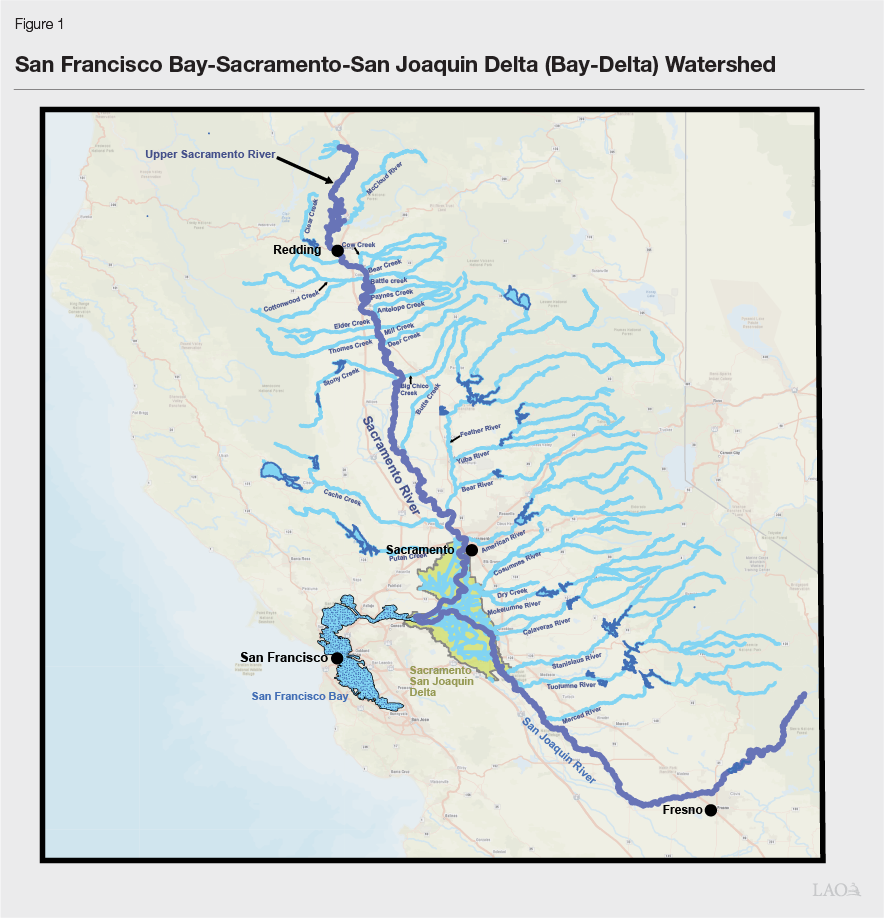
The Delta Has a Pivotal Role in Supplying Water Around the State. The Delta provides a portion of drinking water for more than 27 million people and agricultural water for more than six million acres of farmland. Two major water projects—the state‑run SWP and the federally run CVP—operate pumps at the southern end of the Delta to move water into canals which convey it to the Central Valley, coastal regions, and Southern California. The SWP provides water to 29 different public water agencies that enter into contracts to receive water (“contractors”) and the CVP provides water to more than 250 contractors (public water agencies, irrigation districts, local governments, and private farms/companies) in 29 counties. In addition, numerous water agencies, irrigation districts, and individual farmers use water upstream of and within the Delta. Delta supply is one critical piece of the water supply puzzle for many California water users. When Delta supply is lower, for example, reliance on groundwater increases, which can exacerbate groundwater overdraft and land subsidence issues.
The Delta Also Provides Vital Habitat to Hundreds of Fish and Wildlife Species. The Delta supports hundreds of fish and wildlife species, including migrating fish through the estuary and birds along the Pacific Flyway. Several species that depend on the Delta have been designated as threatened or endangered under state and/or federal statutory definitions, including winter‑run and spring‑run Chinook salmon, Central Valley steelhead, Delta smelt, longfin smelt, and the greater sandhill crane.
Bay‑Delta Watershed Holds Deep Tribal Significance. The Bay‑Delta is culturally and spiritually vital for a number of tribes and central to traditional diets. For example, the Shingle Springs Band of Miwok Indians maintains ties to multiple rivers, which are used for offerings, medicinal plant gathering, cultural education, and salmon harvests.
State Uses Bay‑Delta Plan to Help Balance Multiple Water Uses
Water quality control plans—including the Bay‑Delta Plan—are key tools the state uses to protect water quality and help manage water resources throughout the state. SWRCB implements the Bay‑Delta Plan primarily through rules about diversions and Delta exports.
State Has Public Trust Responsibilities for Protecting Waterways and Wildlife for All Californians. The public trust doctrine is a common law principle that requires the state to protect certain natural resources for the benefit of all people. In California, the doctrine applies to navigable waters, tidelands, submerged lands, streams, lakes, and associated wildlife and ecosystems. These responsibilities are reflected in the California Constitution and state law, which mandate the reasonable and beneficial use of water and prohibit waste and unreasonable use. Balancing the full range of beneficial uses—including drinking water, agriculture, fisheries, navigation, recreation, and environmental needs—requires the careful management of water rights, supply, and quality. This balancing act is growing increasingly complex due to the impacts of climate change, which are beginning to result in more severe and prolonged droughts, more intense floods, and more extreme wildfires—all of which threaten water reliability and ecosystem health.
Using Water Also Comes With Responsibilities. Under the public trust doctrine and California law, water is not privately owned, and water rights holders also have obligations. Water users are expected to avoid harming public trust resources and to mitigate environmental damage resulting from their operations.
Water Quality Control Plans Are a Key Mechanism for Regulating Water Quality. Under state and federal law, SWRCB—along with its nine Regional Water Quality Control Boards—develops water quality control plans to regulate and protect water quality in California’s major water basins, including the Delta.
These plans include three key elements:
- Identification of Beneficial Uses That the Plan Seeks to Protect. For example, plans typically designate municipal and domestic supply (such as drinking water for communities) as a beneficial use.
- Water Quality Objectives. These may be numeric or narrative and are intended to ensure reasonable protection of the identified beneficial uses. For instance, for municipal supply, a plan might include a limit on chloride concentration in source water.
- Program of Implementation. This outlines the actions needed to achieve those objectives, including a time line and monitoring plan.
Federal law mandates that SWRCB review these plans at least once every three years, while state law requires them to be “periodically reviewed.” Updating a plan typically involves several steps, including preparation of a staff report, which serves as a Substitute Environmental Document under the California Environmental Quality Act (CEQA). Other steps include preparing a scientific basis report, holding public hearings, putting the plan to a board vote, and obtaining final approval from the Office of Administrative Law. The U.S. Environmental Protection Agency (U.S. EPA) subsequently must review and approve the plans to ensure they comply with the federal Clean Water Act and contain enforceable, scientifically supported standards. Finally, for the Bay‑Delta Plan, SWRCB must either hold individual water rights proceedings or adopt regulations to effectuate the plan’s flow requirements for water users.
Both the state and federal governments require public participation throughout the plan review and update process. SWRCB must notify the public of proposed changes, hold public hearings, and consider and respond to written comments. The board also may hold workshops or informal meetings to gather input. Additionally, state policy (via executive orders and CEQA) directs agencies—including SWRCB—to consult with native tribes when decisions, such as updates to the Bay‑Delta Plan, may affect tribal interests.
Bay‑Delta Plan Applies to the Entire Watershed. The Bay‑Delta Plan identifies beneficial uses, sets water quality objectives, and prescribes a program of implementation for the entire watershed. SWRCB (rather than a regional board) manages the Bay‑Delta Plan because the watershed spans multiple regions and sets flow requirements. Regulating flows often affects water rights, which only the state board has the authority to manage. The plan works alongside two regional water quality control plans—the Central Valley and the San Francisco Bay Basin Plans—to align upstream and downstream water quality standards. Since the Bay‑Delta Plan’s original adoption in 1978, SWRCB has updated it several times—in 1991, 1995, 2006, and 2018. The last comprehensive update occurred in 1995 and largely guides management today. (The 1995 update concerned the entire Bay‑Delta watershed and included substantive changes to water quality objectives for fish and wildlife beneficial uses. By comparison, the 2006 update included relatively minor changes and the 2018 update concerned only one part of the watershed.) The 1995 plan’s water quality objectives are implemented and enforced through SWRCB’s Revised Water Right Decision 1641, which modified the water rights permits for the SWP and CVP.
The Bay‑Delta Plan is not the only tool that government agencies use to manage water in the region. The box below describes some of the primary ways that state and federal rules govern water use in the Bay‑Delta watershed and how they interact.
Numerous State and Federal Rules Govern Water Use in the Bay‑Delta Watershed
Water allocations from the San Francisco Bay‑Delta watershed depend not only on available supply from rainfall and snowmelt, but also on a complex framework of state and federal requirements contained in both statutes and administrative regulations. Congress and the state Legislature established the backbone for policies through laws such as the federal Clean Water Act and state Porter‑Cologne Water Quality Control Act. The U.S. Environmental Protection Agency, State Water Resources Control Board (SWRCB), and other agencies then implement these laws by adopting regulations to establish and enforce specific requirements.
- Water Rights (State). Use of water requires a valid water right—either riparian (for landowners next to a water source) or appropriative (for other users). Under the State Constitution, state statute, and the public trust doctrine, only reasonable and beneficial uses of water are allowed. When water is scarce, such as during droughts, California’s “first in time, first in right” system gives priority to water users with the most senior (oldest) water rights. SWRCB administers the water rights system.
- San Francisco Bay‑Delta Water Quality Control Plan (State). The Bay‑Delta Plan—the focus of this report—identifies beneficial uses of water in the watershed. It includes water quality objectives to protect the beneficial uses and a program of implementation to meet those objectives.
- Endangered Species Laws and Regulations (Federal and State).
- Biological Opinions (BiOps, Federal). Under the federal Endangered Species Act, the U.S. Fish and Wildlife Service and the National Marine Fisheries Service evaluate whether federal actions—such as Central Valley Project operations—jeopardize threatened or endangered species. For example, BiOps may restrict water exports or require mitigation, such as installing improved fish screens, to avoid or limit impacts on particular species. BiOps issued in 2024 currently are in effect.
- Incidental Take Permits (State). Under the California Endangered Species Act, water users may need an incidental take permit from the California Department of Fish and Wildlife. These permits often include conditions—such as diversion limits or implementing habitat improvements—to minimize the incidental “take” (killing or harm) of state‑listed threatened or endangered species.
- Dredge and Fill and Discharge Permits (State and Federal). The U.S. Army Corps of Engineers and SWRCB and its nine regional boards issue permits to regulate dredged and fill materials and discharge (pollutants and stormwater) entering waterways from cities, industries, and farms. These permits are based on regional water quality control plans, which in the Bay‑Delta include the Central Valley and San Francisco Bay Basin Plans.
- Curtailment Orders (State). When water supplies become critically low, such as during droughts, SWRCB can issue curtailment orders that temporarily reduce how much water users can divert. SWRCB applies these rules based on seniority, curtailing junior rights holders before senior rights holders.
- Delta Plan (State). The Delta Reform Act of 2009 established the Delta Stewardship Council and set two coequal goals for the Delta: providing a more reliable water supply for California and protecting, restoring, and enhancing the Delta ecosystem. The Council developed the Delta Plan (which is distinct from SWRCB’s Bay‑Delta Plan) to implement and enforce these goals. While the Delta Plan does not directly govern water allocation, it regulates activities that significantly affect water use, ecosystem health, and certain infrastructure projects in the Delta. For example, relevant projects—such as levee improvements or habitat restoration projects—must demonstrate consistency with the Delta Plan before they can proceed.
Regulating Flows Is SWRCB’s Primary Tool for Implementing the Bay‑Delta Plan. Managing flow amounts and timing is the main tool SWRCB uses to protect water quality under the Bay‑Delta Plan. The Bay‑Delta Plan also sets water quality objectives for salinity and temperature, which affect water quality and fish habitat, but similarly uses flow requirements as the primary method to manage these conditions. For example, increasing freshwater flows into the Delta reduces ocean salinity intrusion. SWRCB regulates flows mainly by managing water rights, which control how much water can be diverted out of the waterbody. SWRCB also can influence flows by ordering reservoir releases—for example, by requiring the CVP or SWP to release cold water from Shasta or Oroville dams, respectively, to lower downstream water temperatures during the critical spawning periods of endangered fish.
Although the Bay‑Delta Plan includes recommendations for other activities apart from flow amounts and timing that could protect beneficial uses (such as habitat restoration projects to support native fish populations), SWRCB can only encourage these efforts because it does not have direct regulatory authority to require them.
State Is in the Process of Updating the Bay‑Delta Plan
The last comprehensive update of the Bay‑Delta Plan occurred in 1995. SWRCB has been working to update the plan since 2009. The protracted time line reflects the complexity of balancing multiple— often competing—goals, ongoing and potential legal challenges, and the board’s willingness to allow time for development of a VA proposal. Below, we discuss why the Bay‑Delta Plan requires an update and how SWRCB has structured the process into two phases.
Reasons for Updating the Bay‑Delta Plan
Federal and state laws require that the Bay‑Delta Plan balance protection of multiple beneficial uses. In recent decades, however, implementation of the current plan has not adequately protected fish and wildlife. Citing well‑documented and extensive evidence of ecosystem decline in the Delta, SWRCB has been working for many years to update the plan with water quality objectives that would better support fish.
Long‑Term Downward Population Trends Threaten Survival of Native Fish. A species native to California, Chinook salmon are important to commercial and recreational fishing, central to many tribes’ cultural practices and traditional sustenance, and integral to the state’s biodiversity and natural ecosystems. Yet the number of salmon returning from the ocean and migrating through the Delta to spawn in rivers has been declining over time. As shown in Figure 2, since the last major update of the Bay‑Delta Plan in 1995, Chinook salmon have continued their downward trajectory. Salmon populations naturally fluctuate from year to year, however, they are particularly vulnerable to low river flows, droughts, predation, and loss of habitat. As shown in the figure, recovery from dry periods can take several years. As the state has begun to experience more severe and prolonged droughts, the Bay‑Delta Plan has not provided sufficient protection to support salmon health or notable recovery.
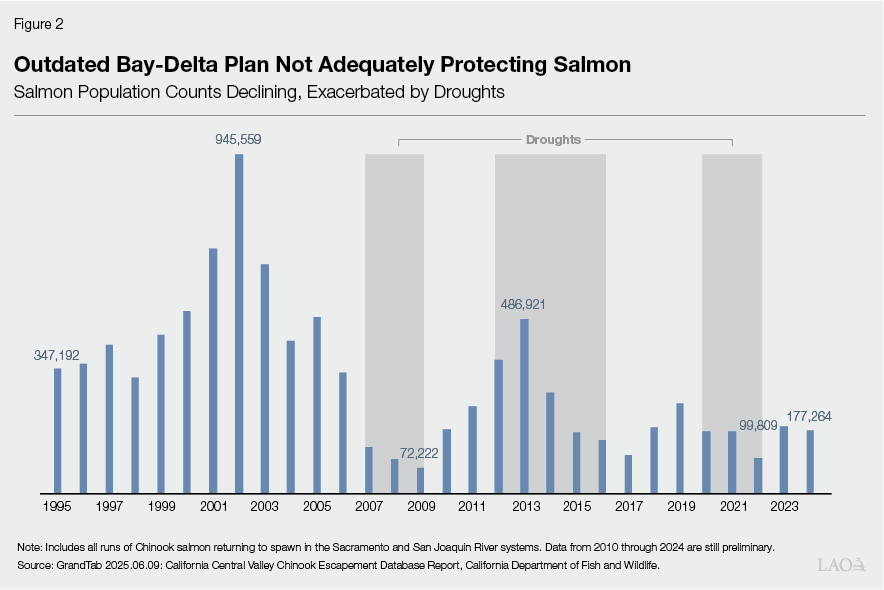
Populations of fall‑run Chinook—the state’s most abundant salmon run that supports commercial and recreational fishing—have declined by an average of 2 percent annually since 1995. (A “run” refers to the season in which the majority of adults return from the ocean to spawn.) Spring‑run and winter‑run Chinook salmon have been listed as threatened or endangered under federal and state law for more than 20 years. Populations remain low, however, with no measurable improvement since adoption of the 1995 Bay‑Delta Plan. In 2024, only about 2,900 spring‑run and 1,400 winter‑run Chinook were counted while returning from the ocean to spawn. These numbers represent about 25 percent and 8 percent, respectively, of their historic annual averages prior to being listed as threatened or endangered under state law. Other fish that migrate through or live in the Delta also are listed as threatened or endangered, including Central Valley steelhead and Delta smelt.
State Failing to Meet Goal for Doubling Natural Salmon Population. In 1992, the federal government enacted the Central Valley Project Improvement Act, requiring improvements in CVP management for the protection of fish and wildlife. The law included a goal of doubling the annual natural production of all runs of salmon relative to the annual average from 1967 through 1991. (Natural production refers to all salmon—whether they are caught or survive—that reach adulthood without the use of hatcheries.) The state added the doubling goal as a narrative water quality objective in the 1995 Bay‑Delta Plan. Doubling natural production relative to the average annual 1967‑1991 baseline would mean nearly 900,000 naturally produced salmon annually. According to estimates from the Delta Stewardship Council, California achieved only about 10 percent of the annual target on average between 2018 and 2023.
Recognition That Rivers Need More Water to Support Native Fish. Multiple different stressors have led to the declining health of the Bay‑Delta watershed, including physical modifications during the state’s early gold mining history and more recent impacts from climate change. However, many of the most significant challenges facing the watershed are directly linked to water use and diversion, including exports from the SWP and CVP. The watershed has been reshaped by a vast network of dams, pumps, levees, reservoirs, and engineered channels to support water storage, water delivery, and flood control. These facilities alter the volume, timing, temperature, salinity, and direction of natural water flows—often with harmful consequences for aquatic and riparian habitats—and create physical barriers that impede fish migration. One of several goals the Legislature expressed for the Delta through approval of the Delta Reform Act in 2009 (Chapter 5 [SB X7 1, Simitian]) was accelerating the process for determining flow needs to protect public trust resources. In a 2010 report, SWRCB concluded that “current flows are insufficient.” The report also acknowledged the need for non‑flow habitat improvements, noting that flow and physical habitat measures are not interchangeable. In its 2018 Bay‑Delta Plan update, SWRCB stated: “While multiple factors are responsible for the decline [of native fish species], the magnitude of diversions out of the Sacramento, San Joaquin, and other rivers feeding into the Bay‑Delta is a major factor in the ecosystem decline.” In several comment letters to SWRCB over the years—most recently in January 2025—the U.S. EPA has concurred that current flows are insufficient to protect fish, acknowledging that the Bay‑Delta watershed is in a state of ecological decline.
Current Requirements Are Limited in Scope. The Bay‑Delta Plan’s current requirements for protecting fish and wildlife beneficial uses remain limited in scope. For example, for the Sacramento River and its tributaries, flow requirements are measured only at the town of Rio Vista, which does not account for conditions upstream and in tributaries that are critical to fish survival. Moreover, responsibility for meeting these flow objectives falls almost entirely on the SWP (operated by the Department of Water Resources, DWR) and CVP (operated by U.S. Bureau of Reclamation, USBR). This is because most other water users in the Sacramento River watershed are not required to adjust their diversions to support these requirements. As a result, the SWP and CVP often have to compensate—particularly in dry years—for upstream depletions by other water users, placing a disproportionate burden on their operations and customers. This allows many diverters to operate without contributing to environmental flow needs. SWRCB is seeking plan updates in part to increase the breadth of protection in the watershed and to apply the plan’s requirements to more water users.
SWRCB Considering Latest Updates in Two Phases
SWRCB Began Process to Update the Bay‑Delta Plan in 2009, Proceeding in Two Main Phases. SWRCB officially began the most recent update to the Bay‑Delta Plan in early 2009. It divided the effort into two phases based on geography, noting that each of the two major river systems is fed by snowmelt from different geographic regions, receives differing levels of precipitation, has distinct topographies, and supports different at‑risk fish and wildlife species. SWRCB organized the update as follows:
- First Phase (Lower San Joaquin River/Southern Delta): Affects the Lower San Joaquin River and its three main tributaries—the Stanislaus, Tuolumne, and Merced Rivers—as well as the Southern Delta. The Lower San Joaquin River supports fall‑run Chinook salmon.
- Second Phase (Sacramento/Delta): Affects the Sacramento River and its tributaries, Delta eastside tributaries (the Calaveras, Cosumnes, and Mokelumne Rivers), the interior Delta, and Delta outflows. Four distinct runs of Chinook salmon—including the fall‑run and endangered winter‑run Chinook—depend on the Sacramento River and its tributaries.
SWRCB Adopted First Phase Amendments in 2018… SWRCB formally adopted the Bay‑Delta Plan amendments for the Lower San Joaquin/Southern Delta in 2018. The update includes two primary changes:
- Lower San Joaquin River Watershed Flow Objective to Protect Fish and Wildlife Beneficial Uses. For the Stanislaus, Tuolumne, and Merced Rivers, the amendment generally requires 40 percent of unimpaired flow from February through June. Unimpaired flow refers to the estimated natural flow that would occur absent human alterations such as dams, reservoirs, or diversions. Previously, the Bay‑Delta Plan did not include flow requirements for these three rivers but instead required a minimum volumetric flow at a single location on the mainstem of the San Joaquin River.
- Southern Delta Salinity Objective to Protect Agricultural Beneficial Uses. The 2018 amendment revised the salinity objective in the Southern Delta.
…But Implementation Has Yet to Begin. SWRCB has delayed implementing 2018 phase one amendments for two related reasons: litigation and consideration of a VA. Petitioners—including water agencies, environmental groups, and the federal government (as operator of the CVP)—challenged the amendments under CEQA and the public trust doctrine. Although the Sacramento Superior Court rejected all 116 claims in March 2024, petitioners have since appealed the decision. Separately, SWRCB also agreed to evaluate whether VAs could serve as an alternative to the regulations. The box below describes what a VA is. Ultimately, only Tuolumne River water agencies submitted a VA proposal. In September 2025, SWRCB released a scientific basis report for this VA proposal, but, as of this writing, has yet to release a staff report or propose associated plan amendments. Regardless of whether it incorporates the VA, the board will subsequently have to issue regulations or hold water rights proceedings to fully implement the plan’s new flow requirements.
What Is a Voluntary Agreement (VA)?
In water management, VAs—also sometimes referred to as settlement agreements—are negotiated arrangements among multiple parties to address water allocation, environmental flows, and ecosystem restoration. While VAs can result from litigation, they differ from regular court orders or traditional top‑down regulations in that the affected parties negotiate a settlement to try to achieve agreed‑upon objectives. Parties might include water agencies, irrigation districts, state and federal regulatory agencies, and/or environmental organizations. Each participant agrees to specific actions or concessions—such as water allocations, habitat restoration, flow contributions, and/or funding—in exchange for regulatory flexibility or other benefits. Some notable examples of previous VAs include: (1) the Quantification Settlement Agreement, adopted in 2003 to address longstanding disputes over Colorado River water rights and to reduce use of Colorado River water in California; (2) the San Joaquin River Restoration Settlement, agreed to in 2006 following an 18‑year legal dispute, with the goal of restoring fish populations while reducing adverse water supply impacts on farmers; and (3) the Mono Basin Stream Restoration Agreement to implement court‑ordered streamflow and restoration measures in the Mono Lake Basin beginning in 2013. In contrast to these historical examples, the proposed VAs for the Sacramento/Delta watershed were developed not directly in response to litigation but rather with the stated goal of trying to meet the needs of multiple interests and avoid future legal challenges.
SWRCB Has Not Yet Adopted Second Phase Sacramento/Delta Updates. The second phase of the planned Bay‑Delta Plan updates—which focuses on fish and wildlife beneficial uses in the Sacramento/Delta watershed—remains under development by SWRCB and has not yet been adopted. These updates have been delayed for more than a dozen years due to several factors. Chief among them was the board’s willingness to wait for a viable VA proposal from water agencies, state and federal agencies, and environmental groups based on the rationale that a collaboratively negotiated solution could reduce legal risk and foster broader support and compliance. In addition, the board faced internal capacity limitations as staff were redirected to address emergency drought response activities during multiple extended dry periods.
Sacramento/Delta Updates to Bay‑Delta Plan
The rest of this report addresses the phase two update for the Sacramento/Delta currently under consideration by SWRCB. In this section, we provide some history about the process and details about SWRCB’s proposed plan updates—which incorporate VAs and tribal cultural beneficial uses—and then describe the VA time line and oversight mechanisms. We conclude this section with a discussion of the potential economic impacts of the proposed plan updates.
Evolution of Current Sacramento/Delta Updates
SWRCB Began the Sacramento/Delta Update Process in 2012. As shown in Figure 3, SWRCB began the process of updating the phase two Sacramento/Delta portion of the Bay‑Delta Plan in 2012. After finalizing its scientific basis report in 2017, SWRCB released a framework in 2018 that proposed regulatory objectives for Sacramento/Delta inflows, cold‑water habitat, Delta outflows, and interior Delta flows. The board did not proceed with adopting these changes, however. Instead, it invited submission of a watershed‑wide VA proposal by March 1, 2019 that could potentially be adopted in lieu of the regulatory framework, and directed SWRCB staff to provide technical and regulatory information to support such efforts.
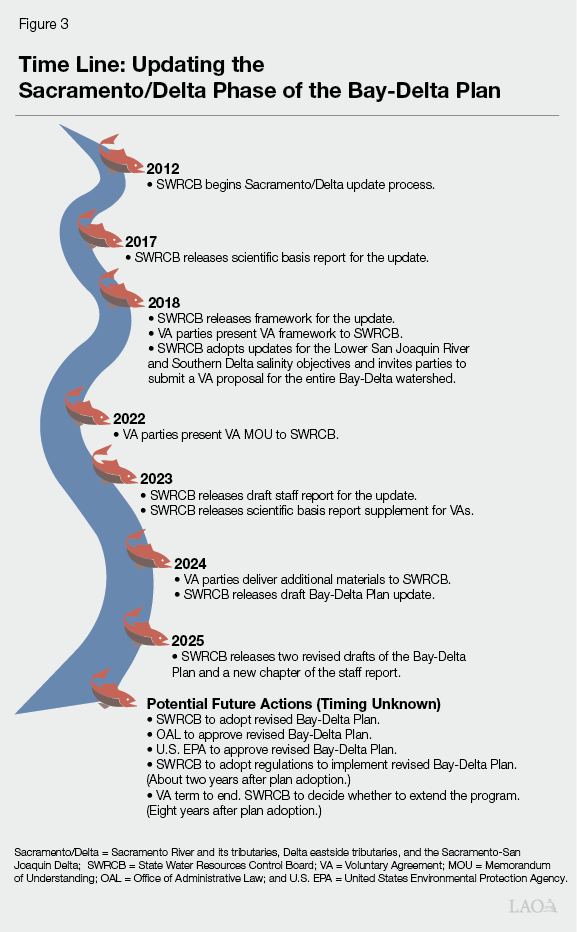
VA Parties Submitted an Alternative Proposal in 2022. Water users missed the 2019 deadline to submit a VA proposal to SWRCB. In March 2022, they came forward with an initial Memorandum of Understanding detailing terms to advance a VA for the Sacramento/Delta. Over the next two years, VA parties renamed the program “Healthy Rivers and Landscapes” and released additional materials and details, including plans for governance, science, flow accounting, non‑flow measure accounting, and funding. SWRCB posted all of these materials on its website.
Figure 4 displays current VA parties. (Some environmental groups participated in early VA discussions but later withdrew, and tribal participation has been limited. None of those groups or tribes participated in or signed on to the final agreement.) These VA parties would be responsible for meeting the VA program’s commitments. (Certain other water users on the relevant tributaries also would be covered by the VA program but not necessarily be responsible for implementing activities.) Notably, the water rights associated with the VAs account for most of the water use (roughly 85 percent) in the Sacramento/Delta watershed. Other water users in the watershed would remain outside of the VA program for various reasons. For example, they might obtain most of their water from another source, such as groundwater. Under the plan, these water users would follow a regulatory compliance pathway (as discussed in the next section).
Figure 4
Voluntary Agreement Partiesa
|
State and Federal Agencies |
|
California Environmental Protection Agency |
|
California Natural Resources Agency |
|
California Department of Fish and Wildlife |
|
California Department of Water Resources |
|
U.S. Bureau of Reclamation |
|
Water Agencies |
|
Contra Costa Water District |
|
East Bay Municipal Utility District |
|
Friant Water Authority |
|
Garden Highway Mutual Water Company |
|
Glenn‑Colusa Irrigation District |
|
Kern County Water Agency |
|
Metropolitan Water District of Southern California |
|
Nevada Irrigation District |
|
Reclamation District 108 |
|
Regional Water Authority |
|
River Garden Farms |
|
San Luis and Delta‑Mendota Water Authority |
|
Solano County Water Agency |
|
South Sutter Water District |
|
State Water Contractors |
|
Sutter Mutual Water Company |
|
Tehama‑Colusa Canal Authority |
|
Western Canal Water District |
|
Westlands Water District |
|
Yolo County Flood Control and Water Conservation District |
|
Yuba Water Agency |
|
aThree additional water agencies signed the Voluntary Agreement term sheet Memorandum of Understanding—Modesto Irrigation District, San Francisco Public Utilities Commission, and Turlock Irrigation District. Their participation concerns the Tuolumne River, which the State Water Resources Control Board has not yet addressed in the revised draft Bay‑Delta Plan, and which is not the main subject of this report. |
SWRCB Currently Considering Draft Bay‑Delta Plan That Incorporates VA Alternative. In December 2025, SWRCB released a revised draft Bay‑Delta Plan that includes a number of new narrative Sacramento/Delta water quality objectives, incorporates a VA compliance pathway into its implementation program, and adds tribal cultural beneficial uses. (The first and second drafts of the plan update were released in October 2024 and July 2025, respectively.) We discuss the major components of the draft plan in the next section. Over the course of developing draft updates to the Bay‑Delta Plan, SWRCB has held numerous public hearings, workshops, and working groups to collect input and feedback. This included workshops focused on VAs, technical working groups, and tribal listening sessions and a workshop. The board has not yet released an estimated time line for adopting the updated plan, but its executive director has indicated it could be ready to consider plan adoption by this fall. Once the plan is adopted, SWRCB expects it will take an additional two years to adopt regulations to effectuate flow requirements (assuming it uses regulations, as it currently anticipates doing, rather than water rights proceedings). Because the VA pathway is based on negotiated agreements among water users, SWRCB could begin to implement VA requirements upon the plan’s adoption and the revised draft plan indicates that implementation of the VA program would begin no later than January 1, 2027 (with a possible delay of up to one year). However, to use its enforcement authority to protect VA flows from other diversions, SWRCB would need new regulations in place.
Tribal Coalition Has Raised Legal Concerns About SWRCB Process. In 2022, the Delta Tribal Environmental Coalition—comprised of the Buena Vista Rancheria of Me‑Wuk Indians, Shingle Springs Band of Miwok Indians, Winnemem Wintu Tribe, Save California Salmon, Little Manila Rising, and Restore the Delta—filed two petitions and a civil rights complaint. One petition—to SWRCB—cited a long delay in updating the Bay‑Delta Plan and called for enforceable regulations instead of VAs, as well as designation of tribal beneficial uses. The civil rights complaint and other petition—to the U.S. EPA—alleges SWRCB discriminated against tribes and communities of color in its management of the Bay‑Delta and requested federally enforceable water quality standards instead of VAs. SWRCB denied the state petition, noting it was in the process of trying to update the plan. While the U.S. EPA has not acted on the federal petition, it accepted the civil rights complaint for investigation, which has not yet been resolved.
SWRCB Proposes Hybrid Approach With Two Compliance Pathways
SWRCB’s Draft Bay‑Delta Plan Incorporates Both Regulatory and VA Pathways. For the water users regulated by the Bay‑Delta Plan, SWRCB proposes two compliance pathways—one using traditional regulatory tools and the other using VAs. Under the proposal, requirements—regardless of pathway—would apply to nearly all water users (rather than primarily to DWR/SWP contractors and USBR/CVP contractors) and to most rivers and streams throughout the watershed (whereas now they do not). Both the regulatory and VA pathways would attempt to achieve one set of water quality objectives for the protection of fish and wildlife beneficial uses, including six new narrative objectives. In addition, the proposed plan would designate a new beneficial use—tribal tradition and culture—which is described in the box below Figure 5. Figure 5 summarizes the key requirements in the draft Bay‑Delta Plan, highlighting the major differences between the regulatory and VA compliance pathways. Of note, several existing Decision 1641 requirements, including the current Sacramento River flow requirement measured at Rio Vista, would remain. If the board adopts the current draft plan, the included VA activities would become legally binding and not voluntary. (The term “voluntary” derives from the fact that the parties came together voluntarily to develop to an alternative approach.)
Figure 5
Major New Elements of Draft Bay‑Delta Plan for the Sacramento/Delta Watersheda
|
New Beneficial Use and Water Quality Objectives |
||
|
New Designated Beneficial Use |
Tribal Tradition and Culture: uses of water supporting cultural, spiritual, ceremonial, or traditional rights or lifeways of native tribes. |
|
|
New Narrative Water Quality Objectives |
Six new narrative objectives added related to the following: tributary inflows, cold‑water habitat, Delta outflows, inflow‑based Delta outflows, interior Delta flows, and fish viability. |
|
|
Implementation Requirements for Water Users |
||
|
Regulatory Pathway |
Voluntary Agreements Pathway |
|
|
How Implementation Actions Were Developed |
Developed by SWRCB using traditional regulatory processes. |
Negotiated among water agencies, DWR, USBR, CNRA, CalEPA, and CDFW. Binding once adopted. |
|
Who Is Affected |
Any water user not covered by VA pathway. |
Water users covered by VAs (VA parties and other identified water rights holders). |
|
Affected Water Sourcesb |
|
|
|
Tributary Inflow Requirements |
Requires 55 percent of unimpaired flows year‑round. Can be reduced under certain circumstances and for specific tributaries. |
Requires specified volumes of additive flows above a base, defined seasonally, varying by water year type, and tailored to each water source. |
|
Habitat Restoration |
Habitat projects encouraged, but cannot be required. |
About 47,000 acres of instream habitat, new spawning and rearing habitat, floodplain habitat, and fish food production. |
|
Term |
Ongoing until revised through SWRCB regulatory process. |
Eight years. Could be extended if various criteria are met. |
|
Implementation Requirements for SWRCB and VA Parties |
||
|
Tribal Engagement |
Requirements for both SWRCB and VA parties, including developing tribal engagement plans and considering tribal input. |
|
|
Science and Monitoring |
SWRCB will establish Bay‑Delta Monitoring and Evaluation Program (BDMEP). BDMEP will incorporate supplemental science required of VA parties. An appendix to the plan, BDMEP can be updated regularly without amending the plan itself. |
|
|
Reporting |
|
|
|
aSacramento/Delta watershed includes Sacramento River and its tributaries, Delta eastside tributaries, and the Delta. bThe VA pathway requires specified amounts of additive flows from specific rivers, water purchases, and forgone SWP/CVP exports. While the regulatory pathway does not require a specific reduction in SWP/CVP exports, meeting the unimpaired flow requirements on rivers and in the Delta would necessarily lead to reduced exports. |
||
|
SWRCB = State Water Resources Control Board; DWR = Department of Water Resources; USBR = U.S. Bureau of Reclamation; CNRA = California Natural Resources Agency; CalEPA = California Environmental Protection Agency; CDFW = California Department of Fish and Wildlife; VAs = Voluntary Agreements; CVP = Central Valley Project; and SWP = State Water Project. |
||
Draft Bay‑Delta Plan Designates Tribal Cultural Uses, Requires Tribal Engagement
The draft Bay‑Delta Plan proposes to designate a new beneficial use to the entire Bay‑Delta watershed—tribal tradition and culture—to support the cultural, spiritual, ceremonial, and traditional practices of native tribes, such as navigation, ceremonies, and fishing. The draft plan also “incorporates” two additional uses—tribal subsistence fishing and subsistence fishing—both related to noncommercial fishing for sustenance. Although the State Water Resources Control Board (SWRCB) does not yet propose to “designate” these uses to a specific river or stream (or the entire Bay‑Delta watershed), incorporating them into the plan lays the groundwork for future designations and signals SWRCB’s intent to protect these activities even if protection is not yet required or enforced. Beyond beneficial uses, the plan would require enhanced tribal interactions, including an engagement plan, annual tribal listening sessions, regular updates for tribes, and a Bay‑Delta Tribal Advisory Group. It also would require Voluntary Agreement (VA) parties to engage with tribes, consider tribal feedback, and include tribal participation in the VA science committee.
Primary Difference Between Pathways Is How to Handle Flows and Habitat Restoration. As described earlier, SWRCB has a limited number of regulatory tools under its authority. Consequently, the regulatory pathway would rely primarily on the management of flows to achieve improvements in native fish populations, while the VA pathway would include both management of flows and habitat restoration. The basic distinction between the proposed requirements is as follows:
- Regulatory Pathway Uses Unimpaired Flows Approach. This pathway would require 55 percent of unimpaired flows (within a range of 45 percent to 65 percent) to be maintained year‑round in the Sacramento River and its tributaries and Delta eastside tributaries. Under certain circumstances, “Water Supply Adjustments” would apply, lowering the requirement to 45 percent or 35 percent—depending on how dry the prior 12 months were—to reduce impacts to municipal and agricultural water supply. In specific tributaries, it also could be lowered or removed altogether depending on water storage conditions in certain connected reservoirs. To meet the plan’s cold‑water habitat objective, reservoir operators would be required to develop long‑term cold‑water management strategies.
- VA Pathway Combines Specific Flow Volumes With Habitat Projects. The VA pathway includes both flow and habitat measures that participating agencies would be obligated to implement:
- Flow Measures. The plan would require VA parties to provide specified volumes of additive flows (and associated Delta outflows) above a base. The base would be the amount of water that would have been required using today’s state and federal rules. The volume of water required would vary depending on the river, season, and type of water year. For example, on the American River, VA parties would have to provide 40,000 acre‑feet of additional water in a dry year across the three months of March, April, and May. The plan requires VA participants to meet the cold‑water habitat objective but does not include specific requirements other than reporting.
- Habitat Projects. The program would require VA parties to help fund or implement about 47,000 acres of habitat enhancement or restoration projects. These projects would address fish spawning and rearing conditions, fish passage, fish food production, and predator control. They could include activities such as reconnecting and restoring floodplains, adding gravel to spawning and rearing sites, or installing fish screens on pumps. Specified projects initiated as of December 2018—when SWRCB invited submission of a VA proposal—would count toward the total VA habitat commitments. (As discussed in the box below Figure 6, this means that many projects are already underway.) Figure 6 displays some additional details about the projects included.
Figure 6
Habitat Enhancement and Restoration Included in the Voluntary Agreements
(In Acres)
|
River |
Spawning |
Instream Rearing |
Floodplain |
Totals |
|
Sacramento |
114 |
138 |
40,000a |
40,251 |
|
American |
25 |
75 |
— |
100 |
|
Yuba |
— |
50 |
100 |
150 |
|
Feather |
15 |
5 |
1,655 |
1,675 |
|
Putah Creek |
1 |
— |
— |
1 |
|
Mokelumne |
— |
1 |
25 |
26 |
|
Delta |
— |
— |
5,228b |
5,228 |
|
Totals |
155 |
269 |
47,008 |
47,431 |
|
aOf the total, 20,000 acres of floodplain will be restored to provide fish rearing habitat, and an additional 20,000 acres will support fish food production, such as by temporarily inundating rice fields to promote natural insect growth. bIncludes tidal wetland habitat and associated floodplain habitat. |
||||
Despite Plan Not Yet Being Adopted, Voluntary Agreement (VA) Projects Already Underway
Although the State Water Resources Control Board (SWRCB) has not formally adopted Bay‑Delta Plan updates with VAs incorporated, VA parties—including the state—have already begun implementing habitat projects that would count toward their future VA obligations. Under the draft plan, projects initiated as of December 2018—when SWRCB invited a VA proposal—would be counted toward the total VA habitat requirement and they must be completed by the end of the VAs’ eight‑year term. As of this writing, VA parties have already started or completed about one‑third of the total acreage (roughly 15,000 of 47,000 acres), and the state has provided about $1.5 billion in funding toward projects to date.
By implementing projects before the state board had made a formal decision, VA parties essentially took a calculated risk that VAs would be included in the adopted plan. However, despite having invited a VA proposal, SWRCB is under no legal obligation to adopt a plan incorporating the alternative VA pathway. At the same time, the projects themselves—focused on habitat restoration and enhancement—likely will yield ecological benefits regardless of what is included in the final plan updates.
VA Pathway Allows for Greater Water Diversions Than the Regulatory Pathway. Generally speaking, both pathways would reduce the amount of water that users could divert from rivers and the Delta, relative to current requirements. However, one key reason VA parties pursued the proposed alternative approach is that it would allow them to divert more water than they could under SWRCB’s proposed stricter regulatory pathway. In exchange, they would commit to implementing habitat restoration intended to benefit native species.
VA Term Would Last for Eight Years, Include Reporting Requirements. Once adopted, the VA program would last for eight years. VA parties would be required to submit various reports to SWRCB, including annual reports providing an accounting of the previous year’s flows and habitat projects as well as monitoring data on fish populations, and periodic reports every three years describing the VA program’s progress toward helping to achieve plan objectives.
In year six, the plan would require parties to complete an ecological outcomes report assessing the scientific basis and rationale for the future of the VA program. SWRCB would then decide whether to extend the program beyond eight years—with or without modification—or terminate the program. SWRCB would consider whether VA parties fulfilled their commitments and whether the program is substantially achieving its targets and metrics. SWRCB also could decide to modify or terminate the VA program for some or all participants prior to year eight if they fail to meet their commitments or if SWRCB has significant evidence that the program is not working. Should the program be terminated (early or at the conclusion of year eight), affected participants would revert to the regulatory pathway.
Potential Economic Impacts of the Proposed Changes to the Bay‑Delta Plan
Below, we discuss the primary factors that will affect the plan’s potential costs and benefits, SWRCB’s estimates of economic impacts of the VA pathway, VA parties’ estimates for the direct costs of the VA program, and the potential benefits of the draft plan.
How the Plan Affects Water Supply and Fish Will Determine Costs and Benefits. The main driver of costs associated with implementing changes to the Bay‑Delta Plan is the potential reduction in water supply available for municipal and agricultural use. Such reductions could have economic impacts on water agencies and growers, which could have ripple effects on other industries. In addition, the VA program has direct implementation costs. Potential benefits of plan changes depend on the degree to which they increase native fish populations, which in turn could have associated economic benefits to fisheries and fishing‑related services and tourism.
SWRCB’s Economic Analysis of VA Pathway Provides Best Proxy for Draft Plan’s Hybrid Proposal. SWRCB’s staff report includes estimates for the potential economic impacts of the plan updates considering two different scenarios: (1) the regulatory pathway (assuming all water agencies were subject to it) and (2) the VA pathway. The board did not estimate impacts specifically for its current proposed hybrid approach. However, as noted previously, the water rights associated with the VAs comprise most of the water use in the Sacramento/Delta watershed. Consequently, and as noted by SWRCB in the new staff report chapter released in December 2025, the economic impacts of the plan’s proposed hybrid approach would be most similar to the board’s estimates for the VA pathway. While the costs of the hybrid approach likely would be somewhat higher than SWRCB’s VA pathway estimates due to water supply reductions that will apply to the water users that follow the regulatory pathway, SWRCB did not provide specific estimates for that particular segment of Sacramento/Delta water use.
VA Pathway’s Estimated Water Supply Impacts and Associated Costs Are Relatively Low. In assessing the effects of the VA pathway, SWRCB estimated very small reductions in water supply for municipal purposes and therefore assumed no economic impacts for participating water agencies and their municipal customers for this use. Instead, SWRCB assumed the water supply impacts would mostly affect growers who likely would respond by shifting to less water‑intensive crops or by fallowing fields. SWRCB estimated relatively modest annual reductions in crop revenues—one‑quarter of 1 percent or less, regardless of water year type. Because these declines are modest, SWRCB estimates only very minor impacts to other sectors of the broader economy, such as agriculture and construction.
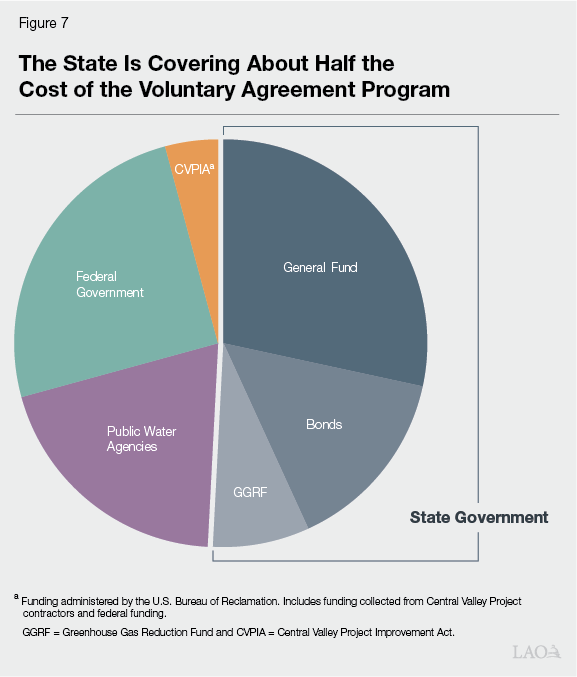
VA Pathway Also Has Direct Implementation Costs. Implementation of the VA program also includes direct costs, mostly one time, which VA parties estimate will total approximately $3 billion. Over the eight‑year period, about one‑half of the identified funding is planned to support habitat projects and scientific monitoring, while the remainder will support water purchases and infrastructure to help increase flows in rivers. (For example, water purchases could include obtaining water rights to keep water in rivers rather than being diverted.) VA parties, the state government, and the federal government will contribute funding to pay for VA costs. Based on current estimates, the state is funding the largest share of costs—roughly half, or $1.5 billion—as shown in Figure 7, and has already appropriated this funding through recent budget actions. Under the plan, water agencies will contribute about 20 percent of total funding, the CVP close to 5 percent, and the federal government about 25 percent. Thus far, VA parties have only secured about one‑quarter of the needed federal government funding.
Unclear Whether Plan Would Lead to Benefits for Fish and Fisheries. The draft Bay‑Delta Plan could lead to improvements in the health and abundance of native fish if the amount of additional flow and associated habitat improvements provide sufficient support for their recovery. If fish numbers improve, commercial and recreational fishing also could experience gains. The decline in salmon has had serious negative impacts on fisheries. For example, for an unprecedented three consecutive years (2023‑2025), fishery regulators cancelled the state’s commercial Chinook salmon fishing season, resulting in millions of dollars of lost revenues annually for the industry. (They also banned recreational Chinook fishing in 2022 and 2023 and limited it in 2025.) If salmon populations stabilize and begin to grow, commercial and recreational fishing, and any related services and tourism, could pick back up. On the other hand, if salmon populations fail to improve or continue to decline under the plan, economic outcomes could worsen for the fishing industry and services and tourism.
Key LAO Findings
Although the board had not yet formally adopted plan updates as of this writing, the revised draft that SWRCB released in December 2025 signals its intent to move forward with the VA approach. In light of this, below, and as shown in Figure 8, we (1) discuss the theoretical potential for VAs to balance competing goals, (2) note some of the main uncertainties associated with VA implementation, (3) identify outstanding questions about the effectiveness of either pathway to protect native fish species, and (4) point out the need for SWRCB to act quickly despite the uncertainties.
Figure 8
Key LAO Findings
|
Voluntary agreements (VAs) offer theoretical potential to balance multiple competing goals. |
|
Implementation of VA program still has some key uncertainties. |
|
Degree to which either pathway would help native fish recover is uncertain. |
|
Despite uncertainties, timely action is needed to protect the Bay‑Delta Watershed. |
VAs Offer Theoretical Potential to Balance Multiple Competing Goals
Balancing the state’s many goals for the Bay‑Delta watershed remains a complex and challenging task. Considering that SWRCB’s authority is limited mostly to regulating flows, VAs offer a broader suite of tools. Below, we discuss the potential for VAs to offer some key benefits.
Theoretically, VA Pathway Could Improve Conditions for Fish… One compelling rationale for pursuing VAs is that participating parties would commit to restoring and enhancing about 47,000 acres of habitat—something SWRCB cannot directly mandate under the regulatory pathway. These habitat improvements—designed to support fish spawning and rearing, food fish production, and fish passage—would begin to address some of the historic alterations to natural systems that have been destructive for fish and wildlife. Moreover, because the VA framework attempts to align the timing, location, and amount of flows with the life cycles and migratory patterns of native fish, it could, in theory, allow for an ecologically effective and water‑efficient approach. For example, if the right amounts of flows are delivered when and where fish need them, more water could potentially be diverted at other times without undermining ecological goals. In addition, VA parties would be required to test a number of scientific hypotheses, which would add to the body of knowledge about which activities are and are not promising for fish and ecosystem recovery.
…If Scientific Analyses Are Sound and Selection of Habitat Projects Is Strategic. The effectiveness of the VA approach, however, depends on having robust, regularly updated information; strong enforcement of flow commitments; effective monitoring; real‑time adaptations; and the strategic selection of habitat projects. Both the VA and regulatory pathways emphasize the use of science‑based adaptive decision‑making—an appropriate approach given the importance of using up‑to‑date information about environmental conditions and native fish behavior to adjust flows.
VA Pathway Likely Offers More Flexibility to Adapt. The VA pathway likely offers greater built‑in flexibility than the regulatory pathway since it is grounded in collaborative agreements and would not require the same types of regulatory changes to modify flows. Successful implementation, however, will depend on strong collaboration and cooperation among water agencies and a willingness of these agencies to make adjustments if conditions change significantly and/or outcomes are not materializing as anticipated.
Adverse Effects on Water Users Less Than Under Regulatory Approach. Because the VA pathway would allow comparatively more water diversions than a broadly applied regulatory approach, the water supply impacts for municipal and agricultural customers would be lower under this approach. Because agencies could divert more water, this also could ease reliance on groundwater pumping. Moreover, given that water supply reductions are the main cost driver of changes to the Bay‑Delta Plan, this means that costs for water agencies and their customers, growers, and the broader economy would be comparatively lower under the VA pathway as well (even accounting for VAs’ direct costs for habitat projects and water purchases). While the public trust doctrine and state responsibility to protect fish and wildlife require that economic impacts not be the only driving factor in determining how to balance water use in the Bay‑Delta, this comparison does highlight one additional benefit of the VA pathway.
VA Pathway Provides More Certainty to Water Agencies About Water Supply. Compared to the regulatory approach, the VA pathway gives water agencies more certainty about the specific volumes of flows they must contribute for compliance. For each water year type (wet, above normal, below normal, dry, critical), the draft Bay‑Delta Plan sets specific flow amounts that VA parties would be required to provide. Because the water year type is determined only a few times per year, agencies can plan in advance and know the total flow for which they will be responsible. By contrast, the regulatory pathway requires a percentage of unimpaired flow. While the percentage is fixed (for example, 55 percent), the estimated unimpaired flow amount itself could change regularly, making planning more challenging.
VA Pathway Could Take Effect More Quickly. Although the terms of the VA program would become binding upon adoption of the Bay‑Delta Plan, they are based on a set of negotiated agreements among water agencies and state and federal agencies. This means that implementation of the VA pathway does not depend on subsequent regulations or water rights proceedings—VA parties can begin to fulfill their commitments upon SWRCB’s adoption of the plan. (However, to exercise its authority to protect those flows from other diversions, SWRCB would need to adopt regulations.) Additionally, as described earlier, VA habitat projects have already begun. By contrast, implementation of the unimpaired flow requirements for non‑VA parties will not begin for at least another two years following approval of the plan, as SWRCB will need additional time to adopt regulations.
Implementation of VA Program Still Has Some Key Uncertainties
While the VAs have the potential to offer some benefits toward balancing water uses in the Bay‑Delta, several uncertainties remain regarding certain core elements of this pathway. The outcomes of these outstanding questions will be important factors in whether or not this new water management approach is successful.
Effectiveness of Water Purchases Remains Uncertain. The VA program envisions meeting a good portion of its flow commitments through water purchases (water rights sales or water transfers) made with funding contributed by the state and VA parties. Currently, relatively little information is available about the mechanics of how this strategy will work. Whether water purchases will work at a large scale is not yet certain. For example, accounting for this water flowing through the Sacramento/Delta—and thus ensuring that it remains in the system for environmental purposes—will be complicated. The stakes associated with these uncertainties are high, as water purchases are an important component upon which the overall success of the VA program depends.
New Water Projects Could Undermine Future VA Base Flows. The proposed Sites Reservoir and Delta Conveyance Project (DCP) could affect the amount and timing of water available to meet base flow commitments under the VA program. The box below describes these two projects. While the board includes language in the revised Bay‑Delta Plan stating it would consider imposing requirements on future water rights to protect base flows, it does not set any specific rules or limits now to prevent these new projects from reducing them. The vulnerability of VA base flows to the impacts of these new projects likely would not be a major issue within the initial eight‑year term of the VA program given the time needed to build the projects. (If approved, Sites could take roughly eight years to build, and DCP about 15 to 20 years.) However, these projects could be significant factors in future water supply availability, and if they reduce base flows, they could undermine gains achieved by the VA program—a risk not addressed in the current draft plan.
Two New Major Water Infrastructure Projects Could Affect Bay‑Delta Flows
Alongside updates to the Bay‑Delta Plan, Governor Newsom’s administration is advancing two large water infrastructure projects: Sites Reservoir and the Delta Conveyance Project (DCP). While these projects are intended to increase water supply reliability, they also raise questions about how they might interact with the Bay‑Delta Plan and alter the timing and amount of flows into the Delta estuary.
Sites Reservoir Proposed in Glenn and Colusa Counties. Sites Reservoir is a proposed off‑stream storage project in the Sacramento Valley. Its goal is to capture and store runoff from the Sacramento River during wetter periods for use in drier times. While designed to increase water supply flexibility, the new reservoir could change the timing and quantity of water flows in the Sacramento River system, raising questions about impacts on existing flow commitments.
The DCP Would Divert State Water Project (SWP) Water Around the Delta. The DCP is the latest proposal to bypass the central Delta to convey water from the northern Delta to pumps south of the Delta as part of the SWP. Previous bypass concepts were controversial, heavily debated, and ultimately abandoned. DCP proponents—including Governor Newsom, the Department of Water Resources, and State Water Contractors—argue it would improve the reliability of the state’s water supply given the risks of climate change, salinity intrusion, sea‑level rise, and earthquakes in the Delta. Opponents—including environmental groups, Delta residents and local governments, fishing groups, and some tribes—contend the project would jeopardize the Delta’s ecosystem and regional economy and advocate instead for strengthening Delta levees and increasing water conservation and recycling. While intended to improve water delivery reliability, the project could alter how water is diverted and managed in the Delta, which, in turn, could affect existing flows.
Federal Policy Changes Could Impede Implementation. The federal government plays a key role in the Bay‑Delta Plan and several federal policy decisions could have important implications for the VA program:
- Recent USBR Decision Could Lower VAs’ Base Flow Amounts. The state and federal governments historically have worked together to coordinate operations of the SWP and CVP, including management of major reservoirs and Delta exports and compliance with state and federal endangered species laws and regulations. Together with existing state requirements, the required flows stemming from the 2024 federal biological opinions (BiOps) would form the baseline for VA amounts. The new VA flow commitments are intended to be additive to this base. In January 2025, the federal administration issued an executive order directing federal agencies to maximize water deliveries in California. Later that year, USBR signed a Record of Decision adopting an updated long‑term operation plan for the CVP to implement that directive. USBR asserts that the updated plan is consistent with the 2024 BiOps. It also indicates that the CVP could potentially increase deliveries (and thus reduce instream flows left in rivers), subject to hydrologic conditions and coordination with the state. If the CVP were to increase deliveries, it would reduce the flow base upon which the VA program is built. As a result, the planned net increase in flows to be achieved after adding new VA flow commitments may not materialize as planned, potentially undermining the benefits envisioned in the draft Bay‑Delta Plan.
- Will USBR Remain a Reliable VA Participant? USBR, as operator of the CVP, was one of the original signatories to the VA MOU in 2022. While the MOU was not a binding commitment, it signaled USBR’s intent to collaborate and contribute to the voluntary, multiparty alternative to the regulatory pathway. The 2025 Record of Decision noted above states that USBR may modify CVP operations to facilitate implementation of VAs, provided all other VA parties fulfill their respective commitments. However, the extent to which USBR would contribute CVP flows—particularly in light of its stated objective to maximize water deliveries—and participate fully in the governance and scientific activities associated with the program appears uncertain.
- Will the Federal Government Provide Sufficient Funding? As discussed earlier, the VA program depends on funding from water agencies (about 20 percent), the state government (50 percent), the CVP (5 percent), and the federal government (25 percent). While some federal funding has been provided already, whether the remaining amount will materialize is unclear. How the VA program would adapt without this funding also is uncertain—either funding would have to be secured from another source or fewer habitat projects and water purchases would be completed, which could weaken the overall VA program.
- Will the U.S. EPA Approve Incorporation of VAs Into the Bay‑Delta Plan? Under the Clean Water Act, the Bay‑Delta Plan must be approved by the U.S. EPA. In 2024—under the prior administration—the U.S. EPA raised concerns that the VAs lacked sufficient evidence to ensure protection of beneficial uses. Whether the U.S. EPA will maintain this same stance about the revised draft plan is unknown. If the U.S. EPA were to find VA provisions insufficient, it could delay approval or require revisions, potentially affecting Bay‑Delta Plan implementation.
Degree to Which Either Pathway Would Help Native Fish Recover Is Uncertain
In addition to the uncertainties noted above, many unknowns exist about the potential effectiveness of either the regulatory or VA pathway—or about the effectiveness of implementing both approaches together—in helping fish populations rebound. This makes assessing the estimated merits of the plan’s proposed approach difficult.
Neither Pathway Has Been Attempted on This Scale. While some voluntary agreements have been implemented in California, none have occurred at the scale of the VAs proposed for the Bay‑Delta, and the results of previous efforts have been mixed. For example, for each of the examples mentioned previously (Quantification Settlement Agreement, San Joaquin River Restoration Settlement, and Mono Basin Stream Restoration Agreement), implementation has taken longer than originally planned and required substantial funding over many years. The regulatory pathway also includes approaches that have not been tested at this level. For example, none of the existing regional or statewide water quality control plans in California use an unimpaired‑flows approach (only the 2018 phase one updates to the Bay‑Delta Plan for the Lower San Joaquin River include unimpaired flows, but these updates have not yet been implemented). Moreover, none of the watersheds covered by regional water boards are as large, hydrologically complex, or legally contested as the Bay‑Delta. Consequently, while both SWRCB and VA parties can model and predict outcomes, the reality is that neither pathway has been tested at this level—so potential outcomes, complications, and unintended consequences remain uncertain.
Unclear Whether Amount of Flows Proposed for VA Pathway Will Be Sufficient. Regardless of the pathway adopted by SWRCB, scientific evidence has found that native fish in the Bay‑Delta watershed need both additional flows and improved habitat to support their survival. Importantly, this means habitat improvements alone will not be sufficient. When water levels are too low, fish face elevated salinity levels, warmer water temperatures, and flow conditions that disrupt migratory routes. Low flows also can reduce the amount of available habitat, lower oxygen levels, increase predation, and concentrate pollutants—adding further pressure on already vulnerable fish populations. Whether the additive flows proposed by VA parties—and the timing and location of those flows—will be sufficient to support the long‑term survival of native fish remains uncertain. The U.S. EPA—under the prior administration—also expressed this concern several times in letters to SWRCB.
Despite Uncertainties, Timely Action Is Needed to Protect the Bay‑Delta Watershed
While the uncertainties associated with the VA approach and fish recovery goals are numerous and significant, in our view, they do not merit further delays in adopting updates to the Bay‑Delta Plan. Given the significant declines in ecosystem health and native fish populations, as well as the expected increase in droughts, SWRCB needs to act quickly to improve conditions in the Bay‑Delta watershed. The responsibility to make improvements should be shared across all affected parties, with the state playing a key leadership role.
Water Users Bear Responsibility for Mitigating the Negative Effects of Their Water Use… As noted earlier, scientists have found that water diversions for human use—including construction of physical barriers and changes to water flows and temperatures—have been a primary driver of declining fish populations and degraded habitat in the Bay‑Delta. Accordingly, expecting municipal and agricultural water users to play a substantial role in helping improve conditions in watershed health is reasonable, including by changing their existing practices and implementing new activities.
…But the State Also Is Accountable for Balancing Human and Environmental Needs. Although water agencies bear some obligation to help ameliorate the current conditions of the Bay‑Delta watershed due to the impacts of their diversions, the state shares this responsibility—not only because it built and continues to operate the SWP, but also because of its role as regulator. The state led or sanctioned many of the alterations to the natural landscape that have served certain human needs but harmed native species and damaged aquatic and riparian habitats. In this light, helping to fund habitat restoration projects, water purchases, and water infrastructure improvements (as part of the VA program) could be considered an appropriate state role. Moreover, the state maintains the legal obligation to balance beneficial uses in the Bay‑Delta and to protect water resources in the public interest.
SWRCB Plays a Key Role in Making Sure VAs Are Successful. Assuming SWRCB adopts its proposed hybrid approach that includes both regulatory and VA pathways, ensuring that all parties meet their obligations will be essential. Compliance alone does not guarantee ecosystem recovery, but it is a necessary first step toward restoring the health of the Bay‑Delta. SWRCB is responsible for holding parties accountable for flow contributions, habitat actions, monitoring, and other performance metrics—some of which SWRCB cannot normally mandate. Because the VA pathway relies on more flexible actions rather than prescriptive standards, its success depends on ongoing oversight, robust monitoring, timely reporting, and credible adaptive decision‑making based on generated and available evidence. SWRCB will need to ensure these processes are operating at the appropriate scale, frequency, and level of transparency—and that adjustments are made when outcomes fall short.
Independent Monitoring of VA Parties Could Be Important to Support Accountability. Under the current VA framework, much of the proposed monitoring, scientific testing and analyses, and governance would be carried out by the VA parties themselves. While this structure may support flexibility and collaboration, it also raises questions about whether resulting transparency, oversight, and accountability will be sufficient. To ensure that implementation remains aligned with agreed‑upon commitments and ecosystem goals, independent monitoring by SWRCB and/or an outside entity at key milestones may be appropriate and beneficial.
Ensuring Effective Legislative Oversight
Historically, the Legislature has not played a large role in SWRCB’s regulatory water management decisions in the Bay‑Delta, but rather has deferred to the board to implement statutory goals through the Bay‑Delta Plan. While delegating a significant portion of the implementation decisions to SWRCB—which has more technical expertise—might be appropriate, the Legislature still has a critical function in helping oversee implementation of the Bay‑Delta Plan. This is particularly important given the significant uncertainties highlighted above about how VAs will be implemented and what outcomes the program might achieve. Below, we identify some essential qualities of effective oversight and discuss some reasons why this role is so vital for the Legislature, identify some key issues for the Legislature to monitor, and summarize potential avenues for conducting effective legislative oversight.
Essential Qualities of Focused, Ongoing Oversight and Why It Is Important
The Legislature has a critical interest in ensuring that SWRCB implements the Bay‑Delta Plan successfully given the watershed’s importance to California’s drinking and agricultural water supply, the survival of native fish species, and other beneficial uses. Legislative oversight will be essential to ensuring the plan is implemented as intended and results in meaningful improvements to the watershed.
Good Oversight Is Iterative. While the Bay‑Delta Plan is guided by formal regulatory processes, it also could be viewed as a living document. Both state and federal laws require periodic review, and the dynamic nature of the Bay‑Delta—along with its many vital beneficial uses—means the plan should be regularly updated or designed with flexibility to support adaptive decision‑making. Similarly, good oversight should be iterative: it should be conducted consistently and adapted over time to monitor key developments and milestones. That is, oversight should evolve alongside the implementation process, allowing the Legislature to revisit priorities, refine its questions, and shift its focus as new information becomes available.
Good Oversight Requires Good Data. High‑quality data will be essential for monitoring compliance, tracking trends, and assessing outcomes. The draft Bay‑Delta Plan outlines data collection and reporting expectations under both the regulatory and VA pathways. The Legislature can use its oversight role to ensure that all responsible parties are meeting their commitments, that SWRCB has access to the data it needs, and that the information being collected is meaningful—that it measures what was intended and can inform adaptive decision‑making. Additionally, the Legislature may wish to request information about whether any persistent data gaps emerge and whether the data is publicly accessible, which could support independent review and promote transparency more generally.
Good Oversight Focuses on the Most Important Outcomes. Given the complexity of the Bay‑Delta watershed and Bay‑Delta Plan and the many parties involved, keeping the focus of oversight on the most meaningful indicators could help the Legislature understand whether the state’s investments and regulatory actions are having their intended effect. In the early stages of implementation, this might include monitoring compliance, tracking progress on habitat projects, assessing the quality and availability of data, and identifying any key data gaps. As implementation progresses, oversight can begin to focus more on ecological and policy outcomes—for example, trends in native fish populations, flow improvements during critical periods, whether projects are delivering anticipated ecosystem benefits, and how water agencies are managing with reduced Bay‑Delta supplies.
Key Issues and Tools for Legislative Oversight
Seven Key Issues to Watch. To ensure the adopted plan aligns with and advances the state’s broader goals, in Figure 9 we summarize seven key issues the Legislature may wish to monitor. As shown, these relate to: flows, habitat, fish, tribes, accountability and funding, implementation, and future planning.
Figure 9
Seven Key Issues for the Legislature to Watch
|
Flows. Are flows increasing beyond what is currently required under existing regulations? (Under both the regulatory and VA pathways, flow levels should exceed those mandated by current rules.) Are flows occurring in the right places at the right times? |
|
Habitat. Are VA parties fulfilling their habitat restoration commitments? Is new habitat acreage truly additive compared to the December 2018 baseline? Were projects strategically selected to maximize ecological benefit? |
|
Fish. Are populations of native fish showing signs of recovery? While improvements may take time, has a positive trend begun to emerge in population numbers and overall fish health? |
|
Tribes. Are native tribes meaningfully engaged in both implementation and scientific processes? Is tribal input reflected in key SWRCB and VA decisions? |
|
Accountability and Funding. Are all parties (SWRCB and VA parties—including USBR and other water users) meeting their agreed‑upon commitments? Have VA parties secured required funding? |
|
Implementation. Are data being collected, shared, and used effectively? Are collaboration and real‑time adaptation occurring as envisioned? What lessons is the state learning from the novel VA approach? |
|
Future Planning. Is the state making progress in planning for the post‑VA period? How will current and new habitat projects be supported and maintained after the eight‑year VA term? How will SWRCB avoid long delays in adopting future plan updates? |
|
VA = Voluntary Agreement; SWRCB = State Water Resources Control Board; and USBR = U.S. Bureau of Reclamation. |
Legislature Has Several Tools to Conduct Oversight. The Legislature can oversee implementation of the Bay‑Delta Plan in various ways. Below, we outline several oversight mechanisms—also summarized in Figure 10—for moving forward with the updated plan.
- Hold Oversight and Informational Hearings. Legislative committees could hold oversight and/or informational hearings on key issues. These hearings could feature expert panelists; updates from state and federal agencies and water users (including VA parties); and input from tribes, environmental groups, and community members. Hearings could be held as standalone sessions or integrated into relevant committee hearings.
- Create a Select Committee or Oversight Taskforce. The Legislature could establish a select committee or oversight taskforce focused on Bay‑Delta Plan implementation. This would provide a dedicated venue for continued monitoring and engagement. In the lead‑up to the 2009 Delta Reform Act and during discussions about a proposal to convey water around the Delta via twin tunnels, the Senate created a Select Committee on the Sacramento‑San Joaquin Delta and held hearings. (The Assembly also held numerous informational hearings through a standing committee.) A contemporary version could support coordinated implementation and help the Legislature remain engaged as the state moves from planning to implementation.
- Require Reporting to the Legislature. Although the draft Bay‑Delta Plan would require VA parties to report to SWRCB at select intervals, the Legislature also may wish to receive periodic reports from SWRCB. For example, these could include updates on flows and habitat projects, expenditures on the VA program, progress made on ecosystem health and native fish populations, changes in groundwater pumping, and economic effects—particularly on growers.
- Require Independent Scientific Evaluations. In addition to SWRCB reporting, the Legislature could consider funding independent evaluations from academic institutions or other entities with appropriate scientific expertise. Given that neither the unimpaired flows nor VA approach has previously been implemented at this scale or level of complexity, independent scientific assessments could offer valuable insight into program effectiveness.
- Promote Transparency. SWRCB has committed to posting scientific and progress reports online, holding public meetings and hearings, and conducting tribal listening sessions. To ensure information is accessible to all interested and affected parties, the Legislature could consider pursuing additional measures. For example, it could require SWRCB to share all VA‑related materials, data, and reports in a centralized location and provide plain‑language summaries of the latest science and progress updates.
- Review Spending. The Legislature has already approved substantial appropriations for VA‑related habitat projects and water purchases. It may wish to examine details about how specifically these funds are being used, whether VA parties and federal partners are contributing their shares, and whether the funding is advancing the state’s goals in the Bay‑Delta watershed as intended. It might also request information to determine whether habitat projects, scientific monitoring, and other activities will require ongoing funding and what funding sources would be appropriate to support them.
Figure 10
Legislature Has Several Tools to Conduct Oversight
|
|
|
|
|
|
Conclusion
The Bay‑Delta watershed supports residents, farms, fish, wildlife, and businesses, yet its ecosystem has been significantly compromised over the years. The current Bay‑Delta Plan has not provided adequate protection of all beneficial uses, and long delays in updating the plan further threaten native fish. Making near‑term progress on updating the plan is a critical step in beginning to reverse these trends. While SWRCB’s regulatory tools—focused on flows and diversions—are essential, they cannot directly compel habitat restoration and, on their own, likely will not be able to fully rebuild fish populations or ecosystem health. In this context, the VA approach could theoretically offer some benefits. However, significant uncertainties remain, including whether flows will be sufficient, whether flows combined with habitat will adequately support fish, and whether federal policy changes will undermine the VA parties’ ability to implement the plan. The VA program must therefore be closely monitored. The Legislature plays a critical role in this regard. By holding SWRCB accountable to the Bay‑Delta Plan’s objectives and shining a light on the successes, challenges, and unintended consequences of the VA program, the Legislature can help ensure the state achieves its environmental and water management goals for this important watershed.