Gökçe Sencan

March 6, 2026
The 2026-27 Budget
California Highway Patrol Proposals
Summary
In this post, we review two of the Governor’s 2026-27 budget proposals for the California Highway Patrol (CHP): a $60 million temporary augmentation from the Motor Vehicle Account (MVA) for equipment and operating costs, and a total of $2.3 million on a one-time basis from the General Fund for two capital outlay projects. We recommend the Legislature reject the proposed equipment and operating cost augmentations, as we do not find them to be well justified. We recommend the Legislature approve the capital outlay projects, but switch their funding source from the General Fund to the MVA.
Background
MVA Is the Primary Funding Source for CHP. The MVA is a special fund that the state typically uses to implement motor vehicle regulations and conduct highway safety and highway law enforcement activities. The MVA’s primary source of revenue is from vehicle registration fees, as well as—to a lesser degree—from driver’s license and identification card fees. CHP receives roughly 60 percent of the MVA revenues ($3 billion) annually, with most of the remainder supporting activities at the Department of Motor Vehicles. Growth in CHP’s expenditures, however, has been outpacing the MVA’s revenue increases. This can be attributed to several reasons, the most significant being CHP officers’ compensation structure. Under current law, CHP officers receive annual salary increases based on the compensation provided to peace officers employed by five major local law enforcement jurisdictions in California, which have tended to grow faster than the statutory inflationary adjustments applied to vehicle fees.
Administration Projects MVA Is Fiscally Stable in the Near Term, but Will Face Insolvency Starting in 2028-29. The MVA has been experiencing a structural imbalance for many years, with expenditures consistently outpacing revenues. The state has been able to delay the account’s insolvency through various budget adjustments, policy changes, and temporary transfers from other special funds. (Please see our report, The 2025-26 Budget: Transportation Proposals, for more background on the MVA.) At the time of the 2025-26 budget enactment, the administration projected a $166 million shortfall in the account and therefore proposed—and the Legislature adopted—shifts from two other special funds to cover some MVA expenditures. The administration has since made upward adjustments to its MVA projections and now estimates the account to be in stable condition for both the current year and the 2026-27 budget year. (Accordingly, the Governor’s budget proposes undoing the $166 million current-year fund shift and letting the MVA reassume the associated costs.) However, several underlying causes of the MVA’s structural deficit remain unaddressed and the account is projected to become insolvent from the 2028-29 budget year onward. Moreover, given the scale of the state’s projected budget shortfall in the coming years, the option of relying upon the General Fund or other special funds to help cover the MVA expenditures will be challenging.
Equipment and Operating Costs Augmentations
Governor’s Proposal
The Governor proposes providing a one-time augmentation of $60.3 million from the MVA for CHP to cover various equipment and operating costs. The proposal includes $15.7 million to be provided in 2025-26 and $44.4 million in 2026-27. (The administration indicates it may request that the Legislature take early budget action on the current-year proposal.) As shown in Figure 1, the proposal includes funding for ten categories of activities, with the three largest relating to vehicles (insurance, new vehicle purchases, and fuel).
Figure 1
Governor’s Proposed CHP Equipment and
Operating Costs Augmentations
(In Millions)
|
Category |
2025‑26 |
2026‑27 |
Totals |
Existing Annual Budget |
|
Vehicle insurance premiums |
$7.1 |
$5.9 |
$13.0 |
$16.2 |
|
Attorney General costs |
4.1 |
2.8 |
6.9 |
6.5 |
|
Utility costs |
3.1 |
3.1 |
6.2 |
13.0 |
|
Law enforcement materials |
1.4 |
4.1 |
5.5 |
7.9 |
|
Communications |
— |
3.4 |
3.4 |
9.8 |
|
Vehicle gasoline |
— |
7.2 |
7.2 |
22.3 |
|
Vehicle purchases |
— |
7.3 |
7.3 |
20.0 |
|
Electronic control devices |
— |
3.1 |
3.1 |
— |
|
Duty weapons |
— |
2.7 |
2.7 |
— |
|
Tablets |
— |
5.0 |
5.0 |
— |
|
Totals |
$15.7 |
$44.4 |
$60.1 |
$95.7 |
|
Note: Numbers may not add up due to rounding. |
||||
|
CHP = California Highway Patrol. |
||||
Assessment
Concerning MVA Condition Raises the Bar for Approving New Spending. Despite the MVA’s projected near-term stable condition, the account’s surplus margins remain slim and the administration estimates it will become insolvent in 2028-29. These projected out-year shortfalls likely will make it challenging for the account to fund core expenses such as CHP salaries and could increase pressure to raise fees on drivers. For this reason, every new expenditure from the account—especially those that are comparatively large—should be well justified and clear a high bar for approval.
Historically, CHP Has Funded Equipment and Operational Costs Through Its Base Budget. As displayed in Figure 1, the types of costs for which CHP is requesting additional funding represent equipment and activities that support the basic, core functions of the department. These include costs related to vehicles, weapons, technology, and utilities. In previous years, the department has not typically come forth with specific, discrete budget requests to support these types of expenses—even when costs have risen due to inflation. Rather, with a few exceptions (such as for purchasing tablets in 2019), it has typically covered such expenses through the funding in its base budget using two methods. First, as shown in the figure, several of the augmentation categories requested in the proposal are supported with dedicated funding ($95.7 million in total) within the department’s annual budget. Second, the department reports that it historically has used salary savings from vacancies to help cover additional operational costs.
Department States That High Costs and Low Vacancy Rates Have Created Unique Cost Pressures… CHP states that it cannot depend on its historical approach to fund these activities—and therefore needs the proposed supplemental augmentation—because (1) inflation and other costs like technology upgrades have led to uniquely higher costs, and (2) it has comparatively lower officer vacancy rates now and thus cannot depend on salary savings to help cover equipment and operational costs as it typically has.
…However, Data Do Not Support This Assertion. We have two concerns with the rationale CHP provided for its request.
Cited Cost Increases Are Not Out of the Ordinary. The department has always faced costs related to inflation, replacement of old equipment, and increases in gas prices—these are not anomalous events. As such, why the department needs an augmentation for covering baseline costs this year rather than accommodating them through relying on its historical practice is unclear.
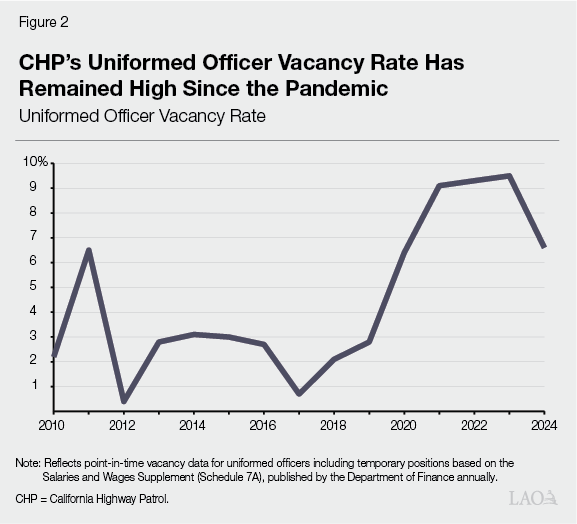
Unclear Why the Department Is Unable to Use Salary Savings. Data do not seem to support the department’s explanation for why it is unable to use salary savings to cover some costs as it has in the past. As shown in Figure 2, the department’s uniformed officer vacancy rate including temporary positions, is still well above the pre-pandemic levels. Specifically, while the vacancy rate was 2.8 percent in 2019, it then rose to over 9 percent in 2021, and remained at 6.6 percent as of 2024, per the most recent data available. (The total number of authorized officer positions for the department has remained roughly the same since 2012.) A different data source—the state Position Vacancy Report, which calculates the average annual vacancy rate across all types of staff in the department excluding temporary positions—reports an even higher vacancy rate: 13.6 percent as of 2024. While the department anticipates that its officer vacancy rate will drop further as new cadets graduate from its academy, as of this writing, available evidence on actual vacancies suggests that its existing budget should still have capacity from salary savings to help cover baseline costs consistent with its historic practice. Moreover, if the department generally was able to cover most operating and equipment costs within its baseline budget when its officer vacancy rate was at roughly 3 percent or below (as it was from 2012 through 2019), it is unclear why it cannot do the same when its vacancy rate is notably higher.
Recommendation
Reject Proposed Equipment and Operating Costs Augmentation. We recommend that the Legislature reject this proposal. Despite the MVA’s stability in the short term, pressure on the account remains high, and we recommend the Legislature preserve funding only for essential activities. In our assessment, CHP has not provided compelling evidence for why it is unable to cover its equipment and operating expenses using its existing operations budget and salary savings from vacancies, as it traditionally has.
Capital Outlay Projects
Governor’s Proposal
Proposes $2.3 Million General Fund for CHP Capital Outlay. The Governor proposes one-time General Fund for two capital outlay-related activities in 2026-27:
CHP Field Office Planning and Site Identification. The budget includes $1 million from the General Fund for CHP to identify suitable parcels for replacing up to three field offices and to develop studies for those sites.
CHP Enhanced Radio System (CHPERS) Tower and Vault Replacement. The budget includes $1.3 million from the General Fund for the incremental preliminary plans and working drawing phases of the Sawtooth Ridge radio communication tower and associated support infrastructure as part of the CHPERS project.
Assessment
Two Capital Outlay Proposals Appear Justified. Both proposals would support activities that have been underway at CHP for more than a decade. We find they each would help to address important public health and safety objectives.
CHP Offices Have Unique Qualities That Can Complicate Site Replacement. CHP has found that many of its area offices need to be replaced due to seismic risk. A number of factors make this process somewhat challenging. For example, CHP offices need to be located close to the highway and large enough to accommodate certain site requirements such as communication towers, patrol vehicles and other law enforcement infrastructure. Many of the older area offices are also out of compliance with modern building requirements and therefore replacements need to be located on larger parcels than their current sites. These constraints can significantly narrow the number of qualified parcels, meaning the process of identifying and acquiring new sites for CHP office replacements can be difficult. We therefore find the Governor’s proposal for a $1 million supplemental appropriation for CHP to undertake these efforts to be justified. Moreover, this approach is not without precedent. For example, previous budgets provided funding to CHP for similar purposes in 2017-18, 2022-23, and 2023-24.
CHPERS Project Is Already Underway, Meets Public Safety and Radio Communications Needs. The Legislature approved the CHPERS project in 2006-07 to enhance the interoperability of CHP’s radio communications system among public safety agencies. The proposed Sawtooth Ridge radio tower is the last tower to be constructed and intended to mitigate a coverage gap in radio communications in San Bernardino County. We find the proposed funding to be consistent with previous legislative approvals for this ongoing project and important in facilitating CHP’s regional communication and public safety operations.
MVA Has Sufficient Funding in 2026-27 to Cover Relatively Minor Capital Outlay Expenses. The MVA is the typical fund source that supports CHP’s activities and projects, as it follows the “beneficiary pays” principle. That is, through their vehicle fees, the state’s vehicle and road users—rather than the general taxpayer—pay for the expenses associated with helping keep them safe on state highways. In our view, abiding by this historical principle is ideal and appropriate whenever possible. While the MVA is facing out-year shortfalls, it has sufficient funding to accommodate the two proposed minor capital outlay proposals in 2026-27. Besides the policy rationale for following the historical CHP funding approach, the General Fund is projected to face significant out-year revenue shortfalls. For these reasons, we find the MVA to be a more appropriate fund source for these proposals in 2026-27.
Recommendation
Approve Both Capital Outlay Proposals, but Switch Funding Source From General Fund to MVA. We recommend the Legislature approve funding for both of the Governor’s capital outlay proposals in 2026-27. However, to align with the state’s historical funding approach for CHP and due to General Fund constraints, we recommend shifting the funding source for these activities to the MVA.