Florence Bouvet

February 26, 2026
The 2026-27 Budget
University of California
Summary
Brief Covers the University of California (UC). This brief reviews core funding and spending trends at UC, then analyzes the Governor’s budget proposals relating to UC’s core operations and enrollment. The final section covers federal funding for UC and the implications of recent federal developments.
Over the Past Ten Years, UC Spending Has Outpaced Inflation. Over this period, core spending grew at an average annual rate of 4.3 percent, compared to inflation growing by 3.3 percent. This faster growth reflects increases both in student enrollment and underlying cost drivers. UC’s largest cost driver is employee compensation, accounting for about 75 percent of UC spending in 2024‑25. Growth in employee compensation has been mostly driven by the expansion of UC’s workforce.
Recommend Reducing or Eliminating Base General Fund Increase. The Governor proposes a $351 million (7 percent) base increase for UC in 2026‑27 and assumes UC generates $273 million in additional tuition revenue. Given the state’s fiscal outlook, the Legislature could provide a smaller base increase aligned with inflation. Alternatively, it could provide no base increase to help manage the structural deficit and reduce pressure for more significant reductions over the coming years. Even without a base increase, UC’s core funding would grow by 3.5 percent.
Recommend Using Available One‑Time Funding to Retire Payment Deferral. In 2025‑26, the state began deferring a $130 million General Fund payment from one fiscal year to the next. If one‑time funding becomes available, we recommend the Legislature make retiring this payment deferral a high priority. Retiring the deferral would return UC’s state payments to their regular schedule, eliminate the associated debt obligation, and reduce state budgetary pressures in the out‑years.
Recommend Removing Out‑Year Commitments. Under the Governor’s budget, the state commits to providing UC with a one‑time back payment of $241 million in 2027‑28, followed by a 3 percent ongoing base increase of $144 million in 2028‑29. We recommend removing these out‑year commitments. The Legislature could determine each year how much support to provide UC in light of overall fiscal conditions and its budget priorities.
Recommend Funding Enrollment in 2026‑27 at Original Target, Separately From Base Increase. The Governor’s budget maintains the original resident undergraduate enrollment target established in the 2025‑26 Budget Act for 2026‑27, a level that UC expects to exceed by more than 3,000 students. Given the projected budget deficits and moderating demographic pressures, we recommend the Legislature maintain the original target set for 2026‑27. We further recommend the Legislature fund enrollment growth separately from, and in addition to, any base increase to enhance transparency and accountability. For 2027‑28, we recommend holding enrollment flat to help UC avoid the potential negative programmatic impacts of adding students without associated funding.
Recommend Pausing the Nonresident Replacement Plan. The Governor’s budget provides $61 million ongoing General Fund to replace a certain number of nonresident students with resident students at three high‑demand campuses. We recommend an alternative that funds the same number of resident students while leaving the number of nonresidents flat. This alternative costs $36 million less than the Governor’s proposal. Given all three high‑demand campuses have added resident students beyond replacing nonresidents the past few years, they appear to have associated physical capacity.
Introduction
Brief Focuses on UC. UC is one of California’s three public higher education segments. Under state law, UC is to provide undergraduate and graduate education, including doctoral programs and professional programs in law and medicine. It also is to serve as the primary state‑supported academic agency for research. The UC system consists of ten campuses. Nine of UC’s campuses enroll students across a range of disciplines, whereas one campus enrolls graduate health science students only. This brief analyzes the 2026‑27 budget plan for UC. The first section of the brief provides an overview of UC’s budget and the planned changes for 2026‑27. The second section focuses on UC’s core operations, whereas the third section focuses on enrollment. The final section of the brief covers the importance of federal funds in UC’s operations and the implications of recent federal developments for UC.
Overview
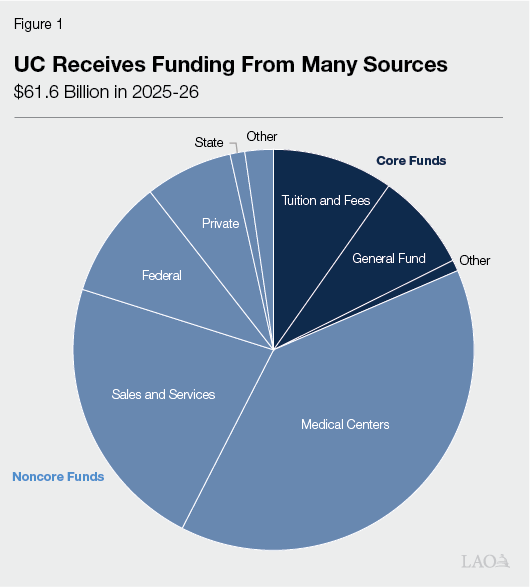
UC Budget Is $61.6 Billion in 2025‑26. Of the three public higher education segments, UC has the largest budget, with total funding greater than the California State University (CSU) and California Community Colleges (CCC) combined. As Figure 1 shows, UC receives funding from a diverse array of sources. State budget decisions typically focus on UC’s “core funds.” Core funds consist primarily of student tuition and fee revenue and state General Fund. A small portion comes from lottery funds, a share of patent royalty income, and overhead funds associated with federal and state research grants. Core funds comprise approximately 20 percent of UC’s total budget. UC uses core funds for undergraduate and graduate instruction as well as general campus operations. UC’s “noncore funds” include revenue from its medical centers, sales and services, federal research grants, and philanthropic support, among other sources.
Ongoing Core Funding Increases Notably Under Governor’s Budget. As Figure 2 shows, ongoing core funding increases by $806 million (7.1 percent) in 2026‑27. Of this amount, $533 million is additional ongoing General Fund support (an 11 percent increase) and $273 million (4.5 percent) is additional tuition and fee revenue. Under the Governor’s budget, UC’s other, smaller sources of core funding are assumed to remain flat.
Figure 2
UC’s Two Main Core Fund Sources Increase Notably Under Governor’s Budget
(Dollars in Millions, Except Funding Per Student)
|
2024‑25 |
2025‑26 |
2026‑27 |
Change From 2025‑26 |
||
|
Amount |
Percent |
||||
|
Ongoing Core Funds |
|||||
|
Tuition and feesa |
$5,822 |
$6,000 |
$6,273 |
$273 |
4.5% |
|
General Fund |
4,858 |
4,853 |
5,386 |
533 |
11.0 |
|
Lottery |
56 |
61 |
61 |
— |
— |
|
Other core fundsb |
488 |
488 |
488 |
— |
— |
|
Totals |
$11,224 |
$11,402 |
$12,208 |
$806 |
7.1% |
|
FTE Studentsc |
300,027 |
304,258 |
301,127 |
‑3,131 |
‑1.0% |
|
Ongoing Core Funding Per Student |
$37,410 |
$37,475 |
$40,541 |
$3,066 |
8.2 |
|
aIncludes funds that UC uses for tuition discounts and waivers. bIncludes a portion of overhead funding on federal and state grants and a portion of patent royalty income. cAn FTE student equates to 30 credit units for an undergraduate and 24 credit units for a graduate student. Student counts include resident and nonresident students. |
|||||
|
FTE = full‑time equivalent. |
|||||
Governor Proposes Base Increases and Some One‑Time Research Funding. As Figure 3 shows, the Governor proposes $573 million in new General Fund support for UC in 2026‑27. Of this amount, $541 million is for ongoing augmentations and $32 million is for one‑time research‑related purposes. (The budget for UC also includes the removal of $8.1 million in ongoing debt service for an intersegmental student housing project that was shifted to being supported by Proposition 2 funds.) The largest ongoing proposals are for providing UC with unrestricted base increases. The Governor also proposes $61 million ongoing General Fund to complete implementation of a plan to replace some nonresident students with more resident students at three high‑demand campuses. Although the administration proposes to provide UC broad discretion over the additional 2026‑27 ongoing funding, UC would be expected to cover the costs of enrollment growth within its base increase. The Governor’s budget maintains the expectation that UC increase resident undergraduate enrollment by about 3,000 full‑time equivalent (FTE) students (1.4 percent) in 2026‑27. The one‑time research funds are related to reappropriating some unspent funds from four research initiatives the state authorized several years ago. The Governor proposes extending the expenditure period to give these research initiatives more time to spend their original allocations.
Figure 3
Governor Has Several UC Proposals
Reflects Governor’s Budget, 2026‑27 (In Millions)
|
Ongoing Spending |
|
|
Base increase (5 percent) |
$254 |
|
Base restorationa |
130 |
|
Base increase (2 percent delayed from 2025‑26)b |
96 |
|
Nonresident enrollment replacementc |
61 |
|
Subtotal |
($541) |
|
One‑time Spendingd |
|
|
Jordan Syndrome research |
$13 |
|
California Institutes for Science and Innovation |
10 |
|
UC and CSU Collaborative for Neurodiversity and Learning |
8 |
|
California Institute on Law, Neuroscience, and Technology |
1 |
|
Subtotal |
($32) |
|
Total |
$573 |
|
aThe 2025‑26 Budget Act included a payment deferral from 2025‑26 to 2026‑27. The Governor’s budget backfills for the one‑time reduction related to that payment deferral. bThe 2025‑26 Budget Act included intent language to provide UC with this augmentation. cConsists of $30 million for 2026‑27 and $31 million delayed from 2025‑26. dReflects amount UC reports as still available for each initiative. |
|
Core Operations
In this section, we first discuss UC’s core funds and the extent to which UC relies on state support and tuition revenue for its core operations. We then highlight notable spending trends over the past decade. Next, we describe the Governor’s proposals relating to UC’s base budget, assess those proposals, and make associated recommendations.
Funding Trends
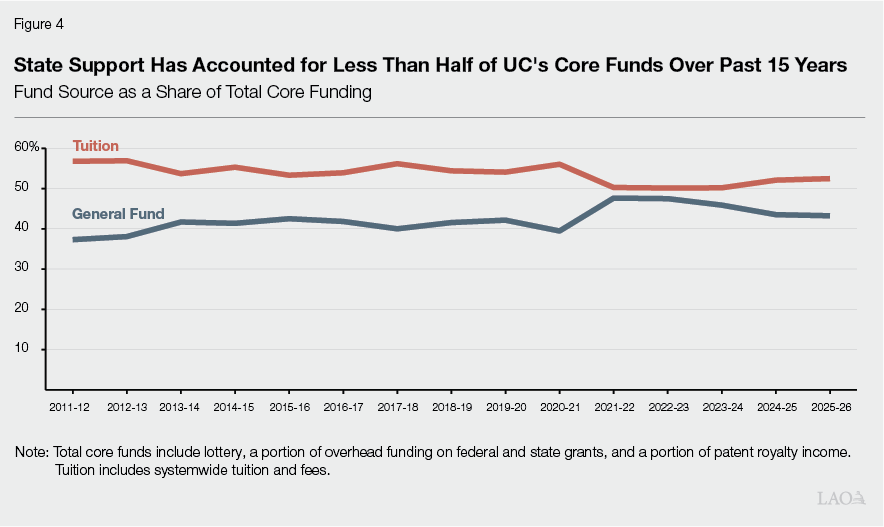
UC’s Reliance on State Support Has Increased Somewhat Over Past 15 Years. UC’s ongoing core funding primarily consists of state General Fund and tuition and fees, with smaller shares from lottery funds and federal contract and grant overhead. State General Fund support has fluctuated over time—generally rising during economic expansions and falling during recessions. As Figure 4 shows, the General Fund share of UC’s total core funding has increased from 37 percent in 2011‑12 to 43 percent in 2025‑26. As the state share has increased, the tuition share had decreased—falling from 57 percent in 2011‑12 to 52 percent in 2025‑26.
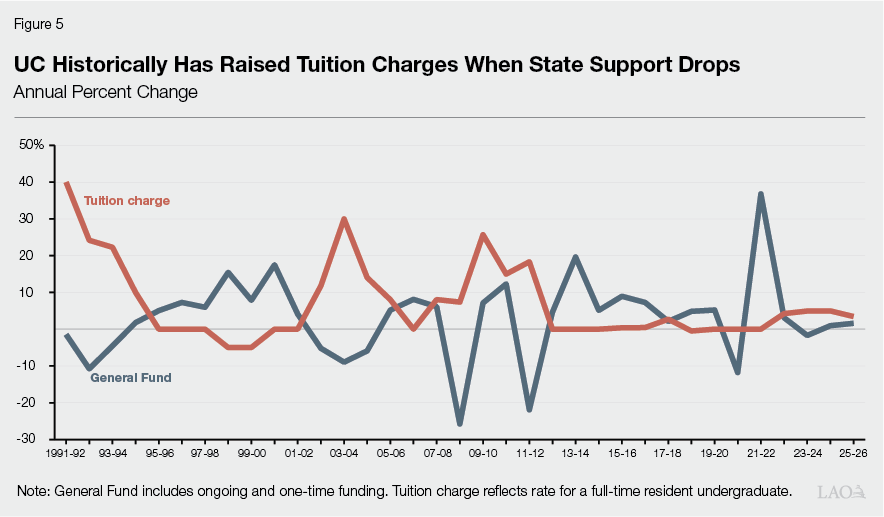
UC Tuition Charges and State Support Historically Move in Opposite Directions. For most of the past 30 years, neither the state nor UC had a tuition policy. Partly as a result, changes in tuition charges tended to move contrary to changes in state General Fund support. As Figure 5 shows, UC tuition and fee levels have had long flat periods generally corresponding to years of economic growth and increasing state contributions. These periods tend to be followed by steep tuition increases generally corresponding to economic slowdowns or recessions, when state contributions tend to fall.
UC Began Implementing a Tuition Policy in 2022‑23. In 2021, the Board of Regents approved a new tuition policy that took effect in 2022‑23. Under this policy, tuition increases annually for new undergraduates and all graduate students, while continuing undergraduates pay a flat rate for up to six academic years. Annual increases are generally based on a three‑year rolling average of changes in the California Consumer Price Index, with a 5 percent cap. In November 2025, the Regents extended and revised the policy. The revised policy allows for tuition increases of up to 1 percentage point above inflation as long as the rate remains below the 5 percent cap. Beginning in 2027‑28, if the approved rate increase is less than the 5 percent cap, UC also may carry forward the unused portion and apply it in a future year (as long as the 5 percent cap is not exceeded each year). The revised tuition policy is scheduled to be in effect from fall 2026 through July 2033.
UC Plans to Increase Tuition Charges by 4.4 Percent in 2026‑27. In 2026‑27, systemwide tuition and fees are set at $15,588 for new resident undergraduate students, reflecting an increase of $654 (4.4 percent) from 2025‑26. UC also is raising its nonresident supplemental tuition charge. The supplemental rate for nonresident undergraduates (which is in addition to the base rate for resident students) is set at $39,270. The supplemental rate rises by $1,668 (4.4 percent) from 2025‑26. These rate increases reflect the policy to increase charges by 1 percentage point above the rolling three‑year average change in the California Consumer Price Index.
UC Also Relies on Three Other Ways to Support Core Operations. Beyond state support and tuition revenue, UC relies on three other much smaller sources of support for its core operations. UC places its pooled cash in investment accounts and uses some of the annual investment earnings to support core operations. UC also receives overhead revenue associated with federal contracts and grants—known as federal indirect cost recovery—that helps support campus research infrastructure and certain central administrative costs. UC also regularly seeks to contain growth in its operating costs. One way it regularly realizes operational savings is through negotiating discounts and rebates from vendors and service providers.
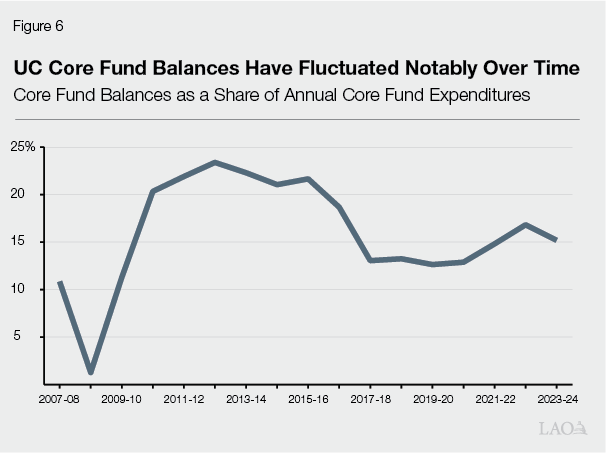
UC Reserve Levels Generally Have Tracked With Broader Fiscal Factors. As Figure 6 shows, UC core fund balances as a share of its annual core fund expenditures have been as low as 1.8 percent in 2008‑09 and as high as 23 percent in 2012‑13. UC reserves dropped notably at the onset of the Great Recession. UC reserves climbed the subsequent few years, likely in part due to heightened economic uncertainty. During the following years of economic expansion and reduced economic uncertainty, UC reserve levels declined. UC reserves also were impacted by the infusion of federal stimulus funding and one‑time state funding provided in 2021‑22 and 2022‑23, with levels growing somewhat over those years. In 2023‑24 (the most recent year for which UC has reported data), UC reserves declined from 17 percent to 15 percent of annual core fund expenditures—equating to just under two months of reserves. Within this core fund balance, UC campuses retain some funds specifically to respond to economic uncertainties. Systemwide, very little (1.6 percent in 2023‑24, less than six days of reserves) is earmarked for this purpose. The remainder is committed to various planned activities, including faculty recruitment, capital outlay planning, and launching new academic programs.
Spending Trends
UC’s Spending Is Driven by a Few Major Cost Pressures. In addition to understanding UC’s reliance on state support and tuition revenue, it is important to understand UC’s spending trends and core cost pressures. Understanding UC’s spending trends is especially important when the state faces challenging fiscal situations. As discussed in The 2026‑27 Budget: Overview of the Governor’s Budget, the state faces projected deficits in the out‑years. As a result, budget makers will likely have to make difficult decisions in the coming years to realign state spending with available revenues. As part of that process, the Legislature may have to contemplate how to prioritize amongst competing state spending priorities.
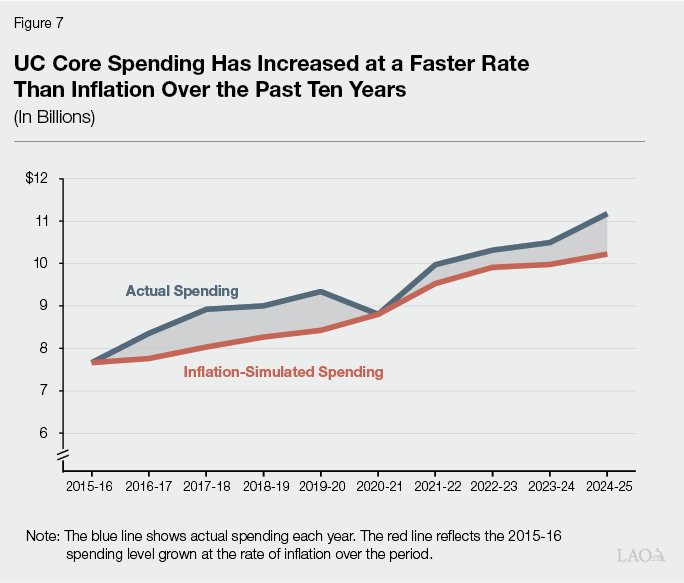
UC Spending Has Outpaced Inflation Over Past Ten Years. As Figure 7 shows, UC’s core spending has grown faster than inflation over the past ten years. Over this period, core spending grew at an average annual rate of 4.3 percent compared to an average annual inflation rate of 3.3 percent over the same period. In 2024‑25, UC’s actual core spending was 9.3 percent higher than it would have been had spending simply kept pace with inflation since 2015‑16. This faster growth reflects both increases in student enrollment and increases in underlying cost drivers. The remainder of this section examines these cost drivers in greater detail. Trends in enrollment are covered in the “Enrollment” section of this brief.
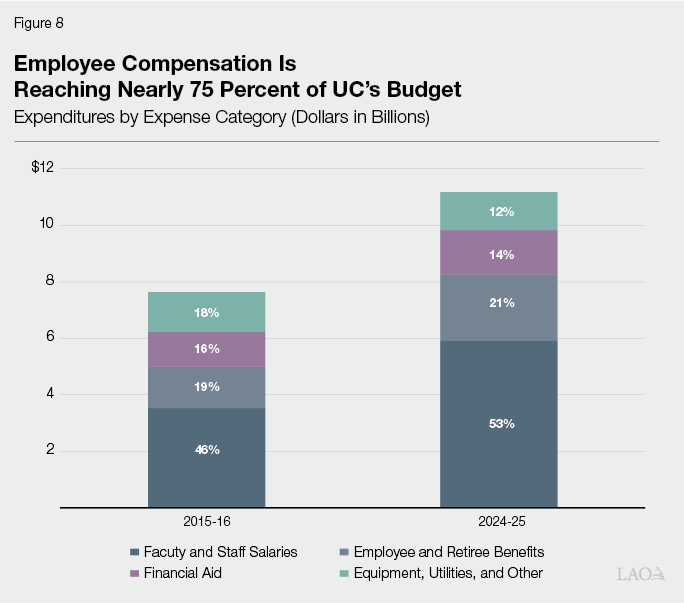
Employee Compensation as a Share of UC’s Budget Has Grown. Employee compensation has been and remains UC’s largest operating expense. As Figure 8 shows, salaries and benefits accounted for about three‑fourths of UC spending in 2024‑25. Over the past decade, the share of spending devoted to compensation has increased, rising from 65 percent in 2015‑16. At the same time, the shares of UC spending devoted to student financial aid and other operating expenses have declined slightly. From 2015‑16 through 2024‑25, UC spending increased at an average annual rate of 5.9 percent for salaries and 5.3 percent for benefits. This trend in employee payroll growth is comparable to that experienced at other similarly classified institutions. As discussed next, this growth in overall compensation at UC reflects both expansion in the size of its workforce and increases in average salaries and benefit costs over time.
UC’s Workforce Has Grown Notably Over Time, Especially Nonfaculty Staff. In April 2025, UC employed more than 145,000 FTE campus employees, excluding medical centers. UC staffing levels have generally increased over time. Over the past decade, overall staffing growth has outpaced enrollment growth. Between 2015‑16 and 2024‑25, UC’s FTE workforce increased by an annual average of 2.4 percent, while its FTE enrollment rose by 1.9 percent. As a result, the student‑to‑employee ratio declined slightly over the period (from 2.2 to 2.1). Faculty, however, grew at a slower rate than enrollment over this period. Faculty FTE increased by 1.5 percent annually over the past decade, contributing to an increase in the student‑to‑faculty ratio from 14.0 to 14.6. Though UC’s workforce grew notably over much of the past ten years, UC implemented a systemwide hiring freeze beginning April 1, 2025. Although campuses retain some discretion in how the freeze is applied, it is expected to constrain faculty and staff hiring through the 2026‑27 academic year. Recruitments for the 2026‑27 cycle may proceed on a limited basis where positions address critical needs or are supported by specific funding sources.
Growth in UC Salary Spending Has Been Driven Mostly by Workforce Expansion. Over the past decade, UC spending on faculty salaries increased by an annual average of 4.4 percent, while spending on nonrepresented staff salaries increased 5.6 percent. As a group, represented employees (including various other staff positions and union‑represented academic employees) saw their salaries increase by 6.7 percent each year over the last ten years. After accounting for workforce growth, salary growth largely matched inflation, with little to no growth in inflation‑adjusted wages for core‑funded employees over the past decade.
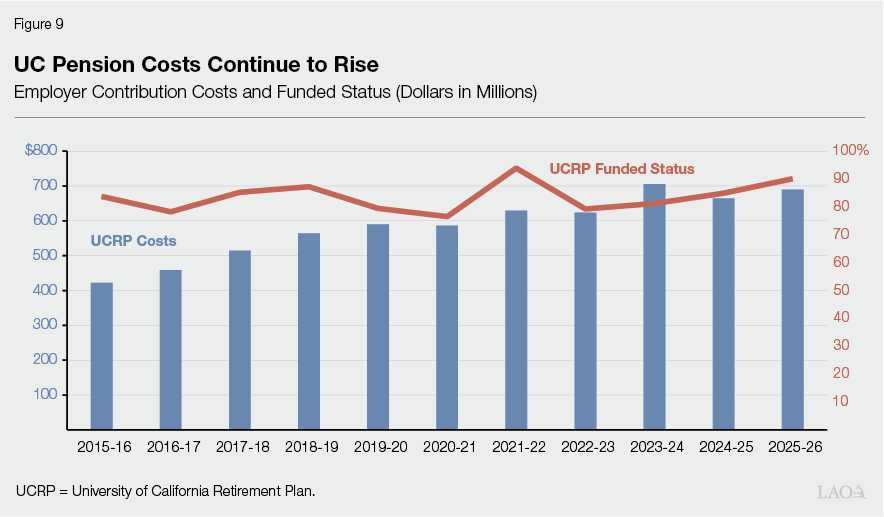
Rising Pension Costs Are Due to Both Workforce Expansion and Rate Increases. Whereas many state employees participate in the California Public Employees’ Retirement System or the California State Teachers’ Retirement System, UC employees participate in the University of California Retirement Plan (UCRP). The UC Board of Regents manages UCRP. Each year, the Board of Regents determines how much UC contributes to its pension program. For the last ten years, the UC employer contribution rate has increased gradually, from 14.6 percent of payroll in 2015‑16 to 16.71 percent in 2024‑25. As Figure 9 shows, annual program costs have steadily grown over this period, reaching more than $665 million in 2024‑25 (growing at an average annual rate of 5.2 percent over this period). In 2024‑25, UCRP’s funded status (comparing assets to liabilities) was 85 percent and is expected to reach 90 percent in 2025‑26. UCRP’s funded status has tended to be better than other California state retirement plans. The increase in UCRP’s funded status is primarily due to strong investment returns in recent years. The UC employer contribution rate, however, remains somewhat below the rate needed to fully fund the pension system.
Health Care Costs Are Growing but Stable as a Share of Spending. UC offers a range of health plans for UC employees and retirees, with premiums set annually for the respective plans. The premium costs that UC covers for employees depends on an employee’s income level, with lower‑paid employees receiving a higher share of their premium costs covered. UC’s health care spending generally has increased over time, growing from $532 million in 2015‑16 to an estimated $781 million in 2024‑25 (up 4.4 percent on average each year). While health care costs at UC are growing, these costs as a share of UC’s total core expenditures have remained fairly stable over the past decade, hovering around 7 percent.
Financial Aid Spending Has Increased in Tandem With Enrollment Growth and Tuition Increases. Beyond employee compensation, UC faces several other ongoing cost pressures. The largest of these is institutional student financial aid. UC sets aside a portion of new tuition revenue generated by tuition increases and enrollment growth to support its institutional aid programs. In 2024‑25, UC’s institutional aid totaled about $1.5 billion, representing 14 percent of core funding. Over the past decade, institutional aid spending has grown notably, driven in part by increases in student enrollment and in part by increases in tuition charges (for which a portion is dedicated to institutional aid). Institutional aid spending, however, has not grown as fast as employee compensation (which has grown at more than twice the rate of institutional aid).
Debt Service Has Been Hovering at Around 4 Percent of Core Spending. UC typically borrows to undertake major capital projects. It carries debt mostly from former state general obligation bonds and, beginning in 2013‑14, from university bonds. In 2013‑14, the state initiated a new policy intended to provide UC with greater ability to manage its facilities, more predictability in facility financing, and more incentive to contain costs. Specifically, the state gave UC authority to sell its own university bonds for state‑approved academic capital projects and use its main General Fund appropriation to cover the associated debt service. Under this system, the expectation is that UC undertake capital projects regularly, as UC no longer has to depend on periodic, voter‑approved bonds. Total UC debt service on state‑approved academic facilities and certain student housing facilities increased from $324 million in 2015‑16 to $503 million in 2024‑25.
Proposals
Governor’s Budget Includes Ongoing Increase in State Support for UC in 2026‑27. The Governor proposes to increase ongoing base General Fund support for UC by $351 million (7 percent) in 2026‑27. This increase reflects two components. First, the Governor’s budget includes a 5 percent base increase ($254 million) for UC in 2026‑27, reflecting the fifth‑year base increase of his multiyear compact. Second, the Governor’s budget includes an additional 2 percent increase ($96 million) associated with the 2025‑26 compact payment that was postponed to 2026‑27 under last year’s budget agreement. The administration proposes to give UC discretion in allocating this additional funding in 2026‑27.
Governor Proposes to Continue Deferral Arrangement for One More Year. The Governor’s budget continues the payment deferral arrangement adopted last year for UC. In 2025‑26, the state deferred a $130 million General Fund payment from 2025‑26 to 2026‑27, while allowing UC to take a no‑interest General Fund cash loan to cover costs in the meantime. UC requested and received this cash loan in fall 2025. Under the Governor’s proposal, the state would extend this approach by deferring another $130 million payment from 2026‑27 to 2027‑28 and again offering a short‑term, no‑interest cash loan to UC. The administration intends to retire the deferral in 2027‑28, resulting in a one‑time General Fund cost of $130 million at that time. The deferral is intended to have no programmatic effect on UC.
Governor Retains Out‑Year Funding Commitments. Under the Governor’s budget, the state would continue to make two additional out‑year funding commitments to UC. The state would commit to providing UC with a one‑time back payment of $241 million in 2027‑28 to address the base increase that it did not receive in 2025‑26, followed by a $144 million ongoing increase in 2028‑29, reflecting the remaining 3 percent base increase from the postponed 2025‑26 compact payment.
UC Anticipates Receiving Additional Revenue From Tuition and Other Sources in 2026‑27. UC has identified a total of $308 million from nonstate sources that it plans to use for its core operations in 2026‑27. Most notably, UC estimates it will generate $273 million in additional tuition and fee revenue. (Of this amount, UC has earmarked $95 million for its systemwide program that provides student financial aid.) In addition, UC intends to use $20 million from its investment earnings for its core operating costs in 2026‑27. UC also anticipates generating $15 million in freed‑up funds from procurement savings and other operational efficiencies that it will use for its core operations in 2026‑27.
UC Will Use Additional Funding for Its Spending Priorities. Under the Governor’s budget assumptions, after restoring UC’s General Fund base support for the payment deferral, UC would have $658 million in total additional core funding for new spending priorities in 2026‑27. With this additional funding, UC likely would:
- Provide salary increases for nonrepresented and represented employees. We estimate each 1 percent increase in payroll would cost $55 million in 2026‑27.
- Cover health benefit and pension cost increases. UC estimates benefit costs will increase by $134 million. UC estimates its health care costs will grow by 8.2 percent, while its employer contribution rate to UCRP will be 17.2 percent of payroll, up from 16.5 percent of payroll in 2025‑26.
- Cover the cost associated with enrollment growth, particularly for the hiring of additional faculty and support staff. We estimate each 1 percent increase in resident undergraduate enrollment would have a total marginal cost (state and student shares combined) of $54 million in 2026‑27.
- Increase student financial aid by $99 million primarily to account for enrollment growth and tuition increases.
- Pay for nonpersonnel operating cost increases (such as for utilities and insurance).
- Potentially launch a few, small new initiatives.
Assessment
Unrestricted Base Increase Lacks Transparency and Accountability. The Governor’s proposed base increase for UC clouds transparency and accountability, as the funds are not earmarked for specific purposes. UC’s 2026‑27 Budget Plan for Current Operations, presented to the Board of Regents in November 2025, outlines UC’s spending priorities, but the amount requested is higher than proposed by the Governor. Moreover, no statutory language requires UC to allocate the base increase consistent with this plan. Furthermore, the Legislature could have different priorities—for example, prioritizing compensation increases, enrollment growth, or the building up of UC’s reserves for economic uncertainties differently than the Board of Regents.
Despite Large Increase in State Support, None Is Designated for Capital Renewal. The Governor gives UC full discretion in deciding how to spend the proposed $658 million in additional core funding. Neither the Governor nor UC’s budget plan identifies spending any of this funding for capital renewal projects. UC, however, is carrying an estimated capital renewal backlog of $9.1 billion. When projects are not done on time, project costs can increase in the future and the likelihood of programmatic disruptions due to failing building components increases.
Governor Presents No Plan for How to Honor Out‑Year Commitments. The Governor’s budget continues to make out‑year funding commitments to UC in fiscal years when the state is projected to have deficits. Despite making these out‑year funding commitments, the administration does not identify corresponding funding sources or budgetary offsets to support these commitments. Absent a clear plan for how the state would accommodate these costs alongside other General Fund priorities, the out‑year commitments might be delayed further, not made at all, or necessitate budget solutions in other areas.
Recommendations
Recommend Reducing or Eliminating Base General Fund Increase. When facing fiscal uncertainty and ongoing budget shortfalls, the Legislature typically considers ways to contain state spending. The Governor, however, proposes to increase UC spending significantly. In addition, the Governor’s budget does not specify how the proposed ongoing augmentations to UC’s base funding would be supported in future years. Given this context, if the Legislature wishes to continue providing base increases to UC despite the challenging budget outlook, it could consider approving smaller increases that are more closely aligned with current inflationary benchmarks—such as the 2.41 percent base increase proposed for community colleges. Alternatively, the Legislature could consider eliminating the proposed base increase for UC to help manage the state’s structural deficit and reduce pressure for more significant reductions in later years. Even without the proposed 7 percent base General Fund increase, UC’s core funding would increase 3.5 percent in 2026‑27, and UC would be able to cover some of its spending priorities. This growth rate is slightly below the average annual rate of growth in UC’s total core funding over the past ten years (4.3 percent).
Recommend Earmarking a Share of Any Ongoing Base Increase for Capital Outlay. If UC were to receive a base General Fund increase and designate none of it for capital improvements, its facility conditions would worsen and backlog of projects would continue to grow. To mitigate this issue, we recommend the Legislature adopt provisional budget language earmarking some share of any approved base increase for capital renewal projects. For example, earmarking around 10 percent of a base increase would allow UC to undertake some capital renewal projects while still retaining the preponderance of any base increase for other spending priorities. Undertaking at least some capital renewal projects would help reduce the risk of higher project costs in the future.
Recommend Using Available One‑Time Funding to Retire Payment Deferral. If one‑time funding becomes available, we recommend the Legislature make retiring this payment deferral a high priority. Retiring the deferral would return UC’s state payments to their regular schedule, eliminate the associated debt obligation, and reduce state budgetary pressures in the out‑years.
Recommend Removing Out‑Year Commitments. We recommend removing the state’s out‑year funding commitments to UC in 2027‑28 and 2028‑29. Eliminating these out‑year augmentations would reduce projected state deficits in 2027‑28 and 2028‑29 without requiring programmatic cuts or tax increases. Rather than making commitments in advance, the Legislature could determine each year how much ongoing support it can afford to provide UC in light of overall fiscal conditions and competing budget priorities.
Enrollment
In this section, we first provide background on UC enrollment. Next, we cover enrollment trends. We then discuss the state’s enrollment expectations for UC in 2026‑27. Finally, we assess UC’s enrollment situation and make associated recommendations.
Background
UC Enrolls a Mix of California Resident and Nonresident Students. In 2024‑25, of the approximately 300,000 FTE students enrolled at UC, 83 percent were California residents and 17 percent were nonresidents (domestic and international). Compared to the two other segments, UC enrolls a notably larger share of nonresident students. (In 2024‑25, nonresidents comprised 5.4 percent of CSU FTE students and an estimated 3 percent of CCC FTE students.) Nonresident students comprise a larger share of graduate enrollment than undergraduate enrollment at UC. In 2024‑25, 32 percent of UC graduate students were classified as nonresidents (of which 80 percent were international students), compared to 14 percent of UC undergraduates (of which 53 percent were international students).
UC Enrolls a Mix of Freshmen and Transfer Students. Besides aiming to enroll a mix of resident and nonresident students, UC seeks to enroll a certain mix of new incoming freshmen and transfer students. Specifically, UC aims to enroll two resident freshmen for every one resident transfer student. In 2024‑25, the average freshman‑to‑transfer ratio was somewhat higher than the target—at 2.2 systemwide. Most UC campuses did not meet the 2:1 ratio in 2024‑25 despite a recent rebound in community college enrollment and resident transfer applications. The only campuses to meet the 2:1 target in 2024‑25 were Los Angeles, San Diego, and Irvine.
State Typically Sets Resident Enrollment Targets. Over the past two decades, the state’s typical enrollment approach for UC has been to set systemwide resident enrollment targets. These targets have typically applied to total resident enrollment, giving UC flexibility to determine the mix of undergraduate and graduate students. Recently, the state has departed from this practice by setting enrollment growth targets only for undergraduates. The state also has departed from historical practice by setting enrollment growth targets not only for the budget year but also budget year plus one. The state made this change in an effort to better align its targets with UC’s admissions cycle. UC completes its admissions cycle for the coming fall term before the state enacts the annual budget each June. Setting an enrollment growth target for budget year plus one allows the state to influence UC’s planning for the next admissions cycle, prior to UC making its admission decisions. In the 2025‑26 Budget Act, the state set UC resident undergraduate enrollment targets for 2025‑26 and 2026‑27.
State Typically Provides Associated Enrollment Growth Funding. If the state sets an enrollment growth target for UC in the budget year (sometimes the state leaves the target flat), the state has usually provided associated General Fund augmentations. Augmentations have been calculated using an agreed‑upon per‑student funding rate derived from the “marginal cost” formula. This formula estimates the cost to enroll each additional student and shares the cost between the state General Fund and student tuition revenue. In 2025‑26, the total marginal cost per student is $23,531, with a state share of $12,885. Due to budget constraints, the state did not provide General Fund support for enrollment growth at UC in 2025‑26.
State Has Directed UC to Reduce Nonresident Undergraduate Enrollment. The state has also acted to limit the number of nonresident undergraduates at high‑demand UC campuses, with the intent to make more slots available for resident undergraduates. Specifically, the state has directed UC to reduce nonresident undergraduate enrollment at the Berkeley, Los Angeles, and San Diego campuses by a combined 902 FTE students each year and increase resident undergraduate enrollment by the same amount. The nonresident enrollment reduction plan began in 2022‑23 and is intended to extend through 2026‑27. By 2026‑27, UC campuses are to have nonresident students comprise no more than 18 percent of their total undergraduate enrollment. (The 18 percent cap applies to all UC campuses, but only the Berkeley, Los Angeles, and San Diego campuses currently are above that cap.) To help the three campuses achieve this goal, the state has provided UC with ongoing General Fund augmentations of about $30 million each year. These augmentations are intended to backfill the associated lost nonresident supplemental tuition revenue and cover the higher financial aid costs for resident students. The state paused this funding in 2025‑26 but retained the expectation that UC replace 902 FTE nonresident students with resident students at the high‑demand campuses.
Trends
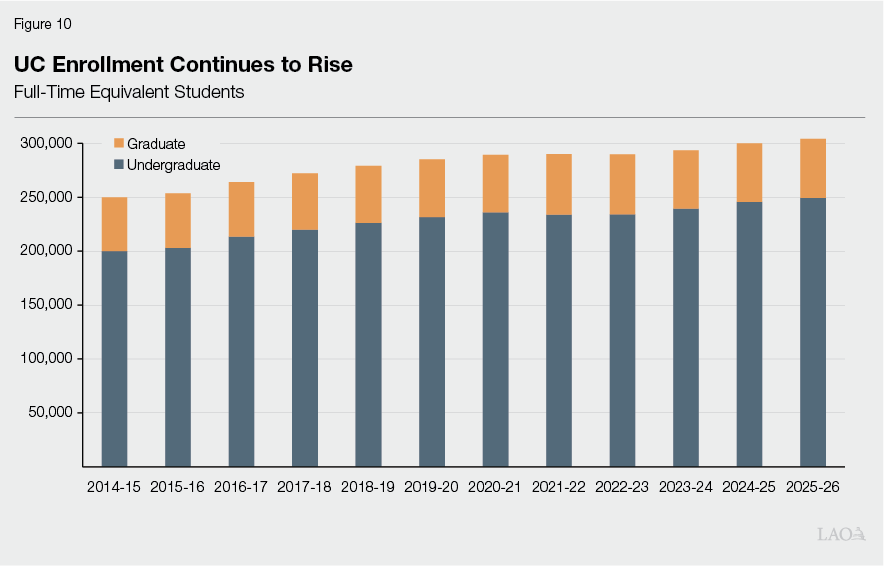
UC Enrollment Has Grown Over the Past Decade. As Figure 10 shows, UC enrollment has increased every year but one (2022‑23) over the past decade. Total enrollment has grown by nearly 47,000 students (18 percent), an increase equivalent to the current total enrollment of UC Los Angeles. Undergraduate enrollment has grown faster than graduate enrollment. From 2015‑16 through 2024‑25, undergraduate enrollment increased by 21 percent, whereas graduate enrollment increased by 8 percent. As a result, the share of undergraduates has grown slightly (from 80 percent to 82 percent of overall enrollment), as the share of graduate students has declined (from 20 percent to 18 percent). Undergraduate enrollment growth has varied somewhat across UC campuses. Over the last decade, UC Merced added the fewest number of undergraduates but grew at the fastest rate. UC Los Angeles grew at the slowest pace.
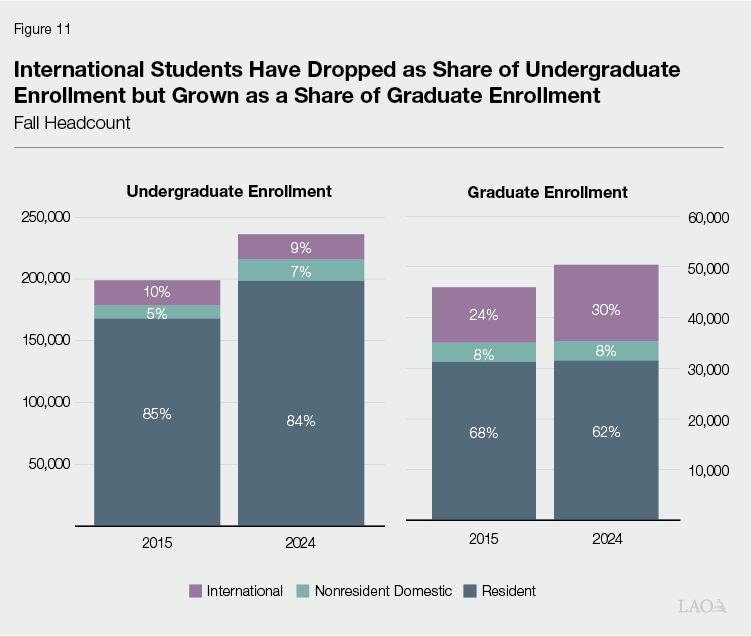
Shares of Resident, Domestic, and International Students Have Changed Somewhat. From 2015 through 2024, UC added about 37,000 undergraduates, nearly 31,000 of whom were residents. Resident undergraduates grew at about the same rate as nonresident undergraduates. As Figure 11 shows, the most notable change among undergraduates over this period was a decrease in the share of international students, which was largely offset by a higher share of domestic nonresidents. In contrast, the most notable change among graduate enrollment was the growing share of international students. The shares of both resident and domestic graduate students declined over the period.
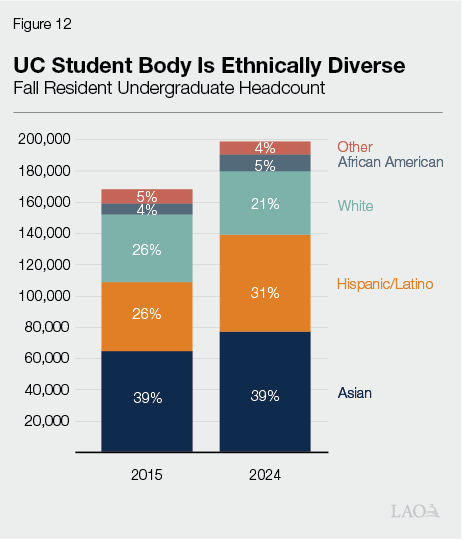
Composition of UC Undergraduate Student Body Has Changed Somewhat Over Past Decade. As Figure 12 shows, the share of Hispanic/Latino students at UC rose from 26 percent in fall 2015 to 31 percent in fall 2024, while the share of White students declined from 26 percent to 21 percent. The share of Asian students remained stable, while the share of African American students rose slightly. The share of resident undergraduates receiving Pell Grants (a proxy for low income) declined from 46 percent in fall 2015 to 43 percent in fall 2024. Regarding academic preparation, the share of freshmen enrolled with a weighted high school GPA of 4.0 or above increased from 53 percent to 66 percent over the period.
Proposals
Governor Maintains 2026‑27 Enrollment Expectations but Sets No Target for 2027‑28. The 2025‑26 Budget Act set a resident undergraduate enrollment expectation for UC in 2026‑27. Specifically, UC is to add 2,968 FTE students (a 1.4 percent increase) in 2026‑27, bringing resident undergraduate enrollment to 212,503 FTE students. Under the compact, UC is to fund much of this growth (2,066 FTE students) from within the proposed base increases. The rest is funded through the nonresident replacement plan. In contrast to past state practice, the Governor does not set enrollment growth expectations at UC for budget year plus one (2027‑28).
Governor’s Budget Resumes General Fund Support for Nonresident Enrollment Reduction Plan. The Governor’s budget includes $61 million ongoing General Fund support for the nonresident undergraduate replacement plan—effectively doubling up funding in 2026‑27 (given the pause in funding in 2025‑26). Provisional budget language continues to direct UC to replace 902 FTE students combined at the three high‑demand campuses in 2026‑27. (The 902 additional resident FTE students are included in the overall 2,968 resident FTE student growth target.) Under the Governor’s proposal, the expectation effectively would be that all UC campuses reach the statutory 18 percent cap (of nonresidents to total undergraduate enrollment) in 2026‑27.
Assessment
UC Undergraduate Resident Enrollment Has Grown Much More Quickly Than Underlying Demographic Trends. Between 2015‑16 and 2024‑25, UC resident undergraduate enrollment grew at an average annual rate of 2.1 percent, substantially outpacing underlying demographic drivers. Over the same period, the number of California public high school graduates increased only 0.4 percent annually, while the age 18 to 24 population declined (‑0.3 percent). These demographic factors appear to have impacted the other public higher education segments—with resident undergraduate enrollment growing at an average annual rate of only 0.3 percent at CSU and enrollment declining at CCC.
Undergraduate Applications Increased Substantially With the Removal of Standardized Testing. Figure 13 illustrates a sharp rise in applications following UC’s May 2020 decision to drop standardized testing from its admission process. First affecting applicants for the fall 2021 term, total undergraduate applications rose by 16 percent from the previous fall. Domestic nonresident applications rose the most—by 44 percent. By fall 2025, the number of applications remained far above the 2020 level. This sustained increase in applications notably expanded the pool of potential enrollees, even as growth in California’s high school population was modest.
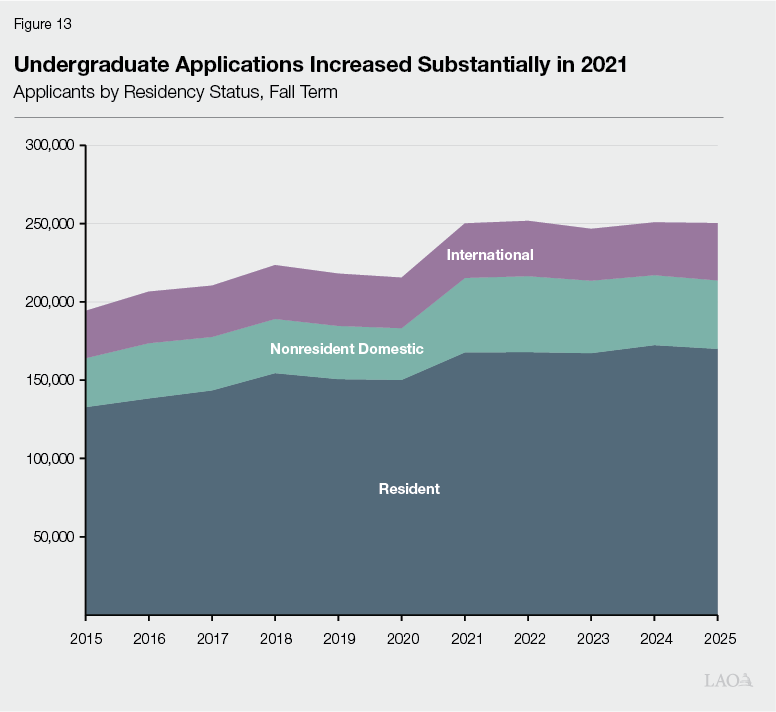
Some Trends Signal That UC Enrollment Pressures Have Weakened. Typically, a large increase in applications would be followed by a drop in admission rates. Systemwide admission rates at UC, however, increased over the past decade, with admission rates for resident undergraduates increasing from about 60 percent to nearly 70 percent. Higher systemwide admission rates are an indication that enrollment pressures are easing. Consistent with this trend, UC now enrolls a larger share of California public high school graduates than ever before—rising from 7 percent in 2015‑16 to 8.4 percent in 2024‑25. (Admission rates have declined at the three highest‑demand campuses, though this too can largely be attributed to more applications rather than reduced access. Resident undergraduate enrollment has continued to grow at all three of the highest‑demand campuses.)
UC Expects to Exceed Its Resident Undergraduate Enrollment Target in 2025‑26. The 2025‑26 Budget Act set the expectation that UC grow its resident undergraduate enrollment by 2,947 FTE students (1.4 percent) in 2025‑26, for a total level of 209,535 FTE students. Based on data from the summer and fall 2025 terms, UC estimates that its resident undergraduate enrollment will be up 8,144 FTE students (3.9 percent) in 2025‑26, for a total level of 214,732 FTE students. This level of growth even exceeds the 2025‑26 Budget Act enrollment target set for UC in 2026‑27—212,503 FTE students. UC is planning to apply the excess growth in 2025‑26 toward its 2026‑27 enrollment target. UC is accommodating the cost of this enrollment within its core budget.
A Confluence of Factors Might Be Negatively Impacting Academic Programs. UC exceeded the state’s 2025‑26 enrollment growth target substantially, even though the state did not provide UC with a notable base General Fund increase in 2025‑26. UC also increased enrollment while simultaneously implementing a systemwide hiring freeze (since March 2025). Together, these factors appear to have begun impacting course offerings, course availability, and class sizes, at least at some campuses. (To gain a better understanding of these current impacts, the Legislature could request UC share applicable data during spring hearings.)
UC Expects to Miss Its Nonresident Undergraduate Enrollment Reduction Target in 2025‑26. Despite substantially exceeding its 2025‑26 resident undergraduate enrollment target, UC anticipates that it will not meet the target of replacing a combined 902 FTE nonresident students with resident students at the Berkeley, Los Angeles, and San Diego campuses. Compared to 2024‑25, nonresident undergraduate enrollment is expected to decline by 22 FTE students at Berkeley and 169 FTE students at Los Angeles but increase by 265 FTE students at San Diego (for a new increase of 74 FTE students). Whereas the Berkeley and Los Angeles campuses reduced nonresident undergraduate headcount as a share of their total undergraduate headcount, the San Diego campus increased it. None of the three campuses has yet reduced nonresident undergraduate enrollment below the 18 percent cap.
Nonresident Replacement Plan Is Based on Questionable Assumption. The state’s nonresident enrollment reduction plan is premised on the assumption that the Berkeley, Los Angeles, and San Diego campuses lack the capacity (particularly in terms of housing or instructional space) to enroll additional resident undergraduates without reducing nonresident enrollment. Available evidence, however, does not clearly support this assumption. During the first four years of the plan, all three campuses increased resident undergraduate enrollment notably beyond the replacement of nonresident students (enrolling more than 4,500 new resident students in addition to the replaced nonresident students). Moreover, other available evidence indicates the three campuses do not face insurmountable physical capacity constraints. Over the past five years, all three campuses have initiated and/or completed housing projects adding several thousand beds. Furthermore, UC classroom and laboratory utilization reports indicate the three campuses are not using these facilities up to legislative standards.
Less Costly Option Exists for Funding More Resident Undergraduates. The nonresident replacement plan effectively funds resident undergraduate growth at an implied cost of $33,902 per student, which is much higher than the state share of the marginal cost ($14,419 in 2026‑27). At the marginal cost rate, the state could meet its current goal of enrolling 902 additional resident undergraduates for just under $13 million—substantially less than the $31 million provided annually under the replacement plan.
Recommendations
Recommend Maintaining Original Target for Undergraduate Resident Enrollment in 2026‑27. We recommend the Legislature maintain the UC resident undergraduate enrollment target of 212,503 FTE students for 2026‑27, as established in the 2025‑26 Budget Act and proposed by the Governor. This level reflects what the Legislature deemed the state would be able to afford and sustain over time, even with its projected budget deficits. UC could accommodate the cost of any students above the state target within its budget, or it could manage its enrollment down to the state target in 2027‑28. Several factors, including key demographic factors and rising systemwide admission rates, suggest more accelerated enrollment growth is not critical at this time. Moreover, faster enrollment growth in the near term could exacerbate existing issues with course offerings, course availability, and class sizes.
Recommend Earmarking Funding for Enrollment Growth in 2026‑27. Consistent with historical legislative practice, we recommend the Legislature fund enrollment growth at UC apart from and on top of any base increase to provide greater transparency and accountability. Relative to the Governor’s budget, the Legislature effectively could shift funding from the unrestricted base increase and designate it for enrollment growth. We recommend the Legislature fund UC enrollment growth using the marginal cost formula. Based on the 2026‑27 marginal cost state rate, the ongoing General Fund cost of adding 2,968 resident undergraduate FTE students (1.4 percent) is $43 million. (Under this recommendation, none of the additional students are funded at the higher nonresident‑replacement rate.)
Recommend Pausing the Nonresident Replacement Plan. Given the state’s projected budget deficits, along with the evidence that the three high‑demand UC campuses can accommodate more resident students (beyond replacing nonresident students), we recommend pausing the implementation of the nonresident replacement plan. In tandem, we recommend capping nonresident undergraduate enrollment at the Berkeley, Los Angeles, and San Diego campuses at their respective 2024‑25 levels—the last year for which the state provided funding to support implementation and the replacement target was met. As resident enrollment grows while nonresident enrollment remains flat, the Legislature’s statutory objective of reducing nonresident enrollment to 18 percent of undergraduate enrollment still will be reached, though it would take somewhat longer. Of the Governor’s proposed $61 million for the nonresident replacement plan, this recommendation yields $36 million ongoing General Fund savings. (Our recommendation effectively redirects $13 million to fund 902 resident FTE students at the 2026‑27 marginal cost rate and $12 million to fund 902 resident FTE students at the 2025‑26 marginal cost rate.) Achieving budgetary savings in this way could help the state address its structural deficit without major programmatic implications.
Recommend Holding Enrollment Flat in 2027‑28. Given the sizeable projected deficit in 2027‑28, we recommend holding UC’s enrollment expectations flat for that year. If UC were to continue enrolling additional students without state support, it could experience more negative programmatic impacts.
Federal Funds
In this section, we provide background on the federal funding that UC receives, then discuss some of the potential major impacts of recent federal actions on UC.
Overview
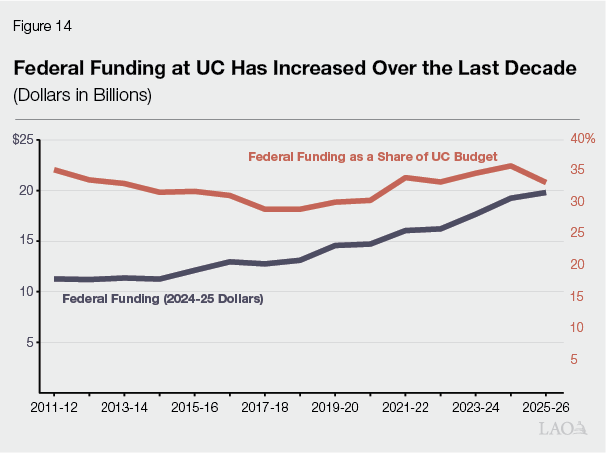
Federal Funding Comprises About One‑Third of UC’s Budget. As Figure 14 shows, federal funding at UC has grown over the past decade, reaching $19.2 billion in 2024‑25. Federal funding at UC grew more quickly than inflation. Even after adjusting for inflation, the average annual growth rate over this period was 5 percent. The rest of UC’s budget also grew over the period, such that federal funding hovered around one‑third of UC’s total operating budget. The exact percentage, however, has fluctuated somewhat. The federal share has been as low as 29 percent of UC’s budget (in 2018‑19 during the first Trump Administration) and as high as 36 percent (in 2024‑25 during the Biden Administration). Federal funds must be used for specified purposes and are not fungible with core funds.
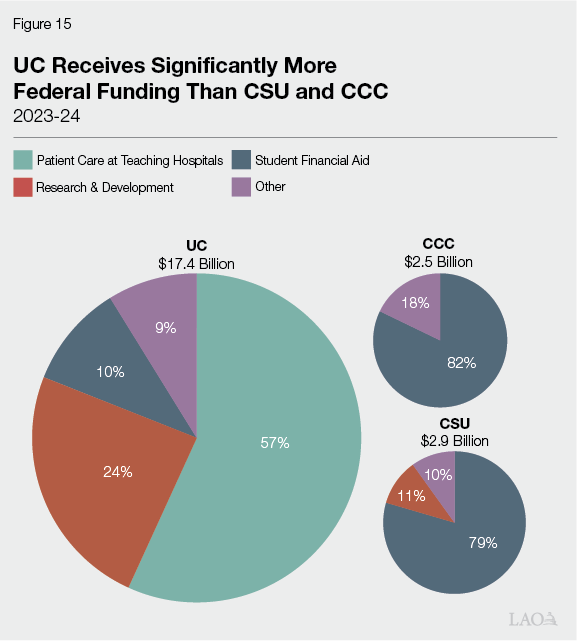
Federal Funding Supports UC in Three Main Areas. The federal government provides support to UC primarily for (1) health care delivery and training, (2) research, and (3) student financial aid. As Figure 15 shows, more than half of federal funding at UC is for health care delivery and training, mainly at UC’s five medical centers. About one‑quarter of federal funding is for research. All ten UC campuses receive some federal funding for research annually. About 10 percent of federal funding is for student financial aid, namely for student loans and Pell Grants. The remaining funding is for training, student support, and outreach programs, among various other purposes. As Figure 15 also shows, UC receives substantially more federal funding than CSU and CCC—nearly six times more. In contrast to UC, the vast majority of federal funding for CSU and CCC is for student financial aid.
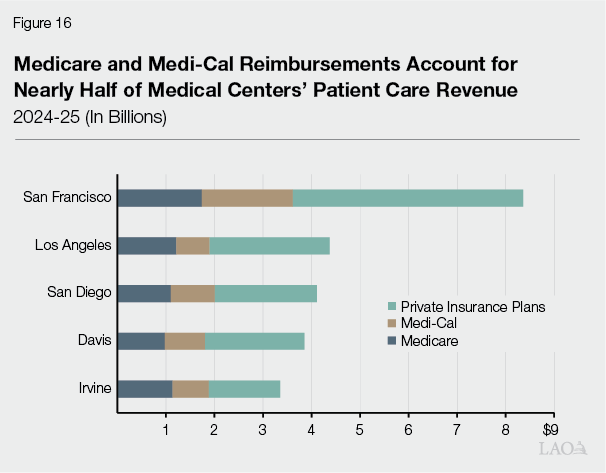
UC Medical Centers Rely Heavily on Federal Health Care Funding. Among other types of patients, UC medical centers serve patients participating in the federal Medicare and joint federal‑state Medicaid programs. The Medicare program generally serves adults age 65 and older, whereas the Medicaid program serves low‑income people. The costs for the Medicaid program in California—also known as Medi‑Cal—are covered by a mix of federal and state payments. In 2024‑25, UC received $11.2 billion in Medicare and Medi‑Cal reimbursements. (This EdBudget table summarizes federal funding provided to UC for patient care and other key purposes.) As Figure 16 shows, among UC’s five medical centers, UC San Francisco (UCSF) received the most in Medicare and Medi‑Cal reimbursements ($3.6 billion). This is because UCSF serves the largest number of patients. Among all its patient care revenue, UCSF relies least on Medicare and Medi‑Cal reimbursements, whereas UC Irvine relies most heavily on those reimbursements. The remainder of UC’s patient care revenue comes largely from private insurance plans.
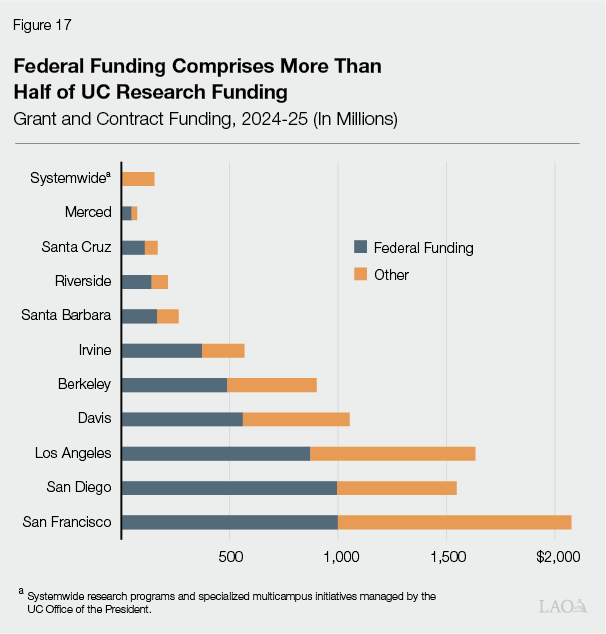
UC Campuses Rely Heavily on Federal Research Funding. In 2024‑25, UC received $4.8 billion in federal research funding (and an additional $1.8 billion for the management and operations of three Department of Energy national laboratories). Federal research funding comprised 55 percent of UC’s total research funding systemwide in 2024‑25. UC’s institutional funding—drawn from gifts, endowments, General Fund, and other sources—accounts for about 22 percent of total research funding. (UC also receives research funding from nonprofit organizations, other state agencies, and private businesses.) As Figure 17 shows, some UC campuses received much more federal research funding than other UC campuses. Whereas UCSF and UC San Diego each received nearly $1 billion in federal research funding, six other UC campuses each received less than $500 million. While most federal agencies provide some research funding to UC campuses, the National Institutes of Health (NIH) accounts for over 40 percent of UC’s federal research funding. NIH funding is particularly concentrated on campuses with medical centers.
Federal Financial Aid Represents One‑Third of Student Financial Aid at UC. In 2024‑25, UC received nearly $2 billion in federal funding for student financial aid. (This EdBudget table summarizes federal financial aid funding provided to UC students.) More than half of this amount consisted of student loans to undergraduate and graduate students, while grants and gift aid—primarily Pell Grants—totaled over $700 million. Overall, federal aid accounted for nearly one‑third of the total financial aid received by UC students, with the remainder provided by the state and UC. The relative importance of federal aid varies across campuses, ranging from 38 percent of total financial aid at UCSF (driven largely by graduate student borrowing) to 27 percent at UC Berkeley.
Impacts of Recent Federal Actions
Recent Federal Developments Have Important Implications for UC Medical Centers. Recent federal policy changes will reduce the amount of federal reimbursements at all UC medical centers. (This handout summarizes these federal policy changes.) Among the most notable changes are tighter Medi‑Cal eligibility rules and lower federal payments for patient care. These changes are expected to reduce the number of people receiving Medi‑Cal benefits, increase uncompensated emergency‑room care, and lower the federal payments medical centers receive for patient care. UC medical centers could respond to these federal developments potentially by absorbing the impact within their budgets (that is, reducing their annual margins) or adjusting their costs (for example, by reducing staff and scaling back certain types of low‑revenue‑generating medical services). UC medical centers have varying capacities to absorb the impact. The federal policy changes are scheduled to go into effect over time, with the first set of changes taking effect as of October 2026. Over the coming years, more information will become available on the fiscal impacts of these changes.
Short‑Term Risks to UC’s Federal Research Funding Appear More Limited Than Initially Anticipated. Several federal actions taken in early 2025 to reduce research funding subsequently have been paused or reversed by court decisions. Moreover, later congressional actions have further reduced the likelihood of significant federal research reductions. In particular, recently enacted federal budget legislation rejects most of the originally proposed research cuts, provides NIH funding above its 2025 level, and does not impose a cap on indirect cost recovery. As a result, near‑term funding risks for UC research appear more limited than initially expected. Consistent with this assessment, currently available expenditure and award data indicate that UC’s total federal research funding has not declined substantially to date relative to prior‑year levels (though there have been operational disruptions). As of January 2026, UC estimates 389 research awards totaling $173 million had been canceled, while 1,272 research awards totaling $832 million had been reinstated. (A notable share of the reinstated awards involve UC Los Angeles. The nearby box describes the federal investigations that led to the initial freezing and subsequent releasing of research grants at that campus.)
Federal Investigations Were Linked to Research Funding
UC Los Angeles (UCLA) Was a Focus of Federal Investigations. Following campus protests in 2024, the federal government initiated civil rights investigations at certain campuses across the country, including at some UC campuses. The investigations stemmed from allegations that these campuses did not adequately address antisemitic harassment and discrimination connected to the protests. The federal interactions with UCLA ultimately went beyond the actions taken at other UC campuses. Below is a time line of key developments in the UCLA situation.
- On July 29, 2025, the federal Department of Justice issued a notice concluding UCLA had violated certain civil rights provisions.
- Also in late July 2025, federal agencies suspended nearly $600 million in UCLA research grants citing concerns related to alleged antisemitism, along with broader policy issues involving the university’s admissions and diversity, equity, and inclusion practices.
- In August 2025, the Trump Administration sought a $1.2 billion penalty and package of policy changes from UCLA to settle the civil rights allegations and release the frozen research funding.
- In November 2025, a federal judge issued a preliminary injunction blocking the Trump Administration from pursuing the proposed UCLA payment and constraining the use of broad funding threats as coercive leverage.
- In February 2026, reports emerged indicating the federal administration dropped its appeal.
Graduate and Professional Programs Face the Greatest Impact of Federal Student Aid Changes. H.R. 1 makes major changes to federal student aid programs. Figure 18 describes the major changes. Among the most notable changes are new annual and lifetime caps on graduate and professional student borrowing, along with the elimination of Graduate PLUS (Grad PLUS) loans for new borrowers. (Grad Plus loans allow students to borrow up to the full cost of attendance minus other aid.) These changes would disproportionately affect students in high‑cost graduate and professional programs, particularly in medicine, law, and health sciences, where borrowing sometimes exceeds the new federal caps. In 2023‑24, about 20 percent of UC students in professional programs had Grad PLUS loans, and most of these students borrowed above the new loan caps. (The Grad PLUS borrowing rate is higher among law‑school students, at 35 percent.) With the elimination of Grad PLUS loans, some students could face higher out‑of‑pocket costs and increased reliance on private loans. (This handout covers how the new student loan caps could affect medical school students in California.) Given strong demand for UC’s graduate and professional programs, UC would be more likely to experience a shift in student composition—toward a higher share of higher‑income students—than an overall decline in enrollment.
Figure 18
H.R. 1 Makes Major Changes to Federal Student Aid Programs
Changes Take Effect July 1, 2026, Unless Otherwise Noted
|
Policy Area |
Key Changes |
|
|
Graduate and Professional Students |
Graduate PLUS (Grad PLUS) |
Eliminates Grad PLUS for new borrowers. |
|
Direct Loan annual limits |
Sets annual caps: $20,500 (graduate); $50,000 (professional). |
|
|
Direct Loan program limits |
Adds program caps: $100,000 (graduate); $200,000 (professional). |
|
|
Undergraduate Students |
Parent PLUS |
Adds annual cap ($20,000 per dependent student) and lifetime cap ($65,000 per dependent student). |
|
Pell Grant eligibility |
Students become ineligible for Pell Grants if: |
|
|
||
|
Workforce Pell Grant |
Creates a Workforce Pell Grant program for short‑term academic and training programs meeting defined criteria. |
|
|
All Students |
Federal student loan lifetime cap |
Establishes $257,500 lifetime borrowing cap, excludes Parent PLUS and Grad PLUS debt. |
|
Direct Loan program eligibility |
Uses an earnings‑based accountability measure to determine an academic program’s eligibility for future participation in the federal Direct Loan program. |
|
|
Repayment plans, new borrowers |
For new loans, borrowers generally limited to two options: a new standard option (fixed payments) or the RAP income‑based option. |
|
|
Repayment plans, current borrowers |
Current borrowers can remain in some existing plans, but borrowers on certain income‑driven repayment plans must transition to the new standard or RAP plans by July 1, 2028. |
|
|
Annual loan caps, part‑time students |
Requires proration of annual loan amounts for students enrolled less than full time. |
|
|
RAP = Repayment Assistance Plan. |
||
Federal Student Aid Changes Would Have More Modest Effects on Undergraduates. Although H.R. 1 makes several changes affecting federal student aid for undergraduates, their overall impact on UC undergraduate students is expected to be more modest than for graduate and professional students. Changes to Pell Grant eligibility are expected to affect relatively small numbers of UC students. In 2023‑24, only 74 undergraduates received Pell Grant aid exceeding their cost of attendance. Changes in the new Student Aid Index thresholds, however, could somewhat reduce Pell participation, particularly among moderate‑income families near the eligibility margin. In addition, new caps on Parent PLUS borrowing are likely to have a small systemwide impact, as only 6 percent of UC undergraduates relied on Parent PLUS loans in 2023‑24. However, for the subset of families that depend heavily on Parent PLUS to bridge financing gaps, the new limits could increase unmet need, shift borrowing toward private loans, or constrain enrollment choices. (We cover recent federal changes relating to the federal Minority‑Serving Institution designation and their significance for UC campuses in the nearby box.)
Many UC Campuses Have Special Federal Designations
All UC Campuses Hold at Least One Federal Minority‑Serving Institution (MSI) Designation. MSI designations identify colleges and universities that enroll substantial proportions of students from historically underrepresented racial or ethnic groups and meet specific other statutory eligibility criteria (such as enrolling a high portion of students with financial need). MSI categories include, among others, the Hispanic‑Serving Institution (HSI), Historically Black Colleges and Universities, Asian American and Native American Pacific Islander‑Serving Institutions (AANAPISI), and Native American‑Serving Nontribal Institutions. Designations are reassessed annually by the U.S. Department of Education. Campuses may gain or lose MSI designations as their student demographic and financial characteristics change. Currently, all nine UC general campuses hold the AANAPISI designation. Five UC campuses also have the HSI designation (Irvine, Merced, Riverside, Santa Barbara, and Santa Cruz).
MSI Designations Provide Eligibility and Priority for Certain Federal Programs. Having an MSI designation makes institutions eligible for certain federal grant programs, which primarily support student success and institutional capacity. Beyond these MSI‑specific programs, the designation can also provide advantages in broader federal competitions, including access to set‑asides, waived cost‑sharing requirements, and priority consideration. MSI institutions may also be attractive partners in large, multi‑institution research grants, particularly in programs that emphasize workforce diversity.
Recent Reductions in MSI Grant Funding Are Expected to Have Limited Fiscal Effects on UC. In September 2025, the U.S. Department of Education discontinued roughly $350 million in MSI grant funding nationwide, resulting in the cancellation of some MSI grants at UC campuses. Despite these cancellations, the systemwide fiscal effect on UC is expected to be small. In 2024‑25, UC received only an estimated $12 million to $15 million in MSI grant funding. Though the systemwide impact is small, some UC campuses will be impacted by the loss of MSI funding they had been using for student success initiatives and/or research.
New Federal Accountability Rules Increase Regulatory Risk for Certain UC Programs. H.R. 1 also introduces a new program‑level earnings accountability rule. Under the new rule, programs that do not meet an earnings threshold risk losing access to federal student financial aid. Under the H.R. 1 regulations, the median earnings of undergraduate‑program graduates four years after completion must exceed the median earnings of people ages 25‑34 with only a high school diploma. Similarly, median earnings for graduate‑program completers must exceed the median earnings of people ages 25‑34 whose highest attainment is a bachelor’s degree. Programs with lower earnings are most at risk of losing federal financial aid. UC believes the new earnings rule likely will have a very small overall impact. It estimates the new rules could affect up to 2,000 undergraduate students (mostly enrolled in arts and humanities programs), about 3,800 professional‑degree and master’s students (mostly in education, social work, and fine arts programs), and fewer than 200 academic doctoral and medical students. Repercussions for failing the new measure will not occur for several more years.