Anita Lee

February 11, 2026
The 2026‑27 Budget
Judicial Branch
Summary
In this brief, we provide an overview of the proposed funding for the judicial branch in 2026‑27. We also analyze the Governor’s budget proposals related to court construction and facility modification projects.
Governor Proposes Funding for Ten Court Facility Projects. The Governor’s budget includes $320 million in lease revenue bond authority, $130 million from the General Fund, and reimbursement authority for ten court facility projects. This would support eight existing construction projects, a new project to relocate 24 courtrooms within Los Angeles County, and additional funding to address cost increases for the Orange Central Justice Center (CJC) facility modification project.
No Concerns With Requested Amounts… The state’s multiyear deficits means that any new General Fund spending comes at the expense of other programs, meaning new spending must meet a higher bar for approval. However, we find the proposed projects meet this higher bar as they seek to address critical health, safety, and other needs in buildings frequented by the public and their costs and scope seem reasonable.
…But Various Factors Raise Questions About Long‑Term Plan for Addressing Court Facility Needs. The state’s slow pace at initiating construction projects, as well as increasing costs, raise questions about the long‑term plan for fully addressing court facility needs. Delays in initiating projects could result in significant, unexpected costs occurring simultaneously if facilities worsen to the point of needing immediate replacement. As such, it could be reasonable to consider whether the state should concurrently or alternatively prioritize facility modification projects to extend and/or improve the usability of existing facilities.
Recommend Legislature Direct Judicial Branch to Report on Long‑Term Plan for Facilities Based on Legislative Direction. Given the magnitude of the judicial branch’s facility needs and deficits facing the state General Fund, it cannot fully address such needs in the short run. Accordingly, we recommend the Legislature instead consider how much General Fund to dedicate annually to court facility needs. We also recommend it direct the judicial branch to provide by January 2028 a long‑term plan for addressing facility needs. This should include an assessment of how the annual funding amount chosen by the Legislature should be divided between new construction and facility modification projects to maximize the life of existing facilities. Additionally, given the cost and scope changes for the CJC project, we recommend the Legislature consider increasing oversight of facility modification projects receiving one‑time General Fund support to help ensure it receives accurate and complete data and that state funds are used cost‑effectively.
Overview
Background
Roles and Responsibilities. The judicial branch is responsible for the interpretation of law, the protection of people’s rights, the orderly settlement of all disputes, and the adjudication of accusations of legal violations. The branch consists of statewide courts (the Supreme Court and the Courts of Appeal), trial courts in each of the state’s 58 counties, and state entities of the judicial branch (Judicial Council, Judicial Council Facility Program, and the Habeas Corpus Resource Center). The branch receives support from several funding sources including the state General Fund, civil filing fees, criminal penalties and fines, county maintenance‑of‑effort payments, and federal grants.
Majority of Support From General Fund. As shown in Figure 1, total operational funding for the judicial branch has steadily increased from 2016‑17 through 2025‑26. The percent of total operational funding from the General Fund has also steadily increased during this period—from 46 percent in 2016‑17 to a high of 59 percent in 2022‑23 and 2023‑24, before decreasing slightly to 56 percent in 2025‑26. Since 2019‑20, the majority of the judicial branch budget has been supported by the General Fund. This growth is due to various reasons, including increased operational costs.
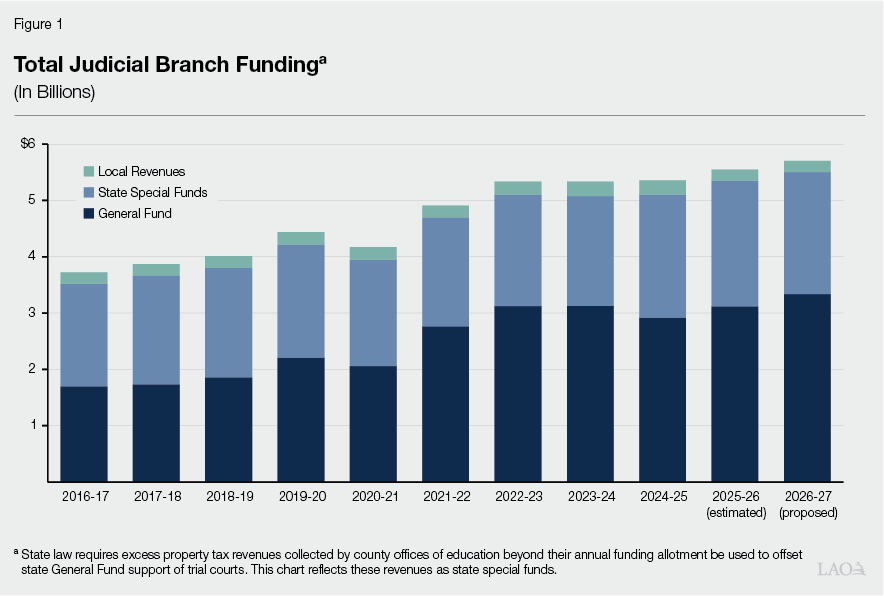
Governor Proposes $5.5 Billion in State Funds for Judicial Branch. For 2026‑27, the Governor’s budget includes $5.7 billion from all fund sources in support for the judicial branch. This amount includes about $5.5 billion from all state funds (General Fund and special funds), an increase of $152 million (2.8 percent) above the revised amount for 2025‑26, as shown in Figure 2. (These totals do not include expenditures from local reserves or trial court reserves.) Of this amount, about $3.3 billion (60 percent) is from the General Fund. This is a net increase of $220 million (7 percent) from the revised 2025‑26 General Fund amount. This net increase reflects various changes, including increased operational costs and facility modification costs.
Figure 2
Judicial Branch Budget Summary—All State Funds
(Dollars in Millions)
|
2024‑25 |
2025‑26 |
2026‑27 |
Change From 2025‑26 |
||
|
Amount |
Percent |
||||
|
State Trial Courts |
$3,885 |
$4,037 |
$4,090 |
$53 |
1.3% |
|
Supreme Court |
53 |
58 |
57 |
‑1 |
‑2.5 |
|
Courts of Appeal |
283 |
298 |
312 |
14 |
4.8 |
|
Judicial Council |
281 |
283 |
280 |
‑4 |
‑1.3 |
|
Judicial Branch Facility Program |
585 |
654 |
743 |
89 |
13.6 |
|
Habeas Corpus Resource Center |
18 |
20 |
20 |
— |
0.2 |
|
Totals |
$5,105 |
$5,350 |
$5,502 |
$152 |
2.8% |
Trial Courts Report $405 Million in Reserves at End of 2024‑25. Trial courts have a limited ability to keep and carry over any unspent funds (also known as “reserves”) from one fiscal year to the next. Specifically, trial courts are only allowed to carry over funds equal to 3 percent of their operating budget from the prior fiscal year under current law. However, certain funds held in the reserve—such as those that are encumbered, designated for statutory purposes, or funds held on a court’s behalf by Judicial Council for specific projects—are not subject to this cap, meaning they also can generally be carried over. At the end of 2024‑25, trial courts reported having $405 million in reserves. Of this amount, $310 million (76 percent) is not subject to the cap. This amount consists of funds that are encumbered ($152 million), statutorily excluded ($124 million), designated for prepayments or other purposes ($16 million), or held by Judicial Council on behalf of the trial courts for specific projects ($18 million). This leaves $95 million (24 percent) in reserves subject to the cap. This is less than the $106 million the trial courts could have retained under the current 3 percent cap.
Court Facilities
Background
Judicial Branch Has Extensive Facility Needs. The judicial branch currently manages around 430 facilities across all 58 counties. Its facility program is responsible for various activities including maintaining these facilities, managing leases, and constructing new courthouses to replace outdated facilities. In a November 2019 assessment of its facilities, the judicial branch identified a need for a total of 80 construction projects—56 new buildings and 24 renovations—totaling $13.2 billion. These projects were categorized into five groups—and ranked within each group—in the following descending priority order: 18 immediate need projects ($2.3 billion), 29 critical need projects ($7.9 billion), 15 high need projects ($1.3 billion), 9 medium need projects ($1.6 billion), and 9 low need projects ($100 million). Additionally, in August 2024, the judicial branch identified 22,396 deferred maintenance projects totaling around $5.4 billion. Of this estimated cost, the state would be responsible for around $4 billion (74 percent). (The remaining amount would generally be the responsibility of counties that share space in court facilities.)
Existing Construction Account Insolvent. State law authorizes Judicial Council to construct trial court facilities and established a state special fund—the State Court Facilities Construction Fund (SCFCF) to support construction and other facility‑related expenses. (A second construction account was consolidated into the SCFCF in 2021‑22.) The SCFCF is used to support both the construction and maintenance of court facilities and is mainly supported by criminal and civil fines and fees. The amount of revenue deposited into the fund steadily declined over the past years, resulting in expenditures routinely exceeding revenues. Additionally, since 2009‑10, nearly $1.7 billion has been transferred from the judicial branch’s construction accounts to the General Fund or to support trial court operations. These transfers were originally made to help address the fiscal difficulties then facing the state. This led to the fund becoming insolvent and required various actions be taken—most notably the cancelation and suspension of projects supported by the construction account. Currently, the fund remains insolvent and is estimated to require a General Fund backfill in the tens of millions of dollars annually through 2036‑37 to maintain existing facility‑related activities and to pay the debt service for completed construction projects.
New Construction Supported by the General Fund. For a period, the SCFCF’s insolvency halted the judicial branch’s construction program. However, after the fiscal difficulties facing the state subsided, the state shifted support for the construction program to the state General Fund. Specifically, the 2018‑19 budget included $1.3 billion in lease revenue bond authority backed by the General Fund—rather than the SCFCF—to finance ten previously planned projects. This commitment effectively backfilled the $1.4 billion transferred from the SCFCF to the General Fund to help address the state’s budget condition between 2009‑10 and 2017‑18. The 2021‑22 budget formally shifted support for the construction of any future courthouses to the General Fund. When proposing new projects, the administration generally follows the ranked project priority list identified in the judicial branch’s 2019 assessment of facility needs. Since 2021‑22, the construction or renovation of 12 of the highest ranked immediate need projects have commenced.
Some Facility Modification Projects Supported by General Fund. In addition to construction projects, the judicial branch manages smaller facility modification projects. These are projects that involve physical changes to a facility (or its building components) that improve its designed level of functionality. The judicial branch currently receives about $80 million annually—$65 million from the SCFCF and $15.4 million from the General Fund—for use at Judicial Council’s discretion. Judicial Council maintains a list of modification projects and categorizes them into one of six priority categories (such as “immediately or potentially critical” or “beyond rated life but serviceable”). Annual funding typically is used to address projects in the highest two priority categories, such as major flooding or substantial roof damage. Any unaddressed projects essentially add to the judicial branch’s deferred maintenance list. In recent years, some one‑time funding has been also provided from the General Fund to support specific, larger facility modification projects. These are typically higher‑priority projects whose costs would have otherwise required a significant portion of the discretionary funding in one or more years. Such projects typically go through the annual budget review process as an operations request rather than a capital outlay request. In other words, these projects do not necessarily undergo the same review as the new construction projects. For example, some of these projects may not go through formal review by Department of Finance (DOF) staff that focus on capital outlay.
Governor’s Proposal
The Governor’s budget includes $320 million in lease revenue bond authority, $130 million from the General Fund, and reimbursement authority for ten courthouse facility projects. These projects are described in more detail below.
Existing Construction Projects. The budget proposes $320 million in lease revenue bond authority for the design‑build phase of the new San Luis Obispo Courthouse project. (While this would not result in immediate General Fund costs, the lease revenue payments will come from the General Fund.) In addition, it proposes $47.6 million one‑time General Fund for the continuation of the following construction projects:
- $18.1 million reappropriation of funds for the performance criteria phase of the New Fresno Courthouse project, which had been delayed due to an extended site selection process.
- $14.1 million for the construction phase of projects to build out two courtrooms to accommodate new judgeships in Kings and Sutter Counties.
- $6.4 million for the working drawings and construction phase of a project to build out one courtroom to accommodate a new judgeship in San Joaquin County.
- $5.1 million reappropriation of funds for the performance criteria phase of the New Solano Hall of Justice project, which had been delayed due to an extended site selection process.
- $2.3 million for the performance criteria phase of the New Quincy Courthouse project in Plumas County.
- $1.5 million for the performance criteria phase of the New Nevada City Courthouse project in Nevada County.
Relocation of Los Angeles Spring Street Courtrooms. The budget proposes $11 million one‑time General Fund to relocate 24 courtrooms out of leased space in Los Angeles County. The lease will not be extended as the building is expected to be sold. Of this amount, $4.6 million would be used to relocate 17 courtrooms into six existing courthouses. The remaining $6.3 million would be used for the preliminary plans and working drawings phase of a project to renovate the existing Chatsworth Courthouse to build out six courtrooms.
Additional Funding for the Orange Central Justice Center (CJC). The budget includes $71 million limited‑term General Fund ($36 million in 2026‑27 and $35 million in 2027‑28) and $7.1 million SCFCF reimbursement authority ($3.6 million in 2026‑27 and $3.5 million in 2027‑28) for a previously approved facility modification project at the Orange CJC. (The reimbursement authority would allow the state to accept payment from Orange County for its portion of the project costs as this is a shared facility.) This project generally addresses fire and egress safety issues. This funding would be in addition to $64.1 million one‑time General Fund provided in prior budgets.
Assessment
No Concerns With Requested Amounts… As discussed in our January budget publication, The 2026‑27 Budget: Overview of the Governor’s Budget, the state faces serious multiyear deficits that will need to be addressed. This means the state lacks the necessary revenues to sustain current expenditure levels. As such, any proposals that require new General Fund support require greater scrutiny and must meet a higher bar for approval as it would reduce General Fund spending elsewhere. Such a higher bar can include spending to address critical infrastructure issues. We find that the identified projects meet this higher threshold as they seek to address critical health, safety, and other facility needs in buildings frequented by the public. Additionally, the costs and scopes of these identified projects generally seem reasonable. The existing construction projects were largely selected based on the judicial branch’s 2019 ranked list of facility project needs and require funding to continue moving forward. The projects related to the relocation of the Los Angeles Spring Street courthouses are also necessary as the landlord is terminating the state’s lease of space. Without this funding to build or modify space to relocate the courtrooms into existing courthouses, service levels would be impacted. Finally, the Orange CJC project is already in progress and addresses key safety issues in a building with large numbers of people visiting on a daily basis.
…But CJC Proposal Raises Questions About Appropriate Oversight. While the CJC project is necessary, the project’s cost has more than doubled. Specifically, prior budgets included $64.1 million for this project, which was estimated to cost a total of $70.2 million, with the county covering the remaining balance. The judicial branch estimates that an additional $71 million will now be necessary to complete the project due to various factors that were unidentified at the start of the project, including unanticipated asbestos remediation and the need to address new issues identified by the Office of the State Fire Marshall (OFM). However, construction is currently only 25 percent complete and discussions with the OFM continue. This means that additional issues could be identified that drive further cost increases. The sizeable increase in funding raises questions on whether sufficient oversight was in place to appropriately assess the scope of work and costs before the project began. Sufficient oversight would ensure the Legislature has the information it needs as it weighs court facility projects against its other priorities. This is particularly important in tough budget times with scarce General Fund resources.
Total Costs of Court Facility Projects Continue to Increase… As noted above, the judicial branch’s 2019 assessment estimated a total of $13.2 billion would be needed to address 80 projects. Of this amount, about $6.1 billion was associated with 17 projects in Los Angeles County. In April 2024, the Los Angeles Superior Court completed a reassessment of its facilities needs based on its operations. The estimated costs of these 17 projects increased to around $14 billion. Similarly, while most of the remaining projects on the 2019 list have not been reassessed, the costs of projects in other parts of the state are likely increasing. For example, the 2019 assessment estimated the new Fresno Courthouse project would cost $483 million. This project is currently in the middle of pre‑construction activities, which has resulted in an updated cost estimate of $965 million—double the original estimate. In combination, as shown in Figure 3, it makes it likely that at least $21 billion could be needed to complete the list of 80 projects. These costs will likely continue to increase over time due to inflation and various other factors.
Figure 3
Status of Trial Court Construction Projects
Beginning in 2019‑20a
|
Priority Group |
Number of |
Estimated Project |
Number |
|
Immediate Need |
17 |
$2.0 |
12 |
|
Critical Need |
26 |
10.6 |
— |
|
High Need |
17 |
4.7 |
— |
|
Medium Need |
10 |
3.5 |
— |
|
Low Need |
10 |
0.2 |
— |
|
Totals |
80 |
$21.0 |
12 |
|
aReflects data from 2019 facility assessment, adjusted to include updated data from 2024 reassessment of Los Angeles facilities. |
|||
…And Pace of New Construction Projects Is Slow… As shown in Figure 3, the state has only initiated 12 (or 15 percent) of the construction projects identified in 2019. Additionally, the state’s current plan is to initiate one new project a year. Absent any changes, this means the last immediate need project would be initiated in 2030‑31. Continuing at this pace means that it would take decades to fully address the list. During this time, it is likely that the condition of the facilities on the list will worsen and additional facilities could be added to the list.
…Raising Questions About Long‑Term Plan for Addressing Court Facility Needs… The slow pace in initiating construction projects, as well as the increasing costs, raises questions about the long‑term plan for fully addressing court facility needs. Delays in initiating projects means that the facilities on the list could worsen to the point where the state has no option but to replace them immediately. This could result in significant, unexpected costs occurring simultaneously. For example, if multiple courthouse projects—including some large, multistory courthouses—needed to be started at the same time, it could require hundreds of millions of dollars in General Fund annually to pay for pre‑construction costs or debt service. Under such a circumstance, the judicial branch and the state’s capacity to appropriately conduct oversight of such projects could be strained. At the same time, the condition of other facilities could worsen resulting in the need for new construction, facility modification, or deferred maintenance projects. As General Fund is a major source of supporting these costs, it would be prudent to have a long‑term plan or strategy to address these needs while balancing other state General Fund priorities.
…And Whether More Funds Should Be Dedicated to Facility Modification Projects. Given the current plan of starting one new construction each year, it could be reasonable to consider whether the state should concurrently or alternatively prioritize facility modification projects to extend and/or improve the usability of existing facilities. This could prevent facility conditions from worsening—thereby delaying the need for a new replacement courthouse or full‑scale renovation. It could also enable the state to more slowly build new courthouses and avoid a surge of unpredictable facility costs. Finally, such an approach could distribute the monies across more facilities throughout the state—thereby increasing the number of people benefiting from improved facilities.
Recommendations
Consider How Much General Fund to Dedicate to Court Facilities. Given the magnitude of the judicial branch’s facility needs and deficits facing the state General Fund, it is not possible for the state to fully address such needs in the short run. Accordingly, we recommend the Legislature instead consider how much General Fund it would like to dedicate annually to address court facility needs. A stable commitment of funding would allow the state and judicial branch to make short‑ and long‑term plans to maximize use of these funds. For example, this would allow the judicial branch to make choices between new construction or facility modification projects. The specific amount would depend on its other General Fund priorities. This is because increased and consistent facility funding would come at the expense of other General Fund priorities given the multiyear deficits facing the state. If it is comfortable with the level of funding proposed for facilities in 2026‑27, we recommend it approve the Governor’s proposals. If the Legislature would like to dedicate a different level of funding, it could work with the judicial branch to prioritize how to use whatever level of funding the Legislature deems appropriate.
Direct Judicial Branch to Report on Long‑Term Plan for Facilities Based on Legislative Direction. We recommend the Legislature direct the judicial branch to report by January 2028 on a long‑term plan for addressing facility needs based on the Legislature’s direction on the amount of annual General Fund that would be prioritized for court facilities. This plan should include an assessment of how the funding should be divided between new construction and facility modification projects to maximize the amount of time existing facilities may be safely used. It could also consider innovative ways to use the funding to finance new construction or facility modification projects. To enhance the plan, the Legislature could also consider whether it should provide funding for the judicial branch to reassess the total estimated costs of the construction project list—excluding Los Angeles facilities which were reassessed in 2024. We estimate this could cost several million dollars—or slightly more—depending on what the Legislature asks for the reassessment to include. Such a reassessment could also include direction to reconsider existing operations—such as the impact of increased remote proceedings—and whether existing projects should move up or down in the prioritization list. As costs seem to be significantly increasing, having more recent information could provide the Legislature with more accurate information on how much the full list of construction projects will cost as well as which projects are the most pressing.
Consider Additional Oversight of Facility Modification Projects Receiving One‑Time Funding. We recommend the Legislature consider increasing oversight of facility modification projects receiving one‑time General Fund support. As noted above, these project costs typically would use a significant portion of the judicial branch’s discretionary funding if they were not funded separately. The doubling of the Orange CJC project from initial estimates, with the potential for even more future costs as the project is only 25 percent complete, raises questions about whether state oversight of such larger or more complex projects is sufficient. It is possible that the Orange CJC project faces unique factors based on the specifics of its existing condition that will not be an issue in other facility modification projects. However, if the state prioritizes more General Fund for facility modification projects, it becomes critical to ensure appropriate oversight is in place to ensure the Legislature has sufficient information. At a minimum, this information should include an accurate assessment of the existing condition of a facility, the scope of the project, and the costs to complete it. One way to accomplish this would be for the Legislature to require that such projects undergo review in the budget process by DOF in a manner similar to new courthouse facility capital outlay projects. This would mean that similar construction expertise is applied by DOF in its assessment and monitoring of these larger facility modification projects. This could help ensure the Legislature receives accurate and complete data to inform its decision‑making and that state funds are used cost‑effectively.