
|
Analysis of the 2006-07 Budget BillLegislative Analyst's Office
|
Our updated economic and revenue forecasts lead us to project different Proposition�98 outcomes than the Governor. Specifically, we estimate a somewhat higher Proposition�98 minimum guarantee for both the current and budget years. We also discuss various issues related to Proposition�98, including an update on the outstanding maintenance factor and our recommendation that the Legislature enact trailer bill language to rebench the Test 1 factor. Finally, based on updated economic data, we estimate that the K-12 cost-of-living adjustment (COLA) will be higher than the Governor�s projection-5.8�percent instead of 5.2�percent. Funding COLAs at this level could lead to additional state costs of around $300�million.
The Governor�s budget includes only minor adjustments to overall prior-year and current-year Proposition 98 funding levels. Figure 1 shows changes in Proposition�98 K-14 spending from 2005-06 Budget Act levels. The figure also shows changes in support for Proposition�98 from the General Fund and local property tax revenues.
|
|
||
|
Figure 1 Changes in Proposition 98 Funding |
||
|
(In Millions) |
||
|
|
2004‑05 |
2005‑06 |
|
Total Proposition 98 |
|
|
|
2005‑06 Budget Act |
$46,941 |
$49,968 |
|
2006‑07 Governor's Budget |
47,016 |
49,986 |
|
Differences |
$75 |
$18 |
|
General Fund Share |
|
|
|
2005‑06 Budget Act |
$34,009 |
$36,591 |
|
2006‑07 Governor's Budget |
33,995 |
36,311 |
|
Differences |
-$14 |
-$280 |
|
Local Property Tax Share |
|
|
|
2005‑06 Budget Act |
$12,932 |
$13,377 |
|
2006‑07 Governor's Budget |
13,021 |
13,675 |
|
Differences |
$89 |
$298 |
|
|
||
Spending Increases by $75�Million Due Mainly to Declining Enrollment. For 2004-05, overall Proposition�98 spending increased by a total of $75�million above the level assumed in the 2005-06 Budget Act, to a total of $47�billion. This increase in costs is the net result of two main factors-a decrease in the K-12 attendance growth rate, and an increase in the cost of the declining enrollment provision. Specifically, the actual attendance growth rate for 2004-05 was 0.36�percent-slightly lower than the 0.52�percent previously assumed. This results in savings. However, the cost assumptions for the state�s declining enrollment funding mechanism were significantly underestimated. Statute allows school districts to claim the higher of the prior-year�s attendance level or the current-year�s attendance level when determining revenue limit funding. Due to technical budgeting reasons, the costs of the declining enrollment provision were underestimated by $115�million. (We discuss the costs related to the declining enrollment adjustment in greater detail in the �Revenue Limits� section of this chapter.) In combination, the savings from having less students and the costs of funding declining enrollment result in net additional spending of $75�million. Because local property tax revenues increased by an additional $89�million for 2004-05, General Fund spending was decreased by $14�million.
The Governor�s budget proposes roughly the same spending level for Proposition�98 in 2005-06 as what was assumed in the budget act-it increases slightly by $18�million. Estimates for revenues from local property taxes increase by $298�million, resulting in estimated General Fund savings of $280�million.
Spending Still Above the Proposition�98 Guarantee, but by Less Than Was Assumed in the Budget Act. When the 2005-06 budget was adopted, the budget assumed Proposition�98 spending would be $741�million above the minimum guarantee. While the overall spending level has remained about the same, additional General Fund revenues have increased the minimum guarantee for the current year. Under the Governor�s assumed revenues, the 2005-06 spending level is now roughly $265�million above the minimum guarantee.
As discussed in the �Overview� section of this chapter, the Governor�s budget proposes a spending level of $54.3�billion for Proposition�98 in 2006-07. This is a $4.3�billion, or 8.7�percent, increase over revised current-year spending. Based on the administration�s revenue estimates, this would provide $1.7�billion more than required by the minimum guarantee, plus $426�million for after school programs as required by Proposition�49.
Due to the timing of the budget�s release, the Governor had to develop his budget before data from the end of 2005 was made available. We benefit from receiving economic information on the final quarter of 2005, as well as revenues from year-end tax payments. Based on this data, our updated economic and revenue forecasts indicate that General Fund revenues will be significantly higher in 2005-06 and 2006-07 compared to the administration�s estimates. (Throughout this chapter we use the term �General Fund revenues� to refer to revenues received from taxes-the revenues used in the Proposition�98 calculation. These differ slightly from overall General Fund revenues.) These alternate projections result in somewhat different outcomes for Proposition�98, as shown in Figure�2. Below, we discuss our estimates for Proposition�98 in the current and budget years.
|
|
||
|
Figure 2 Proposition 98 Funding |
||
|
(In Millions) |
||
|
|
2005‑06 |
2006‑07 |
|
Governor's Budget Revenues |
|
|
|
Governor's Proposed Funding Level |
$49,986 |
$54,318 |
|
Minimum Guarantee |
49,721 |
52,645a |
|
Differences |
$265 |
$1,673 |
|
LAO Revenues |
|
|
|
Governor's Proposed Funding Level |
$49,986 |
$54,318 |
|
Minimum Guarantee |
50,186 |
52,760a |
|
Differences |
-$200 |
$1,558 |
|
|
||
|
a Includes $426 million funding for after school programs, as required by Proposition 49. |
||
|
|
||
State Owes $200�Million More to Education in Current Year Due to Increase in Minimum Guarantee. Our forecast projects General Fund tax revenues will be $1.2�billion higher than the administration�s estimates for 2005-06. Because the Proposition�98 calculation requires that a portion of these revenues go to fund K-14 education, we project the minimum guarantee is actually about $465�million higher than what is estimated in the Governor�s budget. However, because the Governor�s current-year spending is $265�million above the minimum guarantee, our higher revenue estimates will only require the state to spend an additional $200�million in the current year to meet the minimum guarantee (as shown in Figure�2). Because of uncertainty in projecting General Fund revenues-discussed in detail below-we suggest the Legislature wait to address its funding obligation in the current year until the May Revision.
Forecast Projects a Similar Minimum Guarantee. Under our revenue forecast, the required spending level for Proposition�98 in 2006-07 is almost the same as the level projected by the Governor-$52.8�billion as compared to $52.6�billion. Our minimum guarantee is slightly more-$115�million-than the Governor�s. Both estimates include the $426�million required for Proposition�49 after school programs. Because the guarantee is slightly higher under our forecast, maintaining the Governor�s spending level-$54.3�billion-would exceed the minimum guarantee by $1.6�billion, slightly less than the Governor�s estimate of $1.7�billion.
Almost $1�Billion More Revenue but Similar Guarantee in 2006-07? Our Proposition�98 forecast provides an unintuitive outcome. Compared to the Governor, we project the state will receive around $1�billion more in revenue in the budget year, yet estimate that the minimum guarantee is only $115�million more. It would seem that significantly higher revenues should lead to significantly higher funding for education, especially given our projection that budget-year funding will be growing off a base funding level that is $200�million higher in 2005-06. There are two primary reasons this is not the case. First, we project a slightly lower growth rate for per-capita personal income for 2006-07-3.4�percent instead of 3.6�percent. This lower growth rate partially offsets the effect of our higher 2005-06 base.
Second, although our revenue forecast is considerably higher, our year-to-year revenue growth rate is similar. Proposition�98 drives off the year-to-year growth in General Fund per-capita revenues, not the actual amount of revenues. Figure�3 shows that our revenue forecast is $1.2�billion higher than the administration�s in 2005-06, leading to a significantly higher per-capita growth rate from 2004-05-6.3�percent compared to 4.9�percent. As discussed, this raises the 2005-06 minimum guarantee above the Governor�s estimates by $465�million. For 2006-07, our revenues are around $1�billion above the administration�s. Because the magnitude of this increase is close to that of the increase we project for 2005-06, our forecast and the administration�s forecast result in relatively comparable growth rates off of our respective estimates for the current year-4.1�percent compared to 4.3�percent. Similar year-to-year growth rates lead to similar Proposition�98 guarantees.
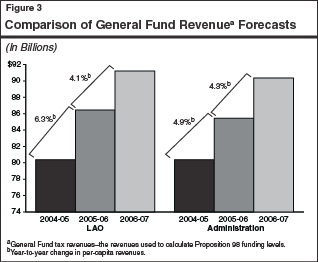
Thus, even though our forecast has the state receiving around $2.2�billion more total revenues than the administration in the current and budget years combined, K-14 education would only be entitled to $315�million in additional funding-$200�million in 2005-06 and $115�million in 2006-07. (This amount would have been $265�million higher had the Governor�s 2005-06 spending level not already exceeded estimates for the minimum guarantee.) This surprising outcome illustrates how strongly the Proposition�98 funding model is influenced by year-to-year changes in General Fund revenues. That is, it is more than just how much revenue the state receives that determines the K-14 funding level, but also when that revenue is received.
Proposition�49 Pays Off Maintenance Factor ObligationProposition�49 requires the state to provide an additional $426�million to fund after school programs starting in 2006-07. The funding mechanism in Proposition�49 requires the state to first meet the Proposition�98 minimum guarantee for the year in which the measure takes effect, and then provide an additional $426�million. Because of the specific statutory language of this requirement, both the Legislative Analyst�s Office and Department of Finance interpret the measure such that the additional after school funding would count as restoring Proposition�98 �maintenance factor.� (Some in the education community disagree with this interpretation and believe the Proposition�49 funding should not score as maintenance factor restoration.) |
Difficulty Predicting Revenues Leads to Uncertainty for Proposition�98. As discussed in The 2006-07 Budget: Perspectives and Issues (P&I), there is a high degree of uncertainty regarding where the state�s economy is headed in the budget year and beyond. In the P&I, we also discuss uncertainties regarding the timing of future collections and refunds resulting from the 2004-05 tax amnesty program. These questions about the future make it difficult for forecasters to accurately project the General Fund revenues that drive the Proposition�98 formulas. Given that Proposition�98 is so dependent on year-to-year revenue changes, the specificity of these yearly projections matter a great deal. As such, the increasing degree of uncertainty in forecasters� revenue estimates may make estimating and planning for Proposition�98 increasingly uncertain as well. Since revenue estimates will likely change multiple times over the course of a fiscal year, the Legislature should anticipate ongoing adjustments to required Proposition�98 spending levels. In cases where the minimum guarantee is estimated to increase, such as 2005-06, the Legislature may wish to wait for updated projections in May before providing additional funding.
There are a number of technical issues related to Proposition�98 which the Legislature will face in the budget year. These include (1) questions related to the Proposition�98 suspension in 2004-05, (2) restoration of maintenance factor, (3) making adjustments to the Test 1 factor as a result of changes in the allocation of local property tax revenues, and (4) determining and meeting �settle-up� obligations from prior years when the Proposition�98 guarantee was not fully funded. Below, we discuss these issues in greater detail.
In 2004-05, the state suspended the Proposition�98 guarantee. The legislation authorizing the suspension-Chapter�213, Statutes of 2004 (SB 1101, Committee on Budget and Fiscal Review)-established a target funding level for K-14 education that was $2�billion lower than the amount called for by the guarantee. We refer to this spending level-$2�billion below the minimum guarantee-as the Chapter�213 target. Over the course of the 2004-05 fiscal year, an improving economy resulted in the state receiving significantly more revenues than were projected when the 2004-05 Budget Act was enacted. This increase in revenues would have resulted in a substantial increase to the K-14 minimum guarantee had the state not suspended Proposition�98. Specifically, the minimum guarantee would have increased an additional $1.7�billion above what was estimated at the time of the budget act. Correspondingly, the amount of savings the state realized from the suspension also increased by an additional $1.7�billion above the Chapter�213 target level, for a total of $3.7�billion.
As discussed below, the Governor proposes to appropriate $1.7�billion above the Proposition�98 minimum guarantee in 2006-07 to restore K-14 funding to roughly the Chapter�213 target level.
Over the long run, Proposition�98 has historically grown annually by attendance and growth in the economy (Test 2). At certain times-in Test�3 or suspension years-the state has provided less growth in K-14 funding than under the Test 2 formula. The gap between the Test 2 level and the actual funding provided is called the maintenance factor. The maintenance factor is tracked over time, and Proposition�98 contains a mechanism to accelerate K-14 spending in future years to restore the maintenance factor to the ongoing funding base. In addition, if the state decides to fund above the minimum guarantee, maintenance factor is restored. The suspension of Proposition�98 in 2004-05 created $3.7�billion in maintenance factor obligation. The Governor�s budget proposal would restore a small portion of this outstanding maintenance factor to the ongoing Proposition�98 base in 2005-06, and restore an even larger share in 2006-07. Figure�4 shows Proposition�98 spending, the amount of maintenance factor restored under the Governor�s budget, and the outstanding maintenance factor.
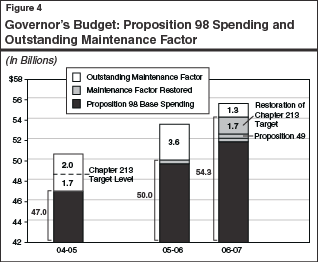
Some Maintenance Factor Restoration in the Current Year. As discussed, the Governor proposes to provide $265�million above the minimum guarantee in 2005-06. This �overappropriation� would restore a small portion of the outstanding maintenance factor (as shown in Figure�4). Our higher revenue estimates would require an additional $203�million in maintenance factor payments in the current year, for a total of $468�million (not shown in the figure).
Governor Proposes to Restore Funding to Chapter�213 Target Level in 2006-07. As discussed above, the Governor proposes to spend a total of $54.3�billion for Proposition�98 in 2006-07. Under the Governor�s revenue forecast, the minimum guarantee for 2006-07 is $52.2�billion, including a $334�million maintenance factor restoration required by the Proposition�98 formula. Thus, as shown in Figure�4, the proposed level of funding would restore a total of $2.4�billion of outstanding maintenance factor to the ongoing Proposition�98 base in 2006-07-$334�million required restoration, $1.7�billion as a discretionary appropriation above the minimum guarantee, and $426�million in required Proposition�49 funding. (See nearby box for a discussion of how Proposition�49 interacts with maintenance factor obligations.) The Governor proposes to provide the $1.7�billion above the guarantee in order to restore the funding schools would have received in 2004-05 had the state met the Chapter�213 target in that year.
According to the administration�s revenue estimates, spending at the proposed level would leave $1.3�billion in maintenance factor outstanding at the close of 2006-07. Because our revenue estimates project an additional $200�million in maintenance factor payments in 2005-06 and a slightly higher minimum guarantee in 2006-07, we estimate that spending at the Governor�s level in the budget year would leave slightly less maintenance factor outstanding-$1.2�billion.
We recommend the Legislature enact trailer bill legislation to clarify how the administration should rebench the Proposition�98 Test 1 factor to reflect the effect of changes in the allocation of local property tax revenues.
The Test 1 factor requires that Proposition�98 receive a minimum fixed percentage of General Fund revenues. When Proposition�98 was passed by voters in 1988, the Test 1 factor was set at 40.7�percent-that is, spending on K-14 education had to make up at least 40.7�percent of overall General Fund revenues. As directed by the initiative language approved by voters, this was intended to mirror the proportion of General Fund spending provided to K-14 education in 1986-87. To date, Test 1 has been operative only in 1988-89, the first year after Proposition�98 was passed by voters. However, based on the Governor�s proposed level of spending and our estimates for revenues, attendance, and local property taxes in the future, we project that Test 1 may become operative again as early as 2008-09.
Test 1 Factor Adjusted in 1992-93 and 1993-94 Due to Changing Allocations of Property Tax Revenues. In 1992-93 and 1993-94, the state shifted a portion of property tax revenues which had previously gone to local governments to instead fund K-12 schools and community colleges. These were known as �educational revenue augmentation funds,� or ERAF shifts. Because local revenues were now covering a greater share of K-14 funding, the Test 1 General Fund requirement was adjusted downward, from 40.7�percent to 34.6�percent. Had this Test 1 �rebenching� not occurred, the state would have had to provide schools 40.7�percent of the General Fund plus the higher local property tax revenues (including ERAF). This would have resulted in K-14 education receiving funding that significantly exceeded what schools would have received had the ERAF shifts not occurred. Thus, the rebenching allowed overall school funding requirements to remain unchanged by the ERAF shifts-all that changed was the proportion contributed by each funding source.
Additional Local Property Tax Shifts. In 2004-05, the state made additional permanent property tax shifts between schools and local governments, only this time funds were shifted in the other direction. Specifically, the state provided local governments with additional property tax revenues in exchange for reductions in (1) vehicle license fee (VLF) revenues through the VLF �swap,� and (2) sales tax revenues that the state designated as the payment source for the deficit-financing bonds passed by the voters in March�2004. The additional property tax revenues provided to local government resulted in less property tax revenues being available for schools. So, the state provided schools additional General Fund revenues to backfill the reallocated property tax revenues.
Figure�5 shows that starting in 2004-05, the state transferred a net of $3.9�billion in local property taxes from schools to local governments. These transfers increase to $6.8�billion in 2006-07, due primarily to the end of a two-year agreement under which local governments transferred $1.3�billion annually in property taxes to schools. The $6.8�billion in transfers to local governments is backfilled by the state providing additional General Fund revenues for Proposition�98.
|
|
||||
|
Figure 5 Transfers of Local Property Tax Revenues |
||||
|
(In Millions) |
||||
|
|
2004-05 |
2005-06a |
2006-07 |
2007-08 |
|
Vehicle License Fee (VLF) backfill |
$4,075 |
$5,209 |
$5,419 |
$5,853 |
|
�Triple flip�b |
1,136 |
1,208 |
1,426 |
1,503 |
|
Two-year savings from local |
-1,300 |
-1,300 |
— |
— |
|
Totals |
$3,911 |
$5,117 |
$6,845 |
$7,356 |
|
|
||||
|
a The total for the VLF backfill includes a one-time $318 million payment to cities and counties to settle up the state's 2004-05 obligation. Similarly, the triple flip payment for 2005-06 includes a one-time reduction of $173 million because the state's payment to cities and counties in 2004-05 was too high. |
||||
|
b The state dedicates a one-quarter cent portion of sales tax revenues that previously went to cities and counties to finance the deficit-financing bonds authorized by Proposition 57. In exchange, cities and counties receive an equivalent amount of property tax revenues that previously went to schools, and schools receive additional General Fund revenues instead of local property tax revenues. These shifts are commonly referred to as the triple flip. |
||||
|
|
||||
LAO and Department of Finance (DOF) Differ on How to Adjust the Test 1 Factor. As a result of the property tax shifts described above, the Test 1 factor must be adjusted again. While both DOF and our office agree that an adjustment to the Test 1 factor is necessary, we disagree on how that adjustment should be made. Under the DOF methodology, the Test 1 factor would be adjusted to roughly 41�percent. Using our methodology, we estimate a Test 1 factor of around 41.6�percent.
While a 0.6�percent difference seems pretty close, the effect on the minimum guarantee under Test 1 would vary by over half a billion dollars. Since Test 1 may be operative in the near future, we believe that the Legislature should address this issue. We recommend the Legislature enact trailer bill language to clarify how the administration should rebench the Test 1 factor, and recommend that the methodology used provide schools with a level of resources comparable to what they would have received had the local government transfers not occurred.
Statute requires DOF, the California Department of Education (CDE), and the California Community Colleges (CCC) to jointly certify the Proposition�98 calculation and funding level nine months after the end of a fiscal year. If the minimum guarantee calculation requires the state to provide more funding in a specific year, the Legislature can either appropriate those funds, or within 90 days the Controller must allocate the funds to K-12 schools and CCC. This statutory requirement was only met in the first year Proposition�98 was operative. Proposition�98 funding levels were again certified in the mid-1990s through the enactment of legislation to settle the CTA v. Gould lawsuit. Since 1994-95, the state has not certified the Proposition�98 calculation.
Chapter 216, Statutes of 2004 (SB 1108, Committee on Budget and Fiscal Review), included language intended to determine finalized Proposition 98 required funding levels for fiscal years 1995-96 through 2003-04. Specifically, the legislation required the Superintendent of Public Instruction and Director of Finance to jointly determine by January 1, 2006, the outstanding balances-settle-up obligations-of the Proposition 98 minimum funding obligation for the nine years in question. Figure 6 summarizes these �determinations.� In total, CDE and DOF estimate the state owes schools $1.4�billion to meet the minimum guarantee for past years.
|
|
||||
|
Figure 6 Outstanding Settle-Up Owed for Proposition 98 |
||||
|
(In Millions) |
||||
|
1995‑96 |
1996‑97 |
2002‑03 |
2003‑04 |
Totala |
|
$76.3 |
$165.9 |
$540.8 |
$617.6 |
$1,400.6 |
|
|
||||
|
a The Governor proposes to pay schools $133 million in settle-up payments in 2006-07, reducing the outstanding obligation to $1.3 billion. |
||||
|
|
||||
Chapter�216 also continuously appropriates $150�million annually beginning in the 2006-07 fiscal year for the purposes of repaying settle-up obligations. (Because $17�million was �prepaid� in 2005-06, only $133�million is provided for this purpose in the Governor�s budget.) Chapter�216 states that, unless the Legislature directs it for another purpose, settle-up funding is to be used to repay schools and community colleges for the costs of prior-year mandates.
Each year, the budget provides most Proposition�98 programs with a COLA, or an increase in funding to reflect the higher costs schools experience due to inflation. Some programs receive this adjustment through statute, and others are typically provided with a discretionary COLA in the annual budget act. The K-12 COLA (also used for community college programs) is based on the gross domestic product deflator for purchases of good and services by state and local governments (GDPSL). For 2006-07, the K-12 COLA will be based on GDPSL growth rates from the final three quarters of 2005 and the first quarter of 2006.
Budget-Year COLA Expected to Be Higher Than Governor�s Estimates. Based on the two quarters of GDPSL data available at the time the budget was developed, the administration estimated a 5.2�percent COLA and the budget provided corresponding adjustments to K-14 programs. The Governor�s budget provided approximately $2.6�billion in Proposition�98 funding to support COLAs for K-14 education. Recently released fourth quarter 2005 data indicates that the actual COLA factor may be even higher-around 5.8�percent. We estimate funding a 5.8�percent COLA would cost just over $300�million more than the level currently funded in the Governor�s budget, for a total of $2.9�billion. Figure�7 provides a breakdown of these additional costs. The COLA factor will be finalized at the end of April, when the federal government releases the cost data for the first quarter of 2006.
|
|
|
|
Figure 7 Increased Cost of |
|
|
(In Millions) |
|
|
|
|
|
K-12 Revenue limits |
$202.2 |
|
K-12 Categorical programs |
71.1 |
|
Community colleges |
33.6 |
|
Total |
$306.9 |
|
|
|
|
a Compared to a 5.2
percent COLA, as provided in the |
|
|
|
|
Why Is the COLA Rate So High? As shown in Figure�8, the projected budget-year COLA of 5.8�percent is considerably higher than K-12 COLAs have been in recent years, and substantially higher than other COLAs provided in the state budget. (For a detailed discussion of COLAs, see �Perspectives on State Expenditures� in �Part IV� of our companion document, the P&I). The figure also displays the historical and projected growth rates for the primary inputs to the overall GDPSL-general government employee compensation, gross investments (which include construction and building costs), and nondurable goods (which include costs for oil and gas). General compensation, including salaries and benefits, has grown moderately over the last few years, ranging from 3.6�percent to 4.6�percent annually. Until recently, the cost of gross investment and nondurable goods had grown slowly. As shown in the figure, however, 2006-07 estimates for these two factors appear significantly higher than they have been in prior years. This is primarily due to substantial increases in the costs of energy and construction, in part resulting from the hurricanes in the fall of 2005. Although first quarter 2006 data are not yet available, the high growth rates for nondurable goods and gross investments during the first three data periods indicate a higher-than-usual K-12 COLA rate for the budget year.
|
|
|||||
|
Figure 8 Rates for K-12 Cost-of-Living Adjustment (COLA)
|
|||||
|
2002-03 Through 2006-07 |
|||||
|
|
2002‑03 |
2003‑04 |
2004‑05 |
2005‑06 |
2006‑07 Estimatea |
|
K-12 COLA |
2.0% |
1.9% |
2.4% |
4.2% |
5.8% |
|
K-12 COLA Factors |
|
|
|
|
|
|
Nondurable Goods—including oil and gas |
-3.5% |
3.6% |
4.5% |
12.1% |
14.0% |
|
Gross Investment—including construction |
1.9 |
1.9 |
1.3 |
3.7 |
5.8 |
|
General Government Employee |
4.1 |
4.6 |
4.4 |
3.6 |
3.8 |
|
|
|||||
|
a Projected based on three quarters of 2005 data and estimates for first quarter of 2006. |
|||||
|
|
|||||
2006-07 COLA Rate May Be Higher Than Schools� Actual Costs of Inflation. The cost factors that school districts face may be different than those reflected in the GDPSL. For schools, employee compensation accounts for a vast majority of operating expenditures-typically between 80�percent and 90�percent. In contrast, compensation makes up around 57�percent of the GDPSL. Conversely, the GDPSL weighs cost increases for energy and construction more heavily than the weights reflected in K-14 operating budgets. (Construction expenditures are typically supported by bond funds and developer fees rather than Proposition�98, and have an alternative COLA mechanism.) As shown in Figure�8, employee compensation costs are only projected to increase at a rate of 3.8�percent in 2006-07-significantly less than the 5.8�percent COLA schools are expected to receive. This indicates that overall K-14 costs may grow more slowly than the K-12 COLA. Thus, providing a 5.8�percent COLA to all applicable Proposition�98 programs may overcompensate schools for the costs they actually face. However, as shown in Figure�8, there have been several years when the costs of inflation for employee compensation were actually higher than was reflected in the K-12 COLA rate. In those years, schools had to absorb the additional compensation costs without corresponding COLA funding from the state. Because the state did not provide additional COLA funds in years where the K-12 COLA rate may not have provided sufficient funding to help schools meet their actual costs of inflation, it may be unfair for the state to provide less than the actual K-12 COLA rate in 2006-07, even if it overestimates schools� actual rate of inflation for the budget year.