Analysis of the 2007-08 Budget Bill: Education
California Community Colleges (CCC) provide instruction to about 1.6 million students (fall headcount enrollment) at 109 colleges operated by 72 locally governed districts throughout the state. The state’s Master Plan for Higher Education and existing statute charge the community colleges with carrying out a number of educational missions. The system offers academic and occupational programs at the lower division (freshman and sophomore) level, as well as recreational courses and precollegiate basic skills instruction. Based on agreements with local school districts, some college districts also offer a variety of adult education programs. In addition, pursuant to state law, many colleges have established programs intended to promote regional economic development.
Funding Increases Proposed. As shown in Figure 1, the Governor’s proposal would increase total Proposition 98 funding (General Fund and local property taxes) for CCC by $377 million, or 6.4 percent, over the revised current-year estimate. This augmentation funds a cost-of-living adjustment (COLA) of 4.04 percent, enrollment growth of 2 percent, a fee-reduction backfill, and several program expansions. Counting all fund sources—including student fee revenue and federal and local funds—CCC’s budget would total $8.6 billion in 2007-08.
|
|
|
Figure 1
Community College Budget Summary |
|
(Dollars in Millions) |
|
|
Actual
2005-06 |
Estimated 2006-07 |
Proposed 2007-08 |
Change From 2006-07 |
|
|
Amount |
Percent |
|
Community College Proposition 98 |
|
|
|
|
|
|
General Fund |
$3,669.7 |
$4,039.6 |
$4,223.6 |
$184.0 |
4.6% |
|
Local property tax |
1,802.7 |
1,857.4 |
2,050.5 |
193.1 |
10.4 |
|
Subtotals, Proposition 98 |
($5,472.4) |
($5,897.0) |
($6,274.1) |
($377.1) |
(6.4%) |
|
Other
Funds |
|
|
|
|
|
|
General Fund |
($264.8) |
($293.3) |
($278.6) |
(-$14.7) |
(-5.0%) |
|
Proposition 98 Reversion Account |
35.6 |
22.3 |
— |
-22.3 |
-100.0 |
|
State operations |
9.2 |
9.7 |
9.9 |
0.2 |
2.1 |
|
Teachers' retirement |
82.2 |
83.0 |
82.0 |
-1.0 |
-1.2 |
|
Bond payments |
137.8 |
148.3 |
187.3 |
39.0 |
26.3 |
|
Loan for Compton CCDa |
— |
30.0 |
— |
-30.0 |
-100.0 |
|
Compton CCDa
Loan Payback |
— |
— |
-0.6 |
-0.6 |
— |
|
State lottery funds |
177.9 |
173.9 |
173.9 |
— |
— |
|
Other state funds |
13.3 |
13.9 |
13.7 |
-0.2 |
-1.4 |
|
Student fees |
344.9 |
321.7 |
281.9 |
-39.8 |
-12.4 |
|
Federal funds |
249.8 |
267.0 |
267.0 |
— |
— |
|
Other local funds |
1,241.7 |
1,326.9 |
1,326.9 |
— |
— |
|
Subtotals, other funds |
($2,292.4) |
($2,396.7) |
($2,342.0) |
(-$54.7) |
(-2.3%) |
|
Grand Totals |
$7,764.8 |
$8,293.7 |
$8,616.1 |
$322.4 |
3.9% |
|
|
|
a Community college
district. |
|
Detail may not
total due to rounding. |
|
|
CCC’s Share of Proposition 98 Funding. As shown in Figure 1, the Governor’s budget includes $6.3 billion in Proposition 98 funding for CCC in 2007-08. This is almost three-quarters of total community college funding. Overall, Proposition 98 provides funding of approximately $57 billion in support of K-12 education, CCC, and several state agencies. As proposed by the Governor, CCC would receive 11 percent of total Proposition 98 funding. This is slightly higher than its statutory share, which is 10.9 percent of total Proposition 98 appropriations. In recent years, this provision has been suspended in the annual budget act and CCC’s share of Proposition 98 funding has been somewhat lower than 10.9 percent. (The CCC’s share of Proposition 98 funding in the current year is 10.7 percent.) In order to provide an amount different from the 10.9 percent specified in statute, the administration proposes again to suspend this provision.
Figure 2 shows the changes proposed for community college Proposition 98 spending in the current and budget years. Major base increases in 2007-08 include $225 million for a COLA of 4.04 percent and
$109 million for enrollment growth of 2 percent. (Following longstanding practice, the Governor proposes that CCC receive the same statutory COLA as K-12 schools. The statutory COLA is based on an estimate of inflation that will not be finalized until April.) The administration also proposes to continue the student fee reduction that went into effect halfway through the current fiscal year. The budget proposes an additional $33 million to backfill the full-year effect of this fee reduction (from $26 per unit to $20 per unit). In addition to these base adjustments, the Governor proposes program expansions for career technical and nursing education. (We discuss the
career technical education proposal earlier in the “Crosscutting Issues” section of this chapter, and the nursing proposal in the “Intersegmental” section.) The Governor’s budget proposes to permanently redirect $33 million from CCC basic skills enrollment funding to a new “student success” initiative that expands counseling, tutoring, and other support services for students. (We discuss the “student success” initiative later in this chapter.)
|
|
|
Figure 2
California Community Colleges
Governor’s Budget Proposal |
|
Proposition 98 Spending
(In Millions) |
|
2006-07 (Enacted) |
$5,885.0 |
|
Increase for nursing education programs |
$9.0 |
|
Increase for California Partnership for
Achieving Student Success |
1.0 |
|
Local property tax adjustment |
4.0 |
|
Lease-purchase payment reduction |
-2.0 |
|
2006-07 (Estimated) |
$5,897.0 |
|
Proposed Budget-Year Augmentations |
|
|
Cost-of-living adjustment (COLA) for
apportionments |
$224.9 |
|
Enrollment growth for apportionments |
109.1 |
|
COLA and enrollment growth for categorical
programs |
19.6 |
|
Current year fee reduction backfill |
33.2 |
|
Fiscal Crisis Management Assistance Team |
0.3 |
|
Subtotal |
($387.1) |
|
Proposed Budget-Year
Reductions |
|
|
Lease-purchase payments |
-$2.5 |
|
Adjustment for revised fee estimates |
-1.3 |
|
Technical adjustments |
-6.2 |
|
Subtotal |
(-$10.0) |
|
2007-08 (Proposed) |
$6,274.1 |
|
Change From 2006-07
(Estimated): |
|
|
Amount |
$377.1 |
|
Percent |
6.4% |
|
|
Figure 3 shows Proposition 98 expenditures for community college programs. As shown in the figure, apportionment funding (available to districts to spend on general purposes such as salaries, equipment, and supplies) accounts for $5.6 billion in 2007-08, an increase of $360 million, or 6.9 percent, from the current year. Apportionment funding in the budget year accounts for about 89 percent of CCC’s total Proposition 98 expenditures.
|
|
|
Figure 3
Major Community College Programs
Funded by Proposition 98a |
|
(Dollars in Millions) |
|
|
Estimated 2006-07 |
Proposed 2007-08 |
Change |
|
|
Amount |
Percent |
|
Apportionments |
|
|
|
|
|
General Fund |
$3,347.4 |
$3,513.8 |
$166.4 |
5.0% |
|
Local property tax revenue |
1,857.4 |
2,050.5 |
193.1 |
10.4 |
|
Subtotals |
($5,204.8) |
($5,564.3) |
($359.5) |
(6.9%) |
|
Categorical Programs |
|
|
|
|
|
Basic skills overcapb |
$33.1 |
— |
-$33.1 |
-100.0% |
|
Matriculationb |
95.5 |
$134.4 |
38.9 |
40.7 |
|
Career technical education |
20.0 |
20.0 |
— |
— |
|
Nursing |
25.9 |
25.9 |
— |
— |
|
Extended Opportunity Programs and Services |
112.9 |
119.8 |
6.9 |
6.1 |
|
Disabled Students |
107.9 |
114.5 |
6.6 |
6.1 |
|
Apprenticeships |
15.2 |
15.2 |
— |
— |
|
Services for CalWORKsc
recipients |
43.6 |
43.6 |
— |
— |
|
Part-time faculty compensation |
50.8 |
50.8 |
— |
— |
|
Part-time faculty office hours |
7.2 |
7.2 |
— |
— |
|
Part-time faculty health insurance |
1.0 |
1.0 |
— |
— |
|
Physical plant and instructional support |
27.3 |
27.3 |
— |
— |
|
Economic development program |
46.8 |
46.8 |
— |
— |
|
Telecommunications and technology services |
26.2 |
26.2 |
— |
— |
|
Financial aid/outreach |
52.6 |
51.3 |
-1.3 |
-2.5 |
|
Child care funds for students |
6.5 |
6.8 |
0.3 |
4.0 |
|
Foster Parent Training Program |
4.8 |
4.8 |
— |
— |
|
Fund for Student Success |
6.2 |
6.2 |
— |
— |
|
Other programs |
8.7 |
8.0 |
-0.7 |
-8.0 |
|
Subtotals, categorical programs |
($692.2) |
($709.8) |
($17.6) |
(2.5%) |
|
Totals |
$5,897.0 |
$6,274.1 |
$377.1 |
6.4% |
|
|
|
a Excludes available
funding appropriated in prior fiscal years. |
|
b Governor proposes
to permanently redirect basic skills overcap funding to
matriculation in 2007-08 as part of his
“student success initiative.” |
|
c California Work
Opportunity and Responsibility to Kids. |
|
|
Categorical programs (whose funding is earmarked for specific purposes) also are shown in Figure 3. These programs support a wide range of activities—from services to disabled students to part-time faculty health insurance. The Governor’s student success initiative would eliminate $33.1 million from the basic skills overcap categorical program and augment the matriculation categorical by the same amount. In addition, the Governor’s budget proposes increases of approximately 6 percent for matriculation and two other categoricals to fund a COLA and enrollment growth. For most other programs, he proposes no changes.
Effective January 2007, student fees on credit courses decreased from $26 to $20 per unit. (There continues to be no fee charged for noncredit courses.) The Governor proposes no change to the student fee level in the budget year. Under the Governor’s budget, student fee revenue would account for 3.3 percent of total CCC funding, down from 3.9 percent of CCC funding in 2006-07. (We discuss the fee reduction in more detail in our “Intersegmental” section of this chapter.)
The state’s community college system is the nation’s largest system of higher education and accounts for about 22 percent of all community college students in the country. Three out of four public postsecondary students in the state are enrolled in a California community college.
What Influences Enrollment at CCC? Many factors affect the number of students that attend a community college. Changes in the state’s population, particularly the college-age population, can be a major factor affecting enrollment levels. Fluctuations in participation rates affect enrollment at California’s community colleges as well, but these are much more difficult to project. Factors such as state educational policies—relating to fees and financial aid, for example—and personal choices of potential students help determine participation rates. Additionally, factors such as the availability of certain classes, local economic conditions, and the perceived value of the education to potential students also affect participation rates.
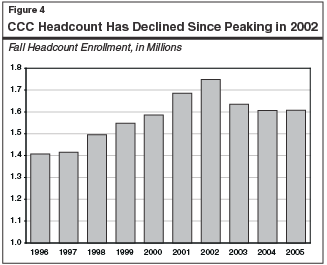
Enrollment Levels Up and Down. As shown in Figure 4, headcount enrollment (the number of individual part-time and full-time students attending a community college) is about 200,000 students higher than a decade ago. Growth has been uneven, fluctuating on a year-to-year basis. Enrollment peaked in fall 2002, but since then has declined by about 8 percent (140,000 students). During the same period, the college-age population (18- to 24-year olds) has grown by 5 percent, and the adult population (aged 25 to 64) has grown by 7 percent. As we discussed in our
2006-07 Analysis of the Budget Bill (page E-250), several factors may be contributing to this recent decline, including students opting for employment as a result of an improving state economy. A census survey of community colleges in November 2006 suggests that fall 2006 enrollment may be slightly higher than fall 2005. A final headcount for fall 2006 will not be available until the spring.
Enrollment Growth Overfunded in Past Four Years. Each year the CCC budget includes an augmentation to accommodate additional students. In some years, funding has been insufficient to cover actual growth. For example, enrollment significantly exceeded funding in 2001-02, due in part to individuals returning to attend college at the time of a tight job market. Since the enrollment peak of a few years ago, however, the state budget has provided more funding for enrollment growth than community colleges could use. Figure 5 compares budgeted and actual enrollment increases since 2001-02. As the figure shows, budgeted enrollment funding has grown faster than actual enrollment (measured as full-time equivalent [FTE] students) for the past four years. For example, the community colleges were funded for enrollment growth of almost 4 percent in 2004-05, but actual enrollment levels increased by less than 1.5 percent. In 2005-06, the community colleges were funded for enrollment growth of slightly more than 1.1 percent, but FTE enrollment levels actually declined by 1.3 percent.
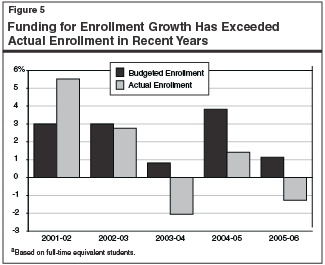
Recent annual budgets have provided community colleges with more enrollment funding than they have been able to use. We recommend that the Legislature reduce the CCC’s current-year Proposition 98 appropriation to account for unused enrollment funding in 2006-07. This will help address the state’s budgetary problem, with no impact on the segment’s ability to accommodate actual enrollment growth.
As a result of the state’s recent overfunding of community college enrollment growth, a large amount of enrollment funding is available to the community colleges in the current year. Below, we discuss the two types of enrollment funding available to accommodate growth in 2006-07: (1) enrollment restoration funding for slots that became vacant in past years, and (2) new enrollment growth funding.
In recent years, over half of community college districts have experienced declining enrollment. State law allows these districts to retain enrollment funding for vacant slots in the year they become vacant in order to cushion district budgets from year-to-year enrollment volatility. However, districts lose enrollment funds from their base for slots that remain vacant for a second year. Although individual districts lose funding in these cases, the same amount of funding remains in the overall CCC base budget for three years. These funds are available to “restore” the enrollment base of districts that regain lost enrollment within that three-year period. At the end of each year, any of this funding not used for restoration is available for one-time purposes. Regulations developed by the Chancellor’s Office permit use for one-time purposes such as covering shortfalls in student fee revenue and providing general apportionments to districts.
Figure 6 shows the amount of funding that was reduced from district budgets as a result of declining enrollment over the past three years. The figure shows that these districts are entitled to “earn back” up to $161 million in enrollment restoration funding to the extent that new students fill the vacant slots in the current year.
|
|
|
Figure 6
Significant Restoration Funding Available to
Districts in Current Year |
|
(Dollars in Millions) |
|
Year of Decline |
Enrollment
Restoration Funds Available |
Vacant Slotsa |
|
2003-04 |
$2.5 |
1,282 |
|
2004-05 |
16.3 |
4,985 |
|
2005-06 |
142.6 |
41,222 |
|
Total Available in 2006-07 |
$161.4 |
47,489 |
|
|
|
a Full-time equivalent
students. |
|
|
Most Districts Unlikely to Restore Enrollment in Current Year; Recommend Reducing CCC’s Proposition 98 Appropriation. Based on our discussions with CCC officials and our demographic projections, we expect that only a portion of the $161 million in enrollment funding will be restored to districts in the current year. The remaining funds would be freed up for other one-time purposes in the current year. At the time this Analysis was being prepared, the exact amount of unused funding was not clear. Our preliminary estimate is that roughly one-half of the enrollment restoration funds (approximately $80 million) could be freed up. We expect to have a reliable estimate by the time of the May Revision. We therefore recommend the Legislature at that time reduce on a one-time basis CCC’s current-year appropriation of Proposition 98 funding by the amount of unused enrollment restoration funding that remains.
As we discuss earlier in this chapter (see “Proposition 98 Priorities for 2007-08”), our revenue forecast suggests that the state’s current-year spending level for Proposition 98 is about $600 million higher than the minimum guarantee. For this reason, a reduction in Proposition 98 spending would generate a like amount of General Fund savings. This would also reduce the 2006-07 Proposition 98 base, from which the 2007-08 Proposition 98 guarantee is calculated. Our recommendation would accomplish all this without affecting the ability of the segment to address student enrollment demand.
Districts Unlikely to Use All Current-Year Enrollment Growth Funding; Recommend Reducing CCC’s Proposition 98 Appropriation. The CCC also has $97.5 million in current-year funding for new enrollment. Based on our demographic projections and anecdotal information from districts, we expect districts will again not be able to use all of this funding.
We therefore recommend that the Legislature reduce the 2006-07 appropriation for CCC enrollment growth. Although a better estimate will not be known until the May Revision, even if the Legislature reverted only one-half of the budgeted enrollment growth funding, current-year spending would be reduced by almost $50 million. This recommendation would also generate General Fund savings for the current year, thus improving the state’s carry-in balance for 2007-08. It would also reduce the Proposition 98 minimum guarantee for 2007-08 by roughly the same amount, thus facilitating further savings in the budget year.
The Governor’s budget proposes an augmentation of $109 million to fund 2 percent enrollment growth at the California Community Colleges. This level of enrollment growth exceeds the statutory growth guideline of 1.65 percent. We recommend the Legislature fund 1.65 percent enrollment growth, for a savings of $19 million. (Reduce Item 6870-101-0001 by $19 Million.)
The budget proposal provides an increase of $109 million for enrollment growth in 2007-08 to fund about 23,000 additional FTE students (a 2 percent increase). With this augmentation, the Governor’s budget proposes funding a total of about 1.2 million FTE students in 2007-08.
Chapter 631, Statutes of 2006 (SB 361, Scott), requires CCC’s annual budget request to include funding for enrollment growth at least as large as the average growth rate of two state population groups (19- to 24-year olds and 25- to 65-year olds), as determined by the Department of Finance (DOF). The DOF projects that these groups will increase by a combined average of 1.65 percent in 2007-08. This growth rate would translate into about 19,000 additional FTE students, at a cost of $90 million.
We feel the growth rate derived from the new statutory guideline would easily allow CCC to accommodate all projected enrollment demand. This is because we project that demographically driven enrollment in the community colleges (which accounts for growth rates in the underlying population and assumes constant participation rates) will increase by about 1.1 percent in the budget year. It is not yet known the extent to which the fee reduction—which went into effect in January 2007—will affect participation rates among students. However, our recommendation would accommodate modest increases in participation rates.
Recommend 1.65 Percent Enrollment Growth Funding. For 2007-08, we recommend the Legislature provide funding for 1.65 percent enrollment growth. The Master Plan calls on CCC to be open to all adults who can benefit from instruction, and DOF estimates that this eligibility pool will grow by 1.65 percent. We believe that this amount would easily fund all anticipated increased enrollment demand at the community colleges. If the amount of funding for growth were reduced to our recommended level of $90 million, there would be $19 million in Proposition 98 savings. Depending on the minimum spending requirement in 2007-08, these funds would be available either for General Fund savings or for redirection within Proposition 98 for other K-14 priorities.
The CCC system serves over one and one-half million students (fall headcount) enrolled at 109 campuses operated by 72 locally governed districts, and spends over $8 billion in public funds annually. For such a large and decentralized system, oversight and accountability measures are critical for ensuring that public resources are being spent efficiently and effectively. The CCC’s Board of Governors (BOG) and Chancellor’s Office are generally charged with oversight responsibilities. In recent years, system accountability has come into question. Recent reports have highlighted concerns with CCC performance, such as low student completion rates. In response, the Legislature and Governor have sought more formalized oversight and accountability provisions in statute.
In 1998, the Legislature and Governor established the Partnership for Excellence (PFE) program through Chapter 330, Statutes of 1998 (SB 1564, Schiff). In general, the PFE provided additional funding to community colleges in exchange for their commitment to improve performance in five specified areas, such as the percentage of students that complete courses. A key accountability provision of the PFE called for district- and system-level performance in these specified areas to be reported annually. This information was to inform state-level budgeting, and could be used (if the BOG so chose) to influence the allocation of funding among districts. The BOG chose not to pursue this linking of funding to performance. The system made some very modest gains in some of the specified areas, such as workforce development, although toward the end of the program, performance again declined and most of those gains were lost. The PFE was allowed to sunset in January 2005.
Anticipating the sunset of PFE, the Legislature and Governor enacted Chapter 581, Statutes of 2004 (AB 1417, Pacheco), which required BOG to develop “a workable structure for the annual evaluation of district-level performance in meeting statewide educational outcome priorities,” including transfer, basic skills, and vocational education. Pursuant to statutory direction, the BOG consulted with our office, DOF, and various other higher education experts and interested parties as it developed its proposal. The final proposal was adopted as part of the 2005-06 budget package in Chapter 73, Statutes of 2005 (SB 63, Committee on Budget and Fiscal Review). Chapter 73 requires community college districts to report specified data to the CCC Chancellor’s Office, which in turn is to submit an annual report to the Legislature and Governor.
While Chapter 73 established several major types of outcomes to be measured (such as student transfers), it did not specify what specific data was to be used to measure outcomes. For example, transfer rates can be measured using various definitions of the pool of potential transfer students. To resolve these kinds of measurement questions, the Chancellor’s Office established a “Technical Advisory Workgroup.” In addition to staff from the Chancellor’s Office, the workgroup includes research and analysis experts from the community college districts and other agencies, including DOF and LAO. The workgroup developed the measures for the project, known as Accountability Reporting for the Community Colleges (ARCC).
Drafts of the first annual report were released in October 2006 and January 2007 for districts and colleges to review for accuracy. The final version will be released publicly in March 2007. (Please see nearby box for a summary of the ARCC accountability measures.)
|
Using data provided primarily by the community colleges, the Chancellor’s Office is to submit an annual report that provides an assessment of the community college system. Reports will include system- and college-level performance and demographic data over multiple years in several categories:
-
Total degrees and certificates earned by community college students, and student transfers to four-year institutions.
-
Completion and persistence rates for community college students.
-
Income trends of students earning a vocational degree or certificate.
-
Student progress and achievement in basic skills and English as a second language courses.
-
Demographic makeup (such as age and ethnicity) of students at each college.
-
A comparison of students’ performance at each college with those of comparable “peer” colleges in the system.
The March 2007 report will evaluate the performance of students in credit courses only; reports in subsequent years will include an assessment of noncredit courses as well. In addition, each annual report will include a brief self-assessment of each college’s performance, including mitigating factors that might account for certain outcomes.
|
Draft Report Points to Both Positive and Negative Trends. Although the final report will not be released until March 2007, the January 2007 draft report suggests a mixture of good and bad news about the community college system. For example, although the total number of student transfers from a community college to a four-year institution has generally increased in the past few years, the number of basic-skills students advancing in their coursework has declined. The data also reveal a wide performance disparity among colleges. For example, students’ basic skills course completion rates range from about 40 percent at some colleges to 80 percent at others.
Reports Should Help Legislature in a Number of Ways. The CCC’s accountability reports should be helpful for a number of different purposes. For example, they can assist the Legislature in its oversight function, depicting overall system performance and effectiveness in carrying out CCC’s educational missions. The reports may also inform budgeting and policy decisions by the Legislature and Governor, helping to identify results from budget investments and issues that require attention. In addition, the reports should be useful to local residents in holding their local community college governing boards accountable for district performance.
Equalization Achieved. For years the amount of general purpose or “apportionment” funding the state provided for each credit FTE student varied considerably by district. This was due to tax base differences that predate Proposition 13 in 1978, coupled with complex district allocation formulas. In 2003-04, for example, districts’ funding per credit FTE student ranged from $3,500 to $8,200 (most districts, however, had levels within a few hundred dollars of the state median of about $4,000). Beginning in 2004-05, the Legislature providing funding toward the goal of “equalizing” community college district funding within three years. The 2006-07 Budget Act included the final installment of monies to fully achieve the state’s equalization goal, that at least 90 percent of statewide community college enrollment receive the same level of funding per credit FTE student. (Funding for noncredit students has not been an equalization issue because all districts have received the same amount for each noncredit FTE student.)
Elimination of Program-Based Funding. Along with providing funds to equalize districts, the Legislature recently enacted legislation that changes the method for allocating apportionment monies to districts. Chapter 631, Statutes of 2006 (SB 361, Scott), ensures that district funding remains equalized in subsequent years. Chapter 631 replaced the program-based funding system that had attempted to account for the different costs that different districts experience. Under program-based funding, districts did not receive equal funding rates on a per-FTE student basis. Instead, district allocations were influenced by headcount enrollment, total square footage of district facilities, and other factors. As such, program-based funding worked at cross purposes from the goal of funding statutory equalization targets, and would have eroded the state’s equalization efforts over time. By contrast, Chapter 631 promotes and maintains equalization goals by providing virtually all CCC districts with apportionment funding at the same amount per credit FTE student ($4,367 in 2007-08).
Equalization Funding and New Statute Should Enhance Accountability. The state’s Master Plan for Higher Education and state law assign to community colleges a number of educational missions. The state also has called on the community colleges to improve in a number of areas, including preparing students to transfer to a four-year institution, awarding degrees and certificates, and improving course completion rates. Generally, it is more difficult to hold all districts accountable for their performance when the amount of funding provided per student varies significantly from district to district. With equalized funding, districts now have comparable levels of resources and the state is in a better position to evaluate performance outcomes across community college districts.
National Discussion on Outcome Measures and Accountability. The ARCC project and recent CCC funding reforms coincide with a new national focus on higher education accountability. For example, a recent study commissioned by the United States Department of Education suggests that institutions of higher education lack adequate accountability systems for measuring performance and recommended that the federal government provide incentives for states and institutions to implement performance-based systems that track and report student outcomes (such as graduation rates). Similarly, a National Conference on State Legislatures commission has called on state legislators to exert stronger leadership in higher education public policy by defining clear goals and expectations for two- and four-year institutions, and holding them accountable for their performance.
Studies Find Low Student Success in CCC System. The spotlight on higher education accountability comes at a time in which several new reports have focused on the performance of California’s community colleges. In particular, these reports have highlighted the relatively low persistence and completion rates of CCC students. According to the National Center for Public Policy and Higher Education, for example, while the college participation rate of working-age adults in California is among the highest in the country (due primarily to the state’s large community college system), persistence rates are below the national average. In fact, researchers report that less than one-half of first-year, full-time CCC students return their second year, which is about 10 percent below the national average. Another study (by the National Center for Higher Education Management Systems) finds that the CCC system ranked 45th among states in the ratio of FTE students to the number of degrees awarded in 2004-05.
The California State University—Sacramento’s Institute for Higher Education Leadership and Policy (IHELP) recently analyzed a cohort of CCC students who first enrolled in 1999-00. The study found that less than one-quarter of degree- or transfer-seeking CCC students actually earned an associate’s degree or certificate and/or transferred to a four-year institution within six years of their initial enrollment. The completion rates were low for students in all racial/ethnic groups, but particularly for black and Latino students. A study released by the Public Policy Institute of California in fall 2006 found similarly low graduation and transfer rates among community college students it identified as degree- or transfer-seeking.
Various Policies Cited as Contributing to Low Completion Rates. The IHELP cites several policies that can contribute to the community college’s low completion rates. For instance, the amount of funding a district receives from the state depends largely on the number of students enrolled at a point early in the semester. This funding policy creates incentives to get students “in the seats” early on, but provides no strong incentive to help students pass or even complete their courses.
In general, we share the concern that current CCC funding mechanisms and related policies can unintentionally create incentives for community colleges and students to behave in ways that can inhibit student completions. In the following section, we illustrate a way the Legislature could move toward a system that fosters higher completion rates by giving local colleges more decision-making authority, rewarding improvements, and holding community colleges accountable for results. We propose to do this by redirecting funds from the basic skills overcap categorical to a block grant that targets a select group of community colleges.
The Governor proposes to permanently redirect $33.1 million in base funding for basic skills “overcap” enrollment to enhance counseling and other support services at the community colleges. While we find merit with the Governor’s plan to eliminate the basic skills overcap categorical program, we recommend the Legislature use the freed-up funding as needed to reduce Proposition 98 spending in the budget year. If the Legislature desires to retain the money in the California Community Colleges’ budget, however, we recommend it provide the funding as block grants to a targeted group of community colleges, with the funds used to improve student achievement and completion rates. (We also recommend the deletion of unused overcap funds in the current year.)
The budget for the community college system includes a specified amount of funding for enrollment growth. Growing districts use this funding to accommodate additional students (above their previous year’s level). Using an allocation formula, the Chancellor’s Office determines the amount of growth funding available to each district. This “growth cap” sets the ceiling for how many students the state will fund in the district in a given year. In recent years, districts that enrolled above this cap level risked not receiving funding for those students. An exception was created for districts with overcap growth in basic skills courses. (Basic skills courses include precollegiate classes such as elementary mathematics and English.) Districts meeting certain requirements qualify for basic skills overcap funding. This categorical program was created to fund additional basic skills students.
Reappropriated Overcap Funds Used in Current Year for “Basic Skills Initiative.” Given that no district enrollment is any longer above cap, no basic skills overcap funds have been “earned” since 2003-04. As a result, the Legislature has redirected this funding for other purposes. Specifically, the 2006-07 Budget Act includes $30.7 million in reappropriated overcap funds from 2005-06 for a basic skills initiative that augments the amount of spending on each basic skills student.
Under the basic skills initiative, funds are allocated to districts on a one-time basis in proportion to their share of statewide basic skills enrollment. Districts may use funds for activities and services such as curriculum development, additional counseling and tutoring, and the purchase of instructional equipment for basic skills classes. A portion of the funds ($750,000) is for the Chancellor’s Office to facilitate statewide research on improving basic skills education in the community colleges.
Low Success Rates for Basic Skills Students. According to the Chancellor’s Office, about 75 percent of incoming community college students arrive unprepared for college-level English, and about 90 percent arrive unprepared for college-level math. Moreover, of those students that enroll in basic skills courses, only about 60 percent successfully complete (receive a grade of “C” or better) a basic skills English course, while just 50 percent of students successfully complete a basic skills math course. In addition, only a small percentage (under 15 percent) of community college students that begin at basic skills level English and math eventually advance to and successfully complete transfer (college) level English and math courses.
In addition to the reappropriated basic skills funding from the prior year, the current-year budget also includes $33.1 million in base funding for overcap basic skills enrollment. Provisional language redirects any funds not needed for overcap enrollment to basic skills enhancements—essentially the same purpose as the basic skills initiative. Given that no districts are expected to be over cap in the current year, these monies will essentially double the basic skills initiative funding. It is not clear that the Legislature expected to fund the basic skills initiative at this level.
Recommend Reducing CCC’s Proposition 98 Appropriation. We recommend the Legislature reduce on a one-time basis CCC’s current-year appropriation of Proposition 98 funding by $33.1 million. This action would avoid double funding the basic skills initiative and would have no effect on the number of basic skills students served. In addition, it would provide General Fund relief. As we discuss earlier in this chapter (see “Proposition 98 Priorities for 2007-08”), our revenue forecast suggests that the state’s current-year spending level for Proposition 98 is about $600 million higher than the minimum guarantee. For this reason, a reduction in Proposition 98 spending would generate a like amount of General Fund savings. This would also reduce the 2006-07 Proposition 98 base, from which the 2007-08 Proposition 98 guarantee is calculated, allowing additional savings in the budget year.
The Governor proposes to permanently redirect the basic skills overcap funds in 2007-08 for a new “student success initiative.” Specifically, the $33.1 million in base funding previously set aside for basic skills overcap funds would be added to categorical funding for matriculation programs. Matriculation programs include orientation, skills assessment, counseling, tutoring, and related student support services. The majority of funding ($19.1 million) would be provided to districts to provide tutoring and academic and career counseling to students identified by the community colleges as most in need of these services (particularly recent high school graduates). The remaining $14 million would be made available to districts to provide additional matriculation services to the general student body.
Basic Skills Overcap Categorical Has Not Served Intended Purpose. We agree with the Governor’s proposal to abolish the basic skills overcap categorical. The intended purpose of the categorical was to reduce the risk of basic skills students being turned away if a district exceeded its growth cap and experienced unfunded FTE students. We believe that the categorical has been problematic for two reasons. First, the Chancellor’s Office does not have a way to determine if basic skills students are the ones that pushed a district “over cap.” Therefore, districts that go over cap become eligible for this categorical funding regardless of the whether they increased their enrollment in basic skills. Second, since there is no requirement for districts to spend these funds on basic skills education, funding from this categorical has not necessarily helped basic skills students.
Given the state’s General Fund situation, we recommend spending no more than the Proposition 98 minimum guarantee on K-14 programs in 2007-08. To the extent this requires additional reductions beyond what we have already identified, we would recommend the Legislature use the money freed up from the basic skills overcap categorical for General Fund savings. If, however, the Legislature chooses to keep this funding in CCC’s base, we recommend an alternative approach to the Governor’s proposed student success initiative.
Increase Local Flexibility, Emphasize Outcomes. We think that the Governor’s proposal has merit insofar as it focuses resources on improving student outcomes. It recognizes and seeks to address concerns with low student achievement. However, California’s 109 community colleges have different student populations, local resources, and job environments, and thus the causes of student performance issues can vary. For example, some community colleges may have a relatively high need for matriculation services, while others may have a greater need for funding to enhance the quality of instruction in the classroom. Certain colleges may recognize the need to improve their basic skills curriculum, while others may be more in need of additional programs in vocational education. By requiring districts to spend the funds for a specific purpose (matriculation), however, the proposal limits local flexibility to direct funding in ways that address student needs most effectively.
In our view, a more effective approach would be to allow local officials to decide how these funds are spent. Community colleges would then be able to develop their own creative and targeted responses to local educational needs. In addition, we believe that a reduced emphasis on inputs (what kind of activities locals fund) should be accompanied with a renewed emphasis on outcomes (how students perform). By increasing local autonomy over the use of funds and instead focusing on results, the state—as well as students—will benefit.
Target Community Colleges Serving the Least Prepared Students. With these principles in mind, we recommend that the Legislature redirect base funding for basic skills overcap enrollment to block grants to districts to increase student achievement and completion rates. We recommend the Legislature target this funding to a small number of community colleges that have the least prepared incoming students. Recipients could be identified by, for example, the Academic Performance Index of the community colleges’ feeder high schools. These colleges would be permitted to use the grants to address local needs and priorities with enhanced educational services of their choosing. While colleges could employ different strategies, they would share the goal of increasing student performance.
In order to allow CCC time to implement a plan and measure results, we recommend providing this additional funding for a two- to three-year period. Continued funding in subsequent years would be contingent on demonstrated improvements in student outcomes. Colleges’ progress could be tracked using CCC’s forthcoming accountability reporting system (discussed earlier in this chapter), which includes multiple measures of achievement and completion for all campuses.
Consider Temporarily Waiving Certain Restrictive Policies. As we discuss earlier in our write-up on accountability, there are several laws and regulations in place that limit how community colleges can allocate resources. For example, current policies require a certain ratio of full-time faculty to part-time faculty employed by a district and limit the number of terms temporary faculty can teach within a three-year period. In past Analyses (see, for example,
“Part-time Faculty Issues: Changing the Focus to Education Outputs,“ 2001-02 Analysis of the Budget Bill [pages E-210 to E-216]), we found no evidence that these policies improve student outcomes. Indeed, recent studies suggest that policies such as these can impede the ability of community colleges to improve student performance. To further enhance local flexibility and accountability, we recommend the Legislature adopt budget bill language to exempt spending of student-success block grants from these restrictions. This could also provide an opportunity for the Legislature to reevaluate the usefulness of these policies more broadly.
Chapter 1124, Statutes of 2002 (AB 3000, Budget Committee), requires the LAO to review each mandate included in the Commission on State Mandates’ (CSM) annual report of newly identified mandates. In compliance with this requirement, this analysis reviews the mandate entitled “Integrated Waste Management.”
Chapter 764, Statutes of 1999 (AB 75, Strom-Martin), requires state agencies (defined to include locally governed CCC districts) to divert from landfills at least 25 percent of generated solid waste by January 2002, and at least 50 percent by January 2004 through reduction, recycling, and composting activities. State agencies must develop an integrated waste management plan and report annually to the California Integrated Waste Management Board (CIWMB) on their ability to meet solid waste-diversion goals.
In March 2004, CSM determined that these activities constitute a state-reimbursable mandate for community college districts. In March 2005, CSM adopted “parameters and guidelines,” which determine the methodology for reimbursing the mandate. Based on the determinations in the parameters and guidelines, CSM estimated in October 2006 the statewide cost of this mandate to be $10.8 million (for total costs incurred by 27 community college districts from 1999-00 through 2007-08). The estimate is based primarily on the salary and benefit costs of the employees performing activities on behalf of the waste-reduction program, as well as other costs such as developing and maintaining an accounting system to track reduction, recycling, and composting activities. Since only about one-third of districts submitted a claim for this mandate, the long-term cost could be considerably higher. The Governor’s budget does not propose any funding to pay for this mandate.
While waste-diversion programs can entail costs (such as training staff on recycling requirements and tracking performance), they can also result in increased savings and revenues. For example, savings can be realized to the extent that recycling activities reduce solid-waste disposal costs. In addition, revenues can be generated from the sale of recyclable materials such as glass bottles and aluminum cans.
In reviewing the integrated waste management mandate, however, CSM found that savings and revenues generated by community college districts could not be used to offset districts’ cost claims. This is due to CSM’s interpretation of a provision in Chapter 764 which states that:
Any cost savings realized as a result of the state agency integrated waste management plan shall, to the extent feasible, be redirected to the agency’s integrated waste management plan to fund plan implementation and administration costs, in accordance with Sections 12167 and 12167.1 of the Public Contract Code.
The CSM found that the term “cost savings” did not refer to savings from such activities as avoiding disposal fees. This is because the codes cited in the statute (Public Contract Code sections 12167 and 12167.1) refer only to revenues from the sale of recyclable materials. As a result, disposal-related cost reductions are not considered offsetting savings.
The CSM also found that revenues from the sale of recyclable materials are generally not considered offsets to waste diversion-related program costs. This is for two reasons. First, the commission determined Chapter 764’s phrase “to the extent feasible” to mean that the Legislature did not intend revenues to be a mandatory offset. Instead, CSM interpreted it to mean that districts had discretion to redirect these revenues for other purposes should they decide that using them to offset recycling program costs is not “feasible.” Second, Public Contract Code 12167.1, which is referenced in the statute, states that revenues that do not exceed $2,000 annually are continuously appropriated for expenditure by state agencies (interpreted by CSM to include community college districts) to offset recycling program costs. Revenues above $2,000, however, are available to districts as offsets only when appropriated by the Legislature. Since appropriations are discretionary acts of the Legislature, CSM found that only the revenue up to $2,000 can be considered as offset, and then only “to the extent feasible” for districts.
The Legislature has several options to reduce or eliminate the state cost of this mandate. We recommend, at a minimum, that the Legislature amend statute to ensure that community college districts take into account offsetting savings and revenues in calculating net program costs.
The Legislature has several options to reduce or eliminate the costs from this mandate:
-
One option would be to treat community college districts similarly to other local governments, which are authorized to charge fees to cover program costs. This would eliminate future mandate claims.
-
Second, the Legislature could treat community colleges the same as K-12 school districts, which are encouraged—but not required—to comply with diversion goals. This would also eliminate future mandate claims.
-
Finally, if the Legislature chooses to continue requiring community college districts to achieve statutory diversion rates, and does not want to authorize fees, we recommend it amend statute to require community college districts to apply savings and revenues to offset diversion-program costs. This could be achieved through simple changes to current law. While this option would not eliminate the state mandate, it would eliminate (or greatly reduce) future state reimbursements. This is because the community colleges experience significant offsetting savings and revenues. For instance, CIWMB estimates that the total value of collected recyclables by community college districts from 2001 to 2005 was approximately $23 million. In addition, CIWMB estimates that districts saved roughly $20 million between 2001 and 2005 in disposal costs. If the Legislature chooses this option, we further recommend the Legislature direct CSM to amend the “parameters and guidelines” to reflect this change in law.
The budget proposes to spend $546.6 million in bond funds on 67 CCC capital projects in the budget year. (Most of this amount—$479.4 million—would be from Proposition 1D, the bond approved by voters in November 2006.) The proposed funding would support new phases of 32 projects previously funded by the state and 35 new projects.
Proposition 1D allocated $1.5 billion in funds to CCC. After accounting for the costs to complete all projects proposed by the budget, there would be just over $100 million in 2006 bond funds remaining to support additional projects in the future.
New Projects. The new proposals cover a wide variety of projects—new classroom, laboratory, and library space; renovations and replacement; campus infrastructure; and seismic-related improvements. While we do not raise questions with specific proposals in this year’s budget, we do have a concern about how the segment calculates districts’ needs for new space, which we discuss below.
We recommend that the Chancellor’s Office, in calculating future district requests for new instructional space, take into account the capacity available with year-round operation.
While community college districts are responsible for building and maintaining their capital facilities, the state has historically played an important role in the funding of those facilities. (State funds have typically been provided through voter approval of general obligation bonds.) Districts submit capital outlay proposals to the Chancellor’s Office, which must then decide how to allocate available funding among the districts. In performing this allocation, the office has developed a comprehensive project rating system to help it assess the relative priorities among the proposals. For example, it gives a higher ranking to a project that addresses a fire and life deficiency or a seismic problem. It also gives more points to a project based on the level of local funding contribution.
While we think the office’s system is a reasonable way to balance the varied demands of the districts, it has one significant weakness. In assessing districts’ requests for new instructional space, the office uses what it calls “capacity load factors.” Simply put, these factors ensure that the state does not fund new space until the district is using its existing space to its full capacity. (This is done through the application of long-established space and utilization standards.) The problem is that the office assumes that the district’s space is available for use only nine months of the year.
For many years, our office has advocated more intensive, year-round use of the state’s higher education facilities. In so doing, the state would not only avoid major costs in building new facilities, but also provide important benefits to students and faculty. The Legislature has taken several actions in recent years—both funding and policy decisions—to increase year-round use. Despite these actions, the California State University (CSU) is using about 10 percent of its summer capacity, the University of California (UC) is using about 20 percent, and CCC is using about 30 percent.
Year-round operation is particularly important for the community colleges. Whereas UC and CSU—as statewide and regional systems—can accommodate the relatively moderate enrollment growth projected over the next decade without adding much new instructional space, the community colleges will have many districts in growing areas of California experiencing increased enrollments that will have to be addressed. If these districts are assumed to operate on a year-round basis, their instructional space requests will be considerably smaller than would otherwise be the case.
Consequently, we recommend the Chancellor’s Office, in calculating future district requests for new instructional space, take into account the capacity available for year-round operation. This would require adjustments to their capacity load factors to account for facility utilization throughout the 12-month year. (It is important to note that such a change would not require any district to change the way it operated in the summer. It would simply ensure that the state did not provide funding for increased instructional space until the district’s enrollment exceeded its year-round capacity.)
Return to Education Table of Contents,
2007-08 Budget Analysis