Analysis of the 2007-08 Budget Bill: Judicial and Criminal Justice
There were 172,508 inmates in the prison population as of June 30, 2006. About 93 percent of the population is male. Other demographics of the inmate population include the following:
-
About 50 percent of inmates are incarcerated for nonviolent offenses.
-
About 62 percent of all inmates were committed to prison from Southern California, with about 33 percent from Los Angeles County alone and 8 percent from San Diego County. The San Francisco Bay Area is the source of about 12 percent of prison commitments.
-
About 46 percent of all inmates are between 20 and 34 years of age, with the number of inmates falling dramatically starting at age 50.
-
The prison population is divided relatively evenly among whites, blacks, and Hispanics.
-
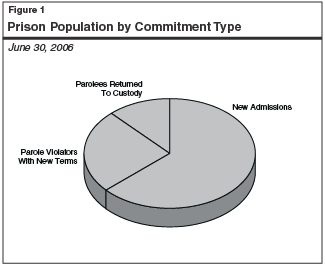
About 63 percent of the inmates are new admissions from the courts, 25 percent are offenders returned by the courts for a new offense while on parole status, and 12 percent are parolees returned to prison by administrative actions for violation of their conditions of parole (see Figure 1).
The California Department of Corrections and Rehabilitation (CDCR) is projecting the inmate and parolee populations to increase in the current and budget years, though more slowly than what was assumed in the 2006-07 Budget Act.
Inmate Population Increase. As of June 30, 2006, CDCR housed 172,508 inmates in prisons, fire and conservation camps, and community correctional facilities. The CDCR forecasts the inmate population will increase to 179,558 by June 30, 2008, a projected two-year increase of 7,050 inmates, or about 4 percent, compared to the beginning of the current fiscal year. The projected increase in the inmate population is the result of a recent trend of increasing admissions to prison from county courts, as well as more parole violators returned to prison through the state’s administrative returns process. Figure 2 shows the year-end inmate and parole populations for the period 1997 through 2008.
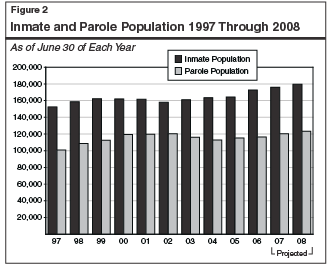
Parole Population Increase. As of June 30, 2006, CDCR supervised 116,563 persons on parole. As shown in Figure 2, CDCR projects the parolee population to increase to 123,336 by the end of the budget year, an increase of 6,773, or 6 percent. This increase is primarily a result of the increase in the number of inmates released to parole after serving their prison sentence.
Fiscal Implications of Population Changes. The CDCR is requesting additional funds of about $7 million in the current year, growing to $79 million in the budget year. This reflects the additional costs for out-of-state beds, partially offset by savings from slower population growth than assumed in the 2006-07 Budget Act.
Housing the Projected Growth in Inmate Population. The Governor’s budget proposes an inmate housing plan to accommodate the additional inmates that CDCR expects to receive by the end of the budget year. The plan has the following major elements:
-
Out-of-State Beds. The department’s housing plan includes the establishment of 2,260 beds contracted with facilities in other states. State inmates began filling those beds in late 2006. As of January 31, 2007, CDCR had transferred about 350 inmates to out-of-state facilities.
-
Overcrowding of Existing Prison Space. The housing plan assumes that, by the end of the budget year, an additional 4,060 inmates would be placed in gymnasiums, dayrooms, and dorms in CDCR prisons. This is intended to be temporary housing.
-
Loss of Pitchess Contracted Beds. In 2006, Los Angeles County chose to end its contract to house 1,300 state parole violators in its Pitchess Detention Center effective February 2007. Offsetting this decrease in capacity, CDCR proposes to increase contracted capacity at other facilities in California by 1,580 beds.
Potential Risks to Accuracy of Projections. As we have indicated in past years, the accuracy of the department’s latest projections remains dependent upon a number of factors, changes to any of which could result in significantly higher or lower populations. These factors include sentencing law, crime rates, and local criminal justice practices. For example, these projections do not take into account a recent U.S. Supreme Court decision in Cunningham v. California ordering the state to change its procedures under which courts can increase the length of sentences for crimes involving aggravating circumstances. At this time, it is unclear how this ruling will affect prison terms for current and future inmates. This is because the Supreme Court sent the case back to a lower court to determine how to implement the decision.
We withhold recommendation on the 2007-08 budget request for caseload funding pending receipt of the May Revision because recent data indicate that the population is trending lower than the department’s projections. We recommend that the administration provide, as part of its updated spring population projections, an estimate of the impact of the Governor’s policy proposals on the inmate population. We will continue to monitor the caseload and recommend further changes, if necessary, following review of the May Revision.
Inmate Population Relatively Level. The fall 2006 projections anticipated that the inmate population would grow by about 500 inmates during the first half of 2006-07. Instead, the inmate population stayed relatively level over the past six months. However, the parole population was about 2,400 higher at the midpoint of 2006-07 than what the fall projections anticipated. The CDCR will issue updated population projections in spring 2006 that form the basis of its May Revision proposal. At that time, we will review whether adjustments to CDCR’s funding for inmate and parole caseloads are warranted.
Budget Does Not Reflect Population Impact of Governor’s Policy Proposals. The department’s budget includes budget-year policy changes to reduce the parole population. (See our discussion of the Governor’s prison capacity proposals later in this chapter.) Should the Legislature choose to enact these changes, there would likely be a reduction in the prison population compared to what would occur in the absence of these policy changes. That is because the discharge of offenders from parole would also eliminate the possibility of administrative return to prison for parole violations. The Governor’s budget does not include any estimate of the likely impact of the proposed changes on the prison population and the associated fiscal effects.
Similarly, the budget plan does not reflect the Governor’s budget proposal (discussed in more detail in our analysis of the “Department of Alcohol and Drug Programs” in the
Health and Social Services chapter) to reduce funding for Proposition 36 allocations to counties. Because Proposition 36, an initiative approved by voters in 2000, provides for offenders to receive drug treatment in lieu of their incarceration in prison or jail, the proposed reduction in spending for this program could begin to increase the prison population during the budget year.
We recommend that the department provide estimates of the impacts of the Governor’s policy changes for adult parole and for reductions in Proposition 36 funding as part of the May Revision process.
Analyst’s Recommendation. We withhold recommendation on the 2007-08 caseload funding request, though we recommend that the department adjust its request to reflect the likely impact of population adjustments proposed in the Governor’s budget. We will continue to monitor CDCR population, and make recommendations as appropriate at the time of the May Revision.
The Governor requests $9.6 billion (combined General Fund and lease-revenue bonds) for a 14-part package of proposals designed primarily to address overcrowding in state prisons and county jails. While the package offered by the administration has merit, we have a number of concerns, in particular that the package would result in a large surplus of state prison capacity and provide the wrong mix of beds. We recommend that the Legislature consider an alternative package that would also address overcrowding but result in a more limited surplus of prison beds and reduce capital outlay costs relative to the Governor’s proposal by $2.1 billion. (Reduce Item 5225-001-0001 by $146 million and Item 5225-002-0001 by $23 million.)
When inmates are sent to state prison, they are assessed during the intake process at reception centers. One of the assessments done is to determine the appropriate security level at which they can be housed, based primarily on the likelihood that they will attempt to escape, commit violence, or otherwise break prison rules while incarcerated. Based on factors such as length of prison sentence, criminal history, and behavior during prior time in prison, inmates are assigned a classification level ranging from Level I (minimum security) to Level IV (maximum security). After receiving their security classification and undergoing other assessments at the reception center, inmates are generally transferred to other prisons matching their security classification. Female offenders are all assigned to the same prisons regardless of security classification.
Ten Percent of Inmates Housed in Gyms and Dayrooms. As of December 31, 2006, the California Department of Corrections and Rehabilitation (CDCR) was estimated to have 173,100 inmates in the state prison system, based on CDCR’s fall 2006 population projections. However, as shown in Figure 3, the department only operates or contracts for a total of 156,500 permanent bed capacity (not including out-of-state beds, discussed in more detail later), resulting in a shortfall of about 16,600 prison beds relative to the inmate population. The most significant bed shortfalls are for Level I, II, and IV inmates, as well as at reception centers. As a result of the bed deficits, CDCR houses about 10 percent of the inmate population in temporary beds, such as in dayrooms and gyms. In addition, many inmates are housed in facilities designed for different security levels. For example, there are currently about 6,000 high security (Level IV) inmates housed in beds designed for Level III inmates.
|
|
|
Figure 3
State Prisons Overcrowded |
|
(December 31, 2006) |
|
Security Housing Type |
Inmatesa |
Permanent Capacityb |
Surplus/
Deficit(-) |
|
Men |
|
|
|
|
Level I |
30,537 |
23,013 |
-7,524 |
|
Level II |
42,359 |
35,122 |
-7,237 |
|
Level III |
34,065 |
42,451 |
8,386 |
|
Level IV |
26,895 |
20,571 |
-6,324 |
|
Reception Center |
24,413 |
20,063 |
-4,350 |
|
Specialc |
3,070 |
3,927 |
857 |
|
Totals, Men |
(161,339) |
(145,147) |
(-16,192) |
|
Women |
11,761 |
11,356 |
-405 |
|
Totals, All Housing |
173,100 |
156,503 |
-16,597 |
|
|
|
a Based on
department’s fall 2006 population projections. |
|
b Includes prison and
contracted capacity. |
|
c Includes Security
Housing Unit and Protective Housing Unit. |
|
|
|
Discussions about overcrowding in California prisons are frequently complicated by the use of various similar sounding terms. We define a few of these terms below and describe how we use them in our analysis of the Governor’s proposals to address overcrowding.
Design Capacity. Design capacity refers to the number of beds the department would operate if it housed only one inmate per cell and did not double-bunk in dormitories. The department identifies its design capacity as about 83,600 in state prisons (not including 7,500 community contracted bed capacity). Double-ceiling and double-bunking of inmates in cells and dormitories is standard practice—with some exceptions—in prisons nationally. For this reason, we do not rely on design capacity figures in our analysis of the department’s bed capacity.
Permanent Capacity. “Permanent capacity” refers to the number of beds the California Department of Corrections and Rehabilitation (CDCR) would have if it used double-celling and double-bunking in all facilities when it was reasonably able to do so given the dangerousness of the inmates housed in those facilities and the size of the cells. As shown in Figure 3, the department reports that its permanent capacity is about 156,500 beds.
Temporary Housing. Because the department does not have permanent capacity for all inmates, CDCR utilizes “temporary housing.” This typically involves housing inmates in space not originally designed for housing, such as gyms and dayrooms. As shown in the figure, the department currently houses about 16,600 inmates in temporary beds. The CDCR reports that it will exhaust its supply of temporary beds by spring 2008.
Overcrowding. For purposes of this analysis, overcrowding refers to the use of temporary housing due to having more inmates than permanent capacity available.
|
Consequences of Overcrowding. Based on our discussions with department administrators, significant overcrowding has both operational and fiscal consequences. Overcrowding and the use of temporary beds create security concerns, particularly for medium- and high-security inmates. Gyms and dayrooms are not designed to provide security coverage as well as in permanent housing units, and overcrowding can contribute to inmate unrest, disturbances, and assaults. This can result in additional state costs for medical treatment, workers’ compensation, and staff overtime. In addition, overcrowding can limit the ability of prisons to provide rehabilitative, health care, and other types of programs because prisons were not designed with sufficient space to provide these services to the increased population. The difficulty in providing inmate programs and services is exacerbated by the use of program space to house inmates. Also, to the extent that inmate unrest is caused by overcrowding, rehabilitation programs and other services can be disrupted by the resulting lockdowns.
Historical Inmate Population Growth. Over the past 20 years, the state inmate population has grown at an average annual rate of 5 percent, increasing from 59,000 inmates in 1986 to 173,000 inmates in 2006. As shown in Figure 4, the overall increase in the inmate population over the past 20 years includes more rapid growth between 1986 and 1998 (9 percent average annual growth), a period of no net growth between 1998 and 2002, and a period of moderate growth between 2002 and 2006 (2 percent average annual growth).

What Factors Have Driven the Growth in the Inmate Population? Several factors have contributed to the overall change in the inmate population over the past 20 years. These factors include growth in California’s adult population of an average of 2 percent annually over the past 20 years. In addition, the proportion of the total California population incarcerated in state prison increased over the past 20 years from 220 state inmates for every 100,000 Californians in 1986 to about 460 state inmates out of every 100,000 Californians in 2006. This increase in the incarceration rate coincided with a 41 percent decline in the state’s crime rate but was driven mainly by changes in sentencing laws that increased penalties for many offenses, as well as an increase in the number of parole violators returned to prison via the administrative parole revocation process.
How Much Will the Inmate Population Grow in the Future? As shown in Figure 4, CDCR projects the state prison population to grow to about 190,000 by June 30, 2012, about 17,000 more inmates than the current population. This represents projected average annual growth of about 2 percent annually, consistent with the level of growth that has actually occurred over the past four years, although a significantly lower rate than the trend over the past 20 years.
It is also important to consider what level of inmate population growth may occur beyond CDCR’s five-year projection period, particularly because it can take several years of planning to construct new prison capacity. The failure of the state to anticipate and respond to the amount of inmate population growth in the past (either by adding capacity or taking actions to reduce the inmate population) is a key factor contributing to the current levels of overcrowding. Figure 4 shows how the inmate population would grow under three alternative scenarios during the ten-year period from 2012 to 2022—after the end of CDCR’s projections. These three scenarios assume average annual growth rates of (1) 0.5 percent—a conservative estimate based on the projected rate of growth of the California population of men ages 18 through 44, (2) 2 percent—a moderate rate of growth mirroring recent inmate population growth, and (3) 5 percent—a more rapid rate of growth consistent with the actual population growth experienced during the past 20 years. These scenarios calculate a range of possible inmate populations by 2022 of between 200,000 and 309,000 inmates.
Which scenario (if any) will actually play out is difficult to predict. Long range forecasts such as these are particularly subject to error. The actual prison population growth will be affected by a number of factors, including demographics, changes to sentencing laws, crime rates, law enforcement and judicial practices, and the performance of the economy. It will be important for the Legislature to monitor inmate population change on an ongoing basis and take steps to minimize dangerous overcrowding conditions.
Prison Capacity Nearly Exhausted. As discussed above, the department is currently operating with a significant level of overcrowding. The CDCR reports that it expects to exhaust both its permanent and temporary capacity by spring 2008 based on its most recent population projections. (It is worth noting that the current inmate population is somewhat lower than anticipated in these projections. Should this trend continue, it would take CDCR longer to exhaust its total capacity.) Under the most conservative of the three scenarios discussed above, the state would be short of permanent capacity by 43,000 beds in 2022 (not counting temporary beds). If the state’s prison population were to resume growth at the rate seen during the past 20 years, CDCR’s permanent capacity would be short by almost 153,000 beds. Figure 5 shows the projected bed shortfall under the three scenarios previously discussed.
|
|
|
Figure 5
Prison Bed Shortfalls in
2022
Under Various Inmate Growth Scenarios |
|
Growth Scenariosa |
Projected
Population In 2022 |
Bed Shortfall Compared to Current Permanent Capacity |
|
0.5% |
199,600 |
43,100 |
|
2.0 |
231,500 |
75,000 |
|
5.0 |
309,400 |
152,900 |
|
|
|
a Average annual rates
from 2012 through 2022. |
|
|
The administration has presented the Legislature with a 14-part package to address prison as well as county jail overcrowding. In all, the Governor’s package provides $9.6 billion in the 2007-08 budget plan for these purposes.
Four Main Types of Proposals. The Governor has presented the Legislature with a new proposal to address prison and jail overcrowding that differs in some respects from the package he offered during last summer’s special session. The new package has 14 components that fall into four general categories. These are policy changes that would (1) increase state prison bed capacity, (2) reduce the state prison population, (3) provide additional funds for the local government criminal justice system, and (4) implement various other policy proposals related to prison overcrowding.
In all, the budget plan includes $9.6 billion for these proposals. However, at the time this analysis was prepared, the legislation that would be necessary to enact some of the proposals had not yet been introduced in the Legislature. The components of the Governor’s proposals are summarized in Figure 6 and discussed in more detail below.
|
|
|
Figure 6
Governor’s Proposals to Address Prison
Overcrowding |
|
(Dollars in Millions) |
|
|
|
Fiscal Impact |
|
Component of Proposal |
Number of
Beds at Full
Implementation |
Capital
Outlaya |
2007‑08
State
Operations |
|
State Prison Capacity Expansion |
|
|
|
|
Infill housing |
16,238 |
$2,342 |
— |
|
Reentry facilities |
5,000‑7,000 |
1,600 |
— |
|
Female Community Rehabilitation Facilities |
4,350 |
— |
$2 |
|
Out-of-state transfers |
2,260 |
— |
13 |
|
Health care facilities set-aside |
Unknown |
1,000 |
— |
|
Subtotals |
(27,848—29,848b) |
($4,942) |
($15) |
|
State Prison Population Reduction |
|
|
|
|
Eliminate diagnostic services for counties |
205 |
— |
-$4 |
|
Changes to parole discharge policies |
— |
— |
-53 |
|
Shift of adult offenders to jail |
25,000 |
— |
|
|
Subtotals |
(25,205) |
— |
(-$57) |
|
Local Jails and Probation |
|
|
|
Jail beds for adult offendersc |
45,000 |
$4,000 |
— |
|
Adult probation grants |
— |
— |
$50 |
|
Subtotals |
(45,000) |
($4,000) |
($50) |
|
Other Components of the Proposals |
|
|
|
Infrastructure improvements for infill
housing |
— |
$303 |
— |
|
Condemned Inmate Complex |
— |
268 |
— |
|
Southern California training academy |
— |
58 |
— |
|
Sentencing commission |
— |
— |
< $1 |
|
Subtotals |
— |
($326) |
($303) |
|
Total Costs of Proposals |
|
$9,268 |
$311 |
|
|
|
a Multiyear funding,
primarily from lease-revenue bonds. |
|
b Does not include
health care facilities. |
|
c Does not include
$400 million for juvenile facilities. Governor’s proposal assumes
additional $1.1 billion match from local governments for adult and
juvenile beds. |
|
|
State Prison Capacity Expansion. The administration proposes $4.9 billion in lease-revenue bond authority and $15 million General Fund in 2007-08 to expand the capacity of the prison system by 28,000 to 30,000 beds (plus an unknown number of medical beds). This includes proposals to build new facilities at existing prisons, reentry facilities, and medical facilities. These proposals also include the use of out-of-state facilities and an expansion of community facilities for female offenders.
State Prison Population Reduction. The Governor proposes to change sentencing law so that certain low-level offenders would be housed in county jails rather than state prisons. The budget also proposes to eliminate provisions of current law which permit the housing of county inmates in state prison for diagnostic purposes, as well as change parole discharge policies to reduce or eliminate the parole terms served by some low-level offenders. In sum, the administration estimates that these policy changes would reduce the prison population by about 25,000 inmates when fully implemented. The administration estimates General Fund savings of $57 million in the budget year, which would grow in 2008-09 and succeeding years.
Additional Funding for Local Criminal Justice System. The Governor proposes $4.4 billion in lease-revenue bonds—requiring $1.1 billion in matching funds from counties—to construct 50,000 beds at the local level. This total includes 45,000 jail beds proposed for adult offenders and 5,000 beds in juvenile halls and camps. In addition, the budget proposes $50 million in the budget year (growing to $100 million in 2008-09) for a new grant program targeted for supervision and treatment programs for adult probationers ages 18 to 25. We discuss the proposed funding for juvenile capacity and the new probation grant program in separate analyses later in this chapter.
Other Changes Related to Prison Capacity and Overcrowding. The budget plan proposes $629 million for other projects, such as $268 million (including $117 million for increased project costs) to complete construction of the new death row facility at the San Quentin state prison (referred to as the Condemned Inmate Complex [CIC]), $303 million to improve infrastructure systems at existing facilities, $58 million to build a new correctional officer training academy in Southern California, and $457,000 to create a sentencing commission.
We find that the Governor’s package of proposals to address overcrowding in the state prison system has merit overall, in that it provides a more balanced approach than the proposal presented to the Legislature in last summer’s special session. However, we have identified several concerns pertaining to how the package fits together as a whole. The Governor’s proposals, if adopted in their entirety, would result in a dramatic surplus of prison beds, provide the wrong mix of beds, increase local jail overcrowding in the short-term, and generate operational costs that have not been fully identified in the plan. As the Legislature reviews the Governor’s package, it should consider not just how many and what types of beds are built, but whether they would be available on a timely basis to relieve overcrowding.
There are sound fiscal and policy reasons to support the Governor’s overall approach to addressing the prison capacity issue, as well as reasons to be concerned about the way his package of proposals fits together as a whole. We discuss our overall assessment of his approach below.
The administration’s package of proposals has merit, in that it attempts to address the current overcrowding problem as well as the anticipated future growth in the inmate population. In so doing, it could improve prison safety, increase inmate access to rehabilitation programs and health care services, and help lower rates of recidivism. While the package would result in significant additional costs to accommodate additional inmates, it also would likely result in partially offsetting state savings and some avoidance of future increases in costs in prison and parole operations.
In June 2006, the Governor called a special session of the Legislature, proposing $6 billion in capital outlay expenditures to build a total of 44,000 prison beds. The administration’s current set of proposals is a more balanced one than was proposed as part of the special session, in that the current proposals include components which would both increase prison capacity as well as reduce the inmate population. In the past, our office has similarly recommended that the Legislature take such a balanced approach to addressing inmate population growth and overcrowding.
While it makes sense to provide some beds beyond those needed immediately, our analysis indicates that the Governor’s package goes much too far in providing for future growth. Specifically, we estimate that adoption of his package of proposals in its entirety—including both components that would increase state capacity and others that would reduce the prison population—would result in a significant surplus of permanent prison capacity. The administration’s package of proposals would increase permanent state prison capacity to about 189,000 and reduce the inmate population to about 157,000, resulting in a total surplus of about 32,000 beds by 2012 when fully implemented. Figure 7 shows this total surplus of beds broken out by security levels. This total surplus equates to roughly six empty prisons that, if present prison population growth trends continued, would probably take between 8 and 11 years beyond 2012 to fill. In our view, it would not be wise to use state resources to build excessive prison capacity which is likely to remain unused for such a long period.
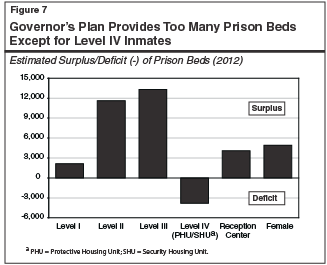
While the Governor’s package of proposals would provide a surplus of beds, it contains, in our view, the wrong mix of beds when the plan is compared with the security level of inmates now held in the prison system as well as the number of inmates projected to be housed at each security level in the future.
Based on our estimates of these factors, as shown in Figure 7, the Governor’s plan would result in a surplus of 25,000 medium-security beds (Levels II and III). To a lesser extent, the proposal results in more reception center, Level I, and female capacity than would be needed.
However, we estimate that the Governor’s plan would also result in a deficit of beds for inmates who require the highest security beds (Level IV). Housing inmates with higher security levels in facilities intended for lower-level inmates without any proposed modifications to the housing units could eventually pose a significant security problem.
While the 2007-08 budget plan provides for the capital outlay costs associated with the Governor’s prison capacity package, the administration has not provided estimates of the operational costs for several of the proposals. This information gap could make it more difficult for the Legislature to assess the overall approach proposed by the administration for addressing the prison capacity and overcrowding problem.
Additional Prison Facilities. Specifically, the proposals for infill housing, reentry beds, and female community facilities would all result in significant additional state operational costs for activating new facilities, particularly for establishing the initial compliment of custody and administrative staff that have not been identified. The additional state cost to operate these new facilities would probably amount to several hundred million dollars annually.
Moreover, the reentry and female facilities would likely be more costly to operate than typical state prison beds because of the more intense concentration of rehabilitation programs proposed for these facilities. The additional state costs for these additional rehabilitation services would depend on the amount and type of programs provided, but would likely be in the several tens of millions of dollars to the low hundreds of millions of dollars annually once fully implemented.
New Training Academy. Similarly, the department has not identified the operational costs for the proposed Southern California training academy. These are likely to be in the tens of millions of dollars annually, depending primarily on the size of the academy.
Possible Subsidies to Counties for Jail Operations. As discussed later, the administration has indicated that it is considering providing subsidies to counties to help them accommodate more offenders in additional county jail beds financed by the package. However, the administration proposal does not clearly indicate whether and to what extent the state would provide such funding to counties. Conceivably, the cost of such subsidies to counties could amount to hundreds of millions of dollars annually.
It is important that the Legislature carefully consider proposals that will help to relieve overcrowding in the short term, particularly during the next one to three years, during which time CDCR is likely to exhaust its total capacity. Our analysis finds that the Governor’s package does address the immediate threat of short-term loss of total prison capacity. Specifically, the Governor’s proposals for out-of-state beds, changes in parole discharge policies, and shifting inmates to local jails would significantly reduce inmate overcrowding in the first couple of years even before any significant construction could be completed. This short-term relief to overcrowding is also important because three federal court judges overseeing the provision of health care services to inmates are considering motions by plaintiffs seeking court-ordered remedies to overcrowding. This could include the imposition of a cap on the CDCR prison population.
However, there are some significant timing issues for the Legislature to consider relating to the administration plan. The proposal for sentencing law changes that would have the effect of shifting inmates to local jails is proposed to go into effect in July 2008. Part of the basis for the administration proposal to build additional jail space is to help counties to accommodate the effect of this change in sentencing laws-moving offenders from the state to the local level. However, we believe it is unlikely that a significant amount of new jail capacity could be built by that time. In fact, most of this additional jail capacity could take years longer to construct.
As the Legislature considers the overall approach to addressing the prison overcrowding problem, we recommend that it consider an alternative strategy that would avoid the creation of an excessive surplus of prison beds and provide a more appropriate mix of beds. We further recommend that the Legislature direct the administration to provide it with estimates of the future operating costs for some of the major components of its plan.
Consider Alternative Approach. Taking into account our concerns about some aspects of the Governor’s prison capacity package, as well as some of its strengths, we recommend that the Legislature consider an alternative package of proposals.
The most significant modifications we recommend to the Governor’s approach are these:
-
Approve infill projects, and related infrastructure improvements, only for Level IV and reception center beds.
-
Adopt the new parole discharge policies proposed by the administration, but with technical budgetary changes recognizing reduced institution populations.
-
Halt the increasingly costly death row project at San Quentin and direct the remaining project funds instead to build high-security capacity elsewhere in the prison system.
-
Redirect savings from other recommendations to convert some existing Level III facilities to Level IV.
-
Modify the Governor’s proposed sentencing law changes so that offenders who committed a more limited list of low-level crimes would be guilty of a misdemeanor rather than a felony offense likely to result in a jail sentence.
-
Appropriate only those capital outlay funds necessary in the budget year to begin building the reentry facilities.
We discuss the rationale for each of these individual alternatives in more detail later in this analysis.
LAO Alternative Has Advantages. Based upon our analysis of the Governor’s proposals, we believe our alternative prison capacity package would reduce the current levels of overcrowding; reduce surplus prison capacity in the Governor’s plan; ensure sufficient capacity in the prison system where it is needed, particularly for Level IV inmates; and reduce state operational and capital outlay costs relative to the Governor’s proposal. Some of its specific advantages are outlined below:
-
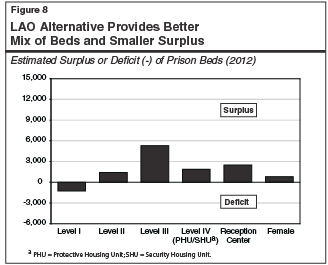
Smaller Surplus of Beds. We estimate that our proposal would result in permanent prison capacity of about 175,000 beds and an inmate population of 164,000 by 2012. (Inmate populations levels are reduced due to policy and sentencing changes.) This is a net surplus of only about 11,000 beds by 2012, a reduction of about two-thirds compared to the 32,000-bed surplus that would result under the Governor’s plan. The bed surplus in our plan would provide some flexibility to manage the inmate population should it grow faster than projected or if it took longer than expected to site and activate reentry and other facilities. It would be important for the Legislature to monitor the inmate population and capacity on an ongoing basis to prevent severe overcrowding in the long term, particularly in light of our findings that even moderate growth in the inmate population would result in tens of thousands more inmates by 2022. Another benefit of our plan is that room would remain for infill housing should capacity need to be added relatively quickly in the future. Figure 8 illustrates the estimated result of our recommendations on prison bed surpluses and deficits by security level.
-
Better Mix of Beds. As Figure 9 shows, our alternative provides a more appropriate mix of beds than the Governor’s package of proposals. It would likely generate a surplus (rather than the deficit provided in the Governor’s plan) of Level IV beds, where overcrowding poses the greatest security risks. Under our approach, there would also be much lower surpluses of medium-security (Level II and III) beds, compared to the Governor’s proposal. Based on our estimates, our plan would result in a deficit—although a much smaller one than currently exists—of Level I beds. However, these low-security offenders could be housed safely in the surplus capacity of Level II or III beds.
|
|
|
Figure 9
Comparison of Prison Bed Surplus/Deficit
(-)—Administration Versus LAO Proposals |
|
|
Bed Surplus (+) or Deficit (-) |
|
|
Administration |
LAO |
|
Level I |
2,100 |
-1,200 |
|
Level II |
11,600 |
1,400 |
|
Level III |
13,300 |
5,300 |
|
Level IVa |
-3,800 |
1,900 |
|
Reception center |
4,100 |
2,500 |
|
Female |
4,900 |
800 |
|
Totals |
32,300 |
10,700 |
|
|
|
a Includes
Security Housing Unit and Protective Housing Unit. |
|
|
Lower State Costs. Our proposals would cost much less than the Governor’s package. Were the Legislature to adopt all of our recommendations—as well as to approve the projects for which we are withholding any recommendation pending the Legislature’s receipt of additional information—the state would save about $189 million General Fund in the budget year (including recommended modifications to the adult probation grant proposal discussed in the “Local Assistance Programs” analysis later in this chapter). In addition, capital outlay costs would be reduced by about $2.1 billion due to reduced infill construction and cancellation of the CIC project. This would result in average General Fund savings of approximately $150 million for debt service annually, though the exact amount would depend on the timing of bond sales and interest rates. Figure 10 displays the amount of savings generated from each component of our alternative.
|
|
|
Figure 10
Fiscal Impact of LAO Option
Compared to Governor’s Package |
|
(In Millions) |
|
Changes Made Under LAO Alternative |
Capital
Outlay |
2007-08 State Operations |
|
Infill housing and infrastructure for only
Level IV and reception centers |
-$1,967 |
— |
|
Technical changes to parole discharge and
diagnostic policies |
— |
-$169 |
|
Redirect existing death row funding to build
Level IV bedsa |
-117 |
— |
|
Make
probation grant a pilot program, divert some savings to Proposition
36b |
— |
-20 |
|
Convert 5,000 Level III beds to Level IV |
5 |
— |
|
Make select low-level crimes misdemeanorsc |
— |
— |
|
Preliminary plans only for reentryd |
— |
— |
|
Total |
-$2,079 |
-$189 |
|
|
|
a Assumes creation
of Level IV beds to house condemned and maximum security inmates. |
|
b Recommendation
discussed in “Local Assistance Programs” analysis. |
|
c General Fund
savings generated in out-years. |
|
d Assumes total
project costs are $1.6 billion as originally proposed. |
|
|
Obtain Information on Operating Impacts. We recommend that the Legislature direct the administration to provide it with estimates of the future operating costs for some of the major components of its plan. Absent this information, it will be difficult for the Legislature to fully assess the fiscal implications for the state of the new facilities proposed in the Governor’s prison capacity plan.
In addition to assessing how the Governor’s proposals fit together as a package, the Legislature should carefully consider a number of key issues relating to each of the specific components of the plan.
Based upon our review of each of the Governor’s proposals, we find that many have merit and fit into our alternative approach, at least to some degree. However, we raise concerns about various aspects of the proposals and have identified ways to modify and improve them. We examine the Governor’s proposal to provide $50 million for a new adult probation grant program in the “Local Assistance Programs” analysis of CDCR, and comment on the proposal for $1 billion in lease-revenue financing for medical facilities as part of our analysis of the California Prison Receivership later in our analysis of “Adult Corrections.” We discuss our findings and recommendations in regard to each of the remaining proposals below.
We recommend that the funding proposed for infill housing projects be reduced by $1.7 billion, and funding for related infrastructure be reduced by $225 million, to limit the projects to Level IV and reception center beds.
Proposals. As shown in Figure 6 earlier, the Governor’s plan includes $2.3 billion in lease-revenue bonds to construct additional housing units at existing facilities to create capacity for an additional 16,238 inmates of varying security levels, primarily for Level I and II male inmates. Figure 11 shows the proposed housing total by security level. The department requests an additional $303 million from the General Fund in 2007-08 to improve the infrastructure at those facilities—such as water and sewer systems—in order to support a larger population of inmates. Proposed trailer bill language also permits the conversion of the Northern California Women’s Facility (NCWF) to a reception center or reentry facility for men. Currently, NCWF is being used as a satellite training academy.
|
|
|
Figure 11
Governor’s Budget
Infill Housing by Security Level |
|
Security Level |
Number of Beds |
|
Level I and II |
10,420 |
|
Level III |
2,223 |
|
Level IV |
1,505 |
|
Reception center |
2,090 |
|
Total |
16,238 |
|
|
Revised Fiscal Estimates Recently Provided. On February 8, 2007, we received revised cost estimates for these projects, totaling about $107 million less than originally proposed. At the time this analysis was prepared, we were continuing to review the revised proposal.
Approve Only Level IV and Reception Center Infill Beds. Consistent with our alternative prison capacity package, we recommend approval of a reduced level of funding ($600 million, a reduction of $1.7 billion) to construct only the Level IV and reception center infill housing. We further recommend approval of a reduced level of funding ($78 million, a reduction of $225 million) for the infrastructure improvement projects related to the Level IV and reception center infill housing. We recommend rejection of the infill and infrastructure proposals related to Level I, II, and III beds because, in our view, these beds will not be needed by 2012 if the Legislature approves the proposals related to parole discharge and the shift of inmates to jails. The department should also report at budget hearings regarding the basis for its revised cost estimates for infill and infrastructure projects. We will adjust our savings estimates based on further review of the revised fiscal detail supporting these proposals.
We withhold recommendation on the funding requested to build reentry facilities so that the California Department of Corrections and Rehabilitation can provide the Legislature with key fiscal and operational details regarding these proposed new facilities.
Proposal. The Governor proposes $1.6 billion in lease-revenue bonds (or, alternatively, lease-purchase authority for projects) to create secure reentry facilities for an estimated 5,000 to 7,000 inmates. The reentry facilities would be smaller than other prisons in California which average about 5,000 inmates each and would be located near urban communities to which many inmates return after release from prison. Inmates housed in reentry facilities would be those serving the final months of their prison sentence prior to release or short-term parole violators. The facilities would provide inmates with services such as education, substance abuse, and job training to prepare them for successful reentry into the community.
Important Details Lacking. Research studies suggest that the establishment of reentry beds could benefit public safety by providing rehabilitation and other programs to assist inmates before they are released to the community. However, at the time this analysis was prepared, the department had not provided important fiscal and operational details regarding the proposal, such as specific facility locations, the length of stay and risk classification of inmates, the specific reentry programs that would be provided or required, or how the relatively expensive construction costs for these beds ($229,000 to $320,000 per bed) were estimated.
Modify Reentry Proposal Based on Additional Information. We withhold recommendation on this proposal until the department provides more information to the Legislature about these projects, including (1) the basis for its construction cost estimate, (2) the characteristics of their inmate population, (3) their proposed programs, and (4) the communities that have expressed interest in accepting a reentry facility. Based on this information, the Legislature can make a more informed decision about whether the proposals match the priorities of the state.
Should the Legislature decide to approve such projects, we recommend that it authorize only the General Fund resources sufficient for preliminary plans in order to provide oversight over these projects, given that they are not fully developed at this time. We estimate these costs to be about $45 million. The Legislature should also consider whether parolees who have been returned to custody for parole violations might be the best population to place in these facilities. Parole violators as a group typically have a high need for services that could be provided in reentry centers, such as substance abuse treatment, education and vocational training, and employment services. Diverting parole violators from reception centers could also reduce the significant levels of overcrowding in those prison facilities.
We recommend approval of the Governor’s request for $1.7 million in the budget year, but recommend that these funds be redirected to planning expanded programs for female parolees. We further recommend that the Legislature authorize only the community female beds needed each year to prevent overcrowding of female facilities.
Proposal. The budget includes $1.7 million and 14 positions to begin the planning and procurement process to contract with private or nonprofit organizations to house 4,350 additional female offenders in community facilities by June 2009. The facilities would be required to provide rehabilitation programs—such as education and substance abuse treatment—to address the specific rehabilitative needs of female offenders.
Gender-Specific Approach Has Merit but Would Create Big Surplus of Female Beds. The department’s proposal appears to be consistent with research that recommends that corrections departments develop gender-specific policies, procedures, and programs designed specifically to address criminality of females. However, we are concerned that this proposal, along with other changes proposed by the Governor, would result in a surplus of 5,000 beds for female offenders, due particularly to the proposals to reduce the number of low-level offenders incarcerated in prison.
Activate Female Beds Only as Capacity Is Needed; Redirect Funding. The Legislature should provide resources to CDCR to activate only the number of female community beds needed to avoid creating a surplus of female beds. Our alternative prison capacity package assumes activation of no new female community rehabilitation beds by 2012 because the proposals to reduce prison population (parole discharge and shifting inmates to jails) will sufficiently reduce overcrowding in female prisons without a need for additional capacity. Nevertheless, we recommend that the Legislature direct CDCR to use the funding and positions requested in the budget year to expand community programs for female parolees in need of treatment and services. For example, the department currently contracts for the Female Offender Treatment and Employment Program (FOTEP), which has been found by researchers to significantly reduce recidivism rates of participants. (For more information on FOTEP and other parole programs, see our analysis of parolee employment programs later in the “Adult Corrections” analysis.)
We withhold recommendation on the proposal for additional funding to house state inmates in prison facilities in other states. The budget request is overstated because transfers of inmates are well behind schedule and is likely to be adjusted at the May Revision.
Proposal. The budget includes $10 million in the current year and $13 million in the budget year to transfer and house 2,260 inmates to prison facilities in three other states (Arizona, Oklahoma, and Tennessee). These figures reflect the additional cost for these beds above the amount the department would normally be budgeted for housing these offenders in state prison. Thus, the full cost of these contracts is $31 million in the current year and $60 million in the budget year. Most of these costs are based on the contracted rate of $63 per inmate per day, estimated transportation costs of about $900 per inmate flown to these facilities, and 64 new positions at CDCR primarily to administer these contracts and coordinate the transportation of inmates.
The CDCR Behind Schedule on Transfers. The Governor’s budget assumes that all 2,260 out-of-state beds will be filled by February 2007. However, it has already fallen behind that schedule. As of January 31, 2007, CDCR had transferred only about 350 inmates. As a result of these delays, the department’s budget is likely over-funded for the activation of out-of-state beds. The department identifies legal challenges as the primary reason for falling behind schedule.
Withhold Recommendation until May Revision. We withhold recommendation until the May Revision, at which time the department will update its estimated costs to house inmates in out-of-state facilities as part of the normal population budgeting process.
We recommend that the Legislature approve but further reduce the California Department of Corrections and Rehabilitation budget by 43 positions to reflect technical adjustments to a proposal to end diagnostic referrals of convicted offenders to state prison.
Proposal. The Governor proposes to eliminate provisions of current state law allowing courts to send convicted felons to state prison for up to 90 days for diagnostic evaluation and treatment before they are sentenced. Under current law, CDCR is responsible in such cases for providing the court its diagnosis and a recommendation regarding the disposition of the inmate’s case at no cost to counties. The department projects this change to reduce the inmate population by 205 inmates in the budget year, resulting in savings of $4.2 million.
Proposal Does Not Reduce Positions. The administration proposes to reduce funding for CDCR based on the assumption that the inmate population will decline by about 200 inmates but does not adjust the number or classification of staff positions relating to housing and diagnosing this population.
Proposal Requires Technical Adjustments. We recommend that the Legislature approve this proposal to reduce state costs but with a further technical reduction of 43 positions.
We recommend approval of the Governor’s proposal to provide for (1) direct discharge from prison (no parole term) and (2) early discharge from parole for certain offenders. We recommend a further reduction to the California Department of Corrections and Rehabilitation’s budget of $169 million to reflect the projected reduction to the inmate population resulting from the adoption of this policy proposal.
Proposal. The Governor proposes two changes to state law regarding the discharge of parolees from state supervision, resulting in combined state savings of $52.5 million in the budget year from a reduction in the parole population.
The first proposal is to provide for direct discharge from prison—no parole term served—for inmates with a record of no current or prior serious or violent crimes or sex offenses requiring registration. (We are advised that trailer bill language to implement this proposal is being revised to reflect this approach.) The second change would mandate the discharge from parole supervision for certain parolees who have served 12 consecutive months without revocation or placement in an in-custody program (or who have received other sanctions in lieu of revocation) for a violation of parole. This second change would apply only to parolees whose most recent term in prison, as well as any prior terms, were for offenses that were not serious or violent or sex offenses requiring registration. The administration indicates that these parole changes for low-level offenders would bring California’s parole practices more in line with those of other states.
Both of the administration’s proposals would go into effect at the beginning of the budget year. The department estimates the first change in statute would reduce the parole population by 22,300 parolees, and the second by about 4,400, in the budget year. These estimated savings would grow in the subsequent years.
Proposal Does Not Include Prison Savings. The department’s budget proposal does not recognize the full savings that would be likely to result from these policy changes. First, the budget proposal does not recognize that these proposals would be likely to reduce the prison population. That is because a reduction in the parole caseload would mean that fewer parolees would be returned to prison for parole violations. The department has estimated that these changes in parole rules would reduce the prison population by about 8,100 inmates (for prison savings of $164 million) in the budget year, growing to 11,400 inmates (for prison savings of $230 million) in 2009-10. However, CDCR did not include these savings in its budget.
The savings assumed in the budget plan from these proposals are also understated because they are based on current-year estimates of costs rather than updated budget-year estimates. We also note that the department’s proposal does not reduce parole division positions to reflect the assumed significant reduction in the parole population.
Reduce Budget by Additional $169 Million. We recommend approval of the administration budget proposal and related legislation to discharge certain offenders from parole. We believe it offers a reasonable trade-off of significant budget savings at relatively little risk to public safety and would make California’s parole policies more consistent with those of other states. However, we recommend that the Legislature adopt further reductions in the CDCR budget amounting to about $169 million and 2,266 positions to recognize the additional related savings on prison costs and the fewer number of parole agents and other positions that would be needed as parole caseloads declined. Our recommendation for additional savings includes technical adjustments using the full budget-year cost for inmates and parolees.
The Legislature should consider modifying the administration’s proposal to change sentencing laws to shift low-level offenders out of the state prison system in order to reduce the potential fiscal and operational impacts on county jail systems.
Proposal. The Governor proposes to change sentencing law to require that certain offenders sentenced to prison under current law would instead be housed in county jails. Specifically, beginning July 1, 2008, offenders who (1) are convicted of specified felony offenses punishable by prison, (2) are sentenced to three years or less, and (3) have no prior convictions for serious or violent crimes or a sex offense requiring registration would serve their sentence in jail instead of state prison. Under current law, offenders convicted of the felony crimes specified in this proposal can receive prison terms of 16 months, 2, or 3 years. The specific prison term given depends on the circumstances of the crime and the criminal history of the offender. Under the Governor’s proposal, these inmates would be sentenced to jail for “not more than three years.” Probation—and in some cases misdemeanor jail terms and fines—would still be sentencing options.
The CDCR estimates this proposal would shift approximately 25,000 inmates from the state to local corrections systems, saving the state approximately $500 million annually once fully implemented. Figure 12 shows the list of crimes specified under this proposal, CDCR’s estimate of the number of offenders affected, and the average time served (including jail time served prior to being sent to prison) for these crimes by all state inmates under current law.
|
|
|
Figure 12
List of Crimes Proposed for Shift to County Jails |
|
Crime |
Estimated Inmate Population Shifted to Jails at Full Implementation |
Average Time Serveda
(In Months) |
|
Drug possession for saleb |
6,300 |
25 |
|
Drug possession |
6,200 |
17 |
|
Vehicle theft |
3,100 |
17 |
|
Petty theft with a prior |
2,000 |
18 |
|
Receiving stolen property |
1,900 |
15 |
|
Driving under the influence |
1,400 |
17 |
|
Forgery/fraud |
1,400 |
17 |
|
Grand theft |
1,300 |
17 |
|
Hashish possession |
700 |
12 |
|
Other property crimes |
300 |
15 |
|
Total |
24,600 |
|
|
|
|
a Includes inmates who
would be excluded from shift based on offense history. |
|
b Includes sales of
controlled substance and marijuana. |
|
|
Funding Policy for Counties Unclear. The shift of low-level state inmates to jails would benefit the state by relatively quickly reducing prison overcrowding as well as prison operating costs. The budget proposal states that the administration recognizes that this approach could result in additional operating costs for counties, and indicates that it will work with counties to address these costs. However, the administration proposal does not actually budget any funding for local operations and does not clearly indicate whether it intends to do so in the future. (The administration does propose funding to build additional jail facilities, although, as we discuss later in this analysis, few such improvements are likely to be completed by the time these changes in sentencing law would take effect.)
A number of counties are now subject to court-ordered or self-imposed inmate population limits on their jail operations that are resulting on a regular basis in the early release of offenders from jail. Absent additional funding from either the state or counties for the support of jail operations, as well as the construction of additional jail capacity, it is likely that the Governor’s proposal would result in (1) additional overcrowding of jails and/or (2) additional early releases of some offenders from jails.
Also, it is important to note that the new sentencing structure providing felony terms of not more than three years provides broader sentencing discretion than prison sentences under current law, which are limited to 16 months, 2, or 3 years. It is unclear whether this discretion might lead to longer or shorter sentences on average than those received under current law.
In addition, it is important to consider whether the proposed legislation to accomplish this shift contains any provisions that could result in a local government mandate that would require reimbursement by the state. Current state law generally exempts changes in criminal penalties from mandate consideration.
Jail Impacts of Sentencing Law Change Could Be Reduced. The Legislature may wish to consider whether it wishes to commit the significant additional funding that would be needed (for jail operations as well as jail construction) for counties to house the group of offenders affected by the Governor’s proposal. Each state dollar committed to this purpose would in effect reduce the savings otherwise achieved by removing these offenders from the state prison system.
Our alternative proposal is to change the definition of some of the proposed crimes from felonies to misdemeanors to reduce the fiscal and operational impacts on county jail systems. (Our proposal excludes the categories of drug possession for sale and driving under the influence from consideration for reclassification because these crimes appear to be more serious than the others proposed by the administration.) Under our alternative, offenders would serve a maximum of one year in county jail, less time than the maximum of three years proposed by the Governor. We note, however, that, in many cases, the time served under our proposed changes in sentencing law would be only a few months below the average terms actually being served in prison by most of these offenders under current law. We intend that our proposal constitute a change in criminal penalties that would not be considered a reimbursable state mandate under current state law.
In considering this proposal, the Legislature may also wish to consider staggering the implementation of these sentencing changes in order to phase in the impact to the county jails. This would delay the relief for overcrowding in the state prison system but would make it easier for county jail systems to absorb the new population as they activated new jail facilities, if they choose to do so.
We recommend that the Legislature conduct hearings to resolve key policy, operational and fiscal issues pertaining to the proposal for state assistance to build 45,000 new county jail beds.
Proposal. The administration proposes $4 billion in lease-revenue bonds for the construction of 45,000 local jail beds to address existing overcrowding at jails, as well as to provide additional jail capacity to accommodate the Governor’s proposal to shift certain inmates to county jails (discussed earlier). (An additional $400 million in bond funding would be provided for the construction of as many as 5,000 juvenile beds.) Local governments would be required to provide up to 25 percent in matching funds in order to access the state funds, totaling $1 billion for adult jail beds, bringing the total state and county resources available for adult jail bed capacity potentially to $5 billion.
Important Questions Need to Be Addressed. We discuss the proposal for additional juvenile beds in more detail in the the “Juvenile Justice” analysis later in this chapter. The proposal for additional adult jail beds raises a number of key policy, operational and fiscal questions for the Legislature to consider as we discuss later.
First, in general, what role should the state have in the building of jails, which is traditionally a local responsibility? The state has provided some jail construction funding in the past, but jail construction has generally been funded by local governments. Given the state’s current fiscal constraints, it is important to consider whether such projects are a state priority and the level of local matching funds that should be required to obtain state assistance.
The proposed changes in sentencing laws that would shift part of the prison inmate population to jails in our view does justify some level of state help in constructing some additional beds. However, the timing of these two policy proposals is out of sync. The inmate shift would begin July 1, 2008, but it would likely take much longer than that for counties to complete the application and construction process necessary to build new jails beds. We note, therefore, that fewer beds, and lesser state assistance, would be needed under our proposed alternative version of these sentencing law changes. Our approach, which reverts these lower-level crimes to misdemeanors carrying shorter jail sentences than felonies, would lessen the need for additional jail beds and the impacts on jail operations.
A second concern is that, while law enforcement agencies have indicated that they support proposals for a large state-funded jail construction project, the administration has not provided the Legislature with its own independent analysis justifying 45,000 additional jail beds for adults. Nor has it provided evidence that the counties would have the funding available—about $1 billion a year—to operate them.
We also note that the administration has not provided any justification for its estimated cost of $5 billion for the jail beds. It is, therefore, unclear whether this level of funding (including the county match) would actually provide more or less funding than is needed to build the 45,000 beds that have been proposed.
Hearings Needed to Gather More Information. We believe the provision of some state assistance to counties is reasonable, given the part of the proposal that would shift some adult offenders from the state to the local level. However, we withhold recommendation on the $4 billion proposal at this time. We recommend that the Legislature conduct hearings to obtain additional information to determine whether, and to what extent, it wishes to provide state resources for construction of additional county jail beds. Specifically, the Legislature should request information from the administration, counties, and other stakeholders regarding the appropriate level of local match, the number of beds needed to relieve local jail overcrowding, actual costs to construct jail facilities, the capacity and interest of counties to operate additional jail space of this magnitude, and the coordination of this proposal with the proposed shift of prison inmates to jails.
We recommend canceling the condemned housing project at San Quentin and using the remaining funding authorized for this expensive project to build additional prison capacity for condemned and maximum-security inmates at a lower cost per bed elsewhere.
Proposal. The budget requests an additional $117 million to complete the construction of a new death row facility, known as the Condemned Inmate Complex (CIC), at the state prison at San Quentin. These new costs are due primarily to inflation and other increases in site construction costs. It is now estimated that, when finally completed, the project will cost $337 million. According to CDCR, it has spent about $15 million to date on the CIC project, leaving $205 million in funding appropriated for the project available for our alternative approach. The CIC would have 768 cells, providing capacity for a total of 1,152 male inmates on death row. As of September 2006, there were 640 male inmates on death row.
Costs for CIC Escalate Significantly but Do Not Add System Capacity. While the Legislature has previously authorized the CIC project, important aspects of the project have changed, which we believe warrant reconsideration of the merits of the project. The estimated increase in construction costs of $117 million represents a 53 percent increase in estimated costs since 2003 despite the fact that the department reduced the size of the project by 25 percent in 2005. At the revised project cost estimate, each CIC bed would cost almost $300,000 to construct, more than twice the cost of other high-security beds. These higher costs are primarily due to the location of the project. In particular, engineering requirements are more challenging at San Quentin because of the instability of the soil. Also, labor and materials are more expensive in the Bay Area than other potential sites for such a facility.
Moreover, this high level of expenditure may not add to overall prison system capacity. We are advised that the state agreed in the project’s Environmental Impact Report (EIR) to a restriction on the total number of inmates that can be housed at the San Quentin state prison (6,558). Consequently, even though the construction of CIC would allow the state to vacate the existing cells housing death row inmates, this agreement might prevent CDCR from using all of those cells to increase the prison’s overall capacity.
Cancel CIC and Build Death Row Capacity Elsewhere. We recommend canceling the CIC project and using the remaining funding already authorized for this expensive project to build additional prison capacity at a lower cost per bed elsewhere. This could include (1) building a new death row complex at an existing prison or at a new site or (2) constructing new Level IV capacity and moving condemned inmates to Level IV housing.
Using the funds currently designated for CIC to build Level IV beds for both Level IV and death row inmates at another location would have significant benefits. The state could use these funds to obtain additional beds for both condemned inmates and Level IV inmates. As we have shown earlier (Figure 7), the Governor’s plan does not resolve the current deficit of Level IV beds. Based on our discussions with correctional experts, housing condemned inmates in Level IV facilities would be safe for staff and inmates if properly designed and staffed. In fact, one option would be to house condemned inmates with the Level IV population in a single facility. At least one other state, Missouri, takes this approach.
Our proposed approach would also allow CDCR to house its current and future condemned inmate population. The current death row housing unit could house other groups of inmates without violating the EIR, thereby adding more than 600 beds to CDCR’s total capacity. Given the age and design of the condemned cells at San Quentin, these beds are probably best-suited for lower security inmates, and could help address the significant statewide shortage of Level I and II beds.
We withhold recommendation on the Southern California academy proposal pending the Legislature’s receipt of additional information on its construction and operational costs and the need for this facility.
Proposal. The proposal includes $58 million to construct a new training facility in Southern California for correctional officers and other personnel. (On February 8, 2007, CDCR provided a revised estimate of $135 million for this proposal. At the time this analysis was prepared, we were continuing to review this proposal.) Currently, the state operates one primary correctional officer academy in Galt, as well as two satellite academies in Stockton and Susanville. According to the department, the activation of a new training academy would allow them to close the satellite academy in Stockton.
A Southern Academy Could Make Sense, but Proposal Lacks Detail. The department has experienced high vacancy rates for correctional officers and other staff positions in recent years. According to a December 2006 report from the State Controller’s Office, 2,200 correctional officer positions were vacant, up by about 500 from the same time last year. In addition, the department had an additional 700 vacancies in sergeant, lieutenant, and parole agent positions. High vacancy rates for these positions present significant fiscal and operational problems for the department and result in payment of additional overtime at a significant cost to the state.
According to the department, having its primary academy in Galt often makes it difficult for CDCR to recruit cadets from Southern California who may be unable or unwilling to move and be away from their families for the 16-week academy. Therefore, having an academy in Southern California could help the department recruit more officers and fill its vacancies.
While this proposal has merit, the department has not provided the Legislature with important details about the project. For example, the department has not identified how it estimated the proposed construction costs of $58 million (revised to $135 million). The cost of operating the new facility has not been identified, nor has CDCR indicated how many additional cadets would be trained annually in the new academy. Finally, the department has not identified the expected reduction in vacancy rates resulting from the expansion. We note that the Legislature approved $58 million in the 2006-07 budget to expand training capacity at Galt.
Withhold Recommendation Pending Additional Information. We withhold recommendation on the Southern California academy proposal pending additional information from CDCR regarding construction and operational costs, as well as more detailed information supporting the operational need for this facility.
Should the Legislature decide to create a sentencing commission, it will be important that the enabling legislation provides for an independent agency, with balanced membership, that is appropriately staffed for the significant workload involved.
Proposal. The Governor proposes to establish a permanent state sentencing commission within CDCR in 2007-08. The commission would review and annually make recommendations on sentencing guidelines, provide analysis on the impacts of any proposed legislation affecting sentencing laws, and become the state’s clearinghouse for sentencing data. The proposed trailer bill language directs the commission to review the proposed changes to parole discharge policies by October 2007.
The commission would be comprised of the Attorney General, the Secretary of CDCR, and 15 members appointed by the Governor representing the Legislature, law enforcement, victims, labor, and other groups. The Governor proposes $457,000 and four positions in the 2007-08 budget for the operation of the commission.
Sentencing Commission Has Merit, but Details Lacking. The creation of a sentencing commission in California has merit. The state’s sentencing laws are complex, and changes in them could have wide-ranging impacts on state and local criminal justice agencies. Many other states have taken a similar approach, and California does not currently have an agency that carries out these activities.
Some additional information is needed by the Legislature in order to evaluate this specific budget proposal. This budget requests four positions—an executive director, researcher, analyst, and office technician—to staff the commission. One concern is whether four positions would be sufficient given the heavy workload that is proposed to be assigned to them. According to the department, sentencing commissions in other states with similar responsibilities have average staff sizes of about six or seven.
The Legislature may also wish to consider the independence of the commission and the balance of its membership. As currently proposed, the commission would not be an independent body, but a division of CDCR, which would likely be directly impacted by many of the commission’s recommendations. As currently proposed, the Governor would appoint members to the sentencing commission. Legislative confirmation would not be required.
Our analysis also finds a discrepancy between this proposal and the administration’s parole discharge policies. Specifically, the sentencing commission’s report making recommendations about the discharge policies is due October 1, 2007, but the discharge policies would go into effect July 1, 2007.
Ensuring That the Commission Is Independent, Balanced, and Appropriately Staffed. Should the Legislature decide to create a sentencing commission, it will be important that enabling legislation provides for an independent agency with balanced membership. It could do so by creating the sentencing commission outside of CDCR, perhaps as an independent department as was done with the Office of the Inspector General. The Legislature could ensure more independence and balance to the commission by requiring Senate confirmation of commissioners and ensuring that the membership of the commission, as detailed in legislation, reflects the broad range of stakeholders in the criminal justice system. A balanced membership is more likely to lead to recognition and acceptance of commission recommendations by the many stakeholders across the state.
We further recommend that the Legislature require the administration to provide justification for its request for positions and funding to support the commission to ensure that these resources are sufficient.
Our analysis indicates that prison overcrowding is a significant short- and long-term problem today—one that will only grow worse absent significant actions by the Legislature and the administration. The Legislature has many approaches from which to choose, but, ultimately, we recommend that it adopt a balanced approach that includes proposals both to increase state prison capacity as well as to slow population growth. (For a listing of additional options to expand prison capacity or reduce the inmate population, see our publication,
California’s Criminal Justice System: A Primer.) As the Legislature develops this balanced approach, it will be important to take steps that (1) reduce overcrowding today and in the near future but without overbuilding unnecessary capacity, (2) minimize the risk to public and institutional safety by ensuring that there is sufficient prison capacity for the highest security offenders, and (3) minimize the impact on the General Fund.
The federal court appointment last year of a Receiver to take over the state’s prison medical care system is already resulting in a number of actions intended to improve inmate care. There are uncertainties regarding the costs and savings likely to result from the actions of the Receiver, but the net effect is likely to be significant increases in state spending. So far, the Legislature has received only limited information about the fiscal implications of the changes in the medical system that the Receiver is pursuing. We discuss (1) our recommendations regarding various budget requests submitted to the Legislature relating to the actions of the Receiver and (2) key Legislative oversight considerations for the inmate medical system.
Court Appoints Receiver to Fix “Broken” System. In April 2001, a class-action lawsuit, now known as Plata v. Schwarzenegger, was filed in federal court contending that the state was in violation of the Eighth and Fourteenth Amendments to the U.S. Constitution by providing inadequate medical care to prison inmates. The court has ruled in the case that the state’s prison medical care system “is broken beyond repair” and is so deficient that it results in the unnecessary suffering and death of inmates. Specifically, the court found, among other problems, that the California Department of Corrections and Rehabilitation (CDCR) medical system is poorly managed, provides inadequate access to care for sick inmates, has deteriorating facilities and disorganized medical record systems, and lacks sufficient qualified physicians, nurses, and administrators to deliver medical services.
The state agreed in 2002 to take a series of actions to settle the case, with the result that an estimated $194 million has been added to the state budget from 2002-03 through 2006-07 to address the problems identified in inmate medical care. However, on the basis of further review of the performance of the medical system, the court found that CDCR had failed to comply with a series of its orders since 2002 to improve the inmate medical care system. The court concluded that on average one inmate a week had died and that many more had been injured by the lack of reliable access to quality medical care.
In February 2006, the court appointed a Receiver to take over the direct management and operation of the prison medical health care delivery system from the state and to develop a remedial plan, to be presented to the court by November 2006, for a new medical system that would improve medical care for inmates. The plan is to include a proposed timeline for implementing the new medical system and a set of “metrics” by which to evaluate the Receiver’s progress and success in upgrading inmate patient care. While the remedial plan is being developed, the court order directs the Receiver to implement short-term measures to improve medical care and to begin to restructure the health care delivery system. Although the Receiver’s appointment is deemed “temporary,” he has stated his belief that it is likely it will be many years before control of medical services programs reverts to the state.
Scope of Receiver’s Authority. The Plata federal court ruled that the Receiver has the authority to “determine the annual CDCR medical health care budgets,” and specifically grants him the authority to spend money to implement changes in medical care. The court requires the state to pay “all costs incurred in the implementation of the policies, plans, and decisions of the Receiver.” The Receiver was granted the authority to hire and fire staff and contractors, to acquire and dispose of property, to develop information technology systems, and to seek waiver by the court of any state or contractual requirements that are impeding his progress in improving the inmate health care system. (The text box on the next page discusses how court-appointed receivers differ from special masters.)
The court order directs other state agencies—specifically the Department of Personnel Administration (DPA), the State Personnel Board (SPB), the Department of Finance (DOF), and the Department of General Services—to “fully cooperate” with requests from the Receiver for assistance in carrying out his duties or be subject to contempt proceedings before the court.
While the Plata Receiver has authority over the general medical care of inmates, including primary and acute care and treatment of chronic health conditions such as asthma, the federal court order does not provide the Receiver authority over mental health or dental care for adults or any aspect of health care for juveniles. That is because these areas of health care are separate CDCR operations that are the subject of other federal court cases. (See Figure 13 for a summary of the other major class-action cases affecting CDCR health care.) However, because of the overlapping issues in these cases, such as the joint need for new facilities and improved clinician staffing, the Receiver and parties in the other cases are attempting to coordinate their actions.
|
|
|
Figure 13
Major Class-Action Cases Affecting CDCR Health
Care |
|
|
|
All
of the following legal cases pertaining to the California Department
of Corrections and Rehabilitation (CDCR) health care are active and
involve ongoing compliance and monitoring activities under the
jurisdiction of the federal courts: |
|
·
Plata v. Schwarzenegger. Filed in 2001,
the Plata case contends the state failed to meet U.S.
constitutional standards for medical care for inmates in the
California prison system. The state and plaintiffs agreed to settle
the case in 2002, with the state agreeing to remedial actions. But,
the federal court appointed a Receiver in February 2006 to take
direct control of the prison medical system after finding that CDCR
had failed to comply with prior court orders to improve inmate
patient care. |
|
·
Coleman v. Schwarzenegger. The
Coleman case, filed in 1992, involves allegations that the state
prison system provided constitutionally inadequate psychiatric care
for inmates. A federal court found the state to be in violation of
federal constitutional standards for inmate medical care and
established a special master in 1995 to monitor state efforts to
remedy the problems. The state implemented a series of remedial
actions, which are still continuing. |
|
·
Perez v. Tilton. The Perez case,
filed in 2005, contends that CDCR provides inadequate dental care to
prison inmates. The lawsuit was filed concurrently with a settlement
agreement between the state and the plaintiffs. The agreement
requires the state to phase in new policies and procedures statewide
over six years to improve the quality of dental care and access to
care for inmates. |
|
·
Farrell v. Tilton. In 2003, plaintiffs in the
Farrell case filed suit contending that the state provided
inadequate care and ineffective treatment to wards held in state
juvenile institutions. This case involved a number of different
issues relating to high levels of violence in juvenile facilities,
wards with disabilities, and other matters, but also included
allegations of problems in medical care and mental health care. The
state entered into a consent decree to settle the case in 2004 and
agreed to develop and implement improvements in six areas, including
changes in health care and mental health treatment. |
|
|
|
A Receiver, such as the one appointed by the court in the Plata case, differs from special masters that have been approved in other legal cases affecting the California Department of Corrections and Rehabilitation (CDCR). A Receiver has direct executive authority, and acts in place of the Secretary of CDCR in regard to the management of the medical care system. We are aware of only a few federal court rulings involving prison systems that have involved the appointment of a receiver. They include a 1979 federal court order that made the Governor of Alabama the receiver of that state’s prison system and the 1995 federal court appointment of a receiver for the Washington DC jails.
Special masters, such as the one appointed in a separate legal case known as Coleman v. Schwarzenegger involving improvements in inmate mental health care, are a more common remedy in such cases. Special masters monitor the compliance activities of other parties (in this case, CDCR). They lack, however, direct executive authority and must rely on the federal courts to order changes when they discover problems in compliance with court orders.
|
Court-ordered interventions in prison operations are subject to constraints in federal law under the Prison Litigation Reform Act (PLRA). The PLRA, among its other provisions, states that court orders to address prison conditions “shall extend no further than is necessary to correct the violation” and “shall give substantial weight to any adverse impact on public safety or the operation of a criminal justice system.” Also, PLRA specifies that federal law does not authorize the courts to order the construction of prisons or to raise taxes to remedy problems.
A nonprofit corporation, called the California Prison Health Care Receivership Corporation, has been created as a vehicle for operating and staffing the Receiver’s operation. A November 2006 report to the court listed 20 direct employees of the Receiver and 6 contract staff who were working for the corporation. The report identified a widening array of short-term actions which have been taken to improve inmate patient care.
How the Medical System Is Changing. The actions taken to date by the Receiver to revamp CDCR’s medical services system are summarized in Figure 14. They include efforts to improve contracting with medical providers, create a new system for managing pharmaceuticals provided for inmates, increase pay to help fill vacant medical positions, and modify the staffing classifications used to provide medical services. The Receiver has also focused on testing a number of new approaches for improving inmate medical care at the San Quentin prison that include these and additional components.
|
|
|
Figure 14
Summary of Key Actions to Date Taken by the
Prison Medical Care Receiver |
|
|
|
·
Nonprofit Corporation. Established the
California Prison Health Care Receivership Corporation, a nonprofit
entity, and hired employees and contract staff for its operation. |
|
·
Pharmacy. Commissioned an audit of
correctional pharmaceutical services and awarded a contract to a
vendor to improve and manage pharmacy operations. In so doing, the
Receiver also halted a previously approved $22 million information
technology project to track the medication of inmates but has a new
effort under way to do so. |
|
·
Contracts With Community Providers. Paid
outstanding invoices (at one point, amounting to $100 million) owed
to contract medical providers in the community, renewed expiring
agreements with providers for such services, and awarded a contract
for a new electronic contract management system. |
|
·
Salaries. Increased the range of
salaries for various clinicians, and implemented salary increases
for nurses, pharmacists, and other clinicians for the purpose of
reducing the number of vacant positions. |
|
·
New Positions and Reclassifications.
Established 300 new correctional licensed vocational nurse positions
to take the place of medical technical assistants who have both
medical and custody duties, as well as various other new and
reclassified positions in the medical system. |
|
·
Shifts in Management Authority. Assumed
direct, day-to-day management of some components of the California
Department of Corrections and Rehabilitation medical system,
including physician and nursing operations. |
|
·
Plata Compliance Unit. Created a Plata
Compliance Unit that reports directly to the Receiver that carries
out medical recruitment and hiring, certain personnel functions,
medical staff investigations and discipline, and processing of
medical contracts. |
|
·
San Quentin Pilot Programs. Implemented
pilot projects at San Quentin state prison intended to improve the
availability of staffing, medical supplies, and equipment; medical
record-keeping; the process for screening and placement of inmates
needing medical services; and the maintenance and cleanliness of
medical care facilities. |
|
·
New Facilities Planning. Initiated
planning for new medical facilities, including up to 5,000 medical
and 5,000 mental health beds, a 50-bed treatment center at San
Quentin, and a pharmaceutical distribution facility. |
|
|
In some cases, the Receiver has implemented changes through direction to CDCR medical system managers. In other cases, such as physician and nursing care, he has indicated that he has assumed direct day-to-day control of medical and nonmedical functions, with CDCR staff reporting directly to his office. The Receiver has also expedited the implementation of his orders by using authority provided by the federal court in the Plata case to waive or deem his operations not subject to state laws and regulations relating to civil service, salary-setting, competitive bidding of contracts, and the development of information technology projects.
Capital Outlay Projects Being Planned. The Receiver is still developing plans, outlined in his regular progress reports to the court, for projects to obtain or build new medical facilities of various types. The most important of these involves the direction the Receiver has given to CDCR staff to develop and submit a plan to site, design, and construct up to 10,000 “health care beds”—5,000 medical beds related to the Plata case and 5,000 mental health beds relating to the Coleman case—within three to five years at up to seven sites across the state (six state prisons and one former youth institution site). At the time this analysis was prepared, neither the Receiver nor the court had determined exactly what type of medical beds and facilities would be constructed, including how many, if any, of the additional beds for inmates would be licensed medical beds. (However, CDCR did release a plan in late January with an as yet undetermined cost to add more than 4,000 mental health beds to respond to court orders in the Coleman case.
In addition, the Receiver is proposing to build a 50-bed correctional treatment center at San Quentin, estimated to cost about $140 million, that would also provide new space for mental health and dental care practitioners. He also has stated his intention to obtain 500 additional “step down” beds in the short term (either on the grounds of state prisons or in the community, such as in hospital buildings that have closed) for recovering inmates who could be shifted out of more expensive acute care medical beds. A new facility for the centralized distribution of pharmaceuticals is also planned. To help carry out such projects, the Receiver has proposed to establish a new health care capital outlay unit—estimated by CDCR to require 130 new staff positions as well as additional funding for contracts for environmental and project management services.
Remedial Plan Delayed. The federal court had initially set a deadline of 180 to 210 days (in other words, October to November 2006) for the Receiver to submit his remedial plan, time line, and metrics to the court. However, the Receiver requested and was granted an extension of time by the court, citing, among other factors, the complexity and magnitude of the task of devising a new approach to medical care for prison inmates. Under the revised process that was approved by the court in December, the Receiver is to present a “first proposed” remedial plan and proposed metrics to the court by May 15, 2007, with a “revised” plan to be submitted to the court by November 15, 2007.
The Governor’s budget would provide a combined amount of about $152 million in operating funds from the General Fund for CDCR and other state agencies to implement and respond to the actions of the Plata Receiver and federal court in 2007-08. In addition, the budget plan proposes $1 billion in lease-revenue bonds for capital outlay projects to carry out decisions relating to Plata and the other legal cases affecting inmate health care. Below, we discuss the budget actions taken as part of the enactment of the 2006-07 Budget Act in response to the appointment of the Plata Receiver, and then describe the additional expenditures for these activities proposed in the Governor’s 2007-08 spending plan.
The 2006-07 Budget Act established a separate item in the CDCR budget (5225-002-0001) for health care services programs for inmates. This includes the medical care services programs subject directly to the control of the Receiver as well as mental health and dental care services that continue to be administered by CDCR with some direction from the federal courts. The budget act provided about $1.5 billion from the General Fund for these programs, including the separate scheduling of $100 million in an unallocated reserve to support new initiatives undertaken by the Receiver.
Statutory language in the budget act authorizes the DOF to transfer funds out of the $100 million unallocated reserve for purposes determined by the Receiver, including to departments other than CDCR. These funds are available for both support and capital outlay purposes. The language requires that notice be provided by DOF to the fiscal committees of the Legislature within ten days of any transfers of funds from the unallocated reserve. Also, immediate notice is to be provided if DOF determines that the $1.5 billion provided in the budget item is being spent at a rate that would expend the resources before the end of the fiscal year. As shown
in Figure 15, various actions of the Receiver and the federal court orders in the Plata case had resulted in the transfer of about $50 million from the reserve at the time this analysis was prepared.
|
|
|
Figure 15
Funding Transfers by Receiver |
|
Transfers Requested August 2006 Through January
2007
(In Millions) |
|
Purpose of Transfers |
Transfer
Total |
|
Increase medical staff salaries (not including
physicians). |
$24.7 |
|
Establish 300 new
positions for prison licensed vocational nurses. |
12.3 |
|
Fund software and
related services for new health care contracts tracking system. |
5.7 |
|
Establish 41 new
positions for San Quentin prison pilot projects to improve inmate
care. |
3.0 |
|
Replenish fund to
support Receiver staff and expenses. |
3.1 |
|
Establish 16 registered nurse
positions at Correctional Training Facility. |
1.2 |
|
Establish staff
counsel and locksmith positions at San Quentin. |
0.2 |
|
Total |
$50.3 |
|
|
|
Detail may not
total due to rounding. |
|
|
The 2007-08 budget plan goes beyond setting aside funding to directly implement the orders of the Plata Receiver and federal court. It also sets aside funding for other efforts to respond to their actions, such as increasing salaries for medical clinicians in other state departments so they do not shift to CDCR to obtain higher pay. Below, we describe the requests included for additional funding in the budget plan for CDCR as well as for several other state agencies. These include a revised plan for 2006-07 and a new plan for 2007-08.
Additional Funding for CDCR in 2006-07. The budget plan proposes a new appropriation from the General Fund to replace the $50 million transferred out of the unallocated reserve for initiatives by the Receiver. (We discuss some fiscal issues relating to the use of this reserve later in the analysis.) This would bring the total resources available to the Receiver in 2006-07 to $150 million. In addition, about $1.3 million in additional funding is proposed in the current year to bring the salaries for various medical clinicians in CDCR’s Division of Juvenile Justice (DJJ) to the levels ordered in the Plata case for adult clinicians to prevent them from leaving DJJ for higher salaries.
2007-08 Funding Requests for CDCR. The Governor’s budget proposes to spend $1.9 billion General Fund in 2007-08 for health care services, including the components controlled by the Receiver as well as mental health and dental care for adult inmates. This amounts to an overall increase of about $222 million, or 13 percent, over the revised proposed current-year level of spending for these programs. This continues a trend of significant increases in health costs for CDCR in recent years, as shown in Figure 16. (Adult inmate health care costs would have quadrupled over ten years if the funding level proposed in the budget is enacted. The DOF has estimated that about $194 million in costs were added to the health care system just as a result of decisions made in the Plata case before the appointment of the Receiver.) A substantial part of the proposed increase in spending for 2007-08 is due to augmentations for mental health and dental care operations, but most of the increase is for medical care services under the direction of the Receiver.
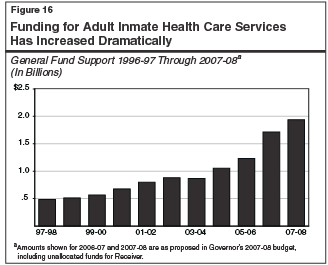
The CDCR budget identifies proposals totaling about $131 million that are related directly to the actions of the Receiver and the court in the Plata case. These proposals are summarized in Figure 17.
|
|
|
Figure 17
2007-08 Operating Budget Proposals
Related to the Plata Case |
|
(In Millions) |
|
|
|
General Fund Cost |
|
California Department of
Corrections and Rehabilitation (CDCR) |
|
|
|
Increase unallocated funding reserve to
$150 million |
$50.0 |
|
|
Cost in 2007‑08 of Plata actions to
date in 2006‑07 |
49.7 |
|
|
Pay raises for CDCR medical clinicians |
31.1 |
|
|
Subtotal for CDCR |
|
$130.8 |
|
Other State Agencies |
|
|
|
Department of Personnel
Administration |
|
|
|
Item 9800, augmentation for employee
compensationa |
$20.8 |
|
|
Administrative workload related to
receivershipb |
0.2 |
|
|
State Personnel Board |
|
|
|
Administrative workload related to
receivershipb |
$0.2 |
|
|
Department of Finance |
|
|
|
Administration coordinator on CDCR litigation
issues |
$0.1 |
|
|
Subtotal for Other State Agencies |
|
$21.3 |
|
Total Augmentations to Operating Budget |
|
$152.1 |
|
|
|
a Affects Departments
of Mental Health, Veterans Affairs, and Developmental Services. |
|
b Supported with
reimbursements from the General Fund in the CDCR budget. |
|
|
First, the budget plan proposes to carry forward the $50 million increase in the unallocated reserve for new initiatives by the Receiver that is proposed for 2006-07 (keeping the total funding provided for this purpose at $150 million). The spending plan would also provide about an additional $50 million to reflect the cost in the budget year of various actions begun in the current year by the Receiver and the court to improve patient care. Also, about $31 million is included in the budget plan to pay for pay raises ordered by the Plata court for various medical clinicians, and to provide commensurate pay raises for DJJ clinicians. The budget does not propose any changes in the level of spending provided for pharmaceuticals and contract medical services for CDCR inmates.
In addition, the 2007-08 budget plan proposes $1 billion for capital outlay projects to improve medical facilities in response to litigation, including the Plata and Coleman cases. The budget plan does not identify any specific projects at this time related to the Plata case, but assumes that any projects authorized would be funded entirely with lease-revenue bonds. The budget plan also does not reflect the recent administration proposal to add more than 4,000 mental health beds.
2007-08 Funding Requests for Other Departments. As shown in Figure 17, the budget plan includes about $21 million from the General Fund related to the actions of the Receiver involving other state agencies and budget items. These include additional funding for DOF, SPB, DPA, Department of Mental Health (DMH), Department of Veterans Affairs (DVA), and Department of Developmental Services (DDS). (The DMH, DVA, and DDS funding is reflected in Item 9800 of the 2007-08 Budget Bill for augmentations of employee compensation.) These augmentations are for (1) state administrative staff to help implement decisions of the Receiver and (2) salary raises to bring medical clinician pay in other agencies closer to the salaries provided for CDCR medical clinicians due to the Plata case to prevent them from leaving their agencies to go to CDCR.
Our analysis indicates that the Legislature faces significant uncertainties regarding the costs and savings likely to result from the Receiver’s past and future actions. Only limited fiscal information about the costs of implementing many aspects of the Receiver’s plans are now available to the Legislature. This information gap could pose a challenge for the Legislature as it attempts to fund these costs in the forthcoming budget plan.
Several examples discussed below demonstrate the fiscal uncertainties faced by the Legislature. Specifically, we discuss fiscal issues pertaining to the Receiver’s own operation, the submission of budget proposals, the sufficiency of and expenditures from the Receiver’s reserve fund, and auditing of expenditures. We also discuss our analysis of the likely fiscal impacts on the Receiver’s decisions on CDCR and other state agencies as a result of his recent actions and proposed future projects. This includes how the net fiscal “bottom line” will be affected by savings resulting from his decision, as well as the remedial plan he is now drafting to improve inmate medical services.
Data Available on Receiver Staffing but Not Other Activities. As directed by the Plata federal court, some specific fiscal information about the costs of the Receiver’s own operation has been reported in court documents. The reports to the court indicate, for example, that the annual budget for the Receiver was initially set at about $8.4 million for 2006-07 and that he is paying some compensation rates significantly higher than for comparable state administrative positions and state contracts. Figure 18 provides a summary of the compensation rates reported to the court by the Receiver. (The totals do not include additional compensation payments valued at 30 percent of their salary made in lieu of a benefits package still under development.) The Receiver has advised the court that this level of compensation is necessary to attract staff members with the knowledge and capabilities to revamp inmate correctional medical services.
|
|
|
Figure 18
Compensation Rates for
Receiver Employees and Contract Staffa |
|
Employees |
Compensation |
|
Receiver |
$500,000 |
|
Chief Medical Officer |
350,000 |
|
Chief Medical Information Officer |
275,000 |
|
Chief Financial Officer |
275,000 |
|
Chief Information Officer |
275,000 |
|
Acting Health Care Project Officer |
187,678 |
|
Director of Communications |
180,000 |
|
Staff Attorneys (2) |
150,000b |
|
Special Assistant to the Receiver |
101,000 |
|
Inmate Patient Relations Manager |
93,600 |
|
Project Coordinator |
80,000 |
|
Administrative Assistant (2) |
50,000b |
|
Administrative Aide |
37,500 |
|
Staff Aide |
35,000 |
|
Director, Custody Support Services |
125/hour |
|
Construction Analyst |
75/hour |
|
Custody Support
Services Specialist (2) |
75/hourb |
|
Contract Staff |
|
|
Chief of Staff |
$250/hour |
|
Medical Consultant |
200/hour |
|
Nursing Consultant |
200/hour |
|
Legal Consultant |
100/hour |
|
Financial Consultant |
75/hour |
|
Special Assistant |
75/hour |
|
|
|
a Does not include
additional compensation payments valued at 30 percent of salary
while a benefits package is under development. |
|
b Amount per person. |
|
|
Budget Proposals Not Submitted Directly. Although the federal court order establishing the Receiver grants him budgetary authority, he has not directly submitted a specific budget request to the Legislature or Governor for 2007-08 for CDCR medical services. (He has indicated he will eventually begin to directly prepare and submit his own budget requests.) Therefore, the specific funding requests presented in the 2007-08 budget plan represent the administration’s request for resources on behalf of the Plata Receiver. The DOF indicates that the 2007-08 budget requests are based upon DOF staff conversations with the Receiver and the Receiver’s reports to the courts about his intentions.
Sufficiency of Reserve Fund. While notice has been provided to the Legislature after the fact about the transfers of funding from the Receiver’s reserve fund for new initiatives, the Receiver could not advise us at the time this analysis was prepared whether the $100 million unallocated reserve would be more or less funding than he would need in 2006-07. Early in the fiscal year, the Receiver had reported to the court that the $100 million set aside in the reserve might prove insufficient, but more recently he indicated that less than the full $100 million might be used. Some additional expenditures beyond the $50 million transferred so far are likely. Notably, salary increases authorized in October 2006 at the request of the Receiver for prison physicians could potentially cost the state tens of millions of dollars in 2006-07 (and thereafter). Likewise, the Receiver has recently approved a $5 million per year contract (plus additional bonuses for good performance) for pharmacy management services that will require a funds transfer during 2006-07. Because of this and other potential costs, the administration has proposed (as we noted earlier) to increase the unallocated reserve fund total in 2006-07 to $150 million.
Expenditures of Transferred Funds. Little information has been made available to the Legislature on an ongoing basis regarding what expenditures of funds have actually occurred after they have been transferred out of the unallocated reserve. For example, about $12 million was transferred at the request of the Receiver to establish 300 new prison licensed vocational nurses effective September 2006. However, several months later, none of the positions had been filled, making it unclear what portion of the $12 million transfer will actually be spent in 2006-07.
Potential Fiscal Impacts on Departmental Operations. It is also not clear at this time what fiscal impacts are occurring on a day-to-day basis as CDCR carries out the directions of the Receiver. These potential fiscal impacts include both expenditures of funds that could exceed the department’s budget act appropriation from the Legislature as well as the redirection of existing CDCR resources that could eventually result in new budget requests to the Legislature.
For example, the Receiver has regularly given orders to officials at particular prisons he has visited to immediately remedy a lack of medical supplies or equipment. These directives could eventually result in aggregate expenditures by CDCR in excess of the amounts budgeted by the Legislature for these purposes. Because the Receiver is not required to estimate or report these fiscal effects to DOF, it will be difficult for DOF to track such additional spending and to promptly advise the Legislature in advance of overspending as required by statutory language in the 2006-07 Budget Act.
Another potential fiscal impact relates to actions taken by the Receiver to redirect CDCR staff with other assignments to work on his projects to improve inmate medical care. One such example is his creation of a Plata Compliance Unit using various CDCR administrative staff. If such actions continue, it is likely to eventually lead to departmental requests for new and additional staff resources to replace the staff he is using.
Fiscal Impacts of Future Projects. The reports of the Receiver to the court about his forthcoming projects often lack fiscal detail, sometimes characterizing fiscal impacts only on a broad order of magnitude and not estimating their cost at all. A full estimate of costs has not been reported to the court, for example, in regard to proposals he is developing to (1) establish a new 130-person CDCR unit to build new medical facilities, (2) construct up to 5,000 medical beds as well as another 5,000 mental health beds, (3) build a new medical center at San Quentin prison, and (4) acquire or build a pharmacy distribution facility. Nonetheless, we are advised by the administration that the Legislature will be requested to authorize at least some of these proposals within a limited period of time (reportedly by spring 2007, in the case of the new San Quentin building) upon their submission for funding.
“Domino Effect” on Other State Health Care Programs. As noted earlier, the budget plan includes funding in 2006-07 and 2007-08 for a series of salary adjustments for medical clinicians working at DJJ as well as other state departments. We anticipate that the actions of the Plata court will continue to have a domino effect. By this term, we mean that, as the Plata case has resulted in higher salaries for CDCR’s medical clinicians, administrators of other CDCR health care programs as well as those of health care programs operated by other state agencies such as DMH are likely to seek increases in compensation to prevent their staff from moving to CDCR medical services to obtain higher pay. Our recent review of state personnel data shows persistently high rates of vacancies continue for medical services staff at CDCR. This suggests that the Receiver may eventually order additional increases in clinician pay. Any such actions by the Receiver are likely to affect staff salaries elsewhere within CDCR, as well as at DMH, DDS, DVA, and other state agencies.
Auditing of Expenditures. At the time it established the Receivership, the Plata court required independent annual audits of the expenditures of the Receiver. At the time this analysis was prepared, the Receiver was still working out a plan with the Office of the Inspector General (OIG) to conduct these audits. Recent discussions suggest that the audit will be limited to the direct operations of the office of the Receiver. The court did not require that expenditures of the CDCR medical care system managed by the Receiver be subject to such audits.
Some Savings Likely, but Not Reflected in Budget Plan. The Receiver has estimated that the state could achieve savings in the high tens of millions of dollars annually due to the implementation of his various efforts to improve inmate medical care. We agree with the Receiver’s conclusion that some significant state savings are likely to occur as a result of the types of improvements he is planning for the inmate medical system. Expenditures for nursing registries to backfill for vacant positions should decline, for example, as salary increases attract more nurses to jobs at state prisons.
However, the 2007-08 budget plan submitted by the Governor does not contain adjustments to reflect any of the savings that the Receiver estimates will result in pharmacy operations or in contracting with community providers for medical services. The Receiver has recently advised us of his intention to redirect any current- or budget-year savings to finance other efforts by his office to improve inmate medical care.
In any event, the estimates of savings that the Receiver has reported to the court appear in some cases to be overstated. For example, the Receiver has reported to the court that the shift now in progress from medical technical assistants (MTAs) to nurses at prisons will result in $39 million in state savings annually because nurses are paid lesser salaries and benefits. However, that level of savings assumes that 100 percent of all proposed new nursing positions are filled, an unlikely outcome despite the increases in nursing salaries he has implemented. His savings estimate also does not take into account the increase in custody staff that will probably be required to replace the custody functions previously handled by MTA positions that are now being abolished.
Remedial Plan Key to Better Understanding Fiscal and Programmatic Impacts. The overall level of resources to provide in the 2007-08 budget for inmate medical services and related capital outlay will be difficult for the Legislature to assess until the Receiver has completed the specific remedial plan required by the court to remedy problems in the state’s system of inmate health care. The State Constitution directs the Legislature to pass a budget plan by June. The delay in the completion of the remedial plan means that it now may not become available until May 2007, with revisions possible until November 2007. The Legislature, thus, is likely to have to make decisions about how much funding to appropriate for inmate medical services in 2007-08 before the costs and metrics included in the remedial plan have been fully assessed and before the plans themselves have been finalized.
As discussed earlier, a key component of the remedial plan required by the Plata court is the metrics that are to be proposed by the Receiver to measure the quality of inmate medical services and the improvement in that care as a result of changes that are made in the medical care system. After the state initially entered a settlement of the Plata case (prior to the appointment of the Receiver), the state, independent court medical experts, and the plaintiff’s counsel together developed a detailed audit instrument that was to be used to asses the compliance by the state, on a prison-by-prision basis, with court orders to improve inmate care. A prison was to be deemed to be in “substantial compliance” if it scored 85 percent on two separate audits using this instrument. All state prisons were to have been found in substantial compliance before the court case could be resolved.
In his regular reports to the court, such as on the San Quentin pilot projects, the Receiver has discussed the steps he has taken to improve inmate patient care, such as clearing up a backlog of referrals of inmates to specialty care. However, the Receiver has discussed the steps he has taken to improve inmate patient care, such as clearing up a backlog of referrals of inmates to specialty care. However, the Receiver has not reported to the court any specific metrics on the outcomes for inmate health care at San Quentin. Nor has he yet indicated whether the previously developed audit instrument, or new measures that have yet to be developed, will be the basis he proposes the court apply to measure inmate health care outcomes.
The Bottom Line: Net Increase in State Costs Likely Through 2011-12. In November 2006, the Legislative Analyst’s Office published its projections of state revenues and spending for 2006-07 through 2011-12 in our annual report,
California’s Fiscal Outlook. The report included our estimate that CDCR would incur a net increase in costs of about $1.2 billion annually by 2011-12 in support of prison operations and lease-revenue debt payments related to ongoing litigation in the federal courts over prison health.
Our projections took into account several legal cases related to inmate health care, including the Plata case. They further reflected our estimates of the savings likely to result from changes in the inmate health care system as well as increased costs for medical staff salaries, anticipated new information technology projects, and capital outlay for new medical facilities that will be required by the courts. Although we did not separately project the costs of each pending legal case, a large segment of the increase in expenditures that was assumed in our forecast is related to the Plata case. We will update our estimate of these costs and savings after the Receiver has announced his remedial plan and more is known about the specific projects and actions he intends to implement.
The Receiver has indicated that he concurs that there will be a net increase in costs for state operations and capital outlay after expected savings have been taken into account.
We recommend that, to the extent that it is practical, the Legislature apply its standard budgetary processes to carefully review and act upon each support and capital outlay budget request submitted to it in behalf of the Receiver. Based on our reviews, we make specific recommendations on various budget requests relating to actions of the Receiver. In addition, we discuss the Legislature’s key oversight and reform role in prison medical care.
If spending increases of the magnitude we have estimated do result from Plata and the other court cases related to improving inmate health care, the Legislature faces difficult budgetary choices in the future. Increased spending on the activities mandated by the Receiver and various federal court cases could leave less funding available for the support of other state programs. This would particularly be problematic if the state is unable to address its ongoing structural operating deficit or if that deficit unexpectedly worsens sometime in the future due to an economic downturn.
The $222 million (13 percent) increase in General Fund spending proposed in the 2007-08 budget plan for inmate health care, including the medical services under the direction of the Receiver, thus warrants careful consideration by the Legislature. Below, we discuss our recommended overall approach to the budget requests submitted on behalf of the Receiver, present our specific recommendations in regard to the 2007-08 budget request, and outline the key role that the Legislature could play in oversight and further reform of the inmate medical system.
The Receiver and the federal courts are continuing to independently and actively exercise their authority over CDCR’s medical services programs to bring inmate health care up to federal constitutional standards. Nevertheless, the Legislature continues to bear the responsibility under the State Constitution to appropriate funds and to enact an annual state budget to support a variety of state programs, including CDCR. Under these circumstances, one key question is how the Legislature can and should reconcile its state constitutional role with the legal authority and actions of the Receiver and the federal courts in the Plata case in budgeting resources in 2007-08 for correctional medical services at CDCR. This question is particularly important given the Receiver’s view that his appointment may continue for many years.
Based on our discussions with the Receiver and other state officials, we believe it is possible and desirable for the Legislature and the Receiver to exercise their respective responsibilities under a cooperative and mutually respectful approach that will strengthen fiscal controls over medical services programs as well as improve the quality of care provided to prison inmates.
Accordingly, we recommend that, to the extent that it is practical, the Legislature apply its standard budgetary processes to carefully review and act upon each support and capital outlay budget request submitted to it. Specifically, if the Legislature believes that a particular budget proposal submitted by the administration on behalf of the Receiver is overbudgeted or overstaffed on a workload or other technical basis, we believe that it should act to modify the proposed expenditures within Item 5225-002-0001 of the budget bill. In our view, the Legislature should also make appropriate adjustments in the future where additional costs likely to result from a budget proposal have not been recognized in a budget request, or where unrecognized savings are found.
Support Budget Proposals. Our recommendations in regard to the various 2007-08 operating budget proposals related to the Plata case are as follows:
-
CDCR Pay Raises. We recommend approval of the nearly $30 million provided in the CDCR budget to implement the pay raises for clinicians that have been implemented at the direction of the Receiver. We believe the amount of funding provided in the budget plan is based on a reasonable estimate of these costs.
-
Pay Adjustments for Other State Agencies. We recommend approval of the $21 million proposed in Item 9800 of the budget bill to help DMH and other state agencies operating medical programs to keep the salaries of their medical clinicians more in line with those of CDCR staff. We believe the amounts provided in the budget plan are a reasonable estimate of these costs, and that it makes sense to minimize the disruption that could be caused by a shift of clinicians from their medical program to CDCR. These funds would assist DMH, for example, in its efforts to hire additional staff to comply with a federal consent decree to remedy civil rights violations in state mental hospitals.
-
Administrative Workload. We recommend adoption of the proposals in the Governor’s budget (as shown in Figure 17) to provide additional administrative resources to DPA, DOF, and SPB related to their workload resulting from the actions of the Receiver.
-
Unallocated Reserve. We withhold recommendation at this time on the $50 million in additional funding requested to bolster the Receiver’s unallocated reserve fund to $150 million for the budget year. Further information on the Receiver’s remedial plan may be available in May.
-
Ongoing Costs of Receiver’s 2006-07 Actions. We withhold recommendation on the budget plan proposal to add $50 million to the CDCR budget for the ongoing costs in 2007-08 of initiatives begun by the Receiver and the Plata court in 2006-07. We agree in concept with the proposal for making such adjustments. Between now and the end of 2006-07, however, the Receiver has indicated that he is likely to launch additional initiatives using the reserve funding available to him. This could increase the amount of funding needed beyond the amount reflected in the budget plan. On the other hand, it is not clear whether all of the funds that have been transferred from the current year, such as those for 300 new nurses, will actually be spent. Further information may be available at the time of the May Revision to appropriately adjust this budget request.
Capital Outlay for Medical Facilities. We withhold recommendation on the budget request for $1 billion in lease-revenue bond funding because no specific capital outlay projects related to the Receiver have been submitted to the Legislature for its review. The $1 billion included in the budget plan by the administration is essentially a placeholder amount until further decisions regarding new facilities have been made in the Plata, Perez, and Coleman court cases regarding health care facilities. (More detailed estimates of the costs of the 4,000 additional proposed mental health beds are expected this spring.) Once that has occurred, and more specific proposals are forthcoming, we recommend that the Legislature review the justification presented for the facilities and determine whether the proposals are consistent with federal law (in particular, the PLRA), the Receiver’s remedial plan, and the orders of the federal courts.
Following this review, we recommend that the Legislature include in the state spending plan only the resources actually needed in the budget year for capital projects to move ahead in a timely manner. In many cases, a construction project that takes several years to build would only require funding for site acquisition or preliminary planning. That approach would allow the Legislature to fully review the projects prior to providing funding for the working drawing and construction phases. This approach could require direct General Fund appropriations to initiate projects in 2007-08. In future years, the Legislature could authorize the financing of the latter phases of these facilities projects with lease-revenue bonds, as proposed by the administration.
Finally, we note that the actual cost of constructing new health facilities required as a result of actions of the Receiver in the Plata case and the other court cases is likely to be much higher than the $1 billion placeholder amount in the Governor’s budget. Our November projections estimated the collective cost of such projects at $4.6 billion by 2011-12.
Separate and aside from the efforts of the Receiver, the Legislature has a key role in overseeing and furthering reform of CDCR’s medical operations.
Specifically, we recommend that the Legislature conduct hearings on the draft plan proposed by the Receiver for improving the inmate health care system when it is available—possibly in May 2007. We believe such hearings could help the Legislature to better understand the fiscal and operational implications of the plan on CDCR and other state agencies, as well as the metrics recommended by the Receiver to measure improvements in inmate medical care. Also, if the audit plan worked out by OIG and the Receiver remains limited to the Receiver’s own operations, we recommend that the Legislature request that the Receiver and the federal court agree to a broader audit of the CDCR medical care operations to provide greater financial and program accountability.
In addition, the Legislature may wish to build on its prior efforts to expand the cost-effective use of telemedicine for prison inmates. As we discussed in last year’s Analysis of the 2006-07 Budget Bill, expansion of the telemedicine program has the potential to enhance public safety, generate cost savings, and improve inmates’ access to care. Similarly, the Legislature may also wish to explore the opportunities for establishing a new electronic medical record system and to introduce other new technology, which if carefully designed and implemented, could both reduce state costs and improve inmate patient care.
Correctional experts frequently identify stable housing, sobriety, and employment as key factors in a parolee’s success once he or she has been released to the community. In recent years, the Legislature and administration have expanded programs to address the problems of homelessness and substance abuse among offenders. However, less attention has been given to the problem of parolee unemployment. In this analysis, we (1) focus on this problem, (2) identify shortcomings of current programs, and (3) recommend actions the Legislature can take to increase parolee employment. (Reduce Item 5225-001-0001 by $3.4 million. Increase Item 5225-001-0995 by $3.4 million.)
Most Parolees Are Unemployed. In California and nationwide, there is ample research evidence that parolees have difficulty finding and maintaining stable employment. Studies of California parolees have found that from 20 percent to 40 percent of parolees are fully or frequently employed. At any given time, this means that approximately 70,000 to 100,000 parolees do not have regular employment. This stands in stark contrast to other research findings that about four-fifths of inmates have had some employment prior to their admission to prison. Importantly, even when parolees do get a job, they tend to receive significantly lower wages than similar workers who have not been incarcerated. Some studies estimate this wage differential for comparable work at about 10 percent to 20 percent.
Researchers have identified several reasons why parolees tend to have low employment rates. These include: (1) low education and employment skills before entering prison; (2) erosion of job skills while incarcerated; (3) limited participation in prison job skills and vocational programs; (4) stigma among employers who are reluctant to hire known offenders; (5) laws and licensing requirements that exclude ex-felons from employment in certain professions, such as real estate, nursing, and education; and (6) concentration of parolees within neighborhoods with high rates of unemployment and relatively few available jobs.
Parolee Unemployment a Costly Problem. New criminal offenses committed by unemployed parolees come at a high cost to the state correctional system as well as to society as a whole. In 2005, there were 81,000 cases in which a parolee was returned to prison. (This number includes some parolees with jobs, although probably most were unemployed at the time of their return. Also, because it is possible for a parolee to return to prison more than once in a year, the number of individual parolees who were returned to prison would be lower than 81,000.)
Most of these parole returns were accomplished through administrative actions by parole agents and the state Board of Parole Hearings (BPH), although one-quarter were returned by the actions of the courts upon their conviction for a new crime. Inmates who are returned to prison by their parole agents and BPH can spend up to a year in prison, at an average cost of more than $40,000 annually, although many are incarcerated for a few months at a time. Parolees who are convicted in criminal courts for new offenses spend an average of two years in prison. It costs the state approximately $2 billion annually to incarcerate offenders returned to prison by administrative revocations and the courts.
A number of other costs as well as some revenue losses accrue to taxpayers, victims, and families when parolees fail to gain employment and commit new offenses. These include law enforcement costs to investigate crimes, apprehend offenders, incarcerate offenders in a local jail, and prosecute the offenses. Other costs include health care expenses for victims of crime, loss of tax revenues while offenders are incarcerated or unemployed, public assistance payments, damage to and loss of property, loss of earnings, as well as pain and suffering of victims and families.
Parolee unemployment and reincarceration can also negatively impact the families and children of offenders. Recent survey data indicate that the reported primary source of income for almost one-third of California parolees is support from family and friends. This is a larger number than those reporting employment as their primary income source. In addition, incarceration of parolees frequently results in placement of their children in foster care. Recent studies, for example, estimate that about 13 percent of all felony arrests involve a custodial parent of minor-age children.
The Keys to Parolee Employment. Research evidence indicates that stable employment is an important key to successful reentry of offenders released from prison back into the community. Research consistently finds that a parolee who finds and maintains a steady job—and who also has stable housing and avoids substance abuse—is more likely to avoid subsequent offenses and to successfully complete his term on parole. Steady work provides income, activity, and stability which can reduce a parolee’s likelihood of committing new offenses. This view is echoed in research surveys of parolees—90 percent of whom reported in one study that employment is critical to their ability to stay out of prison—as well as our own discussions with parole agents and administrators.
The research literature not only identifies that employment is important to the success of parolees, but also identifies the keys to ensuring stable employment for parolees. We briefly discuss each of these key success factors below.
-
Pre-Release Planning and Preparation. Prior to his or her release to parole, it is beneficial to identify the skills and deficiencies of an inmate and implement a plan to assist them in preparing for employment after release. This can include plans to improve literacy, professional skills, as well as more general job-related skills, such as interviewing for jobs.
-
Skills Development. Time that an inmate spends while incarcerated is time which can be used to make the inmate more employable through participation in education, vocational, and life-skills classes. This skills development can also begin, or be continued, after an inmate is released to parole.
-
Job Placement Services. After an inmate is released to parole, he or she frequently needs assistance in finding employers in his area who will hire parolees with a particular set of skills and training.
-
Focus on Job Retention. Some research has found that parolees have difficulty maintaining employment once hired. In response, some programs are providing follow-up services and incentives to support and encourage parolees to maintain employment.
The California Department of Corrections and Rehabilitation (CDCR) administers several programs to assist parolees in obtaining employment. Some of these programs—such as education and vocational programs—are in-prison programs designed to increase employment-related skills of inmates prior to release. Other programs involve pre-release planning and transitional programs for offenders prior to and immediately following their release to the community. The remaining programs are for parolees, and include, for example, employment referral programs. In all, we estimate that these employment-related programs, which are summarized in Figure 19 and described in more detail later, provide assistance to an estimated 144,000 participants annually. (As we discuss below, some offenders may have participated in more than one program during the period.) The availability, as well as intensity, of these programs varies across the state.
|
|
|
Figure 19
Employment Programs: Budget and Participants |
|
(Dollars in Millions) |
|
|
|
Programs |
2006‑07
Program Budgeta |
Annual Number Of Participants |
|
Institution |
$138.5 |
27,600 |
|
Academic educationb |
93.9 |
12,300 |
|
Vocational training |
44.6 |
9,400 |
|
Prison Industry Authority |
— |
5,900 |
|
Pre-Release |
$9.8 |
13,300 |
|
Pre-release education |
8.7 |
10,900 |
|
Offender Employment Continuum |
1.1 |
2,400 |
|
Transitional |
$23.9 |
82,400 |
|
Parole Planning and Placement |
14.9 |
33,500 |
|
Parole and Community Team |
9.0 |
48,900 |
|
Parole |
$60.5 |
20,900 |
|
Parole Service Center |
22.3 |
4,100 |
|
Residential Multi-Service Center |
18.0 |
1,400 |
|
Female Offender Treatment and
Employment Program |
13.2 |
900 |
|
Computerized Literacy Learning Center |
3.0 |
3,000 |
|
Parolee Job Program |
2.2 |
6,600 |
|
Parolee Employment Program |
1.8 |
4,900 |
|
Total All Programsc |
$232.7 |
144,200 |
|
|
|
a All funds. |
|
b The budget for
academic education also includes administrative costs for vocational
programs. |
|
c Offenders can
participate in multiple programs in a year. |
|
|
In-Prison Academic and Vocational Programs. The primary employment-related programs available in prisons are academic education and vocational training. These programs are designed to provide inmates with literacy and professional skills which can assist them in jobs after release. In addition, the Prison Industries Authority (PIA) provides work assignments to inmates to produce goods sold mainly to government agencies. The PIA is a self-funded program covering its costs from the sale of its goods and services rather than from a General Fund appropriation. Inmates working in some PIA industries can earn a vocational certification.
Pre-Release Programs. The department offers some classes for inmates, in the months prior to release, that are intended mainly to provide them some of the key skills needed (such as job interviewing) to enter the world of work as well as realistic expectations about the job market for parolees. One pre-release program is operated by the department’s education office. Another in-prison program, known as the Offender Employment Continuum (OEC), is operated by the parole division. The OEC used to include a post-release employment component. However, this component of the program was eliminated by CDCR due to the anticipated loss of federal funding, as discussed later in this analysis.
Transitional Programs. In 2006, the department began utilizing a new system to assess the risk and needs of parolees prior to their release from prison. The program is known as Parole Planning and Placement (PPP). The purpose of the PPP program is to identify (1) the appropriate level of supervision for the parolee and (2) the types and level of services the parolee will benefit from once released, such as housing assistance, anger management counseling, or job referrals. Parole agents are responsible for using the information provided by the risk and needs assessment to help make appropriate referrals to jobs and other programs and to provide other assistance to parolees once they have been released to the community. The PPP program also provides social workers in parole offices to assist those parolees identified as having the highest need for services and assistance.
Another transitional program operated by CDCR requires many parolees to attend a Parole and Community Team (PACT) meeting, typically within a month after release from prison. Local service providers, including those that can help parolees secure employment, are usually present at these meetings, providing an opportunity for parolees to connect with those services shortly after release from prison.
Parole Programs. The CDCR offers two job referral programs for unemployed parolees. The Parolee Employment Program (PEP) and the Parolee Job Program (PJP) refer parolees to local organizations or the state Employment Development Department (EDD), respectively, for job assistance. The department also operates Computerized Literacy Learning Centers (CLLCs) in parole offices throughout the state to assist parolees achieve a sixth-grade reading proficiency level that would make them more employable. Finally, the department offers several residential programs for parolees in which job preparation is frequently one component. These include (1) Residential Multi-Service Centers (RMSCs) for homeless parolees, (2) Parole Service Centers (PSCs) which are typically used for parole violators, and (3) the Female Offender Treatment and Employment Program (FOTEP) for female parolees with substance abuse problems.
The Federal Workforce Investment Act (WIA) provides states with federal funding for job-related programs. Most of these funds are designated for specific programs. The remainder are discretionary funds that can be used for other state employment related programs. A share of these discretionary WIA funds are currently the sole source of funding for four parolee employment programs (PJP, PEP, OEC, and CLLC), as well as a significant part of the funding of FOTEP. A total of $9.7 million in WIA funding was allocated for these programs in 2005-06.
According to the department, the administration will reduce the majority of CDCR’s WIA funding over the next five years and replace it with General Fund, beginning in 2007-08. In the current year, the five employment-related CDCR programs are expected to receive about $9 million, reflecting a 7 percent decrease from the prior year. The WIA funding is proposed to decrease to about $2 million by 2010-11—a 77 percent reduction below the initial funding level. The Governor proposes $3.4 million General Fund in the budget year to replace WIA, growing to $7.5 million in 2010-11. We discuss our recommendations related to this proposal later in this analysis.
Currently, employment-related programs operated by CDCR are beset by a number of problems. In particular, and as summarized in Figure 20, there are shortcomings related to the current capacity of programs, limited program evaluation, problems with the mix of programs available, a lack of incentives in PJP, and weakness in casework management.
|
|
|
Figure 20
Shortcomings of Current
Parolee
Employment-Related Programs |
|
|
|
»
Capacity of existing programs too limited. |
|
»
Evaluation limitations hamper strategic
approach. |
|
»
“Mix” of programs to reduce unemployment not most
cost-effective. |
|
»
Funding structure of Parolee Job Program does not
provide incentives for good
performance. |
|
»
Department could improve casework. |
|
|
Small Segment of Inmate Population Reached. Our analysis indicates that the current set of CDCR employment-related programs reach only a small segment of the inmate and parole populations. For example, the CDCR now administers about 28,000 academic and vocational education program slots for inmates (including PIA). Thus, these programs are available to only about 16 percent of the inmate population, despite estimates that two-thirds of inmates cannot read at a high-school level and evidence that most will be unemployed following their release from prison.
Similarly, pre-release program slots, including OEC, are available to about 1,000 inmates at any given time. Because these programs are short in duration—usually taking a month or less to complete—the program has an estimated capacity of about 13,000 inmates annually. With about 120,000 inmates released from prison each year, this means that pre-release programs can be offered to no more than one in ten inmates prior to their release into the community.
Capacity in parole programs is also limited. The two parolee job referral programs (PEP and PJP) we discussed earlier provide job training and assistance to about 12,000 parolees annually, resulting in about 4,000 job placements annually. In addition, the state has about 2,000 RMSC, PSC, and FOTEP beds statewide, providing housing and other services to about 6,000 parolees annually. In 2004-05 (the most recent year for which complete data are available), the CLLCs served only about 3,000 inmates statewide in literacy labs. In summary, these parole programs provide job-related services to about 21,000 parolees annually, despite the estimates we cited earlier of a total population of 70,000 to 100,000 unemployed parolees.
Importantly, even our estimate of 21,000 parolees being served by various employment-related programs is likely an overestimate. That is because (1) some program capacity is not filled because the state has not secured contracts for hundreds of the budgeted residential beds and (2) parolees frequently participate in multiple programs. It is also important to note that many parole programs are only available in certain regions of the state, leaving parolees in some communities without many of these resources.
Available Data Shows Promising Results. Some of the programs have been evaluated for their impacts on recidivism rates and employment outcomes. As regards recidivism rates, some available data indicate that existing CDCR employment-related programs are effective in reducing recidivism of individual offenders. For example, university researchers under contract to CDCR have completed evaluations of CLLC, OEC, PEP, RMSC, and FOTEP with promising results, including prison return rates as much as 16 percent lower for program participants compared to nonparticipants. An assessment of the employment outcomes of the WIA-funded in-prison and parole programs is also required by federal authorities. This is accomplished using data collected with assistance by EDD. These outcomes again are promising, with almost one-half of the participants in CLLC, OEC, PEP, PJP, and FOTEP succeeding in obtaining employment, and almost 70 percent of this group of parolees maintaining employment for at least the next three subsequent quarters.
These results are generally consistent with the findings in national research literature for employment-related programs similar to the ones utilized in California. For example, an analysis of the existing literature on various types of inmate and parole programs conducted by the Washington State Institute for Public Policy found that in-prison vocational training reduces returns to prison by 13 percent, and that in-prison academic education and job-referral programs for parolees each reduce returns by about 5 percent.
Data Limitations Affect Program Implementation. While the above data is certainly promising, our analysis indicates that its significance is somewhat limited by a couple of important factors. First, no program evaluations have been done at all for several CDCR programs, including PACT and PSC. Second, two of the programs that have been evaluated—OEC and PEP—have changed significantly since some of the evaluations were completed, suggesting that the prior evaluations of their results may no longer be relevant. Specifically, the OEC no longer has a post-release program component, and PEP (formerly called Jobs Plus) utilized different contract providers and some differences in contract requirements. Third, the database used by the state to track employment outcomes of CLLC, OEC, PEP, and PJP aggregates the data such that outcomes cannot be distinguished for each of these different programs. This means it is not possible to determine if some of these programs are more effective than others at providing employment. Fourth, the value of the evaluations was limited somewhat by their design. Specifically, the authors of the reports acknowledge the possibility of a bias in the results because program participants were not randomly assigned to the programs. It is thus possible that the parolees selected for inclusion in the study were those more likely to succeed anyway in obtaining employment and staying out of prison.
Limited Data Management Impedes Performance Evaluation. We are also concerned that CDCR does not consistently track parolee employment on an ongoing basis and use this data to evaluate the performance of employment-related programs and parole operations as a whole.
The department currently uses a parolee database called CalParole to collect certain information about parolees, including their criminal history, residence, and employment. However, parole agents report that the employment status of parolees is not always kept current in the CalParole database, typically because this administrative work is a low priority for agents as compared to their other work and responsibilities. Moreover, parole administrators report that they do not regularly review the parolee employment data in the CalParole system because they are concerned with the reliability of the data that has been entered.
The end result of these problems is that the department is unable to use CalParole or any other system to evaluate how well it is doing at keeping parolees employed in various parts of the state—information that would potentially allow it to make more strategic decisions about where to more effectively target its limited employment program resources.
Most Programs Generate Net State Savings. The limited amount of capacity in employment-related inmate and parole programs reflects in part the limited funding dedicated to these purposes at a time of continued state fiscal problems. Given these limitations, it is important that program dollars be used in the most cost-effective way possible.
With this in mind, we have estimated the net benefit of CDCR’s employment-related programs to the state. Specifically, we compared the state’s cost to provide these programs to the savings that occur from reduced recidivism and reincarceration. Figure 21 shows the results of our analysis. The net benefit numbers represent the net savings (positive numbers) or costs (negative numbers) per program participant.
|
|
|
Figure 21
LAO Cost and Benefit Comparison
Of Employment Programs |
|
Programs |
Estimated
Cost Per
Participant |
Recidivism
Reduction From
Program After
One Year |
Net
State Benefit
(Positive Number Reflects Net
Savings) |
|
Institution |
|
|
|
|
Prison Industry Authority |
$33,500a |
8%b |
$9,300 |
|
Vocational training |
4,700 |
13b |
7,300 |
|
Academic education |
7,600 |
5b |
100 |
|
Pre-Release |
|
|
|
|
Offender Employment Continuum |
$500 |
16%c |
$8,100 |
|
Pre-release education |
800 |
N/A |
N/A |
|
Transitional |
|
|
|
|
Parole Planning and Placement |
$400 |
N/A |
N/A |
|
Parole and Community Team |
200 |
N/A |
N/A |
|
Parole |
|
|
|
|
Parolee Employment Program
(formerly JobsPlus) |
$400 |
15%c |
$7,700 |
|
Computerized Literacy Learning Center |
1,000 |
10c |
4,400 |
|
Parolee Job Program |
300 |
5b |
2,400 |
|
Residential Multi-Service Center |
12,800 |
12c |
-6,300 |
|
Female Offender Treatment and
Employment Program |
14,700 |
12d |
-8,200 |
|
Parole Service Center |
5,400 |
N/A |
N/A |
|
|
|
a PIA costs are
offset by revenues generated from the sale of its goods. |
|
b Based on national
literature for similar programs. California Department of
Corrections and Rehabilitation programs not
directly evaluated. |
|
c Based on
evaluation conducted by researchers from California State
University, San Marcos. |
|
d Based on
evaluation conducted by researchers from the University of
California, Los Angeles. |
|
N/A=Data not
available. |
|
|
In reviewing our cost-benefit analysis, two factors are particularly important to note. First, we reiterate the point made above that the recidivism reduction benefits achieved by some CDCR programs may be overstated to the extent that the research results were biased because participants were not randomly assigned to the programs. Second, our analysis may nonetheless understate total savings from these programs because we estimated only savings to the state criminal justice system from
reduced reoffending. Our calculations do not attempt to include savings that occur for other agencies, groups, and individuals that are affected by reductions in crime, including local criminal justice agencies, health care systems, and crime victims and their families. We would note that some national research of correctional programs that includes estimates of these benefits is consistent with our findings that vocational education, academic education, prison industries, and community employment and job training programs all yield significant net savings, ranging from net savings per participant of $4,400 for community job programs to $13,700 for in-prison vocational training.
Funding Not Targeted to Most Cost-Effective Programs. Based on our analysis, we find that the most cost-effective programs are not the ones now receiving the most funding. For example, among institution programs, our calculations suggest that vocational programs yield significantly more net savings than academic education. (We note that the net benefit of academic education is somewhat understated because it includes administrative costs for other education programs, including vocational training and pre-release education.) However, the state spends twice as much for academic education as vocational training programs.
Our analysis finds that PIA programs generate the greatest net savings to the state. These savings are primarily the product of the reduced recidivism generated, as well as the fact that PIA is a self-funded program requiring no direct state funding for its operations.
The parole programs that appear to generate the greatest net benefit are the two job referral programs (PEP and PJP) and CLLC. Yet, these three programs receive a combined total of $7 million annually, far less than the $54 million invested in the three residential programs (FOTEP, PSC, and RMSC). Moreover, funding for RMSC and PSC has expanded in recent years, while funding for PEP and PJP has declined.
Current Approach Limits Program Participation. These findings suggest that the state is investing the majority of its employment program resources in a less than efficient manner. The state is more heavily invested in the more expensive programs, yet these programs do not yield sufficiently better outcomes that would make them more cost-effective. The state has not invested as much in less expensive and comparatively more cost-beneficial programs. As a result, fewer inmates and parolees are able to receive employment-related training and services than could be bought, and the state is potentially facing higher return to prison rates than it would if it were more invested in the more cost-beneficial programs.
It should be noted that these findings do not necessarily imply that the Legislature should eliminate or reduce funding for programs that yield lower net savings, such as academic education, FOTEP, and RMSC. These programs provide services to inmates and parolees with specific needs that the other programs may not be able to provide. For example, academic education programs are important because inmates often cannot participate in vocational training without having achieved minimum levels of academic proficiency. Also, residential programs such as FOTEP and RMSC provide parolees with a broader array of services—such as substance abuse treatment—than do parole job referral programs.
However, the data displayed above do raise important questions about the funding levels allocated within CDCR for employment-related programs. These data also suggest that future increases in funding should be prioritized for those programs that are shown to be the most cost-effective and that maximize the number of parolees who would benefit from such an investment of state resources. Finally, our analysis of this data reinforces the need for the state to obtain quality evaluations of its existing employment-related programs in order to better understand which ones are the most cost-effective. For example, we would note that the state is investing $56 million in programs—PSC, PPP, PACT, and pre-release education—with no evaluations of their effectiveness.
Link Pay to Performance. The PJP job referral program we discussed earlier is administered through an interagency agreement between CDCR and EDD. The EDD job specialists make job referrals for parolees in return for payments under the interagency agreement from CDCR. However, the payments to EDD for PJP job referral services are not contingent on EDD achieving success in the employment outcomes for parolees participating in this program.
In contrast, the payments made by CDCR under its other main job referral program—PEP—are tied to the performance of the program in its provision of employment services. The agencies that operate PEP programs are partly reimbursed by the state at a set rate for providing employment workshops and job referral services. But the majority of PEP payments to job placement agencies are based on their actual performance in placing parolees in jobs and their retention of that job for at least 20 days. This arrangement provides a significant incentive for PEP agencies to maximize these positive outcomes. No such incentive exists for PJP programs under its current payment structure.
Agent’s Responsibility Not Clear. While CDCR operates a number of employment-related programs, their limited capacity and their unavailability in many parole regions means that much of the responsibility for job assistance to parolees falls upon parole agents. Yet, CDCR policy—the department’s regulations and operations manual—are both largely silent on a parole agent’s case management responsibility in assisting a parolee to find and maintain employment.
For example, department policy does not specify whether parolees are to be required to obtain employment, or the appropriate response by agents when a parolee assigned to their caseload is unemployed. This lack of a clear written policy suggests, and conversations with department officials and employees confirm, that individual parole agents differ greatly in their level of involvement and extent of the assistance that they provide to unemployed parolees.
Inventories of Employers Not Kept Consistently. In addition, department policies do not require parole offices to maintain inventories of local employers in various professions who are known to be willing to hire parolees. Instead, some individual agents keep their own separate lists of such employers which (1) are not likely to be comprehensive and (2) could be lost to the office when agents retire or transfer to other parole units. This inconsistent approach to case management makes it more likely that some parolees will not receive sufficient assistance in obtaining and retaining employment that could reduce their odds of returning to crime and state prison.
Our analysis indicates that there are several steps the Legislature should take to increase rates of parolee employment, thereby improving public safety and generating state savings through the reduced incarceration of parole violators. These steps focus on continuing federal funding for these programs, targeting funding to cost-effective programs, looking outside of California for successful approaches, requiring the department to track parolee employment rates, improving the contracts for parole referral programs, and improving policies and procedures.
We recommend that the Legislature reject the administration’s proposal to reduce federal WIA funds for parolee employment programs by $3.4 million and increase General Fund expenditures by the same amount in the budget year. As we discuss in our analysis of EDD in the “General Government” chapter, we have concerns with the administration’s proposal to use WIA funds to establish new regional collaborative programs for which there is insufficient justification. Based on our cost-benefit comparison, we believe these federal funds would be better utilized for parolee-employment programs that reduce recidivism. Therefore, we recommend reducing General Fund expenditures by $3.4 million and increasing WIA funding in this item by the same amount.
Investment in effective parolee employment programs is likely to yield some long-term savings from reduced incarceration. However, given the state’s current fiscal condition, it may not be practical to increase funding to expand the capacity of these programs in the short term. Therefore, in its deliberations on the 2007-08 budget, the Legislature should target the limited dollars already designated for employment programs in the most effective way possible. Relatively more funding should be allocated to the programs like job referral and vocational education which yield the greatest net benefit. Enhancing these programs would allow the state to achieve the greatest benefit for its investment in programs by targeting funding to those programs that can both reach a greater number of offenders and reduce recidivism more for each dollar invested.
Existing funds already budgeted for parole programs can be reallocated to expand such preferred programs without disrupting the programs already operating in the field. This is possible in part because CDCR has not been able to expend all of the resources now budgeted for RMSC and PSC beds. According to the department, as of January 2007, there were about 370 beds funded for these two programs which had still not been implemented. This equates to approximately $8.5 million in unused funding annually that should be used to expand other programs.
The difficulties that CDCR has encountered in contracting for residential beds mean that even more resources could be redirected in the future to other, more cost-effective approaches to employment assistance. The Governor’s “Recidivism Reduction Strategies” program, which was approved by the Legislature as part of the 2006-07 budget plan, had assumed that the $1.6 million budgeted for RMSC beds in 2006-07 would grow to $22.3 million in 2008-09. A portion of these anticipated future augmentations should be used instead for programs with better cost benefit results. Specifically, we recommend these future resources be directed toward in-prison academic and vocational education, as well as PJP, PEP, and CLLC.
We would also note that there may be opportunities to increase the net benefits of some programs by improving program design and implementation. For example, while studies have found that FOTEP significantly reduces recidivism rates for program participants overall, it is a much less successful program for female offenders with diagnosed mental health problems. This suggests that FOTEP outcomes—and, hence, its net benefit—could be improved by directing these offenders to other programs and services, or possibly by adding a mental health component to FOTEP.
Should the Legislature decide to increase funding for parolee employment programs—in the longer term, for example, when state finances have improved—it should consider new approaches in addition to the expansion of the state’s existing programs.
One such alternative we believe is worth considering is the assignment of a social worker to each state parole office. The duties of the social worker would include assisting parole agents in the identification of the services already available in the community to assist parolees with unemployment, homelessness, substance abuse, and other issues. We estimate that an appropriation of about $15 million from the General Fund would be sufficient to add a social worker to all parole offices. Given the lack of evaluation data available, as well as the costs of this approach, the Legislature should consider a first step of testing a pilot project using this approach in a limited number of urban and rural offices.
Several states have developed other successful models for increasing parolee employment, thereby reducing returns to prison by parolees. This includes programs by which the state directly provides jobs and job training to parolees for a specified period after release from prison and until they transition into private employment. Jobs for parolees include maintenance and repair, grounds-keeping, and minor construction. In California, a similar approach could be piloted and include assistance prior to release with applying for these types of jobs in state and local governments. Other states have partnered with businesses and labor unions to provide training in prisons so that those inmates can work for those businesses or in that profession after their release to the community. For example, PIA could expand its recent efforts to create private business partnerships and connect inmates with employers who will hire them after release from prison. (For more information on a similar proposal by our office, see our 1996 report,
Reforming the Prison Industry Authority.)
The CDCR reports that it has begun gathering additional data on the impact of its programs, particularly related to recidivism rates of program participants. This data should be provided to the Legislature for oversight purposes and to allow the Legislature to make more informed funding decisions about these programs at budget hearings.
In addition, the Legislature should direct CDCR to begin to more effectively track parolee employment and employment rates using the CalParole database already in operation. Tracking parolee employment more closely would allow the department to better assess the effectiveness of its employment-related programs and to compare the performance of different parole offices in regard to this important component of parole casework. The regular collection and reporting of this employment data would also provide the Legislature with a means to assess the magnitude of the unemployment problem, which types of parolees are at the highest risk of being unemployed, and which parole units within the state have highest rates of parolee unemployment. With such data, resources to address the parolee unemployment problem could be better targeted to where they are needed most. Of particular importance, CDCR should begin tracking and evaluating those programs for which no outcome data are available—PSC, PPP, PACT, and pre-release education.
Specifically, we recommend that the Legislature adopt Supplemental Report Language (SRL) directing CDCR to report (1) recidivism rates of individual participants in employment-related programs, and (2) parolee unemployment rates by parole unit using its existing CalParole system. We include proposed SRL below.
We recommend that the Legislature direct CDCR to make two key changes to its job referral contracts to make them more effective. First, the department’s contract with EDD should be restructured to make part of the payments contingent on the successful placement of parolees in jobs, similar to the way the PEP contracts are currently structured.
Second, we recommend that the Legislature direct that both the PJP and PEP contracts be modified by CDCR to provide stronger financial incentives for the retention of parolees in those jobs. The current PEP contracts tie part of the contract payments to evidence that a parolee has been retained in employment for 20 days. We believe a more appropriate retention standard for PEP would be 90 days. As noted earlier, the current PJP contracts include no incentives at all for retention. We recommend the same 90-day retention standard be established for PJP.
Our analysis suggests that adding such incentives to CDCR’s job referral contracts would encourage its job referral agencies to increase follow-up services and support for parolees in new jobs—efforts which research shows is important to encourage parolees to maintain their employment and path to success. We include proposed SRL below.
In order to improve its case management for unemployed parolees, the Legislature should direct CDCR to modify its policies and procedures regarding parolee employment. The CDCR should clarify its policies that parole agents are responsible for assisting parolees with employment placements; referring parolees to jobs; encouraging parolees to retain their jobs; and imposing sanctions, when appropriate, on able-bodied parolees who fail to attempt to obtain work. In addition, the department should be directed to require all parole offices to create and maintain a central catalog of local employers that can serve as a resource for agents and parolees. This new duty could be assigned to the social workers we have proposed be tested as a pilot program in some parole units should the Legislature decide to fund such an approach. Improvement of CDCR’s policies and procedures will result in better case management and reduce the likelihood of reoffending and the return of parolees to prison. We recommend the Legislature approve SRL directing the department to make these changes. The SRL proposed in this analysis is listed below.
Item 5225-001-0001—California Department of Corrections and Rehabilitation. The California Department of Corrections and Rehabilitation (CDCR) shall take steps to improve the likelihood that parolees will obtain and maintain employment. In order to accomplish this objective, CDCR shall (1) begin collecting employment and recidivism data for parolees statewide and by parole unit, including offenders participating in employment-related programs; (2) modify its contracts for job referral services so that a portion of the payments would be contingent on successful job placements, as well as job retention for at least 90 days; (3) update its policies and procedures to specify the responsibilities of parole agents in supporting the goal of parolee employment, as well as require all parole offices to maintain an up-to-date inventory of local employers who are willing to hire parolees; and (4) no later than March 1, 2008, provide to the Legislature a report identifying the progress made in implementing these changes and the employment and recidivism data described above.
In future years, the Legislature may wish to further augment the budgets for CDCR employment-related programs in order to further close the gap between unemployed parolees and program capacity. However, before such augmentations are made, it is important that the department be able to demonstrate that it can fully utilize the resources it has to implement programs, as well as have more data demonstrating the effectiveness of its employment-related programs. If able to demonstrate the ability to implement successful programs, the department could then better justify additional program resources.
The capital facilities of the adult prisons operated by the California Department of Corrections and Rehabilitation (CDCR) represent an investment in today’s dollars of as much as $20 billion. Despite having made this significant investment, the state faces a growing backlog of special repair work that now exceeds $200 million. This is partly the result of an aging prison infrastructure and sustained high levels of overcrowding of facilities but also due to the way that CDCR has managed and organized the responsibilities of keeping its adult institutions in good repair. We recommend a series of actions by the Legislature to ensure that the state’s major investment in adult prison infrastructure is protected.
Infrastructure. The CDCR is responsible for 33 adult institutions, 8 youth facilities, 43 fire camps, and 5 prisoner-mother facilities, which together total more than 40 million square feet of building space. These institutions are very diverse in age, size, and mission. The adult institutions vary from the more than 150-year old San Quentin prison to the Kern Valley State Prison maximum-security facility (at Delano), activated in 2005. This CDCR infrastructure represents a significant state investment. The adult facilities alone, which are the focus of this analysis, would cost as much as $20 billion by our estimate to fully construct new today.
Importance of Maintenance. Maintenance is a key component of management of the state’s physical assets, including its adult prison infrastructure. Asset management specialists agree that the proper maintenance of infrastructure can delay the cost of replacement by prolonging the use of valuable assets. Maintenance can also minimize the cost of potentially more costly repairs.
Since prisons are 24-hour institutions, interruptions to facilities systems must often be fixed immediately before they pose a danger to health or safety. For example, a broken boiler can prevent the distribution of warm water at the institution—affecting kitchen operations, laundry service, or restroom facilities—and lead to a potential health hazard.
The value of maintenance thus is not only in protecting physical assets but also in allowing the functions of those assets to continue uninterrupted. Such interruptions constitute a major public safety concern. In some cases, the very security of facilities and their ability to house thousands of inmates in highly overcrowded settings could be put at risk by breakdowns in key building systems.
Nevertheless, even with proper maintenance practices, system breakdowns become more likely as infrastructure wears out or becomes obsolete. As such, the investment in maintenance required to ensure reliable use of the infrastructure normally increases over time.
Several Types of Facility Expenditures. The CDCR divides its expenditures on facilities into several categories that are detailed in Figure 22, including several distinct types of maintenance work, special repairs, and capital outlay. As shown in the figure, one key category of maintenance that prolongs the useful life of assets is preventative maintenance.
|
|
|
Figure 22
Types of Expenditures on Facilities |
|
|
|
|
Preventative maintenance |
Maintenance performed on a predetermined schedule that prolongs the
use and capacity of a facility. |
|
Corrective
maintenance |
Small-scale maintenance not done on a
regular basis resulting from a breakdown of equipment. |
|
Deferred maintenance |
Maintenance resulting from not
conducting preventative or corrective maintenance that is needed to
bring a capital asset from sub-par conditions to needed service
levels. |
|
Special repairs |
Large-scale corrective maintenance
that is undertaken when a system fails. |
|
Minor capital outlay |
Projects under $400,000 that increase
the capacity of the facility. |
|
Major capital outlay |
Projects over $400,000 that increase
the capacity of the facility. |
|
|
Maintenance Funding. As shown in Figure 23, CDCR now receives multiple and different types of maintenance funding for adult facilities amounting to roughly $220 million in the current year. The funding for preventative, corrective and deferred maintenance is budgeted as an “allocation for maintenance” and distributed among institutions by CDCR headquarters. The funds for special repairs are provided in a separate appropriation that is also distributed to institutions by headquarters. Staff positions for the maintenance and operation of prison facilities, and the funding to support them, generally remain stable from year to year unless changes are made through the budget process. A schedule of proposed purchases of new equipment for prison facilities is also prepared each year as part of the CDCR budget plan. Major and minor capital outlay funds are not discussed in this analysis, or included in the figure, because those funds are for new projects, not for the maintenance or repair of existing infrastructure.
|
|
|
Figure 23
Budget for Adult Prison
Maintenance and Repairs |
|
(In Millions) |
|
|
2006‑07 |
|
Plant operation positions |
$141 |
|
Allocations for maintenancea |
36 |
|
Equipment |
23 |
|
Special repairsb |
21 |
|
Totals |
$221 |
|
|
|
a Actual expenditures
can be less than allocations. |
|
b Includes one-time
$11 million increase to address backlog. |
|
|
Governor’s Budget Proposal. The 2007-08 budget proposes a $46 million General Fund augmentation for support of various types of facility maintenance activities at CDCR. This includes $12 million for special repairs, which is a $1 million increase over the amount provided in 2006-07.
The administration indicates that it would use these additional resources to, among other actions, improve the maintenance of transformers, generators and other high-voltage devices; establish an ongoing maintenance program for roofing; repair and replace roads and parking lots; and perform other critical deferred maintenance work. The funding would be used to improve maintenance at both adult and juvenile facilities, although most of the money would go for the much larger system of adult prisons. A summary of the various components of the administration plan is provided in Figure 24.
|
|
|
Figure 24
Proposed Budget Augmentations
For Facility Maintenance and Repairs |
|
(In Millions) |
|
Program Component |
General Fund |
|
Continue
and modestly increase 2006‑07 augmentation for special repairs |
$12.0 |
|
Expand state inventory of parts and materials |
10.0 |
|
Complete preventative maintenance and minor repairs
on roofs |
6.4 |
|
Increase preventative maintenance
of transformers, generators, and other electrical systems |
6.0 |
|
Create three regional teams to
maintain heating, ventilation and air
conditioning systems |
5.9 |
|
Provide ongoing support for maintenance of electric
fences |
3.1 |
|
Establish pilot program to improve
roads and parking lots on the grounds of state facilities |
1.6 |
|
Improve maintenance
of fire alarms and fire suppression systems |
1.0 |
|
Total |
$46.0 |
|
|
For this analysis, we examined available data on CDCR adult institution maintenance, interviewed institution facilities operations staff, spoke with headquarters staff, visited adult institutions, and reviewed existing literature on asset management. The CDCR staff advised us that comparable data are not now available on the status of maintenance activities at its juvenile facilities, although anecdotal information and site visits to these facilities suggest the same issues regarding facility maintenance are a concern that warrants future review.
Prisons Historically Poorly Maintained. The data indicate that CDCR has handled its corrective maintenance workload fairly well, with adult institutions having completed about 90 percent of such work during 2004-05 (the most recent year for which there is complete data). However, CDCR data show that various other types of maintenance projects, especially preventative maintenance, are not being completed in a timely manner. For example, statewide during 2004-05, adult institutions did not complete 40 percent of their identified preventative maintenance work. On a prison-by-prison basis, about one-third of adult institutions completed 50 percent or less of their preventative maintenance during 2004-05, as shown in Figure 25.
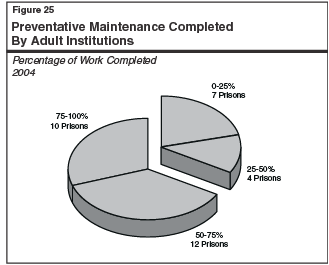
Ramifications of Poor Maintenance. The state’s failure to perform preventative maintenance is becoming a liability for CDCR as small problems grow and require more costly special repairs. For example, by not completing preventative maintenance that might have fixed the small leak on a roof, some CDCR institutions have suffered water damage to their buildings. The CDCR’s inability to complete preventative maintenance is contributing to more systems breakdowns. Eventually such breakdowns become special repairs, which are large-scale and more expensive replacements or repairs that are necessary for the continued operation of a facility.
Data we have reviewed indicate that CDCR’s adult institutions currently have a combined backlog of more than $213 million in special repairs. This is the amount of funding that would be required to complete all currently identified special repair projects needed to ensure the health and safety of facilities. As shown in Figure 26, the special repair backlog has grown by nearly $160 million over the most recent six-year period. As a result, the estimated cost of addressing the backlog has grown at an average annual rate of 37 percent (about $32 million per year) during this period.
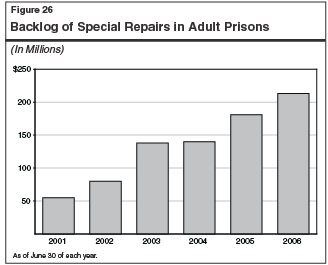
Our analysis indicates that the CDCR’s current baseline budget of $10 million for special repair projects in adult facilities is not enough to address the new projects and reduce the backlog built up over the years. With the current level of funding, the backlog would be likely to grow in 2007-08 and beyond.
The CDCR’s backlog of maintenance and repair work is partly the result of certain special factors. These include an aging prison infrastructure, sustained high levels of overcrowding facilities, and additional wear and tear on facilities from destructive acts by some inmates.
Aging Prison Infrastructure. As discussed earlier, as buildings age, the maintenance required to keep them in routine operation increases. Plumbing, electrical wiring, and other building systems degrade with age, requiring repairs or replacement. More than one-third of CDCR’s adult institutions are over 40 years old, with some much older than that. Only 3 of the state’s 33 adult institutions are less than 10 years old. Notably, most large-scale equipment, such as heating, ventilation and air-conditioning systems, and boilers, only have an approximate life span of 20 years.
Many of these aging structures are degraded beyond the normal wear and tear that would be expected due to factors such as poor maintenance or a failure to replace worn-out equipment.
Prison Overcrowding. We are advised by correctional authorities that sustained high levels of inmate overcrowding of prisons is creating additional stress on key infrastructure systems, such as water mains, sewer lines, and electrical grids. The older institutions were built to a capacity of one inmate per cell, but currently regularly house two inmates per cell. Even newer facilities designed for two persons to a cell are also housing more inmates than anticipated in such spaces as gyms and dayrooms. This situation puts stress on the plumbing and other infrastructure. For example, sewage flows in some cases have exceeded the original design capacity of treatment and collection systems.
Deliberate Destruction by Inmates. An added problem for CDCR is that some inmates are willfully destructive of their surroundings. Incidents such as blankets stuffed into toilet pipes are a daily occurrence in prisons and take up a significant amount of maintenance worker staff time.
Our analysis has found significant problems in the way that CDCR has organized and managed its responsibilities of keeping its adult institutions in good repair. These problems are aggravating the maintenance and repair problems we have identified above, contributing to a lack of preventative maintenance and the growing backlog of special repairs of its facilities.
Prisons Not Provided Guidance. Under the present system, with the exception of certain centralized duties such as maintenance of electric fences, each adult correctional institution is responsible for its own maintenance. Headquarters provides an allotment of funds to institutions for maintenance purposes, such as purchasing parts and service contracts. The warden at each correctional institution determines the use of that allotment, and facilities operations staff located at the institutions independently decide what maintenance work they will actually carry out each day. As a consequence, CDCR headquarters has in the past had no ongoing role in prioritizing the maintenance work accomplished by the institutions or in ensuring that high-priority tasks are completed.
Our analysis indicates that the lack of policy guidance from headquarters to the prisons is problematic. Clear statewide policies on protecting the state’s prison infrastructure have often been lacking. For example, individual prisons are not being provided guidance regarding when they should make a one-time investment to replace worn out equipment rather than repeatedly repairing equipment, potentially at a higher cost in funding and staff overtime.
Preventative Maintenance Not Well-Tracked or Coordinated. The state has an information technology (IT) system in place to track preventative maintenance at its adult facilities. However, our analysis indicates that, due mainly to a lack of staff, the IT system has not been used as effectively as it could be to minimize state maintenance and repair costs and to better coordinate such work.
The Statewide Automated Preventive Maintenance System (SAPMS) tracks the preventative maintenance schedules for every type of regular maintenance activity at each of the adult facilities. For example, institutional staff can use SAPMS to help determine what equipment is due for preventative maintenance during a given month. After a preventative maintenance item is completed, the institution’s maintenance staff members are to enter completed work orders into SAPMS to log the completion of that work. This data is then to be available for analysis for systemwide failures and increasingly frequent breakdowns of equipment.
However, we are advised by CDCR that headquarters currently does not have specialized staff fully trained to analyze the maintenance data generated by SAPMS in order to identify efficiencies and help improve maintenance practices. For example, by tracking data from all of the prisons, patterns of maintenance work and neglect could be detected by headquarters staff. If such analysis was being conducted, a systems failure occurring in multiple prisons could be spotted and dealt with on a systemwide basis.
Despite having an IT system that tracks preventive maintenance, CDCR does not maintain a list of equipment needing replacement. Thus, CDCR is failing to use the IT it has to minimize repair work (and the inefficient use of state resources) by tracking worn-out equipment that should be replaced rather than repaired.
Headquarters Authority Fragmented. As shown in Figure 23??, the CDCR budget provides funding for operating expenses related to prison maintenance, equipment, special repairs, and salaries for maintenance employees. All together, these funds totaled approximately $220 million in 2006-07. However, different management units within CDCR administer various components of the funding. For example, the Adult Support Division determines allocations for maintenance, while the Office of Facilities Management makes funding decisions about large special repair projects. The division of control over key asset management issues among multiple branches within CDCR has made communication and decision making about the best overall approaches to repair and replacement of facilities more difficult.
This fragmentation of authority within headquarters over the allocation of these funds undermines CDCR’s effective use of these state resources. Our analysis indicates that it has thwarted the implementation of a long-term maintenance strategy that makes smart trade-offs between investments in maintenance and repairs and the best use of staff time for these functions. This division of responsibility among multiple CDCR branches could create conflicts in asset management strategy and its execution as each branch develops its own approach.
Some Maintenance Funds Being Redirected to Other Purposes. Despite the growing backlog of special repairs, CDCR data indicate that many of the adult institutions are not spending all of their maintenance funds on maintenance. As shown in Figure 27, on average from 2001 through 2005, 16 institutions diverted more than 10 percent (roughly $4 million annually) of the budget allocations made to them specifically for operating expenses related to maintenance to nonmaintenance items. In addition, similar diversions of resources are occurring for equipment funding. Specifically, from 2000 through 2004, 22 of the 33 adult institutions diverted more than 15 percent of their equipment budgets to nonequipment expenses.
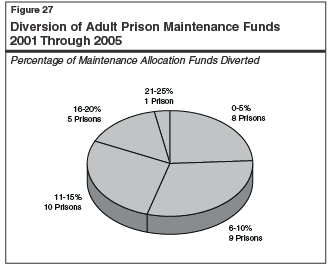
In the short run, these redirected resources are being used as a stopgap for the support of other prison operations. In discussions with department staff, we were advised that wardens sometimes view maintenance expenditures as discretionary and use maintenance funds to cover other expenses they view as more critical. However, the long-term impact of this practice is a growing backlog of maintenance and repairs.
Wardens Have Little Training or Incentive for Performing Maintenance Work. Currently, the warden at each institution is the state official chiefly responsible for maintaining the institution. However, each warden has a wide range of responsibilities from ensuring public safety to providing education programs to the inmates, with the result that maintenance of infrastructure is but one of many competing concerns. Wardens vary in their experience in maintenance or facilities operations, and some are involved only in a limited way in the maintenance process. Wardens are generally not evaluated based on their maintenance of their facilities. Our analysis suggests that these factors have contributed to an environment in which maintenance frequently has been a lower priority than other demands for prison resources.
Institution Funding Based on Outdated Allocation Formula. As noted earlier, the maintenance allotment is intended to pay for parts and contracts for preventative, corrective and deferred maintenance work. Headquarters annually determines the maintenance allotment that adult institutions will receive using a formula that is based primarily on a prison’s historical allocation. (The formula subtracts any one-time special repair project funding an institution received in the prior years, and adds one-time funding for any new special repair projects.) The basic formula does not take into account the age of the facility, its physical size, its mission, or the number of inmates it houses. In our view, this formula is outdated and does not allocate resources across the system in a way that ensures that they are used in the facilities where they are needed the most.
For example, from 2000 through 2005, based on CDCR’s historical funding formula, Pleasant Valley State Prison received an average maintenance allocation of $0.83 per square foot of facility space, while the Centinella State Prison received an average of $1.47 per square foot. This particular disparity is occurring even though the two prisons are both housing approximately the same number of maximum-security inmates, were constructed one year apart, and have nearly the same square footage of facility space. Notably, the Department of General Services, which manages more facility space than CDCR, does take into account such factors as age, mission, and size of facilities in allocating funding for maintenance.
Staffing Not Available for Preventative Maintenance Work. Each adult facility is allocated both general maintenance staff and specialized trade workers, such as locksmiths and electricians, to operate and maintain the state’s correctional infrastructure. In addition to the specialized trade workers who focus on only a limited number of projects, some maintenance workers are devoted to specific tasks that make them unavailable for other preventative or emergency maintenance. At some facilities, for example, the need for maintenance specialists for such complex tasks as water purification leaves relatively few maintenance workers available for general preventative maintenance.
Yet, it is the general maintenance workers who are chiefly responsible for accomplishing preventative maintenance tasks as well as for responding to emergency and urgent corrective maintenance demands. Those problems requiring an immediate response appear to be “crowding out” preventative maintenance work at some facilities. For example, during 2004 the staff at adult prisons responded to more than 313,000 emergency and corrective repair requests, which constituted 55 percent of all maintenance work accomplished in that year. Our analysis indicates that maintenance staff is also limited in its effectiveness by security, internal paperwork, and cumbersome parts-ordering procedures.
Our analysis indicates that the complement of plant maintenance and operations staff workers established for individual institutions is not consistent with or based upon any objective measure of their maintenance and repair needs, such as their size, age, or the mission of their facility. Moreover, as part of the redirection of resources occurring at some prisons, some institutions have purposefully held plant maintenance and operations positions vacant in order to redirect the salary from those positions to pay for the overtime pay for other, nonmaintenance, positions as well as other prison costs. As a consequence of this and other factors, the overall vacancy rate for these positions in CDCR is currently 12 percent.
Use of Inmate Labor Limited. Currently, institutions are permitted to use minimum- security inmates for maintenance work. This program was intended to allow institutions to expand their maintenance workforce at a relatively minor cost and to provide inmates with job training and good work habits that would make them less likely to return to crime after their eventual release from prison.
However, our analysis indicates that there are practical limits on this strategy. Inmates are not permitted to work on any maintenance that would bring them into contact with the facility’s security system. Frequently, inmates have no prior experience or training in plumbing or electrical work that is needed for maintenance projects. In addition, the practice of CDCR in implementing current labor agreements is to require a staff trade worker to supervise inmate maintenance workers at all times. Lockdown of prisons during security incidents, along with mandatory searches before and after work shifts to ensure tools or building materials are not stolen for use as weapons, limit the time inmate laborers are available on the job.
Some Efforts Underway Address Maintenance Problems. Notably, we are advised by CDCR that some new initiatives are beginning to attempt to improve its management of the maintenance and special repair functions. Among these efforts:
-
The department is establishing a Maintenance Services Branch within the Office of Facilities Management to improve coordination of maintenance of CDCR facilities, such as by more fully using SAPMS (previously discussed) to track maintenance activities. The department is currently proposing to staff the office (which now has four employees) through the redirection of existing positions.
-
The department intends to contract with a private firm to conduct a comprehensive assessment of the condition of its facilities and to estimate the level of funding needed by the CDCR system for deferred, preventative, and corrective maintenance.
Adjust Governor’s Request for Additional Funding. In the aggregate, the proposed $46 million augmentation in base funding for maintenance proposed in the 2007-08 budget plan amounts to roughly a 20 percent increase above current levels for the combined budget for maintenance and repair work (shown in Figure 23). Our analysis indicates that, on the whole, the administration proposal to increase the amount of state resources devoted for support of maintenance activities has merit given the estimated $20 billion value of just its adult facilities and the rapidly growing backlog of special repair projects.
For these reasons, we recommend approval of the augmentation, but with a $4 million reduction to reflect our rough estimate of the amount of funding already being provided to CDCR for maintenance that has been diverted each year by prison managers to other purposes. We believe it is appropriate for CDCR to use the spending budgeted in the past for maintenance before receiving additional money for this same purpose.
Additional Funding Should Await Demonstration of Reforms. Even with this additional level of funding, the special repairs backlog would be likely to continue to grow in 2007-08. It is also possible that the base level of funding provided for preventative maintenance may warrant adjustments in the future. However, we believe that before CDCR considers seeking further augmentations for these purposes, it should first demonstrate improvement in the way it manages and organizes its maintenance and special repairs responsibilities. We also believe that there are a number of additional actions it can take to ensure that this situation improves. We discuss a number of such approaches below.
Ensure Maintenance Funding Is Used for Maintenance. The Legislature should modify the CDCR budget to appropriate funding for prison maintenance as a separately scheduled item within the main support budget line item for CDCR, or adopt budget bill language allocating a specified amount of the department’s operating expenses and equipment funding (often referred to as OE&E) for maintenance. Either one of these changes would help to ensure that maintenance funds are spent for needed maintenance purposes, while still allowing CDCR to redirect funds to address unanticipated critical problems. Such new protections on maintenance funds could be put in place temporarily for a few years to test whether they improve CDCR’s performance in this area.
Improve Allocations Formula for Institutions. The Legislature should direct CDCR to revise the formula used by headquarters officials for allocating maintenance funding to individual prisons to account for such factors such as the age, mission, and inmate population of each institution. Such changes would help to ensure that more appropriate allocations are made to institutions. We would note that the department has advised us that it intends to allocate much of the new budget resources using a revised approach based on an assessment of prison maintenance needs. However, the department is not now proposing to change the outdated way base allocations of maintenance funds are allocated.
Improve Accountability for Maintenance at Prisons. The Legislature should modify state law to require that management audits conducted of wardens include an evaluation of the performance of wardens in the maintenance of the facilities they are managing. Existing law should require that audit findings in this area (positive or negative) be discussed in the published audit report. To ensure that resources are available for this additional auditing workload, and for other reasons, we concur in a proposal in the Governor’s budget plan to increase the budget of the Office of the Inspector General by $1.7 million at no cost to the General Fund through a redirection of funding previously allocated to CDCR.
To improve accountability for prison maintenance, the Legislature should also direct CDCR to modify the official duty statement of the Associate Warden of Business Services (AWBSs) at each prison to make these state officers responsible for overseeing the maintenance budget. While the AWBSs would continue to be under the supervision of the warden at their assigned facility, they should be directed to report regularly in a standardized format to headquarters on maintenance budget spending and be responsible for budget expenditures in this area.
Reduce Fragmentation and Strengthen Headquarters Decision Making. As we noted earlier, different units within CDCR headquarters are responsible for a variety of maintenance-related activities. The administration’s recent creation of a new branch to manage facilities maintenance is a good first step to solve organizational problems in this area. We propose that this fragmentation of duties be further reduced by moving the responsibility for the allocation of all maintenance funds from the Adult Support Division to the Office of Facilities Management. Under this arrangement, the staff responsible for dividing maintenance allotment funding among institutions would be the same staff responsible for funding special repair projects. Combining responsibility in this way would make it more likely that the department would consider the best approach in each case for prolonging the use of correctional assets.
In the past, the maintenance policy direction provided by headquarters to the institutions has been weak. The Office of Facilities Management (and its new maintenance branch) should begin to set policies on maintenance and repairs for the institutions. It could set benchmarks to assess the performance of institutions in this area, and require the development of a comprehensive plan to address the backlog of special repairs.
Under our approach, the responsibility for day-to-day maintenance decisions would remain at the institutional level while a stronger and better organized headquarters unit provides policy guidance to institutions on maintenance priorities and strategies. In addition, the Legislature should ensure that CDCR follows through on efforts to upgrade the SAPMS system and provide training to field staff so it can be used more effectively to track the progress that the institutions are making on addressing their preventative maintenance workload.
Address Maintenance Staffing Problems. Given the persistent problems in staffing of maintenance and repair functions within the prisons, the Legislature should direct CDCR to take steps to reduce the number of vacant staff positions. Specifically, the department should be directed to attempt to reduce the current 12 percent vacancy rate for maintenance employees to 9 percent by the end of 2007-08. We believe this 25 percent reduction in vacancies is an achievable first step toward resolving these staffing problems.
The administration is proposing to increase its use of inmate labor to handle some of the additional workload that would result from the proposed 2007-08 budget augmentation. However, our analysis suggests it faces difficult barriers in doing so. Accordingly, we recommend that the department be directed to develop strategies that would help to expand the inmate maintenance labor force. For example, CDCR could examine expanding the training of inmates who could assist in maintenance work and making changes in lockdown policies so that more low-security inmate trainees would be available to assist in repairs. The administration, in negotiating future collective-bargaining agreements, should revisit the current practice of requiring trade workers to supervise inmate laborers at all times. Specifically, we recommend that future agreements provide greater flexibility in the use of inmate day labor in cases where doing so would not jeopardize prison security.
Finally, should CDCR prove unable to expand the internal staffing resources to address the maintenance workload, it should explore the legal, operational, and security ramifications of contracting out more prison maintenance work. We believe contracting out additional maintenance work particularly makes sense in the current situation where there is a large, but potentially temporary, backlog of special repairs work.
Juvenile Correctional Facilities. Currently, CDCR does not track the performance of maintenance at juvenile justice facilities. The Legislature should direct CDCR to develop a strategy for incorporating its juvenile correctional facilities into the SAPMS tracking system.
Progress Report. We recommend the adoption of Supplemental Report Language requiring CDCR to include in any future budget request addressing the maintenance and special repair issues the following additional information:
-
An update on the changes being made to the headquarters organizational structure and use of information technology systems, such as SAPMS, for dealing with maintenance issues, including at juvenile facilities.
-
A description of any new policies on maintenance adopted by headquarters to provide guidance to institutions.
-
The status of implementation of a new formula for the allocation of maintenance funds, including an assessment of its initial impact on the funding allocations provided to each institution, the amount of maintenance work completed at the institutions, and any other significant effects on prison operations due to this change.
-
The department’s progress in meeting the goal we have proposed of filling at least part of the large number of vacant staff positions needed for preventative maintenance activities. The CDCR should also report on efforts to expand the inmate labor workforce and its use of contracting with outside firms to accomplish additional maintenance and repair work, including any legal, security, or operational barriers it had encountered to this approach.
-
A comprehensive plan for addressing the backlog of special repairs, and its progress in carrying out that plan.
-
Documentation of the amount of maintenance completed by institutions, with a comparison to the work completed during each of the prior three years.
In our view, this information would help the Legislature to assess whether CDCR has improved its maintenance operations and to then subsequently determine if any further changes are needed.
The Governor’s budget includes two proposals related to the management of sex offenders under parole supervision. We provide background on the state’s current practices for supervising sex offenders who are released to the community on parole, discuss recent changes in state law that are changing these practices, and outline and comment upon the administration’s efforts to implement these new laws as well as other proposed changes in the management of this group of offenders.
Sex Offenders in Prison and on Parole. State law requires offenders convicted of specified sex offenses to register their residence with local law enforcement. As of June 30, 2006, about 22,300 offenders who would otherwise be required to register for sex offenses were in prison while 9,200 who had been released to the community were under parole supervision. Of the sex offender registrants on parole, the California Department of Corrections and Rehabilitation (CDCR) estimates that about 3,300 are high-risk sex offenders (HRSOs) who require more intensive supervision based on their criminal history.
Sexual Assault Felony Enforcement Teams. Chapter 1090, Statutes of 2002 (AB 1858, Hollingsworth), authorized the creation of Sexual Assault Felony Enforcement (SAFE) teams as partnerships between local, state, and federal law enforcement agencies. The purpose of SAFE teams is to (1) proactively monitor habitual sexual offenders (defined in state law as offenders who have committed multiple specified sex offenses), (2) enforce sex offender registration requirements, and (3) collect data to determine if proactive law enforcement is effective at reducing violent sexual assault offenses. Based on our conversations with CDCR, state parole agents do not formally participate in SAFE teams, although they are occasionally involved in these activities.
Global Positioning System Technology. According to the department, about 850 of the HRSOs are supervised using Global Positioning System (GPS) technology, in which HRSOs are required to have an electronic monitoring device on their person at all times. Different types of GPS technology are used for this purpose by parole and probation offices. “Active” GPS units provide nearly instantaneous information on the location of a monitored parolee. “Passive” GPS, on the other hand, provides information to parole agents on the location of monitored parolees less frequently, usually a couple of times a day. Active GPS units are more expensive than passive units.
Recent Changes to State Laws Regarding Sex Offenders. The Legislature and voters enacted several new laws related to sex offenders in 2006. We describe a few of the major new measures below.
-
Chapter 336, Statutes of 2006 (SB 1178, Speier). Chapter 336 requires all sex registrants to undergo a risk assessment. Sex offender registrants found to be at high risk to reoffend would be subject to electronic monitoring.
-
Chapter 337, Statutes of 2006 (SB 1128, Alquist). Among other things, Chapter 337 requires longer prison sentences for certain sex offenders, risk assessment for all sex offender registrants, expanded criteria by which a sex offender can be committed to a state mental hospital under the Sexually Violent Predator (SVP) law, and the creation of a pilot program to provide sex offender treatment for HRSOs while they are in prison, subject to the appropriation of funds.
-
Proposition 83: “Jessica’s Law.” Proposition 83 (titled Jessica’s Law by its proponents) was passed by voters in November 2006. It requires longer prison sentences for certain sex offenders, GPS monitoring for felony sex offenders for life, restrictions on where sex offender registrants can live, and changes to the SVP law expanding the criteria by which an offender can be committed to a state mental hospital for an indeterminate period.
-
Chapter 338, Statutes of 2006 (AB 1015, Chu). Chapter 338 creates the Sex Offender Management Board within CDCR to assess the department’s current sex offender management practices and provide recommendations to the Legislature on ways to improve current management practices.
HRSO Task Force. In May 2006, the Governor issued an executive order creating the HRSO Task Force that was assigned to provide the administration and Legislature with recommendations for improving CDCR policies related to the supervision and placement of HRSOs in local communities. In August 2006, the task force issued its findings and ten recommendations. These recommendations include (1) using procedures to uniformly assess the risk to the public posed by individual sex offenders; (2) providing in-prison sex offender treatment for HRSOs; (3) notifying victims, law enforcement agencies, and communities prior to the release of HRSOs from prison; and (4) supervising HRSO parolees using the “containment model” approach. The containment model involves supervision by specially trained agents, treatment, polygraph testing, and advocacy for victims of sex offenders.
The Governor’s 2007-08 budget includes two proposals related to the supervision and treatment of sex offenders. The first proposal, referred to in the budget plan as a sex offender management package, consists of a series of funding requests to implement the new state laws discussed above. The second proposal is designed to implement the recommendations of the High Risk Sex Offender Task Force. In total, these two proposals request about $30 million from the General Fund in the current year, growing to almost $123 million in the budget year. Figure 28 summarizes both proposals, which we discuss in more detail to follow.
|
|
|
Figure 28
Governor's Budget Proposals Related to Sex
Offenders |
|
(In Millions) |
|
Component |
2006‑07 |
2007‑08 |
|
Sex Offender Management |
|
|
|
Active GPS monitoringa |
$15.5 |
$35.2 |
|
Passive GPS monitoringa |
8.8 |
33.4 |
|
Risk assessments of parolees |
1.8 |
4.1 |
|
Processing of SVPb
cases |
4.3 |
4.0 |
|
Sex Offender Management Board |
— |
0.6 |
|
Subtotals |
($30.4) |
($77.3) |
|
High Risk Sex Offender Task Force |
|
|
|
Sex offender treatment for parolees |
— |
$42.7 |
|
Polygraph testing |
— |
1.7 |
|
Parole agent training |
— |
0.6 |
|
Parole agents for SAFEb
teams |
— |
0.4 |
|
Data and contract management |
— |
0.2 |
|
Subtotal |
— |
($45.6) |
|
Totals, Both Components |
$30.4 |
$122.9 |
|
|
|
a Includes findings
for smaller parole caseloads. |
|
b SVP: Sexually
Violent Predators; SAFE: Sexual Assault Felony Enforcement. |
|
Detail may not
total due to rounding. |
|
|
Sex Offender Management. The CDCR budget plan requests about $30 million and 180 positions in the current year, growing to $77 million and 311 positions in the budget year, to implement the new laws related to sex offenders. The four components of this proposal are described below.
-
GPS Supervision and Smaller Parole Caseloads. The department proposes to supervise all sex offender registrants on parole using GPS technology. The budget request includes funding to monitor all HRSOs with active GPS units and all other sex registrants on parole with passive GPS technology. Additionally, the department requests additional parole agents to supervise sex offenders on reduced caseloads in order to allow agents to supervise these parolees more closely, as well as monitor GPS data on a daily basis. The department proposes to establish parole agent caseloads of 20 HRSOs per parole agent, as well as 40 non-HRSO sex registrants per parole agent. Currently, HRSOs not supervised with GPS are on 40 registrants-to-1 agent caseload, and non-HRSOs are on 70 to-1 caseloads.
-
Risk Assessments of Parolees. The CDCR requests funding to conduct risk assessments of all sex offender registrants prior to release from prison, as well as twice annually while under parole supervision. These evaluations will be used to identify which parolees should be designated as HRSOs. The department’s request also includes funding to provide risk-assessment training to all parole agents.
-
Processing of SVP Cases. Chapter 337 and Jessica’s Law expand the criteria for an offender to be found to be an SVP. Consequently, CDCR requests additional resources to review the criminal history of more inmates nearing their release from prison to determine which meet the new SVP eligibility criteria.
-
Sex Offender Management Board. This proposal includes three staff positions for the newly established Sex Offender Management Board.
We also note that the budget for the Department of Mental Health (DMH) includes $28 million General Fund in the current year and $25 million General Fund in the budget year over the revised current-year budget request to phase in changes in the SVP commitment laws. In particular, the law will increase the number of inmates eligible for commitment to state mental hospitals, thereby requiring DMH to screen, evaluate, and ultimately house more SVPs than under prior law.
Implementation of Task Force Proposals. The CDCR budget includes $46 million and six new staff positions in the budget year to implement recommendations of the High Risk Sex Offender Task Force. This proposal has the following five components:
-
Sex Offender Treatment for Parolees. The department requests resources to contract for sex offender treatment for HRSOs. The department proposes to require these offenders to participate in individual therapy once per month and group therapy twice per week.
-
Polygraph Testing. The department proposes to contract for twice annual polygraph testing of HRSOs. Polygraph testing is designed to assist treatment providers and parole agents by eliciting more honest information that facilitates treatment, ensures the appropriate classification of parolees, assists in the establishment of appropriate parole conditions, and determines ongoing compliance with those parole conditions and state law.
-
Parole Agent Training. This proposal includes funding on an ongoing basis to train all parole agents on the containment model for the supervision of HRSOs.
-
Assignment of Parole Agents to SAFE Teams. The CDCR requests four new parole agent positions to act as liaisons between the department and SAFE teams in each of the department’s four parole regions. According to the department, these agents will perform such duties as (1) assisting SAFE team investigations by sharing data, (2) participating in SAFE team efforts to apprehend sex offenders who have failed to register with local law enforcement, and (3) acting as the department’s liaison to victims and victim’s advocacy groups.
-
Data and Contract Management Positions. The proposal includes two additional positions in headquarters to oversee, coordinate, and otherwise manage (1) parolee sex offender data and (2) the state’s contracts for treatment, polygraph testing, and GPS equipment.
We find that the administration’s proposals are largely consistent with new state laws, as well as recommendations of the HRSO Task Force and our office. However, we also find that the proposal for implementing new laws in this area does not include a plan for rollout of GPS monitoring and is overbudgeted, as discussed in more detail below.
Proposals Generally Consistent With New Laws. We find that the administration’s proposals meet the requirements of the new sex offender laws enacted by the Legislature and voters. This includes proposals related to expanding the SVP criteria, monitoring all parolee sex registrants with GPS technology, conducting risk assessments, and creating the Sex Offender Management Board.
We also note that the recommendations of the HRSO Task Force are largely consistent with previous recommendations by our office to implement the containment model approach to managing the sex offender population on parole. (See
“A ‘Containment’ Strategy for Adult Sex Offenders on Parole”
in the Analysis of the 1999-00 Budget Bill.) At that time, we concluded that the containment model offered a cost-effective way to supervise sex offenders on parole and reduce the likelihood that these offenders would commit new offenses or parole violations and return to prison.
Funding Not Included for Some Components. This proposal does not include funding for two provisions in the newly enacted laws. Chapter 337 provides for the establishment and operation of a pilot program to test an in-prison sex offender treatment program subject to the availability of funds. The Legislature previously approved one-time funding of $50,000 in the current year to study sex offender treatment programs nationwide and design such a program for CDCR. Our analysis indicates that the establishment of in-prison treatment could improve the outcomes of participating offenders after release to parole, as well as reduce the likelihood that some will be committed to state mental hospitals under the SVP law. Implementation of a successful program could thus significantly reduce state costs in the long term. Nevertheless, no funding is provided to implement the pilot program in the Governor’s 2007-08 budget plan.
In addition, the department has not requested any resources to implement the residency restrictions required under Jessica’s Law. Specifically, Jessica’s Law bars any person required to register as a sex offender from living within 2,000 feet (about two-fifths of a mile) of any school or park. Based on our conversations with the department, it is still developing its implementation plan. It is unclear at this time whether this plan will require any additional funding to implement this provision of Proposition 83.
No Implementation Plan for Rollout of GPS Tracking. The department’s budget request assumes that all GPS devices will be acquired and all new parole agents will be hired by July 1, 2007. However, based on our conversations with the department, it is unlikely that the department will be able to implement GPS monitoring for 9,200 parolees in the budgeted timeframe, primarily because of the time necessary to hire and train parole agents and supervisors who will be supervising the sex offender population. The CDCR has informed our office that it is currently in the process of developing an implementation plan for GPS monitoring.
Technical Adjustments Needed. Based on our review of the details of the Sex Offender Management proposal, we find that the following components of the proposal are overbudgeted.
-
Parole Office Space. The department is requesting $9.8 million in the budget year to provide office space for the additional 157 parole agents that will need to be hired to monitor sex offenders wearing GPS devices. However, the administration’s budget also includes a policy change to require early discharge from parole supervision for some low-level offenders. We estimate that this latter proposal would reduce the number of parole agents by about 381 in the budget year. Therefore, should the Legislature approve the administration’s discharge policy proposal, it should reject the requested funding for additional parole office space.
-
Active GPS. The department is requesting a total of 102 new parole agents to supervise the HRSO population on GPS. However, we calculate that the department will only require on a workload basis an additional 71 positions for this purpose, resulting in the request being overbudgeted by $3.2 million. In addition, CDCR’s budget request assumes that the cost for GPS units will increase by $4 per day (36 percent) since the current year, yet provides no justification for this level of increase. Consequently, we find that this component of the request is overbudgeted by $3.1 million.
-
Risk Assessments. The department is requesting $1.6 million and 21 positions to conduct risk assessments of sex offenders prior to release from prison. The CDCR’s request does not include any workload estimate to justify this level of expenditures. We estimate that the actual resources required are two positions and $154,000.
We recommend approval of the proposal to establish the containment model approach to managing the sex offender population on parole consistent with recommendations of the High Risk Sex Offender Task Force. We withhold recommendation on the administration’s sex offender management proposal because the administration has not provided its implementation plan for Global Positioning System monitoring. Should the Legislature ultimately approve funding for the sex offender management request, we recommend reductions of $18 million related to various technical adjustments.
Below, we offer our recommendations regarding the Governor’s package of proposals to implement the HRSO Task Force proposals as well as to implement recent changes in state law in this area. We also offer our recommendation in regard to one aspect of the recent legislation that is not addressed in the Governor’s budget package.
Approve Proposal to Implement Task Force Recommendations. We recommend that the Legislature approve the requested funding to implement the HRSO Task Force recommendations based on our previous findings that the containment model approach is a cost-effective way to supervise sex offenders on parole.
Implementation of New Laws Requires a Realistic Plan. We withhold recommendation on the sex offender management components of the administration budget proposal because the department has not completed an implementation plan for the rollout of GPS monitoring. Moreover, CDCR is unlikely to be able to implement its expanded GPS program by July 1, 2007, as the budget request assumes. Based on these findings, we believe it would make sense for the Legislature to require the department to provide a more realistic implementation plan and to reduce CDCR’s budget request accordingly.
Should the Legislature approve funding to implement new sex offender laws, we recommend total reductions of $18 million in the budget year related to the various technical adjustments described above.
Use Part of Savings for In-Prison Treatment Pilot Program. In our past analysis on the supervision and management of sex offenders on parole, we recommended—as did the HRSO Task Force—the creation of a pilot treatment program for sex offenders in prison. We estimate that a pilot program for a few hundred inmates would cost as much as several million dollars annually when fully implemented but could, if successful, significantly reduce state costs in the long term for the reincarceration of sex offenders and for the commitment of SVPs to state hospitals. Accordingly, we recommend that the Legislature use a portion of the savings from the technical adjustments to the sex offender management request to create an in-prison sex offender treatment program.
We withhold recommendation on capital outlay proposals for new mental health beds and a support proposal for increases in compensation for dental clinicians because pending federal court decisions could result in significant modifications of these proposals.
Budget Proposal. The Governor’s 2007-08 budget plan includes a number of new proposals related to compliance with federal court orders and settlement agreements relating to the health care of state inmates. Among these proposals are the following budget requests:
-
About $3.6 million for preliminary plans for 50 mental health crisis beds at the California Men’s Colony (CMC). The project, which has an estimated total project cost for all phases of about $56 million, and a cost of more than $1.1 million per bed, relates to implementation of a settlement in Coleman v. Schwarzenegger over the adequacy of mental health services provided to inmates.
-
$426,000 for facility improvement to allow the temporary establishment of ten psychiatric service unit beds at the California Institution for Women (CIW). This proposal, with a total estimated cost of $4.5 million, is also related to the Coleman case.
-
About $19 million in the current year and $58 million in the budget year to increase salaries for various dental clinicians. This proposal is to help implement the settlement of Perez v. Tilton regarding the adequacy of dental services provided to inmates.
Action on Proposals Premature. Without prejudice to the possible merit of these proposals, we believe legislative action on them is premature until the federal courts have issued further orders in the Coleman and Perez cases.
In the Coleman case, a federal court decision is pending regarding how many additional new mental health beds should be built in the adult prison system as well as their locations. A proposed mental health bed plan released by the California Department of Corrections and Rehabilitation (CDCR) in late January proposed the establishment of more than 4,000 new beds, including new beds at CMC and CIW. (Although CDCR has not provided the Legislature with estimates of the overall cost of this effort, the more than $1.1 million per bed cost of the CMC project suggests this would be a very expensive undertaking.) However, the court had not yet acted on the CDCR plan at the time this analysis was prepared.
In the Perez case, the court has been considering whether to order increases in compensation for dental staff at the prisons in order to address persistent difficulties in recruiting and retaining such clinicians. However, the court had not acted at the time we reviewed this budget request. The administration has indicated the request is meant to be a placeholder until final court action has been taken, at which time it intends to adjust the level of funding that has been requested for this purpose.
Once further court decisions have been issued in both of these cases, the 2007-08 budget requests related to these health care issues could require significant adjustments.
Analyst’s Recommendation. We withhold recommendation on these proposals at this time and will comment once the federal courts have taken further actions in these cases.
We find that several factors have caused or are likely to cause employee compensation costs in the California Department of Corrections and Rehabilitation to increase significantly. These factors include (1) pay and benefit increases for correctional officers under a now-expired labor agreement (including a recent binding arbitration decision raising correctional officers’ compensation retroactively to 2005-06) and (2) federal court orders increasing pay for clinicians and staff of the prison health care system. Negotiations on a new correctional officer agreement continue.
We discuss the issues surrounding pay increases for employees of the California Department of Corrections and Rehabilitation in the Employee Compensation section of the “General Government” chapter.
Return to Judicial and Criminal Justice Table of Contents,
2007-08 Budget Analysis