
|
Analysis of the 2005-06 Budget BillLegislative Analyst's Office
|
Currently, the state has no student fee policy. Instead of making fee decisions based upon an explicit agreement as to share of cost or an assessment of other specified factors (such as fee levels at similar institutions), the state has made fee decisions based almost entirely on the state's fiscal situation—raising fees in bad fiscal times and lowering them in good fiscal times. Given the recent volatility in fee levels and disparity in cost burden among student groups over time, both the Governor and Legislature worked in 2004-05 to develop a state fee policy. Despite these efforts, fee legislation was not enacted. We continue to recommend the state adopt a fee policy that designates explicit share-of-cost targets. This policy then could be used to guide annual fee decisions.
Below, we describe the Governor's fee agreements with the University of California (UC) and the California State University (CSU), identify our concerns with them, and list the Governor's specific budget-year fee proposals. We then describe a share-of-cost fee policy and illustrate how the Legislature could use this policy to make its budget-year fee decisions. Next, we discuss the Governor's treatment of new fee revenue—treatment that is inconsistent with general budgeting standards—and highlight a technical budgeting error related to excess-unit fee revenue. We conclude with a discussion of community college fees.
Figure 1 shows, in inflation-adjusted dollars, student fees as a share of total education support costs. During the early 1990s recession, students' average share of cost increased notably—peaking between 1993 and 1995. Undergraduates at UC, for example, were paying 21 percent of their total education costs in 1994-95 compared to 10 percent in 1990-91. Similarly, California Community College (CCC) students were paying 13 percent of their total education costs in 1993-94 compared to 3 percent three years earlier.
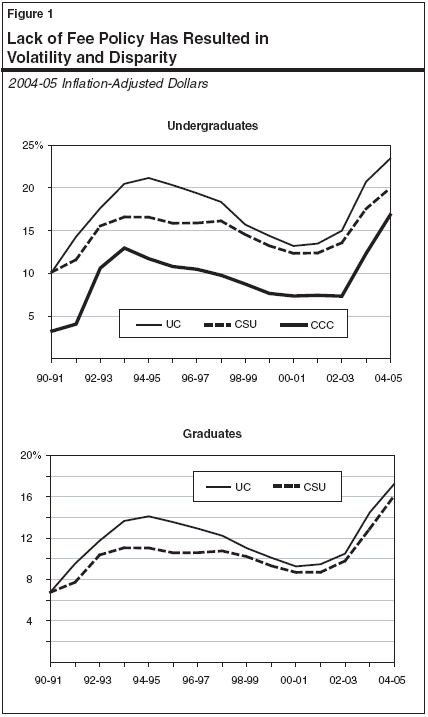
Students' average share of cost declined for the next six to seven years. For example, CSU undergraduates' share of cost fell from 17 percent in 1994-95 to 12 percent in 2001-02. Students' share of cost, as well as fee levels themselves, declined despite increases in education costs, burgeoning financial aid opportunities, a strong economy, and a nationwide trend toward higher fees. Fees declined despite California's public institutions charging much less than similar public institutions. At the same time, California was the only state in the country that was not maximizing its receipt of federal Pell Grant monies and one of few states not maximizing federal tax credit benefits.
Since 2001-02, students' share of cost for both undergraduates and graduate students has increased at all three segments. Despite these increases, students' share of cost remains small, fee levels still are low compared to similar institutions, and California continues not to maximize its receipt of federal financial aid funding.
Partly because of this recent volatility in fees, the Legislature passed a major fee bill in 2004 (AB 2710, Liu). Though the bill was vetoed, it represented a significant step toward developing a state fee policy. (Please see the nearby gray box for a summary of the bill.)
The Governor's compact with UC and CSU, which is not binding on the Legislature but which he nonetheless uses for budgeting purposes, contains the following components.
Legislature Tried to Enact Fee Policy During Last SessionIn the 2004 session, the Legislature passed a fee policy, AB 2710 (Liu), which the Governor vetoed. Assembly Bill 2710 included three primary policy guidelines, which, in many respects, echoed former state fee policies.
Assembly Bill 2710 was distinct from earlier state fee policies in that it suggested share-of-cost targets. Undergraduate fees were not to exceed 40 percent of overall education costs at the University of California (UC) and 30 percent of overall costs at the California State University (CSU). To this end, students' share of cost was to be calculated annually and presumably incorporated into fee-setting discussions. The Governor vetoed the bill because he felt it was "inconsistent" with the provisions of his compact with UC and CSU. |
We have three major concerns with the Governors' fee agreements with UC and CSU.
No Rational Basis for Determining UC and CSU Undergraduate Fees. The Governor's agreement assumes the 2003-04 fee was the "right" fee for UC and CSU and hereafter merely needs to be adjusted annually consistent with families' ability to pay. Given UC and CSU's 2003-04 undergraduate fee levels were (1) the lowest of all their public comparison institutions, (2) substantially beneath the comparison-institution average (20 percent lower at UC and 51 percent lower at CSU), and (3) represented a small share of total education cost (26 percent of total education costs at UC and 21 percent at CSU), it is unclear why the state would want to essentially lock them in place.
No Rational Institutional Aid Policy. The Governor's agreement allows the segments broad discretion to budget for institutional aid without any associated expectation that they justify their decisions. That is, the Governor's agreement does not require the segments to document their need and identify the amount required to cover it—seemingly disregarding even the most basic budgeting standards. Moreover, the segments are effectively granted authority to augment their institutional aid programs without the typical state-level discussion of competing priorities (whether it be the Cal Grant program, other higher education priorities, or other state priorities). Please see the nearby box for a more detailed discussion of our concerns with the segments' institutional aid set aside.
Treatment of New Fee Revenue Translates Into Autopilot Budgeting. Perhaps the most significant problem with the Governor's compact is its treatment of new fee revenue. In contrast to past practice, the Governor's budget proposal does not consider new fee revenue as available to meet needs identified in the state budget. Instead, the Governor's compact would fund all identified budgetary needs entirely with General Fund support, allowing the segments to use all their new fee revenue for whatever additional purposes they deemed worthwhile. This approach allows the segments routinely to receive significantly more total revenue than is needed to cover the normal cost increases resulting from enrollment growth and inflation.
The Governor's budget contains several fee proposals. The justification given for these proposals is that they are consistent with his compact with UC and CSU. The major fee proposals are to increase:
Total nonresident charges at UC and CSU would increase due to these proposed increases in resident fees, which essentially represent base charges for nonresident students. In addition, for UC undergraduates, the budget assumes nonresident tuition (which essentially represents a supplemental charge) would increase by 5 percent. Figure 2 compares 2004-05 undergraduate and graduate fee levels with the proposed 2005-06 levels, and Figure 3 provides comparable information for professional school fees.
|
Summary of Governor's |
||||
|
(Systemwide Charges for Full-Time Students a) |
||||
|
|
2004‑05 |
2005‑06 Proposed |
Change |
|
|
Amount |
Percent |
|||
|
University of California |
|
|
|
|
|
Resident Charge |
|
|
|
|
|
Undergraduates |
$5,684 |
$6,141 |
$457 |
8% |
|
Graduates |
6,269 |
6,897 |
628 |
10 |
|
Nonresident Charge |
|
|
|
|
|
Undergraduates |
$22,640 |
$23,961 |
$1,321 |
6% |
|
Graduates |
21,208 |
21,858 |
650 |
3 |
|
California State University |
|
|
|
|
|
Resident Charge |
|
|
|
|
|
Undergraduates |
$2,334 |
$2,520 |
$186 |
8% |
|
Teacher education students |
2,706 |
2,922 |
216 |
8 |
|
Graduates |
2,820 |
3,102 |
282 |
10 |
|
Nonresident Charge |
|
|
|
|
|
Undergraduates |
$12,504 |
$12,690 |
$186 |
1% |
|
Graduates |
12,990 |
13,272 |
282 |
2 |
|
California Community Colleges |
|
|
|
|
|
Resident chargeb |
$780 |
$780 |
— |
— |
|
Nonresident chargec |
4,470 |
4,530 |
$60 |
1% |
|
a Reflects only systemwide charges. Does not include campus-based fees. |
||||
|
b Reflects $26 per unit charge. |
||||
|
c Nonresident students are charged on a per-unit basis (as are resident students). In 2004‑05, the nonresident per-unit rate was $149. This rate is projected to increase to $151 in 2005‑06. |
||||
|
Summary of Governor's |
||||
|
(Systemwide Charges for Full-Time Students a) |
||||
|
|
2004‑05 |
2005‑06 |
Change |
|
|
Amount |
Percent |
|||
|
University of California |
|
|
|
|
|
Resident Charge |
|
|
|
|
|
Business/management |
$19,324 |
$20,368 |
$1,044 |
5% |
|
Law |
19,113 |
20,150 |
1,037 |
5 |
|
Medicine |
18,513 |
19,532 |
1,019 |
6 |
|
Dentistry |
18,024 |
19,029 |
1,005 |
6 |
|
Veterinary medicine |
16,029 |
16,974 |
945 |
6 |
|
Optometry |
14,139 |
15,027 |
888 |
6 |
|
Pharmacy |
14,139 |
15,027 |
888 |
6 |
|
Theater, film, and television |
11,249 |
12,051 |
802 |
7 |
|
Nursing |
8,389 |
9,105 |
716 |
9 |
|
Public health |
6,269 |
10,092 |
3,823 |
61 |
|
New programsb |
6,269 |
10,092 |
3,823 |
61 |
|
Nonresident Charge |
|
|
|
|
|
Business/management |
$31,569 |
$32,613 |
$1,044 |
3% |
|
Law |
31,358 |
32,395 |
1,037 |
3 |
|
Medicine |
30,758 |
31,777 |
1,019 |
3 |
|
Dentistry |
30,269 |
31,274 |
1,005 |
3 |
|
Veterinary medicine |
28,274 |
29,219 |
945 |
3 |
|
Optometry |
26,384 |
27,272 |
888 |
3 |
|
Pharmacy |
26,384 |
27,272 |
888 |
3 |
|
Theater, film, and television |
23,494 |
24,296 |
802 |
3 |
|
Public health |
20,963 |
22,337 |
1,374 |
7 |
|
New programsb |
20,963 |
22,337 |
1,374 |
7 |
|
Nursing |
20,634 |
21,350 |
716 |
3 |
|
Hastings College of the Law |
|
|
|
|
|
Resident charge |
$18,750 |
$19,725 |
$975 |
5% |
|
Nonresident charge |
30,950 |
30,950 |
— |
— |
|
a Reflects only systemwide charges. Does not include campus-based fees. In 2004‑05, average campus-based fees ranged from $1,199 in public health programs to $4,101 in the veterinary medicine program. |
||||
|
b Public health, public policy, and international relations and pacific studies. |
||||
Institutional Aid Decisions Need Better JustificationAs we have discussed in previous years, we do not think the state (or the segments) should budget for institutional financial aid by setting aside an arbitrary percentage of new fee revenue. This set-aside approach has no rational policy basis and has resulted in funding levels that are disconnected from identified needs. For example, between 2002-03 and 2003-04, the state augmented the Cal Grant Entitlement program by $88 million (or 37 percent) to cover enrollment growth and undergraduate fee increases at the University of California (UC) and the California State University (CSU). Despite providing financial aid increases sufficient to offset costs through the Cal Grant program, UC and CSU's own undergraduate institutional aid budgets increased $130 million (or 54 percent) due to set asides from fee increases. It is unclear what financial aid purposes were served by the set-aside funds that were not explicitly addressed by the Legislature through its Cal Grant funding decisions. The fee set-aside approach also disregards basic budgeting standards for accountability and hinders legislative oversight. For example, when asked for information about the institutional aid set aside, the segments could estimate neither the number of need-based institutional aid recipients nor the average institutional aid award for the prior, current, or budget years. In lieu of this approach, we continue to recommend the elimination of fixed percentage fee set asides. Instead, the segments should be required to provide the Legislature with evidence of their student aid needs and justification for any requested augmentation. In the absence of better information or more sophisticated forecasting tools, we recommend the Legislature address any shortfalls in undergraduate financial aid by augmenting the Cal Grant program (sufficient to cover enrollment growth and fee increases, as is longstanding practice). Since the Cal Grant program does not address graduate financial need, it would be appropriate for the Legislature to consider providing additional resources to the segments in this area, given growth in graduate students and proposed graduate fee increases. (For additional detail about the segments' institutional aid programs and the set-aside approach, please see "The Institutional Aid Set Aside," 2004-05 Analysis of the Budget Bill, pages E-228 to E-233.) |
We recommend the state adopt a fee policy for the University of California, California State University, and California Community Colleges that sets certain targets for the share of education cost to be paid by students.
To address the problems with the state's existing fee-setting practices and the Governor's fee agreements with the segments, we recommend the state adopt a share-of-cost fee policy. Most importantly, a share-of-cost fee policy would provide both an underlying rationale for fee levels and a mechanism for annually assessing these levels. In doing so, it would promote clear expectations about fee levels and consistent treatment of student cohorts over time. It also would create incentives for students to hold the segments accountable for keeping costs low and quality high, and it would formally recognize the private as well as public benefits of higher education.
Promotes Clear Expectations and Consistent Treatment. A share-of-cost fee policy would make explicit the share of total education costs that nonfinancially needy students would be expected to bear. (Financially needy students meeting certain academic and age criteria would continue to receive aid sufficient to cover education fees.) Once the share-of-cost target was achieved, it would be maintained over time. For example, if nonneedy UC undergraduates were expected to pay 40 percent of their total education costs, fees would be adjusted annually such that students continued to pay 40 percent of total costs (without the need to rely upon any specific inflationary index). The central advantages of this approach are that nonneedy students would have clear expectations about the share of cost they would be expected to bear and student cohorts would be treated consistently over time.
Strengthens Accountability. A share-of-cost fee policy would link fee levels to total education costs. As costs increased, fees would increase along with them. In other words, a portion of any increase in the cost of education would be automatically passed on to nonneedy students in the form of higher fees. Students and their families, therefore, would have a much greater incentive to hold their campuses accountable for keeping costs low and quality high.
Formally Recognizes That Higher Education Is Shared Responsibility With Shared Benefits. The fee policies the state adopted in 1985 and 1990 both indicated that higher education should be a shared responsibility among students and the state. A share-of-cost fee policy explicitly recognizes the private returns of higher education by asking nonneedy students to contribute some portion toward their education costs. Clearly, individuals receive significant private benefits from higher education. Although establishing causality is difficult, a high correlation exists between level of education and personal earnings. For example, compared to those with only a high school education, the median earnings for adults with an associate degree is 22 percent higher. The median earnings for adults with a baccalaureate degree is 62 percent higher, and the median earnings of professional degree-holders is more than 200 percent greater. Unsurprisingly, higher education institutions across the country commonly use potential earnings (one key measure of private benefits) to determine appropriate cost-sharing arrangements.
Other Factors Might Be Considered to Provide Fuller Context. Although we think an explicit share-of-cost target would be the simplest, most consistent, and most defensible factor to use in setting and adjusting fees, the Legislature might want periodically to consider fee levels in the context of other factors—including fees at comparison institutions, the quality of specific education programs, the need for additional workers in particular occupations, and federal financial aid policies. This periodic review would help the Legislature better assess how well the share-of-cost fee policy was meeting various policy objectives.
We recommend the Legislature assess the Governor's budget-year fee proposals in light of their effect on students' share of cost. In most cases, the proposals would make at least some progress toward the share-of-cost targets specified in AB 2710 (Liu).
Below, we assess each of the Governor's fee proposals.
Increasing Resident Undergraduate Fees by 8 Percent Progresses Toward AB 2710 Share-of-Cost Targets. Figure 4 shows resident fees as a percent of total operating costs for each of the three segments. As the figure shows, UC and CSU's proposed fee increases for resident undergraduates would increase students' share of total cost slightly. While the share of cost at UC and CSU would remain below the targets specified in AB 2710, some progress would be made toward eventually reaching them.
|
Resident Fees as a Share of Total Education Costs |
|||
|
|
2003‑04 |
2004‑05 |
2005‑06 |
|
Undergraduates |
|
|
|
|
University of California (UC) |
|
|
|
|
Cost of education |
$19,144 |
$19,859 |
$20,087 |
|
Resident fees |
4,984 |
5,684 |
6,141 |
|
Fee as a percent of cost |
26.0% |
29.0% |
31.0% |
|
California State University (CSU) |
|
|
|
|
Cost of education |
$9,699 |
$10,312 |
$10,601 |
|
Resident fees |
2,046 |
2,334 |
2,520 |
|
Fee as a percent of cost |
21.0% |
23.0% |
24.0% |
|
California Community Colleges |
|
|
|
|
Cost of education |
$4,343 |
$4,698 |
$4,883 |
|
Resident fees |
540 |
780 |
780 |
|
Fee as a percent of cost |
12.4% |
16.6% |
16.0% |
|
Graduates |
|
|
|
|
UC |
|
|
|
|
Cost of education |
$28,716 |
$29,788 |
$30,130 |
|
Resident fees |
5,219 |
6,269 |
6,897 |
|
Fee as a percent of cost |
18.0% |
21.0% |
23.0% |
|
CSU |
|
|
|
|
Cost of education |
$14,549 |
$15,468 |
$15,902 |
|
Resident fees |
2,256 |
2,820 |
3,102 |
|
Fee as a percent of cost |
16.0% |
18.0% |
20.0% |
Undergraduate Fees Would Remain Low Relative to Comparison Institutions. The proposed resident undergraduate fee increases likely would not affect UC and CSU's ranking compared to similar institutions. As Figure 5 shows, of UC's four public comparison institutions, only the State University of New York, Buffalo campus had a lower fee level in 2004-05. The UC undergraduate rate was more than $1,000 below the average of its public comparison institutions. Assuming fees at the comparison institutions increase in 2005-06 at the same average rate they increased last year, the UC undergraduate rate would remain more than $1,000 below the comparison-institution average. At CSU, even with the proposed 8 percent fee increase, its fee would very likely remain the lowest of all its public comparison institutions and only about one-half of the average of these comparison institutions.
|
UC and CSU's Resident Undergraduate Fees |
||
|
|
2004‑05 |
2005‑06 |
|
UC and Its Public Comparison Institutions |
||
|
University of Michigan |
$8,722 |
$9,323 |
|
University of Illinois |
7,944 |
8,491 |
|
Average |
7,341 |
7,846 |
|
University of Virginia |
6,790 |
7,258 |
|
UC |
6,312 |
6,769 |
|
State University of New York |
5,907 |
6,314 |
|
CSU and Its Public Comparison Institutions |
||
|
Rutgers University |
$8,869 |
$9,652 |
|
University of Maryland, Baltimore |
8,020 |
8,728 |
|
University of Connecticut |
7,490 |
8,151 |
|
Cleveland State University |
6,618 |
7,202 |
|
State University of New York, Albany |
6,383 |
6,946 |
|
University of Wisconsin, Milwaukee |
5,835 |
6,350 |
|
Wayne State University |
5,819 |
6,333 |
|
Average |
5,656 |
6,155 |
|
Illinois State University |
5,588 |
6,081 |
|
George Mason University |
5,448 |
5,929 |
|
University of Texas, Arlington |
5,093 |
5,543 |
|
North Carolina State University |
4,260 |
4,636 |
|
University of Colorado, Denver |
4,160 |
4,527 |
|
Georgia State University |
4,154 |
4,521 |
|
Arizona State University |
4,066 |
4,425 |
|
University of Nevada, Reno |
3,034 |
3,302 |
|
CSU |
2,916 |
3,102 |
|
a Reflects Governor's budget proposals for UC and CSU. For comparison institutions, adjusts 2004‑05 fee levels by the average prior-year growth rate (6.9 percent for UC's comparison institutions and 8.8 percent for CSU's comparison institutions). |
||
Increasing Graduate Fees by 10 Percent Makes Slight Progress Toward Target Differential. As shown in Figure 4, the graduate fee proposal would result in slight increases in graduate students' share of cost. These shares, however, would remain quite low. For example, even with a 10 percent fee increase, nonneedy graduate students at CSU would be bearing only one-fifth of their total support costs. Moreover, graduate students' share of cost would remain below that of undergraduates. It is unclear why the state would ask nonneedy undergraduates to bear a larger share of their education cost than nonneedy graduate students.
Graduate Fees Likely to Remain Lowest of Comparison Institutions. In addition, UC and CSU's graduate fees are even further below their comparison institutions (in both dollar and percentage terms) than undergraduate fees. The CSU 2004-05 rate, for example, is approximately $600 lower than the next lowest comparison institution and $4,300 less than the average of the comparison institutions. As Figure 6 shows, UC and CSU's graduate fees currently are the lowest of all their comparison institutions, and, even with the proposed 2005-06 fee increases, would very likely remain the lowest.
|
UC and CSU'S Resident Graduate Fees |
||
|
|
2004‑05 |
2005‑06 |
|
UC and Its Public Comparison Institutions |
||
|
University of Michigan |
$13,585 |
$15,204 |
|
Average |
10,138 |
11,346 |
|
State University of New York |
9,455 |
10,582 |
|
University of Virginia |
9,200 |
10,296 |
|
University of Illinois |
8,310 |
9,300 |
|
UC |
7,928 |
8,556 |
|
CSU and Its Public Comparison Institutions |
||
|
University of Maryland, Baltimore |
$13,500 |
$15,466 |
|
Rutgers University |
10,846 |
12,425 |
|
Wayne State University |
9,978 |
11,431 |
|
Cleveland State University |
9,308 |
10,663 |
|
State University of New York, Albany |
8,949 |
10,252 |
|
University of Connecticut |
8,476 |
9,710 |
|
University of Wisconsin, Milwaukee |
8,131 |
9,315 |
|
George Mason University |
7,830 |
8,970 |
|
Average |
7,663 |
8,779 |
|
University of Colorado, Denver |
6,918 |
7,925 |
|
University of Texas, Arlington |
6,740 |
7,721 |
|
Illinois State University |
5,646 |
6,468 |
|
Arizona State University |
5,310 |
6,083 |
|
Georgia State University |
4,830 |
5,533 |
|
North Carolina State University |
4,479 |
5,131 |
|
University of Nevada, Reno |
4,009 |
4,593 |
|
CSU |
3,402 |
3,684 |
|
a Reflects Governor's budget proposals for UC and CSU. For comparison institutions, adjusts 2004‑05 fee levels by the average prior-year growth rate (11.9 percent for UC's comparison institutions and 14.6 percent for CSU's comparison institutions). |
||
Over Next Several Years, Slightly Larger Graduate Fee Increases Would Help Address Existing Disparities. In short, graduate fees represent an even smaller share of cost than undergraduate fees, and, relative to undergraduate fees, are even further below their comparison institutions. Moreover, graduate fees are not yet 50 percent higher than undergraduate fees, a target agreed upon by the segments. To address these existing disparities, the Legislature may want to institute slightly higher graduate fee increases over the next several years.
Inconsistent Treatment of Nonresident Students. Figure 7 summarizes the fees paid by nonresident students at the three segments. As the figure shows, nonresident undergraduates at UC and CSU currently are paying substantially more than full cost, and nonresident students at CCC (largely because of statutory requirements) are paying just about full cost. By comparison, nonresident graduate students at UC and CSU are paying considerably less than full cost.
|
Nonresident Fees as a Share of Total Education Costs |
|||
|
|
2003‑04 |
2004‑05 |
2005‑06 |
|
Undergraduates |
|
|
|
|
University of California (UC) |
|
|
|
|
Cost of education |
$19,144 |
$19,859 |
$20,087 |
|
Nonresident fees |
19,194 |
22,640 |
23,961 |
|
Fee as a percent of cost |
100% |
114% |
119% |
|
California State University (CSU) |
|
|
|
|
Cost of education |
$9,699 |
$10,312 |
$10,601 |
|
Nonresident fees |
10,506 |
12,504 |
12,690 |
|
Fee as a percent of cost |
108% |
121% |
120% |
|
California Community Colleges |
|
|
|
|
Cost of education |
$4,343 |
$4,698 |
$4,883 |
|
Nonresident fees |
4,470 |
4,470 |
4,530 |
|
Fee as a percent of cost |
103% |
95% |
93% |
|
Graduates |
|
|
|
|
UC |
|
|
|
|
Cost of education |
$28,716 |
$29,788 |
$30,130 |
|
Nonresident fees |
17,708 |
21,208 |
21,858 |
|
Fee as a percent of cost |
62% |
71% |
73% |
|
CSU |
|
|
|
|
Cost of education |
$14,549 |
$15,468 |
$15,902 |
|
Nonresident fees |
10,716 |
12,990 |
13,272 |
|
Fee as a percent of cost |
74% |
84% |
83% |
Over Next Several Years, Larger Nonresident Graduate Fee Increases Would Help Align With Full Cost. It is unclear why the state currently is providing a substantial subsidy to nonresident graduate students. A share-of-cost fee policy might have all nonresident students pay full cost. If this were to be the state's policy, then the Legislature would want to increase nonresident graduate tuition more quickly over the next several years while holding nonresident undergraduate tuition steady. Both actions would help align nonresident charges with full cost.
We recommend the Legislature reject the Governor's proposal to let the segments decide how to spend fee increase revenues. We recommend instead the Legislature follow standard budget practices and assess the segments' needs, decide what to fund, and then apply the segment's new fee revenue toward the identified costs.
As described earlier, one of the primary problems with the Governor's budget proposal is that it treats new fee revenue as unavailable to meet legislatively determined needs of the segments. Instead, the segments could use new fee revenue for whatever they deemed worth while. This translates into a highly unusual form of budgeting, whereby the segments raise and spend revenue outside of the regular legislative review process. It also is a departure from longstanding policy that fee revenues are an important funding source for the segments' basic instructional programs.
Focus on Needs, Apply Fee Revenue to Them. We recommend the Legislature follow common budgeting practices and begin by identifying the segments' needs and debating the advantages and disadvantages of specific funding requests. For example, the Legislature might choose to fund enrollment growth and a cost-of-living adjustment for each segment. It also might choose to provide the segments additional support for graduate financial aid. Each action obviously would entail related costs. As a result of the Governor's proposed fee increases, UC and CSU have $114 million and $76 million, respectively, in new revenue from the fee increases that can be used to cover all or a portion of these costs. If fee revenue is inadequate to meet all identified needs, then, as is typically the case, the General Fund would be applied toward the remaining costs.
In sum, rather than following the Governor's approach, which would result in inadequate oversight of the segments' budgets, we recommend the Legislature carefully consider each of the segments' requests and determine which ones should be funded. In doing so, the Legislature should consider new fee revenue as available to help meet identified needs.
We recommend the Legislature score $25.5 million in additional fee revenue associated with the second-year phase in of the excess-unit fee policy and capture a like amount of General Fund savings ($1.1 million for the University of California and $24.4 million for the California State University).
Adopted in the current year, the excess-unit fee policy is to charge undergraduate students full cost for units taken in excess of 110 percent of the units needed to obtain their degree. The policy is to be phased in over a five-year period—capturing only one-fifth of the potential excess-unit fee revenue in 2004-05, two-fifths of potential excess-unit fee revenue in 2005-06, and, so forth, until all excess-unit fee revenue is scored in 2008-09. This extended implementation period was designed to give the segments considerable flexibility in implementing the new policy and determining who should be assessed the higher fee.
UC and CSU Have Been Developing Segmental Policies. The UC Board of Regents plans to adopt a detailed policy at its upcoming March meeting. It tentatively has decided to define "full" cost as the full marginal cost (which is used for the state's enrollment growth funding practices), and it is likely to provide special treatment for students with a double major or high-unit major. The CSU indicates it is making progress on developing its policy, but, at the time of this writing, could provide no detail.
Second-Year Phase In to Yield $25.5 Million in Additional Fee Revenue. Despite being the second-year phase in of the excess-unit fee policy adopted by the Legislature and reflected in the Governor's higher education compact, the 2005-06 budget proposal does not reflect any associated fee revenue. The second-year phase in is to yield $25.5 million in additional fee revenue consistent with the savings scored in 2004-05. We recommend the Legislature score these revenues in 2005-06, resulting in a comparable amount of General Fund savings.
The state currently does not have a policy for setting CCC fees. The Governor's fee agreements do not encompass CCC fees, nor did AB 2710 address CCC fees. Yet, without a fee policy, students have no clear expectation as to what they will need to pay for a CCC education, and the public has no clear understanding of its expected contribution. Currently, the CCC fee is the lowest of any state in the country. In 2004-05, annual community college fees for a full-time student were $780. The national average was about three times this amount ($2,324).
Existing Fee Level Has Unintended Consequence—State Loses Federal Funds, CCC Loses Revenue. Although keeping fees low might seem like a reasonable strategy for maintaining access, it has an unintended effect—the state loses substantial revenue from middle-income and wealthy students—many of whom would receive substantial, if not full, fee refunds from the federal government. California is one of the few states that does not take full advantage of these federal funds (that come back to fee-paying students in the form of tax credits and tax deductions). Moreover, if California's fee waiver program works as intended, a fee increase would have no effect on financially needy students' access to community colleges—as all students with any financial need would receive full fee coverage. Thus, a low fee policy actually works to the disadvantage of the state.
Federal Tax Benefits Result in Fee Refunds for Middle- and Upper Middle-Income Students. Figure 8 provides basic information about the federal Hope tax credit, Lifetime Learning tax credit, and tuition and fee tax deduction. As the figure indicates, the Hope tax credit is designed for middle-income students with family incomes up to $105,000. Through the Hope tax credit, the federal government reimburses these middle- income students for the first $1,000 they pay in education fees. For students with family incomes between $105,000 and $160,000, the federal government provides a tax deduction on the first $2,000 they pay in education fees.
|
Federal Tax Benefits |
||
|
Hope Credit |
Lifetime Learning Credit |
Tuition and Fee Deduction |
|
Directly reduces tax bill. |
Directly reduces tax bill. |
Reduces taxable income. |
|
Covers 100 percent of first |
Covers 20 percent of first $10,000 in fee payments. |
Deducts up to $2,000 |
|
Designed for middle-income |
Designed for any middle-income student beyond |
Designed for any upper |
|
Phases out entirely at adjusted income of $52,000 for single filers and $105,000 for married filers. |
Phases out entirely at |
Capped at adjusted income of $65,000 for single filers and $160,000 for married filers. |
Almost Every Other State in the Nation Maximizes Federal Aid. Currently, only California and some community colleges in New Mexico charge less than $1,000. Only 16 states charge less than $2,000. California, therefore, is one of few states currently not maximizing Hope tax credits for higher education. Put another way, CCC is not collecting from middle- and upper middle-income students fee revenue that, if collected, would be significantly offset with federal tax credits back to these same students. In effect, the state is paying for costs that the federal government would otherwise pay.
We recommend the Legislature increase the per unit fee at California Community Colleges (CCC) from $26 to $33. This higher fee, to be charged only to middle-income and wealthy students, would generate about $100 million in additional revenue for CCC. The federal government, in turn, would fully reimburse those fee-paying students with family incomes up to $105,000 (unless they do not have sufficient tax liability) and partially reimburse those fee-paying students with family incomes up to $160,000. Financially needy students, on the other hand, are entitled to have their fees entirely waived (through a state aid program) and thus should pay nothing even with fees being increased. Given the Governor's budget continues to provide CCC with $37 million for financial aid outreach and counseling, CCC has resources to ensure that all eligible students receive available aid.
The existing $26 per unit fee, which only nonnneedy students are required to pay, represents 17 percent of total education costs. If raised to $33 per unit, nonneedy students' share of cost would increase to 20 percent. We believe it is reasonable for the state to ask nonneedy students (those who demonstrate no financial need using the standard federal means-tested methodology) to pay one-fifth of their total education costs. Raising the fee also would have substantial benefits—increasing CCC revenue and federal aid without restricting access for financially needy students.
Generates More Than $100 Million in State Revenue. Charging nonneedy students an additional $7 per unit would generate about $100 million in additional fee revenue for the community colleges. Of the nonneedy students paying the higher fee, those with family incomes up to $105,000 would qualify for a full fee refund in the form of a Hope tax credit. (This assumes that the family had a tax liability at least equal to the fee payment, which would usually be the case.) Others with family incomes up to $160,000 would qualify for a partial fee refund in the form of a Lifetime Learning tax credit or tax deduction. Based on data in the 2003 Student Expenses and Resource Survey, more than 90 percent of CCC students having to pay the higher fee would receive some offsetting federal tax benefit. In total, we estimate about one-half of the higher fees paid would be offset by these federal tax benefits.
Raising the fee also might result in a small additional Pell benefit (of several million dollars) to the financially neediest students attending some community colleges. That is, raising the fee to $33 per unit would ensure that the financially neediest students at all community colleges, even those with low average full-time workloads, would be able to obtain the maximum federal Pell Grant.
Fee Waiver Designed to Insulate Financially Needy Students From Effect of Any Fee Increase. The fee increase should not affect financially needy students. This is because the Board of Governors' fee waiver program waives fees for all students who demonstrate financial need. The program, which functions as an entitlement, is a generous needs-based program—requiring students to demonstrate only $1 of need to receive full fee coverage. Moreover, it helps financially needy students of all kinds—young and old; entering college for the first time or returning as an adult; seeking an associate degree, vocational degree, certificate, or license; seeking to transfer; already possessing a baccalaureate degree; seeking to prepare for a new career or advance in an existing career; and taking any number of classes.
The program also has relatively high income cut-offs. For example, a community college student living at home, with a younger sibling and married parents, could have a family income up to roughly $62,000 and still qualify for a fee waiver. The income cut-off would increase to roughly $75,000 if this same student was living away from home and would increase to $110,000 if two children were attending community college simultaneously. An older, independent student living alone could have an income up to roughly $40,000 and a student with a one child could have an income up to roughly $76,000 and still qualify for fee waivers.
Outreach Funding Helps Educate About Federal Aid Opportunities. In 2003-04 and 2004-05, in conjunction with the enacted CCC fee increases, the state provided CCC with significant new outreach funding to help educate students about federal and state financial aid opportunities. The Governor's 2005-06 budget proposal maintains this outreach funding at its current-year level of $37 million. These funds are to be used explicitly for individual financial aid counseling and a statewide media campaign that focuses on educating students about state and federal financial aid opportunities. This funding is in addition to the approximately $18 million the Student Aid Commission spends annually on financial aid outreach and counseling. (Even if fees are unchanged, the Governor's budget assumes both CCC and the commission will continue these outreach efforts.)
For all these reasons, we recommend raising the CCC fee, which only nonneedy students are required to pay, from $26 to $33 per unit. This would generate about $100 million in additional fee revenue for community colleges. Significantly, the state could realize these revenues without any effect on financially needy students (who are eligible for full fee waivers) and very little impact on middle-income students (whose fees would be offset by comparable increases in federal tax benefits).