
|
Legislative Analyst's Office
The 2003-04 Budget Bill:
|
SummaryThe centerpiece of the administration's spending plan is a "realignment" of 12 percent of state General Fund program obligations. Under this plan, the state would increase taxes by a net of $8.2 billion and shift this funding to counties and courts, along with a commensurate amount of program obligations. Similar to state actions to implement its 1991 realignment plan, the administration does not include the new taxes in its calculation of the minimum spending requirement for K-14 education under Proposition 98. Given the size and diversity of California, we think that realignment of some state programs could improve program outcomes. For this reason, we think realignment merits consideration by the Legislature— regardless of its decisions regarding taxes or education funding. To assist the Legislature in its review, we identify factors for the Legislature to weigh in considering which programs would benefit from realignment. Using these factors, we identify $9.1 billion in programs meriting consideration: $5.1 billion of programs proposed by the administration and $4 billion of programs suggested by our office. Because of complexities associated with realignment, however, we do not think that a full $9.1 billion realignment plan could be "ready to go" by the start of the fiscal year. Instead, some realignment changes would need to be phased in over several years. Given the requirements of the California Constitution and voter-approved measures, enacting realignment will require achieving a broad consensus among many parties. Because realignment plans are difficult to modify over time, we recommend the Legislature take a long-term view in enacting program and funding changes. |
When different levels of government share responsibility for a program, deciding which government should control, pay for, and administer the program is a complex, but critical, task. If these program responsibilities are aligned sensibly, intergovernmental tension is minimized and program managers can focus their efforts on improving program outcomes and finding efficiencies.
The relationship between the State of California and its 58 counties long has been complicated by tension arising from a poor "sorting out" of many program duties. Typically, the state controls a program's rules, but counties administer the program, paying for it with a mixture of state and county funds. Frequently, state and county governments disagree over the efficacy and efficiency of state program requirements, the extent of county administrative discretion, and the allocation of program costs.
The centerpiece of the Governor's budget proposal is a major "realignment" of program duties, similar to the plan enacted by the state in 1991. In short, the Governor's plan raises $8.3 billion in taxes, and shifts $7.9 billion to counties to implement increased program obligations, $300 million to courts for security costs, and $100 million to other funds to compensate for cigarette tax revenue losses. To enable counties to manage their increased fiscal responsibilities, the administration proposes giving them some increased authority over most realigned programs.
Because counties and courts—not the state—would receive the new revenues, the administration indicates that the new revenues are not included in its calculations of the state's Proposition 98 minimum funding guarantee. Thus, the administration counts the $8.2 billion realignment package as part of its "budget solution."
In our opinion, this proposed realignment, like California's 1991 realignment plan, has potential to improve the delivery of services. For this reason, we believe realignment merits consideration regardless of the Legislature's decisions regarding new taxes or Proposition 98 spending.
Enacting any program realignment, however, would be very complex and involve difficult trade-offs regarding state and county control. In addition, given the difficulties associated with modifying a realignment plan after its enactment, the Legislature would need to develop a plan that could withstand the test of time.
To assist the Legislature in its deliberations, this piece:
The administration proposes to shift about 12 percent of state General Fund spending obligations to counties and trial courts—and to fund these programs from new realignment revenues.
County Changes. The realignment plan transfers to counties full—or increased—funding responsibility for a variety of health, social services, and child care programs, effective July 1, 2003. Along with this $7.9 billion increase in county fiscal responsibilities, the administration indicates it would support changes to increase county authority over most realigned programs.
Court Changes. The administration's plan provides $300 million of realignment revenues to replace state General Fund support for trial court security. The administration indicates courts would be given increased authority over court security decisions.
Figure 1 (see next page) displays the programs in the realignment plan, along with the administration's characterization of the extent of program discretion it proposes be given to counties and the courts. In the chart, the word "Full" identifies programs for which the administration envisions transferring full program authority to counties or courts, including the authority not to operate the program at all. "Partial" identifies programs over which the administration proposes to give counties or courts some additional discretion, such as the authority to change eligibility rules or administrative practices. "Minimal" indicates that the administration envisions very limited changes to county or court program control.
The administration proposes three tax increases to raise $8.3 billion in new revenues: a one cent increase in the sales tax, new 10 percent and 11 percent tax brackets for the personal income tax, and a $1.10 per pack increase in the excise tax on cigarettes. After compensating special funds for expected revenue declines due to the cigarette price increase, $8.2 billion would be available for realignment.
As discussed in the preceding piece, we estimate that over the next several years the realignment revenue portfolio would likely grow in the range of 5.5 percent to 6 percent annually. This rate of projected growth is slightly lower than the 6.4 percent we estimate for the state's General Fund over the same period.
Under the administration's proposal, about $3 billion of the new revenues would be set aside in a new statewide funding pool for county Medi-Cal costs and $300 million of the funds raised from the sales tax increase would be deposited in the state's Trial Court Trust Fund. The remainder of the realignment money, about $5 billion, would be allocated to counties as a single large block grant. In the first year of realignment, the administration proposes to allocate the $5 billion block grant to individual counties based on existing program formulas. Because many existing program formulas reflect dated distribution methodologies rather than current conditions, the administration proposes that a working group comprised of the Legislature, administration, and counties develop a new county block grant formula for 2004-05 and thereafter.
It is our understanding that counties would have the authority to allocate the block grant funds to any realigned program, as local priorities indicate. In the case of drug and alcohol programs, however, counties would need to send a certain portion of its realignment funding back to the state to have it counted as a state expenditure pursuant to a federal maintenance of effort agreement. (We discuss this issue in more detail below.)
Finally, the administration indicates that the new realignment revenues would not affect any element of the 1991 realignment. For programs realigned in 1991 and 2003, therefore, counties would comply with separate sets of funding and program provisions.
The administration indicates that it did not include the realignment revenues in its calculation of Proposition 98's minimum funding guarantee because the new realignment revenues are allocated to counties and the courts, not the state. Were these revenues included in the calculation, we estimate it would raise the state's minimum funding level for schools by about $3.5 billion.
The administration also indicates that it "rebenched," or lowered its estimate of 2003-04 Proposition 98 support, by $880 million to reflect the transfer of child care responsibilities from the State Department of Education (SDE) to counties.
The administration indicates that it is evaluating whether legislation is needed to suspend Proposition 98 if a court were to rule that the realignment revenues must be included in the minimum funding calculation. (The 1991 realignment legislation included such a conditional suspension of Proposition 98.) The administration is also evaluating options to reduce the likelihood of a challenge to the rebenching of Proposition 98.
Before reviewing the individual components of the administration's realignment plan, we recommend that the Legislature consider several matters relating to the realignment package as a whole. Figure 2 summarizes these considerations, which we discuss separately below.
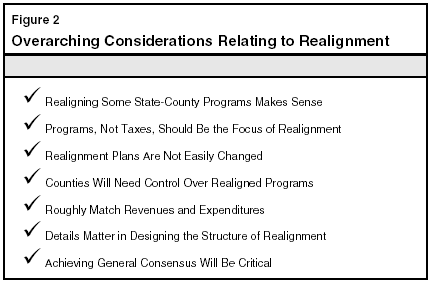
In a state as large and diverse as California, it is difficult to establish statewide program rules, while at the same time promoting program innovation, efficiency, and responsiveness to local conditions. Typically, state laws and regulations strive for uniformity in county actions and compliance with minimum state standards. While this emphasis on "sameness" is appropriate for programs of great statewide concern, for other programs it is an impediment to county program collaboration and innovation.
Achieving good program outcomes in many health and human service programs, for example, requires county agencies to work across policy areas and to experiment with different approaches. Helping a homeless family, for example, often requires services in addition to housing assistance, such as mental health, drug or alcohol treatment, employment services, child care, and/or income assistance under California Work and Opportunity to Kids (CalWORKS). When each of these programs is operated in isolation, in compliance with extensive state rules, the total benefit may be less than if the county structured the programs to work collaboratively.
The administration's realignment plan provides the Legislature with an opportunity to "re-sort" state-county program responsibilities and consider which programs need statewide control and which could benefit from devolution to counties. The lesson California learned from the 1991 realignment is that counties, given the dependability of a dedicated funding stream and freed from centralized regulation, can achieve noteworthy program results.
As discussed above, realignment, implemented correctly, can improve the management and delivery of important programs. For this reason, we believe the Legislature's decision to realign a program should focus on program policy objectives and interest in increasing local control—not simply on raising revenues.
To that end, we recommend that the Legislature begin its work by identifying programs that would benefit from realignment. Should the Legislature determine that it wishes to raise more revenues than it wishes to realign programs, we recommend the Legislature avoid adding programs to the realignment package that are inconsistent with the concept of realignment—or programs over which the Legislature is unwilling to grant counties greater control.
If the Legislature wishes to raise more revenues than is needed to finance its realignment plan, but is concerned about interactions with Proposition 98, we note that the Legislature has other options. As we discuss in the "Education" chapter of the Analysis, for example, the Legislature could enact additional revenues, allow the money to count towards Proposition 98, but suspend the minimum guarantee. Such a one-time suspension of Proposition 98 would have about the same long-term impact on school spending as enacting the realignment plan proposed by the administration.
Alternatively, should the Legislature wish to enact realignment without increasing taxes, the Legislature could earmark a portion of existing state revenues as the dedicated revenues for realignment.
Realignment plans are not easily amenable to future legislative or administrative change. Under the administration's realignment proposal (as well as the 1991 realignment), counties assume a series of program obligations and commit to pay for them with revenues from a dedicated tax base. Developing the realignment package requires extensive legislative work and negotiations with many parties. As discussed further below, the realignment plan likely will be "backed up" by legislative provisions referred to as "poison pills" which safeguard the state's fiscal interests if elements of the realignment are successfully challenged in court.
The net result of these elements is that future changes to the realignment program and tax "package" become exceedingly complicated to change. We note, for example, that very few provisions of the 1991 realignment plan have been modified over the last 12 years. In contrast with many other state-local program and funding relationships, the basic structure of the 1991 realignment plan has remained constant. Before enacting a realignment plan, therefore, the Legislature should have a high degree of comfort with the program changes and revenue base.
The concept of realignment is to focus accountability by placing—to the greatest extent possible—program control, funding responsibility, and administration at the same level of government. Transferring funding responsibility to counties, therefore, is only the first step. Counties also need authority over the realigned programs.
Counties need program authority so that they may modify their programs to meet the highest needs in their community and facilitate innovative approaches and collaboration. Counties also need authority so that they can respond to the inevitable fluctuations in realignment revenues—as well as any long-term gap between realignment revenue growth and program demands. Just as the Legislature annually reviews program requirements and expenditures in light of the state's fiscal fortunes, counties would need authority to adjust program requirements and expenditures to reflect changes in realignment revenues. In fact, counties may have greater need for such authority because counties have less ability to increase taxes to pay for the programs.
In determining a revenue base for the realignment programs, the Legislature should roughly match the revenue base's projected growth rate with projections for overall long-term program spending. This does not mean there must be a "perfect" match between revenues and expenditures, but that the revenue base should grow at about the same rate as program costs.
Our review indicates that, over time, the administration's proposal could result in a contraction of spending for some programs. Specifically, we project that, as currently administered, the cost of the programs proposed for realignment by the administration would grow at about 7 percent to 8 percent annually over the next several years, while realignment revenues likely will increase by 5.5 percent to 6 percent annually. Thus, unless counties used their increased program authority to reduce program costs, or supplementary state or local revenues were added to realignment, funding for some realignment programs may be constrained over time. Alternatively, the Legislature, in reviewing the Governor's proposal, may decide that it would prefer a different mix of revenue sources, a mix which more closely tracks to the projected expenditure growth of the realigned programs.
In addition to selecting programs suitable for realignment, the Legislature will need to develop an appropriate structure for the realignment package. Details of this structure are key to the success of the realignment program and, given the difficulties in enacting future realignment changes, should be considered carefully.
Several components of the realignment structure are particularly important:
California's Constitution and statutory measures approved by the state's voters contain provisions that constrain the Legislature's authority to modify state and local government responsibilities and revenues: Proposition 98, the mandate provision of Proposition 4, Proposition 36, and others.
In 1991, the Legislature's realignment plan sidestepped some of these provisions through the enactment of four legislative provisions referred to as "poison pills." For example, one of these poison pill provisions suspends Proposition 98 if a court rules that the 1991 realignment revenues must be counted towards the Proposition 98 minimum funding guarantee. Another provision renders the entire realignment plan inoperative if a court rules that its provisions are a state-reimbursable mandate under Proposition 4. These poison pill provisions continue to this day, placing the 1991 realignment plan and the delivery of important programs at some risk. To a large extent, therefore, the 1991 realignment plan survives because the various parties involved with realignment think its end results are superior to the alternatives.
Our review indicates that the administration's 2003 realignment plan probably would require at least as many poison pill provisions as in 1991. Before enacting realignment, therefore, the Legislature, administration, counties, education community, and other key parties should achieve general consensus that realignment is a reasonable approach. Absent this consensus, the various requirements in the State Constitution and voter-approved initiatives may prove to be too great of an obstacle to overcome.
Much of the work involved in developing a realignment plan is "sorting out" which level of government should have program authority and funding responsibilities over different programs. As we have discussed in previous publications, government accountability is enhanced when residents know which level of government is responsible for different programs, and efficiency is enhanced when the level of government that pays the bill sets the program requirements. Thus, as the Legislature reconsiders state and county program responsibilities, we recommend that, whenever possible, a single level of government pay for a program and have authority over its design and implementation.
Given this, which programs should the state control and which should counties control? There is no "right" answer to this question. To assist the Legislature in its decision making, we highlight several factors, summarized in Figure 3 (see next page), for the Legislature to weigh as it reviews the assignment of program responsibilities.
Which Programs Should the State Control? As Figure 3 indicates, state control of programs makes sense under certain circumstances. If statewide uniformity is vital because service level variation would impede the achievement of overriding state objectives or create incentives for people to move across county borders, state control of a program makes sense. In addition, state control is appropriate for programs where the costs or benefits of a program are not restricted geographically, and thus individual counties might underinvest in a program because the county does not see the full impact of its actions. Finally, state control over income support programs makes sense, because it allows the redistribution of income to reflect the resources of the entire state, as opposed to the resources of a specific county.
Which Programs Should Counties Control? County control over programs offers different advantages. Counties have greater ability to adjust programs to meet the needs of their communities and experiment to determine which efforts improve program outcomes. Because county departments are smaller than state agencies, it is easier for counties to develop programs involving multiple program specialties. Finally, when budget constraints are significant, counties are in a better position to discern what works in their community and preserve the activities yielding the best outcomes. Thus, when program innovation, responsiveness to community interests, and efficiency is critical, we recommend the Legislature consider assigning the program to counties.
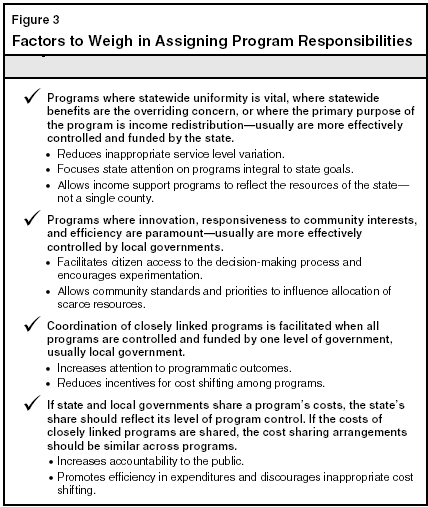
What About Programs That Are Closely Linked to Another? From a practical standpoint, many California programs are linked to others. Sometimes one person, or family, receives services under multiple programs simultaneously (such as mental health and drug or alcohol treatment services) or in succession (such as child welfare services, foster care, and adoptions), with some of the programs being "preventive" in nature and others oriented towards responding to acute problems. When assigning program responsibilities, it is important for the Legislature to acknowledge these program linkages because fostering collaboration among pro gram administrators will facilitate successful program outcomes. Given the scale of California state government, usually counties are in a better position to manage these programs. By keeping closely linked programs "under the same roof," the government controlling the programs can make sure that different program efforts are coordinated—and have the appropriate incentives to invest in programs that focus on prevention.
What About Sharing Responsibilities for Programs? Sometimes, because of federal laws, overriding state concerns, or other factors, it is not practical for the Legislature to assign full program control and funding responsibility to a single level of government. In this case, the state may wish to develop a hybrid system of program control and funding responsibility. If the Legislature assigns funding and program responsibilities to multiple levels of government, we recommend that the Legislature ensure that the state's share of cost is reflective of its degree of program control. As a general rule, we believe that the greater the program control a level of government has, the greater its fiscal share should be. Making sure that the state pays a share reflective of its degree of program control serves as an important check on the state as it contemplates future program changes with fiscal implications.
Using the factors discussed above, we reviewed the programs the administration proposed for realignment, as well as programs not included in the administration's plan. In undertaking this review, we focused primarily on whether a program was a good "fit" with the concept of realignment. For example, we examined whether a transfer to counties of program and funding responsibilities might yield better outcomes—or whether it would impede achievement of overall state objectives. The purpose of our review, therefore, was not to develop a definitive recommendation as to whether the Legislature "should" realign a program, but to identify programs that show the greatest potential for improvement under realignment.
From this review, we identified programs, totaling $9.1 billion, which appear to be good candidates for realigning to county control. These programs are listed in Figure 4 (see next page), along with page numbers denoting where our discussion of each program begins. As shown in Figure 4, we recommend the Legislature consider for realignment $5.1 billion of programs from the administration's plan and $4 billion of additional programs. In considering the list of programs in Figure 4, however, it is important to note that we do not believe that all these proposed changes could be implemented by the start of the fiscal year. Figure 4 denotes the programs where we think the program changes are so significant that future-year implementation would be necessary.
In beginning the Legislature's review of realignment, we recommend the Legislature focus its efforts on the programs shown in the consider column of Figure 4. Over the coming weeks, we will continue to examine state-county programs and may be able to identify additional programs for legislative consideration. Given the short time since the release of the administration's realignment plan, and the conceptual nature of our review, we are not certain whether unknown factors—such as federal regulatory requirements—might limit the Legislature's ability to realign some of the programs in Figure 4. To the extent that we are aware of significant issues limiting the Legislature's ability to realign a program, however, we discuss them in the write-ups below.
Finally, in our program write-ups, we identify some of the areas where the Legislature would need to increase county program authority and flexibility. As we have discussed throughout this document, however, counties would need significant authority for all programs in the realignment package.
The Governor's budget summary indicates that the realignment plan shifts $3.4 billion of health program costs from the state to counties. If the Legislature enacted the administration's provider rate and other budget cuts, however, the proposed health program shift to counties would total $2.9 billion. Regardless of the total amount shifted, as shown in Figure 1, the administration's plan gives counties "full" or "partial" program control over about $375 million of the realigned health programs. Thus, the administration's plan gives counties major fiscal responsibility without the program authority to manage the vast majority of these costs.
As we discuss below, we think that—with modifications—a substantial portion of the health programs in the administration's plan would be appropriate to realign. In our discussion below, we also identify additional programs (totaling about $1.2 billion) meriting consideration for realignment.
The administration's realignment plan shifts to counties a 15 percent share of costs for Medi-Cal medical benefits, or $1.3 billion to $1.6 billion, depending on the Legislature's actions regarding the administration's budget reduction proposals. (The $1.6 billion amount shown in our figures reflects the amount shown in the Governor's Budget Summary.) The estimated Medi-Cal cost for all counties would be taken "off the top" of the new realignment revenues and placed into a single statewide health care cost pool. The state, in turn, would use this revenue pool to pay Medi-Cal benefit costs, without reference to the county in which the Medi-Cal cost was incurred. Individual counties, therefore, would not realize any direct advantage or cost from changes in their residents' utilization of Medi-Cal services.
As shown in Figure 4, we recommend the Legislature remove Medi-Cal benefits from the list of programs to be considered for realignment because federal law requires that this program be provided uniformly across the state and because counties have little ability to affect long-term Medi-Cal benefit costs. Federal and state governments establish eligibility requirements for this program, what services will be provided, and how much will be paid to health care service providers. For these reasons, we see little program or fiscal benefit to assigning counties a share of the cost for medical services provided under this program.
Consider Establishing a Medi-Cal Administrative Cost Share. Although counties have little control over the costs of Medi-Cal benefits, county decision-making and collective bargaining affect the costs of Medi-Cal eligibility determinations. Under current law, however, counties do not pay a share of costs associated with county employees screening applicants for Medi-Cal eligibility. Thus, counties do not face an incentive to minimize these administrative costs. To align county and state fiscal interests in minimizing the administrative cost of this program, we propose that the Legislature consider a county share of costs for Medi-Cal eligibility determinations. Such a cost arrangement would be consistent with current requirements for the CalWORKs and Food Stamps programs. In determining the level of costs to be shared, it is important to note that county Medi-Cal eligibility workers frequently screen individuals and families for other programs, such as CalWORKs and Food Stamps. Establishing a similar state-county administrative cost share for these programs would reduce any incentive for inappropriately cost shifting among programs. As we note under our CalWORKs discussion, we think an administrative cost-sharing ratio for these programs of up to 50 percent would be appropriate, given the extent of county control over these program costs.
Under current law, the state and federal government share the cost of providing nursing home care for Medi-Cal recipients. The administration's realignment plan shifts to counties 100 percent of the state's cost for Medi-Cal long-term care: $1.1 billion to $1.4 billion annually. (The amount of the shift depends on the Legislature's actions regarding the administration's budget reduction proposals. The dollar amount shown in our figure reflects the amount shown in the administration's budget summary.) Similar to the administration's Medi-Cal services proposal, funding for nursing homes would be taken "off the top" of the new realignment revenues and placed into a single statewide cost pool.
Our review indicates that counties would have few tools to manage this major new funding responsibility. Specifically, counties would not have authority over the major factors driving Medi-Cal long-term care costs: provider reimbursement rates, program eligibility, or the decision to place Medi-Cal recipients into nursing homes. Moreover, the Governor's proposal would not address the serious fragmentation and lack of coordination that now exists for long-term care in which multiple agencies operate multiple programs with no real system in place.
Accordingly, we do not recommend the Legislature approve the program shift as proposed for the budget year. We find, however, that the state's long-term care delivery system would benefit greatly by county coordination and control. Thus, we recommend the Legislature transform the administration's proposal into a plan that phases-in over a longer period an integrated system of long-term care, managed by counties. Such a system, described below, would be similar to current county responsibilities for mental health services.
An Alternative Approach to Realignment of Long-Term Care. Under
our modified realignment concept, commencing in two to three years counties
would fund and manage a range of programs and services associated with long-
term care. Thus, counties would manage the shift of Medi-Cal patients, when
medically appropriate, from expensive acute care hospital beds to lower levels
of care. Counties also would coordinate additional support services needed to
care for Medi-Cal beneficiaries in the community and thus in some cases avoid
inappropriate and costly institutionalization in nursing homes.
Developing such a major realignment of long-term care responsibility would be complex, and pilot projects to implement similar changes have encountered significant delays. Accordingly, we do not believe that the transfer of authority over long-term care programs could be implemented immediately. For this reason, we suggest the Legislature consider the following approach:
The administration's realignment plan shifts to counties the fiscal and program responsibility for various maternal and child health, primary and rural health care, and county health grant programs. To offset these program costs, the county block grant includes $68 million in realignment revenues. In addition, counties would receive $78 million in additional Proposition 99 revenues and some related federal funding.
Public health programs, including indigent care for poor individuals not qualified for enrollment in Medi-Cal, were a major component of the 1991 realignment plan. The proposed shift of additional health "safety net" programs would increase county ability to develop innovative approaches for the provision of public health care services and meet specific health needs in their communities. Moving away from a structure where related public health programs receive separate categorical funding gives counties greater ability to coordinate services. For these reasons, we recommend the Legislature consider for realignment in 2003 all safety net programs proposed by the administration, as well as funding for a related program excluded from the administration's plan: the battered women's shelter program ($24 million General Fund proposed for 2003-04).
Finally, although we believe the administration's public health proposal makes sense, we note that currently there are restrictions on the use of Proposition 99 and federal funds. The administration's plan consolidates realignment funding into a single fund and gives counties flexibility to shift revenues in accordance with local priorities. The public health component of this plan, however, includes special funds collected under Proposition 99 (a voter-approved initiative that increased tobacco-related taxes) that must be used for specific purposes. Similarly, federal laws may limit the state's ability to shift Title V federal funds to county use.
The administration's realignment plan shifts to counties two discretionary mental health grant programs totaling $75 million: (1) the Integrated Services for the Homeless, which helps transition homeless individuals into recovery and stability in the community, and (2) the Children's System of Care, which funds programs designed to provide a continuum of care for mental health programs for children.
Our review of the mental health programs realigned in 1991 indicates that counties used their increased program and fiscal authority to improve the overall delivery of mental health services. Given the similarity between the mental health programs proposed for realignment in 2003 with the programs realigned in 1991, we think the administration's proposal makes sense. Providing counties with revenues for services to the homeless and children would allow counties to develop ongoing programs that meet their community's needs.
Given the results of the 1991 realignment, we recommend the Legislature consider realigning mental health programs in addition to those identified in the Governor's plan. Specifically, we believe the following mental health programs, most of which are currently administered by counties, would benefit from increased local program and fiscal authority:
In the case of the mental health managed care program, we note that because this program is funded under a federal Medicaid waiver, changes to the funding mechanism would require federal approval.
Overall, we believe these changes to the authority and control of mental health programs would improve county ability to meet critical local mental health system needs, reduce program administrative costs, and reduce the fragmentation of community mental health programs.
The Governor's plan shifts to counties $230 million of realignment funds to support a variety of substance abuse programs, including Drug Medi-Cal, various discretionary grants, drug court programs, services for parolees, and allocations for Proposition 36 (the November 2000 initiative requiring treatment services for nonviolent drug possession offenders). The $230 million represents a level of funding that is about 10 percent higher than current-year support for these programs.
The realignment plan obligates counties to transfer most of the proposed realignment funding to the state through an intergovernmental agreement. This transfer is intended to enable the state to comply with federal maintenance-of-effort (MOE) rules relating to state program spending. Violation of the federal MOE could jeopardize the ability of counties to obtain about $260 million annually in federal substance abuse treatment grants.
From a policy perspective, we believe the Governor's proposal make sense. Realignment would give counties flexibility in the design and operation of treatment programs. Under realignment, for example, counties may be better able to use their funds to serve people with a dual diagnosis of mental illness and addiction to drugs. Realignment also might open the door for expansion of Drug Medi-Cal services by allowing counties to draw down additional federal matching funds.
Despite these advantages, we find that the Governor's proposal has technical problems that may preclude or complicate its implementation. Specifically:
If these significant issues cannot be resolved, the Legislature may wish to consider alternatives to the administration's proposal, such as (1) excluding Proposition 36 programs from realignment (at least until 2006-07 when state appropriations mandated by Proposition 36 expire), (2) funding realignment though existing state General Fund revenues or a new state revenue source, or (3) maintaining at the state level, outside of realignment, a share of the funding for the Drug Medi-Cal program to ensure compliance with the federal court order requiring certain treatment services be available statewide.
The administration proposes to realign to counties $3.5 billion in state social services program responsibilities. This represents about 44 percent of 2002-03 General Fund spending within the Department of Social Services (DSS).
Given the large number of social services programs—and program components—proposed for realignment, Figure 5 (see next page) provides a more detailed look at the information summarized in Figure 4. As shown in Figure 5, the social services programs proposed for realignment fall into six categories: (1) children's programs, (2) CalWORKs, (3) Food Stamps administration, (4) In-Home Supportive Services (IHSS), (5) noncitizen benefit programs, and (6) Adult Protective Services (APS). With the exception of CalWORKs, the realignment plan shifts 100 percent of the nonfederal costs of these programs to counties. For CalWORKs, the plan shifts 50 percent of the cost for administration and welfare-to-work services. In general, the administration excludes the major social services automation projects from realignment.
Figure 5 shows the proposed funding shift for each social services program, our views as to whether the program should be considered for realignment, and three additional programs (totaling about $830 million) that we suggest the Legislature consider for realignment.
The administration proposes to realign all children's social services programs, with one exception. Specifically, the plan realigns child welfare services, foster care, and the adoptions assistance program (provides cash benefits), but excludes the adoptions program (provides services). Given the close linkages between the children's social services programs, we recommend that the Legislature incorporate the adoptions program into any decision it makes regarding the other programs.
In general, we think realigning the full array of children's programs to counties makes sense. Counties would have control and responsibility for the entire interactive system of child welfare and foster care. Specifically, counties would be responsible for deciding when to remove children from their homes (child welfare services), caring for children who are separated from their families (Foster Care), and determining the best long-range plan for foster children (adoption, reunification, emancipation, or permanent placement with a relative under the Kinship Guardian Assistance Program). Giving counties control and responsibility for this full system of care encourages counties to manage each element of the program effectively and efficiently.
Counties Would Need Increased Program Control As discussed throughout this analysis, in order for realignment to improve program outcomes, counties need sufficient program authority to allow them to administer programs in a way that responds to local needs and conditions. In the case of children's programs, giving counties this authority would require the state to eliminate as many nonfederal requirements as possible, such as the state's requirement for monthly social worker visits (the federal standards is semiannual visits).
Need to Address Federal Children and Family Services Reviews. California recently failed a federal performance review for children's services and must improve performance through a performance improvement plan, or face a reduction in federal funding. Accordingly, we recommend the realignment plan address how the state and counties would share the cost of the performance improvement plan, and how any loss in future federal funding would be allocated.
CalWORKs is a county administered entitlement program for which the state must meet strict federal participation requirements or face significant penalties. In addition, to prevent migration effects, the state has an interest in making sure grant levels are uniform and that recipients have access to necessary services before reaching their five-year time limits. For these reasons, we think that the state should be responsible for most CalWORKS program costs. However, we recognize that county actions do influence this program's long-term costs, and therefore we think there is merit to the administration's proposal to give counties a share of the program's costs for administration and employment services. In addition, we suggest that the Legislature consider giving the counties a share of the grant costs. We discuss these suggestions separately.
Employment Services and Administration Merit Inclusion in Realignment Plan. In general, we concur with the administration's proposal for a 50 percent county share of costs for administration and employment services. Although counties are responsible for developing welfare-to-work plans and providing the necessary training, child care, and case management services in support of those plans, counties pay no marginal cost for CalWORKs employment services or administrative costs. (Counties pay only a fixed cost based on their expenditures in 1996-97.) Without a marginal share of cost for employment services and administration, counties have limited incentive to control costs for these critical inputs, including the labor cost of county employees administering the CalWORKS program.
Add a Share of CalWORKs Grants to Realignment. While economic factors beyond a county's control drive the number of families eligible for CalWORKS in any community, local actions also influence the size of a county's CalWORKs caseload. Specifically, counties are responsible for providing welfare-to-work services that enable recipients to make the transition from cash aid to self-sufficiency. Thus, through the delivery of employment services, counties have some control over program exits. Increasing a county's share of grant costs—it is currently 2.5 percent—would give counties greater incentives to successfully move recipients toward self-sufficiency. Given the degree of control counties have over CalWORKs cash assistance costs, we recommend that the Legislature consider a partial share of cost for grants, perhaps in the range of 25 percent to 35 percent. A 25 percent share would be equivalent to about $750 million.
Currently, counties administer the Food Stamp program, in conformity with federal Food Stamps eligibility rules, but pay no marginal share of costs for this program. The administration proposes to shift to counties 100 percent of the cost of Food Stamps administration. In our view, a shift of 100 percent of the cost of administering this income assistance program would be inappropriate, given the limited county control over these costs. Instead, we recommend the Legislature consider realigning a share of the cost of Food Stamps administration as a reflection of the degree of control counties have over these costs, particularly employee wages.
To avoid any potential for cost shifting among social services programs, we suggest that the county share for Food Stamps administration match the share of cost for CalWORKs administration and services. (In some counties, the same workers perform the eligibility function for both programs.) The Governor has proposed a 50 percent share for CalWORKs administration. We believe any share of cost for Food Stamp administration—in the range of about 25 percent to 50 percent—would work, so long as this share of costs is consistent with the share of administrative costs for related programs.
The Cash Assistance Program for Immigrants (CAPI) and California Food Assistance Program (CFAP) provide cash or food coupon benefits to federally ineligible legal immigrants. As shown in Figure 1, the Governor proposes to give counties full discretion in operating these programs, including the option of eliminating these benefits. As these programs are cash (or cash equivalent) programs, the state has an interest in maintaining uniformity in benefit levels. Variation in benefit levels could lead to migration, or potentially a "race to the bottom," whereby one county's reduction in benefits spurs others to reduce benefits in order to avoid becoming a benefit "magnet." Given the state's interest in uniform benefits, we believe that CAPI and CFAP should remain state responsibilities.
The IHSS program provides various services to eligible aged blind, and disabled persons who are unable to remain safely in their own homes without such assistance. The IHSS program has two components: the Personal Care Services Program (PCSP), which is federally funded through Medicaid, and the Residual program, which is funded entirely with state and county funds. The nonfederal costs of the program are shared 35 percent county and 65 percent state.
The federal PCSP is an entitlement program, with eligibility governed by federal rules that generally provide that low-income aged or disabled individuals are eligible for services. However, such individuals are not eligible for PCSP if they choose a responsible relative provider or need supervisory care. Such persons are served in the state-only Residual program, which is also an entitlement pursuant to state law. Federal and state rules govern the types of services provided, but counties make specific determinations concerning the degree of impairment and hours of service provided. Counties also negotiate the rates paid to service providers. The IHSS program has been one of the fastest growing social services programs—since 1998-99 its General Fund costs have more than doubled to over $1 billion.
Because counties make decisions that significantly affect costs of the IHSS program—assigning hours of service based on their assessment of impairment and negotiating provider payment rates—realigning more program costs to counties has merit. However, we believe a 100 percent program shift to counties does not match counties' level of control over IHSS costs since they do not establish eligibility rules. Accordingly, we believe the Legislature should consider an increased county share, perhaps 50 percent (compared to 35 percent under current law). The Legislature should also consider giving counties more control over IHSS, especially in the Residual program, which is governed by state rather than federal law.
Interaction With Long-Term Care. The IHSS and long-term care programs are integrally linked. The IHSS program assists people in remaining in their homes; long-term care assists people unable to live independently. Earlier in this piece, we argued that the Governor's realignment plan for long-term care as proposed is unworkable. We offered suggestions for modifying the Governor's proposal to phase in a realignment plan for increased county responsibility for an integrated long-term care system. If long-term care is ultimately realigned to counties, then the Legislature should enact commensurate increases in county responsibilities under IHSS.
Created by Chapter 946, Statutes of 1998 (SB 2199, Lockyer), the APS program provides assistance to elderly and dependent adults who are functionally impaired, unable to meet their own needs, and who are victims of abuse, neglect, or exploitation. Like CAPI and CFAP, the Governor proposes that counties have complete flexibility in determining the level of service in this program, including the option of eliminating these services. In recent years, as the Legislature reduced funding for this program, it amended the APS statute to free the counties from certain mandatory activities. The Governor's proposal moves further in this direction by making the program optional. Because we think it is reasonable to allow community standards and priorities to influence the management and funding of this program, we believe it merits legislative consideration for realignment to counties.
Currently the state is responsible for developing and maintaining several large welfare automation projects operated by the 58 counties. These systems include the Statewide Automated Welfare System, the Child Welfare Services/Case Management System, and the Case Management Information and Payrolling System.
Although counties share in the maintenance and operations of such systems, their share of development costs is very small (about 5 percent of nonfederal costs). Counties play a significant role in the development of these systems as the state project managers treat the counties as "clients." Further, counties benefit from these systems because increased automation capacity increases their ability to serve clients while reducing labor costs.
Under the current system, counties have financial incentives to "ask for more" during the development phase because their development cost share is low, and they will benefit from any increased automation functionality that is developed. Because the state has a large interest in overseeing statewide implementation and federal compliance, we believe that the state should continue to support the majority of automation costs. Nevertheless, increasing the county share of development costs would better align state and county goals in automation development. We suggest raising county costs to about 25 percent. For 2003-04, this would shift approximately $42 million in automation costs to the counties.
California's subsidized child care system is administered primarily through SDE and DSS. The 2002-03 Budget Act allocates about $3.1 billion—$1.7 billion from the General Fund and $1.4 in billion federal funds—for over 15 different child care and development programs. About half of this funding is for programs restricted to current and former CalWORKs recipients. The remaining funding is for programs open to all California residents, based on income eligibility and space availability.
The administration's realignment plan shifts to counties responsibility for—and significant authority over—most child care programs administered by SDE. In addition to the $8.2 billion in new revenues that would be available to counties for child care and other programs, the proposed budget includes $863 million in federal funds for child care subject to enactment of the realignment proposal.
Currently, the state's centralized child care system creates significant difficulties for families and local child care providers:
In view of the above, we believe the administration's proposal to realign child care programs to counties merits legislative consideration. Realignment would give counties the flexibility to use child care funds as part of an integrated strategy to serve the needs of their communities' working poor. Counties could reduce the administrative complexity of the system by setting countywide rules relating to eligibility, family fees, and reimbursement rates. (Please see the "Child Care and Development" section in the "Education" chapter of the Analysis for further discussion regarding the child care realignment proposal.)
The administration's plan proposes changes to only one criminal justice program—trial court security. As shown in Figure 4, we recommend the Legislature reject the administration's trial court proposal, but consider for realignment several programs relating to juvenile and adult corrections.
Under the administration's realignment plan, 6.54 percent of the revenues raised by the new sales tax is deposited into the Trial Court Trust Fund for court security purposes. State General Fund support for court security is then reduced by a commensurate amount. Our review indicates that the administration's plan does not realign any governmental duties or improve the delivery of services; it simply moves the costs of a state funded program from the General Fund to a new revenue source. For this reason, we recommend the Legislature exclude this program from the list of programs considered for realignment. While the administration's plan proposes to give courts needed increased flexibility in the management of security costs, the Legislature could provide this increased flexibility through a separate statute.
Currently, the state is responsible for the incarceration and treatment of thousands of adult and juvenile offenders who, within a few years or months, will be released from state facilities. Upon their release, most juvenile and adult offenders return to their home communities. Thus, local governments have a significant interest in the future behavior of these individuals. Counties also administer many of the programs these individuals need to reduce their likelihood of recidivism—drug and alcohol treatment programs, mental health services, indigent health, and some employment services.
We believe that realignment of program and funding responsibility for certain components of the criminal justice system merits consideration by the Legislature because of the program linkages discussed above. In addition, such an approach would provide counties with a strong incentive to intervene early with criminal offenders and develop alternative methods of incarceration and services to minimize an individual's risk of reoffending. The programs we believe worth consideration for realignment are juvenile justice, adult parole, and return-to-custody.
Juvenile Offenders. Counties currently are responsible for more than 95 percent of all juvenile offender cases, primarily through their probation departments. The state's Department of the Youth Authority provides incarceration, rehabilitation services, and community supervision for juvenile offenders who have committed crimes that are more serious in nature or have repeatedly failed to respond to local juvenile justice programs. Current law requires counties to pay a share of the cost for Youth Authority commitments based on a sliding fee schedule that charges counties a higher fee for less serious offenders and a lower fee for more serious offenders. The county share of cost varies from about 4 percent to 63 percent depending on the classification of the ward being committed to the Youth Authority. Under our proposed realignment, counties would be responsible for treatment of all juvenile offenders at the local level, or for paying the full cost of placing offenders in state facilities. This realignment would clarify the responsibility for juvenile commitments and give counties greater incentives to invest in prevention and treatment programs.
Adult Parole. Currently, when a state prison inmate completes his or her sentence, he or she is supervised on parole by state staff in the community for up to three years. The community supervision services provided on parole are very similar to the services provided by county probation departments to probationers. Under our proposed realignment, state parole would be abolished and the community supervision function would be consolidated with county probation departments. Counties would determine the type and intensity of community supervision and how to make the best use of funds. For example, a county may decide to place an offender with a violent history in an intensive supervision program, or an offender with a history of substance abuse in a residential treatment program.
Adult Parole—Return-to-Custody. Currently, parolees who violate the conditions of their parole may have their parole administratively revoked and be returned to state prison for up to one year by the Board of Prison Terms. Such violations usually are for offenses that local law enforcement officials consider minor, such as unauthorized absence from parole supervision. Under our proposed realignment, counties would be responsible for offenders who violated the terms of their supervision. If an offender violated a condition of his or her supervision order (for which he or she is not prosecuted), counties would have the option to place the offender in custody, impose other community-based alternative punishments, or return the offender to state prison for up to one year at county expense.
Funding the LAO Proposed Realignment. We would propose that the realignment financing plan include $1.6 billion to realign these criminal justice programs to the counties. This reflects the current state costs to administer these programs. Counties would determine how best to make use of these realignment funds. In addition, we recommend dedicating additional discretionary funds of $232 million from the elimination of the COPS and Juvenile Justice grant programs for the development of new community-based programs, and/or the expansion of existing services to meet the needs of these juvenile and adult offenders.
The California Constitution requires the state to reimburse schools and other local agencies if it "mandates" a new program or higher level of service. As we have discussed in previous budget analyses, the claiming process associated with mandate reimbursement is slow, burdensome, and fails to give local governments incentives to contain costs.
Our review indicates that about 13 of the state's ongoing mandates (relating to voting procedures, property tax administration and, and mental health mandates, such as the AB 3632 program for children in special education, discussed above) represent county functions of significant statewide importance and could be consolidated and funded through the realignment plan. Such a realignment of mandate funding would provide counties with ongoing resources and eliminate the paperwork associated with mandate claiming. Before including these mandates in state-county realignment, however, we recommend that the Legislature modify the underlying mandate requirement to increase county flexibility and lower compliance costs. The amount of realignment funding provided to counties should reflect these mandate changes.
Given the size and diversity of California, we think realigning some programs from state to county control would provide the needed flexibility and fiscal incentives to improve program performance. For this reason, we think realignment merits consideration by the Legislature—regardless of its decisions regarding taxes or education funding.
Our review indicates that $5.1 billion of programs in the administration's plan and $4 billion of other programs may be good candidates for realignment and merit the Legislature's consideration.
Given the requirements of the California Constitution and voter-approved measures, enacting realignment will require achieving a broad consensus among many parties. Because realignment plans are difficult to modify over time, we recommend the Legislature take a long term view in enacting any program and funding changes.