October 2009
The Budget Package: 2009-10 California Spending Plan
Contents
Chapter 1
Key Features of the 2009–10 Budget Package
Budget Overview
Total State and Federal Funds Spending
The
2009–10 state spending plan was enacted into law on February 20, 2009,
and substantial amendments to that plan were enacted on July 28, 2009.
Both of these packages included various amendments to the 2008–09
spending plan (originally enacted in September 2008) in order to
benefit the state’s overall financial condition.
General and Special Fund Spending Down 15 Percent From Two–Years Ago. After
considering both the February and July budget packages (including the
Governor’s line–item vetoes), the 2009–10 state spending plan includes
total state budget expenditures of $110 billion from the General Fund
and special funds, as shown in Figure 1. This consists of $85 billion
from the General Fund and $25 billion from special funds. Spending from
these funds in 2009–10 will be $20 billion—15 percent—less than it was
in 2007–08. In addition, the budget assumes spending from bond funds of
nearly $10 billion as the state continues to allocate moneys from the
$43 billion bond package approved at the November 2006 election. Figure
2 (see next page) shows General Fund spending in 2007–08, 2008–09, and
2009–10 by policy area.
Figure 1
Total State and Federal Funds Expenditures |
(Dollars in Millions) |
Fund Type |
Actual
2007-08 |
Estimated 2008-09 |
Enacted 2009-10 |
Change
From 2008-09 |
Amount |
Percent |
General Fund |
$103,000 |
$91,547 |
$84,583 |
-$6,964 |
-7.6% |
Special funds |
26,674 |
26,530 |
25,123 |
-1,407 |
-5.3 |
Budget Totals |
$129,659 |
$118,077 |
$109,706 |
-$8,371 |
-7.1% |
Selected bond funds |
$8,405 |
$14,158 |
$9,539 |
-$4,619 |
-32.6% |
Federal funds |
$56,211 |
$76,629 |
$93,636 |
$17,007 |
22.2% |
Figure 2
General Fund Spending by Major Program Area |
(In Millions) |
|
Actual 2007‑08 |
Estimated 2008‑09 |
Enacted 2009‑10 |
K-12 Education |
$39,825 |
$32,356 |
$33,745 |
Higher Education |
11,823 |
10,138 |
10,495 |
Health |
19,906 |
18,794 |
16,077 |
Social Services |
9,432 |
10,009 |
8,876 |
Criminal Justice |
13,059 |
12,778 |
9,032 |
All other |
8,954 |
7,472 |
6,358 |
Totals |
$103,000 |
$91,547 |
$84,583 |
Big Increase in Stimulus Funds From Federal Government. While
state expenditures decline in 2009–10, federal funds spending will
increase dramatically, as shown in Figure 1. Federal stimulus funding
provided by the American Recovery and Reinvestment Act (ARRA) is
largely responsible for the increase in spending from federal
funds—from $56 billion in 2007–08 to $77 billion in 2008–09 and an
estimated $94 billion in 2009–10. (The President signed ARRA into law
on February 17, 2009, as the Legislature and the Governor concluded
consideration of the February state budget package.)
The Condition of the General Fund
Figure 3 summarizes the estimated General Fund condition for 2007–08 through 2009–10.
|
Figure 3
General Fund Condition
As of the July 2009 Budget Revisions |
|
(Dollars in Millions) |
|
|
2007-08 |
2008-09 |
2009-10 |
|
Amount |
Percent Change |
|
Prior-year fund
balance |
$4,549 |
$4,071 |
-$3,379 |
|
|
Revenues and transfers |
102,522 |
84,097 |
89,541 |
6.5% |
|
Total resources available |
$107,071 |
$88,168 |
$86,162 |
|
|
Expenditures |
$103,000 |
$91,547 |
$84,583 |
-7.6% |
|
Ending fund balance |
$4,071 |
-$3,379 |
$1,579 |
|
|
Encumbrances |
1,079 |
1,079 |
1,079 |
|
|
Reserve |
$2,992 |
-$4,458 |
$500 |
|
|
Budget
Stabilization Account |
— |
— |
— |
|
|
Special Fund for Economic Uncertainties |
$2,992 |
-$4,458 |
$500 |
|
2008–09: Large Revenue Drops and a Year–End Deficit. At the time the Governor signed the original 2008–09 Budget Act on
September 23, 2008, General Fund revenues and transfers in 2008–09 were
expected to total $102 billion—just slightly less than the total
recorded in 2007–08. Despite over $1 billion of 2008–09 tax increases
enacted as part of the February 2009 budget package, the recession took
a massive toll on state revenues. As shown in Figure 3, only $84
billion of General Fund revenues and transfers were recorded during
2008–09—18 percent less than estimated in September 2008. In the
February and July budget packages, the Legislature and the Governor
took action to reduce spending in response to the revenue trend.
Because of these actions, 2008–09 General Fund spending will be over 11
percent less than the total estimated when the 2008–09 budget was first
passed in September 2008.
Because the Legislature did not
reduce 2008–09 spending as much as the decline in revenues that
materialized during the fiscal year, the state ended 2008–09 with a
significant deficit—the largest year–end shortfall in the state’s
reserve ever recorded. As shown in Figure 3, the state’s General Fund
reserve had a negative balance of about $4.5 billion as of June 30,
2009. Despite spending more than it took in, the state continued
operations through a variety of cash management measures, as discussed
in the box on page 5.
Cash Management
Cash Management Measures Included in Both Budget Packages.
Throughout the 2009–10 budget process, the state’s budget problems and
disruptions in the worldwide credit markets contributed to serious
problems with California’s state government cash flows—that is, the
state’s ability to make payments on time. In response, the Legislature
included cash flow management measures in both the February and July
budget packages. The Legislature chose to delay billions of dollars in
payments (largely for K–14 education) to later within the 2009–10
fiscal year. In addition, the February budget package added about $3
billion in borrowable special funds—internal state resources available
to bridge seasonal lows in the General Fund’s cash flow. Moreover, the
budgetary changes in the two packages also benefitted the state’s
ability to make its scheduled payments on time.
Controller Delayed Payments in February 2009 and Issued IOUs in July and August 2009.
The February and July budget packages were not enacted early enough to
prevent the Controller from: (1) delaying over $3 billion of scheduled
payments (mainly tax refunds) in February 2009 and (2) issuing 449,000
registered warrants (also known as IOUs) for a total of $2.6 billion of
payments in July and August 2009. The February 2009 delayed payments
generally were paid in March 2009, and the IOUs were able to be
redeemed by recipients beginning on September 4, 2009. This was only
the second time since the Depression that the state issued IOUs for
some of its budgeted payments. In effect, the IOUs forced recipients
(such as state vendors and local governments) to provide the state with
a loan involuntarily. The IOUs were redeemable with interest, paid at a
3.75 percent annual rate. “Priority payments”—including school,
payroll, and debt service payments—were not subject to IOUs.
About $9 Billion of Cash–Flow Borrowing Projected in 2009–10.
As the Legislature began consideration of the Governor’s May budget
proposals, officials warned lawmakers that, absent corrective action by
the Legislature, the state might need to seek a 2009–10 cash–flow
borrowing in the unprecedented (and unlikely) amount of over $23
billion in order to pay all of its bills on time throughout the fiscal
year. As a result of the July budget package, that amount was whittled
down to about $10 billion, according to estimates prepared by the
administration in August 2009. The administration also sought and
received legislative approval for an additional $1.7 billion of delays
in payments now scheduled in early 2010 (principally for higher
education and in September budget legislation). The administration
estimates these September actions will reduce the state’s 2009–10
revenue anticipation note borrowing requirements to about $9 billion. |
2009–10: Large Operating Surplus Projected in Order to Rebuild a Reserve.
The budget plan projects revenues and transfers of about $90 billion
and expenditures of $85 billion in 2009–10. The resulting $5 billion
operating surplus is necessary for the state to address the $4.5
billion carry–in deficit discussed above and rebuild a small $500
million reserve by June 30, 2010. Due in large part to the tax
increases enacted as part of the February budget package, revenues and
transfers are expected to grow from $84 billion in 2008–09 to $90
billion in 2009–10—an increase of 6.5 percent. Budgeted expenditures
decline from $92 billion to $85 billion—a drop of 7.6 percent. As
described later in this report, budgeted revenues and expenditures in
2008–09 and 2009–10 include a variety of one–time and temporary
measures—such as federal ARRA funds which reduce General Fund
expenditures—that make multiyear budget comparisons unusually
difficult.
Solutions Adopted During the Budget Process
Figure
4 shows the budget solutions adopted during the 2009–10 budget process.
As described above, these solutions affected both the 2008–09 and
2009–10 state budgets. Of the roughly $60 billion of General Fund
budget solutions adopted by the Legislature, about $15 billion
(including $10 billion of spending measures and over $1 billion of new
tax revenues) affected the 2008–09 budget, and $45 billion (including
$22 billion of spending measures and about $11 billion from increased
taxes) affected the 2009–10 budget.
|
Figure 4
General Fund Solutions Enacted During
2009‑10 Budget Process |
|
(In Billions, 2008‑09 and
2009‑10 Combined) |
|
|
February Budget
Packagea |
July
Budget
Package |
Totals |
|
Spending-Related Solutions |
|
|
|
|
Reduce Proposition 98 spending to the minimum
guaranteed funding level |
$8.4 |
$6.1 |
$14.5 |
|
Reduce health and social services spending |
1.7 |
3.4 |
5.0 |
|
Furlough state workers, delay June 2010
payroll by one day, and reduce other employee costs |
1.2 |
1.8 |
3.0 |
|
Reduce higher education spendingb |
0.9 |
2.0 |
2.9 |
|
Redirect local redevelopment funds to offset
state spending |
— |
1.7 |
1.7 |
|
Redirect transportation funds |
0.7 |
0.9 |
1.6 |
|
Reduce corrections and rehabilitation spending |
0.6 |
0.8 |
1.4 |
|
Reduce other spending and other
spending-related measures |
1.1 |
1.4 |
2.6 |
|
Subtotals |
($14.5) |
($18.0) |
($32.5) |
|
Temporary Tax Increases |
|
|
|
|
Increase sales tax by 1 cent through end of
2010‑11 |
$5.8 |
— |
$5.8 |
|
Increase personal income tax (PIT) rates by
0.25 percentage point through tax year 2010 |
3.7 |
— |
3.7 |
|
Increase vehicle license fee by 0.5 percent
through end of 2010‑11 |
2.0 |
— |
2.0 |
|
Reduce PIT dependent credit through tax year
2010 |
1.4 |
— |
1.4 |
|
Create new tax credits |
-0.4 |
— |
-0.4 |
|
Subtotals |
($12.5) |
(—) |
($12.5) |
|
One-Time Revenue Measures and Transfers to the General Fund |
|
|
|
Increase schedules for payroll withholding by
10 percent |
— |
$1.7 |
$1.7 |
|
Assume that parts of State Compensation
Insurance Fund can be sold |
— |
1.0 |
1.0 |
|
Accelerate receipts of PIT and corporation tax
estimated payments |
— |
0.6 |
0.6 |
|
Increase other revenue receipts or transfers
in 2009‑10 |
— |
0.2 |
0.2 |
|
Subtotals |
(—) |
($3.5) |
($3.5) |
|
Federal Stimulus Funds |
$8.5 |
—d |
$8.5 |
|
Borrowing |
|
|
|
|
Suspend Proposition 1A to borrow local
government property taxes |
— |
$1.9 |
$1.9 |
|
Borrow from various special fund accounts |
$0.3 |
0.2 |
0.5 |
|
Subtotals |
($0.3) |
($2.2) |
($2.5) |
|
Total Solutions |
$35.9 |
$23.7c |
$59.5 |
|
|
|
a Amounts listed as
scored at the time of enactment of the February package. Actual
solution totals may have changed subsequently. These changes,
including lower revenue estimates, generally were incorporated into
estimates related to the July package. |
|
b Not including
Proposition 98 spending solutions related to community colleges. |
|
c In addition to the
$23.7 billion of solutions listed, the administration's scoring of
the July package reflected as solutions (1) a reduction in the
targeted reserve by $418 million compared to the legislative
leaders' prior budget agreement and (2) $118 million of reduced
2008‑09 spending unrelated to the budget package. |
|
d A portion of the
Proposition 98 and higher education solutions above will be offset
by the availability of federal stimulus funds. |
Spending–Related Solutions.
About $32.5 billion of the solutions affected state spending. These
measures will result in service reductions across state government and
many parts of local government as well. The solutions include:
-
Reduced Proposition 98 Spending for K–14 Education.
By far, the largest single group of solutions adopted during the budget
process—totaling $14.5 billion—brought Proposition 98 spending for K–14
education down to its minimum guaranteed funding level under the State
Constitution in both 2008–09 and 2009–10. The reductions are offset by
school districts’ receipt of $6 billion in federal ARRA funds in
2008–09 and 2009–10. In addition, requirements attached to many
categorical funding programs were relaxed to give districts increased
program and financial flexibility.
· Other Budgeted Solutions.
In addition to budget solutions affecting Proposition 98 expenditures,
the 2009–10 spending plan includes solutions affecting health and
social services spending ($5 billion), state employee compensation ($3
billion), appropriations to the university systems ($2.9 billion), and
virtually every other category of General Fund spending. (More details
of these actions are provided in Chapter 3.)- Temporary Tax Increases.
In the February budget package, the Legislature enacted several
temporary tax increases, as well as some new tax credits. In 2008–09
and 2009–10 combined, these tax changes were estimated in February to
increase General Fund revenues by a net amount of $12.5 billion. (These
are also described in more detail in Chapter 2.)
One–Time Revenue Measures and Transfers to the General Fund. In
addition to the tax increases in the February budget package, the
Legislature and the Governor agreed to various additional revenue
measures—mainly one–time in their benefit to the General Fund—in the
July budget package. These measures total about $3.5 billion in
2009–10. (These are described in more detail in Chapter 2.)
Federal Stimulus Funds.
The February budget package took account of expected funds resulting
from ARRA that could offset General Fund expenditures in 2008–09 and
2009–10. These federal stimulus funds—described in more detail in
Chapter 3—were budgeted at the time of the February budget package to
total about $8.5 billion. Most of these funds will not be available to
help balance the state budget after 2009–10 as the ARRA funds are
one–time in nature.
Borrowing. The
budget package includes about $2.5 billion of borrowing to help return
the 2008–09 and 2009–10 state budgets to balance. The largest single
provision consists of $1.9 billion to be borrowed from city, county,
and special district property taxes, which will be used to offset state
General Fund spending for education and other programs. The $1.9
billion loan is authorized through the Legislature’s suspension of
Proposition 1A (2004).
Evolution of the Budget
The 2009–10
budget process was highly unusual. Because 2008–09 revenues were
severely affected by the recession, lawmakers and the Governor worked
to address both 2008–09 and 2009–10 annual budget deficits
simultaneously from November 2008 through July 2009.
November 2008 Special Session
On
November 6, 2008, just two days after the general election, the
Governor called a special session of the Legislature to deal with major
economic and budget developments that had occurred in the six weeks
since he and the Legislature agreed to terms of the 2008–09 budget.
A Huge Deterioration in Revenue and Economic Forecasts. In September 2008, when the Governor signed the 2008–09 Budget Act,
the state had a projected reserve of $1.7 billion at the end of
2008–09. By the time of the Governor’s November 2008 special session
proclamation, the administration reported that it expected revenues for
2008–09 to fall short of original projections by $11 billion. In total,
it estimated the state would end 2008–09 with a $9.5 billion shortfall
if no corrective actions were taken. In addition, the administration
adjusted its previous projection of 2009–10 state revenues downward by
$13 billion and said the state needed to adopt about $22.5 billion in
budget solutions for the two fiscal years combined in order to keep the
General Fund in the black.
Governor’s November 2008 Proposals.
Total budget solutions proposed in the Governor’s November 2008 package
equaled $24.9 billion over 2008–09 and 2009–10 combined. The majority
of the solutions over the two–year period—totaling an estimated $14
billion—consisted of tax increases. Major components of the package
included:
- A 1.5 cent increase in the sales and use tax for three years.
- Expansions of the sales and use tax (SUT) to various services.
- Imposition of an oil severance tax.
- A
$2.5 billion midyear reduction in 2008–09 Proposition 98 spending
related to the large drop in projected General Fund revenues.
· Reductions in Supplemental Security Income/State Supplementary Payment grants.
Legislative Session Ended Without a Budget Agreement.
The 2007–08 biennial legislative session (including the November
special session) came to an end on November 30. No revised budget
agreement was reached by that date.
December 2008 Special Sessions
New Special Session Called as 2009–10 Legislature Begins Its Work. On
December 1, 2008, the first day of the 2009–10 Legislature, the
Governor declared a fiscal emergency pursuant to his powers under
Proposition 58 (2004) and called a special legislative session. The
Governor reiterated his estimate of a 2008–09 revenue shortfall of
about $11 billion and noted our office’s estimate during November 2008
that the budget problem over the two–year period of 2008–09 and 2009–10
could total $28 billion. The Governor continued to advance the major
elements of his November 2008 special session proposals.
Cash Situation Becomes Major Concern During December 2008.
During December 2008, state finances continued their steep decline. Due
largely to the mounting declines in revenues, the Pooled Money
Investment Board voted on December 17, 2008, to cease advancing money
to about 2,000 bond–funded projects. In the subsequent weeks, this
would cause many such projects to grind to a halt. (That funding halt
would continue for many projects until the state resumed general
obligation bond sales and secured over $13 billion in financing from
investors in March and April 2009.) On December 30, 2008, the State
Controller announced that he would begin delaying many categories of
state payments or issuing IOUs as early as February 1, 2009, due to the
lack of sufficient state cash resources if the Legislature and the
Governor did not reach agreement on returning the budget to balance.
The Controller eventually took action to delay over $3 billion in
scheduled state payments in February 2009, but the state did not issue
IOUs at that time.
December Legislative Package Was Vetoed by the Governor.
On December 18, 2008, the Legislature passed a budget package
addressing a portion of the state’s then–identified budget
shortfall—similar in scope to the Governor’s special session proposals.
Many spending reductions in the vetoed legislative package were similar
to proposals made by the Governor, although in some cases—particularly
in the health and social services areas—the administration’s reductions
at the time went further than the Legislature’s. The Legislature also
passed a personal income tax (PIT) surcharge, a change in income tax
withholding, a 0.75 cent increase in the sales tax, and a conversion of
the gas tax to a fee. The Legislature’s December 2008 package was
passed on a majority vote (as opposed to a two–thirds vote) on the
premise that the package was not a net tax increase. The Governor
immediately announced his intention to veto the December 2008
legislative package, and he did so formally on January 6, 2009.
Another Special Session Called.
Following the Legislature’s actions described above, the Governor used
his Proposition 58 authority to declare another fiscal emergency on
December 19, 2008, and he called another special session. The Governor
also directed his administration to develop a plan to go into effect in
February 2009 to furlough state employees by two days per month in
order to generate budgetary savings. (The furlough plan went into
effect on February 1, 2009, following a Superior Court judge’s
rejection of a lawsuit challenging it.)
January 2009 Governor’s Budget Proposals
Governor Released Outline of 2009–10 Budget Proposal Nearly Two Weeks Early.
On December 31, 2008, the Governor released the outline of the
administration’s 2009–10 budget proposals nearly two weeks before the
typical January 10 deadline. (Because the administration released the
details of the proposal in the ensuing days, we refer to these as the
Governor’s January 2009 budget proposals.)
Huge Additional Budget Problems Forecast by the Administration.
Updating fully its revenue and expenditure estimates, the
administration estimated in its January 2009 package that the state
would face a deficit of $39.6 billion at the end of 2009–10. Compared
to its November 2008 estimate, the administration announced that it
expected $7 billion less in revenue over 2008–09 and 2009–10 combined.
In addition, the magnitude of the revenue drop, as well as the
year–to–year change in revenues, affected the administration’s
calculation of the 2009–10 Proposition 98 minimum guarantee, making it
about $3.5 billion higher than our office’s November 2008 estimate.
Governor’s Package of Proposed Budget Solutions Grows to $41.7 Billion.
Generally, the Governor included his November 2008 special session
proposals in his January 2009 budget proposals, but the value of
several of these options was reduced to reflect the delay in enacting
them. In total, his proposed $41.7 billion of budget solutions in
2008–09 and 2009–10 consisted of $17.5 billion of spending–related
actions, $14.2 billion of revenue increases (primarily tax increases),
and $10 billion of borrowing. The major new proposals included:
- A
proposal to borrow $4.7 billion through issuance of revenue
anticipation warrants (RAWs) that would be applied to eliminate the
year–end 2008–09 General Fund deficit.
- A reduction in the value of the PIT dependent credit beginning in 2009.
- Deferring Proposition 98 costs in 2008–09 to 2009–10.
·
Recognizing $5 billion of lottery securitization proceeds originally
proposed for voter approval along with passage of the 2008–09 budget,
as well as other budget solutions requiring voter approval.
February 2009 Budget Package
Earliest Budget Act Passage in Modern California History. On February 19, 2009, the Legislature approved the 2009–10 Budget Act, amendments to the 2008–09 Budget Act,
and related legislation. The Governor signed the measures on February
20. The list of bills included in the February budget package can be
found at the end of this chapter. As we discussed in our publication, The Fiscal Outlook Under the February Budget Package, the early passage of the 2009–10 budget was unprecedented.
Package Includes $41.7 Billion of Solutions.
The February budget package included $41.7 billion of budget solutions
to close an approximately $40 billion shortfall and build up a reserve
that was then projected to be $2.1 billion by the end of 2009–10. (The
$41.7 billion figure included about $6 billion of measures—principally
included proceeds from the proposed lottery securitization—which were
later rejected by voters and, therefore, are not listed in Figure 4.)
The four main components of the package were:
-
Spending Reductions. The package included
about $15 billion of spending–related budget solutions, the largest of
which involved K–12 education funding.
-
Temporary Tax Increases. The package included
about $12.5 billion of temporary tax increases, principally the result
of increased rates for the SUT, the vehicle license fee, and the PIT.
The tax increases were scheduled to remain in effect for about two
years under the package. The budget package, however, specified that if
voters approved Proposition 1A (a measure to make changes to state
budget practices) at the May 19, 2009 special election, the tax
increases would be extended for either one or two years.
-
Borrowing. As described above, the February
budget package assumed that voters would approve $5 billion of
borrowing from future lottery profits, which required passage of
Proposition 1C at the May 19, 2009, special election.
· Federal Stimulus Funds and the Federal Funds Trigger.
The February budget package assumed receipt of $8.5 billion in federal
funds from ARRA to help balance the budget. In addition, because the
exact amount of funds the state would receive to offset General Fund
expenditures was unknown at the time the February budget package was
passed, legislation provided that if the Treasurer and the Director of
Finance determined that more than $10 billion of ARRA funds would be
available to offset General Fund spending through June 30, 2010, then
$2.8 billion of spending reductions and tax increases in the budget
package would not go into effect. This was known as the federal funds
“trigger.” (On March 27, 2009, the Treasurer and the Director of
Finance determined that the state would receive less than $10 billion
of ARRA funds to offset General Fund spending during the specified time
period.)
Governor’s May 14 Budget Proposals
Large New Budget Problem Identified.
The Governor released his May Revision on May 14, identifying a new
$15.5 billion budget problem. Over $12.5 billion of this problem
related to projected drops in revenues related to the recession in
2008–09 and 2009–10. These declines affected all major taxes. In
addition, various other changes contributed to an additional $3 billion
of budgetary problems, including a $1.3 billion lower property tax
forecast that affected state Proposition 98 obligations and a $1.1
billion increase in health and social services costs related to program
caseloads.
Proposals Included $14.5 Billion of Solutions. The
Governor’s May 14 package included about $14.5 billion of budget
solutions, assuming that voters approved Propositions 1A through 1E on
May 19. The largest proposal was to issue $6 billion of RAWs and apply
them to reducing the 2008–09 year–end budget deficit. The Governor also
proposed to reduce Proposition 98 funding by $1 billion in 2008–09 and
$2 billion in 2009–10 and to reduce University of California (UC) and
California State University (CSU) funding by a combined $1 billion in
2008–09. The proposals included an array of cuts in health and social
services and the proposed $1 billion sale of State Compensation
Insurance Fund. The Governor’s package included a proposed $1.1 billion
General Fund reserve at the end of 2009–10—down from the $2.1 billion
assumed in the February budget package.
Contingency Proposals Included to Address Possible Failure of Special Election Measures.
On May 14, the Governor also announced an additional $6.8 billion of
contingency measures to address the possible failure of Propositions 1A
through 1E on the May 19 ballot. The additional measures included $2.3
billion more of Proposition 98 funding reductions over 2008–09 and
2009–10, the suspension of a different ballot measure also designated
as Proposition 1A (2004) to borrow about $2 billion of local government
property taxes, additional cuts in the corrections budget, and various
health and social services cuts, such as $302 million of savings from
limiting In–Home Supportive Services program benefits. The Governor
proposed increasing PIT withholding schedules by 10 percent to produce
an estimated 2009–10 budgetary benefit of $1.7 billion.
May 19 Special Election and Its Aftermath
Voters Reject Propositions 1A Through 1E.
Voters rejected Propositions 1A through 1E at the May 19, 2009 special
election. In addition to the loss of $5 billion in lottery
securitization funds, the defeat of the special election measures
resulted in the loss of over $800 million of assumed 2009–10 budget
solutions related to early childhood development and mental health
funds.
Governor’s May 26 Budget Proposal
Governor Changes Position on Budgetary Borrowing.
On May 21, the Governor issued a statement indicating he had directed
his administration to develop “additional options to cut state spending
so that we can eliminate the need to seek borrowing in the form of a
RAW.” In making this decision, the Governor cited discussions with
legislative leaders and federal officials (who announced on May 21 that
additional extraordinary assistance to the state was unlikely), as well
as the results of the May 19 special election.
Administration Proposes $5.5 Billion of Additional Budget Solutions.
To make up for the loss of the $5.5 billion RAW from its budget
proposal, the administration proposed an additional $5.5 billion of
General Fund solutions on May 26, 2009. The May 26 proposals included
the elimination of the California Work Opportunity and Responsibility
to Kids (CalWORKs) and Healthy Families Programs (HFP); redirection of
local gas tax funds; additional university budget cuts; elimination of
new Cal Grant awards; deletion of General Fund support for state parks;
and an array of health, corrections, employee compensation, and other
spending actions.
Governor’s May 29 Budget Proposal
Administration Shifts Position to Address Possible $3 Billion Revenue Overestimate.
In our May 21 review of the Governor’s original May Revision proposals,
we described the administration’s May revenue estimates as “reasonable”
but noted that our revenue estimates for 2009–10 were about $3 billion
less than the administration’s. In response to our lower revenue
estimates, on May 29 the administration released another round of
budget solutions totaling $2.8 billion to address this possible
additional revenue problem.
Proposed $2.8 Billion of Additional Actions Affects Various Areas.
The Governor’s May 29 proposals included a $680 million reduction in
Proposition 98 funding to reflect the lower revenue estimates, $550
million from realigning state and county costs, and $470 million from a
permanent 5 percent base salary reduction for all state employees.
Governor’s May Proposals Included Cumulative Total of $24 Billion of Solutions.
Essentially, the Governor’s final set of May proposals included each of
the proposals made on May 14, May 26, and May 29. Cumulatively, these
proposals produced $3.1 billion of budgetary relief for 2008–09 and
$20.8 billion of relief for 2009–10, for a total of $24 billion over
the two fiscal years combined. On June 5, 2009, the administration
estimated that its proposals would leave the state with a General Fund
reserve of $4.5 billion at the end of 2009–10 excluding its
acknowledged $3 billion potential overestimate of General Fund
revenues. (In other words, if the administration had reduced its
revenue estimate by $3 billion at that time, the estimated reserve
under its package would have been $1.5 billion at the end of 2009–10.)
Conference Committee Package
Conference Committee Meets in May and June.
A conference committee consisting of five Senators and five Assembly
Members began public meetings on May 21, 2009, to consider the
Governor’s May Revision proposals. The conferees adopted a set of
proposed budget revisions on June 16, 2009.
Conference Package Rejects Several Key Administration Proposals.
The conference committee package rejected several administration
proposals, including proposed eliminations of CalWORKs, HFP, and new
Cal Grant awards. Borrowing from local governments through suspension
of Proposition 1A (2004) was rejected. A 5 percent base salary cut for
state employees was rejected, although the conference committee
continued to score savings from a two–day monthly furlough of
essentially all state employees and added a measure to delay the June
30, 2010 state payroll one day so about $1 billion in costs could be
attributed to the 2010–11 fiscal year.
More Revenues, Less Expenditure Solutions Than Governor’s May Proposals. The
conference package included a larger revenue package—totaling $7.7
billion—than that in the Governor’s May proposals, including $2 billion
from requiring income tax withholding for payments to independent
contractors, $1 billion from increasing cigarette taxes by $1.50 per
pack, $800 million from instituting a 9.9 percent tax on each barrel of
extracted oil, and $200 million from establishing a park access tax on
California vehicles to preserve park funding. Included in the $15.5
billion of spending–related solutions proposed by the conference
committee were cuts in virtually every area of state government,
although—in many cases, such as in health and social services—these
cuts were much less than proposed by the Governor. The conference
committee package included $5.5 billion of reductions in Proposition 98
funding, as well as $2 billion in university cuts—generally mitigated
by receipt of federal ARRA funds by the educational institutions. The
conference committee package failed to pass either house of the
Legislature.
Governor’s July 1 Budget Proposal
Another Special Session Called, and Another Furlough Day Ordered.
On July 1, 2009, the Governor declared another fiscal emergency
pursuant to Proposition 58 and initiated another special session of the
Legislature. In conjunction with the declaration, the Governor ordered
state employees to take another furlough day—bringing the total number
of furlough days to three per month for essentially all executive
branch employees—and reduced their pay by an additional amount of
approximately 5 percent. Effective July 1, most state offices were
ordered closed on the first three Fridays of most months, known as
“furlough Fridays.” (Previously, state workers generally chose their
own furlough days with managerial approval and state offices did not
close.)
Another $4.9 Billion of Solutions Proposed.
On July 1, the administration updated its revenue estimates to
acknowledge officially that revenues would be $3 billion less than it
projected on May 14. In addition, the administration stated that the
Legislature’s failure to enact several proposed solutions by the end of
the 2008–09 fiscal year—principally related to K–12 and higher
education—had eroded $5.3 billion of possible savings in the 2008–09
and 2009–10 budget. To offset this loss, the administration proposed
the following new solutions:
-
Suspending the Proposition 98 Minimum Funding Guarantee. The Governor proposed suspending the Proposition 98 minimum funding guarantee in 2009–10 to achieve $3 billion of savings.
-
Retroactive Cuts to UC and CSU. The Governor proposed implementing his proposed 2008–09 cuts to UC and CSU on a retroactive basis totaling $1.4 billion.
-
Scoring Savings From Third Furlough Day.
The Governor implemented the third monthly furlough day under his
executive power, as described by the Superior Court decision upholding
his initial furlough order in February. In his July 1 budget proposal,
he proposed scoring $425 million of savings in 2009–10 from this
action.
Governor Lowers Reserve Target to $1.1 Billion.
Under his July 1 budget proposals and revenue revisions, the Governor
lowered his reserve target to $1.1 billion at the end of 2009–10.
July 2009 Budget Package
Legislature Passes Package, but Rejects Solutions Totaling Over $1 Billion.
Following several days of debate, the Legislature adopted further
revisions to both the 2008–09 and 2009–10 budgets, as well as
accompanying legislation (listed in Figure 5), on July 24. Measures
negotiated by the legislative leaders and the Governor included about
$24 billion of solutions and an estimated $900 million reserve at the
end of 2009–10. Two key measures that emerged from these negotiations
did not receive the required number of votes to pass the Assembly.
These measures were (1) a proposed loan of $1 billion of gasoline
excise tax revenue from cities and counties to the General Fund in
2009–10 and 2010–11 for reimbursement of transportation–related bond
payments and (2) authorization for a lease worth about $100 million in
2009–10 for oil drilling in federal waters near Santa Barbara. By
approving the remaining measures, the Legislature adopted budget
revisions that left the state with a slight projected deficit in the
General Fund reserve at the end of 2009–10.
|
Figure 5
2009-10 Budget and
Budget-Related Legislation |
|
Bill Number |
Chapter |
Author |
Subject |
|
February Budget Package |
|
|
|
SBX3 1 |
1 |
Ducheny |
2009‑10 Budget Act |
|
SBX3 2 |
2 |
Ducheny |
Changes to 2008‑09 Budget Act |
|
SBX3 4 |
12 |
Ducheny |
Education |
|
SBX3 6 |
13 |
Ducheny |
Human services |
|
SBX3 7 |
14 |
Ducheny |
Transportation |
|
SBX3 8 |
4 |
Ducheny |
General government |
|
SBX3 10 |
15 |
Ducheny |
Proposition 1E |
|
SBX3 14 |
16 |
Ducheny |
Prison facilities |
|
SBX3 15 |
17 |
Calderon |
Tax credits and sales factor |
|
SBX3 19 |
7 |
Ducheny |
Elections |
|
SBX3 20 |
3 |
Maldonado |
State Controller |
|
SBX2 3 |
1 |
Florez |
Farm equipment and air quality |
|
SBX2 4 |
2 |
Cogdill |
Design-build and public private partnerships |
|
SBX2 7 |
4 |
Corbett |
Residential foreclosures |
|
SBX2 9 |
7 |
Padilla |
Prevailing wage |
|
SBX2 10 |
8 |
Oropeza |
Vehicle license fee (VLF) and rental cars |
|
SBX2 11 |
9 |
Steinberg |
Judicial employment benefits |
|
SBX2 12 |
10 |
Steinberg |
Court facilities financing |
|
SBX2 15 |
11 |
Ashburn |
New home purchase credit |
|
SBX2 16 |
12 |
Ashburn |
Horse racing |
|
SB 6 |
1 |
Maldonado |
Open primaries statutory changes |
|
SCA 4 |
2 |
Maldonado |
Open primaries proposition |
|
SCA 8 |
3 |
Maldonado |
Proposition 1F |
|
ABX3 3 |
18 |
Evans |
VLF, income tax, and sales tax increases |
|
ABX3 5 |
20 |
Evans |
Health |
|
ABX3 11 |
6 |
Evans |
Special election |
|
ABX3 12 |
8 |
Evans |
State lottery |
|
ABX3 13 |
9 |
Evans |
Cash management |
|
ABX3 15 |
10 |
Krekorian |
Tax credits and sales factor |
|
ABX3 16 |
5 |
Evans |
Federal fund trigger |
|
ABX3 17 |
11 |
Evans |
Proposition 1D |
|
ACAX3 1 |
1 |
Niello |
Proposition 1A |
|
ACAX3 2 |
2 |
Bass |
Proposition 1B |
|
ABX2 5 |
3 |
Gaines |
Alternative work week |
|
ABX2 7 |
5 |
Lieu |
Residential foreclosures |
|
ABX2 8 |
6 |
Nestande |
California Environmental Quality Act |
|
July Budget Package |
|
|
|
|
ABX4 1 |
1 |
Evans |
Changes to 2009-10 Budget Act |
|
|
ABX4 2 |
2 |
Evans |
Education |
|
|
ABX4 3 |
3 |
Evans |
Education finance |
|
|
ABX4 4 |
4 |
Evans |
Human services |
|
|
ABX4 5 |
5 |
Evans |
Health |
|
|
ABX4 6 |
6 |
Evans |
Medi-Cal |
|
|
ABX4 7 |
7 |
Evans |
Public social services: statewide enrollment
process |
|
|
ABX4 8 |
8 |
Evans |
CalWORKs policy; IHSS fraud; COLA changes |
|
|
ABX4 9 |
9 |
Evans |
Developmental services |
|
|
ABX4 10 |
10 |
Evans |
Transportation |
|
|
ABX4 11 |
11 |
Evans |
Public resources |
|
|
ABX4 12 |
12 |
Evans |
State government |
|
|
ABX4 14 |
13 |
Budget Committee |
Property tax revenue allocations |
|
|
ABX4 15 |
14 |
Gaines |
Property tax revenue allocations; Proposition
1A payback |
|
|
ABX4 17 |
15 |
Budget Committee |
Revenue acceleration |
|
|
ABX4 18 |
16 |
Budget Committee |
Tax compliance |
|
|
ABX4 19 |
17 |
Evans |
In-home supportive services |
|
|
ABX4 20 |
18 |
Strickland |
Reorganizations and consolidations |
|
|
ABX4 21 |
19 |
Evans |
State contracts |
|
|
ABX4 22 |
20 |
Evans |
Asset management |
|
|
ABX4 25 |
24 |
Evans |
Surplus state funds |
|
|
ABX4 26 |
21 |
Budget Committee |
Community redevelopment fund shift |
|
|
SBX4 13 |
22 |
Ducheny |
Courts/public safety |
|
|
SBX4 16 |
23 |
Ducheny |
Cash deferrals |
|
|
SB 63 |
21 |
Strickland |
Integrated Waste Management Board |
|
|
SB 90 |
22 |
Ducheny |
Supplemental appropriations |
|
|
September Budget-Related
Legislationa |
|
|
SBX3 18 |
— |
Ducheny |
Corrections |
|
|
ABX3 37 |
— |
Evans |
Cash deferrals |
|
|
SB 72 |
— |
Budget Committee |
Payroll deferral and CalPERS health plans |
|
|
SB 73 |
— |
Budget Committee |
Various fee provisions |
|
|
SB 75 |
— |
Budget Committee |
Court fees and pensions/furloughs |
|
|
SB 84 |
— |
Steinberg |
Quality Education Investment Act provisions |
|
|
AB 1383 |
— |
Jones |
Medi-Cal: hospital payments and quality
assurance fees |
|
|
AB 1422 |
157 |
Bass |
Healthy Families; Medi-Cal managed care plan
tax |
|
|
|
|
|
a These bills passed
the Legislature but have not been acted upon by the Governor as of
the date this report was prepared. |
|
Governor’s Line–Item Vetoes and Subsequent Constitutional Challenges.
On July 28, 2009, the Governor signed the July budget package and
announced line–item vetoes to reduce budgeted General Fund spending by
$489 million, principally in health and human services. In addition to
the vetoes, the administration announced $118 million of reduced
2008–09 spending items, such as lower–than–expected interest payments
from the General Fund. After considering these adjustments, the
administration estimated the General Fund reserve at the end of 2009–10
would total $500 million, as shown in Figure 3. The Legislative Counsel
subsequently opined that because the Legislature had structured most of
these budget revisions as reductions to existing appropriations
approved in February, they did not comprise an “item of appropriation”
subject to the Governor’s line–item veto power under the State
Constitution. Subsequently, the President pro Tempore of the Senate and
others filed suit against the Governor challenging the
constitutionality of the line–item vetoes. Our report lists as savings
the Governor’s line–item vetoes (since this annual report usually is
based on estimates of the Department of Finance). We note, however,
that spending would return to its higher levels if the vetoes are
overturned by the courts.
September Budget–Related Legislation
Additional Measures Passed During Session’s Final Days.
During the closing days of its 2009 regular session, the Legislature
passed several additional budget–related measures listed in Figure 5.
These include several “cleanup” bills, as well as legislation affecting
prisons, HFP, and schools.
Chapter 2
Revenue Provisions
The 2009–10 budget
package contains several major revenue–related changes, including more
than $10 billion in temporary tax increases and $1 billion from the
sale of state workers’ compensation insurance business. Figure 1
displays the revenue assumptions underlying the 2009–10 Budget Act,
by source. General Fund revenues are estimated at $89.5 billion, an
increase of $5.4 billion, or 6.5 percent, from the revised 2008–09
level. Increases in personal income tax (PIT), sales and use tax (SUT),
and vehicle license fee (VLF) revenues in 2009–10 are the result of tax
increases, as described below.
|
Figure 1
2009-10 Budget Act
General Fund Revenues |
|
(Dollars in Millions) |
|
|
2007-08
Actual |
2008-09 Revised |
2009-10 Budget Act |
Change From
2008-09 |
|
Amount |
Percent |
|
Personal income tax |
$54,182 |
$43,824 |
$48,868 |
$5,044 |
11.5% |
|
Sales and use tax |
26,613 |
24,288 |
27,609 |
3,321 |
13.7 |
|
Corporation tax |
11,849 |
9,682 |
8,799 |
-883 |
-9.1 |
|
Insurance tax |
2,173 |
2,041 |
1,913 |
-128 |
-6.3 |
|
Vehicle license fee |
— |
360 |
1,657 |
1,297 |
360.3 |
|
Other tax |
463 |
456 |
461 |
5 |
1.1 |
|
Other revenues |
6,005 |
2,398 |
2,705 |
307 |
12.8 |
|
Transfers |
1,237 |
1,048 |
529 |
-519 |
-49.5 |
|
Revenue forecast
adjustment |
— |
— |
-3,000 |
-3,000 |
— |
|
Totals |
$102,522 |
$84,097 |
$89,541 |
$5,444 |
6.5% |
2009–10 Revenues. The 2009–10
estimates for the different revenue sources are based on the Department
of Finance (DOF) economic forecast and its estimate of the impact of
policy changes that were made as part of the budget package—with one
exception. Figure 1 shows a “revenue forecast adjustment” downward of
$3 billion in 2009–10. This adjustment reflects the assumption adopted
in the budget that final General Fund revenues for the fiscal year will
be $3 billion lower than estimated in the May Revision (based
on the Legislative Analyst’s Office’s May forecast). Rather than alter
its baseline revenue forecast for individual tax sources, however, DOF
includes the reduction as a net adjustment to revenues. If the $3
billion does not materialize (as assumed in the budget), total
collections from PIT, SUT, and the other major revenue sources would be
lower than shown in the figure.
2008–09 Revenues.
The 2008–09 revenues in Figure 1 also differ from the department’s May
Revision estimates. Because budget discussions continued well into
July, actual collections data from May and June affected the revenue
picture. Receipts in 2008–09 were lower than estimated by DOF in the
May Revision by about $1.9 billion, partially offset by $1.3 billion in
increases to prior–year revenue amounts. Figure 1 reflects downward
adjustments to DOF’s 2008–09 revenue totals for PIT (about $1.5
billion), SUT ($324 million), and corporation taxes ($101 million) to
account for the lower receipts in May and June 2009.
Tax Rate Increases
As noted above, the 2009–10 Budget Act
reflects more than $10 billion in estimated revenues resulting from
four temporary tax increases. These changes were adopted as part of the
February package, and two of the increases also affected 2008–09
revenues. The estimated revenue gains from these hikes are shown in
Figure 2. As the figure illustrates, the temporary increases are
expected to generate $10.3 billion in additional revenues in 2009–10.
As a result of the continuing struggles of the state’s economy, this
estimate is about $1 billion lower than when the taxes were adopted in
February. In 2010–11, the total revenue expected falls to $8.1 billion,
as some of the tax increases expire halfway through the year. Below, we
briefly describe the four increases.
|
Figure 2
Temporary Tax Increases Included in the
2009-10 Budget Package |
|
(In Millions) |
|
|
2008‑09 |
2009‑10 |
2010‑11 |
|
Sales and use tax: 1 cent increase |
$1,126 |
$4,411 |
$4,637 |
|
Vehicle license fee: 0.5 percent increase |
360 |
1,657 |
1,690 |
|
Personal income tax (PIT): |
|
|
|
|
·
0.25 percentage point increase in marginal rates |
— |
$2,833 |
$1,101 |
|
·
Reduction of the PIT dependent credit |
— |
1,439 |
702 |
|
Totals |
$1,486 |
$10,340 |
$8,130 |
One–Cent SUT Increase. The
increase in the state’s SUT became effective April 1, 2009—raising the
state’s General Fund rate to 6 percent and the average state and local
rate to almost 9 percent. The higher rate will end on June 30, 2011.
The budget assumes additional revenues of $4.4 billion in 2009–10 from
this change.
The PIT Rate Increase. This change increases each of the seven PIT
tax rates by one–quarter of 1 percent. For example, the top PIT rate in
2008 for most taxpayers was 9.3 percent. With this increase, the top
rate will now be 9.55 percent. Similarly, the lowest rate will increase
from 1 percent to 1.25 percent. The change in the rates is assumed to
bring in $2.8 billion in additional revenues in 2009–10. This rate
increase is effective for the 2009 and 2010 tax years.
The VLF Increase.
The Legislature increased the VLF from 0.65 percent to 1.15 percent as
part of the budget package. Of this increase, 0.15 percent is dedicated
to local public safety programs, with the remainder deposited into the
state’s General Fund. The VLF is essentially a personal property tax on
cars and trucks. This change became effective in May 2009, thereby
generating a small amount of revenues in 2008–09. For 2009–10, the
budget assumes this provision will raise revenues by $1.7 billion. The
VLF rate increase ends on June 30, 2011.
Reduction in the Dependent Credit.
This change reduces the dependent credit ($309 in 2008) to the same
level as the personal credit ($99 in 2008). The budget assumes the
reduction in the dependent credit will increase revenues by $1.4
billion in 2009–10. This reduction is in effect for the 2009 and 2010
tax years.
Other Revenue Changes
The 2009–10 budget
package contains a number of other changes to the state’s revenue base.
Figure 3 summarizes these revisions. In 2009–10, the net increase from
the revisions is $3.1 billion. As the figure shows, most of the
increases are one–time revenue accelerations or sales of assets that
boost 2009–10 receipts, but provide no or relatively small long–term
increases. In addition, the budget package includes several new credits
that reduce revenues in 2009–10 and 2010–11. These revisions are
discussed briefly below.
|
Figure 3
Other Tax Changes, 2009-10 Budget Act |
|
(In Millions) |
|
|
2008‑09 |
2009‑10 |
2010‑11 |
|
Personal Income Tax |
|
|
|
|
Increased withholding |
— |
$1,700 |
$98 |
|
Revised estimated payment schedule |
— |
250 |
25 |
|
Increased enforcement |
— |
29 |
29 |
|
Employment tax credit |
— |
-66 |
-10 |
|
Subtotals |
— |
($1,913) |
($142) |
|
Corporate Income Tax |
|
|
|
|
Revised estimated payment schedule |
— |
$360 |
$70 |
|
Employment tax credit |
-$15 |
-264 |
-40 |
|
Optional single sales factor |
— |
— |
-260 |
|
Other new credits |
— |
-11 |
-56 |
|
Subtotals |
(-$15) |
($85) |
(-$286) |
|
Sales tax—increased enforcement |
— |
$138 |
$243 |
|
Sale of state workers’ compensation
insurance business |
— |
$1,000 |
— |
|
Totals |
-$15 |
$3,136 |
$99 |
Personal Income Tax. The
budget package includes two PIT revenue accelerations that generate
almost $2 billion in 2009–10. These changes do not increase the amount
of taxes owed. Instead, they seek to collect the existing tax
liabilities earlier in the year. For instance, the budget increases
suggested income tax withholding rates for individuals by 10 percent
(effective November 2009). The budget assumes an additional $1.7
billion in 2009–10 from this change. As a result, unless individual
taxpayers make manual adjustments to their withholding, they will see
larger income tax deductions from their monthly paychecks. By paying
more during the year, however, individuals will pay less in April 2010
to settle their 2009 taxes or they will receive larger refunds.
The
package also assumes an additional $250 million in PIT revenues from a
permanent revision in how individuals are required to calculate
estimated payments. Prior to the 2010 income years, payments were
required quarterly, generally in equal amounts. (The 2008–09 Budget Act
“front–loaded” the payments in 2009.) The budget package makes
additional changes beginning with the 2010 income year, adopting a
system of three payments each year, coming in April, June, and
December. The April payment equals 40 percent of the expected tax
liability, and the June and December payment equal 30 percent each.
Corporate Income Tax.
Corporate tax payments also are affected by the change in estimated
payments, resulting in an expected increase of $360 million in revenues
in 2009–10. The budget package also includes several tax reductions for corporations. Three new credits were authorized:
-
Employment Credit.
The employment credit has the largest fiscal impact in 2009–10,
reducing General Fund revenues by an estimated $264 million. The
employment credit provides $3,000 for each net new hire in 2009 or
2010. The credit is designed to provide firms that are expanding an
incentive to hire more workers. This credit (which also is available to
small business through a PIT credit) is capped at $400 million over its
life.
-
Film and New Home Credits.
The budget package also establishes two other temporary credits: a film
credit that provides $500 million in personal or corporate tax credits
for qualified activities beginning in 2011–12, and $100 million in
credits of up to $10,000 for individuals who buy newly built homes by
March 2010. These two credits are expected to reduce General Fund
revenues by $11 million in 2009–10.
The Legislature also
enacted legislation as part of the February package that permanently
gives multistate or multinational corporations another option for
determining the proportion of profits that is subject to California’s
corporate tax. Currently, companies must use a three–part formula that
includes the proportion of total company sales, workforce, and property
that is attributable to its California operations. The new legislation
allows companies the option to use only sales to determine income
attributable to California. This “single factor” option becomes
effective for the 2011 tax year and, therefore, has no impact on
revenues in 2008–09 or 2009–10. This change, however, is expected to
reduce state revenues by $260 million in 2011–12, reaching about $1
billion annually over the long run.
Sale of State Compensation Insurance Fund (SCIF) Activities.
The budget assumes $1 billion in one–time revenues in 2009–10 from the
sale of a part of the state’s SCIF business. The SCIF is a publicly run
workers’ compensation insurer that was created as the “insurer of last
resort” for businesses in California. The state also contracts with
SCIF to administer workers’ compensation benefits for injured state
employees. Legislation enacted with the budget authorizes the
administration to sell certain areas of SCIF’s business . The budget
assumes such a sale would occur by the end of the 2009–10 fiscal year.
(The Insurance Commissioner filed suit in August to block the sale.
Among other things, he has claimed the sale of parts of SCIF could
threaten its solvency.)
Chapter 3
Expenditure Highlights
Proposition 98
Proposition 98 funding
constitutes about three–fourths of total funding for child care,
preschool, K–12 education, and the California Community Colleges (CCC).
In this section, we review major Proposition 98 decisions for 2008–09
and 2009–10, identify outstanding Proposition 98 funding obligations,
and discuss the K–12 and child care budgets in more detail. In the
“Higher Education” section, we discuss the community college budget in
more detail.
Major Proposition 98 Budget Decisions
Below,
we explain the effect of revenue changes on the Proposition 98 funding
requirement for 2008–09 and 2009–10 and describe the February and July
Proposition 98 packages. Figure 1 shows the various budget reductions
made for 2008–09 and 2009–10.
|
Figure 1
Proposition 98 Package |
|
(In Millions) |
|
2008‑09 |
|
September Spending Level |
$58,086 |
|
February Package |
|
|
Reduce base K-12 revenue limits |
-$944 |
|
Reduce most categorical programs across the
board |
-944 |
|
Rescind K-14 cost-of-living adjustment |
-287 |
|
Other |
-210 |
|
Defer certain K-14 payments |
-3,244 |
|
Retire settle-up obligation |
-1,101 |
|
Use special funds for Home-to-School
Transportation |
-619 |
|
February Spending Level |
$50,738 |
|
July Package |
|
|
Revert unallocated categorical funds |
-$1,606 |
|
Baseline adjustments |
-30 |
|
Final Spending Level |
$49,102 |
|
2009-10 |
|
February Package |
|
|
Backfill February 2008‑09 one-time solutions |
$4,614 |
|
February baseline adjustments |
253 |
|
February reductions |
-702 |
|
July Package |
|
|
Backfill additional 2008‑09 one-time solutions |
$1,888 |
|
Reduce K-12 revenue limits |
-3,953 |
|
Defer K-12 revenue limit payments |
-1,679 |
|
Provide 2008‑09 unallocated categorical funds |
1,516 |
|
Other K-12 adjustments |
290 |
|
Make various child care reductions |
-102 |
|
Make various community college reductions |
-813 |
|
July Spending Level |
$50,415 |
February Proposition 98 Package Reflects Initial Drop in Revenues. Due
to the ongoing deterioration of the state’s economic situation, General
Fund revenues for 2008–09 were significantly lower than estimated in
the September 2008–09 Budget Act. This revenue decline
resulted in a decrease in the Proposition 98 funding requirement
(commonly known as the “minimum guarantee”). In response to the drop in
the guarantee, the state, as part of the February special session,
reduced 2008–09 Proposition 98 spending to $50.7 billion, a decrease of
$7.3 billion. The February reductions included a $2.4 billion cut to
base programs, primarily from K–12 revenue limits and categorical
programs. The remaining $5 billion in Proposition 98 reductions
reflected funding swaps and deferrals, which were not intended to
affect base programs in 2008–09. The February package also approved an
additional $700 million reduction to 2009–10 spending. This reduction
also was primarily from K–12 revenue limits and categorical programs.
July Package Reflects Continued Deterioration of Revenue Situation. The
July package made additional Proposition 98 reductions to both 2008–09
and 2009–10. Due to a further decline in General Fund revenues, the
Proposition 98 funding requirement further decreased for both years. As
a result, the spending levels approved in February were $1.6 billion
higher than the estimated minimum guarantee in 2008–09 and $4.5 billion
higher than the 2009–10 estimate. The July package reduces Proposition
98 spending to the revised estimates of the minimum guarantee for both
years. For 2008–09, the package made a downward accounting adjustment
to recognize $1.6 billion in K–12 cash disbursements that had not yet
been provided to districts at the time of enactment. The bulk of these
funds (with the exception of $90 million) are paid to school districts
in 2009–10 instead. The new 2009–10 reductions include $2.7 billion in
base reductions and $1.8 billion in payment deferrals.
Various Factors Mitigate Significant Drop in Proposition 98. Figure
2 shows the effect of all the reductions made to Proposition 98
spending in 2008–09 and 2009–10. As shown in the figure, the July
package provides $49.1 billion in 2008–09 and $50.4 billion in 2009–10.
By comparison, Proposition 98 spending in 2007–08 totaled $56.6
billion. Various factors help mitigate this significant drop in
Proposition 98 spending. Most notably,
California is to receive more than $6 billion in federal stimulus funds
from the American Recovery and Reinvestment Act (ARRA) for K–14
education (discussed in more detail in the “K–12 Education” and “Higher
Education” sections). In addition, the state allowed school districts
access to more than $3 billion in previously restricted
reserves—resulting in a like increase in some districts’ general
purpose funding. Lastly, the state also provided school districts and
community colleges with substantially more discretion over previously
restricted categorical funding, as well as loosened certain state
program requirements. For example, the state allowed school districts
to reduce the academic year up to five days. (These flexibility
provisions are discussed in more detail below.)
|
Figure 2
Proposition 98 Funding |
|
(In Millions) |
|
|
2007‑08
Final |
2008‑09
Revised |
2009‑10
Revised |
|
K-12 Education |
|
|
|
|
General Fund |
$37,752 |
$30,028 |
$31,194 |
|
Local property tax revenue |
12,592 |
13,033 |
13,439 |
|
Subtotals |
($50,344) |
($43,062) |
($44,634) |
|
California Community Colleges |
|
|
|
|
General Fund |
$4,142 |
$3,918 |
$3,722 |
|
Local property tax revenue |
1,971 |
2,016 |
1,947 |
|
Subtotals |
($6,112) |
($5,934) |
($5,669) |
|
Other Agencies |
$121 |
$106 |
$112 |
|
Totals, Proposition 98 |
$56,577 |
$49,102 |
$50,415 |
Maintenance Factor
During 2008–09, a
disagreement arose regarding the implementation of the “maintenance
factor” provisions in Proposition 98. In years when state General Fund
revenues grow relatively slowly, Proposition 98 typically allows the
state to provide a lower level of funding than otherwise required.
Though the state can spend at the lower funding level, it must keep
track of the difference between the amount that otherwise would have
been required and the actual funding provided. This difference is known
as the maintenance factor. In future years, the state makes payments
based upon a formula that is intended to accelerate funding until it
reaches the level it otherwise would have been absent the earlier
reduction. At the close of 2007–08, the state had an outstanding
maintenance factor obligation of $1.4 billion.
2008–09 Scenario Leads to Uncertainty. When
budget and economic data was updated as part of the February package,
an unprecedented Proposition 98 scenario arose. Although the
Proposition 98 minimum guarantee was clear, the maintenance factor
obligation created in 2008–09 was unclear. Differing interpretations of
the Constitution led to a disagreement whether maintenance factor was
created in certain low–growth General Fund situations. Under one
interpretation, a $9.3 billion maintenance factor obligation was
believed owed (a $7.9 billion obligation created in 2008–09, plus the
existing $1.4 billion obligation). Under a second interpretation, only
the prior–year $1.4 billion obligation was owed, with no new obligation
created in 2008–09.
July Package Resolves the Issue on a One–Time Basis. As
part of the February budget, the Legislature and Governor agreed to
resolve the issue on a one–time basis by placing Proposition 1B on the
May 2009 ballot. Voters, however, rejected the measure. Similarly, the
July budget package includes a statutory change that addresses the
issue on a one–time basis. The July package establishes an $11.2
billion maintenance factor obligation as of the close of 2008–09 (the
obligation increased as a result of additional Proposition 98
reductions in July). As with Proposition 1B, the July package does not
address similar situations in the future.
“Other” Outstanding Funding Obligations
The
state currently has several other outstanding Proposition 98–related
funding obligations. Several of these obligations, highlighted in
Figure 3, can be funded from within the annual Proposition 98
appropriation. These include “deferrals,” unpaid mandate claims, and
the revenue limit “deficit factor.” At times, the state also can have
K–14 obligations that are paid on top of the Proposition 98
appropriation using other state General Fund monies. Currently, the
state has one such obligation relating to a K–14 program it created in
2006–07. These specific obligations are discussed in more detail below.
|
Figure 3
Proposition 98-Funded
Obligations Grow to $15 Billiona |
|
(In Millions) |
|
|
2007‑08 |
2008‑09 |
2009‑10 |
|
Deferrals |
|
|
|
|
K-12 education |
$1,103 |
$4,007 |
$5,685 |
|
Community colleges |
200 |
540 |
703 |
|
Subtotals |
($1,303) |
($4,547) |
($6,388) |
|
Mandatesb |
|
|
|
|
K-12 education |
$621 |
$808 |
$1,003 |
|
Community colleges |
300 |
355 |
405 |
|
Subtotals |
($921) |
($1,163) |
($1,408) |
|
K-12 Revenue Limits |
— |
$2,978 |
$7,270 |
|
Totals |
$2,224 |
$8,687 |
$15,066 |
|
|
|
a Reflects cumulative
obligations at year end. These obligations are paid from within the
Proposition 98 appropriation. |
|
b Estimates based on
existing mandate claims as well as actions taken by the Commission
on
State Mandates. |
Deferrals to a Subsequent Fiscal Year.
In 2001–02, the state achieved a budget solution by deferring $1.3
billion in K–14 education costs to the subsequent fiscal year. These
deferrals resulted in districts receiving some state funds a few weeks
later than normal (in early July rather than late June). To achieve
additional budget solutions as part of this year’s budget process, the
state approved $3.2 billion in new deferrals of school district and
community college payments for 2008–09 and $1.8 billion for 2009–10. As
a result of all these actions, a total of $6.4 billion in Proposition
98 funds, 12 percent of funding for 2009–10, will not be provided until
2010–11.
Mandates. Since 2001–02, the
state has not funded the annual ongoing costs of school and community
college mandate claims. Essentially, the state requires schools and
colleges to undertake certain activities each year without providing
them immediate reimbursement. Despite a 2008 Superior Court decision
questioning the constitutionality of delaying mandate reimbursements,
the 2009–10 Budget Act continues this practice. We estimate
2009–10 costs for K–14 mandates are about $245 million. (This figure,
however, could easily double once several costly mandate claims finish
the mandate determination process.) Coupled with the backlog of mandate
claims from previous years, we estimate the state will end 2009–10 with
outstanding K–14 mandate claims totaling $1.4 billion.
Revenue Limits. State
law requires school districts to receive annual cost–of–living
adjustments (COLA) to their revenue limits as well as certain
categorical programs. Though the state suspended this statutory
requirement, it created a deficit factor for K–12 revenue limits. The
deficit factor is intended to track both the foregone COLA as well as
base revenue limit reductions. In essence, the deficit factor creates a
statutory commitment to use Proposition 98 funds at some point in the
future to raise revenue limits to the level they would have been absent
the 2008–09 and 2009–10 reductions. As shown in the figure, the base
reductions and foregone revenue limit COLA total almost $7.3 billion in
2009–10—$7.1 billion for school districts (resulting in a deficit
factor of 18.4 percent) and $140 million for county offices of
education (resulting in a deficit factor of 18.6 percent).
Quality Education Investment Act (QEIA). The
QEIA, established by Chapter 751, Statutes of 2006 (SB 1133,
Torlakson), appropriated a total of roughly $2.8 billion over a
seven–year period. The state provided $300 million in 2007–08 and was
scheduled to provide $450 million ($402 million for K–12 education and
$48 million for CCC) every year thereafter until the obligation was
paid in full (through 2013–14). These payments were to be made outside
of annual Proposition 98 spending. The July package required the
2009–10 QEIA payment to be made from within Proposition 98 spending.
This resulted in districts with QEIA schools essentially shifting some
revenue limit funding to the affected school sites to cover program
costs. The July package also extended the QEIA payment schedule for an
additional year (until 2014–15), thereby lengthening the life of the
program. Senate Bill 84, (Steinberg) (Governor’s action pending at time
of publication) makes a further modification—essentially requiring
districts to shift revenue limit funding to the affected school sites
only upon determination by the Superintendent of Public Instruction and
the Director of Finance that an equivalent amount of additional federal
or state general purpose funds had been identified to backfill the
loss. Regardless of whether these general purpose funds materialize,
districts with QEIA schools will receive Proposition 98 funding to
cover program costs, while also being encouraged to access federal
school improvement funding.
“Settle–Up” Obligation Retired. In
2002–03 and 2003–04, the Proposition 98 constitutional funding
requirement ended up being higher than the amount of Proposition 98
funding appropriated. As a result, the state incurred a settle–up
obligation totaling $1.1 billion across the two years. As part of the
February package, however, the state provided $1.1 billion to school
districts in 2008–09 to retire the entire settle–up obligation.
K–12 Education
Major Budget Decisions
Figure
4 displays all significant funding sources for K–12 education for
2007–08, 2008–09, and 2009–10. The figure shows that total K–12 funding
in 2009–10 is $66.7 billion. This is a 2.6 percent decline from 2008–09
and a 6.2 percent decline from 2007–08. The decline in ongoing
Proposition 98 funding is larger—11 percent from 2007–08. The
significant reductions to state funding, however, are mitigated by
various factors—including federal stimulus funding, funding swaps,
deferred rather than eliminated payments, access to restricted
reserves, categorical flexibility, and loosened state requirements, as
discussed in more detail below.
|
Figure 4
K-12 Education Fundinga |
|
(In Millions) |
|
|
2007‑08
Final |
2008‑09
Revised |
2009‑10
Revised |
|
Proposition 98 |
|
|
|
|
State General Fund |
$37,752 |
$30,028 |
$31,198 |
|
Local
property tax revenue |
12,592 |
13,033 |
13,439b |
|
Subtotals, Proposition 98 |
($50,344) |
($43,062) |
($44,637) |
|
Other General Fund |
|
|
|
|
Teacher retirement |
$1,535 |
$1,044 |
$1,153 |
|
Bond payments |
1,993 |
2,211 |
2,416 |
|
Other programs |
1,522c |
2,109d |
280 |
|
State lottery funds |
859 |
806 |
806 |
|
Federal funds (ongoing) |
6,484 |
6,786 |
7,077 |
|
ARRA funds |
— |
3,788 |
2,280 |
|
Otherd |
8,432 |
8,694 |
8,074 |
|
Subtotals |
($20,824) |
($25,438) |
($22,086) |
|
Totals |
$71,168 |
$68,500 |
$66,723 |
|
|
|
a Includes funding for
child care and development programs as well as adult education. |
|
b Includes
$850 million in funds redirected from redevelopment agencies on a
one-time basis. |
|
c Includes spending
for Quality Education Investment Act. |
|
d Includes special
funds, local debt service, and other local revenues. |
July Package Includes Further 2008–09 K–12 Reductions. To
further reduce spending to the 2008–09 minimum guarantee, the July
package makes a $1.6 billion downward accounting adjustment to reflect
K–12 cash disbursements not yet made to districts. (In turn, these
reductions lower the 2009–10 guarantee.) Of these funds, $1.5 billion
is subsequently paid to school districts in 2009–10.
Makes 2009–10 Reductions Mostly From K–12 Revenue Limits. In
the February budget package, K–12 programmatic reductions for 2008–09
were split between revenue limits and categorical programs. As part of
the July package, however, 2009–10 reductions were made primarily from
revenue limits. Specifically, the July package reduces revenue limits
across–the–board by $4 billion. Of this amount, $1.5 billion is reduced
on a one–time basis to backfill the categorical reductions from
2008–09.
asdf
Significant Increase in K–12 Payment Deferrals. The
state relied significantly on payment deferrals to achieve budget and
cash solutions in 2008–09 and 2009–10. As shown in Figure 5, the
2009–10 budget includes $5.7 billion in inter–year deferrals
for K–12 education. These are payment deferrals that are not paid until
the next fiscal year, thereby achieving one–time Proposition 98
savings. The state also adopted $6 billion in intra–year
deferrals—payment deferrals that are paid off within the fiscal year.
These deferrals shift various payments to improve the state’s cash
situation in its cash–poor months, but they do not produce annual
budget savings.
|
Figure 5
Deferrals of K-12
Education Payments |
|
(In Millions) |
|
|
|
|
Inter-Year Deferrals |
|
|
Deferrals Established Prior to 2008-09 |
$1,103 |
|
New Deferrals Enacted in February Budget Package (to
begin in 2008‑09) |
|
|
Increase size of existing K-12 June-to-July
deferral |
$334 |
|
Shift K-3 class size reduction payment from
February to July |
570 |
|
Shift some K-12 revenue limit and categorical
payments from February to July |
2,000 |
|
Subtotal |
($2,904) |
|
New Deferrals Enacted in July Budget Package (to
begin in 2009‑10) |
$1,679 |
|
Total Inter-Year Deferrals |
$5,686 |
|
Intra-Year Deferrals |
|
|
Deferrals Enacted in February Budget Package |
|
|
Shift some K-12 payments from July to October |
$1,000 |
|
Shift some K-12 payments from August to
October |
1,500 |
|
Subtotal |
($2,500) |
|
New Deferrals Enacted in July Budget Package (to
begin in 2009‑10)a |
|
|
Shift some school district revenue limit
payments from July to December |
$1,000 |
|
Shift some school district revenue limit
payments from August to October |
1,500 |
|
Shift some school district revenue limit
payments from November to January |
1,000 |
|
Subtotal |
($3,500) |
|
Total Intra-Year Deferrals |
$6,000 |
|
|
|
a The state also
adopted a 5-5-9 payment distribution method, which aligns state
payments more closely with local costs. |
Federal Stimulus Funds for Education
Federal
stimulus funding will help school districts mitigate the reductions and
deferrals adopted in the February and July packages. In April 2009, the
state received its first installment of federal stimulus funding as
part of ARRA, which included over $2.6 billion in “stabilization”
funding to support K–12 education (as well as $537 million for higher
education). The stabilization funds are intended to help mitigate cuts
in state funding. Sometime during 2009–10, the state is likely to
receive the remainder of its ARRA stabilization funding (totaling $1.8
billion for all of education). In anticipation of this additional
federal support, the 2009–10 Budget Act provides ARRA
stabilization spending authority of $600 million for K–12 education,
and $130 million for CCC. (The division of funds among educational
segments could change slightly as the state finalizes its second–round
application. To allow the state to more easily make adjustments, the
federal funds spending authority in the budget is greater than the
amount of funding actually available. More detail on higher education
funding is included in the “Higher Education” section.)
Additional Stimulus Funds for Low–Income Students and Students With Disabilities. The
ARRA also provides additional stimulus funding for states to support
educational programs serving low–income students and students with
disabilities. In April 2009, California received authority for the
first half of this funding—$540 million for low–income students and
$613 million for students with disabilities. The 2009–10 Budget Act
includes additional spending authority for the other half of available
funding. California likely will receive authority from the federal
government for the remainder of this funding in the summer of 2009.
Greater Flexibility for the Next Several Years
In
addition to the changes in spending, the February and July packages
also made several significant policy changes to loosen restrictions and
give school districts more discretion in making spending decisions.
Among the larger changes, the state eliminated spending restrictions
for a number of categorical programs, postponed the requirements that
school districts purchase new textbooks, and allowed school districts
to reduce the length of the school year. Figure 6 provides a
comprehensive list of these changes.
|
Figure 6
K-12 Flexibility Provisions Included in 2008-09 and 2009-10 Budgets |
|
2008-09 to 2012-13 (Unless Otherwise Noted) |
|
Provision |
Description |
|
Flexibility in Use of Categorical Program Funding |
Creates categorical "flex item" whereby districts can use funds from
roughly 40 programs for any purpose. |
|
Lesser Penalties for Exceeding K-3 Class
Size Reduction Program Guidelines |
Allows districts to exceed 20
students per K-3 classroom
without losing as much funding as under previous penalties. |
|
Reduced Requirement for Routine
Maintenance Deposit |
Lowers the percentage districts must
set aside for maintenance of school buildings from 3 percent to 1
percent of expenditures. Districts with facilities in good repair
are exempt from any set-aside requirement. |
|
Elimination of
Local Spending Requirement to Qualify for State Deferred Maintenance
Match |
Eliminates requirement that districts
spend their own funds on deferred maintenance in order to qualify
for state dollars. |
|
Access to Categorical Fund Balances |
Allows districts to spend leftover
categorical funding from 2007‑08 or prior years for any purpose
(except in seven programs). (2008‑09 and 2009‑10 only.) |
|
Postponement of Instructional Material
Purchase Timeline |
Postpones requirement that districts
purchase new instructional material packages. |
|
Reduced Instructional Time Requirements |
Provides school districts option to
reduce length of school year by as many as five days. |
|
Sale of Surplus
Property |
Allows districts to use the proceeds of surplus property sales for
any purpose if property was purchased entirely with local funds. |
Programmatic Per Pupil Funding Changes Moderately
“Programmatic”
funding reflects the amount of resources school districts have
available to spend each year after accounting for funding swaps,
payment deferrals, and other funding sources (such as ARRA funds). When
these adjustments are taken into account, the change in per–pupil
funding from 2007–08 levels could range from an increase of roughly 3
percent to a decrease of roughly 3 percent.
Child Care and Development
The
July budget package includes nearly $3.1 billion for child care and
development (CCD) in 2009–10. Of that total, nearly $2.6 billion is for
CCD programs administered by the California Department of Education
(CDE). Total CCD funding decreased by just over 3 percent compared to
the revised 2008–09 level of spending.
Programmatic Reductions. Most
of the year–to–year reduction can be attributed to policy changes in
the California Work Opportunity and Responsibility to Kids (CalWORKs)
program that are expected to reduce demand for Stage 1 child care in
2009–10. The July package also eliminates the Extended Day program
(which serves school–age children from low–income families before and
after school), effective August 31, 2009, to achieve $27 million in
savings. The apportionments and number of children expected to be
served in the remaining CCD programs were held virtually flat from
2008–09 levels.
Higher Education
The budget provides a
total of $10.5 billion in General Fund support for higher education in
2009–10 (see Figure 7, next page). While this reflects an increase over
the revised 2008–09 level of funding, it is about $1.3 billion (11
percent) less than the amount provided in 2007–08. Much of
the decline in General Fund support is offset with one–time federal
funding provided through ARRA. In addition, all three public segments
will receive additional new funding as a result of student fee
increases. When all major funding sources are considered, higher
education funding for 2009–10 exceeds 2007–08 funding by $555 million,
or 3.3 percent. (See Figure 8.)
|
Figure 7
Higher Education
Funding |
|
(General Fund Dollars in Millions) |
|
|
|
|
|
Change From 2007‑08 |
|
|
2007‑08 |
2008‑09 |
2009‑10 |
Amount |
Percent |
|
University of California (UC) |
$3,257 |
$2,420a |
$2,636 |
-$621 |
-19.1% |
|
California State University (CSU) |
2,971 |
2,156a |
2,338 |
-633 |
-21.3 |
|
California Community Colleges |
4,170 |
3,948 |
3,736 |
-434 |
-10.4 |
|
Hastings College of the Law |
11 |
10 |
8 |
-2 |
-22.2 |
|
Student Aid Commission |
867 |
897 |
967b |
101 |
11.6 |
|
California
Postsecondary Education Commission |
2 |
2 |
2 |
— |
-4.1 |
|
State Library |
49 |
47 |
44 |
-5 |
-10.6 |
|
Bond debt service |
496 |
594 |
759 |
263 |
52.9 |
|
Totals |
$11,823 |
$10,074 |
$10,491 |
-$1,332 |
-11.3% |
|
|
|
a Reflects reductions
made through Governor’s executive order of $33.1 million for UC and
$31.3 million for CSU. |
|
b Reflects Governor’s
veto of $6.3 million from state operations. |
|
Figure 8
Higher Education
Programmatic Supporta |
|
(Dollars in Millions) |
|
|
|
|
|
Change From 2007-08 |
|
|
2007‑08 |
2008‑09 |
2009‑10 |
Amount |
Percent |
|
University of California |
$4,876 |
$4,449 |
$5,161 |
$285 |
5.8% |
|
California State University |
4,205 |
3,721 |
4,518 |
313 |
7.4 |
|
California Community Colleges (CCC) |
6,693 |
6,791 |
6,504 |
-189 |
-2.8 |
|
Hastings College of the Law |
37 |
43 |
45 |
8 |
21.4 |
|
Student Aid Commission |
962 |
1,031 |
1,105 |
144 |
15.0 |
|
California Postsecondary Education Commission |
2 |
2 |
2 |
— |
-4.1 |
|
State Library |
49 |
47 |
44 |
-5 |
-10.6 |
|
Totals |
$16,824 |
$16,083 |
$17,379 |
$555 |
3.3% |
|
|
|
a Includes General
Fund, state lottery funds, federal stimulus funding, student fee
revenues, and Student Loan Operating Fund. Does not reflect funding
deferrals. Figures for CCC also reflect local property taxes counted
toward Proposition 98. |
UC and CSU
Overall Funding.
As shown in Figure 7, the 2009–10 budget provides University of
California (UC) with $2.6 billion, and California State University
(CSU) )with $2.3 billion, in General Fund support. These amounts
reflect reductions of about 20 percent from 2007–08 levels. However, as
shown in Figure 8, the two segments will receive increases of 5.8
percent and 7.4 percent, respectively, on a programmatic basis when
other major funding such as ARRA funding and student fee revenue are
considered. (The exact amount of federal ARRA funds had not been
determined at the time the report was prepared.)
The figures reflect 2009–10 Budget Act
provisions reverting $1.5 billion in 2008–09 General Fund support from
UC and CSU. About $64 million of this unallocated reduction originally
took the form of cuts the Governor imposed through an executive order
in fall 2008.
Student Fees. For
2009–10, UC and CSU have enacted fee increases of 9.3 percent and 32
percent, respectively. The enacted budget assumes these fee increases
will provide additional revenue of $166 million for UC and $366 million
for CSU (At the time this publication was prepared, the UC Regents were
considering a further fee increase for 2009–10.) Because fee revenue is
unrestricted, the fee increases effectively offset General Fund
reductions. Both segments plan to direct about a third of this new
revenue to augment campus–based financial aid for their students.
Enrollment.
The budget does not specify an expected level of student enrollment for
UC and CSU, nor does it specify a “marginal cost” associated with
enrolling additional students at the universities. In budget hearings,
UC indicated that it expects to enroll about 2,300 fewer new freshmen,
and about 500 more transfer students, in 2009–10 compared to 2008–09.
The CSU indicated it intends to admit no students in spring 2010, thus
trying to reduce overall enrollment by about 40,000 students. The
budget directs the segments to report by March 15, 2010 on whether they
met their 2009–10 enrollment goals.
Academic Preparation Programs.
The Legislature rejected the Governor’s proposal to eliminate funding
for academic preparation (outreach) programs. Instead, the enacted
budget contains language requiring the segments to limit any
redirection of funding from these programs to an amount proportionate
to their overall reduction in General Fund support.
California Community Colleges
The
July 2009–10 budget package provides $3.7 billion in General Fund
support for CCC. This is $434 million (10.4 percent) less than the
2007–08 level. However, some of this funding pays for costs incurred in
different fiscal years. Also, CCC receives substantial funding from
other sources, primarily local property taxes. When all funding sources
are considered and counted toward the year in which costs are incurred,
CCC’s 2009–10 programmatic funding totals $6.5 billion, which is $189
million (2.8 percent) less than 2007–08, or $287 million (4.2 percent)
less than 2008–09.
Proposition 98.
Like K–12 education (but unlike the universities), CCC’s General Fund
support and local property tax revenue are subject to Proposition 98.
For 2009–10, CCC receives $5.7 billion in Proposition 98 support, which
is 11.2 percent of total state Proposition 98 spending. This reflects a
reduction of $265 million (4.5 percent) from the revised 2008–09 level.
In addition, the budget package establishes a maintenance factor
obligation for CCC (as well as K–12) for payments in future years.
Proposition 98 spending is discussed in more detail in the “Proposition
98” section of this chapter.
Deferrals. As
shown in Figure 3, in 2008–09, the Legislature added $340 million to
the existing $200 million in CCC funding deferrals. Thus, while
community colleges incurred costs for certain programs in 2008–09, they
did not actually receive these deferred state payments until early
2009–10. The budget package defers an additional $163 million from
2009–10 to 2010–11, thereby creating an ongoing deferral of $703
million annually.
No New Funding for Enrollment or Cost–of–Living Increases.
The budget provides neither enrollment growth nor a COLA for CCC in
2009–10. This is the second consecutive year that community colleges
have not received a COLA.
Base Apportionment Reductions. The
budget reflects cuts totaling $140 million (about 2 percent) to
Proposition 98 General Fund support for CCC apportionments
(general–purpose monies). This includes an unallocated reduction of
$130 million as well as $10 million in savings from the elimination of
the California High School Exit Exam remediation program.
Local Property Tax Backfill. The
budget includes a total of $63.3 million in General Fund support to
partially compensate for an estimated $116.7 million drop in CCC’s
local property tax revenues in 2009–10 from earlier estimates. This
backfill is derived from two sources: (1) a redirection of $58.3
million in funds previously intended for enrollment growth, and (2) a
$5 million reappropriation of unspent funds from prior years.
Student Fees. The
budget package increased enrollment fees from $20 per unit to $26 per
unit, which returned student fees back to their 2006 level. These
higher fees are expected to generate $80 million in additional revenue
for CCC, thereby mitigating the impact of reduced Proposition 98
support for apportionments. Lower– and middle–income students are
largely shielded from the fee increase by CCC’s fee waiver program and
recently expanded federal tax credits.
Workload–Reduction Provision. The
budget package includes a provision that permits community colleges to
reduce the number of students they serve in 2009–10 in proportion to
the net reduction in base apportionment funding. Another provision
expresses the Legislature’s intent that any resulting workload
reductions be limited as much as possible to areas other than basic
skills, workforce training, and transfer–level coursework.
Categorical Cuts and Flexibility. The
budget package reduces Proposition 98 support for categorical programs
by a total of $263 million compared with revised 2008–09 levels. The
budget assumes that $130 million of this reduction will be backfilled
by federal stimulus funding, for a net reduction of $133 million. In
order to better accommodate these cuts, 12 of CCC’s 21 categorical
programs were moved to a “flex item” (see Figure 9). From 2009–10
though 2012–13, districts are permitted to transfer funds from
categorical programs in the flex item to any other categorical spending
purpose.
|
Figure 9
Budget Package Creates
"Flex Item" for Many
California Community College Categorical Programs |
|
Programs Included In Flex Item |
|
Programs Excluded From Flex Item |
|
Academic Senate |
|
Basic Skills Initiative |
|
Apprenticeship |
|
CalWORKsa
Student Services |
|
Campus Child Care Tax Bailout |
|
Disabled Students Program |
|
Career Technical Education Initiative |
|
Extended Opportunity Programs and Services |
|
Economic Development |
|
Financial Aid Administration |
|
Equal Employment Opportunity |
|
Foster Care Education Program |
|
Matriculation |
|
Fund for Student Success |
|
Part-Time Faculty Compensation |
|
Nursing Grants |
|
Part-Time Faculty Health Insurance |
|
Telecommunications and Technology Services |
|
Part-Time Faculty Office Hours |
|
|
|
Physical Plant and Instructional Support |
|
|
|
Transfer Education and Articulation |
|
|
|
|
|
a CalWorks =
California Work Opportunity and Responsibility to Kids. |
California Student Aid Commission
The budget
package provides $967 million in General Fund support for the
California Student Aid Commission (CSAC), which reflects a $70 million
increase from 2008–09 and a $101 million increase (11.6 percent) from
2007–08. In addition, the budget provides CSAC with $32 million from
the Student Loan Operating Fund to help cover Cal Grant costs.
Rejection of Governor’s Proposals.
The Legislature rejected the Governor’s proposals to phase out the Cal
Grant programs. Instead, the enacted budget fully funds projected Cal
Grant awards in both the competitive and entitlement programs. The
budget package also does not include the Governor’s proposals to (1)
decentralize the administration of Cal Grants to the campuses and (2)
eliminate CSAC and the California Postsecondary Education Commission
and transfer some of their functions to an executive agency. The
Governor in turn vetoed $6.3 million from CSAC’s support budget, and
signaled a willingness to restore $4.3 million of this amount if the
Legislature enacts a decentralization plan. The veto eliminates about
half of CSAC’s support budget, which could affect its ability to
administer state financial aid programs.
Capital Outlay
The
2009–10 spending plan authorizes the segments to spend $263 million in
general obligation bond funding for a variety of capital outlay
projects. As the only segment with a substantial remaining balance of
authorized general obligation bonds, the community colleges received
the majority of the capital outlay appropriations—$216 million for 17
new projects and 8 continuing projects. The Legislature rejected the
Governor’s proposal to use lease–revenue bonds to fund new capital
outlay projects at UC and CSU and provided funding for only those
projects that could be completed using remaining, authorized general
obligation bonds. The spending plan also contained reappropriations for
many projects approved in previous years including:
- Numerous
projects that experienced delays due to the Pooled Money Investment
Board’s freeze on loan disbursements during 2008–09.
- $10 million for the new Life Sciences Research and Nursing Education facility at Charles Drew University.
- The Helios Energy Research Facility at UC Berkeley that was delayed due to changes in the project’s scope.
Health
The 2009–10 spending plan provides
$16.1 billion from the General Fund for health programs. This is a
decrease of $2.7 billion (14.5 percent) compared to the revised
prior–year spending level and a decrease of $3.8 billion from the
2007–08 level, as shown in Figure 10. These spending reductions result
in large part from federal economic stimulus legislation that increased
the federal medical assistance percentage (FMAP) in 2008–09 and
2009–10. The FMAP is the federal formula used to determine the amount
of federal matching funds the state receives for Medi–Cal and certain
social services programs. Part of the reduction in health spending
relates to local government financing shifts discussed later in this
chapter. Significant program reductions were also made by the
Legislature and the Governor to various health programs. The amounts
shown in Figures 10 and 11 also reflect about $270 million in
gubernatorial vetoes that are the subject of pending litigation. The
key aspects of the budget package are discussed below and summarized in
Figure 11.
|
Figure 10
Major Health Programs and
Departments—Spending Trend |
|
(General Fund, Dollars in
Millions) |
|
|
2007‑08 |
2008‑09 |
2009‑10 |
Change From 2008‑09 to 2009‑10 |
|
Amount |
Percent |
|
Medi-Cal—local assistance |
$14,036 |
$12,888 |
$10,910 |
-$1,977 |
-15.3% |
|
Department of Developmental Services |
2,548 |
2,561 |
2,391 |
-170 |
-6.6 |
|
Department of Mental Health |
1,931 |
1,961 |
1,857 |
-104 |
-5.3 |
|
Healthy Families Program—local assistance |
387 |
391 |
225 |
-166 |
-42.5 |
|
Department of Public Health |
362 |
353 |
199 |
-154 |
-43.6 |
|
Other Department of Health Care Services
programs—local assistance |
181 |
184 |
122 |
-62 |
-33.7 |
|
Department of Alcohol and Drug Programs |
285 |
283 |
189 |
-94 |
-33.2 |
|
Emergency Medical Services Authority |
13 |
12 |
9 |
-3 |
-25.0 |
|
All other health programs (including state
support) |
163 |
161 |
175 |
14 |
8.7 |
|
Totals |
$19,906 |
$18,794 |
$16,077 |
-$2,717 |
-14.5% |
|
Health Program Spending Temporarily Paid From: |
|
|
|
|
|
|
General Fund offset due to FMAP changes |
— |
$2,380 |
$3,747 |
$1,368 |
57.5% |
|
Local government finance shift |
— |
— |
565 |
565 |
— |
|
Figure 11
Major Changes—State Health Programs
2009‑10 General Fund Effect |
|
July Budget Actions,
Unless Otherwise Noted (In Millions) |
|
Program |
Total |
|
Medi-Cal |
|
|
Assume federal actions to reduce program
funding requirements |
-$1,000.0 |
|
Continue unspecified reduction to reflect past
program spending trends |
-323.0 |
|
Eliminate certain optional benefits for adults
(February) |
-122.2 |
|
Reduce payments to hospitals ($54.2 million in
February) |
-109.0 |
|
Freeze long-term care rates |
-90.0 |
|
Implement changes to reduce prescription drug
costs |
-66.1 |
|
Governor’s veto of county administration
funding |
-60.4 |
|
Redirect Proposition 99 funds to Medi-Cal from
various health programs |
-50.0 |
|
Expand anti-fraud efforts |
-46.8 |
|
Impose limits on Adult Day Health Care |
-28.1 |
|
Suspend cost-of-living adjustment for county
administration (February) |
-24.7 |
|
Other Department of Health Care Services Programs |
|
|
Reduce funding for community clinics
($25 million from Governor’s vetoes) |
-$35.1 |
|
Public Health |
|
|
Reduce HIV/AIDS programs ($52.2 million from
Governor’s vetoes) |
-$85.7 |
|
Reduce Maternal, Child, and Adolescent Health
programs and domestic violence shelters ($28.2 million from
Governor’s vetoes) |
-40.9 |
|
Suspend immunization local assistance on
one-time basis |
-18.0 |
|
Reduce other public health programs |
-9.6 |
|
Healthy Families Programa |
|
|
Various
reductions (unallocated $124 million, application assistance
$4.6 million, Governor’s veto—$50 million) |
-$178.6 |
|
Department of Mental Health |
|
|
Eliminate funding for services that are not
federally required |
-$64.0 |
|
Defer AB 3632 mandate payments |
-52.0 |
|
Eliminate
state funding for new programs in Early and Periodic Screening,
Diagnosis, and Treatment (EPSDT) |
-28.0 |
|
Defer EPSDT
state funding for 2006‑07 county cost settlements until 2010‑11 |
-15.8 |
|
Reduce state funding for Caregiver Resource
Centers ($4.1million from Governor’s vetoes) |
-7.6 |
|
Coleman bed expansion at Salinas and Vacaville
psychiatric programs |
25.3 |
|
Implement Emily Q. v. Bonta ruling in
EPSDT |
19.0 |
|
Department of Developmental Services |
|
|
Savings
proposals developed through a workgroup process ($100 million in
February) |
-$334.0 |
|
Governor's veto of community program services
for children up to age five |
-50.0 |
|
Department of Alcohol and Drug Programs |
|
|
Eliminate some Proposition 36 funding |
-$90.0 |
|
Reduce Drug Medi-Cal provider reimbursement
rates by 10 percent |
-8.8 |
|
Emergency Medical Services Authority |
|
|
Reduce state funding for California Poison
Control System |
-$3.0 |
|
|
|
a Figures do not
include augmentations or reductions approved in post-budget actions. |
Medi–Cal
The spending plan provides about
$10.9 billion from the General Fund ($38.7 billion all funds) for
Medi–Cal local assistance expenditures. This is a decrease of almost $2
billion, or 15.3 percent, in General Fund support for Medi–Cal local
assistance compared to the revised prior–year spending level. We
discuss the most significant spending changes below.
Additional Federal Funds.
The spending plan assumes a significant increase in the receipt of
federal funds, which reduces the overall level of General Fund
spending. Under ARRA, California benefits from an enhanced FMAP, which
adjusts the federal share from 50 percent minimum FMAP for most
services to 61.59 percent. The enhanced FMAP began in October 2008 and
will continue through December 2010. It mainly affects General Fund
expenditure levels for Medi–Cal benefits provided by the Department of
Health Care Services (DHCS), but also affects components of the
Medi–Cal Program administered by other health departments as shown in
Figure 12. The budget assumes that the enhanced FMAP will provide $2.4
billion in 2008–09 and $3.7 billion in 2009–10 in federal relief for
the Medi–Cal Program.
|
Figure 12
FMAP Savings in
Health-Related Departments |
|
(In Millions) |
|
Department/Program |
2008‑09 |
2009‑10 |
|
Medi-Cal |
$2,137.1 |
$3,159.5 |
|
Developmental Services |
188.9 |
304.8 |
|
Mental Health |
42.9 |
259.4 |
|
Alcohol and Drug Programs |
10.6 |
23.4 |
|
Totals |
$2,379.5 |
$3,747.1 |
|
|
|
FMAP = federal
medical assistance percentage. |
Savings From Increased Federal Flexibility.
The budget plan assumes $1 billion in General Fund savings from the
receipt of additional federal funds and obtaining additional
flexibility to reduce program costs. This includes the possibility that
the federal government will reimburse the state for costs of care for
disabled beneficiaries who should instead have received their care
under the federal Medicare program. Savings may also be achieved
through other changes being sought by the state in the way federal
authorities administer the program.
Funding Shifts.
The spending plan includes $565.2 million in funding from a local
government finance shift to support Medi–Cal. We discuss the shift of
these funds in more detail in the “Local Government” section of this
chapter. In addition, $50 million in tobacco tax revenues from the
Proposition 99 ballot measure approved by voters in November 1988 were
redirected from various health programs to support Medi–Cal.
Unspecified Reduction. The
budget plan includes an unspecified reduction in Medi–Cal local
assistance of $323 million from the General Fund. Comparable amounts of
savings for this purpose were initially assumed in the 2007–08 and
2008–09 budget plans, although the savings were not achieved in
2008–09.
Elimination of Optional Benefits. The
February 2009 budget package eliminated certain optional benefits for
adults effective July 2009 for General Fund savings of $122.2 million.
The bulk of the savings come from the elimination of adult dental
services, but savings also come from the elimination of optician
services, incontinence creams and washes, audiology, acupuncture, and
other services.
Reductions in Hospital Payments. The
February budget plan includes a 10 percent reduction to designated
public hospital rates to achieve savings of $54.2 million for the
General Fund. An additional $54.8 million in General Fund savings were
achieved in July through (1) a 10 percent reduction in payments to
private hospitals ($23.9 million), (2) redirecting the Distressed
Hospital Fund and hospital stabilization funds ($23.9 million), and (3)
reducing rates for small and rural hospitals by 10 percent ($7
million).
Freeze on Long–Term Care Facility Rates and Expanded Fees.
The spending plan freezes rate adjustments that would otherwise occur
for certain long–term care facilities for General Fund savings of $90
million. In addition, the budget plan expands quality assurance fee
assessments on certain long–term care facilities to include Medicare
revenues, resulting in increased state revenue of $17 million in 2009–10.
Changes to Reduce the Cost of Prescription Drugs.
The spending plan includes several changes in pharmacy practices to
reduce the cost of prescription drugs and achieve total General Fund
savings of about $66 million. These changes include: (1) paying lower
drug reimbursements ($37 million), (2) requiring pharmacy providers to
bill at lower rates ($22.5 million), (3) requiring eligible entities to
use “340B” program drug pricing ($3.8 million), and (4) performing a
“therapeutic category review” of antipsychotic drugs to see which are
most cost–effective ($1.5 million) and requiring drug manufacturers to
pay certain rebates for HIV/AIDS and cancer drugs ($1.3 million).
Reduction in Funding for County Administration. The
budget plan includes savings of $24.7 million General Fund from the
suspension of a cost–of–living adjustment for county administration.
The Governor vetoed an additional $60.6 million from the General Fund
for county administration of Medi–Cal.
Expansion of Anti–Fraud Efforts. The
budget plan assumes that efforts to reduce fraud, waste, and abuse in
the areas of adult day health care (ADHC), physician services, and
pharmacy will achieve General Fund savings of $46.8 million.
Limits on ADHC.
The spending plan adopts several modifications to the ADHC benefit to
achieve $28.1 million in General Fund savings. The changes include: (1)
a three day per week cap on services, (2) standards on medical
necessity that will be developed through a workgroup process, (3)
on–site processing of treatment authorization requests, and (4) a
freeze on provider rates as of August 2009. Some of these savings may
not be realized due to a preliminary court injunction on the three day
per week cap.
Development of Plan for Changes to Eligibility Processing. The
budget authorizes the development of a plan to create a centralized
eligibility and enrollment process for Medi–Cal, CalWORKs, and the
Supplemental Nutrition Assistance Program (formerly the Food Stamp
Program). The development of the plan includes stakeholder involvement,
and implementation of the plan requires legislative approval.
Improvement of Care Coordination and Long–Term Cost Containment. The
budget plan gives DHCS broad authority to implement a demonstration
project intended to accomplish a series of goals, including:
- Strengthening the “safety net” of health care for the poor.
- Improving health care quality and outcomes.
- Restructuring the delivery of services to be more responsive
to the most vulnerable Medi–Cal beneficiaries, such as the aged, blind,
and disabled.
The administration estimates that savings of $400 million annually
to the General Fund could be achieved by 2012–13 through this effort to
provide earlier and more appropriate health care to patients.
Other DHCS Programs
Elimination of Community Clinic Programs.
State funding for various community clinic programs was eliminated for
General Fund savings of $35.1 million. This amount reflects the
Governor’s veto of $25 million. The affected programs included Indian
Health, Seasonal, Agricultural, and Migratory Workers; Rural Health
Services Development; and Expanded Access to Primary Care.
Department of Public Health
In
total, the spending plan provides about $199 million from the General
Fund ($2.9 billion all funds) for the Department of Public Health. This
reflects a decrease of about $153 million or 44 percent from the
General Fund ($49 million from all fund sources), compared to the
revised prior–year spending level. The budget reflects a number of
reductions in public health spending.
HIV/AIDS Programs.
The budget reduces General Fund spending on HIV/AIDS programs by a
total of $85.7 million. Of this total, $33.5 million was approved by
the Legislature as a package of cuts to HIV/AIDS programs. These
included cuts to: (1) therapeutic monitoring, education and prevention,
home and community–based care, surveillance and epidemiology, and
housing ($4.6 million); (2) state operations in the Office of AIDS
($3.4 million); and (3) the AIDS Drug Assistance Program (ADAP) ($25.5
million). The Legislature backfilled almost all of the reduction to
ADAP with ADAP Rebate Fund monies.
In addition to these cuts,
the governor vetoed $52.2 million from HIV/AIDS local assistance
programs. This eliminated the remaining General Fund support for a
variety of programs, including therapeutic monitoring, education and
prevention, home and community–based care, and housing, as well as the
Early Intervention Program and HIV counseling and testing. As a result,
all remaining state funding is now devoted to support HIV/AIDS
surveillance and epidemiology, and ADAP.
Maternal, Child, and Adolescent Health (MCAH) and Domestic Violence Shelters.
In total, the budget plan reduces spending for MCAH programs by $20.5
million from the General Fund, and for domestic violence shelters by
$20.4 million from the General Fund. The Legislature reduced spending
for MCAH programs by $8.6 million and for domestic violence shelters by
$4.1 million. The Governor then vetoed an additional $11.9 million from
MCAH local assistance programs and $16.3 million from domestic violence
shelters. These vetoes eliminated all remaining General Fund support
for the MCAH program and domestic violence shelters.
Proposition 99 Programs.
The spending plan reduces Proposition 99 spending by eliminating
funding for uncompensated emergency care and reducing funding for
asthma, breast cancer screening, and other programs as part of the $50
million shift of funds to support the Medi–Cal Program discussed above.
Immunization and Other Reductions. The
budget plan suspends local assistance funding for immunization programs
in 2009–10 for savings of $18 million to the General Fund. In addition,
the plan makes General Fund reductions to other public health programs
for savings of $9.1 million. These include: (1) denial of a capital
outlay budget request for state laboratory improvements ($3.1 million),
(2) a reduction in grants to Alzheimer’s Disease Research Centers ($3.1
million), and (3) suspension of preventative dental services to
low–income children ($2.9 million).
Healthy Families Program
In
total, the July budget package provided about $225 million from the
General Fund for the Healthy Families Program (HFP), which is
administered by the Managed Risk Medical Insurance Board (MRMIB). This
reflected a net General Fund decrease of about $166 million, or 42
percent, compared to the revised prior–year spending level. The
February budget initially increased funding to HFP for caseload
adjustments by about $13 million, but this augmentation was more than
offset by a reduction in General Fund support for the HFP of almost
$179 million. These figures do not reflect the significant post–budget
changes to the HFP discussed below.
In May, the Governor
proposed elimination of General Fund support for HFP. The Legislature
rejected the Governor’s proposal and instead adopted a reduction of
$124 million from the General Fund, along with budget bill language
directing MRMIB to seek assistance from philanthropic and other
organizations to maintain funding for the program. Support for
certified application assistance was also eliminated by the Legislature
for General Fund savings of $4.6 million. Subsequently, the Governor
vetoed an additional $50 million of General Fund from HFP.
Several
actions subsequent to adoption of the budget package are expected to
largely restore funding for the program in 2009–10. These actions
include: (1) a contribution of $81.4 million from the California
Children and Families Commission (also known as First 5 California) for
coverage of children up to age five, (2) estimated program savings of
$17.5 million from premium and co–payment increases for families
enrolled in the program, and (3) estimated funding of $97 million from
a temporary gross premiums tax on Medi–Cal managed care plans that
would be in place until 2011. Changes to co–payments would be made
through regulation, while the gross premiums tax and changes to HFP
premiums would be implemented through post–budget legislation—Chapter
157, Statutes of 2009 (AB 1422, Bass). This tax measure is expected to
raise about $157 million for the General Fund in 2009–10. It specifies
that 38 percent of these revenues (about $60 million) are to be
continuously appropriated to augment the Medi–Cal Program, while the
remaining 62 percent of revenues ($97 million) are continuously
appropriated to support HFP.
MRMIB—Other Programs
The
Legislature reduced Proposition 99 funding for two programs by cutting
(1) $6.6 million from the Major Risk Medical Insurance Program, the
state’s high–risk health insurance pool program, and (2) $4.9 million
from the Access for Infants and Mothers (AIM) health insurance program
for pregnant women. These reductions were part of a larger redirection
of Proposition 99 funds to support the Medi–Cal Program. Also,
Proposition 99 funding for AIM was reduced by $28.5 million to reflect
one–time savings in 2009–10 from implementation of a new methodology
for payments to health plans.
Department of Mental Health
The
spending plan provides about $1.9 billion from the General Fund ($3.5
billion from all fund sources) for the Department of Mental Health
(DMH). This is a net decrease of about $104 million from the General
Fund, or 5.3 percent, compared to the revised prior–year level of
spending. The reductions to DMH community programs are partly offset by
spending increases that are provided mainly for state hospital
operations.
Reduction to Mental Health Managed Care.
The spending plan provides $113.3 million General Fund for support of
the Mental Health Managed Care program, a decrease from the revised
prior–year spending level of $72.3 million General Fund, or 39 percent.
This decrease reflects a $64 million reduction in state funding for
certain services as well as adjustments due to increased FMAP under ARRA.
Reduction to Early and Periodic Screening, Diagnosis, and Treatment (EPSDT).
The spending plan provides about $349 million General Fund for support
of EPSDT, a net decrease from the revised prior–year adjusted spending
level of about $30 million, or 8 percent. This decrease includes an
assumption that $28 million in EPSDT support will come from county
Proposition 63 funds rather than the state General Fund, the deferral
until 2010–11 of $15.8 million for prior–year county cost settlements,
and FMAP adjustments. These reductions are offset by other General Fund
spending increases, including $19 million for compliance with the Emily Q. v. Bonta ruling, which requires DMH to implement a nine–point plan to increase county use of therapeutic behavioral services.
Assembly Bill 3632 Mandate Funding Deferred. The
spending plan includes $52 million General Fund in the DMH budget to
pay for mental health services provided to children enrolled in special
education as directed under so–called AB 3632 programs. This represents
a decrease of $52 million General Fund or 50 percent compared to
revised prior–year spending levels.
Caregiver Resource Centers Reduced. The
spending plan reduces funding for CRCs by $7.6 million, or about 72
percent, as compared to revised prior–year spending levels. The CRCs
provide services to caregivers of a family member with a cognitive
impairment such as respite and counseling. The budget reflects the
Governor’s veto of $4.1 million in addition to a $3.5 million
legislative reduction to the CRCs.
State Hospitals/Long–Term Care Services. The
spending plan provides about $1.2 billion from the General Fund for
state hospital operations and long–term care services for the mentally
ill, a $66.2 million increase in General Fund resources over revised
prior–year spending levels. This includes $25.3 million for the
expansion of mental health beds for prison inmates in the Salinas and
Vacaville psychiatric programs, $24.4 million in increased
lease–revenue debt service payments for DMH facilities, and costs due
to projected caseload growth and other program changes. The spending
plan also achieves $8.3 million General Fund savings in the Sex
Offender Commitment Program due to reduced costs for evaluations and
court testimony.
Department of Developmental Services
The
budget provides $2.4 billion from the General Fund ($4.7 billion from
all fund sources) for services for individuals with developmental
disabilities who are clients of developmental centers (DCs) and
regional centers (RCs). This amounts to a net decrease of about $170
million, or 6.6 percent, in General Fund support compared to the
revised prior–year spending level. The decrease in General Fund
spending for the Department of Developmental Services (DDS) is largely
due to increased federal funds provided under ARRA and the adoption of
several proposals to achieve a department savings target of $334
million. These spending reductions are partly offset by increases for
caseload, costs, and utilization of services. We describe these
proposals in more detail below.
Savings in Community Programs. The
spending plan includes a total of $2.1 billion from the General Fund
for community services for the developmentally disabled. This reflects
a decrease in General Fund support of about $126 million, or 5.8
percent, over the revised prior–year spending level. Working with
various stakeholder groups, DDS developed a variety of proposals to
generate $334 million in General Fund savings in 2009–10. For example,
$60 million in savings would come from obtaining additional federal
Medicaid funds for certain services. In addition, the
Governor vetoed $50 million from the community programs budget for
services provided to children up to age five and directed DDS to
request replacement funds from the First 5 Commission. The spending
plan includes savings of $26.6 million to the General Fund due to the
availability of additional federal funds for California’s Early Start
program under ARRA. The DDS was also required to develop a new service
model that provides consumers with an “individual choice budget” that
allows RC clients to choose the services they want within a fixed
budget.
Net Reduction in DCs. The
spending plan includes about $301 million from the General Fund for the
DCs, a decrease in General Fund of about $27 million, or 8.3 percent,
compared to the revised prior–year spending level. This decrease in
General Fund spending is mainly due to the delay of several capital
outlay projects, and from the closure of the Sierra Vista Community
Facility.
Department of Alcohol and Drug Programs
The
budget provides about $189.5 million from the General Fund ($478.9
million all funds) for the Department of Alcohol and Drug Programs.
This is a decrease of $93.8 million from the General Fund, or 33.1
percent, compared to the revised prior–year spending level, that is due
mainly to reductions in funding for the Proposition 36 and Drug
Medi–Cal programs.
Proposition 36 Programs Reduction.
The spending plan includes the elimination of $90 million in General
Fund support from the Substance Abuse and Crime Prevention Act (also
known as Proposition 36), while maintaining $18 million in General Fund
support for the Offender Treatment Program, which also serves
Proposition 36 offenders. These spending reductions are, in effect,
partly offset with $45 million in one–time federal Byrne Memorial
Justice Assistance Grant funds for the Offender Treatment Program.
Drug Medi–Cal Reduced. The
spending plan includes an across–the–board 10 percent reduction in the
rates paid to Drug Medi–Cal providers that is estimated to achieve $8.8
million in General Fund savings. The spending plan also includes
adjustments due to increased FMAP under ARRA.
Emergency Medical Services Authority (EMSA)
The
spending plan eliminates $3 million, or one–half of the current General
Fund support, for the California Poison Control System (CPCS). The EMSA
is currently attempting to secure alternative sources of funding in
order to continue CPCS operations through 2009–10.
Social Services and Labor
General
Fund support for social services programs in the 2009–10 budget totals
$8.9 billion, a reduction of $1.1 billion (11 percent) compared to the
revised prior–year level. Most of this decrease is from grant
reductions for recipients in the Supplemental Security Income/State
Supplementary Program (SSI/SSP), eligibility and service restrictions
for recipients of In–Home Supportive Services (IHSS), reduced funding
for child welfare services and foster care, and additional available
funds from ARRA. Figure 13 shows the change in General Fund spending in
each major social services program or department. The budget plan also
achieved some significant General Fund savings on labor programs, which
we discuss later in this section.
|
Figure 13
Major Social Services Programs and
Departments—Spending Trend |
|
(General Fund, Dollars in
Millions) |
|
|
2007‑08 |
2008‑09 |
2009‑10 |
Change From
2008-09 to 2009-10 |
|
Amount |
Percent |
|
SSI/SSP |
$3,623.5 |
$3,637.2 |
$2,968.4 |
-$668.8 |
-18.4% |
|
CalWORKs |
1,481.7 |
1,981.6 |
2,015.3 |
33.7 |
1.7 |
|
In-Home Supportive Services |
1,686.5 |
1,588.0 |
1,255.2 |
-332.8 |
-21.0 |
|
Child
Welfare Services/Foster Care/Adoptions Programs |
—a |
1,639.6 |
1,485.4 |
-154.2 |
-9.4 |
|
County administration and automation |
451.0 |
509.4 |
571.1 |
61.7 |
12.1 |
|
Department of Child Support Services |
326.3 |
353.0 |
279.8 |
-73.2 |
-20.7 |
|
Department of Rehabilitation |
55.3 |
56.4 |
58.1 |
1.6 |
2.9 |
|
Department of Aging |
62.2 |
45.1 |
33.4 |
-11.7 |
-25.9 |
|
All other social services programs |
—a |
198.5 |
209.6 |
11.2 |
5.6 |
|
Totals |
$9,432.4 |
$10,008.8 |
$8,876.3 |
-$1,132.5 |
-11.3% |
|
|
|
a Data not available. |
Savings From ARRA. For
2008–09, ARRA provided about $800 million in federal funds which were
used to offset General Fund costs for social services programs. In
2009–10, ARRA funding is projected to increase to about $1 billion.
Figure 14 shows ARRA funding used to offset General Fund spending by
program area.
|
Figure 14
ARRA-Related Savings for
Major Social Services Programs |
|
(In Millions) |
|
Program Area |
2008‑09 |
2009‑10 |
|
FMAP Relief |
|
|
|
In-Home Supportive Services |
-$296.3 |
-$366.8 |
|
Adoptions Assistance Program |
-22.4 |
-32.0 |
|
Foster Care |
-9.7 |
-11.2 |
|
Foster Care Waiver |
-6.2 |
-8.7 |
|
Multipurpose Senior Services Program |
-4.0 |
-5.3 |
|
Other Relief |
|
|
|
Temporary Assistance for Needy Families
Emergency Contingency Fund |
-$474.9 |
-$578.3 |
|
Child Support |
-20.4 |
-27.7 |
|
Total ARRA General Fund Benefit |
-$833.9 |
-$1,030.0 |
|
|
|
ARRA = American
Recovery and Reinvestment Act; FMAP = federal medical assistance
percentage. |
Summary of Other Major 2009–10 Budget Changes.
Figure 15 summarizes the major programmatic changes to social services
programs which were included in the February budget and the July
revised package compared to prior law. The budget totals reflect the
Governor’s vetoes of approximately $125 million in funding for child
welfare services, Department of Aging programs, and IHSS, some of which
are now the subject of pending litigation.
|
Figure 15
Major Changes—State Social Services
Programs
2009‑10 General Fund Effect |
|
(In Millions) |
|
Program |
February Budget Package |
July Budget Package |
Totals |
|
SSI/SSP |
|
|
|
|
Withhold pass-through of federal January 2009
COLA |
-$362.9 |
— |
-$362.9 |
|
Reduce grants by 2.3 percent |
-233.8 |
— |
-233.8 |
|
Make additional grant reductions for
individuals (5.5%) and couples (0.6%) |
— |
-$109.3 |
-109.3 |
|
Suspend June 2010 state COLA |
-27.0 |
— |
-27.0 |
|
Recognize CAPI savings from federal SSI/SSP
eligibility change |
-24.6 |
— |
-24.6 |
|
CalWORKs |
|
|
|
|
Reduce county block grant funds for child care
and employment services |
— |
-$419.4 |
-$419.4 |
|
Reduce grants by 4 percent |
-$160.3 |
— |
-160.3a |
|
Suspend July 2009 COLA |
-79.1 |
— |
-79.1a |
|
Achieve
grant savings from earnings related to expanded subsidized
employment |
— |
-64.0 |
-64.0a |
|
Suspend pay-for-performance county incentive
program |
-40.0 |
— |
-40.0 |
|
Replace Employment Training Funds with General
Fund |
— |
15.0 |
15.0 |
|
In-Home Supportive Services (IHSS) |
|
|
|
|
Net savings from anti-fraud initiatives |
— |
-$162.0 |
-$162.0b |
|
Target services to most vulnerable recipients |
— |
-102.3 |
-102.3b |
|
Reduce state participation in wages and
benefits to $10.10 per hour |
-$98.1 |
— |
-98.1b |
|
Eliminate share-of-cost buyout program |
-1.7 |
-41.1 |
-42.8 |
|
Reduce administrative funding for public
authorities |
— |
-13.3 |
-13.3 |
|
Child Welfare Services |
|
|
|
|
Governor's veto to reduce funding to counties |
— |
-$80.0 |
-$80.0 |
|
Implementation costs for federal requirements |
— |
17.7 |
17.7 |
|
Reduce Transitional Housing Plus Program |
— |
-5.0 |
-5.0 |
|
Foster Care |
|
|
|
|
Reduce foster care group home and agency rates
by 10 percent |
— |
-$26.6 |
-$26.6b |
|
County Welfare Automation |
|
|
|
|
Delay Los Angeles automation system
reprocurement |
-$14.6 |
— |
-$14.6 |
|
Reduce M&O funding for county automation
systems |
— |
-$8.5 |
-8.5 |
|
Community Care Licensing |
|
|
|
|
One-time federal funds to license and inspect
child care homes |
— |
-$5.3 |
-$5.3 |
|
Ten percent fee increase |
— |
-2.1 |
-2.1 |
|
Department of Child Support Services |
|
|
|
|
Reduce child support automation system
upgrades |
-$36.1 |
-$0.5 |
-$36.6 |
|
Eliminate General Fund backfill of previous
federal fund reduction |
— |
-27.7 |
-27.7 |
|
Department of Aging |
|
|
|
|
Eliminate Linkages and community-based
programs |
— |
-$10.4 |
-$10.4 |
|
Totals |
-$1,078.2 |
-$1,044.7 |
-$2,122.9 |
|
|
|
a Because of
interaction with federal relief funds, savings for 2009‑10
overstated by a factor of four. |
|
b Because of
interaction with federal relief funds, savings for 2009‑10
overstated by roughly 20 percent. |
|
COLA =
cost-of-living adjustment; CAPI = Cash Assistance Program for
Immigrants; M&O = maintenance and operation. |
The amounts shown in Figure 15 generally reflect the
ongoing annual savings from the policy changes. For some of the changes
in CalWORKs and IHSS, however, the amounts shown overstate the impact
in 2009–10. This is because the federal government—under ARRA—is
temporarily picking up a greater share of program costs, thereby
reducing the value of General Fund savings in 2009–10 from service
reductions. (The footnotes to the figure provide additional information
regarding this interaction with ARRA.) Although Figure 15 shows a total
General Fund solution of $2.1 billion, the net General Fund savings in
2009–10 would be about $1.8 billion after accounting for the
interaction with ARRA.
Elimination of Automatic COLAs and Other Long–Term CalWORKs Changes.
Prior law required that the maximum monthly grants for SSI/SSP and
CalWORKs be adjusted each year to reflect the change in the California
Necessities Index. Beginning with 2010–11, budget legislation
eliminates this automatic adjustment. Effective in July 2011, the
budget plan substantially modifies the CalWORKs program by increasing
the magnitude of sanctions imposed for noncompliance and reducing the
number of consecutive months an adult may receive cash assistance.
These longer–term changes are discussed in the box on page 49.
Longer–Term CalWORKs Policy Changes
Effective
July 2011, budget legislation makes significant changes to CalWORKs
sanction policies, time limits, and eligibility rules. When
implemented, these changes are likely to result in ongoing General Fund
savings potentially in the low hundreds of millions.
Limit to 48 Consecutive Months of Aid.
Currently, able–bodied adults are generally limited to 60 months of
aid. Once an adult reaches 60 months, the family’s grant is reduced by
the amount attributable to the adult, and the children continue to
receive aid in a program informally known as the safety net. Budget
legislation limits adult receipt of aid to 48 consecutive months. After
48 months, the adult is removed from the case and the children continue
to be aided in the safety net. After “sitting out” for one year, the
adult can rejoin the case for up to one year and the family’s grant is
restored, assuming the adult avoids program sanctions.
Self–Sufficiency Reviews.
Currently, aided adults must be recertified for eligibility with an
in–person interview each year. Budget legislation requires adults in
CalWORKs cases who are not meeting participation requirements to
instead meet with a county social or employment worker every six
months. The purpose of the review is to determine barriers to
participation and help connect the recipient to appropriate services
and resources. If the adult does not attend the review, the family’s
grant is reduced by 50 percent.
Increase in Sanctions for Noncompliance.
Currently when an adult does not meet work participation requirements,
the family’s grant is reduced by the amount attributable to the adult
(leaving the family with a grant equal the “child–only” portion of the
original grant). Budget legislation requires imposition of additional
financial sanctions if the adult does not comply with work
participation requirements. Specifically, if the noncompliance persists
for an additional 90 days, the family’s grant is reduced to 75 percent
of the child–only grant. If the noncompliance persists for another 90
days, then the grant is reduced to 50 percent of the child–only grant.
Before imposing these additional financial sanctions, counties must
review and assess each case to identify barriers to participation and
make good faith efforts to remediate any barriers identified.
Time in Sanction Counts Toward Time Limit.
Currently, during those periods for which an adult is being sanctioned,
their time on aid does not count toward the 60–month time limit.
Pursuant to budget legislation, any months a CalWORKs recipient spends
in sanction status will count toward the 48– and 60–month time limits
on their aid. |
SSI/SSP
The
budget provides $3 billion from the General Fund for SSI/SSP. This is
an overall decrease of $669 million (18 percent) in funding compared to
the revised 2008–09 spending level. This decrease is primarily the
result of reducing COLAs related to grants for individuals and couples.
Changes to COLAs. In January 2009,
recipients of SSI/SSP received a federal COLA which increased the
federally funded SSI portion of the monthly grant by $37 for
individuals and $55 for couples. Pursuant to the February budget
package, the state–funded SSP portion of the grant was reduced in May
2009 by these same amounts. This is referred to as “not
passing–through” the federal COLA. As shown in Figure 16, this action
reduced maximum monthly grants for individuals from $907 to $870 and
grants for couples from $1,579 to $1,524. This action is expected to
result in General Fund savings of $61 million in 2008–09 and $363
million in 2009–10. In addition, the February budget deleted the June
2009 state COLA that would otherwise have been provided for
SSI/SSP recipients. This is anticipated to result in savings of $27
million in 2009–10 and $312 million in 2010–11.
|
Figure 16
SSI/SSP Maximum
Monthly Grants in 2009 |
|
|
January |
May |
July |
October |
|
Individuals |
|
|
|
|
|
SSI |
$674 |
$674 |
$674 |
$674 |
|
SSP |
233 |
196 |
176 |
171 |
|
Totals |
$907 |
$870 |
$850 |
$845 |
|
Percent of Povertya |
100% |
96% |
94% |
94% |
|
Couples |
|
|
|
|
|
SSI |
$1,011 |
$1,011 |
$1,011 |
$1,011 |
|
SSP |
568 |
513 |
478 |
396 |
|
Totals |
$1,579 |
$1,524 |
$1,489 |
$1,407 |
|
Percent of Povertya |
130% |
126% |
123% |
116% |
|
a Compares grant level
to federal poverty guideline. Poverty guideline is from 2009 U.S.
Department of Health and Human Services guidelines. |
Grant Reductions. The budget
includes two other grant reductions for SSI/SSP recipients. The first
is a 2.3 percent reduction to individuals and couples effective July
2009. The second is a 0.6 percent reduction to individual grants and a
5.5 percent reduction to couples grants effective October 2009. We note
that the grant reduction for couples brings their grants to the minimum
amount allowable under federal law. The combined savings from these two
reductions is $340 million in 2009–10.
Combined Impact on Grants.
In total, these changes reduce maximum grants for individuals by $62
per month (about 6.8 percent) and couples by $172 per month (about 11
percent) between January 2009 and October 2009. The state–funded SSP
portion of the grant decreased by 27 percent for individuals and 30
percent for couples over this time period.
Effect of Federal Law Changes on Cash Assistance Program for Immigrants.
The
state–only funded Cash Assistance Program for Immigrants (CAPI)
provides a monthly cash grant to legal immigrants who meet SSI/SSP
eligibility requirements but are not otherwise eligible to receive
SSI/SSP due to their immigration status. Recent federal law increases,
by two years, the amount of time certain CAPI recipients are eligible
to receive SSI/SSP. Accordingly, the budget assumes temporary state
savings of about $25 million in 2009–10.
CalWORKs
Despite
a caseload increase of about 15 percent, General Fund support for
CalWORKs in the 2009–10 budget plan remained essentially flat at about
$2 billion. This is because the budget plan included about $700 million
in budget reductions and because of an increase in federal Temporary
Assistance to Needy Families (TANF) Emergency Contingency Funds (ECF)
provided pursuant to the ARRA. The budget plan rejected the Governor’s
May proposal to eliminate the CalWORKs program.
Grant Reduction.
The budget package deleted the July 2009 COLA and reduced grants by 4
percent. These actions are expected to result in total program savings
of about $240 million. Figure 17 shows the combined maximum monthly
grants and food stamps for a family of three in low– and high–cost
counties. As the figure shows, despite the grant reduction, a
recipient’s combined grant and food stamps is higher as of July 2009
than it was in January, due to the increase in food stamps allotments
pursuant to ARRA. The figure also shows how the combined maximum grant
and food stamps compare to the federal poverty guideline for a family
of three.
|
Figure 17
CalWORKs Maximum Monthly Grant and Food
Stamps
Family of Three, 2009 |
|
|
January |
April |
July |
|
High-Cost Counties |
|
|
|
|
Grant |
$723 |
$723 |
$694 |
|
Food Stamps |
423 |
486 |
495 |
|
Totals |
$1,146 |
$1,209 |
$1,189 |
|
Percent of
Povertya |
75% |
79% |
78% |
|
Low-Cost Counties |
|
|
|
|
Grant |
$689 |
$689 |
$661 |
|
Food Stamps |
433 |
496 |
505 |
|
Totals |
$1,122 |
$1,185 |
$1,166 |
|
Percent of
Povertya |
74% |
78% |
76% |
|
|
|
a Compares grant level
to federal poverty guideline. Poverty guideline is from 2009 U.S.
Department of Health and Human Services guidelines. |
Reduction and Prioritization of County Block Grant Funds.
The
budget achieves about $420 million in savings by reducing county block
grant funds for welfare–to–work services ($162 million) and child care
($215 million), and reverting county block grant funding from 2008–09
to the General Fund ($43 million). Budget legislation states the
Legislature’s intent that $375 million in block grant reductions
continue through the end of 2010–11.
Because of these
reductions, there will not be sufficient funding for counties to
provide services to all eligible CalWORKs recipients. (There are
sufficient funds to pay grants.) To help counties prioritize resources
given this reduction in funding, budget legislation exempts families
with a child under age two, or with two or more children under the age
of six, from work participation requirements. Budget legislation also
provides that, for any month for which a recipient has been excused
from work participation requirements due to lack of support services,
the case does not count toward the state’s 60–month time limit for
their receipt of cash aid. Finally, the budget includes intent language
indicating that counties should be relieved from paying any federal
penalties resulting from the state’s failure to meet statewide work
participation requirements due to these funding reductions.
Subsidized Employment Initiative Utilizes New Federal Funds.
The ARRA created the TANF ECF. This new funding stream provides 80
percent federal financial participation in costs for ongoing basic
assistance (cash grants), and certain other purposes, which exceed the
corresponding costs during FFY 2006–07. Budget legislation authorizes
counties to use these federal funds in combination with county and
other local funds to create subsidized employment positions for
CalWORKs recipients. The budget includes $275 million in ECF for this
initiative and reflects grant savings of about $64 million due to the
higher earnings of recipients who are employed in these new positions.
Other 2009–10 Budget Changes.
The budget plan suspends pay–for–performance incentive payments to
counties to avoid $40 million in costs. Finally, the budget reduces
Employment Training Fund support for CalWORKs by $15 million, resulting
in an identical General Fund cost.
IHSS
The budget
decreases General Fund support for IHSS by $333 million (21 percent) in
2009–10 compared to the revised 2008–09 spending level. These savings
are mostly due to reductions in state participation in wages, service
reductions and eliminations, a planned expansion of IHSS anti–fraud
activities, and the receipt of additional ARRA funds. These savings are
partially offset by a caseload increase.
Reduction in State Participation in Wages.
In January, the Governor’s budget proposed to decrease state
participation in provider wages and benefits from $12.10 per hour to
the minimum wage ($8.00) plus $0.60 for benefits. In February, the
Legislature reduced state participation in IHSS provider wages and
benefits to $10.10 per hour effective July 1, 2009. This reduction is
estimated to save the General Fund about $98 million in 2009–10.
However, in late June, a federal judge issued an injunction to stop the
proposed decrease in state participation in wages for providers until
the state performs an analysis of the potential impacts of such a wage
reduction. (This injunction was still in effect at the time this
analysis was prepared.) As a result, despite current law, the state is
still participating in combined wages and benefits of up to $12.10 per
hour. For each month the state continues to participate at this level,
the estimated savings from the reduction in state participation in
wages is eroded by about $8.2 million.
Service Reductions and Eliminations.
The Governor proposed to eliminate IHSS services for all but the most
impaired recipients (resulting in a reduction of nearly 90 percent of
the IHSS caseload), for total General Fund savings of roughly $700
million. Instead, the Legislature adopted, effective September 2009,
several changes to services and eligibility that were initially
estimated to result in General Fund savings of about $73 million in
2009–10. The first reduction targets domestic and related care services
to the most impaired IHSS recipients. The second eliminates all
IHSS services for the least impaired IHSS recipients. For both of these
reductions, the Legislature adopted exceptions for certain recipients
who meet specified criteria, but authorized the Governor to waive these
exemptions under specified conditions if they put federal IHSS funding
at risk. Ultimately, the Governor cited these conditions in vetoing an
additional $28.9 million from the final budget package. In total, the
savings from these proposals are estimated to be about $102 million in
2009–10. However, the Department of Social Services (DSS) recently
announced that implementation will be delayed. For each month of delay,
the savings are eroded by about $8.5 million.
IHSS Anti–Fraud Initiatives.
The 2009–10 budget includes several anti–fraud activities that are
estimated to save about $162 million for the General Fund. These
activities include (1) fingerprinting of recipients and providers, (2)
authorization of unannounced home visits to verify delivery of
services, and (3) the imposition of civil penalties for fraudulent
timecards.
Elimination of Share of Cost (SOC) Buyout Program.
The budget eliminates the SOC buyout program in IHSS effective October
2009. About 9,300 recipients are expected to lose the state buyout as a
result of this reduction, which is estimated to save $42.8 million in
2009–10.
Public Authority Administration Reduction. The
IHSS public authorities essentially represent the county in provider
wage negotiations. Besides collective bargaining, the primary
responsibilities of public authorities include (1) establishing a
registry of IHSS providers who have met various qualification
requirements, (2) investigating the background of potential providers,
(3) establishing a system to refer IHSS providers to recipients, and
(4) providing training for providers and recipients. In 2009–10, the
Governor proposed $23.3 million General Fund for support of the public
authorities. The Legislature reduced General Fund support for public
authority administration by $4.7 million. The Governor subsequently
vetoed an additional $8.6 million, for a total reduction of about $13.3
million.
Children’s Programs
The budget provides a
combined total of $1.5 billion from the General Fund for Foster Care,
Child Welfare Services (CWS), adoptions, and adoption assistance. This
is an overall decrease of $154 million (9.4 percent) in funding
compared to the revised 2008–09 spending level. This decrease is
primarily the result of a reduction to certain Foster Care rates, a
veto of funding for CWS, and a temporary increase in federal funds
(through ARRA) to offset General Fund costs in Foster Care and adoption
assistance.
CWS Reductions. The
Governor’s veto reduced CWS funding to counties by $80 million (10
percent) from the General Fund. The budget also reduces General Fund
support by $5 million for the Transitional Housing Plus Program, which
provides housing services to emancipated foster youth.
Implementation Costs for Federal Requirements. The
budget provides $13 million from the General Fund to support the
Program Improvement Plan (PIP), which is required because the state did
not meet CWS performance standards in a federal review. The budget also
provides $4.7 million from the General Fund to cover implementation
costs for the federal Fostering Connections to Success and Improving
Adoptions Act.
Foster Care. The
budget includes a 10 percent reduction to Foster Care group home and
foster family agency rates, effective October 2009, for General Fund
savings of $26.6 million.
County Welfare Automation
Delay in Los Angeles Eligibility and Determination, Evaluation, and Reporting System (LEADER) Replacement.
By
delaying for six months the development of the LEADER replacement
system, one of the four welfare automation consortia, the budget
achieves General Fund savings of about $15 million.
Ten Percent Reduction to County Welfare Automation Systems.
The budget reduces funding by 10 percent for the operation and
maintenance of the four welfare consortia systems ($4.5 million General
Fund) and the Child Welfare Services/Case Management System ($4 million
General Fund).
Development of Centralized Eligibility. Budget
legislation authorizes the State Department of Health Care Services and
the State Department of Social Services to implement a centralized
eligibility and enrollment process for CalWORKs, the Medi–Cal, and the
Food Stamp programs. This proposal is discussed earlier in the Health
section of this chapter.
Community Care Licensing
The
budget provides $31.1 million from the General Fund for the Community
Care Licensing program. This is an overall decrease in funding of about
$6 million (16 percent) compared to the revised
2008–09 funding level. This decrease is primarily the result of (1) a
10 percent fee increase for facilities, which results in General Fund
savings of $2.1 million and (2) a one–time $5.3 million increase in
federal funds to offset General Fund costs for licensing and inspecting
family child care homes.
Department of Child Support Services
The
budget provides $280 million from the General Fund for the Department
of Child Support Services (DCSS). This is an overall decrease in
funding of about $73 million (21 percent) compared to the revised
2008–09 funding level. This decrease is primarily the result of General
Fund relief from ARRA and reductions in the cost of automation projects.
Augmentation for Child Support Enforcement Staff. The
budget includes a proposal estimated to result in a net General Fund
benefit of about $500,000 in 2009–10 by maintaining county child
support enforcement staffing. Specifically, the budget includes an
$18.7 million ($6.4 million General Fund) augmentation for DCSS for
this purpose, which is assumed to increase child support collections
and therefore increase General Fund revenues by more than the
augmentation.
New Fee on Certain Families.
Beginning in January 2008, in accordance with the Federal Deficit
Reduction Act of 2005, the federal government began assessing an annual
fee on the state of $25 for certain child support cases. The fee
applies whenever $500 or more is collected on behalf of a child support
family who had never received public assistance (referred to as
“never–assisted” cases). State funds have been used to cover this fee
in recent years, and $3.7 million is provided for this purpose in the
2009–10 budget plan. New budget legislation authorizes DCSS to begin
collecting the annual $25 service fee from the custodial parent in
never–assisted child support families effective October 2010, in effect
reimbursing the state for these costs.
General Fund Savings From Suspending Backfill. The
federal Deficit Reduction Act of 2005 eliminated the states’ ability to
use federal incentive funds to draw down a federal match. In order to
maintain the level of child support enforcement, the Legislature has
been backfilling the lost federal funds with General Fund monies. The
ARRA temporarily (from October 2008 to September 2010) restores states’
ability to use federal incentive funds to draw down other federal
matching funds. In response to this change, the budget act removes the
General Fund backfill, which saves about $28 million in 2009–10.
Reductions to the Child Support Automation System Budget.
In February, the Legislature rejected $36 million in General Fund
support proposed for various system upgrades. Additionally, in July,
the Legislature further reduced by 10 percent the maintenance and
operations budget for the system for an additional savings of $500,000.
Department of Aging
The budget provides $33.4 million
from the General Fund for the Department of Aging. This is an overall
decrease of about $11.7 million (26 percent) in funding compared to the
revised 2008–09 funding level. This decrease is primarily the result of
(1) the elimination of the Linkages program and (2) the elimination of
state support for community–based services.
Elimination of Linkages.
The Linkages program provides case management services that link
elderly and impaired clients to services to assist them in remaining in
their own communities. Instead of adopting an administration May
Revision proposal to eliminate state funding for the Linkages program,
the Legislature reduced its General Fund support by $2.5 million and
adopted legislation to prioritize Linkage services for individuals
living in poverty. The Governor subsequently vetoed additional funding
from Linkages to achieve a total of $6.1 million in General Fund
savings—effectively eliminating state support as of October 2009.
Elimination of Community–Based Services Programs (CBSP).
The Governor’s May Revision proposed to eliminate state funding for
CBSP as of October 2009. These programs include the Senior Companion,
Brown Bag, Alzheimer’s Day Care Resource Center, and Respite programs.
The Legislature approved a reduction of about $1.7 million from the
General Fund in these programs. The Governor subsequently vetoed
additional funding from CBSP to achieve total savings of about $4
million—effectively eliminating state support as of October 2009.
Multipurpose Senior Services Program (MSSP).
The Legislature rejected the Governor’s May Revision proposal to
eliminate MSSP, which provides case management services for elderly
clients to prevent or delay institutional placement. However, due to
the receipt of FMAP relief under ARRA, General Fund savings of $5.3
million were achieved in MSSP in 2009–10.
Labor Programs
Department of Industrial Relations
The
budget provides $27.6 million from the General Fund for the Department
of Industrial Relations (DIR). This is an overall decrease of about
$41.3 million (60 percent) in funding compared to the revised 2008–09
spending level. This decrease is primarily the result of the
implementation of new assessments on employers that make the majority
of DIR’s activities employer fee–funded, rather than supported by the
General Fund.
Department Becomes Mostly Fee–Supported. Currently,
California employers must pay five separate assessments (annual
surcharges) that are added to their workers’ compensation premiums to
support various activities within DIR, including components of the
workers’ compensation program and some workplace safety and health
activities.
In May, the Governor proposed to: increase the
assessment fees for the Division of Occupational Safety and Health
(DOSH) programs, create a sixth assessment to support the activities of
the Division of Labor Standards Enforcement (DLSE), and increase
staffing in DIR by 183 positions to increase enforcement activities.
Essentially, these increased assessments would make DOSH and DLSE
completely fee funded, rather than funded by the General Fund. The
Legislature adopted the proposed changes to the assessments, but
rejected the Governor’s proposal to increase staffing. The budget plan
increases assessments on employers by about $70 million. The budget
establishes a sunset date for the increased assessments of July 2013.
Employment Development Department
Redirect Workforce Investment Act (WIA) Funds to Offset General Fund.
The budget redirects a total of $15 million of WIA job–training program
funds to offset General Fund costs for parolee employment services
provided by California Department of Corrections and Rehabilitation
(CDCR). This increases General Fund savings by $5.5 million compared to
2008–09.
Judiciary and Criminal Justice
The
2009–10 budget provides $11.1 billion from the General Fund for
judicial and criminal justice programs, including support of ongoing
programs and capital outlay projects (see Figure 18). This is a
decrease of about $1.6 billion, or about 12.9 percent, below the
revised 2008–09 General Fund spending level. As discussed in the “Local
Government” section of this chapter, the funding from a local
government finance shift would offset about $2.1 billion in General
Fund costs for state prisons and courts, thereby bringing total General
Fund expenditures for these purposes to about $9 billion in 2009–10.
Although not reflected in the figure, General Fund costs for state
prisons would also be offset with federal ARRA funds—$727 million in
2008–09 and $358 million in 2009–10. Below, we highlight the other
major changes in these budgets.
|
Figure 18
Judiciary and Criminal Justice Budget
Summary |
|
(General Fund, Dollars in
Millions) |
|
Program/Department |
2007‑08 |
2008‑09 |
2009‑10 |
Change From 2008-09 |
|
Amount |
Percent |
|
Department
of Corrections and Rehabilitation |
$10,011 |
$9,932 |
$8,708 |
-$1,224 |
-12.3% |
|
Judicial Branch |
2,211 |
2,212 |
1,940 |
-272 |
-12.3 |
|
Department of Justice |
400 |
331 |
350 |
19 |
5.7 |
|
Other criminal justice programsa |
437 |
303 |
134b |
-169 |
-55.8 |
|
Totals |
$13,059 |
$12,778 |
$11,131 |
-$1,646 |
-12.9% |
|
Estimated General Fund Offsetc |
— |
— |
-$2,099 |
— |
— |
|
|
|
a Includes debt
service on general obligation bonds, Office of Inspector General,
Juvenile Justice Crime Prevention Act Grants, Small and Rural
Sheriffs Grants, and other programs. |
|
b Does not reflect the
transfer of vehicle license fee revenue from the General Fund to the
Local Public Safety and Protection Account. |
|
c
The budget package includes
budget legislation authorizing the Director of Finance to use
resources from a local government finance shift to offset
General Fund spending for certain state programs. The director plans
to use some of these resources for prisons ($588 million) and courts
($1.5 billion). |
Judicial Branch
The budget provides about $3.7
billion for support of the judicial branch. This amount includes $1.9
billion from the General Fund and $499 million transferred from the
counties to the state, with most of the remaining balance of about $1.3
billion derived from fine, penalty, and court fee revenues. The General
Fund amount is $272 million, or 12.3 percent, less than the revised
2008–09 amount. (This figure does not include additional General Fund
savings from offsetting judicial branch costs with a local government
finance shift.) Funding for trial court operations is the single
largest component of the judicial branch budget, accounting for about
84 percent of total spending.
Court Operations. As noted above,
the
support budget for court operations includes a largely unallocated
General Fund reduction of $272 million relative to the revised 2008–09
budget. In addition, the budget provides $124 million less than the
estimated workload budget for the courts for 2009–10, primarily by (1)
continuing permanently various reductions initially enacted on a
one–time basis for 2008–09 (for $92 million in savings) and (2)
eliminating the state appropriations limit (SAL) inflation adjustment
otherwise required under state law for trial courts ($32 million). The
Legislature also approved budget legislation to permanently eliminate
the annually required SAL adjustment. The budget assumes that the total
of $396 million in savings identified above would be accommodated
primarily through the closure of courthouses for one day per month and
related furloughs of court staff, increased court fees, and the
redirection of various special funds. The budget also reflects the
elimination of 100 new superior court judgeships.
Courts Capital Outlay.
The budget provides $177 million for various new and ongoing court
projects. This amount includes (1) $43 million from the State Court
Facilities Construction Fund to continue five previously approved
courthouse projects and (2) $100 million from the Immediate and
Critical Needs Account (ICNA) to acquire sites for 13 new courthouse
projects. (In accordance to Chapter 311, Statutes of 2008 [SB 1407,
Perata], ICNA receives revenue from certain court fee and fine
increases.) The remaining amount reflects $34 million in lease–revenue
bond authority to construct the new Susanville courthouse.
Corrections and Rehabilitation
The
budget contains $8.7 billion from the General Fund for support of CDCR.
This is a net decrease of $1.2 billion, or 12.3 percent, below the
revised 2008–09 level. (This figure does not include additional
savings, discussed above, from offsetting CDCR expenditures with a
local government finance shift.) Major changes to the CDCR budget are
discussed below.
Adult Corrections. The
2009–10 budget reflects a total of $1.2 billion in savings in CDCR’s
budget from these policy actions as well as from other administrative
and programmatic changes in adult corrections. First, the budget
assumes that about $278 million in savings would be achieved in 2009–10
from the specific policies approved in budget legislation (SBX3 18,
Ducheny) to reduce the inmate and parole populations. The five major
actions are:
- Parole System Changes ($179 Million).
The
legislation makes certain parolees who have no current or prior
violent, serious, or sex offenses ineligible for revocation to state
prison by CDCR for parole violations. (Also, in a related change, the
budget plan provides $65 million for increased parole supervision for the most serious and violent offenders.)
-
Additional Credits for Inmates ($42 Million).
The
legislation increases the credits that inmates can earn to reduce their
stay in prison, such as for completing an educational or vocational
program.
-
Changes in Property Crime Statutes ($17 Million).
Previously,
a person could be convicted of certain property crimes, and be eligible
to be sent to state prison, if the crime involved certain types of
property worth more than a specified amount of money. For example,
theft of certain farm crops exceeding $100 could previously have
resulted in a state prison term. This measure adjusts these dollar
amounts (to $250, in this example) for past inflation, which will mean
that fewer offenders will be eligible for state prison.
-
Probation Incentive Program ($30 Million). The budget package
provides
fiscal incentives to counties to reduce the number of revocations of
persons on probation to state prison. The resulting prison savings are
expected to exceed the costs of the payments to counties.
-
Parolee Reentry Accountability Program ($10 Million).
Under
this provision, certain parolees with a history of substance abuse or
mental illness who violate their conditions of their parole will be
referred by the department to a reentry court program designed to
reduce recidivism.
The Legislature rejected two other administration proposals which
would have (1) changed sentencing laws so that certain lower–level
crimes could only be prosecuted as misdemeanors, making these offenders
ineligible for a prison sentence, and (2) transferred certain inmates
from prison and placed them in the community on house arrest. The
budget plan also assumes that about $618 million in savings will be
achieved from other types of administrative and programmatic changes.
These include (1) the commutation by the Governor of the sentences of
undocumented immigrants currently incarcerated in state prison ($182
million), (2) reductions to inmate and parolee rehabilitation programs
($175 million), and (3) other changes to CDCR operations, such as the
elimination of certain headquarters positions and funding for special
building repairs ($261 million).
Taken altogether, the policy
actions approved in SBX3 18 and the various other administrative and
programmatic changes are assumed to achieve about $900 million in
savings. At this time, it is unclear how the remaining $300 million in
savings assumed in the budget will be achieved in 2009–10.
Impact on the Inmate Population.
Figure 19 shows the recent changes and projected decline in the inmate
population. Absent the adoption of policy changes discussed below, the
state’s inmate population would otherwise have been projected to
increase by a few thousand inmates in 2009–10, due largely to increased
admissions from criminal courts. However, the budget plan also reflects
various actions discussed earlier to reduce the inmate population by
roughly 16,000 inmates in 2009–10. As a result, the net impact on the
inmate population in 2009–10 is projected to be a decline by about
14,000 inmates or 9 percent. When these policy changes have been fully
implemented in 2010–11, they are expected to reduce the inmate
population by a total of 22,000 inmates. The budget plan assumes a net
reduction in 2009–10 of about 28,000 or 25 percent in the number of
adult parolees under supervision due to related policy changes.
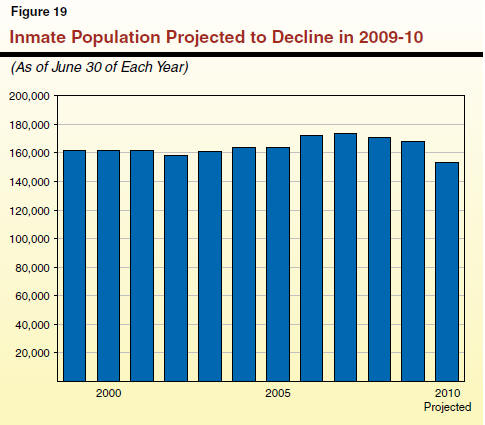
Adult Correctional Health Services. The
budget includes a General Fund augmentation of about $30 million for
compliance with federal court orders and settlements, such as mental
health services under the Coleman case. However, the budget
reflects $180.8 million in General Fund savings from an unallocated
reduction of 10 percent in the federal Receiver’s medical services
operations. In addition, the budget assumes $50 million in savings in
2009–10 from limiting the reimbursement rates paid to private
contractors that provide medical care to inmates outside of prison.
Corrections Capital Outlay. The
budget includes $20 million from the General Fund and $16 million in
lease–revenue bond authority for various CDCR capital outlay projects.
The budget also reverts $20 million of the $300 million General Fund
appropriation initially provided in Chapter 7, Statutes of 2007 (AB
900, Solorio), a measure authorizing additional prison construction, to
the General Fund. The Legislature also approved budget legislation to
make various technical changes to the enacted language of AB 900
intended to help the projects move forward. In signing the budget, the
Governor vetoed statutory language adopted by the Legislature to
prohibit CDCR from encumbering funds for the previously approved
condemned inmate housing complex at San Quentin until specified
conditions were met. This veto is part of a pending legal challenge to
various vetoes to the 2009–10 budget legislation made by the Governor
in July.
Local Assistance Programs
As discussed in
Chapter 2, the Legislature temporarily increased the vehicle license
fee from 0.65 percent to 1.15 percent and dedicated about one–third of
the revenues (0.15 percent, or $497 million in 2009–10) to various
public safety local assistance programs. These monies will in effect
replace General Fund spending for the Juvenile Probation and Camps
Funding Program, the Citizens’ Option for Public Safety program, the
Juvenile Justice Crime Prevention Act program, and local detention
facility subventions (booking fees).
Resources and Environmental Protection
The
2009–10 budget provides about $7.8 billion from various fund sources
for natural resources and environmental programs administered by either
the Natural Resources Agency or the California Environmental Protection
Agency. This is a decrease of $2.1 billion, or 21 percent, when
compared to revised 2008–09 expenditures. Most of this decrease
reflects lower bond expenditures for the budget year, although the
budget still includes a major infusion (around $2.1 billion) of
available bond funds from various resources–related measures. The
budgets also include a combined $1.9 billion from the General Fund.
Figures
20 and 21 compare expenditure totals for resources and environmental
protection programs in 2007–08, 2008–09, and 2009–10. As the figures
show, General Fund expenditures are lower in 2009–10, largely
reflecting much higher–than–average one–time expenditures for emergency
wildland firefighting in 2008–09, due to particularly severe fire
conditions in that year. (This also accounts for much of the decrease
in state operations for resources programs.) The significant decrease
in local assistance and capital outlay for resources programs is
largely due to reduced bond expenditures. For environmental protection
programs, the spending increase for state operations and bond funds
mainly reflects increased spending from Proposition 1B bond funds for
air quality improvements in trade corridors.
|
Figure 20
Resources Programs:
Expenditures and Funding |
|
(Dollars in Millions) |
|
|
|
|
|
Change From
2008-09 to 2009-10 |
|
|
2007‑08 |
2008‑09 |
2009‑10 |
Amount |
Percent |
|
Expenditures |
|
|
|
|
|
|
State operations |
$4,303.2 |
$4,926.1 |
$4,446.1 |
-$480.0 |
-9.7% |
|
Local assistance |
697.2 |
1,402.1 |
744.5 |
-657.6 |
-46.9 |
|
Capital outlay |
363.0 |
1,918.9 |
628.0 |
-1,290.9 |
-67.3 |
|
Totals |
$5,363.4 |
$8,247.1 |
$5,818.6 |
-$2,428.5 |
-29.5% |
|
Funding |
|
|
|
|
|
|
General Fund |
$1,869.4 |
$2,021.0 |
$1,841.7 |
-$179.3 |
-8.9% |
|
Special funds |
2,251.1 |
2,239.0 |
2,060.6 |
-178.4 |
-8.0 |
|
Bond funds |
1,145.5 |
3,748.9 |
1,584.3 |
-2,164.6 |
-57.7 |
|
Federal funds |
97.4 |
238.2 |
332.0 |
93.8 |
39.4 |
|
Totals |
$5,363.4 |
$8,247.1 |
$5,818.6 |
-$2,428.5 |
-29.5% |
|
Figure 21
Environmental
Protection Programs:
Expenditures and Funding |
|
(Dollars in Millions) |
|
|
|
|
|
Change From
2008-09 to 2009-10 |
|
|
2007‑08 |
2008‑09 |
2009‑10 |
Amount |
Percent |
|
Expenditures |
|
|
|
|
|
|
State operations |
$1,584.7 |
$1,260.5 |
$1,799.5 |
$539.0 |
42.8% |
|
Local assistance |
480.3 |
363.1 |
184.6 |
-178.5 |
-49.2 |
|
Capital outlay |
1.4 |
4.2 |
— |
-4.2 |
-100.0 |
|
Totals |
$2,066.4 |
$1,627.8 |
$1,984.1 |
$356.3 |
21.9% |
|
Funding |
|
|
|
|
|
|
General Fund |
$90.9 |
$83.2 |
$73.5 |
-$9.7 |
-11.7% |
|
Special funds |
1,053.2 |
1,143.6 |
1,197.3 |
53.7 |
4.7 |
|
Bond funds |
739.3 |
224.5 |
514.1 |
289.6 |
129.0 |
|
Federal funds |
183.0 |
176.5 |
199.2 |
22.7 |
12.9 |
|
Totals |
$2,066.4 |
$1,627.8 |
$1,984.1 |
$356.3 |
21.9% |
Resources and Environmental Protection Expenditures
Bond Expenditure Summary. The
budget includes about $2.1 billion from a number of bond funds (mainly
Propositions 50, 84, 1B, and 1E) for various resources and
environmental protection programs. Selected highlights of these bond
expenditures are shown in Figure 22.
|
Figure 22
Resources and
Environmental Protection
Bond Expenditures |
|
(In Millions) |
|
Program Area |
Budgeted
Expenditures |
|
Water management and quality (including flood
control projects and CALFED Bay-Delta Program) |
$766 |
|
Air quality improvements in trade corridors |
504 |
|
State and local parks |
454 |
|
Conservation, restoration, and land
acquisition |
345 |
CALFED Bay–Delta Program. The
CALFED Bay–Delta Program is a consortium of 24 state and federal
agencies created to address a number of interrelated water problems in
the state’s Bay–Delta region. The budget provides a total of $297
million in state funds for the CALFED Bay–Delta Program in 2009–10,
including about $16 million of reappropriations. Of this total amount,
the largest program expenditures are for the existing water conveyance
system ($89 million) and levee system integrity ($56 million). Funding
comes mostly from various bond funds ($168 million) and State Water
Project (SWP) funds ($115 million).
Alternative Delta Conveyance.
The Department of Water Resources (DWR) is provided 15 limited–term
positions for the Delta Habitat Conservation and Conveyance Program,
with an estimated cost of $2.6 million (off–budget SWP funds). The
budget act restricts the use of these funds to planning workload
related to the program and prohibits their use for the physical
construction of an “alternative conveyance facility.” This term refers
to infrastructure for the transport of water (perhaps through a new
canal around the Delta) as an alternative to the current system of transporting water
through the Delta.
SWP Positions and Recreation Funding.
Of the 111 positions proposed to be added to SWP in 2009–10, the budget
act includes authority for 49 SWP positions for state operations and
Delta–related projects. The Legislature also rejected the
administration’s proposal to use state funds (fee revenues and bond
funds) to pay for the portion of the SWP’s overall operations as well
as for capital outlay costs that DWR has allocated to recreation.
However, as in past years, the budget includes funding (primarily from
special funds) for operations and maintenance of specific SWP
recreation facilities under the budgets of the Department of Parks and
Recreation (DPR) and the Department of Boating and Waterways.
Federal Economic Stimulus Funding for Water Quality Projects.
The revised state spending plan includes $283 million in federal
economic stimulus monies in 2008–09 and 2009–10 for water quality
improvements. These monies are largely for grants and loans to local
water agencies for wastewater infrastructure, and are administered
through the existing Clean Water State Revolving Fund. The usual state
requirement for local matching funds was waived in order to meet
federal requirements for the use of these funds.
Climate Change. The
budget includes about $48 million (mostly special funds) across ten
state agencies for implementation of the Global Warming Solutions Act
of 2006 (Chapter 488, Statutes of 2006 [AB 32, Núñez]), to reduce the
state’s emission of greenhouse gases (GHGs) to 1990 levels by 2020.
Figure 23 lists the expenditures, number of positions, funding sources,
and activities funded on an agency–by–agency basis for the
implementation of AB 32 in 2009–10. These activities include the
development of the regulations to implement various source–specific
measures to reduce GHGs, and the award of urban forestry management
grants.
|
Figure 23
AB 32 Implementation |
|
2009-10 (Dollars in
Thousands) |
|
Agency |
Positions |
Expenditures |
Fund Source |
Activity |
|
Air Resources Board |
153 |
$32,414 |
Air
Pollution Control Fund (APCF)a |
Develop market-based compliance measures (including cap-and-trade),
Low Carbon Fuel Standard regulations, and vehicular/industrial
measures to create greenhouse gas (GHG) emission reductions. |
|
Forestry and Fire Protection |
8 |
6,876 |
Proposition 84
bond funds |
Award urban
forestry management grants; staff support. |
|
General Services |
5 |
2,936 |
Service Revolving Fund |
Implement Green Building Initiative
and
Sustainability Program. |
|
Secretary for Environmental
Protection |
6 |
1,764 |
General Fund, APCF, Motor Vehicle
Account |
Climate Action Team activities,
including
program oversight and coordination. |
|
Department of Water Resources |
9 |
1,636 |
Proposition 84 bond funds, State
Water Project (SWP) funds |
Evaluate impact of climate change on state’s water supply and flood
control systems; SWP climate change/energy program activities.
|
|
Integrated Waste Managementb |
6 |
1,312 |
Integrated Waste
Management Account |
Develop GHG emission reduction
measures for landfills. |
|
Energy Commission |
5 |
610 |
Energy Resources Programs Account |
Develop GHG emission reduction
measures. |
|
Secretary for Natural Resources |
2 |
425 |
General Fund |
Adopt GHG emissions mitigation
guidelines. |
|
Food and Agriculture |
2 |
343 |
Food and Agriculture Fund |
Develop GHG emission reduction
measures. |
|
Public Utilities Commission (PUC) |
1 |
94 |
PUC Ratepayer Advocate Account |
Monitor PUC implementation of AB 32. |
|
Totals |
205 |
$48,410 |
|
|
|
|
|
a Supported by a
loan from the Beverage Container Recycling Fund, to be re-paid
within three years. |
|
b Funding will be
administered by new Department of Resources Recycling and Recovery
following elimination of the board effective January 2010. |
Assembly Bill 118–Funded Programs. The
budget includes (1) $102 million for financial incentives administered
by the Energy Commission to advance alternative and renewable fuel
vehicle technologies and (2) $44 million for the Air Resources Board
(ARB) to provide grants and loans to owners of heavy–duty diesel
vehicles to retrofit vehicles to achieve early compliance with
regulations requiring reductions in emissions of air pollutants and
GHGs from these vehicles. These expenditures are funded from fee
revenues (smog abatement, vehicle registration, and vessel registration
fees) raised pursuant to Chapter 750, Statutes of 2007 (AB 118, Núñez).
The budget also includes a total of $5 million of AB 118 funds for
Department of Forestry and Fire Protection (CalFire), DPR, and the
Department of Fish and Game to retrofit their on–road diesel vehicles
in compliance with ARB regulations.
Hydrogen Highway.
The Energy Commission has allocated $40 million of its appropriation of
AB 118 monies discussed above to the development of hydrogen refueling
stations. The Governor vetoed budget act language passed by the
Legislature that would have prohibited any expenditure from this
appropriation for hydrogen refueling stations in 2009–10. This veto is
being contested in pending litigation.
Wildland Fire Protection Capital Outlay.
The budget includes $290 million of new lease–revenue bond funding for
fire protection capital outlay projects—primarily to restore or replace
existing facilities.
Emergency Wildland Fire Suppression. The budget act includes $182 million
from
the General Fund that is designated specifically for emergency fire
protection. As has been the case in previous years, the budget act
allows the Director of Finance to augment this amount to pay for
additional fire protection expenses, as needed.
No New Funding Sources for CalFire. The
budget does not include any new sources of funding for CalFire. Both
the administration’s proposal for a 4.8 percent statewide surcharge on
property insurance premiums and the legislative proposal for a fee on
structure owners in State Responsibility Areas were rejected.
General Fund Reduction for State Parks. The
budget includes a $14 million unallocated reduction in General Fund
support for DPR—a decrease of 11 percent from the level of support
contained in the February enacted budget. This includes a veto by the
Governor of $6.2 million that is the subject of pending litigation.
Based on statements by the administration, the reductions will not lead
to the complete closure of any state park in the budget year. A
legislative proposal to replace all General Fund support for DPR with
revenues from a new $15 annual vehicle registration surcharge
(entitling vehicle registrants to free daily access to state parks) was
considered but not adopted.
California Conservation Corps.
The Legislature rejected the Governor’s January budget proposal to
eliminate the California Conservation Corps (CCC) and shift its
functions to local conservation corps (LCCs) over a two–year period.
Instead, the enacted budget includes legislative augmentations totaling
about $15 million for the LCCs—$8.3 million from the Beverage Container
Recycling Fund (BCRF) and $6.7 million from bond funds—for beverage
container litter reduction, workforce training, and other activities.
Beverage Container Recycling Program. Due
to a projected $157 million deficit in the BCRF, the budget reflects
generally proportional reductions to the various programs that are
funded by the BCRF through continuous appropriations (that is, ongoing
appropriations made outside of the budget act). These include reduced
payments to LCCs (see discussion above), to cities and counties for
recycling programs, and to recyclers. The BCRF has now provided a total
of $518 million in outstanding loans to the General Fund and to the Air
Pollution Control Account, including $134 million in additional loans
that are included in the 2009–10 budget.
Rejection of Oil Drilling Proposal. The
Legislature rejected the administration’s proposal to raise revenues by
enacting legislation approving the Tranquillon Ridge offshore
oil–drilling project. The administration estimated that this project,
if approved, could result in state revenues of $100 million in 2009–10
and a total of $1.8 billion over the 14–year lease term of the project.
Energy Expenditures
Federal Economic Stimulus Funding. The
budget package includes $182 million in federal funds—an increase of
about $160 million from 2008–09—for energy–related programs. This
includes state–administered energy efficiency and conservation block
grants (for state and local purposes) and the State Energy Program
(which funds state energy efficiency and renewable energy programs).
Energy Research and Renewable Energy Incentives. The
budget includes $74 million for energy–related research and development
funded through the Energy Commission’s Public Interest Energy Research
Program. It also provides about $69 million for production–based
incentives and purchaser rebates to promote renewable energy under the
Energy Commission’s Renewable Energy Program. This program is funded
from the Renewable Resource Trust Fund, which is supported from utility
ratepayers.
Transportation
The 2009–10
spending plan provides about $17 billion from various fund sources for
transportation programs. This is roughly the same as the overall level
of spending in the prior year, as shown in Figure 24.
|
Figure 24
Transportation Program Expenditures |
|
(Various Fund Sources, in
Millions) |
|
Program/Department |
2007‑08 |
2008‑09 |
2009‑10 |
|
Department of Transportation |
$9,633 |
$12,011 |
$13,592 |
|
California Highway Patrol |
1,729 |
1,834 |
1,881 |
|
Department of Motor Vehicles |
895 |
1,027 |
941 |
|
High-Speed Rail Authority |
17 |
43 |
139 |
|
State Transit Assistance |
306 |
153 |
— |
|
Other expenditures |
537 |
448 |
378 |
|
Totals |
$13,117 |
$15,516 |
$16,931 |
Department of Transportation
The 2009–10
budget plan includes total expenditures of $13.6 billion from various
fund sources for the Department of Transportation (Caltrans), according
to departmental estimates. This level of expenditures is higher than in
2008–09—by about $1.6 billion (or 13 percent). The higher spending
level reflects the planned expenditure of federal stimulus funds on
local roads, and highway repair and maintenance projects. The 2009–10
budget provides approximately $5.7 billion for transportation capital
outlay, $3.6 billion for local assistance, $1.5 billion for capital
outlay support, and about $1.4 billion for highway operations and
maintenance. The budget also provides $512 million for department
administration, $418 million for Caltrans’ mass transportation and rail
program, and $145 million for transportation planning. The balance of
funding goes for program development, legal services, and other
purposes.
Full Funding of Proposition 42.
Consistent with the requirements of Proposition 42, a March 2002 ballot
measure, the 2009–10 budget provides for the transfer of gasoline sales
tax revenue from the General Fund for various transportation purposes.
The total transfer is projected at about $1.4 billion. This amount is
to be allocated as follows:
-
$576 million for the State Transportation Improvement Program to fund state and local transportation projects.
-
$576 million to cities and counties for local streets and roads projects.
-
$288 million to the Public Transportation Account (PTA) for mass transportation purposes.
Repayment of Past Proposition 42 Suspensions. Proposition
1A (the ballot measure with that designation passed by voters in
November 2006), requires that Proposition 42 suspensions that occurred
in 2003–04 and 2004–05 be repaid with interest no later than June 2016.
The budget includes $83 million from the General Fund to partially
repay the outstanding amount. Following this year’s payment, a balance
of about $500 million in Proposition 42 loans (not including interest)
remains outstanding.
Continued Appropriations of Proposition 1B Bond Funds.
Proposition
1B, a ballot measure approved by voters in November 2006, authorized
the issuance of $20 billion in general obligation bonds for state and
local transportation improvements. All Proposition 1B funds are subject
to appropriation by the Legislature. As shown in Figure 25, the 2009–10
budget appropriates a total of about $4.2 billion for various programs.
The funding will mainly be used for capital outlay and local assistance
purposes.
|
Figure 25
2009-10 Appropriation
of Proposition 1B Funds |
|
(In Millions) |
|
Program |
Total |
|
Corridor Mobility Improvement |
$1,351 |
|
Local Streets and Roads |
713 |
|
Trade Corridor Improvement |
490 |
|
Public Transportation Modernization |
477 |
|
Highway 99 Improvement |
431 |
|
Air Quality |
250 |
|
State Local Partnership |
201 |
|
Transit Security |
102 |
|
State Highway Operations and Protection |
78 |
|
State Transportation Improvement |
57 |
|
Local Bridge Seismic |
31 |
|
School Bus Retrofit |
3 |
|
Railroad Crossing Safety |
1 |
|
Port Security |
— |
|
Total |
$4,185 |
|
|
|
Note: Appropriations are through budget act and do not include
statutory appropriations. |
Loan From State Highway Account Would Help General Fund.
The budget loans $135 million from the State Highway Account (SHA) to
the General Fund to help the state’s fiscal condition. This loan would
be repaid no later than June 30, 2012. (The impact to transportation
programs of this loan and the use of transportation funds to help the
General Fund will be reviewed in our 2010–11 budget analysis.)
Special Transportation Programs
Substantial Public Transportation Funds Used to Help General Fund.
The
PTA derives its revenues from diesel sales tax and portions of the
gasoline sales tax, including “spillover.” (Spillover is the amount
that gasoline sales tax revenue at the 4.75 percent rate exceeds the
sales tax revenue amount generated from all other goods at the 0.25
percent rate.) The account also receives a portion of the Proposition
42 gasoline sales tax revenue.
Funds in the PTA are required
statutorily to be used for mass transportation and planning purposes.
Since 2003–04, a portion of the PTA funds have been used each year to
benefit the General Fund. In 2007–08, the Mass Transportation Fund
(MTF) was created to receive a portion of spillover revenues to benefit
the General Fund on an ongoing basis. The budget package directs all
spillover revenues to the MTF to be used for General Fund relief. The
2009–10 budget uses about $1 billion in mass transportation revenues to
benefit the General Fund. This amount includes $652 million from
spillover gasoline sales tax revenues to MTF and $363 million from PTA.
Specifically, the budget plan assumes that the General Fund would be
helped in the following ways:
-
Transportation Bond Debt Service.
The budget uses $652 million in spillover revenues from the MTF to
reimburse the General Fund for debt service on transportation bonds,
including $623 million incurred in prior years and $29 million in
current–year debt service. In addition, the budget provides $225
million in PTA funds to pay for debt service on transportation bonds
incurred in 2009–10.
-
Regional Center Transportation. The budget provides $138 million in PTA funds to pay for the cost of regional center transportation.
-
State Transit Assistance.
The State Transit Assistance (STA) program provides operating
assistance that is distributed to local rail and bus transit operators
on a formula basis. Funding for the program comes from the PTA and
spillover. In February, the Legislature reduced the 2008–09 funding
level for the program by $153 million in order to help achieve General
Fund relief. In addition, Chapter 14 suspended funding for STA for four
fiscal years from 2009–10 through 2012–13.
High–Speed Rail Authority
Funding Levels Increase Due to Passage of Bond Measure.
In November 2008, voters approved a statewide bond measure—Proposition
1A. This measure authorizes the state to sell $9 billion in general
obligation bonds to partially fund the development and construction of
a high–speed train system. The 2009–10 budget provides $139 million in
Proposition 1A bond funds for the California High–Speed Rail Authority
to plan and develop the rail system, with one–half of the funding
available only upon the submittal of a revised business plan by
December 2009. Specifically, the bond funds are budgeted for the
following uses:
- Project–Level Planning and Management.
About $105 million would be spent for contract services to perform
preliminary design and environmental review for the eight segments of
the rail system.
- Program Management and Other Services.
About $27 million would be spent for contract services for overall
program management, as well as roughly $5 million on various other
contracts including ridership/revenue forecasts and financial
consulting services.
· Administrative Costs. About $2 million would be for administrative costs and support of the authority.
California Highway Patrol and Department of Motor Vehicles
The
2009–10 budget provides $1.9 billion to fund California Highway Patrol
(CHP) operations, about $47 million (or 3 percent) more than in
2008–09. The funding includes support for 240 new highway patrol
officers ($25 million), and funds for a new computer–aided officer
dispatch system ($12 million). For Department of Motor Vehicles, the
budget provides $959 million for departmental operations, a reduction
of $67 million (or 6.6 percent) compared to the 2008–09 level due to
the expiration of one–time funding for capital outlay provided in the
prior budget. The budget includes $6.6 million to support a new
multiyear contract for the production of security–enhanced driver
license and identification cards. To cover the cost of the new
contract, driver license fees will increase by $2, beginning 2010. The
budget includes provisional language prohibiting the department’s use
of facial–recognition biometric software as part of the driver license
issuance process. In light of the state’s fiscal condition, the
Legislature rejected approximately $33 million requested by the two
departments for various capital outlay projects.
Motor Vehicle Account (MVA).
To help address the General Fund condition, the 2009–10 budget provides
a one–time transfer of $70 million from the MVA to the General Fund.
Unlike other MVA revenues, these funds are not restricted by Article
XIX of the State Constitution and thus are available for general state
purposes.
Local Government
Overview of Local Government Revenue Shifts
The
budget package provides major General Fund relief by redirecting the
use of two sources of local government funds: (1) property taxes by
borrowing funds under the provisions of Proposition 1A (2004) and (2)
redevelopment dollars. The package establishes a new fund in each
county—the Supplemental Revenue Augmentation Fund (SRAF)—to receive
$3.6 billion of resources related to these sources. Figure 26
summarizes SRAF revenue sources and initial program allocations, as
shown in the budget schedules prepared by the Department of Finance
(DOF).
|
Figure 26
SRAF Revenues and
Initial Allocationsa |
|
(In Millions) |
|
|
|
Sources |
|
Proposition 1A property tax suspension |
$1,935 |
|
Redevelopment/schools fund shift |
1,700 |
|
|
$3,635 |
|
Allocations |
|
|
County Offices of Education |
|
|
Trial courts |
$1,511 |
|
Corrections |
588 |
|
Medi-Cal |
565 |
|
State general obligation bond debt service
(school construction) |
120 |
|
|
$2,785 |
|
Educational Revenue Augmentation Fund |
|
|
K-12 apportionments |
$850 |
|
Total Allocations |
$3,635 |
|
|
|
a The spending plan
gives DOF flexibility to revise SRAF allocations. |
|
SRAF = Supplemental
Revenue Augmentation Fund; DOF = Department of Finance. |
Under the spending plan, county offices of education
serve as state fiscal agents for a wide range of programs.
Specifically, under the direction of DOF, county offices use SRAF
resources to reimburse the state for trial court, correctional, and
other state–funded services and costs in their county. Any resources
remaining in SRAF, after these state reimbursements are made (an
estimated $850 million), are transferred to the county’s Educational
Revenue Augmentation Fund (ERAF) for apportionment to K–12 districts.
The ERAF resources offset state–required spending for education under
Proposition 98.
Proposition 1A Property Tax Suspension
The
budget plan suspends Proposition 1A (2004) and borrows $1.9 billion of
property taxes from cities, counties, and special districts. Under the
Constitution, the funds must be repaid by June 30, 2013. Under the
plan, revenues equal to 8 percent of each local agency’s 2008–09
property tax apportionment (excluding debt levies) are redirected from
the agency to SRAF.
Joint Securitization Option.
The budget plan includes a way to offset losses by local governments
due to the state borrowing. Specifically, the budget plan authorizes a
joint
powers authority to issue “Proposition 1A receivable notes” (backed by
the state’s repayment obligation) and use the proceeds to replace the
revenues diverted from each agency that participates in the
securitization. Under the plan, the state pays the full cost of the
securitization, including interest and debt issuance costs. Local
agencies that do not choose to participate in the securitization would
be reimbursed by the state for their property tax diversion by June 30,
2013, including interest at a rate set by DOF.
Hardship Provisions.
Local agencies facing severe economic difficulties may apply to DOF for
a reduction or elimination of their property tax suspension. If DOF
approves an agency’s hardship petition, any reduced property tax amount
would be reallocated to other agencies in the county so that the total
suspension amount in the county remained unchanged. The department may
not approve suspensions totaling more than 10 percent of the total
suspension amount in a county.
Redevelopment/Schools Fund Shift
The
budget package requires redevelopment agencies to make payments
totaling $1.7 billion (2009–10) and $350 million (2010–11) to K–12
school districts serving students living in or near their redevelopment
areas. Redevelopment agencies deposit these payments into a new county
Supplemental Educational Revenue Augmentation Fund (SERAF) for
allocation to the designated school districts.
These
redevelopment deposits into SERAF, in turn, trigger a shift in school
funds in a manner such that schools would experience no net change in
their financial situation while the state benefits from the
redevelopment deposits. Specifically, county auditors reduce each
school district’s base (“AB 8”) property tax allocations by the amount
the district receives from SERAF. The county auditor deposits these
base school property tax revenues into the county’s SRAF. As described
above, county offices use SRAF resources to reimburse the state for a
variety of programs. All remaining SRAF revenues are shifted to the
county’s ERAF for apportionment to schools.
Other Provisions.
To help redevelopment agencies finance these payments, the budget plan
allows agencies to suspend their contributions to their Low and
Moderate Income Housing Funds or borrow these funds from their parent
city or county. Redevelopment agencies that fail to restore any funds
to their Low and Moderate Income Housing Funds by June 30, 2015,
however, are subject to a 5 percent increase in their required annual
housing set–aside (generally increasing the set–aside from 20 to 25
percent). Agencies that meet their payment obligation under the budget
plan for 2009–10 may extend their time limits for plan effectiveness
and receipt of tax increment revenues by one year.
State–Mandated Local Programs
The
spending plan suspends most non–education mandates, with the exception
of certain mandates relating to law enforcement, election procedures,
open meeting requirements, and tax collection. When the state suspends
a mandate, for one year (1) local governments are not required to
implement its requirements and (2) the state may postpone its
obligations to pay the accumulated mandate bills. The spending plan
also defers a scheduled payment ($88 million) towards retiring the
state’s pre–2004 non–education mandate debt (approximately $1 billion).
Williamson Act Subventions
The spending plan reduced
funding for Williamson Act subventions by 20 percent, or $8 million.
The Governor vetoed the remaining $28 million of Williamson Act funds.
(This veto is subject to the litigation described in Chapter 1.) Under
this program, local governments enter into contracts with landowners to
restrict certain property to open space and agricultural uses. In
return for these restrictions, property owners pay reduced property
taxes. State Williamson Act subventions offset part of these local
government property tax losses.
Other Major Provisions
Employee Compensation
Budget Assumes Savings From Governor’s Three–Day Furlough Order.
Beginning in February, the Governor ordered the furlough of about
200,000 executive agency employees for two days per month, reducing pay
by 9.2 percent. The Governor added an additional furlough day in July,
bringing the total to three days per month and a 13.9 percent reduction
in pay. Currently, nearly all state employees—with limited exceptions,
such as CHP officers and certain CalFire staff—are prohibited from
working on three Fridays per month, resulting in most state offices
being closed. The 2009–10 Budget Act assumes over $2.4
billion ($1.4 billion General Fund) in savings from the Governor’s
furlough orders and related employee compensation savings measures. The
Governor’s furlough orders are under review by the courts in various
suits initiated by state employee unions, the California Public
Employees’ Retirement System (CalPERS), constitutional officers, and
others. Court actions and other matters could affect the actual
expenditure savings generated by furloughs.
Limited Amounts for Increases in Employee Compensation.
While overall employee compensation costs should decline in 2009–10,
prior state employee labor agreements provide for increases in state
health premium contributions for some workers. In particular, state
health contributions for some workers will rise due to an average
increase in CalPERS plan premiums of 2.9 percent in 2010. The budget
bill passed by the Legislature in July included a limited amount—$118
million ($41 million from the General Fund)—for these cost increases
and other costs associated with previous agreements. The Governor
reduced the appropriation as part of his July vetoes to $63 million
($16 million from the General Fund)—with the balance to be funded out
of departmental budgets. As of the date of this publication, 20 of 21
state employee labor agreements have expired. (The exception is the
agreement with the bargaining unit covering CHP officers, which expires
in July 2010.)
Health Plan Funding Holiday Provides Some Relief.
The budget reflects $132 million in savings from an employee and
retiree health plan “premium holiday.” Authorized by the CalPERS board
for its preferred provider organization (PPO) health plans, CalPERS
will waive healthcare contributions from employees, retirees, and
public employers for two months in the fall of 2009 because of excess
reserves in PPO plan accounts.
Rural Health Care Subsidies Eliminated.
The budget package eliminates the Rural Health Care Equity Program,
which subsidized PPO costs for state workers without access to less
expensive health maintenance organization plans, for workers in 20 of
the state’s 21 bargaining units. (An exception continues the program
one more year—to July 2010—for CHP officers.)
Payroll Deferral Shifts One Payday to 2010–11.
The budget package reflects budget savings from moving the final
paycheck of the fiscal year (June 30) to the first day of the following
fiscal year. This facilitates $938 million in one–time General Fund
savings in 2009–10.
Reorganizations and Consolidations
Assumes $50 Million in Savings.
The budget package assumes $50 million in General Fund savings from the
reorganization, consolidation, and elimination of several departments,
boards, and committees. Figure 27 shows actions included in the
package.
|
Figure 27
Reorganizations and Consolidations |
|
Entity |
Action |
Result |
|
Integrated Waste Management Board |
Elimination |
Moves board
functions and recycling functions of the Department of Conservation
to new Department of
Resources Recycling and Recovery |
|
Bureau of Naturopathic Medicine |
Elimination |
Creates committee
in Osteopathic Medical Board to
provide oversight of natural medicine industry |
|
Board of Geologists and
Geophysicists |
Elimination |
Moves function to
Board for Professional Engineers
and Land Surveyors |
|
Structural Pest Control Board |
Reorganization |
Moves board from
DCA to the Department of Pesticide Regulation |
|
Bureau of Home Furnishings and Thermal Insulation and Bureau of
Electronic and Appliance Repair |
Consolidation |
Consolidates both
boards under DCA |
|
Inspection and Maintenance
Review Committee |
Establishment of
Sunset Date |
Forces review of
committee and sets up possible
elimination by 2012 |
|
Various IT programs in DTS,
Telecommunications Division in DGS, and OIS |
Consolidation |
Moves programs and some IT oversight authority
to the Office of the Chief Information Officer |
|
|
|
DCA = Department of
Consumer Affairs; IT = information technology; DTS = Department of
Technology Services;
DGS = Department of General Services; OIS = Office of Information
Security. |
Information Technology
Information Technology (IT) Savings. The
Legislature adopted control language requiring the Office of the State
Chief Information Officer to save $100 million General Fund from
statewide reductions to IT budgets. Savings may come from renegotiating
IT contracts and consolidation of IT purchases and services, among
other actions.
Funding for 21st Century Project Reprocurement.
After experiencing numerous difficulties with its prime vendor, the
State Controller’s Office (SCO) project staff terminated the vendor
contract in January 2009 and began working on a re–procurement
strategy. The SCO staff are currently involved in a two–stage
procurement to secure a new prime vendor. The budget includes about $25
million to fund further project activities.
Financial Information System of California (FI$Cal).
The budget plan includes spending authority of $80 million from the
General Fund to continue project activities to build FI$Cal. Project
staff indicate only about $35 million of that funding will be spent in
2009–10—about $2 million from a General Fund appropriation with the
remainder coming from a General Fund loan. Additionally, a budget act
provision requires the project to report to the Legislature on the
outcome of its competitive multiple stage procurement to secure a prime
vendor.
Procurement Process Changes.
A measure in the July budget package loosens prior contracting
restrictions that prevented a firm from bidding on an IT project for
which it had previously held a consulting contract pertaining to the
development of that project’s scale and scope. The legislation also
allows departments to withhold from vendors less than the previously
required amount of 10 percent of the contract prices for certain goods
and services until their final delivery and acceptance.
Cost–of–Living Increases
The
budget package includes statutory language that eliminates automatic
COLAs for CalWORKs and SSI/SSP grants and automatic increases for state
operations (such as the state courts). Instead, decisions on COLAs
would be made on an annual basis (generally as part of the budget
process).
State Buildings and Surplus Property
The
budget package makes a number of changes to the way in which the state
manages its office buildings and surplus property. The budget
authorizes the administration to enter into additional leases of state
property and “lease–back” contracts for state buildings. Under these
lease–back contracts, the state would sell or offer a long–term lease
on a state building to a private entity. Generally, these types of
contracts would involve the state paying higher costs over several
decades (for rent) in exchange for an up–front cash payment from the
private entity. In addition, the package authorizes the administration
to sell the Orange County fairgrounds.
| Acknowledgments The Legislative Analyst's Office (LAO) is a nonpartisan
office which provides fiscal and policy information and advice to the Legislature.
|
LAO Publications To request publications call (916) 445-4656. This report and others, as well as
an E-mail subscription service, are
available on the LAO's Internet site at www.lao.ca.gov. The LAO is located at 925
L Street, Suite 1000, Sacramento, CA 95814.
|
Return to LAO Home Page