October 2007
California Spending Plan 2007–08
The Budget Act and Related Legislation
Contents
Key Features of the 2007–08 Budget
Budget Overview
Evolution of the Budget
Corrections Capital Outlay
Budget–Related Legislation
Expenditure Highlights
Proposition 98
K–12 Education
Higher Education
Health
Social Services
Judiciary and Criminal Justice
Transportation
Resources and Environmental Protection
2006 Bond Package
Employee Compensation and Retirement
Other Major Provisions
Key Features of the 2007–08 Budget
The 2007–08 budget focuses on closing the gap between its General Fund revenues and expenditures for the fiscal year. The enacted budget, with the Governor’s vetoes, assumed that the state would spend no more than it received in 2007–08 and end the year with a $4.1 billion reserve. Since the budget’s enactment, however, the state has made a one–time payment to the state’s teacher retirement system of $500 million in response to a court decision. In addition, as discussed in more detail below, a number of additional risks will potentially further reduce the reserve.
Budget Overview
Total State Spending
The state spending plan for 2007–08 includes total budget expenditures of $131.5 billion. This includes $102.3 billion from the General Fund and $29.2 billion from special funds. As Figure 1 shows, this is an increase of 4.3 percent from 2006–07, primarily due to increases in special fund spending. The state also expects to spend $14 billion in bond funds for infrastructure during the fiscal year. This is an increase of almost $5 billion (51 percent) from the previous year—which reflects the beginning rollout of spending from $42.7 billion in general obligation bonds approved by voters in November 2006.
Figure 1
2007-08 Budget Package
Total State Expenditures |
(Dollars in Millions) |
Fund Type |
Actual
2005-06 |
Estimated 2006-07 |
Enacted
2007-08 |
Change From 2006-07 |
Amount |
Percent |
General Fund |
$91,592 |
$101,656 |
$102,258 |
$602 |
0.6% |
Special funds |
22,716 |
24,403 |
29,213 |
4,810 |
19.7 |
Budget Totals |
$114,308 |
$126,059 |
$131,471 |
$5,412 |
4.3% |
Selected bond funds |
5,304 |
9,293 |
14,072 |
4,779 |
51.4 |
Totals |
$119,612 |
$135,352 |
$145,543 |
$10,191 |
7.5% |
The General Fund Condition
Figure 2 summarizes the estimated General Fund condition for 2006–07 and 2007–08 under the budget plan. (As described in more detail below, the General Fund condition will be affected by several developments that have occurred since the signing of the budget. The largest such action is the payment of $500 million to the state’s teacher retirement system.)
2006–07. The figure shows that 2006–07 began the year with a fund balance of $10.5 billion. This large balance is related to (1) the sale of over $11 billion in deficit–financing bonds and other forms of budgetary borrowing in previous years and (2) the carryover of unanticipated revenues received in 2005–06 and earlier. The state spent an estimated $6 billion more during the year than was received in revenues. Based on the 2007 May Revision revenue estimates, the year ended with a fund balance of $4.8 billion. However, revenues collected for the months of May and June were about $600 million less than the May Revision estimate. Revenue totals for 2006–07 will be finalized later in the fall.
2007–08. The budget plan projects revenues of $102.3 billion in 2007–08, an increase of 6.5 percent from 2006–07. The plan authorizes expenditures of an equal amount, an increase of 0.6 percent. At the time of enactment, this left the General Fund with a year–end reserve of $4.1 billion. The enacted budget reserve, however, was subsequently reduced by $500 million due to the teacher retirement payment. The reserve is made up of two components:
- $2.6 billion in the state’s traditional reserve—known as the Special Fund for Economic Uncertainties.
- $1.5 billion in the Budget Stabilization Account, which was established when voters approved Proposition 58 in March of 2004. The budget act provides authority for the administration to transfer these funds to the General Fund during the fiscal year if needed.
Figure 2
2007-08 Budget
General Fund Condition |
(In Millions) |
|
2006‑07 |
2007‑08 |
Prior-year fund balance |
$10,454 |
$4,811 |
Revenues and transfersa |
96,013 |
102,262 |
Total resources available |
$106,467 |
$107,073 |
Expenditures |
$101,656 |
$102,258 |
Ending fund balance |
$4,811 |
$4,815 |
Encumbrances |
745 |
745 |
Reserveb |
$4,066 |
$4,070 |
Budget Stabilization Account (BSA) |
$472 |
$1,494 |
Reserve for economic uncertainties |
$3,594 |
$2,575 |
|
a 2006-07 amount includes $472 million and 2007-08 amount includes $1.023 billion in General Fund revenues transferred to BSA, which the administration excludes from its revenue totals. These different treatments do not affect the bottom-line reserve shown. |
b Under the budget's revenue assumptions, the state would need to appropriate from the reserve roughly $400 million more each in 2006-07 and 2007-08 for Proposition 98 spending. |
Programmatic Features of the 2007–08 Budget
Spending by Program Area. Figure 3 shows General Fund spending by major program area for 2005–06 through 2007–08. Specific program area features include:
- K–12 education spending remains the single largest area of the budget, accounting for 38 percent of the General Fund total. Education funding is expected to grow by $921 million (2.4 percent). The bulk of new spending is for a 4.53 percent cost–of–living adjustment (COLA).
- The fastest growing area of the budget is criminal justice, which is budgeted to increase $770 million (6.3 percent). This reflects costs to comply with various health care court cases and implement Proposition 83 (Jessica’s Law).
- The second fastest growing area is higher education, expected to grow by $631 million (5.6 percent). Under the budget plan, the University of California, California State University, and California Community Colleges segments all receive base augmentations to address salaries and other cost increases, as well as augmentations to fully fund anticipated enrollment growth.
- Transportation funding declines by 50 percent—reflecting a one–time $1.4 billion loan repayment made in 2006–07 associated with Proposition 42 transfers that had been deferred from earlier years. (Not reflected in the figure is special fund support for transportation, which increased by 19 percent over the same period.)
Figure 3
2007-08 Budget Package
General Fund Spending by Major Program Area |
(Dollars in Millions) |
|
Actual 2005-06 |
Estimated 2006-07 |
Enacted 2007-08 |
Change From 2006-07 |
Amount |
Percent |
K-12 Education |
$36,425 |
$38,523 |
$39,445 |
$921 |
2.4% |
Higher Education |
10,232 |
11,310 |
11,941 |
631 |
5.6 |
Health |
17,124 |
19,542 |
20,276 |
734 |
3.8 |
Social Services |
9,218 |
9,876 |
9,443 |
-434 |
-4.4 |
Criminal Justice |
10,243 |
12,154 |
12,924 |
770 |
6.3 |
Transportation |
1,699 |
2,986 |
1,481 |
-1,505 |
-50.4 |
All other |
6,651 |
7,264 |
6,749 |
-515 |
-7.1 |
Totals |
$91,592 |
$101,656 |
$102,258 |
$602 |
0.6% |
Budget Solutions. In order to address the state’s operating shortfall, the budget includes the following major solutions:
- Proposition 98. The Governor’s May Revision revenue forecast (assumed by the Legislature in enacting the budget) results in a higher Proposition 98 guarantee for 2006–07 than included in the 2006–07 Budget Act. Due to uncertainty regarding this revenue projection (particularly as it relates to final 2006–07 revenues), the budget does not provide $411 million in 2006–07 Proposition 98 “settle–up” funds. Carrying this lower base into 2007–08, the budget also assumes the 2007–08 minimum guarantee will be lower by $427 million, generating additional General Fund savings. If the May Revision revenue forecast proves accurate, therefore, the state would owe more than $800 million in additional funds to education under the Proposition 98 minimum guarantee. These funds would come from the budget’s reserve.
- Transportation. The budget uses almost $1.3 billion in Public Transportation Account funds to reduce General Fund expenditures. The budget plan also assumes $596 million in General Fund benefit for 2008–09.
- Revenue Assumptions. The budget package assumes $1 billion in one–time revenues from the sale of EdFund, the state’s nonprofit student loan guaranty agency. The budget also assumes $293 million in new General Fund revenues from amended tribal gambling compacts. The budget package accelerates the transfer of $600 million in tobacco securitization funds to the General Fund. These tobacco funds were originally scheduled to be transferred in 2008–09 and 2009–10. Moreover, the budget benefits from an additional $357 million in higher–than–expected revenues from the securitization.
- Social Services Savings. The budget achieves ongoing savings of about $247 million from suspending a California Work Opportunity and Responsibility to Kids (CalWORKs) COLA for one year and permanently delaying the state Supplemental Security Income/State Supplementary Program (SSI/SSP) COLA for five months.
- Governor’s Vetoes. The Governor vetoed $703 million in General Fund expenditures from the budget passed by the Legislature. The largest veto was a $332 million reduction to the state’s Medi–Cal Program based on the administration’s assertion that earlier estimates were too high. The second largest veto was a $72 million reduction in the amount provided for higher state employee compensation costs. The administration expects departments to pay for these higher employee compensation costs from existing funds.
Budget–Related Developments Since Enactment
Since the budget’s enactment in August, there have been a number of other budget–related developments.
Teachers’ Retirement Payment. In 2003–04, as a budget balancing solution, the state reduced by $500 million a statutory annual appropriation to the purchasing power protection program of the California State Teachers’ Retirement System (CalSTRS) on a one–time basis. In September 2007, the Third District Court of Appeal ruled that the reduction unconstitutionally violated the contractual rights of system members. Consequently, the administration repaid the $500 million using the underlying statutory appropriation. The amount of interest owed on the payment is still being determined and will require a future appropriation to be paid. The interest owed could total in the range of $200 million.
Public Transportation Fund Lawsuit. On September 6, 2007, the state was sued by public transit advocates arguing that the budget’s redirection of more than $1 billion in transportation funds to benefit the General Fund is illegal. The case has not yet been heard.
Fifth Indian Compact Approved. The budget package assumes receipt of $293 million in new General Fund revenues from amended compacts negotiated between the Governor and five Southern California Indian tribes. At the time of the budget’s enactment, only four of these compacts had been approved by the Legislature. On September 7, the Legislature approved SB 941 (Padilla) which ratifies the Fifth compact between the state and the San Manuel Band of Mission Indians.
General Fund Spending Over Time
Figure 4 shows General Fund expenditures from 1990–91 through 2007–08 both in current dollars and as adjusted for population and inflation (that is, in real per capita terms). The figure illustrates that after growing rapidly in the late 1990s, real per capita spending fell significantly throughout the first part of the 2000s. From 2004–05 through 2006–07, real per capita spending rebounded somewhat. For 2007–08, the rate of inflation is expected to be greater than the authorized expenditure increase of 0.6 percent—resulting in a drop in real per capita spending.
Out–Year Impacts of the 2007–08 Budget
As described above, many of the budget solutions are of a one–time nature. Based on the 2007–08 budget plan’s policies, therefore, the state would once again face operating shortfalls of more than $5 billion in both 2008–09 and 2009–10. In addition, the CalSTRS payment has already reduced the reserve by $500 million. Other optimistic assumptions and legal risks threaten to reduce the reserve even further. A lower reserve will reduce the carryover funds available to help solve these future budget problems. We will be updating our fiscal projections for 2007–08 and future years in November 2007, when we release our annual publication California’s Fiscal Outlook.

Evolution of the Budget
In this section, we highlight the major developments in the evolution of the 2007–08 budget, beginning with the Governor’s original January budget proposal and ending in August 2007, when the budget was signed into law.
Governor’s January Proposal
The 2006–07 budget benefited from surging revenues to significantly increase education spending and prepay budgetary debt. In contrast, the outlook for the 2007–08 budget was more troubling. Although 2007–08 revenues were forecast to outpace revenue growth in 2006–07, 2007–08 expenditures were expected to exceed available revenues. As a result, the January budget proposed more than $3 billion in budgetary solutions. Even after these solutions, the plan assumed that budget–year expenditures would exceed revenues by almost $1 billion and relied on part of the carryover reserve to make up the difference. It projected a reserve of $2.1 billion at the end of the budget year.
Major Proposals. Figure 5 (next page) summarizes the administration’s major proposals from January. The administration’s major proposal for increased spending was a $595 million supplemental payment towards the retirement of the state’s deficit–financing bonds earlier than scheduled. The administration’s largest budget solutions were:
- A redirection of $1.1 billion from transportation purposes to benefit the General Fund.
- The assumption of more than $500 million in new revenues from amended tribal gambling compacts.
- $496 million in savings from changes to the CalWORKs program, including placing new time limits and sanctions on children whose parents cannot or will not comply with participation requirements.
May Revision
Worse Budget Outlook. Between January and May, the administration’s view of the budget outlook worsened by more than $2 billion. While its revised revenue forecast projected a similar amount of tax revenues in 2006–07 and 2007–08 combined, more of the revenues were now expected in 2006–07. Consequently, the state’s minimum funding requirement under Proposition 98 went up by almost $500 million over the two years combined. In addition, lower property tax receipts in 2005–06 increased state General Fund obligations for K–12 education by about $300 million. In other program areas, higher correctional officer costs from an arbitration decision and higher firefighter costs pushed expenditures upwards. In addition, the administration shifted the expected sale of the pension obligation bonds from 2007–08 to 2008–09—eliminating a $525 million budget–year solution. (A court ruling against the state in July 2007 later forced the administration to drop this proposal altogether.)
Figure 5
Key Elements of Governor’s January Proposal
2007-08 Budget |
|
Deficit-Financing Bonds |
• In addition to the $1.5 billion payment from the sales tax through the “triple flip,” provided a $1 billion payment from the Budget Stabilization Account. |
• Provided an additional $595 million supplemental appropriation for the
accelerated payoff of the bonds. |
Proposition 98 Education |
• Implemented 2006‑07 program expansions, but did not propose new expansions for 2007‑08. Provided Proposition 98 support for CalWORKs-related child care, resulting in General Fund savings. |
• Rebenched the minimum guarantee related to a home-to-school transportation proposal, thus lowering it in future years. |
Transportation |
• Used $1.1 billion from the Public Transportation Account to replace General Fund spending in three areas: Proposition 98 funding for home-to-school transportation; transportation services provided by regional centers; and debt service on general obligation bonds issued for transportation projects. |
Social Services |
• Suspended the July 1, 2007 COLA for CalWORKs grants, and placed new time limits and sanctions on children whose parents cannot or will not comply with CalWORKs participation requirements. |
Revenues |
• Assumed $506 million in new General Fund revenues from amended gambling compacts with five tribes. |
• Assumed sale of pension obligation bonds in 2007‑08 with a General Fund benefit of $525 million. |
New Solutions. In response to the worsening budget outlook, the administration proposed more than $2 billion in new solutions, which are summarized in Figure 6. The largest proposed solution was the sale of EdFund, at an estimated price of $1 billion. The May Revision took advantage of $357 million in higher–than–expected revenues from the state’s securitization of its tobacco settlement funds. In addition, the administration accelerated the General Fund transfers of $600 million of these funds that were originally scheduled to be transferred in future years. The largest proposed reduction in program services was a suspension of the statutory January 2008 SSI/SSP COLA, reducing state costs by $185 million. With these solutions, the May Revision projected a reserve of $2.2 billion.
Figure 6
May Revision—Key Differences From January
2007-08 Budget |
|
Proposition 98 Education |
• Modified home-to-school transportation proposal to eliminate the rebenching of the minimum guarantee. |
• Provided more than $400 million in 2006‑07 settle-up funds to reflect a higher estimated minimum guarantee due to revised revenue estimate. |
Higher Education |
• Proposed selling EdFund to a private buyer for an estimated $1 billion. |
Transportation |
• Proposed to use $200 million in additional transportation funds for General Fund benefit through a modified home-to-school transportation proposal. |
Social Services |
• Suspended the statutory January 2008 SSI/SSP COLA. |
Revenues |
• Reduced estimate of tribal gambling revenues by $192 million. |
• Counted $957 million in additional and accelerated revenues from tobacco
securitization. |
• Shifted sale of pension obligation bonds to 2008‑09 due to legal delays. |
Lease of Lottery. The administration also proposed a long–term lease of the State Lottery to a private vendor. Although suggesting that the one–time benefit of such a lease could total in the billions of dollars, the May Revision made no budgetary assumptions regarding the revenue benefit.
Final Budget
Following the May Revision, the Senate and Assembly took actions on the administration’s revised proposals, and the budget was sent to the Conference Committee to reconcile the differences between the houses. The adopted Conference Committee version of the budget had a reserve of $2 billion. It made a number of key changes to the May Revision including:
- Rejection of the $595 million supplemental payment on the deficit–financing bonds.
- Rejection of the Governor’s proposed CalWORKs time limits and sanctions.
- A reduced General Fund benefit from the redirection of transportation funds.
- Reduced 2006–07 Proposition 98 expenditures by not providing settle–up funds.
After the close of the Conference Committee, the Governor and the Legislature continued budget negotiations. On July 20, the Assembly passed the Conference budget bill along with a supplemental bill that made amendments to the plan. After another month, on August 21, the Senate passed these bills along with additional amendments to the package. After making $703 million in General Fund vetoes promised during negotiations, the Governor signed this budget package on August 24. Figure 7 summarizes the key differences between the enacted budget compared to the May Revision. In comparison to the Conference version of the budget, key negotiated changes were:
- A reserve of $4.1 billion, compared to $2 billion.
- Reducing 2007–08 General Fund Proposition 98 expenditures by assuming a lower minimum guarantee in 2006–07 carried forward to 2007–08.
- Increasing the use of transportation funds to benefit the General Fund to the May Revision’s level.
- Delaying the SSI/SSP COLA by five months.
Figure 7
Final Budget—Key Differences From May Revision
2007-08 Budget |
|
Reserve |
• Increases reserve by almost $2 billion, to $4.1 billion. |
Deficit-Financing Bonds |
• Rejects proposal to make $595 million supplemental payment for outstanding deficit-financing bonds. |
Proposition 98 Education |
• Does not provide 2006‑07 settle-up payment and builds off this lower base for its assumption of the 2007‑08 minimum guarantee. |
Transportation |
• Uses $1.3 billion in transportation funds for General Fund benefit, but modifies the administration’s home-to-school transportation proposal. |
Social Services |
• Delays a SSI/SSP COLA for five months, rather than suspend it for a year. |
• Rejects the administration’s proposals for CalWORKs time limits and
sanctions. |
Revenues |
• Deleted pension obligation bonds from spending plan due to appeals court
decision against the state. |
The Legislature took no action related to the leasing of the Lottery. Additional key features of the enacted budget package are described in the “Expenditure Highlights” section.
Corrections Capital Outlay
As the Legislature was considering the 2007–08 budget, it was also reviewing a proposal by the Governor to authorize $9 billion in lease–revenue bonds for prison construction. The plan would have dedicated $5 billion for the expansion of state prison capacity and $4 billion for local jail beds for adult offenders. After several months of negotiations, the Legislature passed a somewhat different prison construction package, which the Governor signed into law in May as Chapter 7, Statutes of 2007 (AB 900, Solorio). Chapter 7 appropriates $300 million from the General Fund to improve and expand infrastructure capacity (such as water, electrical, or sewage capacity) at existing prison facilities, as well as $50 million from the General Fund to improve rehabilitation and treatment programs for prison inmates and parolees. Chapter 7 also authorizes $7.4 billion in lease–revenue bonds. The lease–revenue bonds authorized by Chapter 7 are intended to add approximately:
- 12,000 beds and programming space at existing prison facilities in order to replace “temporary beds” currently in use.
- 16,000 reentry facility beds for inmates who are within one year of being released to parole.
- Medical, dental, and mental health treatment space and housing for approximately 8,000 inmates.
- 13,000 beds at local jail facilities.
The costs of the lease–revenue bonds appropriated by Chapter 7 will largely be incurred in subsequent budget years as these bonds are sold and paid off.
The Legislature also approved SB 99 (Senate Budget and Fiscal Review Committee) which, if signed into law, would in effect earmark $146 million of these funds for a centralized health facility at the state prison at San Quentin ordered by the court–appointed Receiver currently overseeing the department’s inmate medical system.
Budget–Related Legislation
In addition to the 2007–08 Budget Act, the budget package includes a number of related measures enacted to implement and carry out the budget’s provisions. Several such measures were passed at the end of the legislative session. Figure 8 lists these bills.
Figure 8
2007‑08 Budget and Budget-Related Legislation |
Bill Number |
Chapter |
Author |
Subject |
Budget Package |
|
|
SB 77 |
171 |
Ducheny |
Budget bill (conference report) |
SB 78 |
172 |
Ducheny |
Budget bill revisions |
SB 79 |
173 |
Committee on Budget and Fiscal Review |
Transportation |
SB 80 |
174 |
Committee on Budget and Fiscal Review |
Education |
SB 81 |
175 |
Committee on Budget and Fiscal Review |
Corrections |
SB 82 |
176 |
Committee on Budget and Fiscal Review |
Justice |
SB 84 |
177 |
Committee on Budget and Fiscal Review |
Human services |
SB 85 |
178 |
Committee on Budget and Fiscal Review |
Resources |
SB 86 |
179 |
Committee on Budget and Fiscal Review |
General government |
SB 87 |
180 |
Committee on Budget and Fiscal Review |
Taxation |
SB 88 |
181 |
Committee on Budget and Fiscal Review |
Proposition 1B |
SB 89 |
182 |
Committee on Budget and Fiscal Review |
EdFund |
SB 90 |
183 |
Committee on Budget and Fiscal Review |
Information technology |
SB 91 |
184 |
Committee on Budget and Fiscal Review |
EdFund |
SB 97 |
185 |
Dutton |
California Environmental Quality Act |
AB 199 |
186 |
Budget Committee |
General government revisions |
AB 201 |
187 |
Budget Committee |
Proposition 1B revisions |
AB 203 |
188 |
Budget Committee |
Health |
Post-Budget Legislation |
|
AB 191 |
Pending |
Budget Committee |
Corrections cleanup |
AB 192 |
Pending |
Budget Committee |
General government cleanup |
AB 193 |
Pending |
Budget Committee |
Transportation spillover |
AB 194 |
Pending |
Budget Committee |
Governor’s vetoes modified |
AB 195 |
Pending |
Budget Committee |
Health clinic services |
AB 196 |
Pending |
Budget Committee |
Proposition 1B—local streets |
Expenditure Highlights
Proposition 98
Proposition 98 funding constitutes about three–fourths of total funding for K–14 education (K–12 schools and community colleges). In this section, we review Proposition 98 funding in the 2007–08 Budget Act. We also review various related issues, including the effect of General Fund revenue changes on total Proposition 98 funding levels, the additional funding provided to K–12 schools and community colleges as a result of a recent settlement, and the K–14 education credit card. In a following section, we discuss the total K–12 budget in more detail, and in the “Higher Education” section, we discuss the total community college budget in more detail.
The 2007–08 budget package includes $57.1 billion in total ongoing Proposition 98 funding for K–14 education. This represents an increase of $2.1 billion, or 3.9 percent, from the revised 2006–07 spending level. General Fund support covers about one–third of this increase ($697 million) and local property tax revenue covers the remainder ($1.4 billion). Figure 1 (next page) displays Proposition 98 funding, by source, for K–12 schools, community colleges, and other affected agencies. (In addition to the totals displayed in Figure 1, $300 million is being allocated to K–12 schools and community colleges as a result of a recent settlement agreement. (Please see box on page 16 for additional detail.)
Budget Relies Heavily on One–Time and Special Fund Monies. As shown in Figure 1, the budget contains $2.1 billion in new ongoing Proposition 98 funding for 2007–08. This year–to–year growth is insufficient to cover all 2007–08 K–14 baseline costs. For example, providing cost–of–living adjustments (COLAs) to existing K–12 and community college programs at the statutory rate (4.53 percent) costs roughly $2.4 billion. To fund baseline costs without appropriating more than the Proposition 98 minimum guarantee, the Legislature used other funding sources to supplement the ongoing Proposition 98 budget. In particular, the budget package uses a considerable amount of one–time and special fund monies ($567 million) to support baseline costs. The state, therefore, will enter 2008–09 with a large “hole” in the ongoing Proposition 98 budget. (The shortfall involves only K–12 programs and is discussed in more detail in the K–12 education section. The budget fully funds all community college baseline costs.)
Figure 1
Ongoing Proposition 98 Budget Summary |
(In Millions) |
|
2006-07
Revised |
2007-08
Budget Act |
Change |
Amount |
Percent |
K-12 Education |
|
|
|
|
General Fund |
$36,637 |
$37,203 |
$565 |
1.5% |
Local property tax revenue |
12,346 |
13,594 |
1,248 |
10.1 |
Subtotals |
$48,983 |
$50,797 |
$1,813 |
3.7% |
California Community Colleges |
|
|
|
|
General Fund |
$4,030 |
$4,157 |
$127 |
3.2% |
Local property tax revenue |
1,857 |
2,052 |
195 |
10.5 |
Subtotals |
$5,886 |
$6,209 |
$322 |
5.5% |
Other Agencies |
$114 |
$119 |
$5 |
4.3% |
Totals, Proposition 98 |
$54,984 |
$57,125 |
$2,141 |
3.9% |
General Fund |
$40,781 |
$41,479 |
$697 |
1.7% |
Local property tax revenue |
14,203 |
15,646 |
1,443 |
10.2 |
Revenue Fluctuations Affect 2006–07 Proposition 98 Decision Making. Estimates of state revenues fluctuated notably throughout 2006–07, which, in turn, affected estimates of the 2006–07 Proposition 98 minimum guarantee. Most significantly, the Governor’s May Revision revenue forecast resulted in a higher estimated Proposition 98 obligation for 2006–07 compared to earlier estimates. Specifically, the May Revision forecast assumed the state would have to provide $411 million in additional Proposition 98 “settle up” to meet the minimum guarantee for 2006–07 (see Figure 2). Although the Legislature assumed the May Revision revenue forecast in enacting the overall 2007–08 budget, it chose to use more recent revenue estimates for the purposes of Proposition 98. At the time most Proposition 98 decisions were being made, both state General Fund revenues and the Proposition 98 minimum guarantee for 2006–07 appeared down relative to the May Revision. Based on the updated revenue projections, the state no longer appeared to owe Proposition 98 settle–up for 2006–07. As a result, the budget act does not contain the $411 million settle–up payment proposed in the May Revision.
Depending on Final 2006–07 Revenues, K–14 Funding Could Increase. If finalized revenue figures for 2006–07 result in a higher minimum guarantee than the level provided in the budget, the state will automatically owe a settle–up payment for 2006–07. The state will need to provide this funding through subsequent budget action. In contrast, if finalized revenue figures come in lower than projections, the state cannot reduce Proposition 98 spending for 2006–07 because the fiscal year has already ended. Instead, the state will have spent more than required by the Proposition 98 minimum guarantee.

Decisions for 2006–07 Affect Estimated Proposition 98 Minimum Guarantee for 2007–08. Because the Proposition 98 requirement for 2007–08 builds off the 2006–07 spending level, not providing the settle–up payment in that year also lowers the minimum guarantee for 2007–08. Specifically, as shown in Figure 2, this action reduced the 2007–08 minimum guarantee by $427 million compared to the May Revision. As suggested above, if final 2006–07 revenues come in higher than anticipated, then the estimated Proposition 98 obligation for 2007–08 also would be correspondingly higher.
K–14 Credit Card Update
From 2001–02 through 2003–04, the state achieved substantial budget solution by delaying certain Proposition 98 spending. Specifically, the state decided to defer significant education costs ($1.3 billion) to the subsequent fiscal year. (Rather than a budget reduction, these deferrals resulted in districts receiving some state funds a few weeks later than normal.) In addition, the state delayed reimbursement of outstanding mandate cost claims. (At that time, the state had outstanding claims dating back to 1995–96.) In 2003–04, as a further budget solution, the state also made reductions to K–12 revenue limits. We have referred to these various delays as the education “credit card.”
Still Carrying Almost $1.9 Billion on Education Credit Card. Figure 3 displays the balance of the credit card in 2005–06 and 2006–07 and our estimate of the amount owed in 2007–08. The figure shows that the education credit card balance was reduced by almost $1 billion in 2006–07, with the substantial repayment of K–12 mandate claims and full restoration of K–12 revenue limits.
Figure 3
Update on the K-14 Education Credit Card Balance |
(In Millions) |
|
2005-06 |
2006-07 |
2007-08 |
Deferrals |
|
|
|
K-12 |
$1,103 |
$1,103 |
$1,103 |
Community Colleges |
200 |
200 |
200 |
Mandates |
|
|
|
K-12a |
$900 |
$275 |
$435 |
Community Colleges |
100 |
90 |
115 |
K-12 revenue limits |
$300 |
— |
— |
Totals |
$2,603 |
$1,668 |
$1,853 |
|
a Excludes claims that are unlikely to be paid as the result of court decisions or recent determinations by the Commission on State Mandates. |
In contrast, the 2007–08 budget package increases the credit card balance—making no progress toward paying down outstanding deferral and mandate obligations, providing no funding for new K–12 mandate costs, and providing little funding ($4 million) for community college mandate costs. (We expect K–14 claims for mandated local programs to reach about $185 million in 2007–08, which adds to the $365 million still owed from prior years.) As a result, the credit card will grow to almost $1.9 billion in 2007–08.
Additional Funds Provided Through First Settlement Payment
The Quality Education Investment Act (QEIA), established by Chapter 751, Statutes of 2006 (SB 1133, Torlakson), formalized a settlement agreement between the Governor and the California Teachers Association. Consistent with the lawsuit, QEIA appropriated a total of roughly $2.7 billion over a seven–year period beginning in 2007–08. (As a result of this legislation, QEIA payments are not part of the annual budget process.) As required in QEIA, the state is allocating $300 million to K–12 schools ($268 million) and community colleges ($32 million) in 2007–08. These funds are to be used primarily for class size reduction in grades 4 through 12 and for expanding career technical education in community colleges. Whereas roughly 500 low–performing K–12 schools already have been selected to receive K–12 QEIA funding, the funding allocation process for the community college QEIA share is still being determined. |
K–12 Education
Figure 4 displays all significant funding sources for K–12 education in 2006–07 and 2007–08. The figure shows that funding from all sources totals $68.9 billion in 2007–08, an increase of $2.4 billion, or 3.6 percent, from 2006–07. Ongoing K–12 Proposition 98 spending in 2007–08 totals $50.8 billion, an increase of $1.8 billion, or 3.7 percent, from 2006–07. Spending from all other fund sources totals $18.1 billion, an increase of $568 million, or 3.2 percent, from 2006–07. (Not shown in Figure 4 is a substantial amount of Proposition 98 funding that was unspent in prior years and is reappropriated for various K–12 purposes.)
Figure 4
K-12 Education Budget Summary |
(Dollars in Millions) |
|
Revised
2006-07 |
Proposed
2007-08 |
Changes From 2006-07 |
|
Amount |
Percent |
K-12 Proposition 98 |
|
|
|
|
State General Fund |
$36,637 |
$37,203 |
$565 |
1.5% |
Local property tax revenue |
12,346 |
13,594 |
1,248 |
10.1 |
Subtotals |
($48,983) |
($50,797) |
($1,813) |
(3.7%) |
Other Funds |
|
|
|
|
General Fund |
|
|
|
|
Teacher retirement |
$876 |
$1,496a |
$620 |
70.9% |
Bond payments |
1,764 |
2,179 |
415 |
23.5 |
Other programs |
548 |
401 |
(147) |
-26.8 |
State lottery funds |
904 |
904 |
— |
— |
Federal funds |
7,111 |
6,692 |
(419) |
-5.9 |
Other |
6,347 |
6,446 |
98 |
1.5 |
Subtotals |
($17,550) |
($18,118) |
($568) |
(3.2%) |
Totals |
$66,533 |
$68,915 |
$2,381 |
3.6% |
|
Totals may not add due to rounding. |
a This total includes the estimated K-12 share of a one-time $500 million California State Teachers’
Retirement System payment resulting from a recent court order. |
One–Time Adjustments Contribute to Large Increase in Teachers’ Retirement Costs. As shown in Figure 4, the state’s annual K–12 contribution to the California State Teachers’ Retirement System (CalSTRS) increases significantly in 2007–08—by $620 million, or 71 percent. The magnitude of this increase is due to two one–time adjustments—a settle–up for prior–year accounting errors that resulted in a reduction to payments in 2006–07 and a court settlement that increased the state’s contribution in 2007–08. (See the “Retirement” section for further discussion of this court settlement.) Each of these factors has the effect of increasing the year–to–year change. Absent these one–time adjustments, CalSTRS contributions increase at a rate of roughly 4.2 percent, reflecting typical growth in teacher payroll.
Budget Reflects Decrease in Federal Funds for K–12 Education. The budget includes $6.7 billion in federal funds for K–12 education in 2007–08, a decrease of $419 million from the prior year. Over one–half of this reduction results from the budget action to increase Proposition 98 support for child care by $269 million and redirect a like amount of federal funds to non–K–12 programs. Other large decreases include $50 million resulting from a decline in Stage 2 child care caseload and a $50 million reduction to the federal Title I program.
Budget Includes Increased Payments for School Facility Bonds. Figure 4 also shows an increase of $415 million in debt service due to recent investments the state has made in school facilities through Proposition 47 (2002) and Proposition 55 (2004). These measures authorized the state to sell a total of $21.4 billion in bonds for school facilities. Proposition 1D, approved by voters in November 2006, authorized an additional $7.3 billion for school facilities. These bonds, however, have not yet been sold and so are not reflected in Figure 4. (See the “2006 Bond Package” section for further discussion of Proposition 1D.)
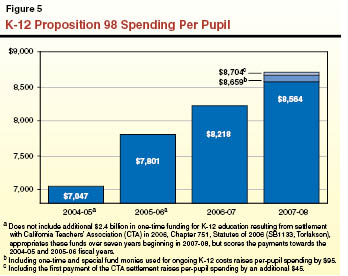
Per–Pupil Spending Continues to Increase. As shown in Figure 5, recent budgets resulted in substantial increases in per–pupil Proposition 98 spending. Specifically, per–pupil Proposition 98 spending increased by $1,171, or 16.6 percent, between 2004–05 and 2006–07 (or 8.3 percent in inflation–adjusted dollars). Based on the 2007–08 Budget Act, ongoing Proposition 98 per–pupil spending is $8,564—an increase of $346, or 4.2 percent, over the prior year. Including the one–time and special funds used to support ongoing costs (a total of $567 million), per–pupil spending grows to $8,659—an increase of $441, or 5.4 percent, above 2006–07. If the first Quality Education Investment Act payment also is included, per–pupil funding further grows to $8,704—an increase of $486, or 5.9 percent, above 2006–07.
Ongoing Funding
Figure 6 displays major changes in ongoing K–12 funding from the revised 2006–07 budget. As shown, the budget provides $1.8 billion in new ongoing Proposition 98 funding.
Major funding changes include:
- Growth and COLA ($2.1 Billion). The budget includes $2.1 billion to provide a 4.53 percent COLA for revenue limits and most categorical programs (including both statutory and discretionary COLAs). The budget also reflects a net of $11 million in savings due to estimates that statewide attendance will decline by 0.48 percent in 2007–08 compared to revised estimates for the preceding year.
- Child Care Shift ($269 Million). The budget increases the Proposition 98 share of Stage 2 California Work Opportunity and Responsibility to Kids (CalWORKs) child care funding by $269 million. This is simply a shift in funding source and does not affect total monies available for child care. Previously, this portion of the state’s child care program was supported with federal funds. Shifting this share to Proposition 98 allows those federal dollars to be used for other related costs previously covered by the state, thereby resulting in a like amount of state General Fund savings.
- School Meals ($24.9 Million). The budget increases the school meals reimbursement rate by 4.7 cents—for a total 2007–08 reimbursement rate of 21 cents per meal. The rate increase is linked to new statutory requirements that school districts improve the quality of the meals they serve.
- High Priority Schools Grant Program (HPSGP) (–$100 Million). The budget recognizes savings due to schools from the first cohort beginning to exit the program and no new cohorts being funded. Full funding is provided for all remaining program participants.
Figure 6
Ongoing K-12
Proposition 98 Funding |
(In Millions) |
|
|
Major Changes |
|
Cost-of-living adjustments |
$2,122.8 |
Child care funding shift |
269.0 |
School meals |
24.9 |
State median income adjustment |
6.8 |
Early Mental Health Initiative |
5.0 |
Preschool wrap-around care |
5.0 |
Other/baseline adjustments |
57.5 |
Growth |
-11.0 |
High Priority Schools Grant Program |
-100.0 |
Ongoing shortfall |
-566.6 |
Total Changes |
$1,813.4 |
One–Time Funding
In addition to ongoing Proposition 98 funding, the budget provides $700 million in one–time and special funds for K–12 education. This funding comes from four sources:
- Proposition 98 Reversion Account ($249 Million). Reappropriates funds that were appropriated for K–14 education in prior years but not used.
- Emergency Repair Program ($250 Million). Transfers unused funds back to Proposition 98 Reversion Account, then reappropriates for new purposes. Funds were previously set aside for emergency facility needs at low performing schools as part of the Williams v. California settlement. Budget control language stipulates that funds be returned to the program if it experiences higher–than–anticipated costs in 2007–08.
- Prior–Year HPSGP Funds ($102 Million). Reappropriates unused funding from prior years to support program in 2007–08.
- Public Transportation Account ($99 Million). Funds portion of school transportation program. The account is funded by gasoline and diesel sales tax revenue that must be used for mass transportation and planning purposes.
One–Time Funds Used to Backfill Ongoing Shortfall. As mentioned earlier, ongoing Proposition 98 funding falls $567 million short of what is required to support the budget’s ongoing K–12 expenditures. Specifically, the budget created ongoing shortfalls in the Home–to–School Transportation, HPSGP, and Deferred Maintenance programs—meaning the budget provided less ongoing Proposition 98 funding than needed to fully cover associated ongoing costs. As shown in the top one–half of Figure 7, the budget uses one–time and special fund monies to backfill the shortfalls. With these additional monies, the three programs are fully funded—meaning base costs as well as cost increases associated with growth and COLA are covered. However, the significant use of one–time funds means the state will enter 2008–09 with a large hole in the ongoing K–12 budget.
Figure 7
K-12 Spending From One-Time and Special Funds |
(In Millions) |
|
Amount |
One-Time/Special Fund Monies Used for Ongoing Purposes: |
|
Home-to-School Transportation backfill |
$349.1a |
Deferred maintenance backfill |
115.5 |
High Priority Schools Grant Program backfill |
102.0 |
Total—Ongoing Purposes |
$566.6 |
One-Time Monies Used for One-Time Purposes |
|
Emergency Repair Program |
$100.0 |
Charter school facilities grants |
18.0b |
Teacher Credentialing Block Grant |
8.8 |
Community Day School deficiency |
4.1 |
High-Speed Network technology refresh |
1.9 |
Reviews of state-administered districts |
0.4 |
Total—One-Time Purposes |
$133.2 |
Grand Total—One-Time/Special Fund Spending |
$699.8 |
|
a Of this total, $250 million is from the Emergency Repair Program (shifted back through the
Proposition 98 Reversion Account) and $99.1 million is from the Public Transportation Account. |
b Appropriated in Chapter 215, Statutes of 2007 (SB 20, Torlakson). |
Other One–Time Spending. The bottom one–half of Figure 7 shows how the remaining one–time funds are used. The budget plan includes $100 million for emergency facility repairs, $18 million for charter school facilities, and roughly $15 million to support four other existing programs.
K–12 Vetoes
As shown in Figure 8, the Governor vetoed $12 million in K–12 expenditures—most of which involved federal funds. The largest veto was $7.1 million for District Assistance and Intervention Teams (DAITs) that would work with districts that face sanctions under the federal accountability system. The Governor’s veto message expressed a desire to withhold funding until an evaluation of the effectiveness of a DAIT pilot project had been completed.
Several Legislative Packages Undone. While most of the vetoes involved relatively small amounts of funding (often less than $500,000), taken together they represented notable reductions to or the entire elimination of, larger legislative packages. For example, the Governor vetoed almost $1 million for various legislative efforts aimed at better serving English learners. Similarly, the Governor vetoed almost $3 million for various legislative efforts to improve services for students attending alternative schools. Other vetoes also eliminated initiatives involving low–performing schools and special education.
Figure 8
Governor’s Vetoes—K-12 Education |
(In Thousands) |
|
Amount |
Fund Type |
Staffing |
Low-Performing Schools |
|
|
|
District Intervention and Assistance Teams |
$7,100 |
Federal ongoing |
— |
Staff to implement corrective actions |
350 |
Federal ongoing |
4 positions |
Alternative Schools |
|
|
|
Technical assistance for English learners |
$1,600 |
Federal one-time |
4 positions |
Technical assistance for special education students |
1,050 |
Federal one-time |
— |
Incarcerated youth coordinator |
133 |
General Fund ongoing |
1 position |
English Learners (EL) |
|
|
|
Evaluation of EL best practices pilot project |
$500a |
Federal one-time |
— |
Pilot project for EL instructional materials |
300 |
Federal one-time |
— |
EL professional development program |
120 |
General Fund ongoing |
1 position |
Outreach to non-English speaking parents |
50 |
Federal one-time |
— |
Special Education |
|
|
|
Learning disabilities best practices study |
$400 |
Federal one-time |
— |
Evaluation of dispute resolution services |
150 |
Federal one-time |
— |
Other |
|
|
|
Support for highly qualified teachers |
$198 |
Federal ongoing |
6 positions |
Study of poverty indicators |
125 |
Federal one-time |
— |
Total |
$12,076 |
|
|
|
|
a Reduced from $1 million. |
|
Higher Education
The budget provides a total of $11.3 billion in General Fund support for higher education in 2007–08 (see Figure 9). This reflects an increase of $475 million, or 4.4 percent, above the amount provided in 2006–07. As shown in the figure, the budget provides the University of California (UC) with $3.3 billion in General Fund support, which is $191 million, or 6.2 percent, more than the 2006–07 level. For the California State University (CSU), the budget appropriates $3 billion in General Fund support, which is an increase of $176 million, or 6.2 percent.
The budget provides the California Community Colleges (CCC) with $4.2 billion in General Fund support for 2007–08, which is $39 million more than 2006–07. (All but about $30 million of this amount counts toward Proposition 98.) However, CCC also receives more than $2 billion in local property tax revenue that is interchangeable with General Fund support for program purposes. When General Fund and local property tax support are combined, CCC’s Proposition 98 funding increases by $322 million, or 5.5 percent, from the prior year.
The budget also provides $873 million in General Fund support to the California Student Aid Commission (CSAC). This funding, which supports the state’s Cal Grant and other financial aid programs, is $70 million, or 8.7 percent, above the 2006–07 level.
Figure 9
Higher Education General Fund Support |
(Dollars in Millions) |
|
2006-07 |
2007-08 |
Amount |
Percent |
University of California |
$3,083.4 |
$3,273.9 |
$190.6 |
6.2% |
California State University |
2,810.4 |
2,985.9 |
175.5 |
6.2 |
California Community Collegesa |
4,148.7 |
4,187.3 |
38.6 |
0.9 |
Student Aid Commission |
802.9 |
873.0 |
70.0 |
8.7 |
Hastings College of the Law |
10.7 |
10.6 |
—b |
— |
California Postsecondary Education Commission |
2.2 |
2.2 |
— |
— |
Totals |
$10,858.2 |
$11,332.9 |
$474.7 |
4.4% |
|
a Excludes more than $2 billion in local property tax revenue under Proposition 98. |
b Less than $50,000. |
UC and CSU
General Fund Base Increases. Both university systems received General Fund base augmentations of 4 percent, amounting to $117 million for UC and $109 million for CSU. Although generally intended to address salaries and other cost increases, the segments’ use of these augmentations is unrestricted.
Student Fees. Student fees are set by the governing boards of the respective university systems. For 2007–08, the UC Regents and the CSU Trustees have approved fee increases of 7 percent and 10 percent, respectively. The enacted state budget assumes these fee increases will provide additional revenue of $105 million for UC and $98 million for CSU. Because fee revenue is unrestricted, it effectively provides additional base increases to the segments’ budgets. When the fee increases and General Fund base increases are combined, UC’s base funding increases by 4.5 percent and CSU’s base funding increases by 5.6 percent.
Enrollment Growth. Both university systems received funding for about 2.5 percent enrollment growth, which is expected to accommodate all likely enrollment demand. Enrollment funding augmentations include $52.9 million for an additional 5,000 full–time equivalent (FTE) students at UC and $64.4 million for an additional 8,355 FTE students at CSU. Funding for these students is determined using a methodology adopted by the Legislature in 2006–07 for determining the marginal cost of serving each additional student. For the second year in a row, the Legislature rejected a different methodology proposed by the Governor.
Student Academic Preparation (Outreach). The Legislature rejected the Governor’s proposal to reduce General Fund support for student academic preparation programs by $19.3 million at UC and $7 million at CSU. With these proposed cuts restored, the budget funds these programs at $31.3 million for UC and $52 million for CSU. The Governor vetoed language that would have required UC to report on its use of this funding and the effectiveness of the programs. However, the Governor’s veto message indicates that he is nevertheless instructing UC to comply with the reporting requirement to the extent resources permit. The Governor did not veto a similar reporting requirement for CSU.
UC Research Programs. The Legislature rejected the Governor’s proposals to quadruple state funding for UC’s Institutes for Science and Innovation from $4.8 million to $20 million. It also rejected the Governor’s proposed $5 million augmentation to support a high–speed computer development project for which UC was also seeking federal grant funding. However, the Legislature did approve $70 million in lease–revenue bond funding for a new alternative energy research facility at UC Berkeley. (This project is described in the Capital Outlay section, below.) The Legislature also rejected the Governor’s proposal to eliminate $6 million in General Fund support for UC’s Labor Institutes.
Nursing Programs. The budget package includes augmentations for expanding enrollment of registered nursing students. These new enrollment slots are provided on top of both segments’ regular growth allocations, and the funding rate for these students is higher than the regular marginal cost amount. For UC, the 2007–08 Budget Act provides an augmentation of $757,000 to fund 57 FTE students in the entry–level master’s program. (This program is available to students that already hold a bachelor’s, or higher, degree in a non–nursing field.) The budget also provides $3.6 million to fund an additional 340 nursing enrollment slots in CSU’s bachelor’s degree program.
Governor’s Vetoes. The Governor vetoed two legislative augmentations to UC’s budget, including $1.5 million for agricultural research and $1.5 million for oceanographic research. He also vetoed $500,000 that had been included in his January proposal to help fund a UC–Mexico research facility in Mexico City.
California Community Colleges
The budget provides CCC with $4.2 billion in General Fund support for 2007–08, which is $39 million more than the revised 2006–07 level. Virtually all of CCC’s General Fund support counts toward the state’s Proposition 98 expenditures, as does CCC’s local property tax revenue. Total Proposition 98 support for CCC in 2007–08 is $6.2 billion, which is 10.9 percent of total Proposition 98 appropriations.
Base Budget Increase. The budget includes $263 million to fund a 4.5 percent base increase for CCC. This increase follows the same statutory formula used to calculate the K–12 COLA. The base budget increase applies to CCC’s general apportionments and selected categorical programs.
Enrollment Growth. The budget reflects two key adjustments for CCC enrollment. First, base enrollment funding was reduced by $80 million to account for recent enrollment declines that have left many slots unfilled. (Even after this reduction, the CCC system retains funding for an estimated 12,000 enrollment slots that were unfilled in 2006–07.) Second, CCC received an augmentation of $108 million to fund new enrollment growth of 2 percent, or about 22,000 FTE students. When remaining unused enrollment capacity from 2006–07 is combined with funded growth for 2007–08, CCC could accommodate a total of 34,000 additional FTE students in 2007–08.
Student Fees. The budget package makes no change to student fee levels, which remain at $20 per unit. These fees are expected to generate $285 million in revenue for the CCC system. Another $224 million in potential fee revenue will be waived as a result of the CCC’s fee waiver program for needy students.
Basic Skills Programs. The budget includes a permanent redirection of $33.1 million in base funding for basic skills enhancements. This funding had previously been available as categorical funding to districts that enrolled students in basic skills courses beyond their established enrollment caps. (Basic skills courses include precollegiate classes such as elementary mathematics and English.) However, as no district currently exceeds its enrollment cap, this funding could not be used for its intended purpose.
The Governor’s May Revision proposed that this funding be redirected to a “student success” initiative that targeted basic skills students. The Legislature rejected the proposal and instead funded an alternative “basic skills initiative” that allocated money differently. The Governor vetoed the funding, but it was subsequently restored through a trailer bill that addressed some of the concerns expressed in the Governor’s veto message.
In addition to this ongoing funding for the basic skills initiative, another $33.1 million in one–time carryover funding from the prior year is available to the CCC system in 2007–08 for similar purposes. The Governor’s May Revision had proposed that these funds be reverted to the Proposition 98 Reversion Account, but the Legislature rejected that proposal.
Noncredit Instruction. Chapter 631, Statutes of 2006 (SB 361, Scott), created a mechanism for increasing the funding rate for noncredit courses that advance career development or college preparation. The 2006–07 Budget Act included $30 million to increase the funding rate for such courses to $3,092 per FTE student, while all other noncredit courses received $2,626 per FTE student. For 2007–08, the Legislature added $13.8 million to further increase the funding rate for these “enhanced” noncredit courses. However, this funding was vetoed by the Governor.
Nursing Education. The community colleges received a base augmentation of $5.2 million to provide a variety of programs (such as tutoring and academic counseling) to reduce attrition among nursing students. In addition, the budget provides $12.1 million in one–time funds—$8.1 million for nursing and other health–related equipment and $4 million to create new nursing programs at four additional campuses.
Governor’s Vetoes. In addition to the vetoes discussed above, the Governor vetoed the following legislative reappropriations from the Proposition 98 Reversion Account:
- $4 million for the Part–Time Faculty Health Insurance Program.
- $1.5 million for a construction training program.
California Student Aid Commission
The budget includes $873 million in General Fund support for CSAC. Almost all of this funding is to support anticipated costs of the Cal Grant programs, the Assumption Program for Loans in Education (APLE), and other student financial aid programs.
Loan Forgiveness Programs. For the third year in a row, the Legislature rejected the Governor’s proposal to restrict 600 APLE awards for the exclusive use of students enrolled in math and science teacher programs at UC and CSU. In addition, the budget package did not include proposed legislation that would have extended the National Guard APLE program’s sunset date of July 1, 2007. As a result, no new awards can be made for this program.
The Legislature adopted provisional language authorizing CSAC to make 100 regular State Nursing Assumption Program of Loans for Education (SNAPLE) awards plus 100 additional SNAPLE awards for nursing students who agree to work in specified state facilities. The Legislature also authorized 100 warrants for the Public Interest Attorney Loan Repayment Program. While it was created several years ago, no warrants have ever been authorized for this program. The Governor vetoed the language authorizing these warrants, as well as the $100,000 the Legislature had appropriated for administrative costs.
Sale of EdFund. The budget package assumes the sale of EdFund, which is a nonprofit public benefit corporation that acts on behalf of CSAC to administer federal loan guarantee programs. The budget assumes that the state will receive $1 billion for this sale, representing a major component of the Governor’s proposed budget solutions. With the sale of EdFund, it is expected that CSAC would relinquish its status as California’s federally designated guarantor for the Federal Family Education Loan Program.
In anticipation of EdFund’s sale, the budget ceases the recent practice of supporting CSAC’s administrative costs with funding generated by EdFund’s activities. To replace this lost revenue, the May Revision proposed a General Fund augmentation of $20.3 million. The Legislature augmented this amount by an additional $3.6 million to maintain the prior–year’s level of funding for the California Student Opportunity and Access Program (Cal–SOAP). The Governor vetoed $2.2 million of this augmentation.
Capital Outlay
As discussed in the “2006 Bond Funding” section of this report, the enacted budget provides the three segments with $1.3 billion in proceeds from the Kindergarten–University Public Education Facilities Bond Act of 2006. This funding supports a variety of capital outlay projects at the three segments. The Legislature made several changes to the Governor’s proposal for spending these funds, including:
- A $68 million reduction to proposed “telemedicine” projects, due to inadequate justification for several projects.
- An appropriation of $10 million for a new Life Sciences Research and Nursing Education facility at a private university (Charles R. Drew University). Provisional language requires formal agreements between UC and the university before the funds can be released.
In addition to funding from the 2006 bond act, the budget includes $105 million for higher education capital outlay from earlier bond acts. Finally, the budget appropriates $70 million in lease–revenue bond proceeds for the construction of an energy research facility at UC Berkeley. That facility will also be supported by a grant from BP (formerly British Petroleum). In budget hearings, the Legislature expressed concern about how the institute would be organized and what BP’s role would be. Because UC and BP had not yet executed an agreement that would address these questions, the Legislature added provisional language preventing the release of funds until after the agreement is signed and provided to the Legislature for review.
Health
The 2007–08 budget plan provides about $20.3 billion from the General Fund for health programs. This is an increase of about $734 million, or 3.8 percent, compared to the revised prior–year spending level, as shown in Figure 10. Several key aspects of the budget package are discussed below and summarized in Figure 11.
Figure 10
Health Services Programs
General Fund Spending |
(Dollars in Millions) |
|
|
|
Change |
|
2006‑07 |
2007‑08 |
Amount |
Percent |
Medi-Cal—local assistance |
$13,621 |
$14,270 |
$650 |
4.8% |
Department of Developmental Services |
2,550 |
2,645 |
95 |
4.0 |
Department of Mental Health |
1,875 |
1,931 |
56 |
3.0 |
Healthy Families Program—local assistance |
362 |
399 |
37 |
10.0 |
Department of Public Health |
— |
391 |
391 |
— |
Department of Health Care Services—local assistance
excluding Medi-Cala |
521 |
163 |
-358 |
-69.0 |
Department of Health Care Services—state operationsb |
269 |
141 |
-128 |
-48.0 |
Department of Alcohol and Drug Programs |
296 |
294 |
-2 |
-1.0 |
Emergency Medical Services Authority |
29 |
13 |
-17 |
-57.0 |
All other health services |
19 |
29 |
10 |
56.0 |
Totals |
$19,542 |
$20,276 |
$734 |
3.8% |
|
a 2006‑07 figure includes expenditures for public health local assistance which transferred to the new Department of Public Health effective
July 2007. |
b 2006‑07 figure includes expenditures for public health state operations which transferred to the new Department of Public Health effective
July 2007. |
Note: May not total due to rounding. |
Figure 11
Major Changes—State Health Programs
2007‑08 General Fund Effect |
(In Millions) |
|
|
Medi-Cal |
|
Governor's veto to reduce program spending |
-$332 |
Increase rates for managed care plans to reflect new rate-setting methodology |
54 |
Governor's veto to reduce funding for managed care plans |
-53 |
Reduce reimbursement rates for drug ingredients |
-39 |
Increase funding for county administration to comply with new
federal eligibility law |
25 |
Exempt certain minors from new federal eligibility law |
20 |
Governor’s veto to delay SB 437 enrollment changes |
-13 |
Governor’s veto to eliminate outreach grants to enroll children |
-10 |
Public Health |
|
Expand efforts to investigate occurrences of foodborne illnesses |
$1 |
Department of Developmental Services |
|
Use Public Transportation Account funds for regional center transportation services |
-$129 |
Department of Mental Health |
|
Governor's veto of funding for Integrated Services for Homeless Mentally Ill Program |
-$55 |
Address prior-year deficiency in Early and Periodic Screening,
Diagnosis and Treatment program |
87 |
Implement Proposition 83 (Jessica's Law) and SB 1128 (Alquist) |
32 |
Department of Alcohol and Drug Programs |
|
Reduce spending on Proposition 36 drug programs |
-$25 |
Medi–Cal
The 2007–08 budget provides about $14.3 billion from the General Fund ($37 billion all funds) for Medi–Cal local assistance expenditures. This amounts to about a $650 million, or 5 percent, increase in General Fund support for Medi–Cal local assistance. This increase would have been greater except for combined Governor’s vetoes of $416 million General Fund from the budget. In his veto messages, the Governor indicated that $332 million of this reduction is based on historical data showing that on average, over the last three fiscal years, Medi–Cal expenditures have fallen short of estimated levels. However, if expenditures exceed the revised level, the state would most likely be obligated to continue to provide Medi–Cal services and to pay the associated costs.
Major Cost Factors. The net increase in expenditures primarily reflects: (1) increases in managed care provider rates, (2) lower drug costs, (3) increases in county administration costs due to changes in federal law, and (4) ongoing growth in base costs and caseloads. Specifically, the Medi–Cal Program is assumed to grow by about 50,000 cases, or 0.8 percent, in 2007–08 to a total of 6.6 million average monthly users.
Changes in Medi–Cal Managed Care Provider Rates. The budget plan includes $54 million General Fund for rate adjustments to Medi–Cal managed care plans as determined by a new rate setting methodology which will be applied to rates established beginning August 1, 2007. The Governor vetoed $53 million General Fund, the same amount that was approved by the Legislature to “hold harmless” certain managed care plans that would have otherwise received a rate reduction under the new rate setting methodology.
Drug Cost Savings. The budget plan includes savings of almost $39 million General Fund due to reductions in the amount Medi–Cal will reimburse pharmacies for certain drug ingredients. It is anticipated that the reduction in drug ingredient payments will bring them more in line with the actual cost of drug ingredients to pharmacies. The change in reimbursements to pharmacies is consistent with recent changes in federal law and regulations. In order to help ensure that pharmacies continue to participate in Medi–Cal after their reimbursements for certain drug ingredients are reduced, the Legislature adopted statutory language to allow for an adjustment in the dispensing fee paid to pharmacies.
County Administration. The budget plan includes increased funding for county administration costs due mainly to program growth and adjustments to account for increased costs. The budget plan also includes about $25 million General Fund for one–time and ongoing costs for implementation of the federal Deficit Reduction Act (DRA) citizenship verification requirements.
Minor Consent. The budget plan includes $20 million General Fund to backfill a loss of federal funds. California will not require minors who independently seek certain health care services to show proof of citizenship and personal identification. Because such documentation is now required by the federal DRA, the state will not receive its usual federal share of funding for services provided to these beneficiaries.
Additional Governor’s Vetoes. In addition to the vetoes described above, the Governor vetoed Medi–Cal funding in two other significant areas.
- Senate Bill 437 Implementation—Chapter 328, Statutes of 2006 (SB 437, Escutia), enacted various changes to enrollment procedures for Medi–Cal and the Healthy Families Program (HFP), including the establishment of a two–year pilot program for self–certification of income for Medi–Cal applicants. The Governor vetoed $13 million General Fund budgeted for Chapter 328, indicating in his veto message that his intent is to delay implementation by one year.
- Children’s Outreach Initiative—The 2006–07 budget provided the initial funds for efforts to expand children’s enrollment in Medi–Cal and HFP, including grants for counties to conduct outreach programs. The Governor vetoed $10 million General Fund included by the Legislature for 2007–08 to continue these grants.
Establishment of the Department of Public Health
Effective July 1, 2007, Chapter 241, Statutes of 2006 (SB 162, Ortiz), created the new Department of Public Health (DPH) and the Department of Health Care Services (DHCS) from the existing Department of Health Services (DHS). The creation of a separate DPH is intended to elevate the visibility and importance of public health issues. It is also intended to result in increased accountability and improvements in the effectiveness of DPH programs and DHCS programs by allowing each department to administer a narrower range of activities and focus on their respective core missions.
The DPH will administer a broad range of public and environmental health programs to prevent illness in, and promote the health of, the public at large. In contrast, DHCS will deliver health care services to eligible individuals, through the state’s Medicaid program (known as Medi–Cal in California) and through other programs, such as the Genetically Handicapped Persons Program and the California Children’s Services Program. As intended by Chapter 241, the creation of the two new departments did not result in increased expenditures for state operations in 2007–08.
In order to create DPH, the administration reclassified over 50 positions (such as sanitary engineer, health physicist, and others) to administrative positions to staff the new department. The reclassification was done to adhere to the intent of Chapter 241 to remain position neutral. In order to help mitigate the potential adverse programmatic effects of redirecting program staff to administrative functions, the Legislature restored 11 program positions at DPH that were funded by special funds or federal funds. The Governor vetoed the restoration of these positions indicating his intent to ensure that the creation of the new DPH remains budget neutral as intended by Chapter 241.
Additionally, the Legislature took action to increase the fiscal accountability and transparency of DPH. Chapter 188, Statues of 2007 (AB 203, Committee on Budget)—the Health Trailer Bill—requires the Department of Finance (DOF) to revise the Governor’s budget document display for DPH to include more detailed information about past year, current year, and budget year expenditures for each branch in the department. It also requires DPH to provide detailed expenditure information for certain major programs.
Public Health Programs
The 2007–08 budget provides about $390 million from the General Fund ($3.1 billion all funds) for support of public health programs. The Legislature adopted statutory language requiring more accountability in budgeting for the new DPH in order to ensure that it will be able to better exercise fiscal oversight in the future. Specifically, the amounts budgeted for each branch within DPH have to be identified by the administration in budget documents starting in 2008–09.
Foodborne Illness. The budget plan provides almost $1 million for DPH to expand its existing efforts to investigate foodborne illnesses and to provide additional emergency outbreak investigation capacity. These additional resources should increase DPH’s capability to investigate foodborne illnesses, obtain and review food processors’ records, review growing and harvesting practices on farms, and embargo contaminated products.
Healthy Families Program
The 2007–08 budget provides about $399 million from the General Fund ($1.1 billion all funds) for local assistance under the HFP. This reflects an increase of about $94 million all funds ($36.5 million General Fund), or almost 10 percent, in annual spending for the program. This growth is primarily due to increases in caseload and provider rates.
Department of Developmental Services
The budget provides $2.6 billion from the General Fund ($4.4 billion all funds) for services to individuals with developmental disabilities in developmental centers (DCs) and regional centers (RCs). This amounts to an increase of about $95 million, or 3.7 percent, in General Fund support over the revised prior–year level of spending.
Community Programs. The 2007–08 budget includes a total of $2.2 billion from the General Fund ($3.6 billion all funds) for community services for the developmentally disabled, an increase in General Fund resources of about $108 million over the revised prior–year level of spending. The growth in community programs is due mainly to increases in caseload, costs, and utilization of RC services. The budget continues several, mostly temporary, actions to hold down community program costs.
The budget plan includes an allocation of $129 million from the Public Transportation Account (PTA) in lieu of General Fund support to provide certain transportation services to RC clients. If this allocation from the PTA had not been included in the budget, General Fund expenditures for community services for 2007–08 would have grown by about $237 million above the prior–year spending level.
Agnews Developmental Center Closure. The budget continues to support plans to close Agnews DC and place many of its clients in community programs by June 2008.
Department of Mental Health
The budget provides about $1.9 billion from the General Fund ($4.8 billion all funds) for mental health services provided in state hospitals and in various community programs. This is an increase of about $56 million from the General Fund compared to the revised prior–year level of spending.
Community Programs. The 2007–08 budget includes about $777 million from the General Fund ($3.5 billion all funds) for local assistance for the mentally ill, a decrease of about $73 million in General Fund support compared to the revised prior–year level of spending.
Integrated Services for Homeless Mentally Ill Program. The Governor vetoed almost $55 million General Fund for Integrated Services for Homeless Mentally Ill, effectively eliminating all funding for the program. In his veto message the Governor indicated that counties could choose to restructure the program to meet the needs of the counties’ homeless population using other county funding sources, such as federal funds, realignment funds, or Proposition 63 funds.
Early and Periodic Screening Diagnosis and Treatment (EPSDT). The budget provides about $454 million General Fund for support of EPSDT, an increase over the prior–year adjusted spending level of almost $48 million or 12 percent. This increase is due mainly to increases in caseload and utilization of services. The increase also reflects modifications to the estimating methodology to eliminate adjustments that generally caused estimates to understate costs in prior years. The modifications to the estimating methodology were recommended by the DOF’s of State Audits and Evaluations which reviewed the Department of Mental Health’s (DMH’s) estimating methodology in light of significant prior–year deficiencies.
The budget provides about $87 million General Fund as the first of three annual payments to reimburse counties for costs from prior years for EPSDT. The prior–year deficiency for the fiscal years 2003–04 through 2005–06, totaling about $260 million, is attributed to several factors including misestimating of EPSDT claims and different accounting methodologies employed by DMH and DHS in conjunction with a technical fund shift that occurred in 2006–07.
Senate Bill 1128 and Proposition 83 (Jessica’s Law). Recent legislation, Chapter 337, Statutes of 2006 (SB 1128, Alquist), and the passage in November of 2006 of Proposition 83, also known as Jessica’s Law, increased the DMH workload related to screening, evaluating, and housing sexually violent predators (SVPs). The budget provides about $27 million for clinical evaluations of sex offenders and court costs mostly related to SVP commitment proceedings. The budget also provides $4.8 million to address increased administrative workload related to implementation of Chapter 337 and Proposition 83.
State Hospitals. The budget provides about $1.1 billion from the General Fund for state hospital operations. The $110 million increase in General Fund resources over the prior–year funding level is due to several factors including caseload that is anticipated to increase from about 5,590 clients in the prior year to almost 6,100 clients, a change of about 9 percent. Almost one–half of the year–over–year increase in projected caseload is from anticipated growth in the number of SVPs that will receive civil commitments.
Salary Increases for DMH Hospital Staff. A federal court, under the Coleman v. Schwarzenegger case, ordered pay increases for certain classifications of mental health care positions within the California Department of Corrections and Rehabilitation (CDCR) to address the shortage of these workers within CDCR institutions. This created a wage differential between mental health care workers in CDCR facilities and DMH hospitals. The budget plan provides funding for various salary increases in order to provide an incentive to DMH staff to remain at state hospitals instead of transferring to CDCR facilities to obtain higher salaries ordered by the federal court in the Coleman and other cases.
Department of Alcohol and Drug Programs
The budget provides about $294 million from the General Fund ($679 million all funds) for community programs operated by the Department of Alcohol and Drug Programs. This is about a $2.1 million, or 1 percent, decrease in General Fund support compared to the revised prior–year level of spending for alcohol and drug programs.
Proposition 36. The budget provides $100 million in funding for the Substance Abuse and Crime Prevention Act (also known as Proposition 36), a reduction of $20 million, or about 17 percent from the prior–year funding level. In addition, the budget provides $20 million General Fund for Proposition 36 substance abuse treatment services that are provided through the Substance Abuse Offender Treatment Program, a reduction of $5 million from the prior–year funding level.
Social Services
General Fund support for social services programs in 2007–08 totals $9.4 billion, a decrease of about $430 million (4.4 percent) since the prior year. Most of this decrease is due to savings from using Proposition 98 funds for CalWORKs child care, replacing General Fund support for CalWORKs grants with federal Temporary Assistance for Needy Families (TANF) funds, and avoiding federal child support automation penalties by seeking certification for an “alternative” system. These savings are partially offset by increased caseload costs in various social services programs and augmentations for programs for children. Figure 12 shows the change in General Fund spending for each major social services program.
Figure 12
Social Services Programs
General Fund Spending |
(Dollars in Millions) |
|
|
|
Change |
|
2006‑07 |
2007‑08 |
Amount |
Percent |
Supplemental Security Income/State Supplementary Program |
$3,531.4 |
$3,650.1 |
$118.7 |
3.4% |
California Work Opportunity and Responsibility to Kids |
2,038.9 |
1,585.4 |
-453.5 |
-22.2 |
In-Home Supportive Services |
1,474.1 |
1,536.9 |
62.8 |
4.3 |
Children's Services/Foster Care/Adoptions Assistance |
1,567.4 |
1,597.3 |
29.9 |
1.9 |
Department of Child Support Services |
542.4 |
329.8 |
-212.6 |
-39.2 |
County administration/automation |
431.9 |
432.9 |
1.1 |
0.2 |
All other social services programs (including state support) |
290.3 |
310.2 |
19.8 |
6.8 |
Totals |
$9,876.4 |
$9,442.6 |
-$433.8 |
-4.4% |
The adopted budget rejects the Governor’s proposals to (1) establish new sanctions and time limits for CalWORKs children and (2) freeze state participation in In–Home Supportive Services provider wages at current levels. The 2007–08 Budget Act and related legislation make various changes to current law and the fiscal impacts of these changes are summarized in Figure 13.
Figure 13
Major Changes—Social Services Programs
2007‑08 General Fund |
(Dollars in Millions) |
Programs |
Change |
SSI/SSP |
|
Permanently reschedule January COLA to June |
-$123.0 |
Establish interim assistance for naturalizing noncitizens |
— |
CalWORKs |
|
Use Proposition 98 funds for stage 2 child care |
-$269.0 |
Suspend July 2007 COLA (3.7 percent) |
-124.0 |
Use TANF reserve to offset General Fund costs |
-84.0 |
Replace General Fund with Employment Training Fund |
-25.0 |
Child Welfare Services, Foster Care, Adoptions |
|
Increase for transitional housing for foster youth |
$20.2 |
Establish single rate for "dual agency" foster children receiving regional center services |
15.2 |
Increase most foster care rates by 5 percent |
9.6 |
Increase private adoption reimbursement rate |
2.0 |
Establish single rate for dual agency foster children receiving
regional center services |
15.2 |
Community Care Licensing |
|
Increase random inspection visits |
$2.3 |
Department of Child Support Services |
|
Backfill for reduced federal incentive funds |
$ 23.0 |
Mandatory federal fee |
1.8 |
Automation penalty held in abeyance |
-220.0 |
Employment Development Department |
|
Reduce support for job services |
-$12.1 |
Total |
-$783.0 |
|
TANF = Temporary Assistance for Needy Families. |
SSI/SSP
COLA Delayed. Trailer bill legislation permanently reschedules from January to June the annual state Supplemental Security Income/State Supplementary Program (SSI/SSP) cost–of–living adjustment (COLA). This results in a five–month savings of $123 million in 2007–08, compared to prior law. Recipients will continue to receive their federal COLA each January. Figure 14 shows the maximum monthly SSI/SSP grants during 2006–07 and 2007–08.
Interim Assistance for Naturalizing Noncitizens. The Cash Assistance Program for Immigrants (CAPI) provides state–only funded benefits to legal noncitizens who are ineligible for federal SSI/SSP benefits due solely to their immigration status. Trailer bill legislation establishes an interim assistance program for CAPI recipients who naturalize and apply for federal benefits. Once CAPI recipients are granted SSI, the federal Social Security Administration will reimburse the state for the interim assistance that was provided by the state. Providing CAPI interim assistance is expected to be cost neutral, with a possibility of savings, because it removes a barrier for current CAPI recipients to naturalize, potentially reducing the caseload for this state–only funded program.
Figure 14
SSI/SSPa Grant Levels |
(Maximum Monthly Grants) |
|
2007 |
|
2008 |
|
January |
|
January |
June |
Individuals |
|
|
|
|
SSI |
$623 |
|
$635 |
$635 |
SSP |
233 |
|
233 |
253 |
Totals |
$856 |
|
$868 |
$888 |
Couples |
|
|
|
|
SSI |
$934 |
|
$953 |
$953 |
SSP |
568 |
|
568 |
605 |
Totals |
$1,502 |
|
$1,521 |
$1,558 |
|
a Supplemental Security Income/State Supplementary Program. |
CalWORKs
Proposition 98 Funding for Stage 2 Child Care. The budget uses $269 million in Proposition 98 funds to replace an identical amount of TANF funding for Stage 2 child care. The freed–up TANF funds are then used to offset grant costs in CalWORKs, resulting in a General Fund savings of $269 million.
COLA Suspended. Trailer bill legislation suspends the statutory July 2007 COLA, resulting in a savings of $124 million. As a result, the maximum monthly grant for a family of three will remain at $ 723 for residents of high–cost counties and $689 for residents of low–cost counties.
Use TANF Reserve Funds to Offset General Fund Costs. The budget uses $84 million from the TANF reserve to replace General Fund support for CalWORKs grants.
Employment Training Fund Shift. The budget shifts an additional $25 million (to a total of $45 million) in Employment Training Funds to offset General Fund costs for CalWORKs welfare–to–work services.
Child Welfare Services, Foster Care, and Adoptions
Transitional Housing for Foster Youth. The budget provides $35.7 million ($20.2 million above the Governor’s May Revision) for county–operated housing assistance programs for emancipating foster youth. This level of funding will allow additional counties to begin providing these services and makes $10.5 million available to reimburse counties for costs incurred during 2006–07.
Modifying Foster Care Payments for Developmentally Disabled Children. Trailer bill legislation prospectively stabilizes the foster care grants for developmentally disabled children, sometimes referred to as “dual agency” children. Currently, some developmentally disabled children receive the standard foster care rates of $1,067 (for children age three and over) and $495 (for children under age three) while other developmentally disabled children receive a rate of $5,159 per month, which corresponds to the Department of Developmental Services’ (DDS) regional center community care facility rates. Trailer bill legislation prospectively establishes a rate of $2,006 per month for children age three and over and $898 per month for those under the age of three. Foster children receiving less than $2,006 (or $898) will have their rates increased, while children already at higher rates ($5,159 for example) would continue at that rate. There would be no change in other services provided by the regional centers for these children. In addition, certain severely disabled children will be eligible for an additional $1,000 per month if they meet specified criteria. This change results in additional costs to bring current rates up to $898 and $2,006 ($22.3 million), and prospective savings from preventing future cases from receiving the previous rate of up to $5,159 (–$7.1 million), for a net cost of $15.2 million in 2007–08. In future years, this change will result in ongoing estimated annual savings of $46 million.
Foster Care Rate Increase. Effective January 1, 2008, trailer bill legislation increases reimbursement rates for foster family homes and group homes by 5 percent. Rates for foster family agency homes remain unchanged. Parents adopting foster children after January 1, 2008, will be entitled to a corresponding 5 percent increase in their adoptions assistance payment. These changes result in costs of $9.6 million in 2007–08, rising to about $20 million in 2008–09.
Private Adoption Agency Reimbursement Payments. Effective February 1, 2008, trailer bill legislation increases the adoption reimbursement rate for private agencies which place special needs foster children in adoptive homes from $5,000 to $10,000 per adoption. This results in General Fund costs of $2 million in 2007–08, rising to $10 million in 2008–09. To the extent this increase in reimbursement rates results in more adoptions, there will be future savings in Medi–Cal and child welfare services.
Community Care Licensing
Increased Inspections. Currently the state conducts random inspections at 20 percent of child care and other residential facilities. The budget includes $2.3 million additional funding to increase the rate of random inspections to 30 percent.
Welfare Automation Systems
Workstation Replacement Veto. The Legislature provided an augmentation of $7.3 million for workstation replacements in county operated welfare automation systems. Consistent with his action in the prior year, the Governor vetoed this funding, indicating that counties should absorb these costs within their existing administrative allocations.
New Welfare Automation System for Los Angeles County. Currently the state operates four separate welfare automation systems:
- Interim Statewide Automated Welfare System (ISAWS), serving 35 small and medium sized counties;
- Los Angeles Eligibility, Automated Determination, Evaluation and Reporting (LEADER);
- CalWORKs Welfare Information System, serving 18 counties mostly in the bay area; and
- Consortium IV, serving Riverside, San Bernardino, Stanislaus, and Merced Counties.
Previously, the Legislature approved the ISAWS Migration Project, which will migrate the 35 current ISAWS counties into Consortium IV. For 2007–08, the budget provides $2 million for the initial planning of a replacement system for LEADER. Like the ISAWS Migration Project, this new system for Los Angeles County will be developed over the next four to five years and will likely have total costs exceeding $100 million.
Adult Protective Services (APS)
APS Augmentation. The Legislature provided an additional $12 million General Fund for the APS Program. However, the Governor vetoed this augmentation. This augmentation would have allowed all counties to “screen out” less calls and serve more cases.
Department of Child Support Services
Backfill Lost Federal Incentive Funds. Previously, states could reinvest federal incentive funds in order to draw down additional federal matching funds. The DRA of 2005 eliminated this matching opportunity. The budget provides $23 million General Fund to backfill for the loss of federal matching funds due to DRA.
Mandatory Federal Fee. Pursuant to DRA, effective January 1, 2008, California must pay a fee of $25 for each never–assisted child support case for which $500 or more is collected, resulting in a cost of $1.8 million. Although the state has the option of recouping the cost of this fee from the noncustodial or custodial parents, the budget pays the fee with General Fund monies.
Federal Penalty Held in Abeyance. Since 1998, the state has paid a total of nearly $1.2 billion in penalties for failing to have a single statewide automation system. In September 2006, the department applied for federal certification of its automated system. While the federal government reviews California’s request for alternative certification, penalties are held in abeyance, resulting in savings of $220 million.
Employment Development Department
The Governor’s budget proposed to eliminate state support for the job services program, resulting in a General Fund savings of $27.1 million. Although the Legislature restored all of this funding, the Governor vetoed $12.1 million.
Judiciary and Criminal Justice
The 2007–08 budget plan contains almost $13 billion from the General Fund for judicial and criminal justice programs, including support of ongoing programs and capital outlay projects. This is an increase of $770 million, or 6.3 percent, above the revised level of General Fund expenditures for 2006–07. Figure 15 shows the changes in General Fund expenditures in some of the major judicial and criminal justice budgets. Below, we highlight the major changes in these budgets.
Figure 15
Judicial and Criminal Justice Budget Summary
General Fund |
(Dollars in Millions) |
|
|
|
Change |
Program/Department |
2006‑07 |
2007‑08 |
Amount |
Percent |
Department of Corrections and
Rehabilitation |
$9,210 |
$9,739 |
$529 |
5.7% |
Judicial Branch |
2,010 |
2,221 |
211 |
10.5 |
Department of Justice |
406 |
412 |
6 |
1.5 |
Citizens' Option for Public Safety |
119 |
119 |
— |
— |
Juvenile Justice Crime
Prevention Act Grants |
119 |
119 |
— |
— |
Other Criminal Justice Programsa |
290 |
314 |
24 |
8.3 |
Totals |
$12,154 |
$12,924 |
$770 |
6.3% |
|
a Includes debt service on general obligation bonds, the State Criminal Alien Assistance Program,
Office of the Inspector General, the State Public Defender, and other programs. |
Judicial Branch
The budget includes $3.8 billion for support of the judicial branch. This amount includes $2.2 billion from the General Fund and $499 million transferred from the counties to the state, with most of the remaining balance of about $1 billion derived from fine, penalty, and court fee revenues. The General Fund amount is $211 million or almost 11 percent greater than the revised 2006–07 amount.
Court Operations. Funding for trial court operations is the single largest component of the judicial branch budget, accounting for about 86 percent of total judicial branch spending. The 2007–08 budget provides for growth in trial court operations funding based on the annual change in the state appropriations limit ($127 million) and partial–year funding for 100 new superior court judgeships ($25 million). It also includes $36 million from the State Court Facilities Construction Fund for acquisition ($31 million) and working drawings ($4.7 million) related to 12 courthouse construction projects.
Corrections and Rehabilitation
The budget contains about $9.7 billion from the General Fund for support of the CDCR, an increase of $529 million, or 5.7 percent, above the revised 2006–07 level.
Adult Corrections. Figure 16 shows the recent growth in the inmate and parolee populations, due largely to increased admissions from criminal courts. Major new spending in adult corrections includes funding to implement Proposition 83 (Jessica’s Law) and other initiatives related to the management of sex offenders under parole supervision ($106 million). The budget also includes funding to upgrade prison maintenance ($36 million) and develop information technology infrastructure at state prisons ($32 million). Additional funding was also provided in the budget to increase teacher pay to levels comparable to public K–12 schools ($14 million), make various inmate and parolee population adjustments ($6 million net), and provide 111 new staff and contract resources to implement the recently approved prison construction program authorized in Chapter 7, Statutes of 2007 (AB 900, Solorio) ($2 million General Fund and $10 million reimbursements). As shown in Figure 17, the spending plan also implements new and expanded programs to reduce recidivism among adult offenders ($96 million, including base funding), as well as reduces revenues the state receives from fees charged on collect telephone calls made by inmates ($7 million in the budget year, growing to $26 million annually in 2010–11).

Figure 17
Increased Funding for Recidivism Reduction Programs |
(In Millions) |
Base Funding Level 2006‑07 |
$52.8 |
Program Funding Increases |
|
Parole programs |
$24.1 |
Inmate rehabilitation and treatment |
3.9 |
Community partnerships |
3.6 |
Inmate education |
1.1 |
Other programs |
4.4 |
Subtotal, funding increases |
($37.3) |
Total Funding 2007‑08a |
$90.1 |
|
a Budget also includes reduced revenues ($6.5 million) from phasing out fees charged on collect calls made by inmates. |
Detail may not total due to rounding. |
Adult Correctional Health Services. The budget plan funds new and continuing initiatives to carry out the remedial plans of the federal Receiver and comply with court orders in the Plata case relating to inmate medical services ($354 million in various funding allocations, plus a shift of $66 million in funding within the corrections budget for medical guarding and transportation). Additional support funding is provided to comply with settlements in the Perez inmate dental care legal case ($79 million) and the Coleman mental health case ($81 million). The various support–spending items related to inmate health care are summarized in Figure 18. Also, the budget plan directs that a $56 million 50–bed mental health crisis unit at California Men’s Colony (near San Luis Obispo) be designed and constructed using available lease–revenue bond funding if the Coleman court does not agree to fold the project into a larger mental health bed facility proposed for the same prison.
Figure 18
Adult Correctional Health Care Services Costs
General Fund |
(In Millions) |
Services |
2007‑08 |
Medical Services |
|
Receiver's reserve fund |
$125 |
Receiver's request to augment CDCR medical item |
128 |
Cost in 2007‑08 of Plata actions initiated in 2006‑07 |
70 |
Plata salary enhancements |
31 |
Shift of medical guarding and transportationa |
— |
Subtotal |
($354) |
Dental Services |
|
Perez salary enhancements |
$57 |
Staffing adjustments for Perez |
21 |
Increased dental staff at headquarters |
2 |
Subtotal |
($79) |
Mental Health Services |
|
Coleman salary enhancements |
$50 |
Cell modifications to reduce suicide risks |
18 |
Activation of California Medical Facility crisis beds |
8 |
Reception center mental health services |
5 |
Subtotal |
($81) |
Total |
$514 |
|
a No net cost. Transfer of $66 million from CDCR custody to medical operations. |
CDCR = California Department of Corrections and Rehabilitation. |
Detail may not total due to rounding. |
Juvenile Justice Programs. The 2007–08 budget plan enacts a major policy change under which nonviolent juvenile offenders would no longer be held at state juvenile facilities and new grant programs would be created to support programs for these offenders at the local level. In approving this change, the Governor vetoed about $15 million in one–time grants to assist with this transition. Also, $100 million in bond funding would be provided to construct or renovate local juvenile facilities. (The fiscal impact of this policy change is net savings of about $12 million in 2007–08 that eventually reaches $70 million in subsequent years.) The budget provides additional support and capital outlay funding to comply with the legal settlement of the Farrell lawsuit to remedy inadequate conditions for offenders held in institutions operated by the Division of Juvenile Facilities within CDCR. These projects include modular buildings to expand program space, telecommunication improvements, and renovation of existing buildings ($10 million General Fund).
Anti–Gang Programs
The spending plan establishes an anti–gang coordinator position and three new gang prevention grant programs in the Office of Emergency Services ($466,000 General Fund and $9.5 million from the Restitution Fund). The grant programs target specific cities with heavy gang concentrations, provide competitive grants to cities as a whole, and support community–based organizations that provide services designed to reduce gang activity. The budget also provides $820,000 General Fund to expand to additional juvenile institutions Project IMPACT, a program to deter offenders from gang participation.
Local Assistance Programs
The budget establishes two one–time probation pilot projects mainly to improve probation supervision and services to serve at–risk youth from age 18 to 25 ($10 million General Fund). The project grants would be allocated by the Corrections Standards Authority (CSA) within CDCR and implemented by counties. The spending plan also reduces funding (by $15 million General Fund) for the Mentally Ill Offender Crime Reduction program (also now administered by CSA) aimed at reducing recidivism among adult and juvenile offenders.
Transportation
Department of Transportation
The 2007–08 budget plan provides total expenditures of $13.4 billion from various fund sources for the Department of Transportation (Caltrans). This level of expenditures is substantially higher than the expenditure level in 2006–07—by about $2.2 billion (or 20 percent). The higher level reflects significantly higher expenditures in capital outlay and local assistance for transportation projects funded from bonds authorized by Proposition 1B, passed by voters in November 2006.
The 2007–08 budget provides approximately $6 billion for transportation capital outlay, $2.5 billion for local assistance, $1.8 billion for capital outlay support, and about $1.4 billion for highway operations and maintenance. The budget also provides $1 billion for Caltrans’ mass transportation and rail program and $562 million for transportation planning and department administration.
Full Funding of Proposition 42. Consistent with the requirements of Proposition 42, the 2007 budget provides for the transfer of gasoline sales tax revenue from the General Fund to the Transportation Investment Fund (TIF) for transportation purposes. The total transfer is projected at $1.48 billion. This amount is to be allocated as follows:
- $602 million for the Traffic Congestion Relief Program (TCRP) to fund 141 state and local transportation projects.
- $702 million for the State Transportation Improvement Program (STIP) to fund state and local transportation projects.
- $176 million to the PTA for mass transportation purposes.
Repayment of Past Proposition 42 Suspensions. Proposition 1A, passed by voters in November 2006, requires Proposition 42 suspensions that occurred in 2003–04 and 2004–05 to be repaid from the General Fund, with interest, no later than June 30, 2016, with the annual repayment being at least one–tenth the amount owed. The budget includes $83 million from spillover revenue (discussed below) to repay one–ninth of the outstanding amount in 2007–08. Figure 19 shows the past Proposition 42 suspensions and the repayments to the TIF in 2007–08 and subsequent years.
Tribal Compact Revenues to Repay Debt, Instead of Bonds. Under current law, $1.2 billion in previous loans to the General Fund from the Traffic Congestion Relief Fund (TCRF) are to be repaid by tribal gaming revenue bonds. Due to pending lawsuits, the bonds will likely not be issued in 2007–08. Instead, the budget uses $100 million in tribal compact revenue each in 2006–07 and 2007–08 to repay a portion of the loan, as reflected in Figure 19.
The repayments will in turn be used to repay the State Highway Account for previous loans made to TCRF.
Figure 19
Transportation Loans and Repaymentsa |
(In Millions) |
|
To General Fundb |
|
To TCRFc |
Year |
From TCRFd |
From TIF |
|
From SHA |
From PTA |
Balance through 2003‑04 |
$1,383 |
$868 |
|
$463 |
$275 |
2004‑05 |
-183 |
1,258 |
|
-20 |
— |
2005‑06 |
-151 |
— |
|
-151 |
— |
2006‑07 |
-100 |
-1,373 |
|
-100 |
— |
2007‑08 |
-100 |
-83 |
|
-100 |
— |
2008‑09 |
-100 |
-83 |
|
-92 |
— |
2009‑10 |
-100 |
-83 |
|
— |
— |
Beyond 2009‑10 |
-649 |
-504 |
|
— |
-275 |
|
SHA = State Highway Account; TCRF = Traffic Congestion Relief Fund; TIF = Transportation
Investment Fund; PTA = Public Transportation Account. |
a Amounts do not include interest. |
b Positive numbers are amounts payable to the General Fund, negative numbers are amounts payable from the General Fund. |
c Positive numbers are amounts payable to TCRF, negative numbers are amounts payable from TCRF. |
d Funds shown from the General Fund as payment to the TCRF in 2005‑06 and beyond come from tribal gaming revenues. Assumes no gaming bonds would be issued. |
Expenditures of Proposition 1B Bond Funds. Proposition 1B authorized the issuance of $20 billion in general obligation bonds for state and local transportation improvements. All Proposition 1B funds are subject to appropriation by the Legislature. The 2007 budget appropriates a total of $4.2 billion for various programs. Figure 20 shows the amount the budget provides to the individual programs. The funding will mainly be used for capital outlay and local assistance purposes. The Legislature also adopted trailer bill legislation that further defines and directs the implementation of Proposition 1B programs.
Figure 20
2007‑08 Appropriations of Proposition 1B Funds |
(In Millions) |
Program |
Amount |
Local Streets and Roads |
$950.0 |
Public Transportation Modernization |
788.1 |
State Transportation Improvement |
727.4 |
Corridor Mobility Improvement |
608.3 |
State Highway Operations and Protection |
402.8 |
Air Quality |
250.0 |
School Bus Retrofit |
193.0 |
Railroad Crossing Safety |
123.1 |
Transit Security |
101.5 |
Port Security |
41.1 |
Highway 99 Improvement |
14.3 |
Local Bridge Seismic |
13.6 |
Trade Corridor Improvement |
0.1 |
Total |
$4,213.3 |
|
Delivery of Transportation Projects. The budget provides $1.8 billion to Caltrans to fund 12,549 personnel–year equivalents (PYEs) in staff resources to design and engineer transportation projects. This is an increase of 527 PYEs over the 2006–07 level.
Special Transportation Programs
Substantial Public Transportation Funds Used to Help General Fund. The PTA derives its revenues from diesel sales tax and a portion of the gasoline sales tax, including a portion known as the “spillover”. The account also receives a portion of Proposition 42 gasoline sales tax revenue. Funds in the PTA are required statutorily to be used for mass transportation and planning purposes. Since 2003–04, a portion of the spillover revenue has been used each year to benefit the General Fund. In 2006–07, $200 million in spillover revenue was used to partially repay a prior suspension of the Proposition 42 transfer. The 2007 budget continues, to use PTA funds, including spillover, to help the General Fund.
Due to high gasoline prices, the budget projects that spillover revenues will total $827 million in 2007–08. This amount of spillover would result in total PTA resources of about $2 billion in 2007–08. To help the state’s fiscal condition, the budget allocates about $1.3 billion (or 63 percent) in PTA funds, including spillover, to benefit the General Fund. The remaining $731 million (37 percent) will be used to fund various public transit and planning activities. Specifically, the General Fund will be helped in the following ways.
- Transportation Bond Debt Service. The budget uses $948 million to pay for debt service of transportation bonds, including $339 million for costs in 2007–08 and $609 million to reimburse the General Fund for similar costs incurred in prior years.
- Regional Center Transportation. The budget provides $129 million in PTA funds to pay for the cost of regional center transportation.
- Home–to–School Transportation. The budget provides $99 million in PTA funds to cover a portion of the cost of home–to–school transportation in 2007–08.
- Partial Repayment of Proposition 42 Loan. As noted above, the budget provides $83 million in spillover revenue to repay a portion of the outstanding Proposition 42 loan in 2007–08.
The Legislature also adopted trailer bill legislation to provide transportation funds on an ongoing basis to help the General Fund beyond 2007–08. Specifically, one–half of spillover revenue will be deposited in a newly created Mass Transportation Fund to be used to cover, on an ongoing basis, various costs which traditionally have been paid for with the General Fund. (For 2008–09, this amount is projected to be $467 million.) The remaining spillover revenue will be split: two–thirds to the State Transit Assistance program and one–third to the PTA. Additionally, the PTA will fund the costs of regional center transportation on an ongoing basis.
In early September, the California Transit Association filed a lawsuit seeking an injunction against the use of PTA funds to help the General Fund. Specifically, the suit claims that most of the uses for these funds in 2007–08, as specified in the budget plan, are not for mass transportation or transportation planning related activities and thus, are not allowable under the provisions of Proposition 116 (passed by voters in 1990). The suit also seeks declaratory relief against the future diversion of spillover revenue from the PTA to the General Fund beyond 2007–08.
State Transit Assistance. The 2007 budget provides $306 million from the PTA for the State Transit Assistance (STA) program. (The amount reflects the Governor’s action that reduced by $100 million the funding level approved by the Legislature.) This program provides funds to assist local rail and bus transit operators in their operations. Under previous state law, the STA program receives one–half of annual PTA revenues, which include all spillover revenues. Trailer bill legislation amended the STA program funding formula. Specifically, beginning in 2008–09, the STA program will be allocated annually two–thirds of the remaining spillover revenue (after one–half of any spillover is deposited in the Mass Transportation Fund) and one–half of all other PTA revenues.
Funding for Local Transportation Capital Improvements. As Figure 20 shows, the 2007 budget appropriates significant amounts of Proposition 1B bond funds for local transportation improvements. These include $950 million for local streets and road improvements, $600 million for local transit capital projects and $100 million to improve local transit security.
In addition, the 2007 budget appropriates $562 million from the PTA to fund local transit capital projects scheduled in the 2006 STIP.
California Highway Patrol (CHP) and Department of Motor Vehicles (DMV)
The 2007 budget provides $1.8 billion to fund CHP operations, an increase of $135 million (8 percent) compared to the 2006–07 level. This increase mostly reflects the second–year cost of CHP’s multiyear project to upgrade and replace its radio communications system ($51 million), and support costs related to hiring additional patrol officers as well as other staff to work in the call centers and perform truck inspections ($43 million). The budget also provides increases for inflationary growth on operating expenses and equipment, and administrative services provided to CHP by other agencies ($35 million).
As regards the DMV, the budget provides approximately $917 million for departmental operations, about $44 million (5 percent) more than in 2006–07. This increase primarily reflects the cost of projects aimed at improving customer service. Most notably, the budget includes funding to (1) further implement DMV’s technology modernization project related to its driver license and vehicle registration programs ($24 million); and (2) cover the growing cost of debit and credit card processing fees for customers who use the Internet, telephone, or self–service terminals for DMV–related business ($11 million).
About $2.1 billion of the total funding for these departments will come from the Motor Vehicle Account.
Resources and Environmental Protection
The 2007–08 budget provides about $7.7 billion from various fund sources for natural resources and environmental programs administered by the Resources and California Environmental Protection Agencies. This is an increase of $188 million, or 2.5 percent, when compared to 2006–07 expenditures. Most of this increase reflects the infusion of new resources–related bond funds approved by the voters in November 2006.
Figures 21 and 22 compare expenditure totals for resources and environmental protection programs in 2006–07 and 2007–08. As the figures show, General Fund expenditures for resources programs are lower in 2007–08, mainly reflecting the elimination of one–time expenditures that occurred in 2006–07 for a number of purposes, including flood management and habitat protection. The significant increases in local assistance for resources programs and in state operations for environmental protection programs are both largely due to increases in bond–funded grant programs.
Figure 21
Resources Programs: Expenditures and Funding |
2006-07 and 2007-08
(Dollars in Millions) |
|
|
|
Change |
|
2006‑07 |
2007‑08 |
Amount |
Percent |
Expenditures |
|
|
|
|
State operations |
$4,097.6 |
$4,087.4 |
-$10.2 |
-0.3% |
Local assistance |
524.8 |
725.9 |
201.1 |
38.3 |
Capital outlay |
1,200.5 |
800.8 |
-399.7 |
-33.3 |
Totals |
$5,822.9 |
$5,686.5a |
-$136.4 |
-2.3% |
Funding |
|
|
|
|
General Fund |
$2,109.4 |
$1,674.0 |
-$435.4 |
-20.6% |
Special funds |
1,939.0 |
2,060.4 |
121.4 |
6.3 |
Bond funds |
1,557.1 |
1,789.0 |
231.9 |
14.9 |
Federal funds |
217.4 |
163.1 |
-54.3 |
-25.0 |
Totals |
$5,822.9 |
$5,686.5 |
-$136.4 |
-2.3% |
|
a Includes $72.4 million not identified by expenditure category. |
Figure 22
Environmental Protection Programs:
Expenditures and Funding |
2006-07 and 2007-08
(Dollars in Millions) |
|
|
|
Change |
|
2006‑07 |
2007‑08 |
Amount |
Percent |
Expenditures |
|
|
|
|
State operations |
$1,167.9 |
$1,599.5 |
$431.6 |
37.0% |
Local assistance |
512.8 |
399.0 |
-113.8 |
-22.0 |
Capital outlay |
0.1 |
5.0 |
4.9 |
4,900.0 |
Totals |
$1,680.8 |
$2,005.4a |
$324.6 |
19.3% |
Funding |
|
|
|
|
General Fund |
$87.5 |
90.4 |
$2.9 |
3.3% |
Special funds |
1,055.4 |
1,045.9 |
-9.5 |
0.9 |
Bond funds |
365.9 |
696.0 |
330.1 |
90.2 |
Federal funds |
172.0 |
173.1 |
1.1 |
0.6 |
Totals |
$1,680.8 |
$2,005.4 |
$324.6 |
19.3% |
|
a Includes $1.9 million not identified by expenditure category. |
Resources and Environmental Protection Expenditures
- Bond Expenditure Summary. The budget includes about $2.5 billion from a number of bond funds (mainly Propositions 50, 84, 1B, and 1E) for various resources and environmental protection programs. Selected highlights of these bond expenditures are shown in Figure 23.
- Flood Management. The budget includes about $900 million for flood management (mainly bond funds) for statewide planning, levee repairs and improvements, and flood corridor improvements. Of this amount, about $775 million is from bond funds, mainly for local assistance and capital outlay; $112 million is from the General Fund
for state operations; and the balance is mostly from reimbursements. Encompassed in the bond expenditure total is about $27 million to increase nonstructural flood protection in floodway corridors (the Governor vetoed a legislative augmentation of $40 million above the amount included in his budget proposal for this purpose). The budget reverts $168 million General Fund from the $500 million appropriation for flood management contained in Chapter 34, Statutes of 2006 (AB 142, Núñez), replacing the reverted funds with bond funds (included in the totals above). The breakdown of the bond expenditures (Propositions 1E and 84) for flood management is shown in Figure 24.
Figure 23
Selected Bond Expenditures |
2007-08
(In Millions) |
Program Area |
Amount |
Flood management projects |
$775 |
Water quality projects |
250 |
Air quality improvements in trade corridors |
250 |
Integrated regional water management projects |
225 |
School bus replacement/retrofit |
193 |
Wildlife Conservation Board—acquisition, development, restoration |
136 |
State parks—acquisitions and improvements |
129 |
State Coastal Conservancy—acquisition, development, restoration |
127 |
Lake Tahoe and Sierra Nevada conservation |
58 |
Other state land conservancies |
71 |
Figure 24
Flood Management Bond Expenditures |
2007-08
(In Millions) |
Program Area |
Amount |
State Central Valley flood control system and Delta levees |
$500 |
Statewide flood control corridors, bypasses, and other projects; floodplain mapping |
175 |
Flood control subventions |
100 |
Total |
$775 |
- Paterno Lawsuit Financing. The budget provides $65 million (General Fund) for the third year of payments related to the $464 million
Paterno lawsuit settlement, stemming from a flood in 1986. (Of the settlement amount, $428 million is being financed over ten years, beginning in 2005–06.)
- CALFED Bay–Delta Program. The CALFED Bay–Delta Program is a consortium of 24 state and federal agencies created to address a number of interrelated water problems in the state’s Bay–Delta region. The budget provides a total of $477 million in state funds for the CALFED Bay–Delta Program in 2007–08, including about $142 million of reappropriations. Of this total amount, the largest program expenditures are for ecosystem restoration ($163 million) and drinking water quality ($96 million). Proposition 50 bond funds are the largest single source of funding, providing $226 million.
- Canal Lining. The Department of Water Resources budget includes $51 million from a prior General Fund appropriation for the lining of the All–American and Coachella Canals, to reduce the amount of water that is lost due to seepage. These projects are related to the “Quantification Settlement Agreement” and, when complete, will save approximately 100,000 acre–feet of water annually.
- Climate Change. The budget includes $31 million across seven state agencies for implementation of the Global Warming Solutions Act of 2006 (Chapter 488, Statutes of 2006 [AB 32, Núñez]), to reduce the state’s emission of greenhouse gases (GHGs) to 1990 levels by 2020. Figure 25 (next page) lists the expenditures, number of positions, funding sources, and activities funded on an agency–by–agency basis, for the implementation of AB 32 in 2007–08.
Both the budget act and resources–related trailer legislation (Chapter 178, Statutes of 2007 [SB 85, Committee on Budget and Fiscal Review]), include language that prescribes or restricts activities to be funded under some of the items listed in the figure above. In this regard, the budget act includes language specifically allocating funding ($1 million) to cover litigation expenses associated with California’s law to limit tailpipe emissions of GHGs (Chapter 200, Statutes of 2002 [AB 1493, Pavley]), and providing for staff positions for two committees established by AB 32—the Environmental Justice Committee and the Economic and Technology Advancement Advisory Committee.
The budget act also provides that the AB 32–related funding allocated to the Secretary for Environmental Protection can only be used for activities associated with the Climate Action Team, including tracking of state actions to reduce GHG emissions. The budget act also provides that funding allocated to the California Public Utilities Commission cannot be expended to adopt or implement market–based compliance mechanisms to reduce GHG emissions in advance of Air Resources Board’s (ARB’s) evaluation of such measures as required by statute. Similarly, the resources trailer legislation provides that ARB cannot spend funds for the adoption or implementation of market–based compliance mechanisms until it has complied with specified statutory requirements.
- Air Quality: Emission Reduction Grants. The budget includes a total of $533 million in special funds and bond funds for grants to reduce air emissions. Of that figure, $90 million is ongoing funding from the Air Pollution Control Fund (supported by smog check–related fees and tire recycling fees) for the Carl Moyer Program, which seeks to reduce emissions of oxides of nitrogen (NOx) from diesel–fueled engines. The budget also includes $250 million in bond funds to pay for projects that reduce goods movement–related emissions along California’s trade corridors, and $193 million in bond funds to pay for replacement of all of California’s oldest, most–polluting school buses and for retrofit of other, newer high–polluting school buses.
- Hydrogen Highway. The budget includes $6 million from the Motor Vehicle Account for staff positions and matching funds to establish up to eight publicly accessible hydrogen fueling stations. This effort is in furtherance of the Governor’s multiphase plan to facilitate commercial deployment of hydrogen vehicles through establishment of hydrogen fueling stations in and between urban regions.
- State Parks. The budget includes $15 million (Proposition 84 bond funds) for the acquisition of parcels located within or adjacent to existing state parks. This is the amount remaining after the Governor vetoed $15 million of a $25 million legislative augmentation for this purpose.
- Salton Sea Restoration. The budget provides about $26 million (various bond funds) for planning, monitoring, and various early actions relating to the restoration of the Salton Sea.
- San Joaquin River Restoration. The budget provides about $14 million (bond funds) for the restoration of the San Joaquin River to implement a lawsuit settlement between the federal government, water users, and environmental groups.
Figure 25
AB 32 Implementation |
2007-08
(Dollars in Thousands) |
Agency |
Positions |
Expenditures |
Fund Source |
Activity |
Air Resources Board |
123 |
$23,696 |
Air Pollution Control Fund |
Develop green house gas (GHG) inventory and GHG reduction plan and measures.
Applied scientific studies.
Outreach, oversight, and support. |
General Services |
— |
3,398 |
Service Revolving Fund |
Green Building Initiative and Sustainability Program. |
Forestry and Fire Protection |
— |
1,500 |
Proposition 84 Bond Funds |
Develop GHG reduction measures. |
Energy Commission |
5 |
610 |
Energy Resources Program Account |
Develop GHG reduction measures. |
Secretary for Environmental Protection |
4 |
586 |
Air Pollution Control Fund |
Climate Action Team activities, including program oversight and coordination. |
Public Utilities Commission |
— |
500 |
Public Utilities Reimbursement Account |
Develop GHG reduction measures.
Economic and market analyses. |
Food and Agriculture |
2 |
331 |
Department of Agriculture Account |
Develop GHG reduction measures. |
Totals |
134 |
$30,621 |
|
|
|
|
Energy Expenditures
- Energy Research and Renewable Energy Incentives. The budget includes about $71 million for energy–related research and development carried out under the Public Interest Energy Research Program and $219 million for production–based incentives and purchaser rebates to promote renewable energy under the Renewable Energy Program.
2006 Bond Package
In November 2006, California voters approved $42.7 billion in general obligation bonds to fund infrastructure projects in transportation, housing, resources, and education. As shown in Figure 26, the budget plan authorizes expenditures totaling $12.2 billion of this amount through the end of the budget year. The remaining $30.5 billion in bonds will be authorized for expenditure in future years.
Figure 26
Bond Spending Plan |
(In Millions) |
|
|
Spending |
|
Total
Authorized |
2006‑07 |
2007‑08 |
Future
Years |
Proposition 1B—Transportation |
$19,925 |
— |
$4,213 |
$15,712 |
Proposition 1C—Housing |
2,850 |
$160 |
808 |
1,882 |
Proposition 1D—Education |
10,416 |
2,041 |
3,447 |
4,928 |
Proposition 1E—Flood Control |
4,090 |
— |
444 |
3,646 |
Proposition 84—Resources |
5,388 |
60 |
1,012 |
4,316 |
Totals |
$42,669 |
$2,261 |
$9,924 |
$30,484 |
Transportation. Of the $4.2 billion appropriated from Proposition 1B for transportation, about $2.1 billion is for capital improvements on state highways and intercity rail. Another $1.7 billion is for improvements of local streets and roads, transit systems, and seismic safety of local bridges.
About $443 million is for air quality improvements, including retrofitting of school buses.
Housing. The budget plan provides $808 million for housing programs under Proposition 1C, about $155 million above the level proposed by the Governor. This includes:
- $128 million for home ownership programs.
- $235 million for multifamily rental housing programs.
- $445 million for other programs, including $300 million for infill incentive grants, $95 million for transit–oriented development, $40 million for farm worker housing programs, and $10 million for the construction of homeless shelters.
Resources. The budget includes expenditures totaling about $1 billion from Proposition 84 for various water, flood management, natural resource protection, park projects, and $444 million from Proposition 1E for flood management projects. We provide further details of these expenditures under the Resources and Environmental Protection section of this report. The Legislature also adopted trailer legislation that: (1) establishes reporting and cost–sharing requirements for Proposition 1E–funded flood control projects and (2) sets funding priorities for Proposition 1B’s provisions that allocate bond monies to the reduction of air emissions in the state’s major trade corridors and the replacement or retrofit of polluting school buses.
Education. The spending plan provides $2.1 billion from Proposition 1D for K–12 school facilities. Specifically, it includes:
- $1.1 billion for modernization.
- $500 million for severely overcrowded schools.
- $250 million for charter school facilities.
- $250 million for career technical facilities.
- $50 million for environmental–friendly projects.
- $25 million for joint–use projects.
The package also includes $1.3 billion from Proposition 1D for public higher education facilities. Appropriations include $450 million for the UC, $376 million for the CSU, and $471 million for the CCC’s.
Employee Compensation and Retirement
Employee Compensation
$1.1 Billion for Increased Pay and Benefit Costs. After the Governor’s vetoes, the budget act provides approximately $1.1 billion ($600 million General Fund) to meet increased pay and benefit obligations for state employees. Most of these obligations were created by labor agreements negotiated in 2006, when the Legislature approved new agreements with 19 of 21 employee bargaining units. The funds are included in Item 9800—the line item in the budget for augmentations for employee compensation—and in the budgets of CDCR, DMH, DDS, and several other departments. The budget act expresses legislative intent that in 2008 virtually all budget augmentations for increased employee compensation will be included in Item 9800 and not in individual departmental budgets. The action is intended to facilitate a single, comprehensive process for considering all proposed employee pay and benefit increases.
Governor Vetoed $72 Million, Most of Which Is to Be Absorbed by CDCR. The Governor vetoed $72 million in General Fund spending included by the Legislature in Item 9800 and directed departments to pay for this portion of required pay raises from existing resources. Subsequent to the enactment of the budget, DOF allocated the $72 million reduction to each department. Of this amount, CDCR is expected to fund $44 million of required pay raises from existing departmental resources.
Bulk of State Employees Receive 3.4 Percent Salary Increase. In 2007–08, employees of 15 bargaining units receive a 3.4 percent COLA to their salaries, effective retroactively to July 1, 2007. Two employee groups—professional engineers and CHP officers—receive pay increases linked to specific formulas that consider pay raises given to comparable employees of local governments in California. The engineers’ pay formula—specified in the bargaining unit’s labor agreement—results in bargaining unit members receiving raises that range between 11 percent and 14 percent, depending on the classification. The CHP officers receive a 6.1 percent general salary increase pursuant to their bargaining unit’s statutory pay formula. In addition, the budget includes $160 million to complete implementation of a $440 million arbitration decision that was awarded to the correctional officers’ union in January 2007.
Significant Spending Related to CDCR Court Orders. Since December 2005, the Receiver and the courts overseeing other CDCR cases have ordered significant pay increases for specified CDCR medical professionals and teachers in order to increase staffing levels, reduce personnel turnover, and improve the quality of staff. Included in the 2007–08 costs described above are over $150 million of expenditures connected to compensation increases ordered by—or resulting indirectly from—the various CDCR court orders. The expenditures include amounts to raise salaries of medical professionals in other departments to levels at or close to parity with the higher salaries ordered for CDCR clinicians.
No Funds for Correctional Officer Raises in Budget. No funds are in the budget for new compensation increases for the state’s correctional peace officers. The prior collective bargaining agreement with the correctional officers’ bargaining unit—which includes 14 percent of the state government workforce—expired in July 2006. Talks went to mediation during 2007, and the union representing the officers withdrew from mediation on August 22, 2007. On September 12, 2007, the administration released its “last, best, and final offer” to the bargaining unit. The offer includes three annual pay raises of 5 percent each, starting July 1, 2007. When the officers’ union rejected the offer, the administration began implementing its final offer on September 18. Components of the offer that require statutory changes or the expenditure of funds will need legislative approval and the administration intends to seek this approval during the 2008 session. The administration estimates its offer will cost $260 million in 2007–08 alone, with virtually all such costs to be paid from the General Fund. Any approved 2007–08 compensation increases for correctional officers would come from the reserve.
No Funds for Attorney Raises in Budget. No funds are in the budget for new compensation increases for the state’s attorneys—such as those employed by the Department of Justice. The labor agreement with the attorneys—who comprise 2 percent of the state government workforce—expired in June 2007. Talks have been continuing, although the attorneys’ bargaining unit has filed legal actions (1) challenging the constitutionality of certain aspects of the state collective bargaining process and (2) seeking clarification concerning its ability to strike.
Retirement
Large Cost Increases Attributable to One–Time Factors. As shown in Figure 27, estimated General Fund contributions to public employees’ retirement programs total about $4.6 billion in 2007–08—up 21 percent from 2006–07. Nearly two–thirds of the increase results from an appellate court order—filed on August 30, 2007—for the state to pay the CalSTRS for funds that were not contributed in 2003–04 to the system’s purchasing power benefit account for retired teachers. Under the court order, the $500 million principal portion of the payment will be made to CalSTRS in 2007–08. The state also will owe interest to the system—perhaps around $200 million—subject to final court orders on the amount of the interest rate and a legislative appropriation. In addition to the court–ordered payment, annual statutory contributions to CalSTRS (including the required annual payment to the purchasing power benefit account) increase by $164 million in 2007–08—up 17 percent from 2006–07. This large rate of increase is attributable largely to a one–time reduction in state contributions to CalSTRS in 2006–07.
Figure 27
General Fund Costs for State Retirement Programs |
(Dollars in Billions) |
|
2006‑07 |
2007‑08
(Estimated) |
Percent Increase |
CalPERS Retirement Benefit Plans |
|
|
|
Public Employees' Retirement Fund |
$1.5 |
$1.5 |
3% |
Judges' Retirement Funds |
0.2 |
0.2 |
12 |
State and CSU retiree health benefits |
1.0 |
1.1 |
6 |
CalSTRS Teachers' Retirement Fund |
|
|
|
Annual statutory contributions |
$1.0 |
$1.1 |
17% |
Court-ordered paymenta |
— |
0.5 |
— |
Other Retirement Programsb |
$0.1 |
$0.2 |
$13 |
Totals |
$3.7 |
$4.6 |
21% |
|
a One-time payment ordered in case concerning state's decision not to contribute $500 million to CalSTRS' purchasing power benefit account in 2003-04. In addition, interest payments to CalSTRS—potentially around $200 million—will be required, subject to final court action to determine the interest rate and a legislative appropriation. |
b Does not include Social Security and Medicare payroll taxes for state employees. |
Legislature Rejects Administration Proposal to Reduce CalSTRS Contributions. Under existing law, retired teachers receive purchasing power benefit payments—an additional increment added to retirees’ monthly checks to protect them from the effects of inflation—only if funds are available in the purchasing power account administered by CalSTRS. In addition, under current law, the state must contribute a specified amount—2.5 percent of the amount of prior–year statewide teacher payroll—to that CalSTRS account. The January budget proposed that, for the first time, the state guarantee payment of this purchasing power benefit. In exchange for this new guarantee, the state would have paid less each year to CalSTRS under the administration’s proposal—an estimated $75 million reduction in General Fund costs in 2007–08. The Legislature rejected the administration’s proposal, and the budget act includes funds for the required annual payment.
Pension Contribution Rates Rise for Peace Officers, Drop for Other Employees. Based on annual actuarial valuations, the CalPERS Board of Administration sets the state’s required pension contribution rates—expressed as a percentage of employee payroll costs—each year. The state’s 2007–08 contribution rates for most state employee groups are lower than its 2006–07 contribution rates due in large part to CalPERS’ recently strong investment performance. For Miscellaneous Tier 1 employees (the largest state employee group in CalPERS), state contributions decline from 17 percent of payroll in 2006–07 to 16.6 percent in 2007–08. Despite CalPERS’ strong investment performance, pension contribution rates increase in 2007–08 for correctional officers, firefighters, and CHP officers—three groups that, collectively, account for 35 percent of the state’s total contributions to CalPERS. Almost one–half of the $89 million of increased pension contributions for these groups results from the state’s first required payment to fund correctional officer and firefighter benefit enhancements authorized by Chapter 1, Statutes of 2002 (SB 65, Burton), and Chapter 617, Statutes of 2003 (SB 439, Committee on Public Employment and Retirement). Under current CalPERS policies, liabilities created by Chapters 1 and 617 will be paid off over the next 20 years.
Overall State Retiree Health Costs Rise 12 Percent. Total state payments to CalPERS’ retiree health program rise by 12 percent in the budget. General Fund contributions to the program increase by $57 million—an increase of 6 percent. In addition, Medicare Part D subsidies received by the state from the federal government will be used to pay $63 million of increased state costs. The budget act includes new provisional language to facilitate legislative oversight of CalPERS’ actions to increase premium costs for its members and governmental entities across the state. The CalPERS adopted 2008 premium increases that average 6.3 percent across its programs—the lowest annual rate of increase in about a decade. To achieve these premiums, the system increased certain health plan copayments for 2008 and instituted two new low–cost plan choices for CalPERS members, while at the same time terminating its relationship with another low–cost health maintenance organization (Western Health Advantage).
No Funds to Begin Addressing $48 Billion of Retiree Health Liabilities. Like most public employers, the state provides a comprehensive package of retirement health benefits to certain eligible retirees. While the state funds the costs of employee pension benefits as they accrue each year, no such funds are set aside for retiree health costs, which have been rising rapidly in recent years. The 2006–07 Budget Act included funds for the State Controller to obtain the state’s first valuation of its unfunded retiree health liabilities related to state government and CSU employees and retirees. On May 7, 2007, the Controller reported that the state’s unfunded retiree health liabilities total $48 billion, an amount that will tend to increase each year that the state does not begin setting aside funds to (1) address benefit costs as they accrue and (2) retire existing unfunded liabilities. According to the Controller’s report, the state would need to begin paying an additional $1.2 billion (in today’s dollars) to an invested trust fund—similar to the pension funds administered by CalPERS—to begin retiring the unfunded retiree health liabilities over an approximately 30–year period. The budget instead continues to fund retiree health benefits on a pay–as–you–go basis. A commission appointed by the Governor and legislative leaders is expected to release a report in January 2008 making recommendations for how the state and other public employers should address issues related to pension and retiree health benefits. In addition to the state’s $48 billion of unfunded retiree health liabilities, UC’s retiree health liabilities are estimated to total between $11 billion and $12 billion, and local governments—including school districts—have unfunded liabilities that, in the aggregate, far exceed those of the state.
Other Major Provisions
Unallocated Reductions
The budget assumes $258 million in General Fund savings from unallocated reductions to departmental budgets. It achieves $86 million of this amount by not providing funds to cover the costs of inflation on operating expenses. Of this amount, $62 million was originally scheduled for CDCR cost increases. The budget provides the administration with the authority to make an additional $100 million in reductions during the fiscal year. As noted earlier, departments will also have to pay for an additional $72 million in higher employee compensation costs from existing resources.
Tribal–State Gambling Compact Revenues
Measures passed by the Legislature in June and September ratify amended compacts between the state and five Southern California Indian tribes and authorize those tribes to expand their casino operations with up to 22,500 new slot machines on a combined basis. Based primarily on a DOF analysis submitted to the Legislature with the May Revision, the budget package assumes that the state will receive $293 million in new General Fund revenues in 2007–08 as a result of the five new compacts. While the measures were passed on a majority–vote basis (meaning that they take effect on January 1, 2008), the DOF analysis assumed that the compacts would be ratified on an urgency basis (to take effect on or about July 1, 2007). Subsequent to the Legislature’s actions on the compacts in June, referendum petitioners began gathering signatures of registered voters in order to place the legislative measures ratifying four of the compacts on the February 2008 statewide ballot. Should the petitioners gather sufficient signatures by early October, the four compacts would need approval by a majority of voters to go into effect. (Final federal approval of the compacts also would be required.) In addition to the five amended compacts with the Southern California tribes, Chapter 37, Statutes of 2007 (SB 106, Wiggins), ratifies a compact with the Yurok Tribe of the Yurok Reservation that allows the tribe—which is based in Del Norte and Humboldt Counties—to operate gambling facilities with up to 99 slot machines.
Section 28.00
Control Section 28.00 provides the administration with a process to notify the Legislature when unanticipated funds (typically federal funds) are received by a state department. For those expenditures which meet the criteria set forth in Section 28.00, the administration is able to begin spending the new funds after legislative notification. The 2007–08 Budget Act makes several changes to the section in order to improve the process. First, the changes emphasize that, when possible, requests should go through the regular budget process rather than Section 28.00 submittals. In addition, in order to ensure timely notifications, departments are expected to submit their Section 28.00 requests to DOF within 45 days of learning of the new funds. Finally, the administration receives greater flexibility for small items, by not having to submit notices for items under $400,000 (previously the level was $200,000).
Tax Changes
The budget permanently eliminates the teacher retention tax credit (which has been suspended the past three years), resulting in annual General Fund revenues of $165 million. The budget does not extend the use tax laws enacted in 2004 related to vessels, vehicles, and aircraft past their June 30, 2007 sunset date. (The Governor had proposed to make the 2004 change permanent, resulting in additional revenue of $21 million in 2007–08.) In addition, the budget rejects the Governor’s proposal to eliminate Williamson Act subventions for open space preservation, which compensate local governments for reduced property tax revenues.
Unclaimed Property Program
The budget package responds to a federal court preliminary injunction which freezes most aspects of the state’s unclaimed property program. When financial institutions cannot locate the owner of property (such as cash, stocks, or safety deposit box contents), the property transfers to the state. The budget provides the State Controller with an $8 million General Fund augmentation for enhanced notifications to property owners, including notices by the state prior to when property transfers to the state. The package assumes that these increased notifications will reduce annual General Fund revenues by almost $80 million.
Civil Service Reform
The budget includes $3 million for the Department of Personnel Administration and the State Personnel Board to further develop their proposed statewide human resources modernization project. The project attempts to address various systemic problems with the existing civil service system (such as prolonged delays for departments to hire applicants) and position the state to cope with a large number of expected retirements from its workforce during the coming years. The initial blueprint for the project—which would require up to eight years to be fully implemented—envisions major changes in state hiring processes, the civil service employee classification system, evaluations of employee performance, and processes for determining merit–based salary adjustments for state employees. The project implementation plan anticipates a budget request to the Legislature for 2008–09 to fund development of a new statewide information technology (IT) system to simplify the state’s employee hiring process.
Financial Information System for California (FI$Cal) Reduction
In January, the Governor proposed to expand a new statewide budgeting computer system project into the FI$Cal project—at a proposed cost of $38 million from the General Fund in 2007–08, with total project costs of approximately $1.3 billion over nine years. The budget provides only $6.6 million on a one–time basis for 2007–08. Budget act language requires that the administration evaluate four different project alternatives (including no action) by April 1, 2008. In addition, budget act language shifts some oversight responsibilities for the project from DOF to the Bureau of State Audits.
Statewide IT Governance Structure
The budget establishes the Office of the Chief Information Officer (OCIO) with a budget of $4.6 million. Budget legislation gives OCIO responsibility for (1) setting statewide IT policy and standards, (2) reviewing and approving IT projects, and (3) oversight of IT projects. The IT project funding approval and fiscal oversight remains with DOF. The budget also establishes the Office of Information Security and Consumer Privacy Protection (OISCPP) within the State and Consumer Services Agency. Responsibility for data security is placed with this office. As part of this IT governance reorganization, the Office of Technology Review, Oversight and Security is transferred out of DOF effective January 1, 2008. Its oversight staff are reassigned to OCIO and security staff are reassigned to OISCPP.
| Acknowledgments The Legislative Analyst's Office (LAO) is a nonpartisan
office which provides fiscal and policy information and advice to the Legislature. |
LAO PublicationsTo request publications call (916) 445-4656. This report and others, as well as
an E-mail subscription service , are
available on the LAO's Internet site at www.lao.ca.gov. The LAO is located at 925
L Street, Suite 1000, Sacramento, CA 95814. |
Return to LAO Home Page