January 22, 2007
Implementing the 2006 Bond Package:
Increasing Effectiveness Through Legislative Oversight
(Note: This report was reprinted in our Analysis of the
2007-08 Budget Bill, published February 21st, 2007. In that
publication we
added a section
related to the Governor's January 24, 2007
executive order intended to increase governmental accountability
and public information about the use of the November 2006
bonds.)
Contents
Introduction
Section 1: Overview
Section 2: Transportation
Section 3: Resources
Section 4: Housing
Section 5: K-12 School Facilities
Section 6: Higher Education
In November 2006, California voters approved $42.7 billion in general obligation bonds to fund infrastructure projects in transportation, education, resources, and housing. The 2006 bond package represents a major opportunity for the Legislature to address many of the state’s most pressing infrastructure concerns. With more than $18 billion allocated to new programs, effective legislative oversight is critical to the success of the programs. In this report, we offer key considerations and recommendations to assist the Legislature in implementing the bonds.
|
Executive Summary |
|
|
|
ü
November 2006 Bond Package Provides
$43 Billion for Infrastructure |
|
·
Five bonds span transportation
($19.9 billion), housing ($2.9 billion), education
($10.4 billion), flood control ($4.1 billion), and
resources ($5.4 billion). |
|
·
The bonds provide the state with a
major opportunity to make infrastructure investments
that will last for a generation or more. |
|
ü
Bonds Fund 67 Different Programs |
|
·
Each of the 67 pots of money has its
own purpose and administering department. |
|
·
More than $18 billion is allocated to
21 new programs. The remaining $25 billion is for
existing programs. |
|
ü
Governor Proposes More Than
$11 Billion in Spending |
|
·
Of the bond proceeds, the
administration proposes spending $2.8 billion in
2006‑07 and an additional $8.7 billion in 2007‑08.
|
|
·
Governor proposes an additional
$29 billion in bonds be put before the voters in
2008 and 2010. |
|
ü
Paying Off the Bonds Will Have to
Fit Into the State’s Long-Term Budget Plan |
|
·
To pay off these bonds over the next
30 years, the state will pay an additional
$41 billion in interest. |
|
·
We estimate that the state’s debt
burden will rise to a peak of 5.6 percent of annual
revenues in 2010‑11. Adding in the Governor’s
proposed new bonds, the burden would rise to a peak
of 6.1 percent in 2014‑15. |
|
ü
Legislature Should Take an Active
Oversight Role to Ensure Accountability |
|
·
In designing the framework for new
programs, the Legislature should emphasize long-term
benefits and statewide priorities. A program’s goals
and the criteria for selecting projects should be
clearly defined. |
|
·
The Legislature can add additional
oversight by rejecting the use of continuous
appropriations, limiting administrative costs, using
special committees and joint hearings, and requiring
and reviewing annual reports. |
|
ü
Desire to Distribute Funds Quickly
Should Be Balanced With Practical Considerations |
|
·
Bond spending will have a modest
effect on the overall state economy. |
|
·
Limits on staff, materials, and the
readiness of high-quality projects will require
spending over multiple years. |
|
ü
Coordination Among State Entities
Needed |
|
·
At least two dozen state entities will
be involved in implementing the bond programs. |
|
·
Some of the programs cut across
traditional state departmental boundaries. The
Legislature should ensure that the proper
coordination and planning between departments is
taking place. |
Introduction
In November 2006, California voters approved five propositions which authorize $42.7 billion in general obligation (GO) bonds. The bonds cover a range of purposes, including transportation, education, resources, and housing. The bond package represents a major commitment by the Legislature, Governor, and the voters to improve the state’s infrastructure.
The large infusion of bond proceeds provides the state with a major opportunity to make infrastructure investments that will last for a generation or more. At the same time, in overseeing the implementation of the bonds, the Legislature faces several challenges. The bonds provide funding to many new programs for which goals and allocation criteria have yet to be established. The way in which these programs are crafted by the Legislature will help determine the level of the bonds’ success. In addition, ongoing legislative oversight of all of the funding would increase accountability and increase the likelihood of positive outcomes. This report aims to assist the Legislature in implementing the 2006 bond package. It offers key considerations and recommendations to the Legislature to help ensure the bond proceeds are used effectively and efficiently.
Organization of This Report. This report has six sections:
-
“Section 1” provides an overview of the bonds, the programs funded, and their long-term financing costs. This section also broadly summarizes the Governor’s proposals for implementing the bonds. The section then discusses key implementation issues that cut across more than one of the bonds.
-
“Sections 2 through 6” provide a program area by program area look at the bonds. In each section (transportation, resources, housing, K-12 education, and higher education), we provide a deeper look at the key issues facing the Legislature. We cover the Governor’s proposals in more detail, discuss specific programs which need attention by the Legislature, and make various recommendations regarding program implementation.
Section 1: Overview
The Bond Package
The 2006 bond package approved by the voters in November provides $42.7 billion for infrastructure spending. The package included five propositions spanning transportation (Proposition 1B), housing (Proposition 1C), education (Proposition 1D), and resources (Propositions 1E and 84).
Interest Costs. As GO bonds, the spending authorized will need to be paid back, with interest, from the state’s General Fund over time. In recent years, GO bonds have been paid off over a 30-year period. Since they are backed by the state’s general taxing power and generally exempt from taxation under federal law, the bonds tend to be sold with the lowest interest rate compared to other types of borrowing. In the voter information guide for the November 2006 election, we assumed most of the bonds would be sold at an average interest rate of 5 percent. (Proposition 1C, the housing bond, will have higher interest rates since a portion of the bonds are not eligible for the federal tax exemption.) Figure 1 summarizes the five bonds and the interest payments that we estimate will be made over the life of the bonds. The interest payments will almost double the costs of the bonds over their life-for a total cost of $84 billion.
|
Figure 1
Long-Term Costs of the 2006 Bond Packagea |
|
(In Billions) |
|
|
Principal |
Interest |
Totals |
|
Proposition 1B—Transportation |
$19.9 |
$19.0 |
$38.9 |
|
Proposition 1C—Housing |
2.9 |
3.3 |
6.2 |
|
Proposition 1D—Education |
10.4 |
9.9 |
20.3 |
|
Proposition 1E—Flood Control |
4.1 |
3.9 |
8.0 |
|
Proposition 84—Resources |
5.4 |
5.1 |
10.5 |
|
Totals |
$42.7 |
$41.2 |
$83.9 |
|
|
|
a LAO
state voter pamphlet estimates, November 2006. |
Many Pots of Money. Within the five bond measures, there are many specified allocations of funds. In total, there are 67 pots of money included in the five bonds. The smallest such pot of money is in the housing bond and provides $10 million for self-help construction grants to organizations which assist households in building or renovating their own homes. In contrast, the largest pot of money is in the transportation bond and provides $4.5 billion for corridor mobility to reduce congestion on state highways and major access routes. Each pot of money has its own purpose, administering department, and restrictions (if any) on its use. Many different state departments will be involved in the implementation and allocation of the bonds. Figure 2 summarizes the broad categories of funding within each bond. In each of the individual program area writeups later in this report, there is a figure which provides a description of each of the 67 pots of funds.
|
Figure 2
Allocations of 2006 Bond Package |
|
(In Millions) |
|
Program |
Funding |
|
Proposition 1B—Transportation |
$19,925 |
|
Congestion Reduction, Highway
and Local Road Improvements |
$11,250 |
|
Transit |
4,000 |
|
Goods Movement and Air Quality |
3,200 |
|
Safety and Security |
1,475 |
|
Proposition 1C—Housing |
$2,850 |
|
Development Programs |
$1,350 |
|
Homeownership Programs |
625 |
|
Multifamily Housing Programs |
590 |
|
Other Housing Programs |
285 |
|
Proposition 1D—Education |
$10,416 |
|
K-12 |
$7,329 |
|
Higher Education |
3,087 |
|
Proposition 1E—Flood
Control |
$4,090 |
|
|
|
|
Proposition 84—Resources |
$5,388 |
|
Water Quality |
$1,525 |
|
Protection of Rivers, Lakes,
and Streams |
928 |
|
Flood Control |
800 |
|
Sustainable Communities and
Climate Change Reduction |
580 |
|
Protection of Beaches, Bays,
and Coastal Waters |
540 |
|
Parks and Natural Education
Facilities |
500 |
|
Forest and Wildlife
Conservation |
450 |
|
Statewide Water Planning |
65 |
|
Total |
$42,669 |
Existing Versus New Programs. Some pots of funding provide state programs with additional resources. Many of these existing programs also have funds remaining from prior bond authorizations. In total, we estimate that almost $5 billion in prior bond funds have not yet been spent on these programs. (As noted in our K-12 discussion, there is an additional $4 billion available for an overcrowded schools program that was replaced with a new program in Proposition 1D.) In other cases, a pot provides dollars for a purpose never previously funded. In these cases, the program purpose at this point may be defined only by a few sentences. As shown in Figure 3, the bond package funds 21 new programs, representing more than 40 percent of total funding. Many of these new programs will need further implementing legislation in order to begin operating.
|
Figure 3
2006
Bond Package Funds
Existing and New Programs |
|
(Dollars in Billions) |
|
|
Number |
Funding |
|
Existing programs |
46 |
$24.5 |
|
New programs |
21 |
18.2 |
|
Totals |
67 |
$42.7 |
Appropriations. Most of the programs will need future legislative action to appropriate funding-either through the annual budget bill or separate legislation-before state departments can begin spending the funds. In some cases, the funds are continuously appropriated-meaning that funding obligations can be made by departments without additional legislative action. These continuous appropriations cover $9.4 billion of the bond funding. They apply to all K-12 education programs, a number of housing programs, and several pots within Proposition 84.
Governor’s
Proposal
In this section, we provide an overview of the Governor’s approach to implementing the 2006 bond package, as outlined in the Governor’s proposed 2007-08 budget. In the specific policy area sections that appear later in this report, we provide a more detailed description of these proposals.
Proposed
Expenditures for 2006-07 and
2007-08
As shown in Figure 4, the Governor is proposing to spend $11.5 billion of the bond funds by the end of 2007-08-or slightly more than one-quarter of the total available. Of this proposed spending, roughly $8.9 billion would be used for existing programs while $2.6 billion would be for new programs.
|
Figure 4
Governor’s Proposed Spending Plan for
2006 Bond Package |
|
(In Millions) |
|
Program |
2006‑07 |
2007‑08 |
Future Years |
|
Proposition 1B—Transportation |
|
|
|
|
Congestion reduction, highway
and local road
improvements |
$503 |
$1,858 |
$8,889 |
|
Transit |
— |
600 |
3,400 |
|
Goods movement and air quality |
15 |
267 |
2,918 |
|
Safety and security |
5 |
64 |
1,406 |
|
Proposition 1C—Housing |
|
|
|
|
Development programs |
— |
$228 |
$1,122 |
|
Homeownership programs |
$35 |
129 |
461 |
|
Multifamily housing programs |
105 |
236 |
249 |
|
Other housing programs |
20 |
67 |
198 |
|
Proposition 1D—Education |
|
|
|
|
K-12 |
$985 |
$2,142 |
$4,202 |
|
Higher Education |
1,056 |
1,359 |
672 |
|
Proposition 1E—Flood Control |
— |
$624 |
$3,466 |
|
|
|
|
|
|
Proposition 84—Resources |
|
|
|
|
Water quality |
— |
$263 |
$1,262 |
|
Protection of rivers, lakes,
and streams |
— |
245 |
683 |
|
Flood control |
— |
276 |
524 |
|
Sustainable communities and
climate change
reduction |
— |
31 |
549 |
|
Protection of beaches, bays,
and coastal waters |
— |
131 |
409 |
|
Parks and natural education
facilities |
— |
25 |
475 |
|
Forest and wildlife
conservation |
$60 |
119 |
271 |
|
Statewide water planning |
— |
15 |
50 |
|
Totals |
$2,784 |
$8,679 |
$31,206 |
Current-Year Expenditures. Of the Governor’s proposed expenditures, $2.8 billion would be spent in the current year. In the case of the $1.1 billion for higher education, the Legislature appropriated these amounts in the
2006-07 Budget Act, with the assumption that Proposition 1D would be passed by the voters. In other cases, such as the $985 million for K-12 education facilities, $160 million for existing housing programs, and $60 million from Proposition 84, the funding is continuously appropriated and became available for spending upon the passage of the bonds. Regarding the $523 million in proposed transportation spending for the current year, however, the Legislature would need to enact urgency legislation to appropriate the funds if it wished to adopt the administration’s planned timing.
Budget-Year Expenditures. The Governor proposes spending $8.7 billion in 2007-08. In some cases, the administration proposes new staffing and statutory language to help implement the programs. In other cases, however, the Governor’s budget does not include any such requests despite a program being funded for the first time. While this proposed spending covers most of the programs authorized by the bond package, the Governor’s plan does not include spending for seven pots of funding, primarily for new programs.
Bond Package in the Context of the
State Infrastructure Plan
Five-Year Plan Required. Chapter 606, Statutes of 1999 (AB 1473, Hertzberg), requires the Governor to annually submit to the Legislature a five-year infrastructure plan in January in conjunction with the submission of the Governor’s budget. The plan is required to identify new and renovated infrastructure requested by state agencies (including higher education), and aggregate funding for transportation and K-12 education. Additionally, the plan is required to provide a cost estimate and a specific funding source for the infrastructure projects identified. Thus, the plan represents the administration’s funding priorities for infrastructure improvements across all departments and programs.
Plan Not Submitted on Time. The administration did not submit a 2007 infrastructure plan this month. Instead, the administration reports that it plans to submit it on March 1, 2007. As such, it is difficult to assess precisely how the $43 billion bond package meets the state’s current overall infrastructure needs from the administration’s perspective. However, the administration’s 2006 plan identified total state infrastructure costs of $90 billion through
2010-11. Clearly, the 2006 bond package significantly increases the amount of funding available to address that $90 billion total. Yet, the two numbers are not directly comparable. The bond package funds a number of programs and purposes not envisioned within the administration’s five-year plan. For instance, the entire $2.9 billion in spending authorized by the housing bond was not identified as a state priority by the administration last year.
Governor Proposes Additional Borrowing. While the 2006 bond package made a sizable commitment to the state’s infrastructure, it did not address all aspects of the state’s infrastructure demands. For instance, the package contained no funding in the criminal justice area. In addition, areas that were funded by the bonds have identified additional demands. For example, Proposition 1D funds for education are expected to fund programs through only 2008-09. In recognition of these limitations, the Governor has proposed additional long-term borrowing as part of his 2007-08 budget package (presented as a second phase to his Strategic Growth Plan). The Governor proposes additional GO bonds totaling $29.4 billion to be put before the voters in 2008 and 2010 (see Figure 5). Of this amount, the vast majority-$23.1 billion-would be for education purposes. Education funding would be split about evenly between K-12 and higher education programs. Most of the remaining funds would be for water development projects ($4 billion) and court facilities ($2 billion). In addition, the Governor proposes the use of lease-revenue bonds totaling $11.9 billion-primarily for corrections and local jails. As with GO bonds, costs for lease-revenue bonds are paid off with General Fund revenues.
|
Figure 5
Approved and Proposed General Obligation Bonds |
|
2006 Through 2010
(In Billions) |
|
|
Approved
2006 |
Proposed
2008 and 2010 |
Totals |
|
Transportation |
$19.9 |
— |
$19.9 |
|
K-12 Education |
7.3 |
$11.6 |
18.9 |
|
Higher Education |
3.1 |
11.5 |
14.6 |
|
Flood control and water |
4.9 |
4.0 |
8.9 |
|
Resources |
4.6 |
— |
4.6 |
|
Housing |
2.9 |
— |
2.9 |
|
Courts and other |
— |
2.3 |
2.3 |
|
Totals |
$42.7 |
$29.4 |
$72.1 |
Our office’s review of the programmatic features of the new proposals is outside the scope of this report. Please see our forthcoming
Analysis of the 2007-08 Budget Bill (to be released February 21) for a discussion of these new infrastructure proposals. In order to assist the Legislature, however, with questions concerning the affordability of additional bonds, we do discuss their fiscal implications in the section which follows.
Issues for Legislative Consideration
Below, we raise a number of issues that the Legislature will need to consider as it makes its decisions this year regarding implementing the bond package.
Costs and Affordability of the Bonds
Bond Costs and the Budget. Faced with ongoing budget shortfalls, as well as the administration’s proposals for additional borrowing, the Legislature will want to consider how infrastructure borrowing fits into the state’s budget plan. The cost of the 2006 bond package in the next few years-and its impact on the state’s budget-will depend primarily on the timing of bond sales, bond maturity structures, and the bonds’ interest rates. In turn, the overall affordability of the package will depend on how its costs affect the state’s future debt-service expenses-including costs for bonds that have already been sold, yet-to-be-sold bonds authorized prior to the November 2006 election, and any future bond authorizations. For example, in addition to the 2006 bond package, the state currently has about $37 billion of bonds outstanding on which it is making principal and interest payments, and another $25 billion in unsold bonds that voters have already approved for various purposes.
Key Assumptions. Our cost projections are generally based on the administration’s assumptions about the timing of bond sales. These assumptions suggest annual bond sales from
all authorizations totaling over $10 billion in 2007-08, rising to a peak of nearly $16 billion in 2009-10. Our projections also assume:
- Maximum maturity lengths for GO bonds and lease-revenue bonds of
30 years and 25 years, respectively.
- GO bond interest rates of 4.5 percent currently, trending up over time to 5.7 percent, with lease-revenue bonds slightly higher.
Debt-Service Amounts. We currently estimate that the state’s annual debt-service costs for infrastructure-related debt outside of the November 2006 package amounted to $3.9 billion in 2005-06, and will be $4.1 billion in
2006-07 and $4.6 billion in 2007-08. These costs will peak at $5.4 billion in 2010-11 as additional already-authorized bonds are marketed, and then decline slowly thereafter as the bonds are paid off over their lifetime. When the bonds approved in November are included, total annual debt service is projected to rise from $4.7 billion in 2007-08 to a peak of $7.5 billion in 2014-15. Finally, when the additional GO and lease-revenue bonds proposed by the administration are included, debt service would peak at $10.4 billion in 2017-18.
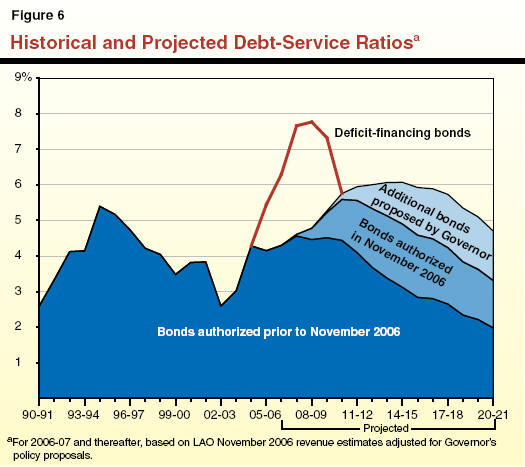
Debt-Service Ratio. The ratio of annual debt-service costs to yearly revenues (DSR) is often used as a general indicator of a state’s debt burden. The DSR helps to look at debt from the perspective of affordability, as it takes into account the amount of revenues the state has available or is projected to have available to fund its programs (including debt payments).
Although concerns have sometimes been voiced in the past about DSRs in excess of 5 percent or 6 percent, there is no “right” level for the DSR. Rather, this depends on such things as a state’s preferences for infrastructure versus other priorities, and its overall budgetary condition. Some states, for example, have comparatively high DSRs but still experience favorable bond ratings. Examples include Maryland, New York, New Jersey, and Illinois.
From an affordability perspective, however, each additional dollar of debt service out of a given amount of revenues comes at the expense of a dollar that could be allocated to some other program area. Thus, the “affordability” of more bonds has to be considered not just in terms of their marketability and the DSR, but also whether their dollar amount of debt service can be accommodated on both a near- and long-term basis within the state budget. (As a rule of thumb, each $1 billion of new bonds sold at 5 percent interest adds close to $65 million annually to state debt-service costs for as long as 30 years.)
LAO Debt-Service Projections. Figure 6 shows California’s DSR in recent years and its projected outlook for the future. The DSR was well under 2 percent during most of the post- World War II period, increased in the early 1990s when it peaked at somewhat over 5 percent, and then fell below 3 percent in the early 2000s. It has since risen as new bond authorizations have been sold, and would peak at 4.6 percent in 2007-08 without the November 2006 bonds. Including the November bonds, the DSR is projected to peak at 5.6 percent in 2010-11. Finally, including the new GO and lease-revenue bonds proposed in the Governor’s budget, the DSR would peak at 6.1 percent in 2014-15. On top of these amounts are the payments the state is making on the deficit-financing bonds (Proposition 57) that were issued to help address the state’s ongoing budget problems, and which the administration is proposing to pay off during 2009-10.
Ensuring Adequate Legislative Oversight And Accountability
- The Legislature’s role in implementing the bond package is to provide:
- A statutory framework to effectively administer and distribute the funds.
- Appropriations of the funds.
- Oversight to ensure the programs are then administered in accordance with the Legislature’s and the voters’ intent.
This legislative role can help ensure that the $43 billion infusion of funding to the state is implemented with accountability and transparency.
Developing New Programs. Since the bonds commit $18.2 billion to new programs, one of the most important tasks for the Legislature will be to effectively design the frameworks for these new programs. Figure 7 lists each of the 21 new programs.
|
Figure 7
Many New Programs Funded by
2006 Bond Package |
|
(In Millions) |
|
Program |
Funds |
|
Proposition 1B—Transportation |
|
|
Corridor mobility |
$4,500 |
|
Local transit |
3,600 |
|
Trade corridors |
2,000 |
|
Highway 99 |
1,000 |
|
State-Local Partnership grants |
1,000 |
|
Air quality |
1,000 |
|
Transit security |
1,000 |
|
School bus retrofit |
200 |
|
Port security |
100 |
|
Proposition 1C—Housing |
|
|
Development in urban areas |
$850 |
|
Development near public
transportation |
300 |
|
Parks |
200 |
|
Pilot programs |
100 |
|
Homeless youth |
50 |
|
Proposition 1D—Education |
|
|
Severely overcrowded schools |
$1,000 |
|
Career technical facilities |
500 |
|
Environment-friendly projects |
100 |
|
Proposition 84—Resources |
|
|
Local and regional parks |
$400 |
|
San Joaquin River restoration |
100 |
|
Urban water and energy
conservation |
90 |
|
Incentives for conservation
planning |
90 |
|
Total Funding |
$18,180 |
- Long-Term Benefit.
Current law essentially requires that GO bonds be used only
for capital purposes which have a long-term life. The
principle behind this law is that the state should not
conduct long-term borrowing for costs that only provide
short-term benefits, such as day-to-day maintenance or
operations costs. If, instead, bond proceeds were used for
short-term benefits, it would mean that taxpayers three
decades from now would be paying for the short-term benefits
enjoyed by today’s California residents. In developing new
programs, we recommend that the Legislature strongly enforce
the principle that bond proceeds should only support
projects that will provide a long-term benefit to the state.
- Criteria and Priorities.
Another important consideration in establishing a new
program is to ensure that the funding will reflect statewide
priorities. The best way to accomplish this goal is to lay
out in state law the program’s goals and the criteria for
selecting projects which meet those goals. By defining who
is eligible for the funds and what are the program’s
priorities, grant recipients will have a fair opportunity to
compete for funding. After allocations are made, the
Legislature can use these statutory criteria to verify that
the administering state department’s process met legislative priorities.
Appropriations. The “power of the purse”-appropriation authority-is one of the Legislature’s most powerful tools to ensure accountability. Without an appropriation, the administration cannot spend bond funds. Therefore, the Legislature should not appropriate funds until it is satisfied that the administration will spend them effectively. On the other hand, continuous appropriations provide minimal opportunities to ensure legislative oversight. Departments can spend continuously appropriated funds without any further action by the Legislature. While continuous appropriations may be appropriate in some circumstances, we recommend that the Legislature not add any new continuous appropriations to the bond programs. In addition, a continuous appropriation does not preclude the Legislature from instead including the appropriation in the budget bill “in lieu” of the continuous appropriation. As described in the resources section, we recommend that the Legislature take this approach for Proposition 84 programs with continuous appropriations.
Limiting Administrative Costs. Each dollar spent on administrative costs within a bond program is one less dollar that is available for infrastructure projects. The Legislature therefore should make every effort to ensure that administrative costs are contained to the greatest extent possible. By actively reviewing requests from the executive branch for staff and other administrative costs, the Legislature likely can increase the funds available for grants and projects. We have recommended in the past that no more than 5 percent of a program’s funding should go towards administrative costs in the resources and housing areas. That level of administrative funding for competitive grant programs is typically sufficient to provide enough state staff to effectively manage a program. (A strict cap on administrative costs may not make sense in every program area, particularly in those areas where the state is responsible for designing and constructing capital outlay projects such as the California Department of Transportation [Caltrans].)
Using Special Committees and Reporting. In the past, the Legislature has performed effective oversight of bond and other programs through the use of joint committee hearings and annual reporting requirements. For instance, by holding a hearing that merges both budget and policy committee members and staff (from one house or jointly between the Assembly and Senate), the Legislature may be better able to assess the full fiscal and policy implications of not only its decisions but also those of the administering entities. Similarly, annual reports from state departments can allow the Legislature to monitor the administration’s progress in achieving specific program objectives. Later in this report, we provide specific recommendations in areas where we think these techniques would be effective.
Infrastructure planning and financing is a complex issue because it is related to so many state functions and involves a long-term vision for the state. We have also recommended in the past that the Legislature establish special committees to deal with infrastructure and capital outlay issues. Looking beyond the 2006 bond package, a special policy or joint committee could assist the Legislature in focusing on the state’s long-term infrastructure planning. Such a committee could help the Legislature review the administration’s 2007 five-year plan and the Governor’s latest proposals for additional infrastructure borrowing.
Economic Impacts of the Bond Package
State expenditures on infrastructure can have important positive impacts on the economy in terms of employment, gross state product, and the various components of the tax base, such as personal income, corporate profits, and taxable sales. This is especially true to the extent that California is the origin of the various intermediate materials and supplies used in construction activities. In addition, infrastructure projects themselves can generate significant economic benefits, such as improved transportation networks that facilitate the movement of people and products, flood control projects which enhance property values and make new geographic areas available for business and residential uses, and school facilities that help produce a more educated labor force that in turn eventually enhances economic productivity.
Yet, while the magnitude of the 2006 bond package is substantial, it is only a fraction of the size of the overall economy and construction sector in California. For example, in the near term, the state’s gross domestic product is expected to be about $1.7 trillion and the combined statewide value of residential and nonresidential new building permits is roughly $70 billion (with probably two or three times that amount being the overall contribution of the building sector to the state’s economy once all of the indirect and induced economic activity associated with construction-related activity is considered). In addition, not all of the bond package represents a net increase in infrastructure funding compared to that which would have occurred without the package. Californians have typically passed individual new bond authorizations fairly regularly in past years. Thus, while the bond spending can be expected to have a substantial positive dollar economic impact, its magnitude will probably be modest in the context of the overall economy.
Timing Considerations
In evaluating the Governor’s proposals and developing its own funding schedule, the Legislature will need to balance several factors related to the timing of spending. Of course, there will be a desire to get the newly authorized funding appropriated and distributed quickly. This desire should be balanced with practical considerations that limit the state’s ability to effectively spend the funds in a short time period. In some cases, the Legislature may need to prioritize among the various infrastructure demands.
Personnel and Materials. As the Legislature considers the large level of new resources available from the bonds, it will need to determine the limits of capacity for state personnel to manage the expansion of programs. Particularly in the short term, the state may be unable to recruit, hire, and train a sufficient number of staff in some programs to accommodate a rapid rise in spending. If the work is for architectural or engineering services, the Legislature could make expanded use of contracted services, as permitted by Article XXII of the State Constitution. For instance in the case of Caltrans, without additional contracting out, the department may have to hire as many as 4800 new staff to deliver projects funded by Proposition 1B.
Another similar factor to consider is the effect of billions of dollars of public works projects on the costs of construction crews and materials. In recent years, the state (as well as other governments and private builders) have struggled with rapidly rising construction costs driven by limited supplies of trades workers and construction materials. For example, the cost of concrete has climbed sharply and has added significant costs to many projects. To the extent that the state funds projects more evenly over time, it may be able to partially mitigate this trend.
Quality of Projects. There is also tension between timing of projects and their quality. From past experience, spreading allocations over several funding cycles would likely improve the overall quality of the projects funded through competitive programs. To the extent that more funds are awarded in any given year for a competitive grant program, for instance, lower-score projects would tend to be funded. By spreading the dollars out, there is more time for higher-quality projects to be put together and submit applications. For example, this longer-term approach is proposed by the administration for the ongoing housing programs (as was the case with previous housing bonds).
Coordination Among State Entities Needed
As shown in Figure 8, at least two dozen state entities will be involved in implementing some component of the 2006 bond package. Throughout the package, there are program allocations for purposes that cut across traditional state departmental boundaries. One of the key roles for the Legislature will be ensuring that departments are communicating and coordinating with each other when appropriate. For instance, the new development programs within the housing bond aim to promote urban development, particularly near public transportation. At the same time, the transportation bond provides billions of dollars for transit improvements. As such, without close coordination among the departments administering these funds, the state may miss an opportunity to make both sets of money go further by linking projects and/or timelines. Likewise, both the housing and resources bonds contain funding for parks. While conceivably the state could operate distinct park grant programs in two departments, designating a single department (such as the Department of Parks and Recreation [DPR]) to act as the primary administrator of all park bond funds would likely result in lower administrative costs and more consistent project evaluation.
|
Figure 8
2006
Bond Implementation
Will Involve Many State Entities |
|
|
|
·
Air Resources Board |
|
·
California Conservation Corps |
|
·
California Community Colleges |
|
·
California Housing Finance Agency |
|
·
California School Finance Authority |
|
·
California State University |
|
·
California Transportation Commission |
|
·
California Department of
Transportation |
|
·
Department of Education |
|
·
Department of Fish and Game |
|
·
Department of Health Services |
|
·
Department of Housing and Community
Development |
|
·
Department of Parks and Recreation |
|
·
Department of Water Resources |
|
·
Division of State Architect |
|
·
Ocean Protection Council |
|
·
Office of Emergency Services |
|
·
Office of Public School Construction |
|
·
Resources Agency |
|
·
State Allocation Board |
|
·
State Conservancies (nine) |
|
·
State Water Resources Control Board |
|
·
University of California |
|
·
Wildlife Conservation Board |
In these instances, the Legislature can take a number of steps to ensure that proper coordination and planning between departments is taking place. Holding hearings that cut across traditional program areas, requiring joint implementation plans, and verifying implementation progress are a few of the approaches available to the Legislature.
Rethinking Labor Compliance
Programs (LCPs)
As described below, the Legislature has dedicated considerable resources from past bonds to increase enforcement of the state’s labor wage laws. In implementing the 2006 bond package, the Legislature again will face decisions about which approach to take in this area.
California’s Prevailing Wage Law and LCPs. The state’s prevailing wage law affects most state and local public works projects, including most projects funded by the 2006 bond package. While the Department of Industrial Relations (DIR) is the primary state entity responsible for enforcing the law, the Legislature in recent years has required LCPs to supplement the work of DIR for some bond acts. Using a portion of bond proceeds, LCPs are supposed to educate contractors and subcontractors about wage laws and review and audit payroll records to verify compliance. About 80 percent of LCPs are operated by school districts, with most of the rest operated by third-party contractors.
LCP Reporting and Accountability Appears Weak. Our review of summary data from annual reports filed with DIR by LCPs suggest that the amount of wages recovered for workers by the LCPs-as well as penalties imposed for violations of wage laws-is minor, given the volume of public works contracts that LCPs monitor and the amount spent on administering LCPs. Despite LCPs having a primary role in enforcing compliance for contracts totaling $8.3 billion between 2003 and March 2006 (primarily for education construction), the reports show that the programs only recovered somewhere around $3 million or $4 million of wages, penalties, and forfeitures related to their wage enforcement activities. The LCPs spent about $70 million of state GO bond proceeds and local matching funds during this period. In other words, LCPs spent between $18 and $23 for each $1 of wages, penalties, and forfeitures they report to have recovered. At the same time, these measures of wage recovery activity do not capture any voluntary compliance or reduction of complaints to DIR that may be the result of LCPs’ work.
Legislative Options for Enforcing Prevailing Wage Laws. As discussed earlier, each dollar spent on administrative costs within a bond program is one less dollar that is available for infrastructure projects. In this instance, the $70 million in LCP spending would have been able to fund about 200 new classrooms if it had instead been directed to construction. Because there is weak evidence concerning the effectiveness of LCPs, we recommend that the Legislature consider other options for future prevailing wage enforcement activity, including projects funded by the 2006 bond acts.
- Stronger Oversight of LCPs and a Sunset Date. If the Legislature wishes to extend LCP requirements to 2006 bond act projects, we recommend that it pass legislation requiring DIR to strengthen its oversight of LCPs. More accurate and detailed reporting, the revocation of poor-performing LCPs’ authorizations, and improved training would increase the likelihood of LCPs effectiveness. In addition, any new authorizations for LCPs should include a sunset date (such as December 31, 2008) to allow for a thorough review of their work.
- Increase DIR Enforcement Staff Instead of New LCP Requirements. As an alternative to LCP requirements, the Legislature could expand DIR’s enforcement staff by authorizing the establishment of new positions. An increase in staffing also should be accompanied by specific reporting requirements on the staff’s productivity.
Instead of these options, the Legislature could choose to not authorize any LCPs for the 2006 bond package while maintaining DIR’s enforcement staff that monitors public works projects at current levels (numbering 22). With the same number of staff and a rising number of public works projects, however, this would tend to reduce the level of enforcement possible per project.
Conclusion
The 2006 bond package represents a major opportunity for the Legislature to address many of the state’s most pressing infrastructure concerns. To use the bond funds most effectively and strategically, the Legislature will need to take steps to exercise its oversight role. We lay out a number of key considerations and recommendations to help the Legislature achieve that purpose. These key issues are summarized in Figure 9.
|
Figure 9
Summary of Key Issues in
Implementing the 2006 Bond Package |
|
Overall |
|
ü
Consider how the costs of repaying the
bonds fit into the state's overall budget plan. |
|
ü
In developing new programs, bond
proceeds should only support
projects that will provide a long-term benefit. |
|
ü
Establish program goals and project
selection criteria that reflect
statewide priorities. |
|
ü
Do not add any new continuous
appropriations. |
|
ü
Generally limit administrative costs
in competitive programs to 5 percent. |
|
ü
Use special legislative committees and
departmental reports to fully
assess policy and budget implications. |
|
ü
Recognize bond spending will only have
a modest effect on the overall state economy. |
|
ü
Balance desire to distribute funds
quickly with practical limits on staffing and
materials costs. |
|
ü
Ensure proper coordination and
planning between departments. |
|
ü
Consider other options besides labor
compliance programs to enforce wage laws. |
Section 2: Transportation
Background
In recent years, California has spent about $20 billion annually in state, federal, and local funds to maintain, operate, and improve its multimodal transportation network. These expenditures have been primarily funded on a pay-as-you-go basis from taxes and user fees.
Primary State Fund Sources. There are two primary state revenue sources that have funded transportation programs. First, the state’s 18 cent per gallon excise tax on gasoline and diesel fuel (often referred to as the gas tax) generates roughly $3.4 billion annually. Second, revenues from the state sales tax on gasoline and diesel fuel provide about $2 billion a year. Additionally, the state imposes weight fees on commercial trucks, which generate roughly $950 million a year. Generally, these revenues must be used for specific transportation purposes, including improvements to highways, streets and roads, passenger rail, and transit systems.
Bonds Have Played a Limited Role in State Transportation Funding. Since 1990 (and prior to Proposition 1B), voters have approved $5 billion in state GO bonds to fund transportation-less than 5 percent of the total investment in transportation over that period. These bond proceeds have been dedicated to passenger rail and transit improvements, as well as retrofit of highways and bridges for earthquake safety. As of November 2006, only $350 million of these bonds remain unissued and most of these funds are committed to specific projects.
Federal and Local Funds. In addition to state funds, California’s transportation system receives federal and local money. The state receives roughly $4.6 billion a year in federal transportation funds. Collectively, local governments invest about $9.5 billion a year into California’s highways, streets and roads, and transit systems. Local governments have also issued bonds backed mainly by local sales tax revenues to fund transportation projects.
Major Provisions of Proposition 1B
Allocation of Funds. Proposition 1B, the
Highway Safety, Traffic Reduction, Air Quality, and Port Security Bond Act of 2006, approved by voters at the November 2006 election, provides $20 billion in GO bond funds for projects to relieve congestion, facilitate the movement of goods, improve air quality, and enhance the safety and security of the transportation system. Figure 10 details the purposes for which the bond money can be used. The bonds will provide a major one-time infusion of state funds into the transportation system to be spent over multiple years.
|
Figure 10
Proposition 1B
Uses of Bond Funds |
|
|
Amounts
(In Millions) |
|
Congestion Reduction, Highway and
Local Road Improvements |
$11,250 |
|
Corridor mobility: reduce
congestion on state highways and major access
routes. |
$4,500 |
|
State Transportation
Improvement Program: increase capacity on highways,
roads, and transit. |
2,000 |
|
Local roads: enhance capacity,
safety, and operations. |
2,000 |
|
Highway 99: enhance capacity,
safety, and operations. |
1,000 |
|
State-Local Partnership:
grants to match locally funded transportation
projects. |
1,000 |
|
State Highway Operations and
Protection Program: rehabilitate and improve
operation of highways and roads. |
750 |
|
Transit |
$4,000 |
|
Local transit: purchase
vehicles and right of way. |
$3,600 |
|
Intercity rail: purchase
railcars and locomotives for state system. |
400 |
|
Goods Movement and Air Quality |
$3,200 |
|
Trade
corridors: improve movement of goods on highways and
rail, and in ports. |
$2,000 |
|
Air quality: reduce emissions
from goods movement activities. |
1,000 |
|
School bus retrofit: retrofit
and replace polluting vehicles. |
200 |
|
Safety and Security |
$1,475 |
|
Transit security: improve security and facilitate
disaster response. |
$1,000 |
|
Grade separation: grants to
improve railroad crossing safety. |
250 |
|
Local bridges: grants to
seismically retrofit local bridges and overpasses. |
125 |
|
Port security: grants to
improve security and disaster planning in publicly
owned ports, harbors, and ferry facilities. |
100 |
|
Total |
$19,925 |
Bond Act Creates Several New Programs, Involves Many Implementing Entities. As shown in Figure 11 (see page 18), $5.5 billion (28 percent) of the $20 billion in Proposition 1B funding are directed to existing state and local transportation programs, while the majority of the bond revenues-$14 billion (72 percent)-will be used to create new programs. Some of these new programs-including Trade Corridors, Port Security, and Transit Security-address goods movement and security issues that have not historically been a focus of state transportation funding.
|
Figure 11
Proposition 1B Programs
Implementing Agencies and Oversight |
|
Programs |
Implementing Agency |
Oversight
Report/Audit |
Funding
(In Billions) |
|
New |
|
|
$14.4 |
|
Corridor mobility |
CTCa |
Annual report |
$4.5 |
|
Local transit |
Local transit operators |
None specified |
3.6 |
|
Trade corridors |
CTC |
Annual report |
2.0 |
|
Highway 99 |
Caltransb |
None specified |
1.0 |
|
Air quality |
ARBc |
None specified |
1.0 |
|
SLPd
grants |
CTC |
Annual report |
1.0 |
|
Transit security |
None specified |
None specified |
1.0 |
|
School bus retrofit |
None specified |
None specified |
0.2 |
|
Port security |
OESe |
Annual report |
0.1 |
|
Existing |
|
$5.5 |
|
STIPf |
CTC |
Annual report |
$2.0 |
|
Local roads |
Cities and counties |
Controller audits |
2.0 |
|
SHOPPg |
CTC |
Annual report |
0.8 |
|
Intercity rail |
Caltrans |
None specified |
0.4 |
|
Grade separations |
CTC/Caltrans |
Annual report/
None specified |
0.3 |
|
Local bridges |
Caltrans |
Annual report |
0.1 |
|
Total
Proposition 1B Bond Programs |
|
$19.9 |
|
|
|
a
California Transportation Commission. |
|
b
California Department of Transportation. |
|
c Air
Resources Board. |
|
d
State-Local Partnership. |
|
e
Office of Emergency Services. |
|
f
State Transportation Improvement Program. |
|
g
State Highway Operations and Protection Program. |
The monies for this myriad of programs, in turn, are to be administered by a variety of state and local entities, as highlighted in Figure 11. State entities include primarily the California Transportation Commission (CTC) and Caltrans. For funds provided directly to locals, recipients include cities and counties, as well as transit authorities, ports, harbors, and ferry terminal operators.
All Funds to Be Appropriated by Legislature. Proposition 1B specifies that all bond funds are subject to appropriation by the Legislature, either through the annual budget process or through other legislation before becoming available to a state or local entity for expenditure. Many Proposition 1B programs do not require oversight measures (such as reports or audits) to verify how bond funds are actually spent.
Some Programs Allow for Further Statutory Direction. With the exception of $1 billion in Air Quality funds, all monies provided in Proposition 1B could be appropriated and put to use without additional implementing statute. However, the bond act explicitly allows the Legislature to provide additional conditions and criteria through statute to five new programs created by the measure, involving $5.1 billion. These programs include Trade Corridors, Transit Security, Air Quality, State-Local Partnership (SLP) grants, and Port Security.
Governor’s Proposal
Proposed Expenditures and New Positions. The Governor’s budget proposes appropriating $7.7 billion in Proposition 1B money in 2007-08, with about $2.8 billion of this being expended in the budget year, as shown in Figure 12. This includes:
- About $1.5 billion to be expended by Caltrans or provided as grants for various highway, bridge, transit, and grade crossing projects.
- $600 million to be expended by transit operators on transit capital improvements.
- $600 million to be expended by local governments on street and road improvements.
- $97 million to be expended by the Air Resources Board on school bus retrofit and replacement.
|
Figure 12
Governor’s Proposed Expenditures |
|
(In Millions) |
|
Program |
2006-07 |
2007-08 |
|
Congestion Reduction, Highway, and Local Road
Improvements |
|
Corridor mobility |
$100 |
$317 |
|
State Transportation
Improvement Program |
262 |
340 |
|
Local roads |
— |
600 |
|
Highway 99 |
— |
28 |
|
State-Local Partnership grants |
— |
170 |
|
State Highway Operation and
Protection Program |
141 |
403 |
|
Transit |
|
|
|
Local transit |
— |
$600 |
|
Intercity rail |
— |
— |
|
Goods Movement and Air Quality |
|
|
|
Trade corridors |
$15 |
$170 |
|
Air quality |
— |
— |
|
School bus retrofit |
— |
97 |
|
Safety and Security |
|
|
|
Transit security |
— |
— |
|
Grade separation |
— |
$55 |
|
Local bridges |
$5 |
9 |
|
Port security |
— |
— |
|
Totals |
$523 |
$2,789 |
Despite proposing significant expenditures in the budget year, the Governor’s budget provides almost no staffing to support the project development activities funded with the bonds. Caltrans advises us that additional personnel resources will be requested in the May Revision.
In addition, the Governor’s budget proposes expenditures of $523 million by Caltrans in the current year on projects mainly in the State Transportation Improvement Program (STIP), State Highway Operation and Protection Program (SHOPP), and newly created Corridor Mobility program. Because all Proposition 1B funds are subject to legislative appropriation, these expenditures would require separate legislative action.
Proposed Policy Changes. In addition to appropriations, the administration is also proposing to expand the oversight role for CTC in the implementation of Proposition 1B. Specifically, the administration proposes that Local Transit funds be dispersed by formula to transit operators, as provided by Proposition 1B, but only after projects are approved by CTC. Moreover, the administration has adopted guidelines for the Highway 99 program, which channel funds through CTC rather than directly to Caltrans, as specified in the bond act.
Issues for Legislative Consideration
The infusion of bond funding is only a first step in improving California’s transportation landscape. In order to realize the full benefits of these funds, it is important that the projects funded are cost-effective in achieving desired results-including improved mobility, a more secure transportation system, and cleaner air. Moreover, these projects must be delivered in a timely manner. In this section, we highlight key challenges to achieving the goals of Proposition 1B and assess how well the Governor’s proposals address these challenges. Also, we recommend measures-statutory and administrative-to ensure that bond funds are used to deliver effective projects in a timely manner and that adequate oversight measures are in place. Our recommendations are summarized in Figure 13.
|
Figure 13
Recommendations to Improve
Proposition 1B Implementation |
|
|
|
ü
Determining Project Eligibility |
|
·
Limit all Proposition 1B funds to
projects with long-term benefits. |
|
·
Decide whether to limit transit
security funds to just security-oriented
investments. |
|
·
Structure state-local partnership
program to spur new local investment. |
|
ü
Adopting Additional Evaluation
Criteria for Project Selection |
|
·
Require measures of
cost-effectiveness. |
|
·
Require fund leveraging be considered. |
|
·
Require air quality impacts be
considered for new capacity projects. |
|
ü
Encouraging Timely Project Delivery |
|
·
Establish delivery deadlines to ensure
funds do not linger. |
|
·
Adopt provisions to remove funds from
lagging projects. |
|
ü
Ensuring Oversight Measures Are in
Place |
|
·
Require periodic reports to
Legislature. |
|
·
Hold joint legislative hearings. |
|
·
Enhance commission’s oversight
capacity. |
|
ü
Identifying Personnel Resources to
Deliver Projects |
|
·
Require annual update of multiyear
personnel resource plan. |
|
·
Authorize additional use of contracted
resources, as necessary to ensure timely delivery. |
|
ü
Streamlining Measures to Improve
Project Delivery |
|
·
Authorize design-build contracting on
pilot basis. |
|
·
Consider measures to streamline
environmental review. |
|
ü
Appropriating Bond Funds |
|
·
Appropriate all funds through budget
bill. |
Determining
Project Eligibility
The bond act varies in the level of detail it provides regarding project eligibility. For three programs totaling $3 billion-Air Quality, Transit Security, and SLP-the act provides little or no guidance as to the types of projects eligible for funding. While no expenditures from the Air Quality and Transit Security programs are proposed for 2007-08, the Governor’s budget shows $170 million in SLP grants to be awarded in the budget year. Before any bond funds are spent, the Legislature should provide eligibility guidelines statutorily to ensure that funds are used for projects that address state priorities. Below we present a general principle for determining project eligibility for all projects. We then discuss eligibility issues particular to two specific programs.
Limit Bond Funds to Projects With Long-Term Benefits. As a general principle, bond funds should be used only for capital improvements or activities that provide benefits over many years to taxpayers who finance the bonds. However, in the case of some Proposition 1B programs, the bond act does not prohibit funding activities that yield only short-term benefits. For example, $1 billion in Air Quality program monies are to be available for “strategies and public benefit projects” to reduce emissions related to goods movement. This language does not exclude short-term operational approaches to emissions reduction, even though the debt-service payments on the bond could outlast the activities they finance. To avoid this issue, we recommend the Legislature enact statute specifying that all Proposition 1B funds are available only for capital purchases or strategies that provide long-term benefits.
Decide Whether to Limit Transit Security Funds to Just Security-Oriented Investments. The bond act limits Transit Security dollars to capital projects, yet provides little additional guidance regarding project eligibility. Language directing the use of these funds is very open-ended-it allows these funds to be used either for transit projects that specifically address a security threat (for example, installing detection devices or security gates at train stations) or for projects that more generally increase a transit system’s capacity (such as adding vehicles to a transit fleet). Given this ambiguity, we recommend enacting statute that outlines more explicit eligibility requirements.
Structure SLP Grant Program to Spur New Local Investment. Proposition 1B provides $1 billion in SLP grants to match local funds for transportation projects over the next five years. The measure also allows the Legislature to add conditions and criteria to the program through statute. The CTC proposed guidelines that would provide funding to local jurisdictions that
have adopted local sales tax measures or developer fees for transportation. These guidelines, however, do not set aside any of these funds to create incentives for
new local revenues to be pursued in the future. In order to spur new local funding for transportation, we recommend that the Legislature adopt guidelines that would set aside a portion of SLP grants for cities and counties that establish new fees or tax measures for local transportation purposes.
Adopting Additional Evaluation Criteria For Project Selection
The bond act specifically authorizes the Legislature to adopt additional conditions and criteria for five new programs, involving $5.1 billion. These programs include Trade Corridors, Air Quality, Transit Security, SLP, and Port Security. Of these programs, the Governor’s budget proposes expenditures of $170 million in SLP grants and $185 million in Trade Corridors funds through 2007-08.
Of the five programs, the bond act provides evaluation criteria only for selecting Trade Corridors projects, but none for the other four programs. We recommend that the Legislature adopt project evaluation criteria for these new programs to ensure that bond funds are used efficiently and deliver effective projects. The following criteria could be applied across multiple Proposition 1B programs.
Require Measures of Cost-Effectiveness. This criterion focuses on the estimated benefit achieved per dollar spent on a project in order to ensure that bond funds consistently deliver the biggest bang for the buck. Depending on the program and its goals, the specific benefits to be measured will vary by program. For example, a measure to evaluate projects competing for Trade Corridors funds could include the volume of goods transported per dollar invested; whereas, the appropriate metric for Air Quality funds would be the level of emissions reduced for the amount spent on the project.
While cost-effectiveness is a useful criterion to evaluate projects competing for a number of Proposition 1B programs, it may not be the most appropriate to use in selecting projects for Transit Security and Port Security funds. This is because the particular benefits achieved by security-oriented projects (for example, lives saved from terrorist attacks) may be difficult to quantify.
Require Fund Leveraging Be Considered. Because the benefits of transportation investments are felt most at the local level, evaluating projects by their ability to tap into local, federal, and private dollars (so that state funds can be applied to more projects) makes sense. Currently, the bond measure requires fund leveraging in only some instances. These include Local Bridge funds that supplement available federal dollars, as well as SLP, Trade Corridors, and Grade Separation grants, which generally require a one-to-one match of nonstate funds. There are other programs, however, where leveraging should play a role in evaluating projects. In selecting Corridor Mobility projects, CTC indicates it will consider a project’s ability to leverage nonstate funds, particularly for large projects where matching funds are available.
In order to stretch bond funds as broadly as possible, we recommend the Legislature require projects be evaluated based on their ability to leverage nonstate funds. For example, statute should require consideration of applicants’ ability to leverage Transit Security and Port Security funds with federal grants or private dollars.
Admittedly, there may be cases where leveraging is less feasible. For example, projects located in rural areas may not be able to generate significant investment from local or private sources. To address such concerns, fund leveraging considerations should take into account a region’s ability to leverage funds.
Require Air Quality Impacts Be Considered for New Capacity Projects. Given that all of California’s major urban areas violate federal air emissions standards, project selection for Proposition 1B programs should consider a project’s impact on air quality. Proposition 1B addresses air quality in varying ways. Some programs, including Air Quality and School Bus Retrofit, are specifically targeted at reducing emissions. Language describing the Trade Corridors program lists emissions reduction as one consideration among many in evaluating projects for funding. The CTC’s proposed guidelines for the Corridor Mobility and SLP programs list air quality analysis as an optional element in project nominations.
So that entities, like CTC, that are charged with selecting projects can take emissions impacts into account, we recommend that the Legislature require analysis of air quality impacts to be included in all nominations where projects would add capacity to the highway and local road network. This would include projects funded by Trade Corridors and SLP grants.
Federal law requires many California regions to evaluate the emissions impact of transportation projects in their long-range plans. Thus, including air quality analysis as a part of the project nomination process should not impose significant additional analysis workload for these regions. For the few rural regions not subject to emissions reporting in their federal plans, these regions might be exempted from quantifying emissions impacts in project nominations.
Encouraging Timely Project Delivery
Projects must be completed and opened to users in a timely manner in order to offer any mobility, air quality, or safety benefits. Moreover, in an era of rising construction costs, delayed delivery often means increased construction costs, reducing the amount of improvements that can be achieved with available funding.
Establish Delivery Deadlines to Ensure Funds Do Not Linger. Generally, the bond act does not require that projects be constructed and opened to users by a specific date. The Corridor Mobility program is an exception-the bond act requires that these projects start construction by December 31, 2012. (If projects fall behind schedule, CTC is to remove funds.) The administration has adopted the same delivery timeline for Highway 99 funds. Setting timelines enables the Legislature to hold the administration and other fund recipients accountable for the delivery of projects. In other state transportation programs, notably the Traffic Congestion Relief Program, the absence of delivery deadlines has allowed funds to remain available indefinitely, even for stalled projects that show few signs of progress. To avoid repeating this situation with Proposition 1B funds, we recommend the enactment of legislation requiring the establishment of deadlines to begin project construction.
To ensure that adopted deadlines are reasonable on a program-by-program basis, the Legislature should direct CTC to specify project delivery deadlines for each program. For example, CTC could specify later deadlines for programs that fund large or complex projects requiring longer timeframes and shorter timeframes for programs where the delivery process is less involved.
Adopt Provisions to Remove Funds From Lagging Projects. In addition to setting delivery deadlines, the Legislature should enact statute that requires projects’ progress to be monitored and funds to be removed from those projects that are not advancing. The state already has a “use-it-or-lose-it” policy, established under Chapter 783, Statutes of 1999 (AB 1012, Torlakson), which allows CTC to redirect certain federal funds not expended by regions in a timely manner. Prior to the use-it-or-lose-it policy, regions had accumulated a $1.2 billion backlog of unused federal funds. This policy gives regions a strong incentive to expend federal funds in a reasonable timeframe and enables the state to make sure funds do not go unused.
Beyond regional agencies, Caltrans has a less than perfect record in delivering projects on time and on budget. Thus, we recommend the Legislature require an entity, like CTC, to regularly check fund recipients’ progress in meeting major project milestones, such as plan approval, completion of environmental review, right-of-way certification, and advertising a project for construction. Admittedly, this approach creates additional oversight workload. But, more importantly, it holds fund recipients accountable for delivering projects in a timely manner and provides the opportunity to identify delays and redirect funds, as necessary, to alternative projects that can meet delivery goals.
The Legislature has a few options in deciding how to redirect funds once removed from a stalled project. One approach would be to transfer funds to the highest performing project that did not previously receive funding. This option maximizes the benefit of bond funds on a statewide basis. Another option would be to redirect funds to other projects in the same geographic region, so that regions are held harmless. This option does not maximize the benefit of bond funds at a statewide level, but ensures that a region maintains its level of investment even when a local project loses funding. How the Legislature redirects funds from stalled projects depends on whether project performance or regional equity is the primary consideration.
To ensure that funds can be removed from lagging projects and redirected to other projects that address state priorities, we recommend the enactment of legislation that (1) directs CTC to monitor project milestones and identify delays, (2) authorizes CTC to redirect funds away from lagging projects, and (3) provides guidance on how these funds should be redirected.
Ensuring Oversight Measures
Are in Place
In many cases, the bond act does not call for specific program oversight through reports or audits, as shown in Figure 11. Given the large number of programs funded by Proposition 1B, the substantial amount of funding provided, as well as the number of entities charged to implement these programs, we recommend the Legislature adopt additional oversight measures to ensure that bond funds are used effectively.
Require Periodic Reports to Legislature. Current law requires CTC to report annually to the Legislature on funds it allocates to transportation programs and related policy issues. This report provides the Legislature with necessary information to monitor programs and take statutory action, as needed, to ensure funds are used appropriately. The CTC plans to include in future annual reports discussion of all Proposition 1B programs for which it will allocate funds. Under the bond act, this includes about one-half of the monies-Corridor Mobility, Trade Corridors, SLP grants, funds for STIP and SHOPP, as well as $100 million of the Grade Separation grants. If the Legislature concurs with the administration’s proposal that CTC allocate an additional $4.6 billion in bond monies, including funds for Highway 99 and Local Transit, these programs would also be included in CTC’s annual report.
However, even if the administration’s proposals are adopted, there would still be almost $5 billion in Proposition 1B funds that would not be included in CTC’s annual report because CTC does not allocate these funds. Though expenditures from some of these programs would be included in other miscellaneous reports, the information would be scattered, making it less conducive to oversight of the total bond program.
We think that having information on the status of all Proposition 1B programs in one place would facilitate legislative oversight. Accordingly, we recommend the enactment of legislation directing CTC to include discussion of all bond-funded programs in its annual report. Additionally, the Legislature should require fund recipients to provide CTC with information on all projects funded by Proposition 1B monies. This information should include each project’s annual expenditures and progress in meeting major milestones (including plan approval, completion of environmental review, right-of-way certification, and listing for construction), as well as explanation of any delays in the delivery process.
Hold Joint Legislative Hearings. Beyond requiring project specific information through annual reporting, we further recommend that the policy committees and budget subcommittees of the Legislature hold periodic joint hearings in which CTC, Caltrans, and other key implementing entities report on the use of bond funds and the timeliness of project delivery. This would provide the Legislature an opportunity to monitor the progress of the bond program in the aggregate, and assess whether the programs are being carried out effectively to meet the measure’s objectives.
Enhance CTC’s Oversight Capabilities. Given the size of the bond program and number of fund recipients, one central entity should provide ongoing oversight of all bond-funded activities. With its experience in overseeing transit and highway programs statewide, CTC is a logical choice to perform that oversight function. The Governor’s budget provides two positions to supplement CTC’s current staff of 16 personnel-years (PYs). However, depending on the role the Legislature decides CTC is to play, significant workload could be involved. We recommend that the Legislature take action to enhance the commission’s oversight capacity.
The Legislature has a few options in doing so. One option is to provide additional staff to CTC, beyond what is proposed in the Governor’s budget. An alternative is to provide CTC with the authority and flexibility to use consultant services to perform selected project evaluation and oversight functions, on an as-needed basis to supplement commission staff.
Identifying Personnel Resources to
Deliver Projects
Caltrans will play a crucial role in delivering $12 billion in highway, bridge, and transit projects through several Proposition 1B programs. This represents a 33 percent increase in the value of total projects that Caltrans is currently working on. To deliver these projects in a timely manner, Caltrans will need additional personnel resources to plan and construct projects in 2007-08 and beyond. Ensuring that Caltrans has adequate capital outlay support (COS) resources-including both state staff and contracted services-will be essential to the timely delivery of many Proposition 1B projects.
Require Annual Update of Multiyear Personnel Resource Plan. Given the upsurge in workload, it is important that Caltrans inform the Legislature about its estimates of the future-year COS funding needs, as well as what portion of the delivery workload it will have to contract out given constraints in hiring state staff.
Supplemental report language accompanying the 2006-07 Budget Act requires Caltrans to develop, by May 1, 2007, a multiyear staffing plan that estimates the level of personnel resources Caltrans will need each year through 2010-11 for project development workload related to Proposition 1B. The report is also required to provide (1) the anticipated composition of these resources, in terms of the breakdown between state staff, cash overtime, and contracting out; (2) data on Caltrans’ recent experience in recruiting and retaining project delivery employees; and (3) actions the department will take to attract employees, cost-effectively train its new workforce, and minimize attrition rates.
The information in the May 2007 report will help the Legislature determine Caltrans’ COS resources requirements in 2007-08. We recommend the enactment of legislation requiring Caltrans to update this report annually, as the Proposition 1B program progresses. We further think that Caltrans should identify in the report administrative as well as statutory actions that can be taken to improve its capacity to efficiently deliver projects.
Authorize Additional Use of Contracted Resources as Necessary to Ensure Timely Project Delivery. In order to deliver the portfolio of bond-funded projects in a timely manner, Caltrans could require as many as 4,800 PY equivalents of additional resources beginning in 2007-08. Meeting this personnel requirement through state staff would mean an estimated 37 percent increase in the level of Caltrans staff currently working on COS activities.
It is virtually impossible that Caltrans could hire this level of state staff in the near term. In 2005-06, for example, Caltrans undertook an ambitious hiring effort for COS staff and was only able to hire a total of 1,040 PYs by the end of the year, an average of 87 new employees per month. Discussions with the department indicate that the 2005-06 hiring effort was likely as fast as the department can possibly employ new COS staff, given the available pool of qualified engineers, right-of-way agents, and environmental planners. Beyond hiring new state staff, Caltrans would have to locate facilities to house these workers. In addition, the department would have to provide extensive training in order for entry-level employees to perform many COS tasks. The department indicates that it has a two-year program to train new employees in the major areas of COS.
Contracted resources have traditionally played a relatively limited role in performing COS workload at Caltrans-about 10 percent of total COS personnel resources in recent years. Contracting-out provides a means for Caltrans to perform project development workload that exceeds the capacity of its state staff to deliver. Accordingly, we recommend that the Legislature authorize and direct Caltrans to utilize a higher level of contracted resources than in prior years so that projects are not delayed.
Streamlining Measures to Improve
Project Delivery
To further facilitate project delivery, the Legislature should authorize the use of design-build contracting and consider measures to streamline processes related to environmental documentation.
Authorize Design-Build Contracting. The design-build contracting method awards both the design and construction of a project to a single entity. The use of design-build to construct projects seeks to reduce project delivery times by integrating the design and construction processes. Under the federal transportation act (SAFETEA-LU), virtually any surface transportation project is eligible to be built using this method. Current state law, however, authorizes the use of design-build only for specific transportation projects (for example, I-405). Thus, Caltrans has little experience using this method to deliver projects. While there are potential advantages to using design-build, including the potential shortening of project delivery time, there are also potential pitfalls to avoid.
We recommend that the Legislature authorize a design-build pilot program similar to that proposed by AB 143 (Nuñez), in 2006 and SB 56 (Runner), in 2007. Both bills propose a demonstration program that allows Caltrans and regional agencies to deliver a set number of projects using design-build. In addition, these bills require that transportation agencies report on their experiences so that the state could use the information in deciding whether to pursue future design-build projects. The Governor’s budget summary indicates that the administration will propose design-build legislation in the 2007-08 session.
Consider Measures to Streamline Environmental Review. Environmental documentation is typically one of the longest phases of the delivery process. Because environmental review is subject to legal challenges, it is also the least predictable phase of the delivery process in terms of time requirements. Thus, measures to streamline the process and minimize uncertainty may offer significant benefits. One such example of environmental streamlining is Chapter 31, Statutes of 2006 (AB 1039, Nuñez). Among other actions, this statute allows Caltrans to take over federal environmental reporting duties on a pilot basis through January 1, 2009. The pilot may include bond-funded highway projects, as well as others receiving state funds. By allowing Caltrans to communicate directly with involved federal agencies, rather than doing so indirectly through the Federal Highway Administration, the pilot seeks to reduce project delivery times.
Caltrans estimates that per project time savings from the pilot will range from a few weeks on the simplest projects to over six months on large projects requiring a federal environmental impact report. If these estimates hold, the Legislature may want to extend the duration and scope of this pilot for several more years, subject to federal approval. We further recommend that the Legislature direct Caltrans to identify additional environmental streamlining measures to improve delivery times for specific bond-funded programs.
Appropriating the Bond Funds
All funds provided in the Proposition 1B bond program are subject to legislative appropriation before they are available for expenditure. The bond act specifically requires that $7.5 billion in funds from three programs-Corridor Mobility, Highway 99, and Trade Corridors-be appropriated in the annual budget bill. The remaining funds may be appropriated either through the budget or separate statute.
Appropriate All Funds Through Budget Bill. To provide the Legislature with a more comprehensive picture of year-to-year expenditures of Proposition 1B funds, we recommend that all Proposition 1B funds be appropriated in the annual budget, rather than through separate pieces of legislation. Doing so also allows the Legislature to see how these expenditures fit in with other state transportation programs, review program performance, and tie operational resources to the delivery of projects.
Section 3: Resources
Background
State Spending on Resources Programs. The state operates a variety of programs to conserve natural resources, protect the environment, provide flood control, and offer recreational opportunities for the public. The state also operates a program to plan for future water supplies, flood control, and other water-related requirements of a growing population. In addition to direct state expenditures, the state also provides grants and loans to local governments and nonprofit organizations for similar purposes. Resources programs support a variety of specific purposes, including:
- Natural Resource Conservation.
The state has provided funds to purchase, protect, and improve natural areas-including wilderness and open-space areas; wildlife habitat; coastal wetlands; forests; and rivers, lakes, streams, and their watersheds.
- Safe Drinking Water. The state has made loans and grants to public water systems for facility improvements to meet state and federal safe drinking water standards.
- Flood Control. As the level of government primarily responsible for flood control in the Central Valley, the state has funded the construction and repair of flood control projects in the state Central Valley flood control system. This system includes about 1,600 miles of levees, as well as other flood control infrastructure such as overflow weirs and channels. The state has also provided financial assistance to local agencies for local flood control projects in the Sacramento-San Joaquin River Delta (the Delta) and in other areas outside the Central Valley. Because a significant portion of the state’s population depends on water supplies that come through the Delta, there is a state interest in the continued operation of the Delta levee system.
- Other Water Quality and Water Supply Projects.
The state has made available funds for various other projects throughout the state that improve water quality and/or the reliability of water supplies. For example, the state has provided loans and grants to local agencies for the construction and implementation of wastewater treatment, water conservation, and water pollution reduction projects.
- State and Local Parks.
The state operates the state park system, and has provided funds to local governments for the acquisition, maintenance, and operation of local and regional parks.
Funding for Resources Programs. Funding for these programs has traditionally come from the General Fund, federal funds, and GO bonds.
Between 1996 and 2002 (the last year, prior to November 2006, that voters approved resources-related GO bonds), voters had authorized $11.1 billion in five GO bonds for various resources purposes. Funding from these bonds was allocated as follows:
- $3.2 billion for a broad array of land acquisition and restoration projects, including ecosystem restoration, agricultural land preservation, urban forestry, and river parkway projects.
- $2.7 billion for state and local park projects and for historical and cultural resources preservation.
- $2 billion for various water quality purposes, including wastewater treatment, watershed protection, clean beaches, and safe drinking water infrastructure upgrades.
- $1.7 billion for various water management purposes, including water supply, flood control, desalination, water recycling, water conservation, and water system security. Of this total amount, about $400 million is allocated specifically for flood control.
- $1.5 billion for the CALFED Bay-Delta Program, a federal-state consortium of over 20 agencies created to address interrelated water quality, water supply, fish and wildlife habitat, and flood protection issues in the Delta region of the state.
- $50 million for grants to improve air quality in state and local parks.
Funds Remaining Available From Prior Bonds. Of the $11.1 billion authorized in the five resources bonds approved between 1996 and 2002, roughly $1.3 billion is projected to remain available for appropriation for new projects at the beginning of 2007-08. Of this remaining balance, most of the funding is available for water quality, water management (potentially including, but not allocated specifically for flood control), and CALFED projects. Little funding remains available for state and local parks and for land acquisition and restoration projects.
Major Provisions of
Propositions 1E and 84
Proposition 1E. Proposition 1E authorizes the state to sell about $4.1 billion in GO bonds for various flood management purposes. Figure 14 summarizes the purposes for which the bond money would be available for expenditure by the Department of Water Resources (DWR) and for grants to local agencies. In order to spend these bond funds, the measure requires the Legislature to appropriate them in the annual budget act or other legislation.
|
Figure 14
Proposition 1E
Uses of Bond Funds |
|
|
Amounts
(In Millions) |
|
State Central Valley flood
control system repairs and improvements; Delta levee
repairs and maintenance. |
$3,000 |
|
Flood control subventions
(local projects outside the Central Valley). |
500 |
|
Stormwater flood management
(grants for projects outside the
Central Valley). |
300 |
|
Flood protection corridors and
bypasses; floodplain mapping. |
290 |
|
Total |
$4,090 |
Proposition 1E also requires the Secretary for Resources to (1) provide for an independent audit of bond fund expenditures to ensure that all moneys are expended in accordance with the measure, and (2) publish annually a list of all program and project expenditures funded from the bond.
Companion legislation to the flood control bond measure-Chapter 31, Statutes of 2006 (AB 1039, Nuñez)-was enacted to streamline the environmental review and permitting process for flood control projects funded from the bond in order to facilitate timely project delivery. Specifically, Chapter 31 includes an exemption from the California Environmental Quality Act for the repair of specified critical levees of the Sacramento River Flood Control Project. Chapter 31 also requires a consolidated environmental permitting process for levee repair projects funded from the bond, to reduce or eliminate unnecessary duplication, overlap, and paperwork associated with the multiple permits required.
Proposition 84. Proposition 84 authorizes the state to sell about $5.4 billion in GO bonds for safe drinking water, water quality, and water supply; flood control; natural resource protection; and park improvements. Figure 15 summarizes the purposes for which the bond money would be available for expenditure by various state agencies and for loans and grants, primarily to local agencies and nonprofit organizations. In order to spend most of these bond funds, the measure requires the Legislature to appropriate them in the annual budget act or other legislation. Specifically, only $620 million in funding ($315 million allocated to the Wildlife Conservation Board [WCB] for forest conservation and wildlife habitat projects and $305 million allocated to DWR for floodplain mapping and flood control projects) is “continuously appropriated,” meaning that a legislative appropriation is not required before funds can be spent.
|
Figure 15
Proposition 84
Uses of Bond Funds |
|
|
Amounts
(In Millions) |
|
Water Quality |
$1,525 |
|
Integrated regional water management. |
1,000 |
|
Safe drinking water. |
380 |
|
Delta and agriculture water quality. |
145 |
|
Protection of Rivers,
Lakes, and Streams |
$928 |
|
Regional conservancies. |
279 |
|
Other projects—public access, river
parkways, urban stream
restoration, California Conservation Corps. |
189 |
|
Delta and coastal fisheries restoration. |
180 |
|
Restoration of the San Joaquin River. |
100 |
|
Restoration projects related to the
Colorado River. |
90 |
|
Stormwater pollution prevention. |
90 |
|
Flood Control |
$800 |
|
State flood control projects—evaluation,
system improvements, flood corridor program. |
315 |
|
Flood control projects in the Delta. |
275 |
|
Local flood control subventions (outside
the Central Valley flood control system). |
180 |
|
Floodplain mapping and assistance for
local land use planning. |
30 |
|
Sustainable Communities and
Climate Change Reduction |
$580 |
|
Local and regional parks. |
400 |
|
Urban water and energy conservation
projects. |
90 |
|
Incentives for conservation in local
planning. |
90 |
|
Protection of Beaches,
Bays, and Coastal Waters |
$540 |
|
Protection of various coastal areas and
watersheds. |
360 |
|
Clean Beaches Program. |
90 |
|
California Ocean Protection Trust
Fund—marine resources,
sustainable fisheries, and marine wildlife
conservation. |
90 |
|
Parks and Natural Education
Facilities |
$500 |
|
State park system—acquisition,
development, and restoration. |
400 |
|
Nature education and research facilities. |
100 |
|
Forest and Wildlife
Conservation |
$450 |
|
Wildlife habitat protection. |
225 |
|
Forest conservation. |
180 |
|
Protection of ranches, farms, and oak
woodlands. |
45 |
|
Statewide Water Planning |
$65 |
|
Planning for future water needs, water
conveyance systems, and flood control projects. |
65 |
|
Total |
$5,388 |
Proposition 84 also requires the Secretary for Resources to (1) provide for an independent audit of bond fund expenditures to ensure that all moneys are expended in accordance with the measure and
(2) publish annually a list of all program and project expenditures funded from the bond.
Governor’s
Proposal
Proposition 1E. The Governor’s budget proposes $624 million in expenditures from Proposition 1E in 2007-08, about 15 percent of total funding authorized in the measure. (No expenditures are proposed for 2006-07.) All of the funding for 2007-08 is proposed for appropriation in the budget bill. The Governor’s budget document was not accompanied by any proposed statutory language to implement the measure. The Governor’s budget proposal is summarized in Figure 16.
|
Figure 16
Governor’s Budget Proposed Expenditures
Proposition 1E—Flood Control |
|
(In Millions) |
|
|
2007-08 |
|
State Central Valley flood
control; Delta levees |
$520a |
|
Flood control subventions |
— |
|
Stormwater flood management |
102 |
|
Flood protection corridors and
bypasses; floodplain mapping |
2 |
|
Total |
$624 |
|
|
|
a
Includes $200 million "payback" to the General Fund
for projects funded prior to bond passage. |
Proposition 84. From Proposition 84, the Governor’s budget proposes $60 million in expenditures in 2006-07 ($25 million for wildlife habitat protection and $35 million for forest conservation) and about $1.1 billion in expenditures in 2007-08, representing about 22 percent of total funding authorized in the measure. Most of the funding is proposed for appropriation in the budget bill, with the exception of $121 million of expenditures in WCB for forest conservation and wildlife habitat projects (in 2006-07 and 2007-08 combined) and $93 million of expenditures in DWR for floodplain mapping and flood control projects (in 2007-08). No statutory language has been proposed by the Governor to implement the measure. The Governor’s budget proposal for 2007-08 is summarized in Figure 17.
|
Figure 17
Governor’s Budget Proposed Expenditures
Proposition 84—Resources |
|
(In Millions) |
|
|
2007‑08 |
|
Water Quality |
|
|
Integrated regional water
management |
$156 |
|
Safe drinking water |
76 |
|
Delta and agriculture water
quality |
31 |
|
Protection of Rivers, Lakes, and
Streams |
|
|
Regional conservancies |
$105 |
|
Other projects |
9 |
|
Delta and coastal fisheries
restoration |
60 |
|
San Joaquin River |
14 |
|
Colorado River |
41 |
|
Stormwater pollution
prevention |
15 |
|
Flood Control |
|
|
State flood control projects |
$93 |
|
Delta flood control projects |
58 |
|
Local flood control
subventions |
100 |
|
Floodplain mapping |
25 |
|
Sustainable Communities and Climate
Change Reduction |
|
|
Local and regional parks |
$1 |
|
Urban greening |
11 |
|
Incentives for conservation
planning |
18 |
|
Protection of Beaches, Bays, and
Coastal Waters |
|
|
Coastal areas and watersheds |
$93 |
|
Clean Beaches Program |
9 |
|
Ocean Protection Trust Fund |
29 |
|
Parks and Natural Education
Facilities |
|
|
State park system |
$25 |
|
Nature education and research
facilities |
— |
|
Forest and Wildlife Conservation |
|
|
Wildlife habitat protection |
$50 |
|
Forest conservation |
35 |
|
Protection of ranches, farms,
and oak woodlands |
33 |
|
Statewide Water Planning |
|
|
Future planning |
$15 |
|
Total |
$1,102 |
|
|
Flood Control Expenditures Have a Local Assistance Focus. It is important to note that of the roughly $600 million total of proposed flood control expenditures from Propositions 1E and 84 in 2007-08 (excluding the $200 million transfer to the General Fund from Proposition 1E), about two-thirds ($401 million) is proposed for local assistance. This local assistance includes flood control subventions (payment of the state share of costs of locally sponsored, federally authorized projects), grants for projects to improve flood protection in urban Central Valley areas, support for local maintenance and improvements of Delta levees, grants for new flood control feasibility studies and levee evaluations, and programs to improve floodway corridors. According to DWR, this local assistance (as opposed to state capital outlay) focus of the expenditures reflects the relatively greater resource capacity at this time of local flood control agencies, particularly urban ones, to deliver projects.
Proposed $4 Billion Water Management Bond. In conjunction with his submittal of the 2007-08 budget, the Governor has proposed a $4 billion water-related GO bond to be submitted for voter approval in 2008. The proposed bond would provide $2.5 billion for surface and groundwater storage projects; $1 billion for conveyance, water quality, ecosystem restoration, and levee improvement projects in the Delta; and $450 million for water conservation and various restoration projects.
Issues for Legislative Consideration
In order to realize the full benefits of the infusion of bond funding provided by Propositions 1E and 84, it is important that the projects and programs funded are cost-effective in achieving the desired results of the measures. In this section, we highlight a number of issues for the Legislature to consider as it evaluates the Governor’s budget proposals for these bond funds. We further recommend a number of legislative actions to provide for the effective and timely implementation of bond programs, consistent with legislative priorities. Our recommendations are summarized in Figure 18.
|
Figure 18
Recommendations to Improve
Proposition 1E and 84 Implementation |
|
|
|
ü
Defining Funding Eligibility |
|
·
Provide legislative direction for
various new programs funded by Proposition 84. |
|
·
Declare private water companies as
eligible recipients of Proposition 84 funds. |
|
·
Define project funding eligibility for
flood control programs. |
|
ü
Establishing State-Local Cost
Sharing |
|
·
Establish local matching requirement,
along with any exemptions, for all flood control
programs funded from the two bonds. |
|
ü
Being Advised of Federal Funding |
|
·
Request administration to advise
Legislature at budget hearings of anticipated
federal funding for flood control and the San
Joaquin River restoration. |
|
ü
Considering Streamlining Measures
to Improve Project Delivery |
|
·
Request administration to advise
Legislature of statutory action that could be taken
to improve timeliness of project delivery. |
|
ü
Coordinating Local Parks Programs |
|
·
Designate Department of Parks and
Recreation as primary administrator for Proposition
1C and 84 local park funds. |
|
ü
Appropriating Bond Funds |
|
·
Appropriate all funds through budget
bill. |
|
ü
Additional Oversight Measures |
|
·
Ensure, during course of budget
review, that bond funds are proposed for capital
outlay-related purposes. |
|
·
Provide controls on charging
administrative costs to bond proceeds. |
|
·
Require reporting of bond fund
information in Governor’s budget. |
|
·
Hold joint legislative hearings on
bond implementation. |
Funding Eligibility
Defining Funding Eligibility for New Proposition 84 Programs. Proposition 84 contains provisions that create substantially new programs, with very general guidance as to the types of projects eligible for funding. The Legislature should provide direction for these programs in order to ensure that these expenditures are consistent with legislative priorities. (We discuss the need for implementing legislation for a number of bond crosscutting issues-such as administrative costs and cost-sharing requirements-later in this section.) The relevant bond provisions for new programs for which the Legislature should provide direction are as follows:
- $90 Million for Urban Greening Projects; $90 Million for Conservation Planning Incentives.
In both cases, the measure does not specify an implementing agency and provides only very general guidance as to the eligible uses of the funds. The Legislature should enact legislation to designate implementing agencies and establish program goals and criteria for awarding grants and funding specific projects under these two new programs. We recommend that the Legislature designate the Secretary for Resources as the lead agency for these two programs. This is because the funds, depending on the nature of the conservation project to be funded-such as water conservation, energy conservation, and urban forestry projects-would be potentially administered by one of several different resources departments within the agency. While the Secretary for Resources would be the lead agency, we recommend that the budget bill place the expenditure authority for the funds in the department most closely related to the particular area of conservation addressed by the funding.
- $90 Million for Matching Grants to Local Agencies for Stormwater Pollution Prevention.
The Legislature should enact legislation to define the matching requirements and establish criteria for awarding grants. While Proposition 84 requires that there be a local match, it does not specify what it should be. We think that a nonstate cost share of 50 percent of the cost of projects funded from these grants would be in keeping with matching requirements for similar grant programs.
- $60 Million for Loans and Grants for Groundwater Contamination Prevention.
The measure directs the Department of Health Services (DHS) to require repayment of grant-funded costs that are subsequently recovered from parties responsible for the contamination. The Legislature should enact legislation to establish criteria for awarding the loans and grants for the groundwater contamination prevention program. Similarly, the Legislature should provide guidance on how the provision concerning payments from responsible parties would be enforced. Regarding the latter, the legislation should define responsible parties (for example, are any polluters exempt from the definition?). The legislation should also clarify the respective roles of DHS and the environmental regulatory agencies (including the Department of Toxic Substances Control and the State Water Resources Control Board) in taking enforcement action against responsible parties to recover costs resulting from their contamination.
Addressing Funding Eligibility of Private Water Companies. Proposition 84 does not specify whether or not private water companies (which serve a significant portion of the state’s residents) are eligible for grants and loans for water quality and water supply projects. We recommend that the Legislature declare its policy position on this issue in legislation to implement Proposition 84. We think that the public purpose stated in Proposition 84 of providing a safe and reliable supply of water to all of the state’s residents and businesses would be furthered by including private entities as eligible recipients of bond funds for this purpose. (For more discussion of this issue please see our report,
Proposition 50 Resources Bond: Funding Eligibility of Private Water Companies [May 2004].)
Defining Project Funding Eligibility for Flood Control Programs. Propositions 1E and 84 together provide $4.9 billion for flood control projects and programs. Both of these measures provide funding for a very broad array of projects and programs, leaving considerable discretion to the administration as to the particular flood management activities funded from the bonds. For example, Proposition 1E provides $3 billion for repairs and improvements to the state Central Valley flood control system and for Delta levee repairs and maintenance, without specifying the funding allocation between these two broad purposes. As another example, Proposition 84 provides $275 million for a broad array of flood control activities, without specifying whether the flood control projects eligible for funding must be part of the state Central Valley system or whether funding is available for any project in the state. In view of the above, we recommend the enactment of legislation for each of the bonds establishing the Legislature’s priorities for allocating funds for flood management activities.
We also recommend that the Legislature include as a priority, expenditures that serve to reduce the state’s potential fiscal liability stemming from flood events. As we noted in The
2005-06 Budget: Perspectives and Issues (P&I) (page 223), a number of recent court decisions, including the decision in
Paterno v. State of California, expose the state to major liability for flood-related damages.
We think there are a number of ways to address the state’s potential fiscal exposure from flood events. First, the Legislature could improve the connection between local land use planning and flood risk. This could be done, for example, by conditioning bond funding to local agencies on improved flood control planning at the local level. In this regard, we have previously recommended that the Legislature tie flood control subvention funding to flood risk, so that local agencies that approve risky development would be ineligible for flood control subventions funding. (Please see our
2005-06 P&I [page 231].)
Second, in light of the Paterno decision, expenditures that correct design deficiencies in the state Central Valley flood control system would also serve to reduce the state’s fiscal exposure from flood events. Addressing such design deficiencies should be a priority when considering the allocation of bond funds.
Finally, the court in Paterno found the state liable for flood-related damages partly on the basis that the state lacked a reasonable flood control “plan” for the state flood control system. Accordingly, developing such a plan would be another key way to reduce the state’s fiscal exposure. Plan development is an authorized use of the flood control bond funds.
Identifying Administration’s Selection Criteria for Initial Flood Control Proposals. As we discussed in The
2005-06 P&I (page 220), there is much evidence that the state’s aging flood control infrastructure contains sections that have lost substantial capacity to carry the flow of water for which they were designed. However, the state lacks comprehensive information on the structural integrity and the channel carrying capacity of the projects making up the state Central Valley flood control system. The state is only now embarking on a comprehensive systemwide evaluation, given the availability of bond funds allocated for this purpose. The evaluation involves exploration, lab testing, and technical analysis for each of the 1,600 miles of levees in the state flood control system. Once complete-DWR anticipates the evaluation will take about four years-the evaluation will provide information essential for setting priorities for the state’s flood management expenditures in future years.
Pending completion of the comprehensive evaluation, the department proposes moving forward with substantial funding of various flood control projects in the budget year. In order to assist the Legislature in its evaluation of these proposals, we recommend that the administration advise the Legislature during the budget process on the criteria it used to select the flood control projects and programs proposed for funding in 2007-08. This will give the Legislature a basis for evaluating whether the proposed flood control expenditures are a reasonable use of funds and consistent with legislative priorities for the interim while the comprehensive evaluation is in progress.
State-Local Cost Sharing
Establishing State-Local Cost Sharing for Flood Control Projects. As previously noted, Propositions 1E and 84 together provide $4.9 billion for flood control projects and programs. Funds will be allocated as grants directly to local agencies for local flood control projects, as well as for the state share of expenditures for projects that have a direct local benefit. However, with specified exceptions, there is no local matching requirement for these bond funds. (The exceptions are: [1] federally authorized flood control projects, [2] the Delta levees subventions program, and [3] the $300 million stormwater flood management grant program.)
The Governor’s budget proposes close to $250 million of flood control expenditures in 2007-08 without a mandatory local matching requirement. While DWR has indicated that it will seek a voluntary local match for these expenditures, it does not plan on requiring it.
As a general rule, we think local matching requirements are appropriate for state bond-funded flood control projects for two reasons. First, as these projects provide direct benefits to local communities, including public safety and economic benefits, it is appropriate for these communities to share in the costs of these projects on the basis of the “beneficiary pays” principle. Second, because the funding requirements to address flood control issues statewide far exceed the funding allocated in the bonds for this purpose, a requirement for local matching funds would allow the state funds to go further and facilitate a greater number of projects.
We recognize that the appropriate matching requirement may vary by flood control program, and that there may be policy reasons for exempting certain local agencies from a matching requirement (for example, on the basis of economic hardship). We therefore recommend the enactment of legislation that establishes a local matching requirement, along with any exemptions, for all flood control programs funded from the two bonds. In so doing, the Legislature should also consider whether any existing cost-sharing requirements in law that would otherwise apply to projects from these two measures continue to be appropriate.
Federal Funding
Being Advised of Federal Funding Uncertainty. There is considerable uncertainty about the amount and the timing of federal funding potentially available to supplement bond expenditures proposed in the Governor’s budget. This uncertainty primarily involves federal funds for (1) federally authorized flood control projects and (2) the San Joaquin River restoration project. As discussed below, we think that it is important for the Legislature to be advised by the administration of the likelihood of federal funding in both of these areas.
For federally authorized flood control projects with a federal-state-local cost share, the state has traditionally secured the federal funding contribution before making state expenditures. Because of the not-before-seen magnitude of state bonds for flood control projects, it is unlikely that the state will have secured a federal funding commitment in all cases before a project expenditure triggers a federal cost share. Proposition 1E appears to recognize this, in that the measure requires the Governor to “secure the maximum feasible amount of federal matching funds…to the extent that this does not prohibit timely implementation of [the bond-funded program].” To assist the Legislature in its evaluation of the Governor’s flood-related bond expenditure proposals, we recommend that the Legislature be advised by DWR during the course of budget hearings of the potential for federal matching funds, the administration’s efforts to seek these funds, and the reasonable likely amount and timing of the federal funding.
Regarding the San Joaquin River restoration, there is a recent lawsuit settlement that provides for a funding contribution from the federal government and specified water agencies for various restoration activities on the San Joaquin River. (While the state was not a party to the lawsuit, the state has signed a memorandum of understanding with the federal government pledging cooperation and financial assistance in implementing the settlement agreement.) The total cost of the restoration effort has been projected to be upwards of $600 million to $700 million. Proposition 84 provides $100 million toward implementing the San Joaquin River restoration settlement, and the Governor’s budget proposes $13.9 million from this allocation for expenditure in 2007-08. However, federal funding for the restoration effort (which requires Congressional action) remains highly uncertain. A bill providing a $250 million federal appropriation for the restoration effort failed to pass this past Congressional session. We recommend that the appropriate administration agencies (DWR, the Department of Fish and Game, and the Secretary for Resources) advise the Legislature at budget hearings on the merits of proceeding with the proposed state expenditures in the context of such federal funding uncertainty. On the basis of such information, the Legislature can evaluate the budget proposal.
Streamlining Measures
Considering Streamlining Measures to Improve Project Delivery. As noted above, the Legislature enacted Chapter 31-companion legislation to the flood bond measure-to streamline the environmental review and permitting processes for levee repair projects in order to improve delivery of these projects. We recommend that the various implementing agencies identified in the two bond measures advise the Legislature of other statutory action that might be taken to significantly improve the timeliness of project delivery.
Coordination
Coordinating Similar Local Parks Programs Across Bonds. We think there are actions that the Legislature should take to ensure that the implementation of similar programs found in different bond measures is coordinated in order to avoid duplication of administrative effort, unnecessary costs, and a potential loss of program effectiveness. In this regard, it is important that the local parks programs funded from Proposition 84 and those funded from Proposition 1C (the housing bond) be coordinated.
Proposition 84 includes $400 million for grants for local and regional parks. These funds will be administered by DPR which, for many years, has had an established process to implement bond-funded grants and loan programs for local and regional parks. Proposition 1C includes up to $400 million for local parks. Of this total, $200 million is broadly available for housing-related parks grants in urban, suburban, and rural areas, and up to an additional $200 million is for grants for park creation, development, or rehabilitation to encourage infill development. In contrast to Proposition 84, Proposition 1C does not designate an agency to administer the park-related funding. The Governor’s budget proposes that the Proposition 1C park-related funding be administered by the Department of Housing and Community Development (HCD), and all of the local assistance bond funding for this purpose is placed under HCD’s budget. However, the budget also proposes three new positions in DPR to help implement the Proposition 1C park programs.
Both Propositions 84 and 1C explicitly provide that the Legislature may establish conditions and criteria governing the allocation of the park funds. As the Legislature further defines the two park-related programs under Proposition 1C in implementing legislation, it should consider which state entity is best suited to administer these funds. As we also note in the section of this report on the housing bond, we think that designating DPR as the primary administrator of all bond funding for local parks (including Proposition 1C and 84 money) would likely result in lower overall state administrative costs, more consistent project evaluation, and better coordinated project selection, than if two agencies (DPR and HCD) administer separate grant programs for substantially similar purposes. In addition, we would expect there to be substantial overlap in the universe of potential grantees of the two bond funds. Running separate programs in different agencies for each of the two bond funds would serve to complicate the grant process for grantees and likely add to the time and costs incurred by them in the application process.
Appropriations
Appropriating Bond Funds. As noted above, all funds in Proposition 1E and most funds in Proposition 84-except for $620 million-are required by these measures to be appropriated by the Legislature. We note, however, that a continuous appropriation in a bond measure does not preclude the Legislature from appropriating these funds in the annual budget act in lieu of the continuous appropriation, as a way of increasing its legislative oversight of the expenditure of these funds. We therefore recommend that the Legislature include the Governor’s proposed expenditures from the continuously appropriated funds in the annual budget bill, enabling review of these expenditures through the legislative budget process.
Oversight Measures
Ensuring That the Bond Funds Are Used for Capital Outlay Purposes. Current law (Section 16727 of the Government Code) essentially provides that GO bonds are to be used for
capital purposes. Without this control, the door would be opened to debt financing of noncapital expenditures, such as the costs of day-to-day program operations. This is in contrast to the legitimate use of bond proceeds to fund the reasonable administrative costs connected with a bond-related capital project or program. (We discuss the issue of bond-funded program administrative costs more generally in the next section.) In order to ensure that bond funds are not proposed for purposes that are clearly not related to capital outlay, we recommend that the Legislature review the Governor’s budget proposals with the Government Code provision in mind.
Ensuring Oversight of Program Administrative Costs. Generally, administrative costs related to bond-funded programs are for general administrative purposes, such as accounting and processing grant applications. These costs include staff salaries, benefits, equipment, and other operating expenses. To the extent that various administrative costs are charged to bond proceeds, there will be less funding available for specific capital projects and local assistance grants.
Both Propositions 1E and 84 leave considerable room for budgetary discretion in defining administrative costs. While Proposition 84 addresses the issue of administrative costs, it does so simply by capping administrative costs at 5 percent of funds allocated to any “program.” The measure does not provide either a definition of program or a definition of what is included in administrative costs. As regards Proposition 1E, it does not impose any limits on administrative costs.
Given the potentially substantial impact of program administrative costs on the amount of bond funds ultimately available for projects, we think it is important that the Legislature exercise effective oversight of these costs. For Proposition 84, we recommend that the Legislature enact legislation to define program for purposes of the 5 percent administrative cost cap and provide a definition of what is included in administrative costs. As a general guideline, we believe that only departmental costs directly attributable to bond-related projects (for example, costs to administratively track bond fund expenditures) should be borne by bond funds. For Proposition 1E, we also recommend legislation be enacted to provide parameters for charging administrative costs against bond proceeds. For example, as we have previously recommended in the context of the Proposition 40 resources bond (please see our report,
Enhancing Implementation and Oversight: Proposition 40 Resources Bond, May 7, 2002), we suggest a cap of up to 5 percent of an appropriation for administrative costs related to Proposition 1E grant programs.
Our recommendations to control bond-funded administrative costs are consistent with recent legislative policy on this issue. Specifically, Chapter 831, Statutes of 2006 (AB 3003, La Malfa), limits DWR’s administrative expenses to 5 percent of GO bonds approved after January 2007.
Requiring Reporting of Bond Fund Information in Governor’s Budget. As noted above, both Propositions 1E and 84 require independent audits and an annual reporting of bond expenditures. In order to exercise oversight of bond programs, the Legislature needs both clear and accurate information about expenditures and periodic updates on the fund balances remaining for the various programs and projects funded by bond measures. Therefore, we recommend the enactment of legislation that requires the balances of each of the funding “pots” of the two bond measures be displayed annually in the Governor’s budget document. This will promote accountability and will facilitate the monitoring of fund balances for use in current and future budget appropriations.
Holding Joint Legislative Hearings. Finally, we recommend that the policy and budget subcommittees of the Legislature hold periodic joint hearings in which DWR and the other key implementing entities of Propositions 1E and 84 bond funds report on the use of bond funds and the timeliness of project delivery and program implementation. This would provide the Legislature with an opportunity to monitor the progress of the bond programs in the aggregate, and assess whether the programs are being carried out effectively to meet the measures’ objectives. This approach would also give the Legislature an opportunity to assess the extent to which bond expenditures are coordinated both among the various implementing departments and with similar programs funded from other fund sources. Finally, this would allow the Legislature to be apprised of the Governor’s overall expenditure priorities from each of these bond measures.
Section 4: Housing
Background
The state supports a variety of housing programs that target low and moderate income and homeless populations. Some of the programs, such as California Homebuyer’s Downpayment Assistance (CHDAP), provide financial assistance so that low- and moderate-income families can purchase a home. Other programs, such as Multifamily and Supportive Housing, provide assistance for the construction, rehabilitation, and preservation of permanent and transitional rental housing for low-income and disabled individuals and households. These programs are generally supported by GO bonds and federal funds, and they are administered by HCD and the California Housing Finance Agency (CalHFA).
Between 1990 and October 2006, there were two bond measures passed by the voters for state housing programs:
- Proposition 107 (1990): $150 Million.
The Housing and Homeless Bond Act authorized $150 million in GO bonds to supply housing for low-income and homeless Californians. The amount includes $100 million for new, affordable rental housing, $25 million for home purchase assistance for first-time homebuyers, $15 million in loans to acquire and rehabilitate residential hotels serving low-income populations, and $10 million for grants for the development and rehabilitation of emergency homeless shelters.
- Proposition 46 (2002): $2.1 Billion. The Housing and Emergency Shelter Trust Fund Act authorized $2.1 billion in GO bonds for 21 housing programs. At the time, it was the largest housing bond ever approved by California voters.
According to HCD and CalHFA, all of the Proposition 107 funds have been committed to fund selected housing projects. The departments estimate that, as of the end of 2006, about $344 million in Proposition 46 funds have not been awarded.
Major Provisions of Proposition 1C
In November 2006, voters approved Proposition 1C, authorizing the use of $2.85 billion in GO bond funds for various housing purposes.
Fund Allocation. Specifically, Proposition 1C allocates $2.85 billion to 13 housing and development programs, as shown in Figure 19. A little more than one-half of the funds (about $1.5 billion) is subject to legislative appropriation. This includes funds designated for three new development programs and funding for the current Building Equity and Growth in Neighborhood program (BEGIN). All other programs in Proposition 1C are continuously appropriated. The major allocations of the bond proceeds from Proposition 1C are:
|
Figure 19
Proposition 1C—Use of Bond Funds |
|
(In Millions) |
|
Development Programs |
|
$1,350 |
|
Regional Planning, Housing and
Infill Incentive |
Grants for projects-including parks,
water, sewer, transportation, and
environmental cleanup-to facilitate
urban "infill" development. |
$850 |
|
Transit-Orientated
Development |
Grants and loans to encourage more dense development
near transit. |
300 |
|
Housing
Urban-Suburban-and-Rural Parks |
Grants for parks throughout the state. |
200 |
|
Homeownership Programs |
$625 |
|
CalHome |
Homeownership programs for low-income households,
such as loans for site development. |
$290 |
|
Homebuyer's Downpayment
Assistance |
Deferred low-interest loans for up to 6 percent of
home purchase price for first-time low-or
moderate-income homebuyers. |
200 |
|
Building Equity and Growth in
Neighborhoods |
Grants
to local governments for homebuyer assistance. |
125 |
|
Self-Help Construction
Management |
Grants
to organizations which assist low- or
moderate-income households in building or renovating
their own homes. |
10 |
|
Multifamily Housing Programs |
$590 |
|
Multifamily Housing |
Low-interest loans for housing developments for
low-income renters. |
$345 |
|
Supportive Housing |
Low-interest loans for housing projects which also
provide health and social services to low-income
renters. |
195 |
|
Homeless Youth |
Low-interest
loans for projects that provide housing for young
homeless people. |
50 |
|
Other Housing Programs |
|
$285 |
|
Farmworker Housing |
Low-interest loans and grants to
develop housing for farm workers. |
$135 |
|
Affordable Housing
Innovation |
Grants
and loans for pilot projects that create or preserve
affordable housing. |
100 |
|
Emergency Housing
Assistance |
Grants
to develop homeless shelters. |
50 |
|
Total |
|
$2,850 |
- Development Programs ($1.35 Billion).
Almost one-half (47 percent) of the bond money, when appropriated by the Legislature, will fund three new programs to promote urban development and parks. The programs are Regional Planning and Housing and Infill Incentive, Transit-Orientated Development, and Housing Urban-Suburban-and-Rural Parks. These programs will provide loans and grants for a wide variety of projects, including water, sewage, transportation, traffic mitigation, brownfield cleanup, parks, and housing around and near public transit.
- Homeownership Programs ($625 Million). About one-fifth (22 percent) of the bond funds will be available for four programs-CalHome, Homebuyer’s Downpayment Assistance, BEGIN, and Self-Help Construction Management-that assist and encourage homeownership for low- and moderate-income homebuyers. In general, these programs aim to lower the cost-whether in the form of downpayment assistance or ongoing mortgage interest payment-of housing. Typically, eligibility for these assistance programs is based on the household’s income, the cost of the home the applicant(s) want to buy, and whether or not it is the household’s first home purchase.
- Multifamily Housing Programs ($590 Million).
Another one-fifth (21 percent) of the bond funds will be available for programs that focus on the construction or renovation of multifamily rental housing projects, like apartment buildings, for the low-income population as well as homeless youth and the disabled. Specifically, the programs will provide local governments, nonprofit organizations, and private developers with low-interest (3 percent) loans to fund part of the construction cost. In exchange, a project must reserve a portion of its units for low-income households for 55 years. Projects in areas where there is a need for infill development and are near existing public services will receive funding priority.
- Other Housing Programs ($285 Million). These programs, such as Farmworker Housing and Homeless Shelters, provide loans and grants for the development of homeless shelters and housing for farm workers. Proposition 1C will also fund pilot projects aimed at reducing the costs of affordable housing through the Affordable Housing Innovation program.
While HCD will administer most of the programs, CalHFA will also be involved. Specifically, CalHFA will manage CHDAP and the Residential Development Loan Program, which is funded by CHDAP.
Proposition 1C Funds Both Existing and New Programs. In total, Proposition 1C will provide $1.35 billion to continue funding eight existing programs for which Proposition 46 (2002) has also provided funding. Figure 20 shows the amount of bond funds allotted by Proposition 1C for these programs compared to the amount provided by Proposition 46. The remaining Proposition 1C funds ($1.5 billion) will be for five new programs created by the measure: Regional Planning and Housing and Infill Incentive, Transit Orientated Development, Housing Urban-Suburban-and-Rural Parks, Affordable Housing Innovation, and Homeless Youth programs.
|
Figure 20
Funding of Continuing Housing Programs |
|
(In Millions) |
|
Program |
Proposition
46 |
Proposition
1C |
|
Multifamily Housing |
$800 |
$345 |
|
CalHome |
115 |
290 |
|
Homebuyer's Downpayment
Assistance |
118 |
200 |
|
Supportive Housing |
195 |
195 |
|
Farmworker Housing |
155 |
135 |
|
Building Equity and Growth in
Neighborhoods |
75 |
125 |
|
Emergency Housing Assistance |
195 |
50 |
|
Self-Help Housing
(Construction Management) |
10 |
10 |
|
Totals |
$1,663 |
$1,350 |
Governor’s Proposal
The Governor’s budget proposes total expenditures of $820 million from Proposition 1C funds in the current and the budget years combined. Figure 21 summarizes the expenditures by programs. Specifically:
- Development Programs: $228 million.
- Homeownership Programs: $164 million.
- Multifamily Housing Programs:
$341 million.
- Other Housing Programs: $87 million.
Of the total amount, $160 million will be expended in the current year for five programs, including four existing programs (CalHome, Multifamily Housing, Supportive Housing, and Farmworker Housing) and one new program (Homeless Youth) that Proposition 1C created. The remaining $660 million will be expended in 2007-08 to provide funding for all 13 programs under the bond measure.
|
Figure 21
Governor’s Proposed Expenditures |
|
(In Millions) |
|
Programs |
2006-07 |
2007-08 |
|
Development |
|
|
|
Regional Planning, Housing and
Infill Incentive |
— |
$101 |
|
Transit-Orientated Development
|
— |
96 |
|
Housing
Urban-Suburban-and-Rural Parks |
— |
31 |
|
Homeownership |
|
|
|
CalHome |
$35 |
$56 |
|
Homebuyer's Downpayment
Assistance |
— |
30 |
|
Building Equity and Growth in
Neighborhoods |
— |
40 |
|
Self-Help Construction
Management |
— |
3 |
|
Multifamily Housing |
|
|
|
Multifamily Housing |
$70 |
$141 |
|
Supportive Housing |
20 |
80 |
|
Homeless Youth |
15 |
15 |
|
Other Housing |
|
|
|
Farmworker Housing |
$20 |
$41 |
|
Affordable Housing
Innovation/Pilot Programs |
— |
16 |
|
Emergency Housing Assistance |
— |
10 |
|
Totals |
$160 |
$660 |
Issues for Legislative Consideration
In implementing Proposition 1C, there are several issues that warrant further consideration by the Legislature to ensure that the bond program is carried out in a timely and cost-efficient manner that achieves the goals of the program.
New Programs Need Further Legislative Definition of Project Selection Criteria. As noted earlier, Proposition 1C establishes five new funding programs. For three of these programs, the measure does not provide any specific directions regarding funding eligibility and criteria to be used to evaluate project funding applications. The three programs are: Regional Planning and Housing and Infill Incentive, Housing Urban-Suburban-and-Rural Parks, and Affordable Housing Innovation. Rather, Proposition 1C only provides broad project categories that may be funded under these programs.
Regarding the use of the Affordable Housing Innovation Fund ($100 million), Proposition 1C specifically requires that eligibility criteria be first enacted in statute and approved by a two-thirds vote of the Legislature, before funds can be allocated for pilot programs that demonstrate “innovative, cost-saving approaches” to create or preserve affordable housing. However, for the other two programs-$850 million for regional planning, housing, and infill incentives and $200 million for parks-Proposition 1C does not explicitly call for further statutory direction, other than making the funds available for a broad range of projects. Such projects include water, sewer, transportation improvements, traffic mitigation, brownfield cleanup, as well as parks that encourage infill and housing developments. As a result, it would be up to the implementing department to determine how the funds should be used as “incentives” to leverage other housing investments, or whether a certain category of eligible projects should have higher priority over others. The measure also leaves it open as to whether these funds should be provided on a competitive or first come, first serve basis.
Absent further legislative direction, the administration will have broad discretion to allocate funds to projects, potentially in ways not consistent with legislative priorities. Accordingly, we recommend the enactment of legislation to provide further direction to the allocation of these funds, including project eligibility, funding priorities, as well as criteria to be used to select projects. Specifically, we recommend that this funding be made available on a competitive basis. Projects should be evaluated using objective criteria which include the housing impact of the proposed projects, as well as the amount of other funds that would be leveraged with the bond money.
Designate Lead Department for New Program. The HCD and CalHFA will administer most of the Proposition 1C funded programs. Proposition 1C, however, does not designate an agency to administer the $850 million for infill incentives and $200 million for park development. As the Legislature further defines these two programs (as discussed above), it should consider which state entity is best suited to administer these funds and equipped to evaluate grant applications. For instance, Proposition 84 (the park and water bond also approved in November 2006) includes $400 million for local and regional parks. These funds will be administered by DPR which, for many years, has had an established process to implement bond-funded grants and loan programs for park development. We believe that designating DPR as the primary administrator of all bond funding for parks (including Propositions 1C and 84) would likely result in lower overall state administrative costs, more consistent project evaluation and better coordinated project selection, than if two agencies (DPR and HCD) administer separate grant programs for park development.
Coordination With Other Departments Essential. The HCD should coordinate with various transportation agencies in implementing the transit-oriented development program. Proposition 1C designates HCD as the administrating agency for the $300 million in transit-oriented development funding, although the department has only limited experience in dealing with transit-orientated housing development projects. At the same time, Proposition 1B (the transportation bond measure that voters approved in November 2006) provides $3.6 billion for transit improvements including the purchase of vehicles to expand services and construction of rail and facilities such as transit stations. Coordination between HCD and various transportation agencies on such matters as project evaluation criteria and timelines for projects would improve the effectiveness of both programs. We recommend that HCD advise the Legislature during budget hearings on the ways in which it intends to coordinate with the various transportation agencies.
Timing of Funding Availability. While Proposition 1C provides a significant amount of funding for housing on a one-time basis, there are, as we discuss below, good reasons for not expending all the funds at one time, but rather over several years.
The HCD indicates that, as in past practice, it plans to make the bond funds for certain programs, such as CalHome and Farmworker Housing, available for project funding over several years. This would allow several granting cycles to be established. While this reduces the amount of funding immediately available, it would improve the overall quality of the applicant projects competing for funds, thereby improving the quality of projects eventually funded. This is because if too large an amount of funding were awarded at any one time, it is possible that low-scoring projects would be funded. By making the funds available over multiple cycles, there is more time for project sponsors and applicants to develop project applications.
We think the department’s approach is reasonable. We recommend that for each of these programs, the department advise the Legislature during budget hearings on the number of cycles it intends to establish, the schedule for the cycles, and the approximate amount of funding that it plans to make available for each cycle. The information would enable the Legislature to better monitor the program’s progress. It would also allow grant applicants to plan when they will compete for funds.
Require Periodic Reporting for Legislative Oversight. In addition to providing further direction on funding eligibility and project selection criteria, as discussed earlier, the Legislature should exercise ongoing oversight of the bond program to make sure that funds are expended in an effective and timely manner to achieve program objectives. To facilitate ongoing oversight, we recommend that the Legislature require that certain information be provided to it annually.
Current law requires HCD to annually report specific information for various Proposition 46 housing programs, including the following:
-
Number of housing units assisted by the programs.
-
Number of individuals and households served and their income levels.
-
The distribution of units among various areas of the state.
-
The amount of other public and private funds leveraged by the assistance provided by the programs.
-
Information detailing the assistance provided to various population groups by the programs.
We think that the information required by current law for Proposition 46 provides measures of the effectiveness of the housing programs, and should be required for Proposition 1C housing programs as well. Proposition 1C requires only that HCD report generally on how specific housing funds are expended. The HCD indicates that given the current law requirement, it together with CalHFA, will provide for each of the housing programs funded under Proposition 1C similar information as is currently reported for Proposition 46 programs.
As indicated earlier, Proposition 1C contains funds for programs that do not directly provide housing but rather fund improvements that encourage housing development. These programs are the infill incentive, transit-oriented development, and parks programs. However, Proposition 1C does not include any reporting requirements for these programs. Because these new programs do not fund housing per se, we think it is even more important that the effectiveness of these programs in terms of housing development be monitored and assessed. Accordingly, we recommend that the Legislature enact legislation that requires the administering entity of these programs to provide information annually on the projects funded, the amount of funding provided to each project, the fund recipient, and the amount of housing to be developed as a result of the projects. The information should be collected by HCD and presented in a consolidated annual report to facilitate oversight of the entire bond program.
Hold Joint Legislative Hearings. Beyond requiring specific information through annual reporting, we further recommend that the policy committees and budget subcommittees of the Legislature hold periodic, joint hearings on the implementation of the bond measure. The hearings would provide the Legislature an opportunity to monitor the progress of the bond program in the aggregate and assess whether the program is achieving the goals of providing housing in an effective and timely manner.
Section 5: K-12 School Facilities
Background
The state created the School Facility Program (SFP) in 1998. Its basic purpose is to help K-12 school districts buy land, construct new buildings, and modernize existing buildings. Under the program, the state shares these costs with school districts. Although the state share of specific project costs varies depending on the type of facility, site-related issues, and the ability to raise resources at the local level, the state generally covers 50 percent of new construction costs and 60 percent of modernization costs. If a school district faces unusual circumstances, however, it may apply for “hardship” funding whereby the state would cover a greater share of project costs (up to 100 percent). In most cases, districts receive project grants on a first-come, first-serve basis.
The SFP is funded from state GO bonds. From 1998 through 2006, voters approved $35 billion in state GO bonds for K-12 facilities (see Figure 22). As shown in Figure 23, approximately $7.5 billion in prior-year bond monies have not yet been released (a close approximation of funds spent). While most of the prior-year bond funding for new construction and modernization has been spent, almost none of the funding for overcrowded schools and charter schools has been spent. (Much of the funding for these latter two types of projects has been “reserved,” but applicants have up to five years from the time funds are reserved to enter a construction contract and seek fund release.)
|
Figure 22
Recent K-12 Bond Funds
Approved by State Voters |
|
(In Millions) |
|
Measure |
Year Enacted |
Authorized Funding |
|
Proposition 1A |
1998 |
$6,700 |
|
Proposition 47 |
2002 |
11,400 |
|
Proposition 55 |
2004 |
10,000 |
|
Proposition 1D |
2006 |
7,329 |
|
Total |
|
$35,429 |
|
Figure 23
Considerable Prior-Year Bond Funds Remain Availablea |
|
(In Millions) |
|
Program |
New
Construction |
Modernization |
Overcrowded Schools |
Charter Schools |
Joint Use Projects |
Totals |
|
Proposition 47 |
|
|
|
|
|
|
|
Authorized |
$6,236 |
$3,294 |
$1,700 |
$100 |
$50 |
$11,380b |
|
Released |
6,117 |
3,285 |
60c |
—d |
41 |
9,502 |
|
Amounts unspent |
$119 |
$9 |
$1,640 |
$100 |
$9 |
$1,878 |
|
Proposition 55 |
|
|
|
|
|
|
|
Authorized |
$4,960 |
$2,250 |
$2,440 |
$300 |
$50 |
$10,000 |
|
Released |
2,445 |
1,955 |
—c |
21d |
14 |
4,435 |
|
Amounts unspent |
$2,515 |
$295 |
$2,440 |
$279 |
$36 |
$5,565 |
|
Totals
Unspent |
$2,634 |
$304 |
$4,080 |
$379 |
$46 |
$7,443 |
|
|
|
a
Virtually all Proposition 1A (1998) funds have been
spent. |
|
b Also
included $20 million for energy projects, bringing
total authorized funding to $11.4 billion. Virtually
all of the $20 million has been spent. |
|
c
Although a total of only $60 million has been
released, most funds have been reserved. School
districts have up to five years from the time funds
are reserved to enter a construction contract and
seek fund release. |
|
d
Although a total only $21 million has been released,
most funds have been reserved. As with overcrowded
school grants, charter schools have up to five years
from the time funds are reserved to enter a
construction contract and seek fund release. |
To retire state GO bonds, the state makes annual General Fund payments. In 2006-07, the state is paying approximately $1.9 billion for debt service relating to K-12 facilities.
School districts cover most of their matching requirements and other construction needs using local GO bonds. These bonds can be authorized with the approval of 55 percent of the voters in the district and are repaid using local property tax revenue. From 1998 through 2006, voters approved $41 billion in local GO bonds for K-12 facilities-somewhat more than was approved in state GO bonds.
In addition to local GO bonds, school districts can receive funds from other types of local bonds and developer fees. School districts, for example, can form special districts, typically known as School Facility Improvement Districts (SFIDs), to sell bonds for K-12 facilities. In most districts, such bonds require 55 percent voter approval. From 1998 through 2006, approximately $855 million was raised statewide from SFID bonds and similar Mello-Roos bonds. In addition to special local bonds, school districts can raise facility funding by imposing developer fees. School districts levy these fees on new residential, commercial, and industrial developments. Developer fees vary significantly by community depending on the amount of local development. In fast-growing areas, they can constitute a significant funding source for K-12 facilities.
Major Provisions of
Proposition 1D
Proposition 1D allows the state to sell $7.3 billion in GO bonds for K-12 facilities. As shown in Figure 24, bond funds are designated for seven types of projects. Three types of projects are new (severely overcrowded schools, career technical facilities, and environment-friendly facilities) whereas four are existing (new construction, modernization, charter school facilities, and joint-use projects).
|
Figure 24
Proposition 1D Allocates $7.3 Billion For Seven
Project Types |
|
|
Amount
(In Millions) |
|
K-12 |
|
|
Modernization projects |
$3,300a |
|
New construction projects |
1,900a,b |
|
Severely overcrowded schools |
1,000 |
|
Charter schools facilities |
500 |
|
Career technical facilities |
500 |
|
Environment-friendly projects |
100 |
|
Joint-use projects |
29 |
|
Total |
$7,329 |
|
|
|
a A
total of up to $200 million is available from these
two amounts combined as incentive funding to promote
the creation of small high schools. |
|
b Up
to $200 million is available for earthquake-related
retrofitting. |
Modernization ($3.3 Billion). These monies are to help districts modernize existing school facilities. “Modernization” encompasses a large variety of work-from replacing a roof to installing new air conditioning and electrical systems. Grants are provided on a first-come, first-serve basis. To be eligible for funding, districts must have a permanent building that is at least 25 years old or a portable classroom that is at least 20 years old. (Funding is increased if permanent buildings are 50 years or older.) Consistent with current law, modernization costs are shared between school districts and the state, with school districts contributing 40 percent and the state contributing 60 percent of total project costs. State funding comes in the form of per pupil grants based on the number of students housed in over-age facilities. Per pupil funding rates are adjusted every January to account for changes in construction costs. Figure 25 shows the 2007 rates.
|
Figure 25
Per
Pupil Funding Rates for
Modernizationa |
|
January 2007 |
|
Classification |
Per Pupil Rate |
|
Elementary pupil |
$3,262 |
|
Middle school pupil |
3,450 |
|
High school pupil |
4,516 |
|
Special day class—Non-severeb |
6,953 |
|
Special day class—Severeb |
10,391 |
|
State Special School |
17,325 |
|
|
|
a
Reflects rates for facilities at least 25 years old
but less than 50 years old. Rates are higher for
buildings 50 years or older. |
|
b
Non-severe and severe are disability classifications
for special education students. |
New Construction ($1.9 Billion). These monies are to help districts build new school facilities. “New construction” includes project design, engineering, construction, and inspection. School districts may receive supplemental grants for site acquisition and development. As with modernization grants, new construction grants are provided on a first-come, first-serve basis. To be eligible for new construction funding, districts must demonstrate that they have “unhoused pupils”-meaning existing facility space is insufficient to house all existing and projected students. Consistent with current law, new construction costs are shared equally between school districts and the state. State funding comes in the form of a per pupil grant based on the number of pupils to be housed by the new facility. As with modernization rates, new construction rates are adjusted every January to account for inflation. Figure 26 shows the 2007 rates.
|
Figure 26
Per
Pupil Funding Rates for
New Construction |
|
January 2007 |
|
Classification |
Per Pupil Rate |
|
Elementary pupil |
$8,081 |
|
Middle school pupil |
8,546 |
|
High school pupil |
10,873 |
|
Special day class—Non-severea |
16,095 |
|
Special day class—Severea |
24,066 |
|
|
|
a
Non-severe and severe are disability classifications
for special education students. |
Overcrowding Relief Grants ($1 Billion). These are grants designed to help overcrowded schools build new permanent facilities. (The grants take the place of the earlier Critically Overcrowded Schools [COS] grants.) Districts that have schools with severe overcrowding (at least 175 percent of the state-recommended pupil density) may receive relief grants, with the highest density projects receiving funding priority. The size of relief grants is based on the number of pupils in portable classrooms at the eligible schools and the new construction per pupil funding rates. As with other new construction projects, districts are required to pay 50 percent of project costs. As a condition of receiving a relief grant, school districts are required to replace portable classrooms with new permanent classrooms, remove portable classrooms from overcrowded schools, and reduce the total number of portable classrooms in the district. Unlike the earlier COS program, districts have only up to 18 months (rather than up to 5 years) from the time of their preliminary reservation of funding to the time they enter a construction contract and seek fund release. Approximately 1,400 schools (or 17 percent of all schools) are eligible for funding under the program. As shown in Figure 27 (see next page), eligible schools are concentrated in a few large urbanized counties.
|
Figure 27
Schools Eligible for Overcrowding Relief Grants
Concentrated in a Few Urbanized Counties |
|
Eligible Schools: |
|
50+ |
11-50 |
1-10 |
None |
|
Los Angeles (730) |
Riverside (41) |
Merced (7) |
Alpine |
|
Orange (92) |
Contra Costa (25) |
Monterey (7) |
Amador |
|
San Francisco (92) |
Sacramento (25) |
Tulare (6) |
Calaveras |
|
Alameda (83) |
Fresno (24) |
Santa Barbara (5) |
Colusa |
|
San Diego (75) |
Solano (19) |
Santa Cruz (4) |
Del Norte |
|
San Bernardino (62) |
San Joaquin (18) |
El Dorado (3) |
Glenn |
|
|
San Mateo (15) |
Imperial (3) |
Humboldt |
|
|
Ventura (15) |
Placer (3) |
Inyo |
|
|
Kern (14) |
Butte (2) |
Mariposa |
|
|
Santa Clara (12) |
Madera (2) |
Modoc |
|
|
Stanislaus (12) |
Marin (2) |
Mono |
|
|
|
Mendocino (2) |
Nevada |
|
|
|
Yolo (2) |
Plumas |
|
|
|
Yuba (2) |
San Benito |
|
|
|
Kings (1) |
Sierra |
|
|
|
Lake (1) |
Sutter |
|
|
|
Lassen (1) |
Tehama |
|
|
|
Napa (1) |
Trinity |
|
|
|
San Luis Obispo (1) |
|
|
|
|
Shasta (1) |
|
|
|
|
Siskiyou (1) |
|
|
|
|
Sonoma (1) |
|
|
|
|
Tuolumne (1) |
|
Career Technical Facilities ($500 Million). These monies are designed to enhance career technical education (CTE) for high school students by helping districts build new facilities and/or reconfigure existing ones. It is a new program. Roughly 400 school districts (that is, all high school and unified districts) and 25 Regional Occupational Programs (ROPs) are eligible for funding. While high schools are eligible for both new construction and modernization grants, ROPs are eligible only for modernization grants. Priority for funding is based on the quality of an applicant’s CTE plan. The highest quality plan within each of the 11 service regions and 3 locales (urban, suburban, and rural) is given first priority. To be eligible for funding, a school district does not have to demonstrate it has unhoused pupils or that a permanent building is more than 25 years old. Total grant amounts are calculated on a square foot basis, with a maximum of $3 million for each new facility and $1.5 million for each modernization project. For both types of projects, a local contribution of 50 percent is required, though applicants can receive a state loan to cover their share and repay it over time (typically 30 years).
Charter School Facilities ($500 Million). These monies are to help charter schools fund new construction and modernization projects. For new construction projects, a charter school receives funding for all students it expects to serve in the new facility. For modernization projects, charters receive funding for all students housed in district facilities that are at least 15 years old. (Unlike prior propositions, under Proposition 1D, charter school facilities do not need to be taken into account when calculating a district’s facility eligibility.) Although funded charter schools are to be generally representative of schools in the state (based on geographic region, locale, size of school, and grade level span), funding priority is given to charter schools in overcrowded districts, in low-income areas, and/or operated by not-for-profit organizations. To receive any funding, charter schools must be deemed financially sound based on at least two years of operation or staff experience. Consistent with current law, they are required to cover 50 percent of new construction and modernization project costs, but they may receive a state loan to cover their share.
Environment-Friendly Projects ($100 Million). These are new types of grants intended to provide a special incentive to create environment-friendly facilities. For example, districts are eligible for funding if their building designs promote the efficient use of energy and water, incorporate recycled materials, and/or maximize natural lighting. Districts also may receive funding if they use acoustics conducive to learning and/or other building designs and materials likely to result in “high performance schools.” The grants are distributed on a first-come, first-serve basis and augment other new construction funding. The highest quality grant applications, as determined by the Division of State Architect, receive the greatest supplement (calculated as a percentage of the base new construction grant).
Joint-Use Projects ($29 Million). These monies are to help districts undertake joint-use projects with community partners. Joint-use projects include multipurpose rooms, gymnasiums, libraries, child care facilities, and teacher education facilities that are located at a school but used for joint school/community or K-12/higher education purposes. Grants are available for both new construction and modernization and are provided on a first-come, first-serve basis. A district’s allocation is calculated on a square foot basis, with the grants adjusted annually for inflation. Consistent with current law, the state and local entities equally share project costs.
Governor’s Proposal
The Governor’s budget proposes to spend a total of $3.1 billion in Proposition 1D monies in 2006-07 and 2007-08. Figure 28 shows the proposed expenditure plan for these monies. As shown, the bulk of the funds ($2.1 billion) are designated for modernization projects. (Currently, the State Allocation Board [SAB] has a backlog of approximately $300 million in modernization projects.) Given the $2.6 billion in prior-year bond monies that remain available for new construction, none of the Proposition 1D monies would be designated for such projects in the current year or budget year. For most other types of projects, the budget plan assumes one-half of available monies will be spent in 2007-08, with the remainder spent in 2008-09.
|
Figure 28
Proposed Proposition 1D
Expenditures for K-12 Facilities |
|
(In Millions) |
|
Project Type |
2006-07 |
2007-08 |
Totals |
|
New construction |
— |
— |
— |
|
Modernization |
$985 |
$1,067 |
$2,052 |
|
Overcrowded relief grants |
— |
500 |
500 |
|
Charter schools |
— |
250 |
250 |
|
Career technical facilities |
— |
250 |
250 |
|
Environment-friendly
facilities |
— |
50 |
50 |
|
Joint-use projects |
— |
25 |
25 |
|
Totals |
$985 |
$2,142 |
$3,127 |
The administration also proposes subsequent bond measures in 2008 and 2010 that would provide an additional $11.6 billion for K-12 school facilities. Figure 29 shows how these monies would be allocated across the two election cycles and various project types. As shown, the Governor’s proposal would provide additional resources for new construction, modernization, charter schools, and career technical facilities but would not provide additional resources for overcrowded schools, joint-use projects, or environment-friendly projects. The Governor’s plan contains two “cost containment” measures. For both new construction and modernization, it would reduce the current state share (50 percent and 60 percent, respectively) to 40 percent. In most instances, it also would reduce the state share of site acquisition costs.
|
Figure 29
Governor’s Plan Would Provide
Almost $12 Billion More for K-12 Facilities |
|
(In Millions) |
|
|
2008 |
2010 |
Totals |
|
New construction |
$2,931 |
$2,130 |
$5,061 |
|
Modernization |
1,539 |
1,000 |
2,539 |
|
Charter schools |
1,000 |
1,000 |
2,000 |
|
Career technical facilities |
1,000 |
1,000 |
2,000 |
|
Totals |
$6,470 |
$5,130 |
$11,600 |
Issues for Legislative Consideration
In overseeing K-12 facility projects and the implementation of Proposition 1D, we recommend the Legislature consider the following four issues.
Track Implementation of New Programs Closely. Given three of the seven project grants authorized by Proposition 1D are new, we recommend the Legislature closely track their implementation. Most importantly, the effectiveness of new provisions and changes to previous provisions enacted as a result of Proposition 1D need to be monitored and assessed. For example, it is unclear whether the stricter time requirements embedded in the new overcrowded schools program alone will be sufficient to ensure more timely fund release. Periodic updates on SAB decisions that affect eligibility criteria, funding rules, and project reporting would facilitate legislative oversight. To this end, we recommend the Legislature hold joint hearings this spring to discuss these types of issues.
Reexamine Charter School Facility Program. As shown earlier in Figure 23, only about $20 million of the $400 million provided by Propositions 47 and 55 for charter school facilities has been released to date. Proposition 1D made few changes that are likely to result in more timely fund release. Given the Governor’s proposal for future K-12 bonds, we think the Legislature should reexamine how this program is structured and consider other alternatives to charter school facility financing. Moving forward, one option for the Legislature to explore would be a comprehensive lease-based facility program. Under such a program, charter schools would receive annual per pupil facility grants that they could use for lease payments or other facility-related costs. Currently, the state has such a program but it is limited to charter schools in low-income areas.
Reassess Out-Year Facility Needs. The administration’s proposal contains no assessment of out-year facility needs. It does estimate that bond funds proposed over the next four years, when coupled with Proposition 1D bond funds, would be sufficient to house about 826,000 students in new classrooms. Currently, districts have identified new construction needs for about 730,000 students. Similarly, under the administration’s plan, bond funds would be sufficient to house more than 2 million students in modernized facilities. Currently, districts have identified modernization needs for less than 1 million students. Given these figures, as well as the projected decline in K-12 enrollment of about 60,000 students from 2006 through 2010, we think the Legislature should reassess out-year facility needs prior to discussing future facility funding levels.
Consider New Approach to Future Facility Funding. Five years ago, in
A New Blueprint for California School Facility Finance (May 2001), our office identified a number of shortcomings with the existing K-12 facility financing system. For example, we noted that the existing financing system made facility planning uncertain and assigning responsibility for facility conditions extremely difficult (with districts suing the state for its failure to provide adequate facilities and the state suing districts for their failure to provide adequate facilities). Even with the changes made in Proposition 1D, these basic problems remain. In response to such problems, we recommended in
A New Blueprint that the state provide annual facility funding to all districts in the form of a per pupil grant. Under such a system, both authority and accountability for facility conditions would be focused on districts.
We continue to recommend such an approach. An annual funding stream like the one we recommend would not be dramatically different from the practical outcome of the state’s existing facility financing system, under which it makes annual debt-service payments. In transitioning to a new system, the state could apply savings from reductions in its debt-service payments toward funding the new per pupil grants. On an ongoing basis, the annual state commitment to school facilities would remain about the same. Funding, however, would not be subject to voter approval, meaning school districts would have more predictability and stability in meeting facility needs.
Section 6: Higher Education
Background
California’s system of public higher education includes 142 campuses in the following three segments:
- The California Community Colleges (CCC) provide instruction to about 2.5 million students at 109 campuses operated by 72 locally governed districts throughout the state. The community colleges grant associate degrees, offer a variety of technical career courses, and provide general education coursework that is transferable to four-year universities.
- The California State University (CSU) has 23 campuses, with an enrollment of about 420,000 students. The system grants bachelor degrees, master degrees, and a small number of specified doctoral degrees.
- The University of California (UC) has nine general campuses, one health sciences campus, and various affiliated institutions, with total enrollment of about 210,000 students. This system offers bachelors, masters, and doctoral degrees, and is the primary state-supported agency for conducting research.
Over the decade preceding the 2006 bond act, California voters approved $6.5 billion in state general obligation (GO) bonds for capital improvements at public higher education campuses. Most of these prior bond funds have been committed to specific projects, but about $350 million currently remains unappropriated.
In addition to these state GO bonds, the higher education segments have various other sources of funding for capital projects.
- Local GO Bonds. Community college districts are authorized to sell GO bonds to finance construction projects with the approval of 55 percent of the voters in the district. Over the last decade, districts have received voter approval to issue roughly $18 billion in local facility bonds.
- Lease-Revenue Bonds. All three segments also make use of lease-revenue bonds (authorized by the Legislature) to finance capital construction. Over the past decade, the three segments have used about $1.3 billion in lease-revenue bonds.
- Gifts and Grants. In recent years, CSU and UC together have received more than $100 million annually in gifts and grants for construction of facilities.
- UC Research Revenue. The UC finances the construction of some new research facilities by selling bonds and pledging future research revenue for their repayment. Currently, UC uses about
$130 million a year of research revenue to pay off these bonds.
Major Provisions of
Higher Education Funding
Proposition 1D provides about $3.1 billion for capital outlay for the higher education segments. Funding may be used to construct new buildings and related infrastructure, alter existing buildings, and purchase equipment for use in these buildings. Almost one-half ($1.5 billion) is to be allocated to CCC, while $690 million is to be allocated to CSU, and $890 million is to be allocated to UC (as well as Hastings College of the Law). Of UC’s amount, $200 million is to be used for “capital improvements that expand and enhance medical education programs with an emphasis on telemedicine aimed at developing high-tech approaches to health care.” The Governor’s budget proposes to spend this amount in 2007-08.
Funding from bonds authorized by Proposition 1D must be appropriated by the Legislature in the annual budget act before it can be used by the higher education segments. As shown in Figure 30, the
2006-07 Budget Act appropriates $1.1 billion of this funding for the three segments ($432 million for CCC, $340 million for UC, and $284 million for CSU).
|
Figure 30
Proposition 1D—Higher Education
Governor’s Proposed Expenditures |
|
(In Millions) |
|
Program |
2006-07 |
2007-08 |
|
Community colleges |
$432 |
$479 |
|
University of California |
340 |
503 |
|
California State University |
284 |
376 |
|
Totals |
$1,056 |
$1,359 |
Governor’s Proposal
The Governor’s 2007-08 budget proposal would appropriate another $1.4 billion in Proposition 1D funds for higher education. Specifically, it would appropriate $503 million for UC, $376 million for CSU, and $479 million for CCC. Coupled with the 2006-07 appropriations, this would result in the appropriation of $2.4 billion, or 78 percent, of the total higher education bond funding authorized by Proposition 1D.
In addition to the Proposition 1D funds, the Governor proposes that voters be asked to approve an additional $11.5 billion in GO bonds for higher education, including $7.2 billion in 2008 and $4.3 billion in 2010. Of the $11.5 billion, about $2.7 billion would be allocated to UC, about $2.7 billion to CSU, and about $6 billion to CCC. The Governor also proposes $70 million in lease-revenue bonds for UC in 2007-08.
Issues for Legislative Consideration
As noted above, the Legislature appropriates Proposition 1D bond funding for higher education through the annual budget act. This gives the Legislature the opportunity to review and approve the specific projects for which funding is proposed, thus providing a measure of oversight and accountability.
In earlier publications we have highlighted some issues the Legislature might want to consider when assessing the merit of higher education capital spending proposals. For example:
- Utilization of Existing Facilities in Summer. The traditional academic year leaves college and university facilities underutilized during the summer months. In recent years, summer enrollment at UC and CSU has been only about 20 percent and 10 percent, respectively, of their fall enrollment. The Legislature has expressed its intent that summer enrollment be expanded as a way of accommodating much of the two segments’ enrollment growth without expanding facilities. In considering proposals to appropriate Proposition 1D funding for new higher education facilities, therefore, we recommend that the Legislature give priority to projects which address needs which cannot be met by making better use of existing facilities during the summer session.
- Adequate Mitigation of Off-Campus Impacts. The segments develop long-range plans for expanding their campuses as a way of accommodating enrollment growth. State law requires that the segments consider the impact these planned expansions could have on surrounding communities, and work to mitigate any adverse impacts. In considering proposals to appropriate Proposition 1D funding for campus projects, we recommend the Legislature look for assurance that the campus and the community have resolved how off-campus impacts potentially created by the project will be mitigated.
- Local Matching Requirements. Currently the CCC Chancellor’s Office gives priority to projects which have a local match. However, the Chancellor’s Office does not require a local match, and there is no match requirement currently in statute. In recent years, local contributions have averaged about one-quarter to one-third of total project costs. We believe a match requirement would be appropriate. (Prior to 1990-91, for example, districts were required by statute to share up to 10 percent of project costs based on their available reserves.) The Legislature may want to align its expectations for local contributions by community college districts with those of K-12 districts, which provide roughly one-half of total project funding.
Legislative Analyst Staff on Infrastructure Bonds
Overview
Michael Cohen 319-8310
Steve Durham (Capital Outlay) 319-8364
Dave Vasché (Debt and Economics) 319-8305
Robert Ingenito (Debt Model) 319-8365
Jason Dickerson (Labor) 319-8361
Transportation
Dana Curry 319-8320
Kendra Breiland 310-8342
Resources
Mark Newton 319-8323
Catherine Freeman (Flood Control and Water) 319-8325
Brendan McCarthy (Parks and Habitat Restoration) 319-8309
Jay Dickenson (Conservancies) 319-8354
Housing
Dana Curry 319-8320
Stephanie Hockman 319-8363
K-12 Education
Jennifer Kuhn 319-8332
Higher Education
Steve Boilard 319-8331
|
|
Acknowledgments The Legislative Analyst's Office (LAO) is a nonpartisan office which provides
fiscal and policy information and advice to the Legislature.
|
LAO Publications To request publications call (916) 445-4656.
This report and others, as well as an E-mail
subscription service
, are available on the LAO's Internet site at www.lao.ca.gov. The LAO is
located at 925 L Street, Suite 1000, Sacramento, CA 95814.
|
Return to LAO Home Page