
September 2006
Programmatic Features of the 2006-07 Budget
Budgetary Debt and the 2006-07 Budget
Out-Year Impacts of the 2006-07 Budget
Resources and Environmental Protection
The 2006-07 budget sharply increases funding for education, provides targeted increases in several other program areas, and prepays nearly $3�billion in budgetary debt incurred during the 2002-03 through 2004-05 fiscal years. The expanded commitments included in this spending plan are in striking contrast to the four previous years, when policymakers were faced with closing major budget shortfalls. This turnaround has been made possible by much stronger-than-expected revenues. As one indication of this strength, between mid-2005 and mid-2006, the revenue estimates for the 2004-05 through 2006-07 fiscal years rose a combined total of $17�billion (see Figure�1), reflecting much better-than-expected performances from the personal income tax and corporation tax.
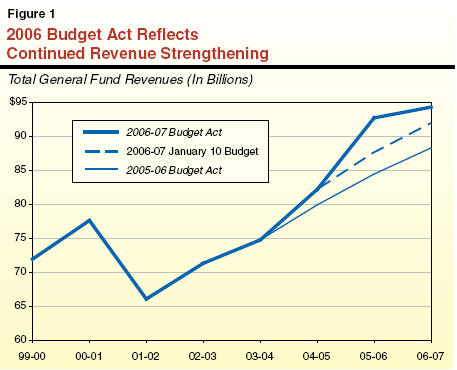
The revenue improvement that occurred in 2003-04 through 2005-06-when combined with past budget-related borrowing and various one-time and ongoing savings enacted in the 2003-04 through 2005-06 budgets-resulted in the accumulation of over $9�billion in carry-over balances that were available to support spending in 2006-07. The 2006-07 budget uses over $7�billion of these carryover balances, along with $94�billion in revenues projected in 2006-07, to finance over $101�billion in spending during the year, 9.5�percent more than in 2005-06.
Key programmatic features of this budget are as follows:
Allocates $7�billion in new funds for K-12 Proposition�98 education, resulting in an over 11�percent increase in per pupil funding relative to the level provided in the 2005-06 Budget Act.
Provides an over 10�percent General Fund increase for California Community Colleges, including funds for district equalization, block grants to districts, and for the backfill of foregone revenues resulting from a reduction in community college fees from $26 to $20 per unit beginning in spring 2007. With the 2006-07 increases, the state has met its goal of fully achieving equalization among the community college districts.
Provides General Fund increases of 8.5�percent for the University of California and 7.4�percent for California State University, including additional General Fund support in lieu of planned fee increases for 2006-07.
Provides the full $1.4�billion annual Proposition�42 transfer of sales taxes on gasoline to fund transportation programs, and it repays $1.4�billion of past Proposition�42 loans (that is, transfers which were deferred in 2003-04 and 2004-05).
Includes largely one-time funding for hospitals to increase patient capacity to meet public health emergencies, such as an avian flu pandemic.
Increases funding for county block grants for California Work Opportunity and Responsibility to Kids, child welfare services, and foster care.
Includes funding for the pass-through of the federal January 2007 Supplemental Security Income cost-of-living adjustment, which-under the terms of the previous 2005-06 budget package-had been delayed until April 2007.
Includes large increases to the Department of Corrections and Rehabilitation to cover inmate population increases and health-related costs.
Includes added funding for local law enforcement and local flood control.
The budget does not include any major tax changes. However, it does include the administration�s proposals to extend two previously enacted measures for one year. These are (1) the suspension of the teachers� tax credit and (2) an increase-from 90 days to one year-in the time period that vessels, vehicles, and aircraft purchased outside of California must be kept out of state to avoid the use tax.
The 2006-07 spending plan includes $2.8�billion in prepayments of budgetary debt that had been incurred in prior years. About one-half of the total is related to repayment of transportation loans (cited above and discussed in more detail in the transportation section). The remainder is accelerated repayments of other special fund loans that had planned repayment dates in the future. These include payments toward deficit-financing bonds (Proposition�57), local government mandate claims, and settle up of prior-year Proposition�98 obligations. Taking into account these prepayments, along with the new debt created by the Proposition�98 settlement (discussed below), the General Fund will have roughly $22�billion in budgetary debt outstanding at the close of 2006-07.
While not part of the budget package for 2006-07, agreements reached between the Governor and Legislature in three areas will have implications for General Fund spending, particularly in future years.
Proposition�98 Settlement. Following enactment of the budget, the Legislature approved a $2.9 billion settlement proposed by the administration relating to funds that some education groups claimed were owed to K-14 education for 2004-05 and 2005-06. Under this settlement, K-14 Proposition�98 will receive annual payments of $300�million in 2007-08 and $450�million per year beginning in 2008-09 until the obligation has been met.
Infrastructure Package. The Governor and Legislature reached agreement in late April on a bond package totaling $37�billion, to be submitted to voters for authorization in November 2006. These include $19.9�billion for state and local transportation projects, $10.4�billion for K-12 and higher education projects, $4.1�billion for various flood management programs, and $2.9�billion for housing and development programs. If approved, debt service on these four bonds would be roughly $100�million in 2007-08, rising to over $2.7�billion in future years when all the bonds were sold.
Collective Bargaining Agreements. The Legislature approved new agreements with 19 of 21 employee bargaining units. (All but one agreement were approved in August 2006.) These agreements result in $632�million ($270�million General Fund) in additional compensation costs during 2006-07. Most employees receive a 3.5�percent general salary increase in 2006-07, and some receive a one-time $1,000 bonus.
The 2006-07 budget is balanced with a significant reserve. As noted above, however, revenues are over $7�billion less than expenditures in 2006-07, with the difference being covered by the drawdown of carryover reserves available from 2005-06. While nearly $3�billion of the difference is due to prepayments of budgetary debt, the remaining $4�billion-plus shortfall reflects ongoing difference between revenues and expenditures for General Fund programs. Based on our out-year estimates of revenues and expenditures, we estimate that this imbalance will continue in 2007-08 and 2008-09 absent corrective action, with annual operating shortfalls in the range of $4.5�billion and $5�billion projected for this period. We will be updating our projections for 2006-07 and future years to reflect economic, revenue, and expenditure developments in our annual publication entitled California�s Fiscal Outlook, scheduled to be released in November 2006.
The state spending plan for 2006-07 includes total budget expenditures of $128.4�billion. This includes $101.6�billion from the General Fund and $26.9�billion from special funds. As Figure�1 shows, the combined spending total from these funds is up $11�billion (9.5�percent) from 2005-06.�
The figure also shows that spending of bond proceeds for capital outlay jumped from $5.6�billion in 2004-05 to $11�billion in 2005-06, before falling back to $3.6�billion in 2006-07. Bond-fund expenditures reflect the use of bond proceeds on capital outlay projects in a given year (or, in the case of education bonds, the allocation of the bond authority to specific local projects by the State Allocation Board). The costs associated with debt service on the bonds are included in the General Fund and special funds spending totals. The one-time jump in bond spending in 2005-06 is primarily related to the allocation of K-12 education bonds (approved by voters in 2004) to specific projects.
|
Figure 1 The 2006-07 Budget
Package |
|||||
|
(Dollars in Millions) |
|||||
|
Fund Type |
Actual |
Estimated 2005-06 |
Enacted |
Change From 2005-06 |
|
|
Amount |
Percent |
||||
|
General Funda |
$79,804 |
$92,730 |
$101,572 |
$8,842 |
9.5% |
|
Special fundsa |
22,192 |
24,509 |
26,824 |
2,315 |
9.4 |
|
Budget Totals |
$101,996 |
$117,239 |
$128,396 |
$11,157 |
9.5% |
|
Selected bond funds |
5,595 |
11,018 |
3,550 |
-7,469 |
-67.8 |
|
Totals |
$107,590 |
$128,257 |
$131,945 |
$3,688 |
2.9% |
|
|
|||||
Figure�2 summarizes the estimated General Fund condition for 2005-06 and 2006-07 that results from the adopted spending plan.�
2005-06. The figure shows that 2005-06 began with a prior-year carryover balance of $9.5�billion. This large balance is related to the sale of over $11�billion in deficit-financing bonds and other forms of budgetary borrowing in previous years, as well as the carryover of unanticipated revenues (associated with both higher tax liabilities and amnesty payments) received in 2003-04 and 2004-05. The figure also shows that revenues and expenditures were an identical $92.7�billion during 2005-06, leaving the fund balance at the end of the year at $9.5�billion, unchanged from the prior year. After accounting for $521�million in year-end funds encumbered by state agencies, the unencumbered year-end reserve was $9�billion.
2006-07. Figure�2 shows that revenues are projected to increase to $94.4�billion (1.7�percent), and that expenditures are projected to increase to $101.6�billion (9.5�percent). The $7.2�billion difference between expenditures and revenues is covered through the drawdown of the 2005-06 year-end reserve, leaving a remaining reserve of about $1.8�billion at the close of 2006-07. This total includes $472�million in the newly created Budget Stabilization Account (as required by Proposition�58, which was approved by the voters in 2004) and $1.3�billion in the Reserve for Economic Uncertainties.
|
Figure 2 The 2006-07 Budget |
||
|
(In Millions) |
||
|
|
2005-06 |
2006-07 |
|
Prior-year fund balance |
$9,511 |
$9,530 |
|
Revenues and transfers |
92,749 |
94,354 |
|
Total resources available |
$102,260 |
$103,884 |
|
Expendituresa |
92,730 |
101,572 |
|
Ending fund balance |
$9,530 |
$2,312 |
|
Encumbrances |
521 |
521 |
|
Reserve |
$9,009 |
$1,791 |
|
Budget Stabilization Account |
� |
$472 |
|
Reserve for Economic Uncertainties |
$9,009 |
1,319 |
|
|
||
|
a Includes 2006-07
budget package, as well as collective bargaining agreements and
certain other |
||
Figure�3 shows General Fund spending by major program area for 2004-05 through 2006-07. It shows that K-12 spending is the single largest area, accounting for nearly 40�percent of the General Fund total. Higher education, health, social services, and criminal justice spending account for most of the balance of total spending.
|
Figure 3 The 2006-07 Budget
Package |
|||||
|
(Dollars in Millions) |
|||||
|
|
Actual 2004-05 |
Estimated 2005-06 |
Enacted 2006-07 |
Change From 2005-06 |
|
|
Amount |
Percent |
||||
|
K-12 Education |
$32,595 |
$36,343 |
$39,174 |
$2,831 |
7.8% |
|
Higher Education |
9,216 |
10,313 |
11,285 |
972 |
9.4 |
|
Health |
15,898 |
17,730 |
19,527 |
1,797 |
10.1 |
|
Social Services |
8,954 |
9,235 |
9,778 |
542 |
5.9 |
|
Criminal Justice |
9,113 |
10,165 |
11,404 |
1,239 |
12.2 |
|
Transportation |
347 |
1,695 |
2,990 |
1,295 |
76.4 |
|
All other |
3,681 |
7,249 |
7,414 |
166 |
2.3 |
|
Totals |
$79,804 |
$92,730 |
$101,572 |
$8,842 |
9.5% |
|
|
|||||
|
a Includes 2006-07
budget package, as well as collective bargaining agreements and
certain other |
|||||
In terms of overall budget growth, the figure shows that General Fund expenditures are projected to rise by 9.5�percent between 2005-06 and 2006-07. Three sets of factors contribute to this increase: (1) one-time and ongoing program increases in education and selected other areas of the budget; (2) rising costs related to program utilization, health care costs, and caseloads; and (3) repayment of past budgetary debt. In terms of specific program areas:
General Fund spending on transportation jumped by 76�percent between 2005-06 and 2006-07. The 2005-06 total includes the annual transfer of sales taxes on gasoline from the General Fund to transportation special funds. The 2006-07 total includes both the annual transfer and an additional $1.4�billion loan repayment associated with Proposition�42 transfers that had been deferred from earlier years.
The second largest percentage increase is in criminal justice, where spending is being boosted by prison inmate population growth, rising health care costs, and targeted increases in spending for courts and local law enforcement.
The third most rapid increase is in the area of health, reflecting rising costs and utilization of services, as well as largely one-time spending increases to deal with public health emergencies, in particular the threat of an avian flu pandemic.
Higher education is projected to increase 9.4�percent. The 2006-07 totals include funds to cover both base increases (that is, growth to cover salaries and other cost increases) of over 5�percent plus enrollment growth for all three segments. The base increases for California State University (CSU) and University of California (UC) include General Fund monies to replace student fee increases previously planned for 2006-07. The budget also includes General Fund spending to offset a reduction in community college fees from $26 to $20 per unit beginning in spring 2007.
K-12 education increases by 7.8�percent. While this is slightly less than the overall average, it is important to note that the gain follows a rapid 11.5�percent increase in 2005-06.
All other spending increases by only 2.3�percent. The spending totals for both 2005-06 and 2006-07 include one-time expenditures for repayment of budgetary debt-that is, loans from schools, local governments, and the private sector in recent years.
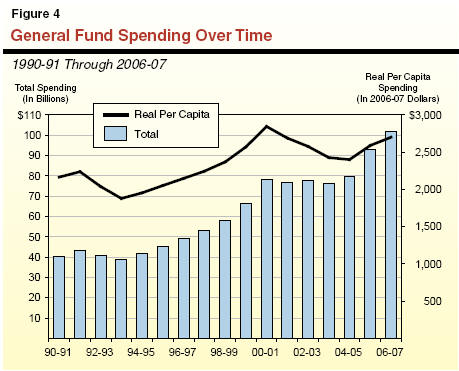
Figure�4 shows General Fund expenditures from 1990-91 through 2006-07 both in current dollars and as adjusted for population and inflation (that is, in real per capita terms). The figure indicates that after growing rapidly in the late 1990s, real per capita spending fell significantly during the 2001-02 through 2004-05 period, before rebounding in 2005-06 and 2006-07. General Fund spending is now 30�percent higher than the peak reached in 2000-01. Adjusted for inflation and population, however, real per capita spending is still slightly below the 2000-01 peak.
In this section, we highlight the major developments in the evolution of the 2006-07 budget, beginning with the original Governor�s January budget proposal and ending in June 2006, when the budget was signed into law.
Although the January budget was based on revenue projections that were less optimistic than the budget that was ultimately enacted in June, the budget proposal still was able to more or less fully fund a �current services� budget in most areas in 2006-07 and still have resources left over for other priorities. This improved outlook relative to previous years reflected both much stronger-than-expected revenues projected for 2005-06 and 2006-07 and the availability of large reserves carried over from 2004-05 (itself due to better-than-expected revenue performance, as well as budgetary borrowing and program savings in previous budgets).
Reflecting this improvement, the Governor�s budget proposed significant funding increases for K-12 and higher education and funding to cover caseload and cost increases in most other state programs. As shown in Figure�5, the budget for K-12 education fully funded enrollment and cost-of-living adjustments (COLAs) and provided an additional $1.2�billion in program spending. The increases were allocated to the equalization of school district funding, restoration of COLAs foregone in prior years, mandate payments, new teacher retention initiatives, and several other new categorical programs. The budget also included first-year funding of after school programs as required by Proposition�49.
|
Figure 5 Key Elements of Governor�s January Proposal |
|
|
|
Increased K-12 Proposition 98 Spending |
|
� Fully funded enrollment and cost-of-living adjustments (COLAs). |
|
� Provided an additional $1.2 billion for various purposes. |
|
Increased Higher Education Spending |
|
� Funded Governor�s compact with University of California and California State University. |
|
� Provided General Fund support in lieu of student fee increases planned for 2006-07. |
|
Transportation |
|
� Made full Proposition 42 transfer to transportation programs. |
|
� Proposed early repayment of $920 million in prior loans from transportation funds. |
|
Criminal Justice |
|
� Proposed phase-in of 150 new judgeships over three years. |
|
� Targeted funding for inmate and parolee programs. |
|
Social Services |
|
� Further delayed pass through of federal COLA for Supplemental Security Income/State Supplementary Program grants, from April 2007 to July 2008. |
|
� Reduced funding for county administration, child care, and welfare-to-work services. |
In higher education, the budget included funds for the Governor�s compact with the UC and CSU systems, and included General Fund monies in lieu of 8�percent student fee increases that had been planned for 2006-07.
In the area of transportation, the budget made the full transfer of Proposition�42 revenues (that is, sales taxes on gasoline) to transportation funds, and included an additional $920�million of repayments for loans made from transportation funds in previous years.
Finally, the budget included funds for the phase-in of 150 new judgeships over three years and targeted increases in the correction�s budget for inmate and parolee programs.
The budget included targeted savings in social services and state operations. For example, it delayed the pass-through of the federal COLA to Supplemental Security Income/State Supplementary Program (SSI/SSP) grants from April 2007 to July 2008 (the pass-through had been previously delayed from January 2007 to April 2007 by legislation enacted with the 2005-06 budget). It also included reductions in funding for county administration of social services programs, child care, and welfare-to-work services. In state operations, the budget assumed unspecified savings of $158�million.
In conjunction with the January budget, the Governor proposed a ten-year infrastructure plan. Areas of capital improvement included transportation, education, flood control and water supply, public safety and courts, and other public service infrastructure. The plan included $68�billion in new general obligation bonds, of which $25�billion would be submitted to the voters for authorization in 2006, and the balance to be authorized over the subsequent four election cycles.
Legislative Package Submitted to Voters. After several months of negotiations, the Governor and Legislature reached agreement in late April on a bond package totaling $37�billion, to be submitted to voters for authorization in November 2006. These include $19.9�billion for state and local transportation projects (Proposition�1B), $10.4�billion for K-12 and higher education programs (Proposition�1D), $4.1�billion for various flood management programs (Proposition�1E), and $2.9�billion for housing and development programs (Proposition�1C). In addition, the Legislature passed Chapter�34, Statutes of 2006 (AB�142, Nu�ez), which appropriates $500�million for flood control.
Major Revenue Improvement. In the months following the release of the January budget, the state revenue picture improved dramatically. Total receipts during the January-through-April period exceeded the budget forecast by well over $4�billion, with more than $3�billion of that gain occurring in April alone. While some of the increase appeared to be related to one-time transactions, the May Revision projected that some of the increase was ongoing as well. Its revised forecast of General Fund revenues was up from the January estimate by $4.8�billion in 2005-06 and $2.7�billion in 2006-07, for a two-year increase of $7.5�billion.
How New Revenues Were Allocated. As shown in Figure�6, the May Revision proposed that the additional $7.5�billion in revenues be used in three major ways.
First, the administration proposed that about $4.3�billion of the total be used for spending on state programs. This included: additional Proposition�98 spending of $2.9�billion; largely one-time spending for hospitals of $400�million for public health emergencies such as an avian flu pandemic; and additional spending in the Department of Corrections and Rehabilitation of $500�million to cover inmate population increases and rising expenditures for health care.
Second, the May Revision included an additional $1.6�billion in prepayments toward outstanding budgetary debt that had been accumulated in previous years. This included $1�billion toward outstanding deficit-financing bonds, as well as $600�million related to Proposition�98 settle-up payments and loans from special funds and local governments. Combined with the $1.6�billion already proposed in January, the additional proposed payments brought the total amount of loan repayments in the May Revision to $3.2�billion.
Third, the May Revision included a 2006-07 year-end reserve of $2.2�billion, or $1.6�billion more than the $613�million reserve proposed in January.
|
Figure 6 May Revision�Key Differences From January |
|
|
|
New Spending ($4.3 Billion) |
|
� Proposition 98�additional $2 billion for 2005‑06 and $800 million for 2006‑07. |
|
� Hospitals�largely one-time funding for hospitals to deal with public health emergencies, such as an avian flu pandemic. |
|
� Department of Corrections and Rehabilitation�added funding for inmate population increase and health care. |
|
Additional Budgetary Debt Repayment ($1.6 Billion) |
|
� $1 billion for deficit-financing bonds. |
|
� $600 million to special funds, local governments, and schools. |
|
Higher Reserve ($1.6 Billion) |
|
� Year-end 2006‑07 reserve increased from $613 million to $2.2 billion. |
Other Provisions. In addition to the 2005-06 and 2006-07 increases for Proposition�98, the May Revision proposed to settle a lawsuit related to $2.9�billion in Proposition�98 funding. Under the proposal, annual payments averaging roughly $400�million would be made over seven years, beginning in 2007-08.
Following the May Revision, the Senate and Assembly took actions on the revised proposal, and the budget was sent to Conference Committee to reconcile the differences between the houses. Following conference actions and subsequent negotiations between the Governor and legislative leadership, an agreement regarding the budget was reached in late June. The resulting budget was passed by both houses of the Legislature on June 27, 2006. After using his line-item veto authority to delete about $320�million ($114�million General Fund) in spending, the Governor signed the budget on June 30, 2006.
Comparison to the May Revision. The final budget package (see Figure 7) reflects a number of elements of the Governor�s May Revision plan. It funds Proposition�98 at a level that is roughly consistent with the May Revision, although it allocates funding within the overall Proposition�98 budget somewhat differently. For example, it provides additional funds for school district equalization and economic impact aid than proposed in the May Revision. It also combines a portion of the funding proposed in the May Revision for various categorical programs into block grants. In higher education, it adopts the Governor�s proposal to provide additional General Fund monies in lieu of planned student fee increases in 2006-07. In addition, it reduces community college fees from $26 to $20 per unit in spring 2007. As proposed in the May Revision, the final budget includes significant funding increases in corrections for inmate population growth and health care.
|
Figure 7 Final Budget�Key Differences From May Revision |
|
|
|
K-12 Proposition 98 |
|
� Roughly the same overall spending level, but with more emphasis on school district equalization and economic impact aid. |
|
� Categorical spending combined into block grant, distributed to school sites. |
|
Community Colleges |
|
� Rolls back student fees from $26 to $20 per unit in spring 2007. |
|
Health and Social Services |
|
� Provides $190 million to expand hospital capacity for public health emergencies or about one-half the May Revision amount. |
|
� Passes through federal cost-of-living adjustment for SSI/SSP grants in January 2007�three months earlier than May Revision. |
|
� Funds shifted from child welfare services to CalWORKs. |
|
Debt Repayment |
|
� Total debt prepayments reduced from $3.2 billion to $2.8 billion. |
|
� Supplemental payment toward deficit-financing bond rejected, and partly replaced with additional loan repayments to transportation, local governments, special funds, and schools. |
In other areas, it includes $190�million in largely one-time funding for hospitals to increase patient capacity to meet public health emergencies, or about one-half the $400�million proposed in the May Revision. It passes through the federal COLA for SSI/SSP grants in January 2007. These grants had been delayed until April 2007 under the 2005-06 budget package, and this delay was assumed in the May Revision. Finally, the final budget contains additional public safety funding for local governments.
Background. Article XIII B of the State Constitution places limits on the appropriation of taxes for the state and each of its local entities. Certain appropriations, however, such as for capital outlay and subventions to local governments, are specifically exempted from the state�s limit. As modified by Proposition�111 in 1990, Article XIII B requires that any revenues in excess of the limit that are received over a two-year period be split evenly between taxpayer rebates and increased school spending.
State�s Position Relative to Its Limit. As a result of the previous sharp decline in revenues, the level of state spending is now well below the spending limit. Specifically, state appropriations were $16�billion below the limit in 2005-06 and, based on the revenue and expenditure estimates incorporated in the 2006-07 budget, are expected to remain $16�billion below the limit in 2006-07. There are two main reasons that the state remains well below the limit in 2006-07 despite the large expenditure increase:
First, about $7�billion of the 2006-07 expenditure increase is financed by a draw-down of reserves carried over from prior years. The limit is applied to the appropriations of tax proceeds (including appropriations into reserves but excluding appropriations out of reserves), thus, spending supported from previously accumulated reserves are not subject to the limit.
Second, much of the increased funding that was supported by taxes is in areas, such as K-12 education and transportation, which are exempt from the state�s limit.
In addition to the 2006-07 Budget Act, the budget package includes a number of related measures enacted to implement and carry out the budget�s provisions. Figure�8 lists these bills at the time of the budget enactment. Our current estimate of the General Fund�s condition also include the impacts of collective bargaining agreements and certain other legislation approved by the Legislature subsequent to the budget�s enactment.
|
Figure 8 2006‑07 Budget and Budget-Related Legislation |
|||
|
Bill Number |
Chapter |
Author |
Subject |
|
Budget Package |
|
|
|
|
AB 1801 |
47 |
Laird |
Budget bill (conference report) |
|
AB 1811 |
48 |
Laird |
Budget revisions |
|
AB 1802 |
79 |
Budget Committee |
Education |
|
AB 1803 |
77 |
Budget Committee |
Resources |
|
AB 1805 |
78 |
Budget Committee |
Local government |
|
AB 1806 |
69 |
Budget Committee |
General government |
|
AB 1807 |
74 |
Budget Committee |
Health |
|
AB 1808 |
75 |
Budget Committee |
Human services |
|
AB 1809 |
49 |
Budget Committee |
Revenues |
|
SB 1132 |
56 |
Budget Committee |
Transportation |
|
SB 1137 |
63 |
Ducheny |
Proposition 36 reforms |
|
Post-Budget Legislation |
|
|
|
|
SB 1131 |
Enrolled |
Budget Committee |
Education trailer bill cleanup |
|
SB 1133 |
Enrolled |
Torlakson |
K-14 settlement |
|
SB 1134 |
Enrolled |
Budget Committee |
Corrections�mental health staffing |
|
AB 1812 |
Enrolled |
Budget Committee |
Grants to counties�sexual assault enforcement |
|
Variousa |
� |
|
Collective bargaining agreements |
|
|
|||
|
a Various measures which ratify agreements with 19 of 21 employee bargaining units. Full listing is provided in "Chapter 3," Figure 25. |
|||
The 2006-07 budget package includes $55.1�billion in ongoing Proposition�98 funding for K-14 education. This represents an increase of $5.2�billion, or 10.3�percent, from the funding level proposed in the 2005-06 Budget Act. Figure�1 shows Proposition�98 funding, by source, for K-12 schools, community colleges, and other affected agencies.
|
Figure 1 K-14 Proposition 98 Spending |
|||||
|
(Dollars in Billions) |
|||||
|
|
2005-06 |
|
Change From |
||
|
|
Budget Act |
Revised |
2006-07 |
Amount |
Percent |
|
K-12 Education |
|
|
|
|
|
|
General Fund |
$33.1 |
$34.6 |
$37.1 |
$4.1 |
12.3% |
|
Local property taxes |
11.6 |
11.8 |
12.0 |
0.4 |
3.5 |
|
Subtotals |
($44.6) |
($46.5) |
($49.1) |
($4.5) |
(10.0%) |
|
California Community Colleges |
|
|
|
|
|
|
General Fund |
$3.4 |
$3.7 |
$4.0 |
$0.6 |
18.4% |
|
Local property taxes |
1.8 |
1.8 |
1.9 |
� |
2.7 |
|
Subtotals |
($5.2) |
($5.5) |
($5.9) |
($0.7) |
(13.0%) |
|
Other Agencies |
$0.1 |
$0.1 |
$0.1 |
� |
6.6% |
|
Totals, Proposition 98 |
$50.0 |
$52.0 |
$55.1 |
$5.2 |
10.3% |
|
General Fund |
$36.6 |
$38.4 |
$41.3 |
$4.7 |
12.9% |
|
Local property taxes |
13.4 |
13.6 |
13.8 |
0.4 |
3.4 |
|
Percent General Fund |
73% |
74% |
75% |
|
|
|
Percent local property taxes |
27 |
26 |
25 |
|
|
Budget Package Also Includes $2.8�Billion in One-Time Funds. As discussed in more detail later in this section, the budget package also includes an additional $2.8�billion in one-time funds for K-14 education ($2.5�billion for K-12 and $305�million for community colleges).�Of these one-time monies, $2.3�billion is for meeting the higher 2005-06 Proposition�98 minimum guarantee (which increased after the 2005-06 budget was enacted due to higher-than-expected state tax revenues), $283�million is for settling up prior-year Proposition�98 obligations, and almost $250�million is from unspent prior-year Proposition�98 funds.
General Fund Share of Proposition�98 Driven by Property Tax Shifts. As shown in Figure�1, the budget assumes that $13.8�billion, or 25�percent of overall 2006-07 Proposition�98 spending, will be funded by local property taxes. The remaining 75�percent is supported by the General Fund. This is about the same proportional split as in the prior year. It is a significant increase, however, from 2003-04-when the General Fund share of Proposition�98 was roughly 65�percent. The increase in the General Fund share is due to various state-level decisions regarding the allocation of local property tax revenues between school districts and other local governments.
During the state�s recent difficult budget times, a number of actions were taken to defer spending or borrow funds. Specifically, as one of its midyear 2001-02 budget solutions, the Legislature decided to defer significant education program costs to the subsequent fiscal year. (Rather than a budget reduction, these deferrals resulted in districts receiving some program funds a few weeks later than normal.) In addition, the state delayed reimbursement of outstanding mandate cost claims dating back to 1995-96. Similarly, as of 2005-06, the state also had not fully restored ongoing revenue limit reductions made in 2003-04. We have referred to these outstanding debts as the education �credit card.�
Figure�2 shows that the budget makes significant progress in paying down the education credit card, reducing it by about 40�percent. Specifically, the 2006-07 Budget Act includes slightly more than $300�million to fully restore the revenue limit �deficit factor� and provides almost $1�billion to school districts and community colleges for the costs of prior-year mandates. Despite this progress, however, the budget includes only $34�million for 2006-07 K-14 mandate costs, which is approximately $120�million less than needed to cover all anticipated costs. In addition, the budget continues to defer to the subsequent fiscal year approximately $1.3�billion in K-14 costs.
|
Figure 2 Update on the K-14 Credit Card Balance |
||||
|
(In Millions) |
||||
|
|
2003-04 |
2004-05 |
2005-06 |
2006-07 |
|
One-Time Costs |
|
|
|
|
|
Deferrals: |
|
|
|
|
|
K-12 |
$1,097 |
$1,083 |
$1,103 |
$1,103 |
|
Community colleges |
200 |
200 |
200 |
200 |
|
Prior-year mandates: |
|
|
|
|
|
K-12 |
860 |
1,105 |
1,100 |
273 |
|
Community colleges |
100 |
100 |
100 |
76 |
|
Ongoing Costs |
|
|
|
|
|
K-12 revenue limit deficit |
$906 |
$663 |
$290 |
�a |
|
Totals |
$3,163 |
$3,151 |
$2,793 |
$1,652 |
|
|
||||
|
a Budget includes $309 million to pay off entire outstanding obligation. |
||||
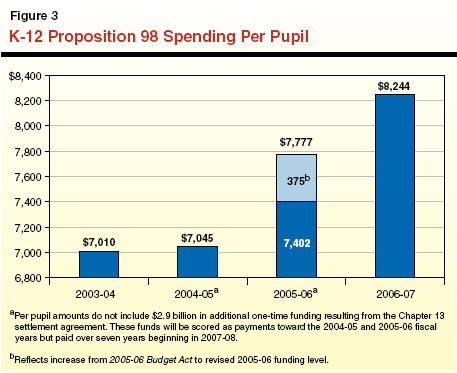
As shown in Figure�3, K-12 Proposition�98 spending in 2006-07 totals $49.1�billion, an increase of $4.5�billion, or 10�percent, from the 2005-06 Budget Act. Per-pupil funding in K-12 also increases substantially. As Figure�3 shows, K-12 per pupil funding increases to $8,244, or $842 above the level assumed in the 2005-06 Budget Act. As the figure also shows, the 2005-06 funding level increased by $375 from the 2005-06 Budget Act-to a total of $7,777 per pupil-as a result of both higher-than-expected state revenues and lower-than-expected student enrollments. This revised 2005-06 funding level is $732 per pupil higher than the 2004-05 level.
As Figure�4 shows, the $4.5�billion in new ongoing K-12 spending is sufficient to fully fund base programs, significantly increase funding for several existing programs, and provide funding for a few new programs. Major ongoing funding changes include:
Growth and Cost-of-Living Adjustment ($2.4�Billion). The budget provides $2.6�billion to fund a 5.92�percent cost-of-living adjustment (COLA) for revenue limits and most categorical programs. The budget also reflects a net of roughly $220�million in savings-mostly for revenue limits-due to estimates that statewide attendance will decline by 0.26�percent in 2006-07 compared to revised estimates for the preceding year. (Despite this decline in attendance, the budget continues to fund most categorical programs at 2005-06 levels plus COLA adjustments.)
Proposition�49 After-School Program ($426�Million). As required by Proposition�49 (passed by voters in 2002), the budget package includes $426�million in new Proposition�98 spending for after-school programs. These funds are provided on top of the base 2006-07 Proposition�98 minimum guarantee. In addition, the budget includes approximately $2�million in non-Proposition�98 General Fund monies for the California Department of Education (CDE) to administer and evaluate the program.
Revenue Limit Equalization ($350�Million). The budget provides $350�million to reduce historical inequities in general purpose spending. Chapter�79, Statutes of 2006 (AB 1802, Budget Committee), stipulates that these funds will be allocated using the current equalization methodology, which sets targets at the 90th percentile of average daily attendance and distinguishes districts by size and type.
Economic Impact Aid ($350�Million). The budget augments Economic Impact Aid (EIA) by $350�million-bringing total program funding to approximately $975�million. The program provides funding for districts to serve economically disadvantaged and English learner students. Chapter�79, Statutes of 2006 (AB 1802, Budget Committee), changes the EIA distribution formula to address various data issues and historic funding inequities.
Deficit Factor Elimination ($309�Million). The budget package provides $309�million in general purpose funds to eliminate the revenue limit deficit factor for school districts and county offices of education. In 2003-04, the state reduced revenue limits and did not provide a COLA, creating a deficit factor of 3.02�percent that would eventually need to be restored. The revenue limit reduction was partially restored in 2004-05 and 2005-06. The 2006-07 budget package fully restores it.
Counselors ($200�Million). The budget provides $200�million for additional counselors in grades 7 through 12. As a condition of receiving these funds, districts must develop coursework plans for each low-performing 7th grade student and each�10th, 11th, and 12th grade student who has not passed the California High School Exit Examination (CAHSEE). In addition, districts must schedule individual counseling sessions with these students and their parents.
Arts and Music Block Grant ($105�Million). The budget includes $105�million for a new block grant designed to enhance and expand standards-aligned instruction in arts and music. The block grant provides districts with supplemental funding to hire and train staff as well as purchase books, supplies, and equipment.
Expansion of Child Care Eligibility ($67�Million). The budget �unfreezes� the child care income eligibility cutoff-raising it to a maximum of 75�percent of the 2005 state median income level. (The income eligibility cutoff had been frozen at 75�percent of the 2000 state median income level.) The budget provides $67�million to fund the associated increase in child care caseload.
Preschool Expansion ($50�Million). The budget provides $50�million for expanded preschool services. Chapter 211, Statutes of 2006 (AB 172, Chan), which implements the expansion, provides additional preschool services in the attendance areas of decile 1 through 3 schools. Of the $50�million, $45�million funds half-day preschool services for more than 10,000 children and $5�million funds required family literacy services for parents of participating children.
Additional Support for High School Exit Exam ($50�Million). The budget provides an increase of $50�million (over base funding of $20�million) for supplemental instruction for 11th and 12th grade students who have not passed the CAHSEE. School districts will receive $500 for each such 12th grade student. Funds remaining after covering 12th grade students will be prorated across 11th grade students who have not yet passed the exam.
|
Figure 4 Ongoing K-12 Proposition 98 Changes |
|
|
2006-07 (In Millions) |
|
|
|
Amount |
|
Cost-of-living adjustments, growth, and other adjustments |
$2,383 |
|
Proposition 49 after-school programs |
426 |
|
Revenue limit equalization |
350 |
|
Economic Impact Aid |
350 |
|
Deficit-factor reduction (including basic aid) |
309 |
|
Counselors |
200 |
|
Arts and music block grant |
105 |
|
Child care eligibility |
67 |
|
Preschool expansion |
50 |
|
Increased support for high school exit exam |
50 |
|
Other |
187 |
|
Total Changes |
$4,476 |
The budget provides an additional $2.5�billion in one-time K-12 education funds. This total is comprised of additional funds required to meet the higher Proposition�98 minimum guarantee in 2005-06 ($2�billion), settle-up payments to meet Proposition�98 obligations from prior years ($258�million), and the Proposition�98 Reversion Account, which are funds that have been appropriated for K-14 education in prior years but not used ($226�million). Figure�5 shows how the final budget package spends these funds. Major one-time spending includes:
|
Figure 5 K-12 Spending From One-Time Funds |
|
|
2006-07 |
|
|
|
Amount |
|
Payment of K-12 mandate claims from prior years |
$927 |
|
Discretionary block grant |
534 |
|
Arts, music, and P.E. equipment block grant |
500 |
|
School facilities emergency repairs (Williams settlement) |
137 |
|
Instructional materials |
100 |
|
Preschool facilities |
50 |
|
Teacher recruitment |
50 |
|
Career technical education equipment |
40 |
|
Mandates�2006-07 costs |
30 |
|
Other |
165 |
|
Total |
$2,533 |
K-12 Education Mandates ($927�Million). The budget provides $927�million in one-time funds to pay for mandate costs deferred from prior years. These funds are drawn from all of the three sources of one-time funds described above. These funds retire over three-fourths of the state�s past-year mandate liabilities.
Discretionary Block Grant ($534�Million). The budget provides $534�million to districts and schools for various one-time costs-including purchasing instructional materials, providing professional development, undertaking maintenance, and paying down outstanding fiscal obligations (such as retiree health liabilities). Of this amount, 25�percent ($133�million) will be allocated to school districts and 75�percent ($400�million) will be allocated directly to school sites.
Equipment Block Grant ($500�Million). The budget includes $500�million to be distributed to school districts on a per-pupil basis. Funds may be used for supplies, equipment, and professional development for art, music, and physical education.
School Facilities Emergency Repairs ($137�Million). As part of the settlement of Williams v. California, the state is required to commit one-half of the funds in the Proposition�98 Reversion Account for emergency facility repairs. The 2006-07 budget meets this obligation by providing $137�million for this purpose.
Instructional Materials Block Grant ($100�Million). The budget includes $100�million to be distributed to school districts on a per- pupil basis. Funds may be used for instructional materials, library materials, or one-time education technology costs.
Preschool Facilities ($50�Million). In addition to the ongoing funds provided to expand preschool, the budget includes $50�million in one-time funds for preschool facilities. This funding comes in the form of a loan and is available for renovation, repair, or improvement of existing facilities as well as for purchase of new portable child care facilities.
Teacher Recruitment and Retention ($50�Million). The budget includes $50�million to be distributed on a per-pupil basis for schools ranked in the bottom three deciles of the 2005 Academic Performance Index (API). Funds are intended to improve the educational culture and environment of participating schools and may be used for various activities, including differential compensation, planning time for teachers and principals, support services for teachers and students, and small group instruction.
The Governor vetoed $37.8�million provided to increase the per meal reimbursement rate for the child nutrition program. The Governor set the funds aside, with the intent to link funding to a requirement that school districts further improve the nutritional quality of school meals. Senate Bill 1674, (Murray), which appropriates the $37.8�million, increases the reimbursement rate for free- and reduced-price meals from 16 cents to 21 cents per meal, subject to specified nutrition criteria.
The Governor also vetoed $15.1�million for a new cohort of federal Reading First schools. In an accompanying action, he deleted language that would have (1) made the continuation of a school�s funding contingent on making significant academic progress, as defined in future legislation, and (2) required CDE to report on program outcomes and the treatment of waivered classrooms.
In addition to the budget package, the Legislature concurred with the Governors proposal to settle a lawsuit initiated by the California Teachers Association. The lawsuit was based on a disagreement over the suspension of Proposition�98 in 2004-05. Chapter�213, Statutes of 2004 (SB 1101, Budget Committee), established a target funding level for K-14 education that was $2�billion lower than the amount called for by the Proposition�98 constitutional guarantee. Because final General Fund revenues for 2004-05 were substantially higher than projected, the final 2004-05 funding level was $3.6�billion lower than the constitutional guarantee (or $1.6�billion lower than the Chapter�213 target). Because the Proposition�98 minimum guarantee is calculated based on the prior-year funding level, the 2005-06 funding level also was affected, being $1.3�billion less than what it would have been had the Chapter�213 target been met.
Settlement Agreement Provides Additional $2.9�Billion to K-14 Education. The settlement agreement essentially covers the difference between the actual 2004-05 and 2005-06 funding levels and the higher levels that would have been provided had the Chapter�213 target been met. The $2.9�billion obligation is to be scored as prior-year Proposition�98 payments ($1.6�billion scored to 2004-05 and $1.3�billion scored to 2005-06). The 2006-07 Proposition�98 base spending level was established based on these higher prior-year Proposition�98 levels.
Monies Paid Over Seven-Year Period. The $2.9�billion is to be paid in installments over a seven-year period (2007-08 through 2013-14). The state is to make a first payment of $300�million in 2007-08. In each of the subsequent years, until the full obligation has been met, the state is to make payments of $450�million. These payments would be on top of the Proposition�98 minimum guarantee for each of those years.
K-12 Funds Targeted to Lowest Performing Schools. Senate Bill 1133 (Torlakson), allocates $2.6�billion of the settlement for K-12 education. Of this amount, $268�million is to be provided in 2007-08 and $402�million in each of the six subsequent years. The funds are designated for a new reform program intended to improve student achievement in schools ranked in deciles 1 or 2 of the 2005 API. Available funds are sufficient to cover about 40�percent of the approximately 1,500 eligible schools. The State Board of Education is to select the specific schools to be funded. Participating schools will receive $500 per K-3 student, $900 per grade 4 though 8 student, and $1,000 per grade 9 through 12 student.
K-12 Funds Used for Major New Class Size Reduction (CSR) Initiative. As a condition of receiving funding, schools would have to meet the requirements of the state�s existing K-3 CSR program as well as reduce class sizes in grades 4 through 12. Specifically, schools would need to reduce average classroom size to 25 students or by at least five students from their 2006-07 levels, whichever is less. The average classroom size is calculated by grade level, but no individual class may have more than 27 students. In addition to meeting the new CSR requirements, high schools would need to have a pupil-to-counselor ratio of no more than 300-to-1. All participating schools would need to demonstrate that: (1) its teachers were highly qualified, as defined by federal law, and (2) the average years of experience of its classroom teachers were equal to or higher than the district�s average.
If K-12 Program Requirements Not Met, Funding Terminated. Schools may use 2007-08 funding for facility costs associated with implementing CSR. They may use all subsequent funding for hiring additional teachers and counselors and meeting the other requirements of the program. If progress is not made, however, toward meeting the program�s requirements, school site funding can be terminated as early as the end of 2009-10.
Community College Funds Designated Primarily for Career Technical Education. Senate Bill 1133 (Torlakson), allocates slightly more than $300�million of the settlement for community colleges. Of this amount, $32�million is to be provided in 2007-08 and $48�million in each of the subsequent six years. The funds are designated primarily for improving and expanding career technical education, including hiring additional faculty to increase the number of related programs and courses. In every year but the first, $10�million is set aside for a one-time block grant that may be used for various other activities, including maintenance and purchasing instructional materials, library materials, instructional equipment, and education technology.
The enacted budget provides a total of $11.3�billion in General Fund support for higher education in 2006-07 (see Figure�6). This reflects an increase of $972�million, or 9.4�percent, above the amount provided in 2005-06. The budget fully funds anticipated enrollment increases at the University of California (UC), the California State University (CSU), and the California Community Colleges (CCC). The budget includes no undergraduate fee increases. In fact, as described below, student fees at CCC will decline in the spring term.
|
Figure 6 Higher Education
Budget Summary |
||||
|
(Dollars in Millions) |
||||
|
Department |
2005-06 |
2006-07 |
Change |
|
|
Amount |
Percent |
|||
|
University of California |
$2,845 |
$3,086 |
$241 |
8.5% |
|
California State University |
2,597 |
2,789 |
191 |
7.4 |
|
California Community Colleges |
3,714 |
4,102 |
388 |
10.4 |
|
Student Aid Commission |
738 |
847 |
108 |
14.7 |
|
California Postsecondary |
2 |
2 |
� |
0.9 |
|
Hastings College of the Law |
8 |
11 |
2 |
27.6 |
|
Other |
408 |
449 |
41 |
10.0 |
|
Totals |
$10,313 |
$11,285 |
$972 |
9.4% |
|
|
||||
|
Detail may not add due to rounding. |
||||
The budget provides about $3.1�billion in General Fund support for UC in 2006-07. This is $241�million, or 8.5�percent, more than was provided in the prior year. For CSU, the budget provides $2.8�billion in General Fund support in 2006-07. This is an increase of $192�million, or 7.4�percent, from 2005-06.
Base Budget Increases. Both university systems received substantial General Fund base augmentations to address salary and other cost increases, which amount to $156�million (5.8�percent) for UC and $130�million (5.2�percent) for CSU. These base increases include funding associated with a �fee buyout� as proposed by the Governor. The Governor had proposed the additional buyout funding in lieu of fee increases that had been planned by UC and CSU.
Enrollment Growth. The budget includes a total of $112�million to fund 2.5�percent enrollment growth at UC ($51�million) and CSU ($61�million). This accommodates an additional 5,149 full-time equivalent (FTE) students at UC and 8,490 FTE students at CSU.
In the prior (2005-06) year, UC fell short of its funded enrollment target by 500 FTE students. As a result, the 2005-06 Budget Act required a one-time reversion $3.8�million, which is the enrollment funding associated with that shortfall. However, this funding returns to the base in 2006-07, thus allowing UC to increase enrollment above the actual 2005-06 level by more than 2.7�percent.
For CSU, the 2006-07 Budget Act redefines an FTE graduate student from 30 units of instruction to 24 units. This change, which is consistent with the definition used by most other university systems, has the effect of increasing the size of CSU�s year-to-year enrollment growth. By reducing the number of units that define a graduate FTE student by 20�percent, this change makes a corresponding increase in the number of graduate FTE students that CSU is funded to serve. Without this change in the definition of an FTE graduate student, CSU�s growth target and overall enrollment levels would be lower.
Marginal Cost. For many years, the state has used a �marginal cost� methodology for determining the amount of funding to provide UC and CSU for each additional FTE student. In response to legislative direction expressed in the 2005-06 Budget Act, our office and the Department of Finance worked with the segments and others to develop an improved methodology. The parties were unable to reach consensus on a new methodology, and the Governor�s 2006-07 budget proposal included enrollment funding based on an entirely new methodology developed by the administration.
The Legislature rejected the Governor�s marginal cost proposal and instead used its own alternative methodology for funding UC and CSU enrollment growth in the 2006-07 Budget Act. Unlike the preexisting methodology, the Legislature�s approach includes costs for operation and maintenance, bases faculty costs on the salaries of recently hired professors, and redefines a full-time graduate student at CSU from 30 units per year to 24 units. Accordingly, the enacted budget funds enrollment growth based on a marginal General Fund cost of $9,901 per additional UC student and $7,225 per additional CSU student. In signing the budget, the Governor vetoed provisional language specifying that future budgets be based on the alternative methodology adopted by the Legislature.
Student Fees. Figure�7 shows student fee levels at the three segments. In fall 2005, the UC Regents and the CSU Trustees both adopted undergraduate fees increases of 8�percent for the 2006-07 academic year. As noted above, the Governor�s budget proposed that those increases be rescinded, and provided $130�million in General Fund support to compensate the segments for the foregone fee revenue. The Legislature adopted the Governor�s proposal, and the segments rescinded the fee increases. As a result, resident undergraduate fees are unchanged from 2005-06 levels.
|
Figure 7 Annual Education Fees for Full-Time Resident Studentsa |
|||
|
|
2004‑05 |
2005‑06 |
2006‑07 |
|
University of California (UC)b |
|
|
|
|
Undergraduate |
$5,684 |
$6,141 |
$6,141 |
|
Graduate |
6,269 |
6,897 |
6,897 |
|
Hastings College of the Law |
$18,750 |
$19,725 |
$19,725 |
|
California State University |
|
|
|
|
Undergraduate |
$2,334 |
$2,520 |
$2,520 |
|
Teacher Education |
2,706 |
2,922 |
2,922 |
|
Graduate |
2,820 |
3,102 |
3,102 |
|
California Community Colleges |
$780 |
$780 |
$600c |
|
|
|||
|
a Fees shown do not include campus-based fees. |
|||
|
b The UC charges special fee rates for 12 professional programs, such as medicine and nursing. |
|||
|
c Effective in spring 2007. |
|||
Student Academic Preparation (Outreach). The Legislature rejected the Governor�s proposal to eliminate General Fund support for student academic preparation programs at UC and CSU. Instead, the budget provides General Fund support of $19.3�million to UC and $7�million to CSU for these programs. Of the UC amount, $2�million is for a new transfer initiative between UC and CCC.
The budget provides CCC with $4.1�billion in General Fund support for 2006-07, which is $388�million, or 10.4�percent, above the revised 2005-06 level. In addition, as discussed earlier the budget provides CCC with another $305�million in one-time funds that, for Proposition�98 purposes, will count toward prior fiscal years. Virtually all of CCC�s General Fund support counts toward the state�s Proposition�98 expenditures, as does CCC�s local property tax revenue. Total Proposition�98 support for CCC in 2006-07 is $5.9�billion, which is 10.7�percent of total Proposition�98 appropriations.
Base Budget Increase. The budget includes $312�million to fund a 5.92�percent base increase for CCC. This increase follows the same statutory formula used to calculate the K-12 COLA. The base budget increase applies to CCC�s general apportionments and selected categorical programs.
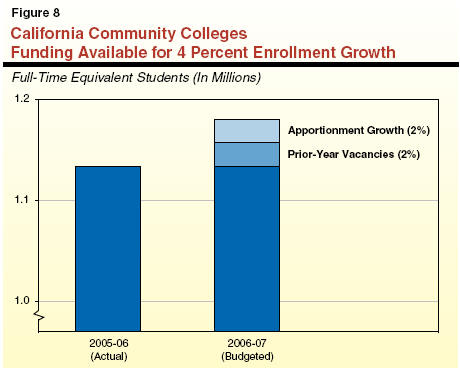
Enrollment Growth. The budget provides CCC with $97.5�million to fund enrollment growth of 2�percent, or 22,688 FTE students. However, as shown in Figure�8, community colleges actually have funded capacity to increase total enrollment by about twice this amount in 2006-07. This is because many colleges have been experiencing declining enrollment, yet will still have some funding in 2006-07 for existing slots that became vacant in 2005-06. This �stability� funding, as it is called, will permit community colleges to enroll about 24,000 additional students to fill funded vacancies from 2005-06.
Student Fees. The budget package reduces CCC student fees from $26 per unit to $20 per unit, effective spring 2007. The budget includes $40�million in General Fund support to replace the fee revenue that will be foregone as a result of the fee reduction.
Equalization. The budget includes $159�million to fully achieve the state�s equalization goal for community colleges. Trailer legislation also modifies the community college funding allocation model in order to ensure that district funding remains equalized in subsequent years.
Noncredit Instruction. The budget includes $30�million to increase the funding rate for noncredit courses that advance career development or college preparation. Such courses, which are to be defined by the Chancellor�s Office, would receive $3,092 per FTE student, while all other noncredit courses would receive $2,626 per FTE student.
Other Augmentations. The budget provides various other augmentations to CCC, including the following one-time funds:
$100�million for a general purpose block grant to all districts.
$94.1�million for facilities maintenance and equipment.
$40�million for career technical education equipment and facility upgrades. (As discussed earlier, the Proposition�98 settlement allocates a total of roughly $250�million to the community colleges over a seven-year period beginning in 2007-08 for the expansion of career technical education programs.)
The budget includes $846�million in General Fund support for the California Student Aid Commission (CSAC). This reflects an increase of $108�million, or 14.7�percent, from the 2005-06 level. Almost one-half of this increase ($51�million) is to replace one-time surplus funding from the Student Loan Operating Fund that had been used to support financial aid programs in 2005-06. Another $50.6�million funds increased costs associated with the Cal Grant programs, and the remaining $6.8�million funds increased costs of the Assumption Program of Loans for Education (APLE).
The budget package also authorizes student participation in several new APLE programs. Specifically, the budget directs CSAC to issue 40 new loan forgiveness awards for the Nurses in State Facilities APLE, 100 new awards for the National Guard APLE, and 100 new awards for the Student Nursing APLE (SNAPLE). The state will not incur costs for these awards until subsequent years after the students receiving them graduate from college. The authorization of SNAPLE awards is part of a larger package of nursing-related items in the budget package, as described below.
The budget package includes a number of augmentations for expanding enrollment of nursing students at all three segments, increasing financial aid opportunities to nursing students, and advancing the recruitment and retention of nurses as faculty members at the community colleges, and as employees at state facilities. The major elements of the nursing package are shown in Figure�9. These include an expansion of graduate nursing enrollment at UC and CSU, an increase in undergraduate nursing enrollment at CSU and CCC, the creation of new CCC programs to recruit and retain nursing faculty and students, and the authorization of loan forgiveness awards for SNAPLE and the Nurses in State Facilities APLE.
|
Figure 9 Major Nursing-Related
Appropriations |
|
|
(In Thousands) |
|
|
Description |
Appropriation |
|
University of California |
|
|
Increase entry-level master's students by 65 FTE students |
$860 |
|
Increase master's degree nursing students by 20 FTE students |
103 |
|
California State University |
|
|
Fund "startup costs" to prepare for 340 additional baccalaureate nursing students in 2007-08 |
$2,000 |
|
Increase entry-level master's students by 280 FTE students |
560 |
|
Increase baccalaureate nursing students by 35 FTE students |
371 |
|
California Community Colleges |
|
|
Fund new Nursing Enrollment Growth and Retention Program |
$12,886 |
|
Fund enrollment and equipment costs for nursing programs |
4,000 |
|
Fund new Nursing Faculty Recruitment and Retention Program |
2,500 |
|
California Student Aid Commission |
|
|
Authorize 100 new SNAPLE awards |
�a |
|
Authorize 40 new nurses in State Facilities APLE awards |
�a |
|
|
|
|
a State will not incur costs of forgiving loans under this program until subsequent years. |
|
|
APLE=Assumption Program of Loans for Education; SNAPLE= Student Nursing APLE. |
|
The 2006-07 budget plan provides about $19.5�billion from the General Fund for health programs, which is an increase of about $1.8�billion or 10�percent compared to the revised prior-year level of spending as shown in Figure�10. Several key aspects of the budget package are discussed below and summarized in Figure�11.
|
Figure 10 Health Services
Programs |
||||
|
(Dollars in Millions) |
||||
|
|
2005‑06 |
2006‑07 |
Change |
|
|
Amount |
Percent |
|||
|
Medi-Cal�local assistancea |
$12,831 |
$13,777 |
$946 |
7.4% |
|
Department of Developmental Services |
2,255 |
2,502 |
247 |
10.9 |
|
Department of Mental Health (DMH)a |
1,276 |
1,727 |
451 |
35.3 |
|
Department of Health Services� |
382 |
560 |
178 |
46.5 |
|
Healthy Families Program� |
322 |
368 |
46 |
14.4 |
|
Department of Health Services� |
384 |
247 |
-137 |
-35.7 |
|
Department of Alcohol and Drug |
242 |
290 |
47 |
19.5 |
|
Emergency Medical Services Authority |
24 |
29 |
5 |
21.1 |
|
All other health services |
14 |
27 |
5 |
21.1 |
|
Totals |
$17,730 |
$19,527 |
$1,784 |
10.1% |
|
|
||||
|
a The DMH budget increased in 2006‑07 by $340 million, with a related reduction made in Medi-Cal support, due to technical shift of General Fund from Medi-Cal to DMH. |
||||
|
b Drop in spending in 2006‑07 reflects (1) shift in support for licensing and certification activities from General Fund to fee support in 2006‑07 and (2) one-time spending in 2005‑06 for emergency drug coverage for Medi-Cal patients shifted to drug coverage under Medicare Part D. |
||||
|
Figure 11 Major Changes�State
Health Programs |
|
|
(In Millions) |
|
|
|
|
|
Enrollment Activities for Children's Health Programs |
|
|
Support new activities to expand enrollment |
$50 |
|
Medi-Cal |
|
|
Provide nursing home rate increase required by current law |
$393 |
|
Increase rates further for nursing homes and long-term care facilities |
87 |
|
Reverse 5 percent reduction in physician rates |
75 |
|
Increase rates for certain managed care plans |
39 |
|
Make technical adjustments for funding shifts to other departments |
-362 |
|
Disaster Preparedness |
|
|
Implement steps to prepare for flu pandemic and other emergencies |
$190 |
|
Public Health |
|
|
Augment AIDS prevention and education efforts |
$6 |
|
Continue local assistance to combat West Nile Virus outbreak |
3 |
|
Licensing and Certification Program Reform |
|
|
Shift support for licensing and certification
programs from General Fund |
-$50 |
|
Department of Developmental Services |
|
|
Provide rate increase for some community service providers |
$47 |
|
Increase wages for direct care staff in day and work activity programs |
24 |
|
Expand the Autistic Spectrum Disorders Initiative |
3 |
|
Department of Mental Health |
|
|
Pay outstanding mandate claims from prior years for �AB 3632� program |
$66 |
|
Create new categorical program for services to special education students |
52 |
|
Address federal court orders on mental health care for prison inmates |
27 |
|
Comply with federal consent decree for state hospitals |
21 |
|
Department of Alcohol and Drug Programs |
|
|
Improve Proposition 36 drug treatment performance and outcomes |
$25 |
|
Establish new statewide campaign to deter methamphetamine use |
10 |
|
Expand felony drug court program |
4 |
The budget plan provides about $50�million in General Fund support for new activities to (1) enroll additional children who are eligible for, but not now enrolled, in Medi-Cal and the Healthy Families Program (HFP) and (2) retain in coverage more children who are enrolled. Specifically, state grants are provided to counties to spur local outreach activities, HFP enrollment procedures are simplified, and new financial incentives are provided for certified application assistants. The spending plan also includes funds for the additional caseloads expected to result from these outreach and enrollment efforts.
The 2006-07-enacted budget provides about $13.8�billion from the General Fund ($35.1�billion all funds) for Medi-Cal local assistance expenditures. This amounts to about a $1�billion, or 7.4�percent, increase in General Fund support for Medi-Cal local assistance.
This increase in Medi-Cal local assistance expenditures would have been significantly greater except for $362�million in technical adjustments reflected in the budget plan. General Fund support previously displayed in the Medi-Cal budget is now shown in the Department of Mental Health (DMH) budget item for mental health services for children and in the Department of Aging budget item for the Multipurpose Senior Services Program. Had these expenditures been included within the Medi-Cal local assistance budget item, the increase in spending for the program in 2006-07 would have been greater than the 7.4�percent figure discussed above.
However, another factor makes the increase in the Medi-Cal local assistance budget in 2006-07 look somewhat larger than it would otherwise have been. In 2005-06, the state allocated $113�million from the General Fund for emergency state assistance to Medi-Cal beneficiaries who encountered problems in obtaining their prescription drugs when they were shifted from Medi-Cal drug coverage to coverage under the new federal Medicare Part D drug benefit. Although these expenditures are primarily for Medi-Cal patients, the administration counted them as part of the state operations budget of the Department of Health Services (DHS) in 2005-06 and did not count them as spending on Medi-Cal Program local assistance. Had these expenditures instead been counted as Medi-Cal local assistance, the increase in General Fund spending for Medi-Cal local assistance in 2006-07 would have been smaller than the 7.4�percent increase discussed above.
Major Cost Factors. The increase in expenditures primarily reflects: (1)�increases in costs and utilization of medical services in the base program; (2) rate increases for physicians and certain other providers; (3) a number of significant policy changes in Medi-Cal; and (4) ongoing growth in caseloads. Specifically, Medi-Cal caseloads are assumed to grow by about 85,000, or 1.3�percent, in the budget year to a total of about 6.7�million average monthly eligibles.
As noted above, expenditures for emergency drug coverage for Medi-Cal beneficiaries were not counted by the administration as Medi-Cal local assistance spending. However, various other fiscal effects of the new Medicare Part D drug coverage on the Medi-Cal Program are reflected in the Medi-Cal budget. The growth in the Medi-Cal budget reflects a number of fiscal effects-both positive and negative-relating to the continued shift of prescription drug coverage for certain aged and disabled beneficiaries to the federal Medicare Part D drug benefit. For example, so-called �clawback� payments by the state to the federal government required under the Medicare Part D law are included in the Medi-Cal local assistance budget.
Changes in Medi-Cal Provider Rates. The budget plan provides $393�million General Fund for rate increases for nursing homes as required by Chapter�875, Statutes of 2004 (AB 1629, Frommer), in addition to $93�million General Fund for rate increases for other facilities that provide long-term care services to Medi-Cal beneficiaries. The budget also includes $75�million General Fund to reflect the reversal of a 5�percent reduction in rates for physicians and certain other Medi-Cal providers that was enacted in 2003-04, but only partially implemented due to a now-resolved legal challenge. In addition, among other provider rate increases, $39�million in state funds is provided for rate increases for certain Medi-Cal managed care plans. The Governor vetoed an additional $9.3�million General Fund augmentation for rate increases for these plans.
New Federal Documentation Requirements. The budget plan adopts changes in state law to comply with new federal requirements that states obtain documentation of the identity and citizenship of individuals who enroll and reenroll in Medi-Cal. Because of uncertainty over its fiscal effect on the Medi-Cal Program, no fiscal changes were made in the state budget plan to reflect the impact of the new federal law.
The budget plan provides about $368�million from the General Fund ($1�billion all funds) for local assistance under HFP during 2006-07. This reflects an overall increase of about $128�million (all funds), or 14�percent, in annual spending for the program, which is administered by the Managed Risk Medical Insurance Board (MRMIB). General Fund spending for HFP local assistance is budgeted to increase by about $46�million. This is primarily the result of increases in caseload assumed to occur as a result of additional funding for application assistance and the implementation of efforts to streamline children�s enrollment, as discussed above. Underlying caseload trends and increases in provider rates are also projected to contribute to the increased spending level for HFP. Overall, program enrollment is assumed to grow by 78,000 children, or about 10�percent, to reach a total of about 859,000 children by the end of the budget year.
After the budget bill was enacted, the Legislature subsequently passed legislation (SB 1702, Speier) to amend the budget plan to augment another health coverage program administered by MRMIB known as the Managed Risk Medical Insurance Program (MRMIP). The MRMIP provides assistance to individuals who have difficulty obtaining private health coverage because of their medical conditions. If the Governor signs the measure, MRMIP would receive an additional $4�million in Proposition�99 tobacco revenues that would expand coverage to an estimated additional 1,400 enrollees now on the program�s waiting lists.
The budget plan adopts, with some significant modifications, various administration proposals to better prepare the state for public health emergencies and, in particular, the threat of an avian flu pandemic. In all, the spending plan provides more than $190�million in state funding (plus federal funds) to DHS and the Emergency Medical Services Authority (EMSA) to make additional hospital beds available in case of a flu emergency, strengthen the state and local public health laboratory systems, and conduct local planning to respond to a major public health disaster. For example, EMSA is allocated funding to establish mobile field hospitals and disaster response teams. Likewise, DHS received additional funding to stock up on antiviral medications and protective masks for health care workers and to purchase ventilators and other supplies and equipment to quickly expand emergency hospital capacity in the event of a disaster. Most of this additional funding is provided on a one-time basis.
The budget plan provides DHS with about $560�million from the General Fund ($2.5�billion all funds) for public health local assistance during 2006-07. General Fund spending for public health local assistance would increase by about $178�million, or almost 47�percent, primarily due to the augmentations for disaster preparedness discussed above. The budget supports various expansions of public health programs, including augmentations for AIDS prevention and education activities, breast cancer screening, Alzheimer�s disease diagnosis and treatment, and clinic programs for agricultural workers and rural areas. Genetic testing of newborns would be expanded to include screening for cystic fibrosis and biotinidase deficiency. The budget also continues state assistance to local special districts in controlling the West Nile Virus, although the Governor used his veto authority to reduce the amount provided for this purpose in 2006-07.
General Fund support for EMSA would increase under the budget by about 21�percent to about $29�million. About $53�million would be provided to EMSA from all fund sources. The increase is due partly to the expansion of EMSA�s disaster preparedness activities discussed earlier. The Governor vetoed a proposed $10�million General Fund augmentation for grants to improve the operation of trauma care centers.
The budget significantly expands staffing for the inspection of nursing homes, hospitals, and other health care facilities. It establishes a special fund within DHS to pay for these activities primarily from fees, but provides some General Fund support to moderate the initial impact of fee increases. After these changes have been taken into account, the budget plan replaces about $50�million in General Fund support for the DHS licensing and certification program with fee revenues, resulting in a General Fund savings to the state.
The budget provides almost $2.5�billion from the General Fund ($4�billion all funds) for services to individuals with developmental disabilities in developmental centers and regional centers. This amounts to an increase of about $246�million, about 11�percent, in General Fund support over the revised prior-year level of spending provided to the department.
Community Programs. The 2006-07 budget includes a total of almost $2.1�billion from the General Fund ($3.2�billion all funds) for community services for the developmentally disabled, an increase in General Fund resources of about $245�million, or 13�percent, over the revised prior fiscal year level of spending. This growth in community programs is due mainly to increases in caseload, costs, and utilization of regional center services. Also, about $47�million General Fund is allocated to provide a 3�percent rate increase for providers of specified regional center services. The budget also provides about an additional $24�million General Fund to increase wages for direct care staff in certain day programs and work activity programs, as well as to increase funding for supported employment programs. Also, the budget includes $2.6�million from the General Fund to expand the Autistic Spectrum Disorders Initiative, an effort to improve the provision of services to persons with autism and their families. The budget continues several mostly temporary actions to hold down community program costs.
Developmental Centers. The budget provides $385�million from the General Fund for operations of the developmental centers (almost $703�million all funds), roughly the same level of support as the revised prior-year level of spending. The budget continues to support plans to close the Agnews Developmental Center and place many of its clients in community programs, but assumes a further postponement of the closure to June 2008.
The budget provides about $1.7�billion from the General Fund ($3.6�billion all funds) for mental health services provided in state hospitals and in various community programs. This is about a $445�million, or 35�percent, increase in General Fund support compared to the revised prior-year level of spending for DMH.
Community Programs. The 2006-07 budget includes about $781�million from the General Fund (almost $2.5�billion all funds) for local assistance for the mentally ill, about an 82�percent increase in General Fund support compared to the revised prior-year level of spending. The increase in General Fund spending is mainly due to the technical budget adjustment discussed above, in which General Fund support previously displayed in the DHS Medi-Cal budget for certain mental health services for children enrolled in Medi-Cal is now displayed in the DMH budget item. The budget plan also assumes $1.2�billion in expenditures of special funds under Proposition�63, a voter-approved measure which established a state income tax surcharge to finance an expansion of community mental health programs.
�AB 3632� Mandates. The budget plan does not adopt an administration proposal to suspend what are known as the AB 3632 mandates for children in special education programs. Instead, the budget provides $69�million in federal special education funds and $52�million from the General Fund for a new DMH categorical program to reimburse a significant portion of the estimated costs for providing these services in the budget year. The spending plan also provides $66�million from the General Fund to pay outstanding mandate claims from 2004-05 and 2005-06.
State Hospitals. The budget provides about $879�million from the General Fund for state hospital operations (about $951�million all funds). The $96�million, or 12�percent, increase in General Fund resources is due to several factors, including projected increases in the state hospital population. The budget provides about $21�million General Fund and 453 staff positions to meet the requirements of a consent decree that resulted from a U.S. Department of Justice civil rights investigation of state mental hospitals. The spending plan also includes about $27�million General Fund and an additional 271 staff positions to address a federal court order in the Coleman case, which requires additional intermediate and acute care inpatient mental health services for state prison inmates.
The budget provides about $290�million from the General Fund ($670�million all funds) for community programs operated by the Department of Alcohol and Drug Programs (DADP). This is about a $47�million, or 19�percent, increase in General Fund support compared to the revised prior-year level of spending for alcohol and drug programs.
Proposition�36. The budget continues funding for the Substance Abuse and Crime Prevention Act (also known as Proposition�36) at the current level of $120�million, and provides an additional $25�million General Fund to improve the performance and outcomes of participants in these drug treatment programs. The budget package also modifies current law to change various provisions of Proposition�36, including establishing new requirements for drug testing, permitting the brief incarceration in jail of some offenders for violation of probation, and excluding some repeat offenders from eligibility for diversion from prison or jail to Proposition�36 treatment. However, these statutory changes to the provisions of Proposition�36 have been challenged in state court and are not now in effect.
Methamphetamine Prevention Campaign. The budget provides $10�million General Fund to DADP to establish a new statewide media and outreach campaign to deter the use of methamphetamine.
Drug Medi-Cal Rate Increase. The Governor vetoed a proposed $2.3�million General Fund augmentation to increase certain reimbursement rates for Drug Medi-Cal providers.
Expansion of Felony Drug Courts. As part of a strategy to reduce state prison costs over time by increasing treatment for drug- and alcohol-addicted offenders, funding for felony drug courts was increased by $4�million from the General Fund.
General Fund support for social services programs in 2006-07 totals $9.8�billion, a net increase of about $560�million, or 6�percent, over the prior year. Figure�12 shows by major program the components of this net increase in year-over-year General Fund spending. Most of the increase is due to (1) caseload increases in the Supplemental Security Income/State Supplementary Program (SSI/SSP), In-Home Supportive Services (IHSS), and Adoptions Assistance programs; (2) passing through the federal SSI COLA in January 2007 rather than the later date required by prior law; (3) new initiatives in child welfare services; and (4) the General Fund costs for backfilling the redirection of Temporary Assistance for Needy Families (TANF) federal block grant funds from child welfare and foster care into California Work Opportunities and Responsibility to Kids (CalWORKs) county block grants.
|
Figure 12 Social Services
Programs |
||||
|
(Dollars in Millions) |
||||
|
|
|
|
Change |
|
|
|
2005‑06 |
2006‑07 |
Amount |
Percent |
|
Supplemental Security Income/State Supplementary Program |
$3,478.1 |
$3,619.7 |
$141.6 |
4.1% |
|
California Work Opportunity and Responsibility to Kids |
1,962.8 |
1,863.6 |
-99.2 |
-5.1 |
|
In-Home Supportive Services |
1,262.4 |
1,332.8 |
70.4 |
5.6 |
|
Children's Services/Foster Care/Adoptions Assistance |
1,351.8 |
1,570.8 |
219.0 |
16.2 |
|
Child Support Services |
512.0 |
570.0 |
58.0 |
11.3 |
|
County administration/automation |
418.4 |
432.6 |
14.2 |
3.4 |
|
All other social services programs |
249.5 |
387.9 |
138.4 |
55.5 |
|
Totals |
$9,235.1 |
$9,777.5 |
$542.4 |
5.9% |
Although total General Fund spending increased by almost $560�million compared to 2005-06, the net increase in spending in relation to the requirements of prior law is significantly less, about $208�million. Figure�13 shows the major changes in General Fund and TANF federal fund spending compared to prior law. Major changes in each program are discussed below.
|
Figure 13 Major Changes�Social
Services Programs |
||
|
(Dollars in Millions) |
||
|
|
Change From Prior Law |
|
|
Programs |
General Fund |
TANF |
|
SSI/SSP |
|
|
|
Pass-through January 2007 federal cost-of-living adjustment |
$42.0 |
� |
|
CalWORKs County Block Grants |
|
|
|
Augmentation to account for higher spending in 2005‑06 |
� |
$140.0 |
|
Reduction for unspent county incentive funds |
� |
-40.0 |
|
Reduce transfer to CalWORKs from Employment Training Fund |
� |
17.9 |
|
TANF Reauthorization Package |
|
|
|
Participation engagement projects |
� |
$90.0 |
|
Grant savings assumed from engagement projects |
� |
-17.2 |
|
Homelessness prevention |
� |
5.0 |
|
Community colleges work study programs |
$9.0 |
� |
|
Replace General Fund with TANF funds |
-101.3 |
101.3 |
|
Foster Care and Child Welfare Services (CWS) |
|
|
|
Replace TANF funds with General Fund |
$100.0 |
-$100.0 |
|
Flexible funding for CWS improvements |
50.0 |
� |
|
Kinship programs |
10.5 |
� |
|
Support for emancipating foster youth |
9.7 |
� |
|
Augmentation for adoptions |
11.1 |
� |
|
Augmentation for dependency drug courts |
3.0 |
� |
|
Community Care Licensing |
|
|
|
Increase random inspection visits/other improvements |
$6.0 |
� |
|
Child Support |
|
|
|
Prepay transitional arrearages |
$25.5 |
� |
|
Augmentation for local child support agency improvement |
4.0 |
� |
|
Department of Aging |
|
|
|
Transfer of local assistance funding for MSSP from Health Services |
$22.3 |
� |
|
Augmentation for MSSP |
3.0 |
� |
|
Employment Development Department |
|
|
|
Los Angeles County health care workforce development |
$5.7 |
� |
|
Department of Rehabilitation |
|
|
|
Increase for supported employment rates |
$5.6 |
� |
|
Department of Community Services and Development |
|
|
|
Increase for Naturalization Services Program |
$1.5 |
|
|
Total |
$207.6 |
$197.0 |
|
|
||
|
TANF=Temporary Assistance for Needy Families. |
||
|
MSSP=Multipurpose Senior Services Program. |
||
The budget includes $3.6�billion from the General Fund for the state-funded portion of the program, an increase of $142�million (4.1�percent). This increase is attributable to caseload growth ($71�million), the loss of one-time savings from 2005-06 from delaying the January 2006 federal COLA ($78�million) by three months, and increased Cash Assistance Program for Immigrants (CAPI) costs ($12�million); partially offset by mostly one-time savings associated with federal Deficit Reduction Act (-$21�million).
State and Federal COLAs. Prior law suspended the state COLA in 2005-06 and 2006-07 and delayed the �pass-through� of the federal January 2006 and January 2007 COLAs by three months until April of the respective years. Budget trailer bill legislation restored the pass-through of the federal COLA in January 2007, resulting in a net General Fund cost of $42�million. Figure�14 shows the SSI/SSP grant levels as of April 2006 and January 2007.
|
Figure 14 SSI/SSPa Grant Levels |
||
|
(Maximum Monthly Grants) |
||
|
|
April |
January |
|
Individuals |
|
|
|
SSI |
$603 |
$616 |
|
SSP |
233 |
233 |
|
Totals |
$836 |
$849 |
|
Couples |
|
|
|
SSI |
$904 |
$923 |
|
SSP |
568 |
568 |
|
Totals |
$1,472 |
$1,491 |
|
|
||
|
a Supplemental Security Income/State Supplementary Program. |
||
CAPI. The Legislature rejected the Governor�s proposal to extend, from the current 10 years to 15 years, the period for which a sponsor�s income is �deemed� (counted for purposes of financial eligibility) to a legal noncitizen. Upon the end of the ten-year deeming period, state-only CAPI payments for certain legal immigrants will commence in September 2006. These payments result in General Fund costs of approximately $12�million in 2006-07, rising to over $40�million in 2007-08.
The budget includes $1.9�billion from the General Fund in the Department of Social Services (DSS) budget for CalWORKs. This is a decrease of about $100�million (5.1�percent compared to the prior year. Most of the decrease results from replacing General Fund spending with federal TANF funds.
CalWORKs Grants. Budget legislation from 2005 suspended both the July 2005 and July 2006 CalWORKs COLAs. Accordingly, CalWORKs maximum monthly grants remain at 2005-06 levels ($723 and $689 for families of three in high- and low-cost counties, respectively).
Net Increase in Funding for County Block Grants. Counties receive a block grant, known as the single allocation, to fund eligibility determination, welfare-to-work services, and child care. Because county block grant spending was higher during the first three quarters of 2005-06 in comparison to prior years, the Legislature increased county block grant allocations by $140�million for 2006-07. However, the budget reduces funding by $40�million, on a one-time basis, in counties that retain unspent CalWORKs performance incentives.
Redirection of Employment Training Funds (ETF). The budget replaces $18�million in ETF support for county block grants with TANF federal funds, freeing up an identical $18�million for use by the Employment Training Panel for its training programs.
TANF Reauthorization Package. In order to meet the higher work participation requirements of the federal Deficit Reduction Act of 2005, the budget provides $90�million for various projects to engage nonworking recipients in work-related activities, and $9�million for work study programs with the community colleges. These changes are assumed to result in grant savings of $17.2�million (higher earnings reduce grant payments). Finally, the budget provides $5�million for homelessness prevention among CalWORKs families facing potential eviction.
New Program for Exempt Recipients. Currently, certain CalWORKs recipients (such as those temporarily disabled, caring for a disabled relative, or over age 60) are statutorily exempt from work participation requirements. Budget legislation creates a separate state program funded exclusively with state monies that are not used to meet maintenance-of-effort requirements or to match a federal funding stream. Because of this exclusive state funding, the recipients of this program are outside the federal TANF program and are excluded from the federal work participation rate calculation. This voluntary program is to be implemented in April 2007 and provides the same benefits and requirements as the regular CalWORKs program. Budget legislation authorizes the administration to delay implementation until October 2007 under specified circumstances. Since enactment of this program, a working group of legislative staff, administration representatives, county staff, and advocates have learned that recipients of this program would receive a pass-through of all child support collected on their behalf. Because this is different than the way child support payments are treated with respect to CalWORKs, it is likely that implementation will be delayed until October 2007 or when this child support issue is addressed by the Legislature.
Restrictions on Midyear Adjustments to TANF Spending. Budget legislation prohibits the administration from increasing the expenditure of federal TANF funds on any program except CalWORKs beyond what is appropriated in the annual budget act.
The budget provides a combined total of $ 1.6�billion from the General Fund for foster care, child welfare services (CWS), adoptions, and adoptions assistance. This is an overall increase of 16�percent compared to 2005-06. This increase is primarily the result of additional spending for child welfare program improvements, as discussed below, and replacing TANF federal funds in the CWS program with General Fund monies. In a post-May Revision letter, the Governor proposed an additional $50�million in funding for child welfare and foster care programs. The final budget, as enacted, exceeded the Governor�s amended proposal by about $25�million General Fund.
CWS. The budget provides $50�million and redirects another $18�million from child welfare improvement pilot programs to provide flexible funding to counties which may be used to reduce social worker caseloads or implement early interventions to improve outcomes for families and children. Budget legislation includes language requiring DSS to work with the County Welfare Directors Association, legislative staff, and organizations that represent social workers to develop and submit to the Legislature a proposed new methodology for budgeting the CWS program, to be implemented in 2007-08.
The budget also adds an additional $3�million in 2006-07 to expand the use of Drug Dependency Courts as an intervention strategy in child welfare cases.
Kinship Support. Budget legislation established the KinGap Plus program in order to (1) increase payments to relatives who become guardians to former foster children with special needs and (2) serve youth exiting the probation system to relative care. The budget redirected the existing KinGAP funding into KinGAP Plus and included an additional $8�million to fund these changes. The budget also adds $2.5�million in funding for county programs that provide support and services to relative caregivers of foster children.
Emancipating Foster Youth. The budget adds $9.7�million to increase support for emancipating foster youth. A portion of these funds ($4�million) eliminates the county share of cost in the transitional housing placement program in an effort to increase county participation and serve a greater number of youth. The budget also includes $5.7�million which creates a state-only program of education and training vouchers for emancipating foster youth.
Adoptions. The budget provides a total of $11.1�million to increase adoptions. This includes $7.1�million to support additional adoption workers. The Legislature also added $4�million to establish a project in five areas of the state to provide pre- and post-adoption services for foster children who have been in care for more than 18 months and are over 9 years of age.
Title IV-E Federal Child Welfare Waiver. Budget legislation authorizes DSS to implement the federal Title IV-E waiver demonstration project in up to 20 counties. Under the project, the state may waive certain provisions of Title IV-E eligibility, in exchange for giving up the open-ended entitlement normally associated with IV-E funding for child welfare services. The state will receive a fixed allocation of funds, adjusted for an annual growth rate, which may be spent on preventive services or for children and families that would normally not be eligible for IV-E funding. Any county, state, or federal savings in the program that result from the demonstration project will be reinvested by the participating counties in continued service improvement efforts. The budget also includes $10�million General Fund to support counties� implementation of the project.
Budget legislation provides $6.1�million ($5.7�million General Fund), and a total of 80 positions in order to increase the frequency of random facility inspection visits and to implement other licensing division reforms, including making certain licensing information available to the public on the Internet. Budget legislation clarifies the requirement that the department conduct unannounced visits in at least 20�percent of facilities each year. The amounts noted above reflect the Governor�s veto of four positions and $320,000 for placing CCL data on the Internet.
The budget increases General Fund spending for child support enforcement by $58�million (11�percent) compared to 2005-06. Most of the increase is for costs associated with the statewide automated child support systems and the decision to hold certain noncustodial parents harmless for a transitional payment, as discussed below.
Holding Certain Noncustodial Parents Harmless for Transitional Payment. In developing its federally required automated child support system, the state changed the date when a child support payment is recorded from the date of wage withholding to the date of receipt. This change places some noncustodial parents (NCPs), through no fault of their own, behind in their child support payments, creating an �arrearage.� Budget legislation allows the state to make child support payments on behalf of the affected NCPs, thus preventing the arrearage and holding these NCPs harmless. The NCPs will be required to repay the state for this prepayment upon termination of their child support obligation. These one-time prepayments result in General Fund costs of $25.5�million in 2006-07.
The Legislature also added $4�million General Fund (and about $8�million in federal matching funds) to the allocations for local child support agencies for the purpose of improving performance on child support enforcement.
The budget increases General Fund support for IHSS by $70�million (5.6�percent) to a total of $1.3�billion. Most of the increase is attributable to growth in caseload. Budget legislation requires DSS to develop an automated system of direct deposit of paychecks for IHSS workers.
General Fund support for EDD increased by $8�million (36�percent) to a total of $30�million. Most of this increase was for training and workforce development for the Los Angeles (L.A.) County public health care system, as discussed in more detail below.
L.A. County Health Care Worker Training. In 2000, the federal government approved a $900�million, five-year Medicaid demonstration waiver for L.A. County. The waiver required the state and L.A. County to provide $40�million in funding for the county�s healthcare workforce training needs. The state agreed to pay two-thirds of these costs, with the county paying the remaining third, through the period of the waiver. At the completion of the term of the waiver, total spending was $15.2�million (state) and $10.1�million (county). Although from a federal perspective, the state�s obligation for training has been satisfied, L.A. County expended additional funds to operate the program. The budget provides $5.7�million from the General Fund to L.A. County for the program.
The budget transfers Medi-Cal local assistance funding ($22.3�million) for the Multipurpose Senior Services Program (MSSP) from DHS to the Department of Aging. The budget also provided $3�million General Fund to support increased reimbursement rates for MSSP service provider organizations.
Legislative Augmentations. The budget includes $5.6�million in the Department of Rehabilitation to fund a rate increase in the Supported Employment Program. Budget legislation codified the Naturalization Service Program (NSP) within the Department of Community Services and Development. Moreover, the budget doubled the funding for the NSP, to a total of $3�million.
The 2006-07 budget contains $12.9�billion for judicial and criminal justice programs, including $11.4�billion from the General Fund. The General Fund total represents an increase of $1.2�billion, or 12�percent, relative to 2005-06 expenditures.
Figure�15 shows the changes in General Fund expenditures in some of the major judicial and criminal justice budgets. Below, we highlight the major changes in these budgets.
|
Figure 15 Judicial and Criminal
Justice |
||||
|
(Dollars in Millions) |
||||
|
Program/Department |
2005‑06 |
2006‑07 |
Change |
|
|
Amount |
Percent |
|||
|
Judicial Branch |
$1,757 |
$1,973 |
$216 |
12.3% |
|
Department of Corrections and |
7,709 |
8,689 |
980 |
12.7 |
|
Department of Justice |
338 |
386 |
48 |
14.2 |
|
Citizens' Option for Public Safety |
100 |
119 |
19 |
19.0 |
|
Juvenile Justice Crime |
100 |
119 |
19 |
19.0 |
|
Other Corrections Programsa |
161 |
116 |
-45 |
-28.0 |
|
Totals |
$10,165 |
$11,404 |
$1,239 |
12.2% |
|
|
||||
|
a Includes debt service costs on general obligation bonds and an offset to reflect the receipt of Federal State Criminal Alien Assistance Program funds. Other programs include the Office of the Inspector General, the State Public Defender, and Payments to Counties for Homicide Trials. |
||||
The budget includes $3.4�billion for support of the judicial branch. This amount includes $1.9�billion from the General Fund; $475�million transferred from the counties to the state; and $957�million in fine, penalty, and court fee revenues. The General Fund amount is $216�million, or 12�percent, greater than the revised 2005-06 amount.
Court Operations. Funding for trial court operations is the single largest component of the judicial branch budget, accounting for over 90�percent of total judicial branch spending. The 2006-07 budget provides for growth in trial court operations funding based on the annual change in the state appropriations limit ($113�million), restoration of one-time reductions ($58�million), and increased court security ($19�million). It also includes partial-year funding for 50 new superior court judge positions ($5.5�million) and a 4.25�percent increase in judge salaries ($7.3�million). The Governor vetoed $10�million added by the Legislature to provide court interpreter services in certain civil cases.
The budget contains $8.7�billion from the General Fund for support of the California Department of Corrections and Rehabilitation (CDCR), an increase of $980�million, or 13�percent, above the revised 2005-06 level. Effective July 1, 2005, the various corrections departments were consolidated into a single department pursuant to Chapter�10, Statutes of 2005 (SB 737, Romero).
Adult Corrections. Figure�16 shows the recent growth in the inmate and parolee populations, due largely to increased admissions from county courts. The budget act includes funding to comply with court settlements relating to the delivery of medical, mental, and dental health care services to inmates ($400�million), address increased inmate and parole caseloads ($303�million), and implement a variety of new and expanded programs aimed at reducing recidivism among adult offenders ($53�million). Figure�17 shows the allocation of new funds for recidivism reduction programs. The budget also provides funding to expand the Basic Correctional Officer Academy ($55�million), reduce the backlog of lifer parole hearings ($7�million), and expand the use of Global Positioning System devices to track sex offenders and other high-risk parolees ($5�million). Subsequent to approval of the budget, the Legislature passed legislation (SB 1134, Budget Committee) authorizing an additional $35�million, primarily to establish 552 mental health staff for the department in accordance with a federal court order in the Coleman v. Schwarzenegger case.
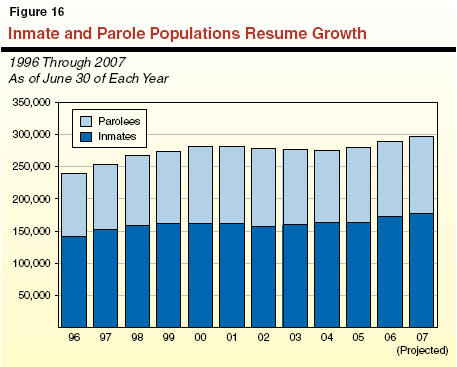
|
Figure 17 Adult Corrections |
|
|
(In Millions) |
|
|
Program Area |
Amount |
|
Inmate education |
$21.1 |
|
Parole programs |
7.8 |
|
Community partnerships |
7.7 |
|
Administrative supporta |
6.2 |
|
Rehabilitative programs |
6.0 |
|
Treatment |
3.9 |
|
Total |
$52.8 |
|
|
|
|
a Includes funding for
research and evaluation, information technology, staff training, and
support |
|
|
Detail may not total due to rounding. |
|
Prison Health Care Receiver. In February 2006, a federal court judge in the Plata v. Schwarzenegger case appointed a federal receiver to manage the CDCR inmate health care program. The receiver�s mandate is to bring the department into compliance with constitutional standards for the provision of medical services. To that end, the receiver�s powers are broad and include determining the program�s annual budget, hiring and firing medical staff, and entering into contracts with community providers. The 2006-07 budget includes $100�million in unallocated funds for the receiver to further implement court orders. It is anticipated that these funds will be used to raise salaries for health care employees, as well as purchase new equipment and supplies.
Special Session on Prison Expansion. On June 27, 2006, Governor Schwarzenegger declared a special session (the second extraordinary of 2005-06) of the Legislature to address prison overcrowding. Though the Legislature considered various bills designed to reduce overcrowding and expand the prison capacity to meet projected growth, no legislation was enacted. The bills considered included funding and authority to build new prisons, construct housing at existing prisons, improve prison infrastructure systems, contract for male and female community beds, and transfer inmates to prisons in other states.
Juvenile Justice. The budget provides funding to further implement remedial plans resulting from the Farrell v. Hickman lawsuit ($60�million). This consists of funds to increase the staff-to-ward ratio in the youth correctional facilities and enhance the delivery of medical and mental health care services. The budget also establishes the Community Re-Entry Challenge Grant Program, which is aimed at reducing recidivism among juvenile parolees through enhanced community-based services ($10�million).
The budget includes $386�million (General Fund) for support of the Department of Justice, an increase of $48�million above the revised 2005-06 amount. Notable new spending includes $6.5�million to create four new Gang Suppression Enforcement Teams, $6�million to expand the California Methamphetamine Strategies Program, $10.6�million for new vehicles and equipment, and $1.3�million to increase the investigation and prosecution of complex financial and identity theft crimes. The budget also provides a total of $30�million for the Proposition�69 DNA Program, which represents an increase of $19�million relative to the 2005-06 funding level. This increase for the DNA program consists of $9�million General Fund and $10�million from the DNA Identification Fund to be generated primarily by a newly enacted increase in criminal penalties.
The budget provides $565�million for the major local public safety programs. This represents an increase of $146�million, or 35�percent, above the 2005-06 funding level. Figure�18 shows the changes in local public safety programs.
|
Figure 18 Major Local Public Safety Programs�General Fund |
|||||
|
(Dollars in Millions) |
|||||
|
|
|
|
|
Change |
|
|
Program |
2005‑06 |
2006‑07 |
|
Amount |
Percent |
|
Citizens' Option for Public Safety |
$100.0 |
$119.0 |
|
$19.0 |
19.0% |
|
Juvenile Justice Crime Prevention Grantsa |
100.0 |
119.0 |
|
19.0 |
19.0 |
|
County Probation Grants |
201.0 |
201.0 |
|
� |
� |
|
Mentally Ill Offender Crime Reduction Grants |
� |
45.0 |
|
45.0 |
� |
|
Vertical Prosecution Block Grants |
8.0 |
16.0 |
|
8.0 |
100.0 |
|
War on Methamphetamine Grants |
9.5 |
29.5 |
|
20.0 |
210.5 |
|
Booking Fee Reimbursement |
� |
35.0 |
|
35.0 |
� |
|
Totals |
$418.5 |
$564.5 |
|
$146.0 |
34.9% |
|
|
|||||
|
a The 2005‑06
Budget Act provided $26 million for this program and anticipated
a $74 million carry |
|||||
Notable initiatives for local law enforcement include those targeting mentally ill offenders and local booking fees. Specifically, the budget provides $45�million to reestablish the Mentally Ill Offender Crime Reduction Grant Program. This program will provide grants to local governments for demonstration projects designed to reduce recidivism among mentally ill offenders. In addition, the budget provides $35�million to reimburse cities for jail booking fees paid to counties in 2005-06 and revamps county authority to collect fees starting in 2007-08. After the budget was enacted, the Legislature passed AB 1812 (Committee on Budget), which provides $6�million in grants for Sexual Assault Felony Enforcement teams.
The 2006-07 budget plan provides total expenditures of $12.3�billion from state special funds and federal funds for the Department of Transportation (Caltrans). This level of expenditures is primarily due to the substantial repayment of past Proposition�42 loans, as detailed below. The 2006-07 expenditure level, however, is about the same as that expended in 2005-06 which included the award of the Bay Bridge self-anchored suspension contract in March�2006.
The 2006-07 budget provides approximately $5.2�billion for transportation capital outlay, $1.5�billion for capital outlay support, $2.2�billion for local assistance, and about $1.1�billion for highway operations and maintenance. The budget also provides about $1.5�billion for support of Caltrans� mass transportation and rail program, and $538�million for transportation planning and departmental administration.
Full Funding of Proposition�42. Consistent with the requirements of Proposition�42, the 2006-07 budget provides for the transfer of gasoline sales tax revenue from the General Fund to the Transportation Improvement Fund (TIF) for transportation purposes. The total amount of the 2006-07 transfer is estimated at $1.4�billion. This amount is to be allocated as follows:
$678�million for the Traffic Congestion Relief Program (TCRP) to fund 141 state and local transportation projects.
$594�million for the State Transportation Improvement Program (STIP) to fund state and local transportation projects.
$148�million to the Public Transportation Account (PTA) for mass transportation purposes.
Substantial �Spillover� Revenues, New Allocation. Current law requires that certain �excess revenue� generated from a 4.75�percent sales tax on all taxable goods, including gasoline, as compared to a 5�percent tax on all taxable goods excluding gasoline (referred to as spillover revenue) be transferred to the PTA for transportation uses. For 2005-06, the transfer was suspended and spillover revenues were retained in the General Fund. Due to high gasoline prices, the 2006-07 budget projects that spillover revenues will total $668�million. These revenues will be allocated as follows:
$200�million to partially repay a Proposition�42 suspension.
$125�million for seismic retrofit of Bay Area toll bridges.
$20�million for farm worker transportation grants. Specifically, the Legislature enacted SB 1135 (Committee on Budget and Fiscal Review), directing Caltrans to provide these funds as matching grants to public agencies to purchase, lease, or operate vans or buses to serve farm workers.
$13�million for high-speed rail development.
Remaining revenues (about $310�million) will be distributed:
80�percent to State Transit Assistance (STA).
20�percent to other mass transportation activities.
The 2006-07 budget provides a greater share of spillover revenue to STA than is required by current law. This, together with other STA revenues sources such as diesel sales tax revenues, Proposition�42 funding, and early repayment of prior suspensions (as discussed below), will provide STA with an estimated $624�million in 2006-07. This is up from a funding level of roughly $237�million in 2005-06.
Early Partial Repayment of Proposition�42 Debt. The 2006-07 budget provides $1,415�million to repay with interest about two-thirds of the amount of Proposition�42 funds suspended in 2003-04 and 2004-05. The repayment includes $920�million that would otherwise be repaid in 2007-08 and $495�million that is due in 2008-09. The repayment includes $1,215�million from the General Fund and $200�million in spillover revenues (as mentioned above). The amount will be allocated as follows:
$315�million for TCRP projects.
$424�million plus interest for STIP projects.
$424�million plus interest for local streets and roads.
$210�million (approximately) to the PTA.
Under Proposition�1A, to be considered on the November 2006 ballot, the remaining Proposition�42 debt (about $754�million) would be repaid by June 30, 2016, with minimum annual repayment of one-tenth the total amount owed. Figure�19 shows the past Proposition�42 suspensions and the repayments to the TIF in 2006-07 and future years.
Tribal Gaming Bond to Repay $827�Million in Transportation Debt. Under current law, $1.2�billion in previous loans to the General Fund from the Traffic Congestion Relief Fund (TCRF) are to be repaid by tribal gaming revenue bonds. The 2006 budget assumes that tribal gaming bonds will be issued in 2006-07 to repay $827�million plus interest to the TCRF, as shown in Figure�19. These bond funds would be allocated as follows:
|
Figure 19 Transportation Loans and Repaymentsa |
|||||
|
(In Millions) |
|||||
|
|
To General Fundb |
|
To TCRFc |
||
|
Year |
From TCRFd |
From TIF |
|
From SHA |
From PTA |
|
Balance through 2003‑04 |
$1,383 |
$868 |
|
$463 |
$275 |
|
2004‑05 |
-183 |
1,258 |
|
-20 |
� |
|
2005‑06 |
-151 |
� |
|
-151 |
� |
|
2006‑07 |
-827 |
-1,373 |
|
-292 |
-245 |
|
2007‑08 |
� |
-84 |
|
� |
� |
|
2008‑09 |
� |
-84 |
|
� |
� |
|
2009‑10 |
� |
-84 |
|
� |
� |
|
Beyond 2009‑10 |
-222e |
-502 |
|
� |
-30e |
|
|
|||||
|
SHA = State Highway
Account; TCRF= Traffic Congestion Relief Fund; TIF= Transportation |
|||||
|
a Amounts do not include interest, only the principal amounts owed and repaid. |
|||||
|
b Positive numbers are amounts payable to the General Fund, negative numbers are amounts payable from the General Fund. |
|||||
|
c Positive numbers are amounts payable to TCRF, negative numbers are amounts payable from TCRF. |
|||||
|
d Funds shown from the General Fund as payment to the TCRF in 2005‑06 and beyond come from tribal gaming revenues. |
|||||
|
e To be repaid from future tribal gaming bonds. The date when these bonds will be issued is unknown. |
|||||
$292�million, plus interest, will be used to repay the State Highway Account for previous loans made to TCRF.
$290�million will remain in the TCRF to fund TCRP projects.
$245�million will be used to partially repay PTA for previous loans made to TCRF.
The budget includes trailer bill language to modify the allocation of tribal gaming bond revenues. Specifically, it provides additional future-year bond revenues to TCRP projects. After 2006-07, TCRF will still be owed $222�million, of which $30�million would go to PTA and $192�million would be used for TCRP projects. It is unknown when tribal gaming bond revenues will repay this debt. Figure�1 assumes these revenues to be available after 2009-10.
Programmatic Funding Impact of Major Budget Actions. The 2006-07 budget provides for the full Proposition�42 transfer, repays early $1,415�million in transportation debt, reallocates substantial spillover revenues, and anticipates that $827�million plus interest will be repaid by tribal gaming bond revenues. Together, these actions result in $4.2�billion in funding for transportation programs. This is about $2.7�billion more than revenues received from Proposition�42 and tribal gaming revenues in 2005-06. Figure�20 shows how revenues from major budget actions are distributed between programs. (The budget provides over $8�billion in additional revenues to transportation beyond those listed here. These additional revenue sources include primarily the excise tax on motor fuels, truck weight fees, and federal funds.)
|
Figure 20
Major 2006‑07 Budget Actionsa |
|
|
(In Millions) |
|
|
Program |
Fundingb |
|
Traffic Congestion Relief Program |
$1,283 |
|
State Transportation Improvement Program |
1,018 |
|
Public Transportation Account |
913 |
|
State Highway Accountc |
443 |
|
Local streets and roads |
424 |
|
Bay Area toll bridges |
125 |
|
Farm worker transportation grants |
20 |
|
High-speed rail development |
13 |
|
Total |
$4,239 |
|
|
|
|
a Includes full
Proposition 42 transfer in 2006‑07, $1,415 million in early partial
repayment for past |
|
|
b Amounts do not include interest. |
|
|
c Amount includes $151 million in tribal gaming revenues received at end of 2005‑06. |
|
The 2006-07 budget provides about $1.6�billion to fund the CHP, an increase of about $120�million (8.3�percent) compared to the 2005-06 level. The increase is primarily due to first-year funding ($56�million) for CHP to begin a multiyear project to upgrade its radio communications system and support costs ($41�million) related to hiring additional patrol officers and 911 call center staff. About $1.4�billion of the total funding will come from the Motor Vehicle Account (MVA).
With regard to DMV, the budget provides $848�million in departmental support, about $77�million (10�percent) more than the 2005-06 level. A major component of the increase in DMV�s support costs is funding provided in the budget that enables the department to begin work on projects to improve its computing infrastructure related to its driver licensing and vehicle registration programs.
The 2006-07 budget provides about $5.7�billion from various fund sources for natural resources and environmental programs administered by the Resources and California Environmental Protection Agencies, respectively. This is a reduction of about $1.4�billion, or 20�percent, when compared to 2005-06 expenditures. This reduction is mainly the result of a decrease in bond fund expenditures for park and water projects due to the one-time nature of these expenditures. While total funding from the General Fund for resources and environmental protection programs remains relatively stable from 2005-06 to 2006-07, the budget reflects a number of one-time General Fund augmentations. The most significant increases include $250�million for deferred maintenance at state parks, $100�million for flood control subventions, and $84.1�million for the lining of the All-American and Coachella Canals. We discuss these and other General Fund changes in further detail below.
Figures 21 and 22 compare expenditure totals for resources and environmental protection programs in 2005-06 and 2006-07. As the figures show, the largest changes in funding for these programs are generally in local assistance and capital outlay due to a reduction in available bond funds.
|
Figure 21 Resources Programs: Expenditures and Funding |
||||
|
2005‑06 and 2006‑07 |
||||
|
|
|
|
Change |
|
|
Expenditures |
2005‑06 |
2006‑07 |
Amount |
Percent |
|
State operations |
$3,392.6 |
$3,519.7 |
$127.1 |
3.8% |
|
Local assistance |
541.3 |
452.5 |
-88.8 |
-16.4 |
|
Capital outlay |
1,438.8 |
389.9 |
-1,048.9 |
-72.9 |
|
Totals |
$5,372.7 |
$4,362.1 |
-$1,010.6 |
-18.8% |
|
Funding |
||||
|
General Fund |
$1,884.9 |
$1,825.7 |
-$59.2 |
-3.1% |
|
Special funds |
1,725.9 |
1,649.7 |
-76.2 |
-4.4 |
|
Bond funds |
1,542.2 |
722.9 |
-819.3 |
-53.1 |
|
Federal funds |
219.7 |
163.8 |
-55.9 |
-25.4 |
|
Totals |
$5,372.7 |
$4,362.1 |
-$1,010.6 |
-18.8% |
|
Figure 22 Environmental
Protection Programs: |
||||
|
2005‑06 and 2006‑07 |
||||
|
|
|
|
Change |
|
|
Expenditures |
2005‑06 |
2006‑07 |
Amount |
Percent |
|
State operations |
$1,098.9 |
$1,128.6 |
$29.7 |
2.7% |
|
Local assistance |
621.0 |
210.3 |
-410.7 |
-66.0 |
|
Capital outlay |
0.1 |
5.1 |
5.0 |
>100.0 |
|
Totals |
$1,720.0 |
$1,344.0 |
-$376.0 |
-21.9% |
|
Funding |
||||
|
General Fund |
$72.6 |
$88.0 |
$15.4 |
21.2% |
|
Special funds |
993.5 |
1,016.0 |
22.5 |
2.3 |
|
Bond funds |
484.4 |
69.2 |
-415.2 |
-85.7 |
|
Federal funds |
169.5 |
170.8 |
1.3 |
0.8 |
|
Totals |
$1,720.0 |
$1,344.0 |
-$376.0 |
-21.9% |
Bond Expenditure Summary. The budget includes just under $800�million from various bond funds, mostly Propositions 13, 40, and 50, for various resources and environmental protection programs. Selected highlights of these bond expenditures are shown in Figure 23.
|
Figure 23 Selected Bond
Expenditures |
|
|
2006‑07 |
|
|
Program Area |
Budgeted Expenditures |
|
CALFED Bay-Delta Program |
$272 |
|
Other water supply and management projects (non-CALFED) |
171 |
|
State parks�acquisition and improvements |
148 |
|
Other water quality projects (non-CALFED) |
58 |
|
Flood control capital outlay projects |
45 |
|
Wildlife Conservation Board�acquisition, development, restoration |
35 |
|
State Coastal Conservancy�acquisition, development, restoration |
32 |
|
Lake Tahoe and Sierra Nevada conservation |
32 |
|
River Parkways Program |
31 |
|
Other land acquisition and conservation |
13 |
|
Farmland Conservancy Program |
8 |
CALFED Bay-Delta Program. The CALFED Bay-Delta Program is a consortium of 24 state and federal agencies created to address a number of interrelated water problems in the state�s Bay-Delta region. The budget provides a total of $246�million in state funds for the CALFED Bay-Delta Program in 2006-07, in addition to about $92�million of reappropriations. Of the $246�million, $103�million is from Proposition�50 bond funds (the largest funding source) and $26�million is General Fund. The budget reflects a reorganization of the program, including a transfer of all funding and position authority of the California Bay-Delta Authority to various other CALFED state agencies. The Secretary for Resources is largely assuming the function of providing staff support to the board of the California Bay-Delta Authority.
Flood Management. The budget includes various increases totaling over $170�million for flood management-related state operations, local assistance, and capital outlay. These increases include: (1) $38.2�million ($7.6�million onetime) from the General Fund for the Department of Water Resources� (DWR�s) state operations and local assistance to improve flood management activities in the Central Valley and Delta regions; (2) $31.4�million (General Fund) for flood control capital outlay projects in the Central Valley; and (3) $100�million (one time) from the General Fund to pay local governments for the state�s share of the costs of federally authorized, locally sponsored flood control projects outside the Central Valley. These increases bring the department�s flood management budget to a total of about $215�million (various funds) for state operations and state and local flood control projects. In addition, the budget includes 28 new positions to implement Chapter�34, Statutes of 2006 (AB 142, Nu�ez), which appropriated $500�million for flood control system repairs and improvements, including the repair of critical erosion sites. These new positions will be paid for from this appropriation. The department anticipates spending this appropriation over multiple years, with $116�million being spent in 2006-07.
Paterno Lawsuit. In addition to the flood management expenditures noted above, the budget includes $62.9�million (General Fund) to pay the second installment of a ten-year, $428�million financing obligation arising from the state�s $464�million Paterno lawsuit settlement relating to a flood in 1986.
Canal Lining. The DWR�s budget includes $84.1�million from the General Fund for the lining of the All-American and Coachella Canals, to reduce the amount of water that is lost due to seepage. These projects are related to the �Quantification Settlement Agreement� and, when complete, will save approximately 100,000 acre-feet of water annually. We note that currently pending litigation relating to the lining project, raising water rights and environmental issues, might delay or require changes in the expenditure of these funds.
State Parks. The budget provides $250�million in one-time funding from the General Fund for deferred maintenance at state parks. The Department of Parks and Recreation (DPR) projects that these funds will be mostly spent over a four-year period. In addition, the budget includes an ongoing augmentation of $15�million (General Fund) for operations and maintenance at new and existing parks.
Fish and Game Preservation Fund. The budget provides $19.9�million in one-time funding and $5.9�million in ongoing funding from the General Fund to address structural deficits in the Fish and Game Preservation Fund.
Allocation of Tidelands Revenues. The budget estimates that $222�million in revenues from oil and gas leases on state-owned tidelands and ocean waters will be deposited in the General Fund. Previously, statute allocated a portion of tidelands oil revenues to particular natural resources programs. With the sunset of that provision on June 30, 2006, all tidelands oil revenues are now deposited in the General Fund. (Please note that the budget includes several one-time appropriations from the General Fund for resources-related purposes previously funded with tidelands oil revenues. These purposes include habitat protection and restoration programs discussed below.)
Habitat Protection and Restoration. The budget includes various General Fund increases totaling about $53�million ($40�million onetime) for habitat protection activities carried out by the Department of Fish and Game, Wildlife Conservation Board, and the State Coastal Conservancy. These increases include: (1) $19�million for marine life and ecosystem protection and management; (2) $14�million for salmon and steelhead restoration; (3) $10�million for nongame fish and wildlife management; (4) $5�million for wetlands and riparian habitat conservation; and (5) $5�million to create an endowment fund for the management of coastal wetlands.
Climate Change. The budget provides about $37�million (mostly from the MVA) to a number of state agencies to reduce the state�s emission of gases that contribute to global warming and to develop alternative fuels. Included in this amount is $6.5�million for continued development of hydrogen fueling stations and hydrogen vehicles.
Air Quality: Emission Reduction Grants. The budget includes a total of $140�million in special funds for grants to reduce air emissions. Of this amount, $90�million is ongoing funding from the Air Pollution Control Fund (supported by smog check-related fees and tire recycling fees) for the Carl Moyer Program, which seeks to reduce oxides of nitrogen (NOx) emissions from diesel-fueled engines. Another $25�million (one-time funding from MVA) is for grants and incentives for the development of efficient and clean alternative fuels and zero-emission vehicles. The final $25�million of this total (one-time funding from MVA) is for grants to local public agencies for purchase of low-polluting construction equipment if voters approve Proposition 1A in the November general election; otherwise, these monies are to fund replacement of pre-1977 model-year school buses.
Energy Research and Renewable Energy Incentives. The budget includes about $70�million for energy-related research and development carried out under the Public Interest Energy Research Program and $163�million for production-based incentives and purchaser rebates to promote renewable energy under the Renewable Energy Program. Senate Bill 1250 (Perata)-passed by the Legislature and awaiting gubernatorial action-reauthorizes these two programs on a permanent basis. They were statutorily scheduled to sunset at the end of 2006.
Public Utilities Commission Staffing. The budget includes about $12�million (special funds) in the Public Utilities Commission (PUC) for implementation of the Telecommunications Consumer Bill of Rights and about $3�million for 33 new positions across several regulatory programs at the PUC.
The 2006-07 budget includes $2.7�billion for capital outlay expenditures (excluding highways and transit), as shown in Figure 24. About 82�percent of total expenditures is from bonds (either general obligation or lease-revenue bonds). The major state capital outlay projects and programs funded in the budget are discussed below.
|
Figure 24 2006-07 Capital Outlay Programs |
|||||
|
(In Millions) |
|||||
|
|
Bonds |
General |
Special |
Federal |
Totals |
|
Legislative, Judicial and Executive |
� |
� |
$66.3 |
� |
$66.3 |
|
State and Consumer Services |
$3.0 |
$1.7 |
� |
� |
4.7 |
|
Business, Transportation and Housing |
� |
� |
23.7 |
� |
23.7 |
|
Resources |
259.1 |
70.5 |
58.2 |
$7.1 |
394.9 |
|
Health and Human Services |
� |
7.4 |
� |
� |
7.4 |
|
Corrections and Rehabilitation |
1.5 |
181.2 |
� |
� |
182.7 |
|
Education |
1,908.3 |
9.0 |
� |
� |
1,917.3 |
|
General Government |
31.7 |
5.4 |
9.2 |
35.4 |
81.7 |
|
Totals |
$2,203.6 |
$275.2 |
$157.4 |
$42.5 |
$2,678.7 |
About $1.9�billion, or 72�percent, of capital outlay expenditures planned for 2006-07 will be for higher education programs:
CCC-$862�million in bond funds for various projects at the community college campuses.
CSU-$541�million in bond funds for various projects at the CSU campuses.
UC-A total of $514�million, with $505 million from bond funds and $9�million General Fund, for various projects.
A majority of these expenditures are contingent on passage of Proposition 1D on the November 2006 ballot.
About $395�million, or 15�percent, of total capital outlay expenditures planned for 2006-07 will be for resources programs, including:
DPR-A total of $190�million, including $135�million in bond funds, for various park projects statewide.
DWR-A total of $81�million, including funds for flood control projects on the American and Sacramento Rivers and the South Delta Improvements Program. In addition, Chapter�34 provides $500�million for levee repair and flood control system improvements. The department anticipates spending $116�million from this appropriation in 2006-07, some of which will be for capital outlay. Also, the department plans $122�million (off-budget funds supported by revenues from water users) in capital expenditures on the State Water Project.
Wildlife Conservation Board-$41�million, including almost $33�million in bond funds, for a variety of habitat conservation and resource protection projects throughout the state.
State Coastal Conservancy-$31�million, including almost $28�million in bond funds, for various projects to protect coastal resources and ecosystems.
Department of Forestry and Fire Protection-$24�million, all General Fund, for projects to construct and upgrade fire stations, conservation camps, and communications facilities.
The capital outlay budget also includes:
CDCR-$181�million in General Fund for projects at various state correctional facilities.
Judicial Branch-$66�million from special funds for four new trial courthouses.
General Government-A total of $81�million mainly from bond and federal funds. The total includes $57�million for the Department of Veterans Affairs for veterans� homes and $16�million for the Military Department for armory improvements and property acquisition for a new headquarters facility.
Noneducation Mandates. The budget includes $232.5�million (General Fund) and $1.7�million (special funds) to pay 2005-06 and 2006-07 claims for 38 noneducation mandates, including the Peace Officer�s Procedural Bill of Rights mandate. Funding for the AB 3632 mental health mandate is provided separately in the budget (we discuss this mandate in the �Health� section of this report). The budget suspends local agency obligations to carry out 29 mandates in the budget year and directs the Commission on State Mandates to reconsider two previous mandate determinations that found state reimbursable costs. The budget starts the process of paying local governments for the large backlog of pre-2004-05 mandate claims. Specifically, the budget provides $169.9�million (General Fund) to make the 2006-07 and 2007-08 payments towards the state�s 15-year plan to retire this mandate debt
$1.2�Billion for Increased Pay and Benefit Costs. The budget act provides $567�million ($361�million General Fund) to meet increased pay and benefit obligations for state employees. Most of these obligations were created by labor agreements approved by the Legislature in prior years. In 2006, the Legislature approved new agreements with 19 of 21 employee bargaining units. Only correctional officers-14�percent of the state workforce-now work under an expired agreement, and state engineers are working under a previously approved agreement that expires in 2008. The bills that ratified the new agreements are listed in Figure 25. Bills approved by the Legislature after passage of the budget appropriate a total of $632�million ($270�million General Fund) to fund the new agreements. In total, the Legislature appropriated $1.2�billion ($631�million General Fund) for increased pay and benefits for state employees in 2006-07, as shown in Figure 25.
|
Figure 25 Augmentations for Employee Compensation |
||||
|
2006-07 |
||||
|
|
|
|
Increased Costsa |
|
|
Bargaining Unit or Employee Group |
Percent of |
MOU Ratification Bill |
General Fund |
All Funds |
|
1�Administrative, Financial, and Staff Services |
20.4% |
AB 1369 (Nu�ez) |
$60 |
$187 |
|
2�Attorneys |
1.7 |
AB 146 (Nu�ez) |
11 |
27 |
|
3�Educators and Librarians (Institutional) |
1.2 |
AB 1369 (Nu�ez) |
11 |
12 |
|
4�Office and Allied |
13.7 |
AB 1369 (Nu�ez) |
29 |
81 |
|
5�Highway Patrol |
2.9 |
AB 2936 (Ridley-Thomas) |
� |
71 |
|
6�Correctional Peace Officers |
14.0 |
Not applicableb |
141 |
142 |
|
7�Protective Services and Public Safety |
3.1 |
AB 2930 (Laird) |
22 |
48 |
|
8�Firefighters |
2.1 |
AB 1165 (Bogh) |
43 |
47 |
|
9�Professional Engineers |
4.8 |
Not applicablec |
3 |
76 |
|
10�Professional Scientific |
1.2 |
AB 1458 (De La Torre) |
3 |
12 |
|
11�Engineering and Scientific Technicians |
1.2 |
AB 1369 (Nu�ez) |
1 |
9 |
|
12�Craft and Maintenance |
5.0 |
SB 357 (Perata) |
14 |
42 |
|
13�Stationary Engineer |
0.4 |
SB 357 (Perata) |
4 |
5 |
|
14�Printing Trades |
0.2 |
AB 1369 (Nu�ez) |
� |
1 |
|
15�Allied Services (Custodial, Food, Laundry) |
1.9 |
AB 1369 (Nu�ez) |
8 |
11 |
|
16�Physicians, Dentists, and Podiatrists |
0.7 |
AB 386 (Lieber) |
43 |
45 |
|
17�Registered Nurses |
1.8 |
AB 1369 (Nu�ez) |
80 |
84 |
|
18�Psychiatric Technicians |
3.2 |
AB 1458 (De La Torre) |
15 |
19 |
|
19�Health and Social Services/Professional |
1.9 |
AB 386 (Lieber) |
11 |
17 |
|
20�Medical and Social Services |
1.0 |
AB 1369 (Nu�ez) |
6 |
8 |
|
21�Education and Libraries (Noninstitutional) |
0.3 |
AB 1369 (Nu�ez) |
1 |
3 |
|
Subtotals |
(82.6%) |
|
($505) |
($947) |
|
Supervisors, Managers, and Judicial Branch |
17.4% |
No MOUd |
$126 |
$241 |
|
Totals |
100.0% |
|
$631 |
$1,199 |
|
|
||||
|
a LAO estimates of increased state salary and benefit costs resulting from provisions of prior memoranda of understanding (MOUs), new MOUs approved by the Legislature in 2006, and court-ordered pay changes for prison health care employees. |
||||
|
b MOU expired July 2, 2006. |
||||
|
c MOU in effect until July 2, 2008. |
||||
|
d Nonrepresented employee raises funded primarily in AB 2936 (Ridley-Thomas). |
||||
Raises for All State Employees. Pay levels for virtually every state employee (including supervisors and managers) will increase in 2006-07 as a result of the Legislature�s actions. Most employees receive a 3.5�percent general salary increase and a one-time $1,000 bonus. Correctional officers, CHP officers, and state engineers receive larger raises, as their pay rises in line with that of comparable local government employees. (These pay adjustments are required by state law for CHP officers and by labor agreements for correctional officers and state engineers.) The new labor agreements provide additional increases to classifications with identified recruitment and retention challenges, representing about 20�percent of the state workforce. Doctors and nurses in CDCR and the DMH receive some of the largest pay increases (over 20�percent) as a result of court orders to boost pay in the prison health care system. (The prison health care receiver has announced that he will order additional pay increases in 2006-07, which will require additional spending.) Most agreements provide additional employee pay increases in 2007-08, generally linked to inflation.
Employer Health Costs Continue to Increase. Rising health care premiums set by the California Public Employees� Retirement System (CalPERS) continue to drive increased state costs to provide employees with health care coverage. CalPERS estimates that state contributions for employee health care premiums will total $1.5�billion in 2006, and average health plan premiums will rise by 12�percent in 2007. While several of the new labor agreements reduce the percentage of premiums required to be paid by the state, overall state costs for health premiums will still rise in 2006-07. Included in the budget and memoranda of understanding bills are additional appropriations of $79�million ($35�million General Fund) to assist departments in covering their increased premium costs. (These costs are reflected in Figure 25.)
Increased CalPERS Contribution Rates. Under state law, CalPERS sets public employer contribution rates sufficient to maintain an actuarially sound pension system. These contribution rates for the state increased for 2006-07. For the most part, the increased rates result from pay raises and demographic factors (such as retiree longevity and the number of employee retirements) that differed from CalPERS� prior actuarial assumptions. The increases vary for each of the retirement categories. For employees in the largest retirement category (Miscellaneous Tier I), state contributions increased from 15.9�percent of payroll in 2005-06 to 17�percent in 2006-07. State contributions for CHP officers increase from 26.4�percent of payroll to 31.5�percent. As a result of these rate increases, state costs will rise by $237�million in 2006-07. We estimate that less than one-half of the increased costs will be paid from the General Fund.
Retiree Health Costs Increase 14�Percent. The state pays up to 100�percent of health and dental premiums for retired state employees and dependents, including those enrolled in Medicare. In 2006-07, state contributions to retiree health premiums will increase by 14�percent to $1�billion. (These costs initially are paid from the General Fund, and the state later recovers a portion-about one-third-from special funds through pro rata charges.) The increased state contributions are driven by (1) higher CalPERS premium charges for Medicare supplement and other health plans and (2) a projected net increase in the number of state retirees and eligible dependents.
Preparing for New Retiree Health Accounting Rules. New public sector accounting rules require disclosure of unfunded liabilities for retiree employee health benefits beginning in 2007-08. The budget includes $3.2�million for (1) the State Controller to contract for an actuarial assessment of liabilities and (2) CalPERS to begin offering services to public agencies that are obtaining actuarial valuations of liabilities and considering setting aside funds to address these liabilities. The budget also holds more than $30�million of expected federal Medicare payments related to state retiree drug benefits in a special account for future legislative consideration.
CalSTRS Contributions Decline. State contributions to the California State Teachers� Retirement System (CalSTRS) will decrease in 2006-07. State law requires contributions from the General Fund equal to a fixed percentage of teacher payroll. As a result of CalSTRS� accounting errors, the state overpaid the system between 2003 and 2006, and the budget reduces CalSTRS payments on a one-time basis to account for the overpayments. Total state contributions will decrease 11�percent to $959�million. In 2007-08, contributions are likely to increase to over $1.1�billion.
The budget assumes $200�million in General Fund savings from authority given to the administration to reduce departmental appropriations during the fiscal year. State operations appropriations could be reduced by no more than 20�percent, and local assistance appropriations could be reduced by no more than 5�percent.
|
Acknowledgments The Legislative Analyst's Office (LAO) is a nonpartisan office which provides fiscal and policy information and advice to the Legislature. |
LAO Publications To request publications call (916) 445-4656. This report and others, as well as an E-mail subscription service, are available on the LAO's Internet site at www.lao.ca.gov. The LAO is located at 925 L Street, Suite 1000, Sacramento, CA 95814. |