Despite improving revenues, California policymakers continued to face significant fiscal challenges in preparing the 2005-06 budget. Although the projected budget shortfall for 2005-06 was considerably smaller than in the three prior years, the state’s ongoing structural budget problem remained a major concern. In this chapter, we (1) briefly review the factors behind the state’s ongoing budget shortfall, (2) highlight the major budget solutions included in the 2005-06 budget package, and (3) provide preliminary estimates of how the actions adopted in the 2005-06 budget will affect the fiscal outlook for 2006-07 and beyond.
California has faced large structural budget shortfalls-that is, persistent operating deficits where annual expenditures have exceeded revenues-since 2001-02, when revenues plunged following the recession and the steep decline in the stock market. Although revenues subsequently improved and some progress was made toward addressing the structural shortfall in the 2002-03 through 2004-05 budgets, policymakers were not able to agree on a sufficient amount of ongoing solutions to eliminate the structural problem. Instead, the 2002-03 through 2004-05 budgets relied heavily on one-time or limited-term solutions-such as borrowing, spending deferrals, and funding shifts-to achieve temporary balance. In addition to providing only temporary savings, many of these solutions resulted in additional future expenditures, as deferred spending and loan repayments come due. At the beginning of the current budget cycle, the state faced repayments on budget-related debt totaling $2 billion in 2005-06 and about $4 billion annually over the period 2006-07 through 2008-09.
Size of Budget Problem. In our November 2004 fiscal forecast, we estimated that the state faced a year-end shortfall in its 2005-06 General Fund budget of nearly $6.7 billion. We also estimated an operating deficit of around $7.3 billion in 2005-06, increasing to $10 billion in 2006-07 as various temporary savings expire and deferred obligations start coming due. In its January 2005 budget proposal, the administration identified an even-larger $8.6 billion projected year-end shortfall in 2005-06. These projected shortfalls declined in the subsequent months due to stronger-than-expected revenues realized in the spring of 2005 (related to both improved economic activity and large amnesty-related tax collections). As a result, by the time the budget was adopted, the projected year-end 2005-06 shortfall had narrowed to around $3.4 billion, and the ongoing structural shortfall in 2006-07 had dropped to slightly under $9 billion.
The 2005-06 budget package contains about $5.9 billion in solutions. These solutions are expected to eliminate the $3.4 billion budget shortfall and establish a $1.3 billion year-end reserve, while at the same time enabling the state to prepay the $1.2 billion vehicle license fee (VLF) “gap loan” from local governments (due in 2006-07). As shown in Figure 1, the solutions fall into four major categories-namely, program savings, fund shifts, loans and borrowing, and revenues from improved tax compliance.
|
Figure 1 Solutions in 2005‑06 Budget |
|
|
(In Millions) |
|
|
|
|
|
Program Savings |
|
|
Proposition 98a |
$2,994 |
|
Social services |
455 |
|
State operations |
100 |
|
Property tax administration |
60 |
|
Employee compensation |
40 |
|
Other |
496 |
|
Subtotal, Program Savings |
($4,145) |
|
Funding Shifts |
|
|
Retain Public Transportation Account spillover |
$380 |
|
Federal funds for certain prenatal care |
192 |
|
Tideland oil revenues |
157 |
|
Subtotal, Funding Shifts |
($728) |
|
Loans and Borrowing |
|
|
Refinance tobacco bonds |
$525 |
|
Loan from Merrill Lynch for Paterno lawsuit settlementb |
361 |
|
Subtotal, Loans and Borrowing |
($886) |
|
Revenues |
|
|
Increased tax compliance |
$94 |
|
Total |
$5,853 |
|
|
|
|
Detail may not total due to rounding. |
|
|
a Consists of $1.823 billion in savings in 2004‑05 and $1.171 billion in savings in 2005‑06. |
|
|
b This amount is net of 2005‑06 General Fund repayments on the $428 million loan. |
|
Program Savings. About $4.1 billion of the solutions involve program savings. Nearly three-quarters of this total is from holding Proposition 98 funding for 2004-05 at the level provided in the 2004-05 budget, instead of providing additional funding to reflect revenue improvements since the budget’s enactment. Another $455 million is in social services, mostly related to the suspension of cost-of-living adjustments for California Work Opportunity and Responsibility to Kids and Supplemental Security Income/State Supplementary Program grants. The balance of the savings is from a variety of areas, including state operations, local property tax administration, and employee compensation.
Funding Shifts. About $728 million in General Fund savings are from funding shifts. These include $380 million from retaining certain sales taxes on gasoline (so-called “spillover funds”) in the General Fund instead of using them for public transit purposes. Other funding redirections include a shift of tideland oil revenues from special funds to the General Fund, and the use of federal funds instead of General Fund for certain prenatal care provided under the Medi-Cal Program.
Loans and Borrowing. Although the budget does not use additional deficit-financing bonds beyond those that already have been issued, it does include budget-related borrowing from two sources. First, it relies on a $428 million loan from Merrill Lynch to finance the settlement costs of flood-related litigation (the Paterno case) against the state. The first repayment of this loan occurs in 2005-06, resulting in net General Fund savings of $361 million from the loan. Second, the budget assumes the refinancing of previously issued tobacco settlement-backed bonds, raising $525 million.
Revenues. Although the budget does not include any new General Fund taxes, it does anticipate additional revenues of $94 million related to increased tax compliance efforts.
The 2005-06 budget contains roughly $2 billion in ongoing budgetary savings. We estimate that these savings, coupled with the prepayment of the VLF gap loan, will reduce the projected 2006-07 operating shortfall between annual current law revenues and expenditures by roughly one-third-from around $9 billion to around $6 billion.
We will be updating our projections for 2005-06 and future years to reflect actions taken in the final month of the legislative session, as well as expenditure and revenue-related developments, in our annual publication entitled California’s Fiscal Outlook, scheduled to be released in November 2005.
The state spending plan for 2005-06 includes total budget expenditures of $113 billion. This includes $90 billion from the General Fund and $23 billion from special funds. As Figure 1 shows, the combined spending total from these funds is up $9.3 billion (9 percent) from 2004-05.
|
Figure 1 The 2005-06 Budget
Package |
|||||
|
(Dollars in Millions) |
|||||
|
|
|
|
|
Change From 2004-05 |
|
|
Fund Type |
Actual |
Estimated |
Enacted |
Amount |
Percent |
|
General Fund |
$76,333 |
$81,728 |
$90,026 |
$8,298 |
10.2% |
|
Special funds |
18,892 |
22,286 |
23,333 |
1,047 |
4.7 |
|
Budget Totals |
$95,225 |
$104,014 |
$113,359 |
$9,345 |
9.0% |
|
Selected bond funds |
6,986 |
14,607 |
4,004 |
-10,603 |
-72.6 |
|
Totals |
$102,211 |
$118,621 |
$117,363 |
-$1,258 |
-1.1% |
The figure also shows that spending of bond proceeds jumped from $7 billion in 2003-04 to $14.6 billion in 2004-05, before falling back to $4 billion in 2005-06. Bond-fund expenditures reflect the use of bond proceeds on capital outlay projects in a given year (or, in the case of education bonds, the allocation of the bond authority to specific local projects by the State Allocation Board). The costs associated with debt service on the bonds are included in the General Fund and special funds spending totals. The one-time jump in bond spending in 2004-05 largely reflects the allocation of K-12 education bonds (approved by voters in 2004) to specific projects.
The General Fund Condition
Figure 2 summarizes the estimated General Fund condition for 2004-05 and 2005-06 that results from the adopted spending plan.
|
Figure 2 The 2005‑06 Budget
Package |
|||
|
(Dollars in Millions) |
|||
|
|
2004‑05 |
2005‑06 |
Percent |
|
Prior-year fund balance |
$7,279 |
$7,498 |
— |
|
Revenues and transfers |
79,935 |
84,471 |
5.7% |
|
Deficit-financing bond |
2,012 |
— |
— |
|
Total resources available |
$89,226 |
$91,969 |
— |
|
Expenditures |
$81,728 |
$90,026 |
10.2% |
|
Ending fund balance |
$7,498 |
$1,943 |
— |
|
Encumbrances |
641 |
641 |
— |
|
Reserve |
$6,857 |
$1,302 |
|
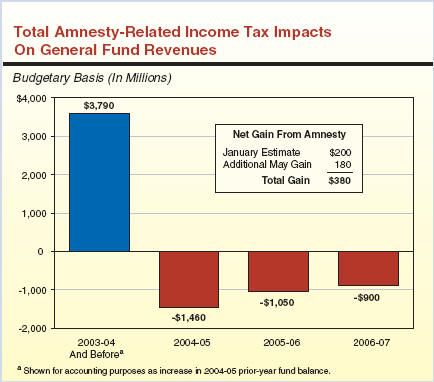
2004-05. The figure shows that 2004-05 began with a prior-year balance of $7.3 billion. This large balance was boosted by a net of $3.8 billion in receipts directly and indirectly related to the tax amnesty program adopted in conjunction with the 2004-05 budget (see box below). These payments were received in the spring of 2005, but since they were related to tax liabilities in 2002 and prior years, they were accrued back to the earlier years and reflected as an increase to the 2004-05 carry-in balance. All but $380 million of the $3.8 billion increase is expected to be offset by lower collections related to audits during the 2004-05 through 2006-07 period. A more complete discussion of the fiscal impacts of the amnesty program is included in the box.
Amnesty-Related RevenuesOne of the key developments during the spring of 2005 was the unexpectedly large amount of cash receipts that resulted directly and indirectly from a tax amnesty program that had been adopted as part of the previous year’s budget. The amnesty filing time frame ran from February 1, 2005 to March 31, 2005, and applied to tax years before 2003. When the program was enacted in 2004-05 it was expected to result in $600 million in cash payments from personal income and corporate taxpayers. Of this total, $200 million was expected to be new revenues and the remainder was expected to represent an acceleration of payments what would otherwise have been received through the state’s ongoing audit process. The actual amount of cash payments received by the Franchise Tax Board dramatically exceeded the original estimates. Total amnesty-related receipts were around $4.4 billion. Of this total, over $800 million was filed by amnesty participants, and another $3.6 billion was largely from nonamnesty participants who filed so-called “protective claims” to avoid the possibility of being charged high post-amnesty penalties if their tax challenges are not upheld or if they receive future audit assessments. The great majority of these new payments are expected to be offset by lower net collections in the future. Specifically, the 2005-06 budget is based on the assumption that, of the $4.4 billion in total amnesty-related collections, about $4 billion either represents an acceleration of future tax payments that have already been projected, or amounts that will have to be refunded in the future because they will exceed what taxpayers owe. These cash offsets are estimated to total roughly $600 million in 2004-05, $1.5 billion in 2005-06, $1.1 billion in 2006-07, and $900 million in 2007-08. Taking into account both the cash payments and the expected offsets, the net gain from the amnesty program is expected to be $380 million, or $180 million more than originally anticipated when the 2004-05 budget was enacted. Budgetary Impacts. California uses an accrual method of accounting for state revenues. In theory, under an accrual system, all of the $4.4 billion in payments should be attributed back to the individual tax years before 2003 to which they apply. However, under California’s method of accounting, the state does not go back and change revenue totals for past years that have been “closed” for accounting purposes. Rather, it shows such amounts as an adjustment to the prior-year’s incoming balance. With regard to expected changes in future payments or refunds associated with the amnesty program, the state’s accounting methodology recognizes revenue that is expected to be received within 12 months. Taking into account these factors, the budgetary impact of the amnesty program is shown in the accompanying figure. It shows that the net impact on budgetary revenues is:
|
The figure also shows that revenues totaled $79.9 billion, or about $1.8 billion less than the $81.7 billion in expenditures, during the year. In addition, the state used $2 billion of deficit-financing bond proceeds. (To date, the state has sold $11.3 billion of the $15 billion in deficit bonds authorized by California voters in March 2004.) After accounting for $641 million in encumbrances (that is, contracts and other spending commitments made in 2004-05 which will be liquidated in 2005-06), the year closed with a reserve of $6.9 billion.
2005-06. Figure 2 shows that revenues are projected to increase by 5.7 percent in 2005-06, to $84.5 billion, while expenditures are projected to increase by 10 percent, to $90 billion during the year. This results in an operating deficit of $5.6 billion. This, in turn, lowers the projected 2005-06 year-end reserve to $1.3 billion.
Programmatic Spending in 2005-06
Figure 3 shows General Fund spending by major program area for the 2003-04 through 2005-06 period. It shows that K-12 spending is the single largest area, accounting for nearly 40 percent of the General Fund total. Higher education, health, social services, and criminal justice spending account for most of the balance of all spending.
|
|
Figure 3 The 2005‑06 Budget
Package |
||||||
|
|
(Dollars in Millions) |
||||||
|
|
|
|
|
|
Change From 2004‑05 |
||
|
|
|
Actual |
Estimated |
Enacted |
Amount |
Percent |
|
|
|
K-12 Educationb |
$29,197 |
$32,527 |
$34,987 |
$2,460 |
7.6% |
|
|
|
Higher Education |
8,789 |
9,302 |
10,185 |
882 |
9.5 |
|
|
|
Health |
13,911 |
16,024 |
17,861 |
1,836 |
11.5 |
|
|
|
Social Services |
8,851 |
8,973 |
9,254 |
281 |
3.1 |
|
|
|
Criminal Justice |
7,333 |
9,161 |
9,663 |
502 |
5.5 |
|
|
|
Transportation |
482 |
352 |
1,673 |
1,321 |
375.6 |
|
|
|
Vehicle license fee (VLF) subventionsc |
3,125 |
— |
1,186 |
— |
— |
|
|
|
All other |
4,645 |
5,388 |
5,144 |
-245 |
-4.5 |
|
|
|
Totals |
$76,333 |
$81,728 |
$90,026 |
$8,298 |
10.2% |
|
|
|
|
||||||
|
a General obligation bond and lease-revenue bond debt service is allocated by program area. |
|
||||||
|
b Includes both Proposition 98 and non-Proposition 98 funding. |
|
||||||
|
c 2005‑06 amount reflects repayment of VLF “gap loan” covering subventions not paid in 2002‑03 and 2003‑04. |
|
||||||
The figure shows that, despite the savings actions adopted in the budget (and discussed in “Chapter 1”), expenditures are still projected to increase by over 10 percent in 2005-06-about double the rate of population growth and inflation in the state. As discussed below, this large increase reflects both
(1) ongoing growth in key state programs and (2) a variety of special factors.
Ongoing Program Growth. We estimate that roughly one-half of the total General Fund spending growth is the result of significant spending increases for a variety of state programs. For example, the budget increases per-pupil funding for both K-12 and community college education. It also funds the Governor’s compact for University of California (UC) and California State University (CSU), and provides a 6 percent general cost-of-living adjustment (COLA) for trial courts. The budget also reflects increased costs and utilization in the state’s ongoing Medi-Cal and related health care programs.
Special Factors. The other half of the spending increase is related to such factors as restorations in spending that had been deferred or suspended in 2004-05, and the payment of obligations incurred in prior years. These factors include:
Proposition 42 Transfer. This transfer of sales taxes on gasoline to transportation special funds was deferred in 2003-04 and 2004-05 but is fully funded in 2005-06. This results in an added cost to the General Fund of $1.3 billion in the current year.
Prepayment of Vehicle License Fee (VLF) “Gap Loan.” The budget provides $1.2 billion in one-time funds to prepay a loan from local governments that was due in 2006-07. The loan is related to state VLF “backfill” payments to local governments (that is, payments that were made to local governments to compensate them for the reduction in revenues that occurred when the state lowered the rate on vehicle license fees). A portion of these backfill payments had been deferred in late 2002-03 and early 2003-04.
Mandate Payments. The budget funds about $239 million in mandates, substantially more than provided in 2004-05. About one-half of the total is related to two mandates requiring services for special education pupils, and is included in the Department of Mental Health’s budget.
“One-Time” Payments Related to Property Tax Shifts. A part of the 2004-05 budget package was a “swap” between the state and local governments, whereby the state stopped funding VLF backfill payments in return for a shift of property taxes from schools to local governments (the school property taxes are replaced with General Fund payments). Payments related to this swap are resulting in a one-time increase in General Fund spending for K-14 education, anticipated in the budget to be over $300 million in 2005-06.
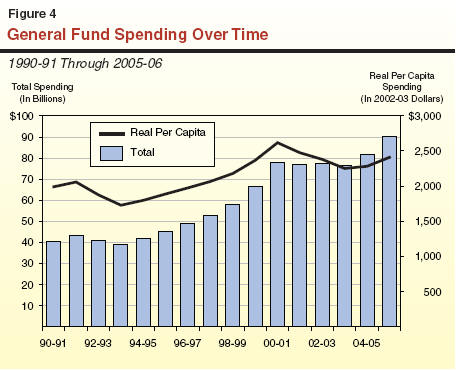
General Fund Spending Over Time
Figure 4 shows General Fund expenditures from 1990-91 through 2005-06 both in current dollars and as adjusted for population and inflation (that is, in real per capita terms). The figure indicates that after growing rapidly in the late 1990s, General Fund spending fell modestly during the 2001-02 through 2003-04 period, before resuming an upward trend in 2004-05. Total spending in 2005-06, is now 15 percent higher than the peak reached in 2000-01. Adjusted for inflation and population, however, real per capita spending is 8 percent below the 2000-01 peak.
In this section, we highlight the major developments in the evolution of the 2005-06 budget, beginning with the original Governor’s January budget proposal and ending in July 2005, when the budget was signed into law.
Governor’s January Proposal for 2005-06
In January 2005, the Governor proposed a 2005-06 General Fund budget which contained about $9.1 billion in solutions in order to both cover an estimated budget shortfall of $8.6 billion and maintain a $500 million reserve. This budget plan would also have reduced the state’s ongoing structural budget shortfall by roughly one-half-from $10 billion to under $5 billion per year. Figure 5 outlines the key savings contained in the original January budget plan.
|
Figure 5 Savings in the January 2005 Budget Plan |
|
|
|
Program Savings ($4.7 Billion) |
|
� Proposition 98 ($2.3 billion). |
|
� Social services cost-of-living adjustments and grant reductions ($0.7 billion). |
|
� In-Home Supportive Services wage contributions ($0.2 billion). |
|
� State employee compensation ($0.4 billion). |
|
� Local mandate suspensions ($0.2 billion). |
|
� Senior citizens’ tax assistance ($0.1 billion). |
|
� Other ($0.8 billion). |
|
Funding Shifts ($0.9 Billion) |
|
� State Teachers’ Retirement System contributions ($0.5 billion). |
|
� Transit “spillover” funds ($0.2 billion). |
|
� Federal funds ($0.2 billion). |
|
Loans and Borrowing ($3.4 Billion) |
|
� New deficit-financing bond sales ($1.7 billion). |
|
� Paterno settlement judgment bond ($0.5 billion). |
|
� Proposition 42 transfer ($1.3 billion). |
|
Tax Compliance ($0.1 Billion) |
|
� Tax gap proposals ($0.1 billion). |
Program Savings ($4.7 Billion). Of this total, about $2.3 billion was related to the two-year effect of holding the 2004-05 funding level for K-14 education at the level included in the 2004-05 Budget Act. Roughly $1 billion was related to reductions in social services. This included: (1) a 6.5 percent reduction in California Work Opportunity and Responsibility to Kids (CalWORKs) grants, (2) the elimination of CalWORKs grant COLAs, (3) the suspension of the state COLA for Supplemental Security Income/State Supplementary Program (SSI/SSP) (including no pass-through of the federal COLA), and
(4) the reduction in the state’s contribution to the wages of In-Home Supportive Services (IHSS) workers. Other savings included an increase in state employee pension contributions and other compensation-related savings, the suspension of various local mandates, the elimination of the senior citizens’ property tax assistance program, and a reduction in the senior citizens’ renters assistance program.
Funding Shifts ($0.9 Billion). The budget included three proposals in this area. First, the budget proposed that the state no longer fund annual base program contribution costs for the State Teachers’ Retirement System (STRS). Instead, these costs would be borne by the schools districts or their employees. Second, the budget proposed to retain Public Transportation Account “spillover” funds in the General Fund in 2005-06, instead of using them for public transit purposes. Third, the budget proposed to replace General Fund support for certain prenatal care services with new federal funds.
Loans and Borrowing ($3.4 Billion). The budget proposed to use $1.7 billion in deficit-financing bonds-about one-half of the amount remaining from the $15 billion authorized by voters in March 2004. It proposed to suspend the $1.3 billion Proposition 42 transfer of sales taxes on gasoline from the General Fund to transportation funds. The suspended amount would be paid over a
15-year period. It also assumed that the state would issue a “judgment bond” to finance a $464 million settlement of flood-related litigation (the Paterno case) against the state.
Tax Compliance ($0.1 Billion). The budget assumed a net gain of about $94 million related to tax compliance measures.
Other Features. In other areas, the budget provided increased funding for UC and CSU consistent with the Governor’s compact with higher education. It also included a series of changes to the Medi-Cal Program, including expansion of managed care for families and kids as well as the aged and disabled, new premiums for certain beneficiaries, and an imposition of a cap on adult dental services. It also included significant funding increases for judiciary and criminal justice areas.
May Revision
In the months following the release of the January budget plan, the state revenue picture improved significantly. The May Revision used these revenues to reduce borrowing and increase spending in a limited number of areas. The key changes incorporated in the May Revision plan are highlighted in Figure 6.
|
Figure 6 May Revision—Key Changes From January Proposal |
|
|
|
New Revenues ($4.2 Billion) |
|
�Increased revenues related to economy—$4 billion. |
|
� Increased revenues related to amnesty—$0.2 billion. |
|
New Proposals ($4.2 Billion) |
|
�Reduced borrowing ($2.3 billion). |
|
— Eliminate new deficit-financing bond sales ($1.7 billion). |
|
— Prepay one-half of vehicle license fee “gap loan” due in 2006‑07 ($0.6 billion). |
|
�New/restored spending ($1.8 billion). |
|
— Proposition 42 transfer to transportation ($1.3 billion). |
|
— Proposition 98 “settle-up” payments ($0.2 billion). |
|
— Senior citizens’ property tax and renters’ assistance programs ($0.1 billion). |
|
— Other ($0.2 billion). |
Improved Revenues. The May Revision assumed a $4.2 billion improvement in the revenue outlook. Of this total, about $4 billion was related to higher-than-expected tax liabilities, mostly from the personal income tax. The balance-$180 million-was related to an increase in the amount of net proceeds from the tax amnesty programs that had been adopted with the 2004-05 budget.
New Proposals. The May Revision reduced borrowing in two key areas. First, it eliminated the sale of $1.7 billion in deficit-financing bonds proposed in January. Second, it proposed to prepay one-half of the outstanding VLF gap loan from local governments. The key spending proposals were
(1) a restoration of the $1.3 billion Proposition 42 transfer, (2) $250 million in Proposition 98 “settle-up” payments (related to underpayments of the minimum funding guarantee in prior years), and (3) restoration of funds for the senior citizens’ property tax and renters’ assistance programs.
The May Revision retained most of the other January savings proposals, including those related to Proposition 98 education funding, CalWORKs and SSI/SSP grants, IHSS wages, employee compensation, and the STRS contributions. Within Proposition 98, it used the settle-up funds along with savings related to lower enrollment to fund a modest expansion of class-size reduction and a variety of other initiatives. It also retained most of the January proposals related to limited Medi-Cal reform, as well as funding increases for higher education and the judiciary.
Following the May Revision, the Conference Committee met in June to reconcile the budget differences of the two legislative houses. Following conference actions and subsequent negotiations between the Governor and legislative leadership, an agreement regarding the budget was reached in early July. The resulting budget was passed by both houses of the Legislature on July 7. After using his line-item veto authority to delete about $320 million ($114 million General Fund) in spending, the Governor signed the budget on July 11, 2005.
Comparison to the May Revision. The final budget package reflects a number of elements of the Governor’s May Revision plan. It funds Proposition 98 at the May Revision level, contains funding increases for CSU and UC which are consistent with May Revision, and incorporates some of the Medi-Cal changes proposed by the Governor.
However, the final budget also contained some significant changes from the May Revision (see Figure 7). Specifically, it provides for full versus one-half repayment of the VLF gap loan, fully funds the General Fund contribution to STRS, contains only modest reductions related to employee compensation, and includes smaller reductions in social services spending than proposed by the Governor. In the social services area, while the budget suspends state COLAs for both CalWORKs and SSI/SSP grants in 2005-06 and 2006-07, it does not include the Governor’s proposed 6.5 percent reduction in CalWORKs grant levels. Nor does it include the Governor’s proposal to permanently eliminate the statutory CalWORKs COLA or reduce the state’s IHSS wage contribution. The enacted budget also passes-through the federal COLA for SSI/SSP, but with a three-month delay.
|
Figure 7 Final Budget—Key Differences From May Revision |
|
|
|
�Full (instead of one-half) repayment of vehicle license fee gap loan. |
|
�State Teachers’ Retirement System contribution funded. |
|
�Reduced employee compensation savings. |
|
�Smaller reductions in social services: |
|
— No 6.5 percent California Work Opportunity and Responsibility to Kids (CalWORKs) grant reduction. |
|
— Federal pass-through of federal Supplemental Security Income/State Supplementary Program cost-of-living adjustment (COLA) delayed three months instead of suspended. |
|
— COLA’s for CalWORKs grants suspended (for two years) instead of eliminated. |
|
— No reduction in state In-Home Supportive Services wage contributions. |
In Medi-Cal, the budget expands managed care to additional counties, but generally rejects the administration’s proposal to require the enrollment of aged and disabled beneficiaries in managed care. It also does not include the administration’s proposal to require certain Medi-Cal beneficiaries to pay monthly premiums.
Finally, the final budget does not include $250 million in settle-up payments to schools. These funds were redirected to support the state’s contribution to the STRS program.
How Added Spending Relative to May Revision Was Financed. The additional spending resulting from the changes in the final budget noted above was partly supported by funding redirections. For example, the budget does not include $250 million in settle-up payments to schools that had been proposed in the May Revision. These funds were redirected to support the state’s contribution to the STRS program. Other financing sources included: (1) an increase in the 2004-05 revenue estimate, reflecting stronger-than-expected cash receipts in May; (2) a higher local property tax estimate, which lowers the General Fund spending requirement for Proposition 98; and
(3) a slightly lower 2005-06 year-end reserve.
Background. Article XIII B of the State Constitution places limits on the appropriation of taxes for the state and each of its local entities. Certain appropriations, however, such as for capital outlay and subventions to local governments, are specifically exempted from the state’s limit. As modified by Proposition 111 in 1990, Article XIII B requires that any revenues in excess of the limit that are received over a two-year period be split evenly between taxpayer rebates and increased school spending.
State’s Position Relative to Its Limit. As a result of the previous sharp decline in revenues, the level of state spending is now well below the spending limit. Specifically, state appropriations were $7.6 billion below the limit in 2004-05 and, based on the revenue and expenditure estimates incorporated in the 2005-06 budget, are expected to be $11.3 billion below the limit in 2005-06.
In addition to the 2005-06 Budget Act, the budget package includes a number of related measures enacted to implement and carry out the budget’s provisions. Figure 8 lists these bills at the time of budget enactment. The Legislature also considered various cleanup bills at the end of session, including SB 65 (Committee on Budget and Fiscal Review)-related to education.
|
Figure 8 2005‑06 Budget and Budget-Related Legislation |
|||
|
Bill Number |
Chapter |
Author |
Subject |
|
SB 77 |
38 |
Committee on Budget and Fiscal Review |
Budget (conference report) |
|
SB 80 |
39 |
Committee on Budget and Fiscal Review |
Budget revisions |
|
|
|
Trailer Bills |
|
|
AB 131 |
80 |
Budget Committee |
Health |
|
AB 138 |
72 |
Budget Committee |
Mandates |
|
AB 139 |
74 |
Budget Committee |
General government |
|
AB 145 |
75 |
Budget Committee |
Uniform civil filing fees |
|
SB 62 |
76 |
Committee on Budget and Fiscal Review |
Transportation |
|
SB 63 |
73 |
Committee on Budget and Fiscal Review |
Education |
|
SB 64 |
77 |
Committee on Budget and Fiscal Review |
Boards and commissions |
|
SB 68 |
78 |
Committee on Budget and Fiscal Review |
Social services |
|
SB 71 |
81 |
Committee on Budget and Fiscal Review |
Resources |
|
SB 76 |
91 |
Committee on Budget and Fiscal Review |
Hydrogen highway/PIER |
The budget package includes $50 billion in Proposition 98 spending in 2005-06 for K-14 education. This represents an increase of $3 billion, or 6.4 percent, from the revised 2004-05 spending level. Figure 1 summarizes the budget package for K-12 schools, community colleges, and other affected agencies. As discussed later, the enacted budget package also includes an additional $407 million in one-time funds for K-14 education ($382 million for K-12 and $25 million for community colleges) needed to meet prior-year Proposition 98 obligations.
|
Figure 1 Proposition 98 Budget Summary |
||||
|
(Dollars in Billions |
||||
|
|
Revised |
|
Change |
|
|
|
2004-05 |
2005-06 |
Amount |
Percent |
|
K-12 Proposition 98 |
|
|
|
|
|
General Fund |
$30.9 |
$33.1 |
$2.2 |
7.1% |
|
Local property taxes |
11.2 |
11.6 |
0.4 |
3.4 |
|
Subtotals, K-12 |
($42.1) |
($44.6) |
($2.6) |
(6.1%) |
|
Average Daily Attendance (ADA) |
5,990,309 |
6,031,404 |
41,095 |
0.7 |
|
Amount per ADA (in dollars) |
$7,023 |
$7,402 |
$378.9 |
5.4% |
|
California Community Colleges |
|
|
||
|
General Fund |
$3.0 |
$3.4 |
$0.4 |
12.4% |
|
Local property taxes |
1.7 |
1.8 |
0.1 |
3.7 |
|
Subtotals, Community Colleges |
($4.8) |
($5.2) |
($0.4) |
(9.3%) |
|
Other Agencies |
$0.1 |
$0.1 |
— |
— |
|
Totals, Proposition 98 |
$46.9 |
$50.0 |
3.0 |
6.4% |
|
General Fund |
$34.0 |
$36.6 |
2.6 |
7.6% |
|
Local property taxes |
12.9 |
13.4 |
0.4 |
3.4 |
General Fund Share of Proposition 98 Driven by Property Tax Shifts. As shown in Figure 1, the budget assumes that $13.4 billion, or approximately 27 percent of overall 2005-06 Proposition 98 spending, will be funded by local property taxes. The remaining 73 percent is supported by the General Fund. This is essentially the same proportional split between Proposition 98 funding sources as the prior year. The nearby box explains the impact that recent property tax shifts have had on the General Fund share of school funding in recent years.
Impact of the 2004-05 Property Tax Shifts On Proposition 98As part of the 2004-05 budget package and the implementation of Proposition 1A and Proposition 57, the state authorized several transfers of local property tax revenues between schools (K-12 school districts and community colleges) and local governments (cities, counties, and special districts). The figure below shows that in 2004-05 and 2005-06 the state reallocated a net of $3.9 billion and $5.2 billion in local property tax revenues from schools to local governments, respectively. These transfers were backfilled by the state providing additional General Fund revenues to schools to meet the Proposition 98 spending levels for those years.
The 2004-05 budget package provided local governments $4.1 billion in higher local property tax revenues in exchange for no longer receiving an equivalent amount of vehicle license fee (VLF) backfill. Because the estimated VLF backfill, which would have otherwise occurred, was higher than anticipated in the 2004-05 budget, the 2005-06 budget provides a $324 million settle-up payment (additional local property tax revenues) to local governments. In addition, the size of the property tax shift is budgeted to grow to $4.8 billion for 2005-06. Because of the significant fiscal impact of the VLF-related property tax transfer and legislative concerns with the backfill calculation, the Legislature asked the Bureau of State Audits to investigate the issue. The audit is to be concluded by October 1, 2005. The state dedicated a portion of the sales tax revenues that previously went to local governments to finance the deficit-financing bonds authorized by Proposition 57. In exchange, local governments received property tax revenues that previously went to schools, and schools received additional General Fund revenues instead of local property tax revenues. This set of transfers, referred to as the “triple flip,” transferred $1.1 billion from schools to local governments in 2004-05 and $1.4 billion in 2005-06. The 2005-06 budget also includes $33 million in settle-up costs for the triple flip for 2004-05. Finally, as part of the 2004-05 budget package, local governments agreed to receive $1.3 billion less local property tax revenues for the 2004-05 and 2005-06 budget years, allowing these funds to be used by schools to meet the state’s Proposition 98 obligations. This shift will end in 2006-07, resulting in schools receiving less local property tax revenues and the General Fund contribution to overall Proposition 98 spending increasing by $1.3 billion. |
|||||||||||||||||||||||||||
Unanticipated Revenue Growth in 2004-05 Results in Greater Savings From the Proposition 98 Suspension. Chapter 213, Statutes of 2004 (SB 1101, Budget Committee) suspended the Proposition 98 guarantee for 2004-05 (see box below). When the 2004-05 Budget Act was adopted, the impact of the suspension was a $2 billion savings to the state. During the 2004-05 fiscal year, the California economy experienced better-than-expected revenue growth. Indeed, the per capita General Fund revenues used to calculate the Proposition 98 minimum guarantee grew by 9.1 percent from 2003-04 to 2004-05. The higher-than-expected revenue growth in 2004-05 resulted in
a $1.8 billion increase in the minimum guarantee from the level assumed
in the 2004-05 budget (after adjusting for technical changes resulting mainly from lower-than-expected K-12 enrollment). Because the minimum guarantee increased and the spending level remained the same, the higher General Fund revenue growth led to the state realizing an even greater savings from the suspension. Specifically, the savings increased from $2 billion to $3.8 billion.
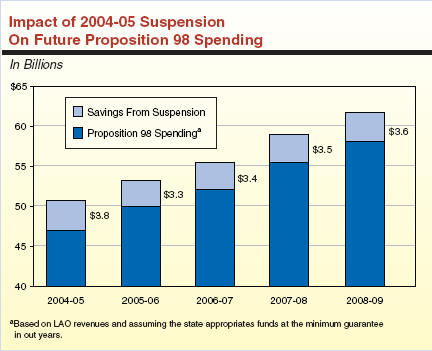
Effects of the 2004-05 Proposition 98 SuspensionIn most years, Proposition 98 minimum funding levels, or guarantees, are determined by a constitutional formula based on three factors: (1) growth in K-12 attendance, (2) growth in per capita personal income, and (3) growth in per capita General Fund revenues. However, the Constitution also allows the Legislature to suspend this formula-driven minimum guarantee in any given fiscal year and to set Proposition 98 funding at whatever level it chooses for that year. Suspension of the Minimum Guarantee in 2004-05. Last year, given California’s continuing structural imbalance between revenues and expenditures, the state suspended the minimum Proposition 98 guarantee for 2004-05. The legislation authorizing the suspension-Chapter 213, Statutes of 2004 (SB 1101, Committee on Budget and Fiscal Review)-established a target funding level for K-14 education that was $2 billion lower than the amount called for by the guarantee. Over the course of the 2004-05 fiscal year, an improving economy led to the state receiving approximately $3.4 billion in additional General Fund revenues over what was projected when the 2004-05 Budget Act was enacted. Because the Proposition 98 guarantee is partially determined by growth in per capita General Fund revenues, the increase in revenues from the budget act forecast would have resulted in a significant increase to the K-14 minimum guarantee in 2004-05, had the state not suspended Proposition 98. Specifically, the minimum guarantee would have increased an additional $1.8 billion above what was estimated at the time of the budget act. Correspondingly, the target funding level set by Chapter 213 (the minimum guarantee less $2 billion) also increased by $1.8 billion as a result of the additional revenues received by the state. Ultimately, in order to realize an additional $1.8 billion in savings, the Legislature decided to maintain the Proposition 98 appropriation level that was set at the time of the 2004-05 Budget Act (adjusted downward slightly due to less-than-anticipated growth in K-12 attendance). That is, the overall Proposition 98 spending level for 2004-05 was set at approximately $46.9 billion, or $3.8 billion less than what the minimum guarantee would have been absent suspension. Current law requires the $3.8 billion in state savings resulting from the suspension to be tracked as maintenance factor and restored to the K-14 funding base in future years when General Fund revenues grow faster than the economy. Long-Run Impact of Suspension on K-14 Spending. The decision regarding the 2004-05 appropriation level for Proposition 98 is significant because it determines what the minimum guaranteed funding level will be in future years. The lower appropriation levels that result from suspending the Proposition 98 minimum guarantee in 2004-05 likely will yield savings to the state in future budgets. The Figure shows our estimate of the annual savings to the state from the 2004-05 Proposition 98 suspension. The figure also shows that the $3.8 billion of savings from 2004-05 decreases to $3.3 billion in 2005-06 due to an appropriation over the minimum guarantee (as discussed in the text). Annual savings from the suspension will continue in the future until the state fully restores the outstanding maintenance factor over the next several years.
|
Slow Revenue Growth in 2005-06 Will Result in Small Growth in the Proposition 98 Guarantee. The 2005-06 budget assumes that per capita General Fund revenues, a key factor in determining the Proposition 98 guarantee, will grow at a moderate rate of 3.7 percent over 2004-05 levels. This moderate growth results in the minimum guarantee being determined by Test 3 for 2005-06, the formula used when General Fund revenues grow slower than the economy (as measured by growth in personal income). This leads to the minimum guarantee growing by only $2.3 billion.
Education Spending in the 2005-06 Budget Act Is Above the Proposition 98 Minimum Guarantee. Between January 2005 and the adoption of the final budget, the 2004-05 revenue estimates increased dramatically (as discussed earlier); however, the General Fund revenue estimates for 2005-06 changed very little. Because the 2005-06 revenue assumptions did not change much, the May Revision maintained the same dollar amount for Proposition 98 spending as proposed by the Governor in the January budget. The final budget maintains spending at this level despite the lower guarantee resulting from the Test 3 calculation. This results in the appropriation level contained in the 2005-06 Budget Act being approximately $741 million more than the Test 3 minimum guarantee requires. This spending level is also above the Test 2 level for 2005-06 by $216 million, and helps to restore a portion of the “maintenance factor” created as a result of suspending the minimum guarantee in 2004-05. After accounting for this $741 million overappropriation, the state continues to realize around $3.3 billion in savings in 2005-06 due to last year’s suspension of Proposition 98.
K-14 Education Credit Card Update
Starting in 2001-02, the Legislature opted to defer significant education program costs to the subsequent fiscal year rather than make additional spending cuts. Additionally, for several years the state has not provided funding for reimbursement of education mandate costs. Combined with ongoing revenue limit reductions made in 2003-04, we have referred to these outstanding debts as the education “credit card,” to reflect the amounts the state has borrowed from schools and community colleges. Figure 2 shows that the budget continues to defer approximately $3.1 billion in K-14 costs to the future. As discussed later, the budget package does provide $406 million to partially eliminate the revenue limit deficit factor, and about $71 million in one-time Proposition 98 funds to pay outstanding education mandate costs for districts and community colleges. However, since the budget does not fund the ongoing costs of education mandates (estimated to be about $250 million annually), cumulative deferrals remain at about $3.1 billion in 2005-06.
|
Figure 2 Update on the K-14 Education Credit Card Balance |
||||
|
Year-End Balances |
||||
|
|
2002-03 |
2003-04 |
2004-05 |
2005-06 |
|
One-Time Costs |
|
|
|
|
|
Revenue limit and categorical deferrals |
$2,158 |
$1,097 |
$1,083 |
$1,103 |
|
Community college deferral |
— |
200 |
200 |
200 |
|
Cumulative mandate deferrals |
690 |
960 |
1,205 |
1,460 |
|
Ongoing Costs |
|
|
|
|
|
Revenue limit deficit factor (including basic aid) |
— |
$906 |
$663 |
$290 |
|
Totals |
$2,848 |
$3,163 |
$3,151 |
$3,053 |
As shown in Figure 1, spending on 2005-06 K-12 Proposition 98 totals $44.6 billion, an increase of about $2.6 billion, or 6 percent, from the revised 2004-05 spending level. This net change consists primarily of increased funding for enrollment growth and cost-of-living adjustments (COLA), funding restorations to ongoing programs, and a limited number of new programs.
Per Pupil Spending
The revised 2004-05 budget yields a K-12 per pupil funding level of $7,023. The 2005-06 budget results in per pupil funding of $7,402, an increase of $379, or 5.4 percent, above the 2004-05 level.
In 2001-02 through 2003-04, the state deferred expenses from one year to another (as discussed above). In past years, these deferrals-which pay districts for program services that were provided in the previous year-have made cross-year per pupil funding comparisons difficult. This is because the “programmatic” funding, or the level reflecting districts’ actual services and expenditures for a given year, have tended to differ from budgeted funding, or the amount districts technically received in that fiscal year. Figure 3 shows these differences.
|
Figure 3 K-12 Proposition 98
Spending Per Pupil |
||||
|
|
2002‑03 |
2003‑04 |
Revised 2004‑05 |
Proposed 2005‑06 |
|
Budgeted Funding |
|
|
|
|
|
Amount per ADAa |
$6,598 |
$7,018 |
$7,023 |
$7,402 |
|
Percent growth |
— |
6.4% |
0.1% |
5.4% |
|
Programmatic Fundingb |
|
|
|
|
|
Amount per ADA |
$6,786 |
$6,874 |
$7,021 |
$7,405 |
|
Percent growth |
— |
1.3% |
2.1% |
5.5% |
|
a Average daily attendance. |
||||
|
b To adjust for the deferrals, we counted funds toward the fiscal year in which school districts had programmatically committed the resources. The deferrals meant, however, that the districts technically did not receive the funds until the beginning of the next fiscal year. |
||||
While the state continued the practice of deferring some payments to districts in both 2004-05 and 2005-06, the amount of deferrals remained relatively the same in these two years. Thus, as shown in Figure 3, the year-to-year growth comparison between 2004-05 and 2005-06 is relatively equivalent for both programmatic and budgeted per pupil spending. That is, K-12 Proposition 98 per pupil spending increased roughly 5.5 percent from 2004-05 both considering how much is actually provided in the 2005-06 budget and the level of resources that districts will programmatically commit this year.
Major K-12 Funding Changes
Figure 4 displays major K-12 funding changes from the revised 2004-05 budget. The budget package provides about $2.6 billion in new ongoing K-12 expenditures. In general, the budget fully funds base programs adjusted for growth and COLA. In addition, the budget provides an additional $406 million in general purpose funds to restore reductions and foregone COLAs from prior years.
|
Figure 4 Major K-12
Proposition 98 Changes From |
|
|
(In Millions) |
|
|
Revenue Limit |
|
|
Cost-of-living adjustment (COLA) |
$1,301.9 |
|
Growth |
189.7 |
|
Public Employees’ Retirement System and |
-116.1 |
|
Deficit factor reduction (including basic aid) |
406.2 |
|
Subtotal |
($1,781.8) |
|
Categorical Programs |
|
|
COLA |
$420.0 |
|
Growth |
138.5 |
|
Restore categoricals funded with one-time funds |
151.5 |
|
Special education augmentations |
70.8 |
|
Veto set-asides |
22.0 |
|
High school exit exam—student assistance |
20.0 |
|
Other |
-31.0 |
|
Subtotal |
($791.8) |
|
Total Changes |
$2,573.6 |
|
|
|
|
a Assumes enactment of
SB 65 (Committee on Budget and Fiscal Review), an education budget
|
|
Major funding changes include:
Growth and COLA ($2.05 Billion). The budget provides $1.7 billion to fund a 4.23 percent COLA for revenue limits and most categorical programs (including statutory and discretionary COLAs). The budget provides $328 million to fund growth (0.7 percent) for revenue limit and most categorical programs.
Deficit Factor Reduction ($406 Million). The budget package provides $406 million in general purpose funds by reducing the revenue limit deficit factor for school districts and county offices of education. In 2003-04, the state reduced revenue limits and did not provide a COLA, creating a “deficit factor” of 3.02 percent that would eventually need to be restored. The revenue limit reduction was partially restored in 2004-05, and the 2005-06 budget package provides further deficit factor restoration. The remaining deficit factor for school districts is now .892 percent. The budget package requires that the remaining deficit factors for both districts and county offices (roughly $290 million) be restored in 2007-08.
Public Employees’ Retirement System (PERS) and Unemployment Insurance (-$116 Million). The Legislature fully funds PERS and Unemployment Insurance, but saves $116 million compared to 2004-05 because of reduced contribution rates for these two programs.
Restoration of Categorical Programs’ Funding Base ($152 Million). The 2004-05 budget used roughly $152 million in one-time funds to support ongoing programs. The 2005-06 budget provides ongoing support for those programs.
Special Education Augmentations ($71 Million). The budget package increases General Fund support for special education by $70.8 million as follows: (1) $52.6 million in ongoing funds for per pupil grants that may be used for any one-time costs (with first priority to help special education students pass the California High School Exit Examination) and (2) an $18.2 million augmentation to the new Out-of-Home Care funding formula. The budget also provides $12.8 million in federal funds as an increase in base special education per pupil grants. To address issues created in the reauthorization of federal special education law, the budget also revises the calculation of the annual COLA to provide an adjustment only on the state-funded portion of the special education budget. With this change, COLAs for the federally funded portion of the program will be considered as part of the annual budget process, relying first on increases in federal funds for special education.
High School Exit Exam-Student Assistance ($20 Million). The only new ongoing program included in the 2005-06 budget is an assistance program for high schools with large percentages of students failing the high school exit exam. These schools will receive $600 for each student who has failed one or both parts of the exam (assuming enactment of AB 128 [Committee on Budget], which amends the 2005-06 Budget Act and provides additional detail on how these funds are to be utilized). These additional resources may be used for a broad set of activities to help students in the class of 2006 pass the exit exam.
Other major budget actions include:
Teacher Retirement Costs. The budget does not include the Governor’s proposal to shift $469 million in teacher retirement costs from the General Fund (non-Proposition 98) to schools and/or teachers. The General Fund continues to fund the state’s contribution to the retirement program. The budget also includes a one-time augmentation of $31 million for a statutorily required payment to reduce the retirement system’s unfunded costs.
High Priority Schools New Cohort. The budget redirects $60 million in savings from schools exiting the state’s intervention programs to create a new cohort of High Priority Schools (Academic Performance Index [API] decile 1 and 2 schools). These schools will receive $400 per pupil to improve their academic performance. In exchange, these schools will have to meet specific achievement targets or potentially face state sanctions.
Child Care Reforms. The Legislature did not adopt the Governor’s proposed child care reforms, which would have changed eligibility for working poor and California Work Opportunity and Responsibility to Kids (CalWORKs) families and created a tiered reimbursement system.
Additional One-Time Funds
The budget provides an additional $382 million in one-time K-12 education funds needed to meet Proposition 98 obligations from prior years. (The Governor’s May Revision included an additional $235 million in one-time Proposition 98 funds, but during final budget negotiations these funds were shifted to help offset the General Fund cost of fully funding the state’s contribution to the teachers’ retirement program.) Figure 5 shows the uses of the one-time funds included in the final budget package.
|
Figure 5 K-12 Spending From One-Time Funds |
|
|
(In Millions) |
|
|
|
|
|
School facilities emergency repairs (Williams settlement) |
$196.0 |
|
Payment of prior K-12 mandate claims |
60.6 |
|
Low-Performing School Enrichment Block Grant |
49.5 |
|
Special Education |
26.0 |
|
Fruits and Vegetables Initiative |
18.2 |
|
Charter School Facilities Grants |
9.0 |
|
Other |
22.3 |
|
Total |
$381.6 |
The major one-time spending includes:
School Facilities Emergency Repairs ($196 Million). As part of the settlement of Williams v. California, the state is required to commit one-half of the funds in the Proposition 98 reversion account (funds appropriated for K-14 education in prior years, but not used) for emergency facility repairs. The 2005-06 budget meets this obligation by providing $196 million for this purpose.
K-12 Education Mandates ($61 Million). The budget provides $61 million in one-time funds to pay for mandate costs deferred from prior years.
Low-Performing School Enrichment Block Grant ($49.5 Million). The budget provides up to $49.5 million for grants to schools in API deciles 1 through 3 to improve the education culture and environment at those schools. Schools would have broad discretion to determine how these funds are used-including changes to facilities, safety, support services for students and teachers, and bonuses for recruitment and retention.
Special Education ($26 Million). The budget package reappropriates $26 million in order to meet the federal maintenance-of-effort requirements for the 2003-04 special education program. Of this amount, $3.2 million will augment the Out-of-Home Care program for 2004-05 and the remaining $22.8 million will be available for any local special education purpose.
K-12 Vetoes
The Governor vetoed $22 million in ongoing K-12 funding, including $20 million for instructional materials for English learners and $2 million for the Healthy Start program. The Governor set aside the funding for future legislation. The Legislature subsequently passed and sent to the Governor SB 72 (Committee on Budget and Fiscal Review), which restores the $20 million in vetoed funding for instructional materials for English learners. The Governor also vetoed $74 million in federal carryover funds from various programs, and set the funds aside in accordance with a May Revision proposal to redirect carryover funds to low performing schools and districts. The Legislature rejected this May Revision proposal.
The enacted budget provides a total of $9.7 billion in General Fund support for higher education in 2005-06 (see Figure 6). This reflects an increase of $882 million, or 10 percent, above the amount provided in 2004-05. In addition, student fee increases approved for the University of California (UC) and the California State University (CSU) will provide another $190 million in new, unrestricted funding for the university systems. Student fees were not increased at the California Community Colleges (CCC).
|
Figure 6 Higher Education
Budget Summary |
||||
|
(Dollars in Millions) |
||||
|
|
|
|
Change |
|
|
|
2004-05 |
2005-06 |
Amount |
Percent |
|
University of California |
$2,715.1 |
$2,844.9a |
$129.8 |
4.8% |
|
California State University |
2,481.1 |
2,616.8a |
135.8 |
5.5 |
|
California Community Colleges |
3,050.5 |
3,512.9b |
462.4 |
15.2 |
|
Student Aid Commission |
598.6 |
752.4 |
153.9 |
25.7 |
|
California Postsecondary |
2.1 |
2.1 |
— |
— |
|
Hastings College of the Law |
8.1 |
8.4 |
0.2 |
3.0 |
|
Totals |
$8,855.5 |
$9,737.5 |
$882.0 |
10.0% |
|
|
||||
|
a Includes $1.7 million for master’s nursing programs, as described in text under “Enrollment Funding.” |
||||
|
b Includes $37.4 million vetoed by the Governor and "set aside" to be appropriated for career technical education. |
||||
UC and CSU
Overview. The budget provides $2.8 billion in General Fund support for UC in 2005-06. This is $130 million, or 4.8 percent, more than was provided in the prior year. For CSU, the budget provides $2.6 billion in General Fund support in 2005-06. This is an increase of $136 million, or 5.5 percent, from 2004-05. In addition to these General Fund appropriations, UC and CSU will receive $114 million and $76 million, respectively, in new revenue from student fee increases. The budget allows UC and CSU to determine how this additional fee revenue will be spent.
Student Fees. Consistent with the Governor’s January budget proposal, the UC Regents and the CSU Board of Trustees approved fee increases for their respective segments for the 2005-06 academic year. As shown in Figure 7, undergraduate fees at both segments would increase by 8 percent and graduate fees increase by 10 percent. Professional school fees and nonresident tuition also have increased for 2005-06.
|
Figure 7 Student Fees |
||||
|
Annual Systemwide Tuition and Fees for Full-Time Students |
||||
|
|
|
|
Change From 2004-05 |
|
|
|
2004-05 |
2005-06 |
Amount |
Percent |
|
University of California |
|
|
|
|
|
Resident Fees |
|
|
|
|
|
Undergraduate students |
$5,684 |
$6,141 |
$457 |
8% |
|
Graduate students |
6,269 |
6,897 |
628 |
10 |
|
Professional school students |
|
|
|
|
|
Public Health |
$6,269 |
$10,792 |
$4,523 |
72% |
|
Public Policy |
6,269 |
10,792 |
4,523 |
72 |
|
International Relations/Pacific Studies |
6,269 |
10,792 |
4,523 |
72 |
|
Nursing |
8,389 |
9,941 |
1,552 |
19 |
|
Theater, Film, and Television |
11,249 |
12,751 |
1,502 |
13 |
|
Optometry |
14,139 |
16,132 |
1,993 |
14 |
|
Pharmacy |
14,139 |
17,641 |
3,502 |
25 |
|
Veterinary Medicine |
16,029 |
17,674 |
1,645 |
10 |
|
Dentistry |
18,024 |
21,276a |
3,252 |
18 |
|
Medicine |
18,513 |
20,232 |
1,719 |
9 |
|
Law |
19,113 |
22,128a |
3,015 |
16 |
|
Business Administration |
19,324 |
22,422a |
3,098 |
16 |
|
Nonresident Tuition and Fees |
|
|
|
|
|
Undergraduate students |
$22,640 |
$23,961 |
$1,321 |
6% |
|
Graduate students |
21,208 |
21,858 |
650 |
3 |
|
California State University |
|
|
|
|
|
Resident Fees |
|
|
|
|
|
Undergraduate students |
$2,334 |
$2,520 |
$186 |
8% |
|
Teacher education students |
2,706 |
2,922 |
216 |
8 |
|
Graduate students |
2,820 |
3,102 |
282 |
10 |
|
Nonresident Tuition and Fees |
|
|
|
|
|
Undergraduate students |
$12,504 |
$12,690 |
$186 |
1% |
|
Graduate students |
12,990 |
13,272 |
282 |
2 |
|
|
||||
|
a Represents midpoint of fee range. |
||||
Enrollment Funding. The budget includes a total of $88.7 million to fund 2.5 percent enrollment growth at UC ($37.9 million) and CSU ($50.8 million). In addition, the enacted budget package makes a one-time reversion of $15.5 million from CSU’s prior-year enrollment funding because CSU did not use this money to enroll students. (The CSU’s 2004-05 enrollment was about 2,700 full-time equivalent [FTE] students less than budgeted.)
The Legislature also adopted language directing the Legislative Analyst’s Office and the Department of Finance to jointly convene a working group to review the current “marginal cost” methodology for funding new enrollment at the two segments and to provide recommendations that would be considered for the 2006-07 budget.
The 2005-06 budget also provides additional funding (above the standard marginal cost amount) for expanded enrollment in specified medical degree programs. Specifically, the budget includes $300,000 for 20 additional medical students in UC’s Program in Medical Education for the Latino Community (PRIME-LC). The PRIME-LC trains physicians specifically to serve in underrepresented communities. In addition, the Legislature added $4 million to expand enrollment in CSU’s entry-level master’s nursing programs, as authorized in Chapter 718, Statutes of 2004 (SB 1245, Kuehl). The Governor vetoed all but $560,000 of the CSU augmentation, and in his veto message called on the Legislature to appropriate the vetoed funds through separate legislation. The Legislature subsequently passed and sent to the Governor SB 73 (Committee on Budget and Fiscal Review), which appropriates $1.72 million to UC and $1.72 million to CSU for one-time costs to support master’s nursing programs.
Outreach Programs. In adopting the 2005-06 budget, the Legislature rejected the Governor’s proposal to reduce state support for UC and CSU’s outreach programs. Instead, the budget maintains funding for these programs at their 2004-05 levels. In signing the budget, the Governor expressed his expectation that UC and CSU would work with the administration to “fully evaluate the cost-effectiveness of each program and eliminate those that cannot demonstrate an adequate return on investment.”
Base Budget Increases. Both university systems received base budget increases of 3 percent. These increases amount to $76.1 million for UC and $71.7 million for CSU. These funds, which generally offset the impact of inflation, may be used for any purpose.
Other Features. For UC, the budget includes $14 million for the Merced campus, which opened in September 2005. The Legislature rejected the Governor’s proposal to eliminate funding for UC’s Labor Institute, and provided $3.8 million to fund the Institute at the prior-year’s level. The Governor vetoed this augmentation.
CCC
Unlike UC and CSU, the CCC receive substantial funding from local property taxes. These revenues, when combined with General Fund support, accounts for CCC’s funding under Proposition 98. The 2005-06 budget provides CCC with $5.2 billion in Proposition 98 support. This is $442 million, or 9.3 percent, more than was provided in 2004-05. The CCC’s share of total Proposition 98 support is 10.4 percent, which exceeds the 2004-05 level of 10.2 percent.
The General Fund portion of CCC’s funding totals $3.5 billion in 2005-06, which reflects an increase of $462 million, or 15.2 percent, from the revised 2004-05 level. The large General Fund increase is due in part to a one-time property tax adjustment in 2005-06.
Major features of CCC’s budget include:
$210 million for a COLA of 4.23 percent.
$142 million for enrollment growth of 3 percent, or about 34,000 FTE students.
$31.4 million to restore general apportionment funding vetoed in 2004-05.
$30 million for equalization.
$10 million in one-time funds to pay for state-mandated program costs incurred by community colleges in prior years.
Career Technical Programs. In the January budget proposal and the May Revision, the Governor proposed a total of $37.4 million in one-time Proposition 98 funding to align career technical (vocational) curricula between K-12 schools and CCC economic development programs. The Legislature approved $20 million of this proposal, but added provisional language that linked this funding to the same level of funding for instructional materials for K-12 English learners. The Governor vetoed the $20 million as well as $17.4 million of the amount that the Legislature had appropriated to backfill an anticipated shortfall in local property taxes. The Governor “set aside” these vetoed funds for anticipated legislation that would fund career technical education. (This funding is reflected in the community college General Fund total in Figure 6.) The Legislature subsequently passed and sent to the Governor SB 70 (Scott), which restores a portion of the vetoed funding.
Accountability. The 2005-06 budget package includes trailer legislation (Chapter 73, Statutes of 2005 [SB 63, Committee on Budget and Fiscal Review]), that creates a district-level accountability system for CCC. The legislation requires community college districts to report specified data to the CCC Chancellor’s Office, which in turn would submit an annual report to the Legislature and the Governor. The first report is due by March 1, 2007.
Nursing Programs. The 2005-06 budget includes $10 million in ongoing Proposition 98 funding to support an expansion of nursing programs at community colleges. This funding, coupled with $4 million in one-time funds, is intended to increase the capacity of nursing programs through recruiting new faculty and purchasing new equipment. This funding is part of a larger nursing initiative adopted by the Legislature, which also expands financial aid opportunities for nurses (described in the following section) and includes funding in the health and social services areas (described later in this report).
Student Fees. Student fee levels remain at $26 per unit, which is unchanged from 2004-05.
Financial Aid and California Student Aid Commission
The budget provides $816 million (all fund sources) for various financial aid programs administered by the Student Aid Commission. The Cal Grant programs will receive the bulk of this funding-$775 million, which is $61 million, or 8 percent, above the prior-year level. In 2005-06, the Cal Grant programs are estimated to serve approximately 191,500 students, which reflects an increase of 6,350 students. Of total Cal Grant funding, $51 million comes from the Student Loan Operating Fund. The budget also provides a $7 million General Fund augmentation, reflecting a 20 percent increase, for the Assumption Program of Loans for Education (APLE). The higher APLE costs are associated with prior-year warrants expected to be redeemed in 2005-06.
The budget also authorizes the commission to issue 100 warrants for the State Nursing Assumption Program of Loans for Education (SNAPLE). This is a new financial incentive program designed to encourage more individuals to become nursing faculty. After receiving their graduate degree and completing the equivalent of one year of full-time work as nursing faculty members, SNAPLE recipients will have up to $8,333 of their education loans forgiven. Additional loan forgiveness of the same amount is provided for up to two additional full-year equivalents of faculty work, for total potential loan forgiveness of $25,000.
Additionally, the Supplemental Report of the 2005-06 Budget Act includes two financial aid-related provisions. The first requires a working group of various state and segmental agencies to define the support documentation concerning UC and CSU’s institutional aid programs that should accompany future budget proposals. The second requires our office by December 31, 2005, to complete a study of the commission and EdFund’s governance, roles, and responsibilities.
The 2005-06 budget plan provides about $17.9 billion from the General Fund for health programs, which is an increase of about $1.8 billion, or 11.5 percent, compared to the revised prior-year level of spending as shown in Figure 8. Several key aspects of the budget package are discussed below and summarized in Figure 9.
|
Figure 8 Health Services
Programs |
||||
|
(Dollars in Millions) |
||||
|
|
|
|
Change |
|
|
|
2004-05 |
2005-06 |
Amount |
Percent |
|
Medi-Cal (local assistance only) |
$11,702 |
$12,984 |
$1,282 |
11.0% |
|
Department of Developmental Services |
2,133 |
2,284 |
152 |
7.1 |
|
Department of Mental Health |
984 |
1,295 |
312 |
31.7 |
|
Healthy Families Program (local assistance only) |
293 |
346 |
53 |
18.1 |
|
Department of Alcohol and Drug Programs |
237 |
243 |
6 |
2.5 |
|
All other health services |
676 |
708 |
32 |
4.7 |
|
Totalsa |
$16,024 |
$17,861 |
$1,836 |
11.5% |
|
|
||||
|
a Totals may not add due to rounding. |
||||
|
Figure 9 Major Changes—State Health Programs |
|
|
(In Millions) |
|
|
2005‑06 General Fund Effect |
|
|
Medi-Cal |
|
|
Adjust for net increase in base program costs |
$484 |
|
Increase rates for nursing homes |
404 |
|
Continue higher rates for Los Angeles County clinics |
30 |
|
Increase rates for two managed care plans |
11 |
|
Medicare Part D Drug Benefit |
|
|
Reflect "clawback" payments owed to federal government |
$511 |
|
Continue coverage of selected drugs not covered by Medicare |
47 |
|
Adjust for savings on Medi-Cal drug costs |
-760 |
|
Reduce payments to managed care plans |
-58 |
|
Public Health |
|
|
Provide local assistance to combat West Nile Virus outbreak |
$12 |
|
Augment AIDS prevention and education efforts |
6 |
|
Use Proposition 99 funds to offset costs of hospital rate increases |
-26 |
|
Prenatal Care Services |
|
|
Shift Medi-Cal and AIM prenatal services to federal fundsa |
-$192 |
|
Healthy Families Program |
|
|
Increase application assistance and enrollment activities |
$6 |
|
Implement increase in premiums for higher-income families |
-5 |
|
Emergency Medical Services Authority |
|
|
Provide grants to improve the operation of trauma care centers |
$10 |
|
Department of Developmental Services |
|
|
Adopt unallocated reductions, rate freeze, other temporary savings |
-$84 |
|
Department of Mental Health (DMH) |
|
|
Fund two state mandates for special education children |
$120 |
|
Activate beds at new state hospital in Coalinga |
66 |
|
Shift General Fund support for prison inmates to DMG |
61 |
|
Include lease-revenue bond payments for Coalinga State Hospital |
27 |
|
|
|
|
a Reflects combined savings for 2004 05 and 2005 06. |
|
Medi-Cal
The 2005-06 enacted budget provides about $13 billion from the General Fund ($34.9 billion all funds) for Medi-Cal local assistance expenditures. This amounts to about a $1.3 billion, or 11 percent, increase in General Fund support for Medi-Cal local assistance. The increase in expenditures reflects (1) ongoing growth in caseload; (2) increases in costs and utilization of medical services in the base program; (3) rate increases for nursing homes and certain other providers; and (4) a number of significant policy changes in Medi-Cal, including those described below.
Medi-Cal Redesign-Expansion of Managed Care. The budget plan expands Medi-Cal managed care to additional counties, but generally rejects an administration proposal to mandate the enrollment of aged and disabled beneficiaries in managed care. The exception would be aged and disabled beneficiaries who enroll in county organized health systems, consistent with the current practice. Funding to begin implementing these changes is provided in 2005-06. However, savings from these changes would not be realized for several years.
A proposal for long-term care integration of health and social services programs in three counties, which was a part of the original managed care expansion package, was not approved as part of the budget plan.
Medi-Cal Redesign-Other Proposals. The budget plan adopts a $1,800 annual limit on dental services provided to adults. In so doing, the Legislature modified an administration proposal for a dental cap in a way that will result in lower savings but also affect fewer Medi-Cal beneficiaries. However, the budget plan does not include some other components of an administration plan to redesign the Medi-Cal Program, including a proposal to require certain Medi-Cal beneficiaries to pay monthly premiums to participate in the program.
Restructuring Hospital Finances. No changes in the structure of state support for public and private hospitals were incorporated in the budget, but it assumes that a new federal hospital waiver will be implemented in the budget year. A recent agreement between the administration and federal authorities over such changes was approved by the Legislature in separate policy legislation. In a related matter, the budget plan continues payments to certain Los Angeles County health clinics at an enhanced reimbursement rate that would otherwise have been discontinued.
Managed Care Rate Increases. The budget provides rate increases to two Medi-Cal managed care plans-Cal Optima in Orange County and the San Diego Community Health Group-to improve their financial stability. Legislative augmentations to increase rates for two additional plans were vetoed by the Governor. These increases would have gone to the Alameda Alliance for Health and the Partnership Health Plan, which now operates in Solano, Napa, and Yolo Counties.
California Medical Assistance Commission
Commissioners’ Salaries. The budget plan reduces commissioners’ salaries to $50,000 annually beginning January 2006. Previously, state law required that the seven commissioners’ salaries equal those of state legislators ($99,000 annually in 2004-05). This change is expected to result in annual General Fund savings of $213,000.
Medicare Part D Drug Benefit
Medi-Cal spending is reduced under the budget plan to reflect the shift of prescription drug coverage for certain aged and disabled beneficiaries to the new federal Medicare Part D drug benefit that takes effect in January 2006. Specifically, payments to Medi-Cal managed care plans are reduced to reflect the change of some plan beneficiaries receiving their drug coverage from Medicare instead of Medi-Cal. The budget plan also recognizes increased state costs resulting from the change, including so-called “clawback” payments that will be owed to the federal government under the new federal law. The budget also recognizes additional costs to the state that would result from continuation of Medi-Cal coverage of certain drugs that are not available under the new Medicare Part D federal benefit. Also, the budget plan calls for preparing state contingency plans for emergency drug coverage in the Medi-Cal Program and other actions to assist Medi-Cal beneficiaries who may encounter problems in their transition to Medicare Part D drug coverage. The budget plan for Medicare Part D also reflects additional related adjustments in Medi-Cal and in the budgets of the Departments of Aging, Mental Health, and Developmental Services.
Public Health
The budget plan provides the Department of Health Services with about $416 million from the General Fund ($2.1 billion all funds) for public health local assistance during 2005-06. This reflects an overall increase of about $79 million (all funds) or 4 percent in annual spending for the program over the revised prior-year level of spending. General Fund spending for public health local assistance would increase by about $28 million.
Changes for New and Existing Programs. The spending plan includes (1) a scaled-down proposal for new programs to prevent obesity, (2) assistance to local agencies to address outbreaks of the West Nile Virus, and (3) an augmentation for an existing state program for AIDS prevention and education. The Governor vetoed a legislative augmentation to expand enrollment in an existing prostate cancer treatment program, but the Legislature subsequently approved legislation to restore this funding. The Legislature did not adopt a proposal for a new program to obtain discounts on drugs for low- and moderate-income Californians.
Proposition 99 Funding Shifts. The budget plan achieves General Fund savings by shifting Proposition 99 funds to cover the cost of certain Medi-Cal hospital rate increases. The budget also provides Proposition 99 funding to augment state programs for tobacco education, indigent care, rural health demonstration projects, assistance to physicians with their student loans, asthma prevention, and breast cancer screening.
Prenatal Care Services
The budget plan achieves about $304 million in state savings in 2004-05 and 2005-06 (combined) by taking advantage of available federal funds for support of prenatal care services provided under the Medi-Cal and Access for Infants and Mothers (AIM) programs. These funds, available under the federal State Children’s Health Insurance Program, take the place of state support. The state would achieve about $192 million in General Fund savings in Medi-Cal and about $112 million in savings of Proposition 99 funds in AIM.
Healthy Families Program
The budget plan provides about $346 million from the General Fund ($959 million all funds) for local assistance under the Healthy Families Program during 2005-06. This reflects an overall increase of about $149 million (all funds), or 18 percent, in annual spending for the program. General Fund spending for Healthy Families local assistance would increase by about $53 million. This increase in costs is primarily the result of underlying increases in caseload and provider rates. The budget plan provides funding for application assistance and other activities to increase the enrollment of children in the program. It also reflects a policy change made in 2004 to increase premiums for participating families that have relatively higher incomes than other eligible beneficiaries.
Emergency Medical Services Authority
Trauma Care Centers. The budget plan augments the Emergency Medical Services Authority by $10 million from the General Fund for grants to improve the operation of trauma care centers. In signing the budget, the Governor indicated that he supports the provision of these additional funds on a one-time basis.
Office of Statewide Health Planning and Development
Nursing Education Initiative. The budget includes $3 million from the General Fund primarily to expand the Song-Brown Family Physician Training Program to support training of registered nurses. This funding was added by the Legislature to a nursing education initiative proposed by the Governor to address a statewide shortage of nursing staff. Additional information regarding other major components of this initiative can be found in the “Higher Education” section of this chapter.
Department of Developmental Services
The budget provides almost $2.3 billion from the General Fund ($3.7 billion all funds) for services to individuals with developmental disabilities in developmental centers and regional centers. This amounts to an increase of about $152 million, or 7.1 percent, in General Fund support over the revised prior-year level of spending.
Community Programs. The 2005-06 budget includes a total of $1.9 billion from the General Fund ($2.9 billion all funds) for community services for the developmentally disabled, an increase in General Fund resources of about $157 million over the prior fiscal year due mainly to increases in caseload, costs, and utilization of regional center services. Part of the budget increase is due to the provision of funds for regional centers to comply with federal waiver requirements and an expansion of the self-directed community services program, which gives regional center clients more control over the services and supports that are purchased for them.
The budget continues several mostly temporary actions to hold down program costs, such as an unallocated reduction to purchase of services funds, rate freezes, and the suspension of startup funds for some new programs.
Developmental Centers. The budget provides $379 million from the General Fund for operations of the developmental centers ($709 million all funds), about a 1.9 percent decrease below the revised prior-year level of spending. The budget continues to support plans to close the Agnews Developmental Center by July 2007, and place many of its clients in community programs.
Department of Mental Health (DMH)
The budget provides about $1.3 billion from the General Fund ($3 billion all funds) for mental health services provided in state hospitals and in various community programs. This is about a $312 million, or 32 percent, increase in General Fund support compared to the revised prior-year level of spending for mental health programs.
Community Programs. The 2005-06 budget includes about $429 million from the General Fund (almost $2 billion all funds) for local assistance for the mentally ill, about a 41 percent increase in General Fund support compared to the revised prior-year level of spending.
The spending plan does not include proposals to suspend or repeal two state mandates on counties to provide mental health care for children who require special education services, and instead augments the budget by $120 million from the General Fund to keep the existing program in place for at least another year. In signing the budget, the Governor indicated that he supports this funding on a one-time basis and directed DMH to draft a plan to convert the program from a mandate to a categorical program next year.
The budget plan also authorizes staffing and funding for DMH and five other state agencies to expand mental health programs in keeping with Proposition 63, approved last year by the voters. Also, some Proposition 63 funding was allocated for efforts to assist the homeless mentally ill.
State Hospitals. The budget provides about $801 million from the General Fund for state hospital operations (about $887 million all funds). The $170 million, or 27 percent, increase in General Fund resources was due to several factors, including caseload increases, funding shifts, the activation of a new state hospital in Coalinga, and the addition of lease-revenue bond payments for this facility.
General Fund support for social services programs in 2005-06 totals $9.3 billion, a net increase of $281 million, or 3.1 percent, over the prior year. Figure 10 shows by major program the components of this net increase in year-over-year General Fund spending. Most of the increase in spending is due to the deferral of the annual federal child support automation penalty from 2004-05 to 2005-06, caseload increases in the Supplemental Security Income/State Supplementary Program (SSI/SSP) and the In-Home Supportive Services (IHSS) program, partially offset by decreases in CalWORKs and Foster Care programs. If the costs associated with deferring the 2004-05 child support penalty until 2005-06 are excluded, General Fund support for social services would have grown by just $63 million (less than 1 percent).
|
Figure 10 Social Services
Programs |
||||
|
(Dollars in Millions) |
||||
|
|
|
|
Change |
|
|
|
2004‑05 |
2005‑06 |
Amount |
Percent |
|
Supplemental Security Income/State Supplementary Program |
$3,417 |
$3,525 |
$108 |
3.2% |
|
California Work Opportunity and Responsibility to Kids |
2,095 |
1,985 |
-110 |
-5.2 |
|
In-Home Supportive Services |
1,178 |
1,234 |
56 |
4.8 |
|
Children's Services/Foster Care/Adoptions Assistance |
1,362 |
1,368 |
6 |
0.4 |
|
Child Support Services |
296 |
514 |
218 |
73.8 |
|
County administration/automation |
409 |
413 |
4 |
1.0 |
|
Other social services programs |
217 |
215 |
-2 |
-0.7 |
|
Totals |
$8,973 |
$9,254 |
$281 |
3.1% |
While social services expenditures increased on a year-over-year basis, compared to the requirements of prior law, program costs have been reduced by $455 million, as shown in Figure 11. About 70 percent of these savings are due to suspension of the state COLAs for CalWORKs and SSI/SSP and a delay in passing through the federal SSI COLA. (Despite the reductions shown in Figure 11, certain social services programs, such as SSI/SSP, continue to grow due to caseload changes and other current-law costs.)
|
Figure 11 Major Changes—Social
Services Programs |
|
|
(In Millions) |
|
|
Department/Program |
Change From Prior Law/ Practice |
|
SSI/SSP |
|
|
Suspends January 2006 state cost-of-living adjustment (COLA) |
-$130.9 |
|
Delays January 2006 federal COLA until April 2006 |
-48.0 |
|
CalWORKsa |
|
|
Suspends July 2005 COLA |
-$135.5 |
|
Increases the amount of State Department of Education child care funding used to satisfy the maintenance of effort requirement |
-85.7 |
|
Establishes pay-for-performance county incentive program |
-22.2 |
|
Veto of county block grant funds |
-25.0 |
|
Reappropriates prior year county block grant funds |
50.0 |
|
Foster Care and Child Welfare Services |
|
|
Replaces General Fund with federal TANF funds for Foster Care |
-$55.1 |
|
Replaces General Fund with federal TANF funds for child welfare services |
-8.0 |
|
Child welfare program improvement plans |
11.0 |
|
Licensing and State Operations |
|
|
Continue fingerprint fee for one year |
-$1.5 |
|
State operations unallocated reduction |
-8.2 |
|
Department of Aging |
|
|
Increase for health insurance counseling services (known as HICAP) |
$3.8b |
|
Total |
-$455.3 |
|
|
|
|
a Combined General Fund and federal TANF block grant funds. |
|
|
b Combined federal and special funds. |
|
SSI/SSP
The budget includes $3.5 billion from the General Fund for the program, an increase of $108 million (3.2 percent). Most of this increase is due to caseload growth and the nine months of additional costs associated with annualizing the April 2005 COLA during 2005-06.
State COLA Suspension. Budget related legislation suspends the state COLA for January 2006 (the 2005-06 fiscal year) and January 2007 (the 2006-07 fiscal year). Suspension of the January 2006 COLA results in a six-month savings of $131 million in 2005-06, rising to $262 million in 2006-07. Suspension of the 2007 COLA will result in additional savings in 2006-07 of about $137 million, with the exact amount depending upon actual future changes in state and federal price indexes.
Federal COLA Delay. The budget delays the “pass through” of the federal COLA to recipients from January to April in both 2006 and 2007. These delays result in estimated one-time savings of $48 million and $42 million, respectively. Figure 12 shows the maximum monthly SSI/SSP grant for individuals and couples from April 2005 through April 2007. For example, in January 2006 the SSI grant for an individual will increase by $15 to $594 pursuant to the federal COLA, and the state funded SSP grant will be reduced by an identical $15 leaving the total grant at $812. Then in April 2006, SSP will be increased by $15 to $233, thus “passing through” the federal COLA.
|
Figure 12 SSI/SSPa
Current and Estimated Grant Levels |
|||||
|
(Maximum Monthly Grants) |
|||||
|
|
2004‑05 |
2005‑06 |
2006‑07 |
||
|
|
April |
January 2006 |
April |
January 2007 |
April |
|
Individuals |
|
|
|
|
|
|
SSI |
$579 |
$594 |
$594 |
$607 |
$607 |
|
SSP |
233 |
218 |
233 |
220 |
233 |
|
Totals |
$812 |
$812 |
$827 |
$827 |
$840 |
|
Couples |
|
|
|
|
|
|
SSI |
$869 |
$891 |
$891 |
$910 |
$910 |
|
SSP |
568 |
546 |
568 |
549 |
568 |
|
Totals |
$1,437 |
$1,437 |
$1,459 |
$1,459 |
$1,478 |
|
|
|||||
|
a Supplemental Security Income/State Supplementary Program. |
|||||
CalWORKs
The budget includes $2 billion from the General Fund in the Department of Social Services (DSS) budget for the CalWORKs program in 2005-06. This is a decrease of about 5 percent compared to the prior year.
Suspension of CalWORKs COLA. Budget-related legislation suspends the CalWORKs grant COLA for two years. Suspending the 2005-06 COLA results in a CalWORKs grant savings of $135.5 million. For 2006-07, the combined savings increases to an estimated $274 million. For a family of three in a high-cost county, the maximum grant will remain at $723 per month through June 2007. (In low-cost counties, the corresponding maximum monthly grant will remain at $689.) Due to the late passage of the budget, CalWORKs participants will receive the statutory COLA for the month of July 2005. The cost of providing that COLA for one month will be approximately $11 million and will come from the Temporary Assistance for Needy Families (TANF) reserve.
Veto of County Block Grant Funds. Budget-related legislation allows county welfare departments to retain up to $50 million in unspent county block grant funds from 2004-05 to support CalWORKs administration and welfare-to-work services. As a result of the availability of these carryover funds, the Governor vetoed $25 million in CalWORKs county block grant funds.
County Incentive Program. Budget-related legislation establishes an incentive system with performance measures designed to encourage counties to increase participation by CalWORKs recipients in welfare-to-work activities. The budget reflects $22 million in grant savings associated with higher earnings by recipients as a result of this incentive system and sets aside $30 million in funding in the TANF reserve to reward counties for improved performance during 2006-07.
Other Actions. By counting spending by the State Department of Education on child care for families who are eligible for CalWORKs (rather than receiving CalWORKs), the budget increases countable child care maintenance-of-effort (MOE) funding by approximately $86 million. This permits an identical savings in the General Fund appropriation for CalWORKs in the DSS budget while maintaining compliance with the federal MOE requirement.
October 2003 COLA Litigation. As discussed in our Analysis of the 2004-05 Budget Bill (page C-223), the state has not provided the October 2003 COLA. In the Guillen court case, advocates for the state’s CalWORKs recipients successfully argued in superior court that the state should provide the October COLA. Currently, the administration is appealing this ruling, and an appellate court decision is expected sometime during the second half of 2005. Unless the state prevails in its appeal, CalWORKs recipients would be entitled to retroactive grant payments back to October 2003. The total budget risk through the end of 2005-06 would be approximately $350 million.
Food Stamps
The budget includes $271 million from the General Fund in the DSS budget for the administration of the Food Stamps program in 2005-06. This is a decrease of about 1 percent compared to the prior year. Below are some of the key changes in the Food Stamps area.
Federal Waiver for Able-Bodied Adult Recipients. Budget-related legislation requires DSS to apply for federal waivers of Food Stamp work requirements in counties that have able-bodied adult recipients without children living in areas of high unemployment. These waivers allow eligible adults to receive Food Stamps for more than three months in a three-year period. State law allows counties to opt out of the federal waiver by a majority vote of the board of supervisors.
Veto in Food Stamps Administration. The Legislature provided $24 million ($10 million General Fund and $14 million federal funds) in increased funding for Food Stamps administration because of a concern that the administration’s estimate of savings associated with quarterly, rather than monthly, eligibility determination was overstated. The Governor vetoed this legislative augmentation and required DSS to work with counties to determine more precisely the cost of Food Stamps administration under quarterly reporting in time for the January release of the 2006-07 budget.
IHSS
The budget increases General Fund support for the IHSS program by $56 million (4.8 percent) to a total of just over $1.2 billion. Most of the increase is attributable to growth in caseload. The Legislature rejected the Governor’s proposal to reduce state participation in provider wages to the minimum wage. Pursuant to current law, the budget includes $12 million to cover the anticipated costs from increasing state participation in wages by $1 per hour to a total of $11.10 per hour.
Children’s Programs
The budget provides a combined total of almost $ 1.4 billion from the General Fund for Foster Care, Child Welfare Services (CWS), adoptions, and adoptions assistance. This is an increase of 0.4 percent compared to 2004-05. As discussed below, the budget provides over $63 million in TANF federal funds for CWS and Foster Care. After adjusting for these additional TANF funds, the increase in spending would be about 5 percent.
TANF Transfers Into the Title XX Social Services Block Grant. In previous budgets, transfers from TANF block grant funds have been used to offset state CWS costs. This budget furthers this practice by using additional TANF fund transfers into the Title XX block grant to offset General Fund costs in foster care grants ($55.1 million) and certain CWS costs ($8 million).
CWS Program Improvement Funding. The budget provides $42 million (all funds) for CWS program improvement activities in 2005-06. Compared to 2004-05, overall funding for these activities increased by $3.2 million while General Fund support increased by $11 million. (The Legislature provided an additional $3.5 million of General Fund in support of these activities, however the Governor vetoed these funds.)
The CWS program improvement funding replaces what was previously described as the CWS Redesign. Under the CWS Redesign initiative, funds were provided to a group of 11 pilot counties to implement program changes. The budget redirects $5.8 million of these funds from these original pilot counties into a competitive grant available statewide to assist all counties as they implement action plans developed in 2004 for CWS program improvement required by Chapter 678, Statutes of 2001 (AB 636, Steinberg).
Dependency Drug Court. The budget adds $1.1 million in Promoting Safe and Stable Families funds to extend the implementation of Dependency Drug court programs from December 2005 through June 2006. This amount includes funds to conduct a cost/benefit evaluation of the program to determine ongoing funding priorities.
Community Care Licensing (CCL)
Continuation of Fees. The budget has the effect of requiring certain licensed providers working in small facilities to continue to pay fingerprint licensing fees. This results in General Fund savings of $1.5 million.
DSS State Operations
The budget provides $78.4 million for DSS state operations, reflecting an $8.2 million unallocated reduction (9.5 percent). The Legislature added $1.4 million to mitigate the potential effect of this unallocated reduction on CCL’s operations. The Governor vetoed this additional funding.
Child Support Services
As mentioned earlier, deferring payment of the 2004-05 federal child support automation penalty until 2005-06 resulted in one-time savings of $218 millions in 2004-05. In 2005-06, California will pay that deferred penalty, and will defer payment of the 2005-06 penalty until 2006-07.
Department of Aging
Compared to 2004-05, General Fund support for the Department of Aging remains essentially flat at $35.4 million. The budget increases funding for the Health Insurance Counseling and Advocacy Program (HICAP) by $3.8 million. This increase was funded by a combination of federal and special funds (including a $667,000 increase in the fees charged to managed care plans).
Naturalization Services
The Legislature rejected the proposed elimination of funding for the Naturalization Services Program operated by the Department of Community Services and Development by providing $2.5 million. The Governor vetoed $1 million, leaving the program at the same level as 2005-06.
Judiciary and Criminal Justice
The 2005-06 Budget Act contains $11.4 billion for judicial and criminal justice programs, including $9.7 billion from the General Fund. The total amount is an increase of $541 million, or 5 percent, from 2004-05 expenditures. The General Fund total represents an increase of $502 million, or 5.5 percent, relative to 2004-05 expenditures.
Figure 13 shows the changes in expenditures in some of the major judicial and criminal justice budgets. We highlight the major changes below.
|
Figure 13 Judicial and Criminal
Justice Budget Summary |
||||
|
(Dollars in Millions) |
||||
|
|
|
|
Change |
|
|
Program/Department |
2004‑05 |
2005‑06 |
Amount |
Percent |
|
Judicial branch |
$1,611 |
$1,746 |
$135 |
8.4% |
|
Department of Corrections and |
6,794a |
7,264 |
470 |
6.9 |
|
Department of Justice |
330 |
333 |
3 |
0.9 |
|
Citizens' Option for Public Safety |
100 |
100 |
— |
— |
|
Juvenile Justice grants |
100 |
26 |
-74 |
-74.0 |
|
Other corrections programs |
226 |
194 |
-32 |
-14.2 |
|
Totals |
$9,161 |
$9,663 |
$502 |
5.5% |
|
|
||||
|
a For purposes of comparison, this figure consists of General Fund spending for the various departments consolidated into CDCR effective July 1, 2005. |
||||
Judicial Branch
The budget includes $3 billion for support of the judicial branch. This amount includes $1.7 billion from the General Fund; $475 million transferred from the counties to the state and $825 million in fine, penalty, and court fee revenues. The General Fund amount is $135 million, or 8.4 percent, greater than the revised 2004-05 amount. The Governor vetoed approximately $67 million in trial court operations funding, indicating that much of it was a one-time adjustment. Most of the reduction will be offset by using reserves from the Trial Court Trust Fund.
Court Operations. Funding for trial court operations is the single largest component of the judicial branch budget, accounting for approximately 75 percent of total judicial branch spending. The 2005-06 budget increases funding to reflect the annual change in the state appropriations limit ($130 million), funds salary and benefit costs as well as court security costs ($93 million); and restores past one-time reductions ($61 million). It also repays a 2003-04 loan from the State Court Facilities Construction Fund to the General Fund ($73 million).
Court Fees. The budget offsets General Fund spending for the courts by approximately $62 million by continuing fee increases made in prior years as well as by adopting new fee increases. Specifically, it (1) extends until December 31, 2005, the $20 surcharge on criminal penalties for court security; (2) reauthorizes the transfer of “undesignated fee” revenue from the counties to the state through 2008-09; (3) increases the civil assessment for failure to appear in court from a maximum of $250 to a maximum of $300; (4) establishes statewide uniformity in court civil fees; and (5) increases certain civil fees.
Corrections and Rehabilitation
The budget contains $7.3 billion from the General Fund for support of the newly created California Department of Corrections and Rehabilitation (CDCR), an increase of $470 million, or 6.9 percent, above the revised 2004-05 level. Effective July 1, 2005, the various corrections departments were consolidated into a single department pursuant to Chapter 10, Statutes of 2005 (SB 737, Romero), and the Governor’s Reorganization Plan No. 1. The primary goal of the reorganization is to increase the efficiency, effectiveness, and accountability of the state correctional system. Figure 14 highlights key features of the corrections reorganization.
|
Figure 14 Key Features of the Corrections Reorganization |
|
|
|
� Consolidation. The youth and adult institutions and parole programs were consolidated into the California Department of Corrections and Rehabilitation (CDCR) along with the Board of Corrections, Board of Prison Terms, and the Commission on Peace Officer Standards and Training. |
|
� Legislative Oversight. Under the reorganization, the Senate will no longer confirm wardens. Instead, the wardens will be appointed by the Governor and serve at the pleasure of the Secretary of CDCR. Several policymaking positions created by the reorganization will require Senate confirmation. |
|
� Office of Inspector General Oversight. The Office of the Inspector General is required to conduct reviews of prospective wardens, and to audit each institution every four years. |
Adult Corrections. Major new spending includes funding to fully activate a new prison in Delano ($91 million), fill vacant positions ($35 million), expand the Basic Correctional Officer Academy ($29 million), and improve inmate medical and dental services ($40 million). The budget also provides $7.5 million to implement new inmate and parole programs and restores $51 million of the $95 million reduction to programs included in the Governor’s January budget.
Youth Corrections. The budget provides funding ($9 million General Fund and $15 million Proposition 98) to implement remedial plans relating to the Farrell v. Allen lawsuit. This consists of funds to increase teacher to student ratios in institution schools ($17 million), meet certain requirements of the Americans with Disabilities Act ($3 million), implement a sex offender treatment program ($2.5 million), and improve suicide watch services ($1 million). The CDCR also received funding ($1.2 million) to hire staff and consultants to develop a juvenile justice reform proposal. The department is required to report quarterly to the Legislature on the status of its juvenile justice reform effort.
Assistance to Local Law Enforcement
Citizens’ Option for Public Safety (COPS) Program. The budget includes $100 million to continue the COPS program, the same level as provided in 2004-05. The program provides discretionary funding on a per capita basis for local police departments and sheriffs for front line law enforcement (with a minimum guarantee of $100,000), sheriffs for jail services, and district attorneys for prosecution.
Rural and Small County Law Enforcement Programs. The budget restores $18.5 million for the Rural and Small County Law Enforcement grant program, which provides discretionary funds ($500,000 for each of the 37 participating counties) to supplement local law enforcement resources.
Assistance for Local Juvenile Justice Programs
County Probation Grants. The budget provides $201 million General Fund to continue probation grants that were previously supported by federal TANF funds. This grant program, administered by the Corrections Standards Authority (formerly the Board of Corrections), supports a variety of juvenile probation services including anger management, family mentoring, and mental health assessment and counseling to youth detained in juvenile halls, camps, and ranches.
Juvenile Justice Grants. The budget includes $26 million, a reduction of $74 million compared to the prior year. This one-time reduction is a technical adjustment, rather than a programmatic reduction, intended to align the state appropriation to the actual timing of the use of the funds at the local level. These funds go to county level juvenile justice-coordinating councils to support locally identified needs related to juvenile crime.
Department of Transportation
The 2005-06 budget provides total expenditures of $8.7 billion from state special funds and federal funds for the Department of Transportation (Caltrans). This is a 5.5 percent increase in comparison to the 2004-05 expenditure level. The budget provides approximately $3.5 billion for transportation capital outlay, $1.6 billion for capital outlay support, $1.7 billion for local assistance, and about $1 billion for highway operations and maintenance. The budget also provides about $113 million for the support of Caltrans’ mass transportation and rail program and about $615 million for transportation planning and departmental administration.
No Suspension of Proposition 42. Consistent with the requirements of Proposition 42, the 2005-06 budget provides for the transfer of gasoline sales tax revenue from the General Fund to the Transportation Improvement Fund for transportation purposes. The previous two budgets, by contrast, fully or partially suspended this transfer in order to address General Fund shortfalls. The total amount of the 2005-06 transfer is estimated at $1.313 billion. This amount is to be allocated as follows:
$678 million for the Traffic Congestion Relief Program (TCRP) to fund 141 state and local transportation projects.
$254 million for the State Transportation Improvement Program (STIP) to fund state and local transportation projects.
$254 million for local street and road maintenance.
$127 million for mass transportation programs.
The previous suspensions of Proposition 42, totaling $2.1 billion plus interest, are to be repaid in 2007-08 and 2008-09, as shown in Figure 15 (see next page).
Tribal Gaming Bond to Repay $1 Billion in Transportation Loans. Under current law, the General Fund is due to repay previous loans totaling $1.2 billion to the Traffic Congestion Relief Fund (TCRF) in 2005-06. Current law also states that the General Fund’s obligation to repay the TCRF is to be covered by a bond securitized by revenue resulting from renegotiation of tribal gaming compacts. The 2005-06 budget deletes the requirement that this money be repaid by the end of 2005-06. It also reduces the estimated amount of money to be received from the tribal gaming bond to $1 billion, as shown in Figure 15. The remaining $200 million, plus interest, would be repaid from revenues resulting from future tribal gaming compacts if more compacts are negotiated, or from the General Fund by an unspecified date.
|
Figure 15 Transportation Loans and Repaymentsa |
||||||
|
(In Millions) |
||||||
|
|
To General Fundb |
|
To TCRFc |
|||
|
Year |
From |
From |
From |
|
From |
From |
|
2000-01 |
— |
— |
— |
|
$2 |
— |
|
2001-02 |
$173 |
$238 |
— |
|
41 |
$180 |
|
2002-03 |
-173 |
1,145 |
— |
|
520 |
95 |
|
2003-04 |
— |
— |
$868 |
|
-100 |
— |
|
2004-05 |
— |
-183 |
1,243 |
|
-20 |
— |
|
2005-06 |
— |
-1,000d |
— |
|
-443 |
-123 |
|
2006-07 |
— |
— |
— |
|
— |
— |
|
2007-08 |
— |
— |
-1,243 |
|
— |
-153 |
|
2008-09 |
— |
— |
-868 |
|
— |
— |
|
|
||||||
|
SHA = State Highway
Account; TCRF = Traffic Congestion Relief Fund; TIF = Transportation |
||||||
|
a Amounts do not include interest. |
||||||
|
b Positive numbers are amounts payable to the General Fund, negative numbers are payable from the General Fund. |
||||||
|
c Positive numbers are amounts payable to TCRF, negative numbers are payable from TCRF. |
||||||
|
d To be repaid from revenues resulting from renegotiation of tribal gaming compacts in 2005-06 or whenever revenues become available. Repayment of the remaining $200 million plus interest owed to TCRF will come from future tribal gaming revenue or the General Fund. |
||||||
If tribal gaming bonds do generate $1 billion for TCRF in 2005-06, this amount will be allocated as follows:
$465 million will be used to repay, with interest, the State Highway Account (SHA) for previous loans made to TCRF.
$290 million will remain in TCRF to fund TCRP projects.
$123 million will be used to partially repay the Public Transportation Account (PTA) for previous loans made to TCRF.
$123 million will be loaned to cities and counties for local street and road maintenance. This amount will be repaid to TCRF when previous suspensions of Proposition 42 are repaid in future years.
No “Spillover” Transfer to Mass Transportation. The 2005-06 budget retains in the General Fund $380 million in spillover revenue resulting from high gasoline prices. This amount would otherwise be transferred to the PTA for mass transportation purposes. A budget trailer bill also changes statute so that, if there is spillover in 2006-07, the first $200 million of that spillover will also be retained in the General Fund.
Caltrans Capital Outlay Support. The 2005-06 budget provides $1.6 billion for design and engineering of capital outlay projects. This amount includes support costs associated with 11,200 personnel-years of state staff, 710 personnel-year-equivalents of cash overtime, and 1,568 personnel-year-equivalents of contracted services.
More Major Maintenance Money. The 2005-06 budget includes $99 million for major maintenance contracts to perform preventive or corrective maintenance work on the state highway system, not including large rehabilitative or reconstruction work. The amount represents a permanent increase of $52 million over past-year funding for these activities, and is $10 million more than the amount originally requested by the department in the Governor’s budget.
Unallocated Operational Savings. The 2005-06 budget also includes an unallocated reduction of $50 million in Caltrans’ operational costs. This is consistent with a commitment by the Director of Caltrans to reduce the department’s costs by $250 million over five years through various efficiencies. If the savings are realized, this money will then be available to use for transportation system expansion projects in the STIP. However, Caltrans has not yet identified where it will achieve these savings.
Toll Bridge Seismic Retrofit Will Use More State Funds. In addition to the state budget, the Legislature and the Governor also enacted Chapter 71, Statutes of 2005 (AB 144, Hancock), which authorizes an additional $3.6 billion for the seismic retrofit of the Bay Area toll bridges. While the bulk of the new funding in this statute-not less than $2.97 billion-is to come from bridge tolls, Chapter 71 also provides $630 million in additional state funds for the retrofit of the toll bridges as follows:
$300 million for the demolition of the East Span of the Bay Bridge from Caltrans’ road rehabilitation funds, project savings, or the federal bridge replacement program.
$130 million from SHA achieved from greater efficiency, operational savings, and lower costs at Caltrans.
$125 million from the 2006-07 PTA spillover, over and above the $200 million dedicated to the General Fund in that year by a previously enacted budget trailer bill.
$75 million from the Motor Vehicle Account (MVA) in 2005-06.
California Highway Patrol (CHP) and Department of Motor Vehicles (DMV)
The 2005-06 budget provides about $1.4 billion to fund the CHP, an increase of about $42 million (3 percent) compared to the 2004-05 level. The increase is primarily to fund salary and benefit costs of the current memorandum of understanding with patrol officers. About $1.3 billion of the total funding amount will come from the MVA.
With regard to DMV, the budget provides $775 million in departmental support, about $20 million (2.6 percent) more than the 2004-05 level. The increase would fund primarily the costs of convenience fees assessed by credit card companies for credit card transactions conducted by DMV customers, such as vehicle registration and driver license renewals. Also, the increased costs are for a new financial responsibility reporting and vehicle registration suspension system being developed pursuant to Chapters 920 and 948, Statutes of 2004 (SB 1500 [Speier] and AB 2709 [Levine], respectively).
Resources and Environmental Protection
The 2005-06 budget provides about $5.3 billion from various fund sources for natural resources and environmental programs administered by the Resources and California Environmental Protection Agencies, respectively. This is a reduction of about $1.5 billion, or 22 percent, when compared to 2004-05 expenditures. This reduction is mainly the result of a decrease in bond fund expenditures for park and water projects due to the one-time nature of these expenditures. In addition, the budget reflects an increase in General Fund expenditures of about $294 million. The most significant General Fund augmentations include $103 million in partial payment of a flood-related court settlement and $59 million for the lining of the All-American and Coachella Canals. We discuss these and other General Fund increases in further detail below.
Figures 16 and 17 compare expenditure totals for resources and environmental protection programs in 2004-05 and 2005-06. As the figures show, the largest changes in funding for these programs are generally in local assistance and capital outlay due to a reduction in available bond funds.
|
Figure 16 Resources Programs: Expenditures and Funding |
||||
|
2004-05 and 2005-06 |
||||
|
|
|
|
Change |
|
|
Expenditures |
2004-05 |
2005-06 |
Amount |
Percent |
|
State operations |
$3,150.2 |
$3,205.1 |
$54.9 |
1.7% |
|
Local assistance |
760.8 |
342.3 |
-418.5 |
-55.0 |
|
Capital outlay |
1,269.1 |
309.7 |
-959.4 |
-75.6 |
|
Totals |
$5,180.1 |
$3,857.1 |
-$1,323.0 |
-25.5% |
|
Funding |
||||
|
General Fund |
$1,064.0 |
$1,356.5 |
$292.5 |
27.5% |
|
Special funds |
1,799.7 |
1,649.2 |
-150.5 |
-8.4 |
|
Bond funds |
2,101.1 |
687.6 |
-1,413.5 |
-67.3 |
|
Federal funds |
215.3 |
163.8 |
-51.5 |
-23.9 |
|
Totals |
$5,180.1 |
$3,857.1 |
-$1,323.0 |
-25.5% |
|
Figure 17 Environmental
Protection Programs: |
||||
|
2004-05 and 2005-06 |
||||
|
|
|
|
Change |
|
|
Expenditures |
2004-05 |
2005-06 |
Amount |
Percent |
|
State operations |
$911.1 |
$1,100.6 |
$189.5 |
20.8% |
|
Local assistance |
646.7 |
299.4 |
-347.3 |
-53.7 |
|
Capital outlay |
0.9 |
3.2 |
2.3 |
255.6 |
|
Totals |
$1,558.7 |
$1,403.2 |
-$155.5 |
-10.0% |
|
Funding |
||||
|
General Fund |
$78.0 |
$79.0 |
$1.0 |
1.3% |
|
Special funds |
799.6 |
983.5 |
183.9 |
23.0 |
|
Bond funds |
517.9 |
172.0 |
-345.9 |
-66.8 |
|
Federal funds |
163.2 |
168.7 |
5.5 |
3.4 |
|
Totals |
$1,558.7 |
$1,403.2 |
-$155.5 |
-10.0% |
The following sections summarize the major features of the 2005-06 budget for natural resources and environmental protection programs. We also include a summary of energy-related spending highlights, including programs both within and outside the Resources Agency.
Minimal Contribution to the State’s General Fund Budget Solution. Unlike past years, the budget does not include any loans or transfers from resources-related special funds to the General Fund or shifts of General Fund costs to fee-based special funds to assist the state in addressing the General Fund budget problem. (The Governor vetoed a $4 million transfer from the Public Interest Research, Development, and Demonstration Fund to the General Fund.) As regards fee changes, the one significant change is an increase of state park fee revenues by $6 million. These revenues will not create General Fund savings, but will instead be used to make water quality-related improvements at state parks. Finally, there are virtually no significant spending reductions in resources and environmental protection programs that create General Fund savings.
Spending Highlights
Below we summarize the spending highlights in resources and environmental protection programs and energy-related programs, respectively.
Resources and Environmental Protection Expenditures
Proposition 40. Proposition 40 is a $2.6 billion resources bond measure approved by the voters in March 2002. The measure provides funds to conserve natural resources (land, air, and water); acquire and improve state and local parks; and preserve historical and cultural resources. The budget includes about $183 million in expenditures from Proposition 40 in 2005-06.
Proposition 50. Proposition 50 is a $3.4 billion resources bond measure approved by the voters in November 2002. The measure provides funds for various water-related programs, and allocates the majority of the funds to coastal protection and the CALFED Bay-Delta Program. The budget includes about $595 million in expenditures from Proposition 50 in 2005-06.
Bond Expenditure Summary. The budget includes a total of about $860 million from various bond funds, mainly Propositions 40 and 50, for various resources and environmental protection programs. Selected highlights of these bond expenditures are shown in Figure 18.
|
Figure 18 Selected Bond
Expenditures |
|
|
2005-06 |
|
|
Program Area |
Budgeted Expenditures |
|
CALFED Bay-Delta Program |
$109 |
|
State parks—acquisition and improvements |
91 |
|
Coastal water quality projects |
67 |
|
State Coastal Conservancy—acquisition, development, restoration |
64 |
|
Integrated regional water management projects |
55 |
|
Wildlife Conservation Board—acquisition, development, restoration |
40 |
|
River parkway programs |
38 |
|
Flood control projects on the Yuba River |
34 |
|
Farmland Conservancy Program |
15 |
|
Sierra Nevada region—grants for land and water resource acquisition |
12 |
CALFED Bay-Delta Program. The CALFED Bay-Delta Program is a consortium of 24 state and federal agencies created to address a number of interrelated water problems in the state’s Bay-Delta region. The budget provides a total of about $153 million from various state and federal funds for the CALFED Bay-Delta Program in 2005-06. Of this amount, $109 million is from various bond funds (primarily Proposition 50) and $11 million is General Fund. This expenditure total reflects a decrease of about $250 million in state funds for CALFED from estimated 2004-05 expenditures. This decrease is due to a couple of factors. First, the Governor’s 2005-06 budget proposal for CALFED was lower than previous years, largely reflecting a reduction in available bond funds. Second, the Legislature further reduced the Governor’s budget proposal by about 46 percent. This action was taken to provide CALFED with a placeholder base budget until a workable long-term finance plan and a zero-based budget justifying the program’s expenditures are developed to guide future-year budget decisions.
Carl Moyer Program and School Bus Replacement/Retrofit. The Air Resources Board and local air districts administer the Carl Moyer Air Quality Standards Attainment Program (Carl Moyer Program). The main objective of this program is to reduce oxides of nitrogen (NOX) emissions from diesel-fueled engines. The budget provides $98.5 million in fee revenues to support the Carl Moyer Program in 2005-06, $10 million of which is targeted to retrofit diesel school buses. Of the $98.5 million, $61 million is from smog check-related fees and $37.5 million is from tire recycling fees. In addition to the $10 million of targeted Carl Moyer monies for the retrofit of diesel school buses, the budget also includes augmentations totaling $15 million from the MVA to retrofit diesel school buses ($2.5 million) and to replace pre-1977 school buses ($12.5 million).
Hydrogen Highway Initiative. The budget includes $6.5 million from the MVA for the Hydrogen Highway Initiative. The funding is to be used to establish three public demonstration hydrogen fueling stations; lease a state fleet of up to 12 hydrogen-powered vehicles and purchase up to two hydrogen internal combustion engine vehicles; and support program staff on a two-year, limited-term basis.
Paterno Lawsuit. The budget includes $103 million from the General Fund for the partial payment of the state’s $464 million settlement of the Paterno lawsuit, stemming from a flood in Yuba County in 1986. Of this amount, $36 million is for a lump-sum cash settlement payment and $67 million reflects the first year of payments under a ten-year financing of the remaining $428 million balance of the settlement.
Flood Control. The budget includes an increase of $10.5 million, mostly from the General Fund, for flood control state operations, including levee maintenance and system evaluation, floodplain mapping, and emergency response. This brings the total flood protection budget of the Department of Water Resources (DWR) to approximately $107 million (all fund sources) for state operations and for state and local flood control capital projects.
Canal Lining. The DWR’s budget includes $59 million from the General Fund for the lining of the All-American and Coachella Canals, to reduce the amount of water that is lost due to seepage. These projects are related to the “Quantification Settlement Agreement” and, when complete, will save approximately 100,000 acre-feet of water annually.
Wildland Firefighting. The budget includes an increase of $23 million from the General Fund for the California Department of Forestry and Fire Protection for firefighting equipment and year-round staffing in Southern California.
Fish and Game Wardens. The Governor vetoed a $5 million legislative augmentation from the General Fund to create 40 new game warden positions in the Department of Fish and Game. If approved, this augmentation would have increased the number of authorized warden positions from 352 to 392.
Allocation of Tidelands Oil Revenues. The budget allocates $6 million of tidelands oil revenues-otherwise deposited in the General Fund-to two resources-related programs. Specifically, $4 million is allocated to salmon and steelhead restoration and $2 million is allocated to state park staffing and deferred maintenance. Tidelands oil revenues are projected to total about $121 million in 2005-06. (The Governor reduced the Legislature’s allocation of tidelands revenues by $16 million-from $22 million to $6 million. Vetoes included $9 million for state park staffing and deferred maintenance, an additional $4 million for salmon and steelhead restoration, and $3 million for state fish hatcheries.)
Sierra Nevada Conservancy. The budget includes $3.5 million (special funds) to establish the Sierra Nevada Conservancy. The conservancy is responsible for preserving and restoring natural, cultural, archaeological, and recreational resources within the 22-county Sierra Nevada-Cascade Mountains region. The conservancy will also develop and implement programs to protect water quality and provide increased recreation and tourism opportunities.
Coastal Programs. The Governor vetoed a $1.5 million augmentation (General Fund and special funds) for regulatory activities and coastal access programs of the Coastal Commission and the State Coastal Conservancy.
Energy Expenditures
Energy Research. The budget includes $15 million (ratepayer funds) for a new public interest energy research program for natural gas. Of this amount, one-half will be expended pursuant to a plan jointly developed between the Energy Commission and the Air Resources Board to coordinate the state’s energy and environmental research priorities.
California Consumer Power and Conservation Financing Authority (Power Authority).
The budget includes no funding for the Power Authority, consistent with the Governor’s proposal (initiated last year) to eliminate the authority as a first step to reorganizing the state’s energy agencies. The Power Authority ceased operations in October 2004, after the partial-year funding provided in the
2004-05 Budget Act ran out. The statutory elimination of the Power Authority, along with the reorganization of other energy agencies, is proposed in
AB 1165 (Bogh), currently under consideration by the Legislature.
The 2005-06 budget includes almost $1.7 billion for capital outlay (excluding highways and transit), as shown in Figure 19. About 88 percent of total funding is from bonds (either general obligation or lease-revenue bonds). The major state capital outlay projects and programs funded in the budget are discussed below.
|
Figure 19 2005-06 Capital Outlay Programs by Funding Source |
|||||
|
(In Millions) |
|||||
|
|
Bonds |
General |
Special |
Federal |
Totals |
|
Legislative, Judicial and Executive |
$14.3 |
$1.5 |
$10.3 |
— |
$26.1 |
|
State and Consumer Services |
90.3 |
11.9 |
— |
— |
102.2 |
|
Business, Transportation and Housing |
— |
— |
23.8 |
— |
23.8 |
|
Resources |
288.8 |
23.3 |
56.8 |
$7.0 |
375.9 |
|
Health and Human Services |
56.9 |
5.7 |
— |
1.3 |
63.9 |
|
Corrections and Rehabilitation |
86.3 |
44.7 |
— |
— |
131.0 |
|
Education |
927.9 |
0.5 |
— |
— |
928.3 |
|
General Government |
17.5 |
5.3 |
— |
9.9 |
32.7 |
|
Totals |
$1,482.1 |
$92.9 |
$90.9 |
$18.2 |
$1,684.1 |
Higher Education
About $910 million, or 54 percent, of capital outlay expenditures planned for 2005-06 will be for higher education programs:
California Community Colleges-$240 million from bond funds for 50 projects at 42 campuses and off-campus centers.
California State University-$317 million from bond funds for
20 projects at 15 campuses.
University of California-$352 million from bond funds for 24 projects at ten campuses.
Resources
About $376 million, or 22 percent, of capital outlay expenditures planned for 2005-06 will be for resources programs:
Coastal Conservancy-A total of $58.3 million, including $50.3 million from bond funds for various coastal conservation and restoration projects.
Conservation Corps-$37.1 million of bond funds for corps facilities in Stockton and Camarillo.
Department of Forestry and Fire Protection-A total of $144.1 million, including $137.5 million from bond funds for 27 forest fire station projects statewide.
Department of Parks and Recreation-A total of $46.2 million, including $32.4 million from bond funds for various park projects statewide.
Other
The capital outlay budget also includes:
Department of Mental Health-Funding of $62.6 million, including $56.9 million from lease-revenue bonds for three renovation projects at Metropolitan State Hospital and Patton State Hospital.
Department of Corrections and Rehabilitation-A total of $131 million, including $86 million from bond funds and $45 million from the General Fund for 28 capital outlay projects at various state correctional facilities.
Local Government
VLF Backfill Loan Repayment. During 2003-04, local governments did not receive a portion of the vehicle license fee (VLF) backfill that was formerly paid by the state General Fund to compensate local governments for previous reductions in the VLF. This local government shortfall of about $1.2 billion was considered a loan from local governments to the General Fund, with repayment by the state due in 2006-07. Under the 2005-06 budget agreement, the state will repay the entire amount of the loan to local governments in 2005-06-one year earlier than required.
Non-Education Mandates. The budget includes $239.4 million (General Fund) and $1.7 million (special funds) to reimburse local agencies for their costs to carry out non-Proposition 98 state mandates in 2004-05 and (partial year costs) in 2005-06. About one-half of these funds ($120 million) reimburse counties for two requirements to provide services for special education pupils (the so called “AB 3632” and the Seriously Emotionally Disturbed Students ”SEDS” mandates). These funds are included under the budget item for the Department of Mental Health. The remaining funds ($119.4 million General Fund and $1.6 million special funds) reimburse local agencies for 36 other mandates, including those relating to absentee ballots, animal adoption, and sexually violent predators. These funds are included under the budget item for the Commission on State Mandates.
The budget suspends local agency obligations to carry out 31 unfunded mandates for the budget year. Funding for the Peace Officer’s Procedural Bill of Rights (POBOR) mandate is deferred to an unspecified future date and the Commission on State Mandates is directed to reconsider its determination that POBOR constitutes a state-reimbursable mandate. The budget package also repeals or greatly modifies four mandates, including the Open Meeting Act mandate, and lengthens from 5 to 15 years the period over which the state must pay previously deferred mandate reimbursements.
Property Tax Administration Program. The budget suspends the Property Tax Administration Grant Program for a two-year period. Under this program, counties receive grants totaling $60 million annually for staff, technology, and other resources to support the administration of the property tax system.
Tax Administration
The budget package continues existing programs and initiates new programs designed to improve tax compliance and enforcement. Regarding the Franchise Tax Board (FTB), an additional $1.8 million was budgeted to allow it to continue its ongoing abusive tax shelter task force activities and generate additional revenues of $43 million. In addition, the FTB received $8.3 million for its “tax gap” efforts, which are expected to result in approximately $34 million in additional revenues in 2005-06. Finally, continued funding of about $3 million for FTB limited-term settlement and collector positions will result in additional budget-year revenues of $18.5 million. The Board of Equalization also received additional funding for tax compliance and enforcement activities. Specifically, the budget includes additional funding of about $400,000, which will be used for enforcement of the consumer use tax. These enforcement efforts are expected to generate additional revenues of $4 million in 2005-06.
Employee Compensation and Retirement
Employee Compensation Savings. The budget assumes $40 million in General Fund savings from reductions in employee compensation costs. These savings would be achieved through the collective bargaining process with employee unions. The Governor’s budget assumed $408 million in savings in this area.
“Smoothing” of Retirement Rates. In the spring, the Public Employees’ Retirement System (PERS) adopted new procedures for determining how much the state annually contributes to the retirement system. The procedures aim to “smooth” the contribution rates over time and reduce fluctuations from year to year. As a result of these new procedures, General Fund retirement costs in 2005-06 will be $1.3 billion-a reduction of $153 million.
Pension Bond. The budget assumes the issuance of a pension bond in 2005-06 to cover a portion of the state’s contribution to PERS. The bond is proposed to cover $525 million of the state’s General Fund costs.
Statewide Issues
Unallocated Reductions. The budget assumes $100 million in General Fund savings from authority given to the administration to reduce departmental appropriations during the fiscal year. (The budget plan assumes an equivalent savings in 2006-07.) The 2005-06 savings are in addition to unallocated reductions included within individual departmental appropriations of roughly the same magnitude.
Department Issues
Data Centers. The budget creates an item (1955) for the new Department of Technology Services (DTS). The DTS is the result of the Governor’s Reorganization Plan No. 2, which merged the Stephen P. Teale Data Center, the Health and Human Services Agency Data Center (HHSDC), and a portion of the Department of General Services’ Telecommunications Division. Funding for DTS will be provided annually in the budget act. Under the plan, the management of several large information technology projects is transferred from HHSDC to the Health and Human Services Agency.
Tourism Commission. The budget provides $7.3 million in General Fund support to the Tourism Commission. The commission operated without General Fund support in 2003-04 and 2004-05.
The Legislative Analyst's Office (LAO) is a nonpartisan office
which provides fiscal and policy information and advice to the
Legislature. To request publications call (916) 445-4656. This report and others, as well as an E-mail
subscription service, are available on the LAO's Internet site at
www.lao.ca.gov. The LAO is located at 925 L Street, Suite 1000,
Sacramento, CA 95814.
Acknowledgments
LAO Publications
Return to Contents