
January 20, 2004
The 2003 statewide evaluation of charter schools, conducted by RAND, concluded that charter schools were cost-effective—achieving academic results similar to those of traditional public schools even though they obtain less state and federal categorical funding. This report summarizes the findings of this evaluation and offers recommendations for improving charter schools in California. Most importantly, we recommend the Legislature restructure the charter school categorical block grant and strengthen charter school oversight and accountability.
I. Overview of Charter Schools
II. Synopsis of RAND's 2003 Charter School Evaluation
Since they first opened their doors in fall 1993, charter schools in California have grown in number and steadily increased enrollment. Over the last decade, the state has funded two comprehensive charter school evaluations—the findings of which were released in 1997 and 2003. Both evaluations concluded that charter schools are a viable reform strategy—expanding families' choices, encouraging parental involvement, increasing teacher satisfaction, enhancing principals' control over school-site decision making, and broadening the curriculum without sacrificing time spent on core subjects. The most recent evaluation deemed charter schools cost-effective—finding that charter schools achieve academic results similar to those of traditional public schools even though they obtain significantly less state and federal categorical funding. The evaluation also found, however, that the state continues to face challenges in the areas of charter school finance and accountability.
After summarizing the findings of the 2003 evaluation, this report offers recommendations for improving charter school finance and accountability. Most importantly, we recommend the Legislature:
Taken together, these reforms would address many of the weaknesses the 2003 charter school evaluation identified and be a significant step forward in improving charter school funding and oversight in California.
In 1992, California became the second state in the country to enact legislation allowing for the creation of charter schools. The first charter schools in California opened their doors for the 1993-94 school year and, during the past ten years, charter schools have grown in number and steadily increased enrollment. To assess how these schools are using their resources in educating students, the state recently funded a two-year evaluation—the results of which were released on June 30, 2003. The evaluation deemed charter schools cost-effective—achieving academic results similar to those of traditional public schools despite receiving less state funding.
Chapter 34, Statutes of 1998 (AB 544, Lempert), required the Legislative Analyst's Office (LAO) to contract for the statewide evaluation. The LAO contracted with RAND, and the state provided a total of $666,000 for the evaluation. (In addition to this evaluation, the state has funded three other independent charter school studies. For a summary of these other reports, please see the box on page 5.) Chapter 34 also required the LAO to report to the Legislature on the general effectiveness of charter schools and, specifically, to recommend whether to expand or reduce the state cap on the number of allowable charter schools.
This report responds to this legislative directive. In this report, we:
Other State-Initiated Evaluation EffortsIn addition to the 2003 RAND evaluation, the state has undertaken several other evaluation activities relating to charter schools, as detailed below. First Statewide Evaluation Affirmed Charter Schools as Viable Reform Option (1997). The first statewide evaluation was authorized by Chapter 767, Statutes of 1996 (AB 2135, Mazzoni), which appropriated $146,000 for the study. The LAO contracted with SRI International, Inc. (SRI) to conduct the evaluation, and the findings were released in December 1997. SRI found that charter schools were located in all parts of the state, operated in all types of communities, and served all grade levels. It found that, statewide, charter schools enrolled students who were similar to students in traditional public schools. It also found that charter schools, on average, had smaller student enrollments, higher parental involvement, and teachers who were more satisfied (because they had more control over decisions affecting their classrooms and felt a greater sense of ownership of their school's educational program). SRI did raise concerns, however, with the legal ambiguities surrounding the liability of charter authorizers and the lack of oversight of charter schools' academic outcomes. State Audit Concludes That Existing Oversight of Charter Schools Is Weak (2002). In November 2002, the Bureau of State Audits (BSA) released the findings of its audit of four large charter authorizers—the Fresno, Los Angeles, Oakland, and San Diego City Unified school districts. The BSA found widespread evidence that: (1) oversight of charter schools' academic outcomes and fiscal management was weak, (2) charter authorizers could not justify the oversight fees they charged charter schools because they did not track their actual costs, and (3) charter authorizers risked double-charging the state because they filed mandate claims for reimbursement of charter-school oversight activities even though they could not demonstrate that the oversight fees they already had collected from charter schools were insufficient to cover these costs. RAND Begins New Study of Charter Schools' Nonclassroom-Based Activities (Expected 2004). Chapter 892, Statutes of 2001 (SB 740, O'Connell), authorized a follow-up statewide evaluation on charter schools' nonclassroom-based activities. The 2002-03 Budget Act provided $333,000 for this follow-up study. Specifically, this evaluation is to assess the state's funding system for nonclassroom-based activities as well as the State Board of Education's (SBE) regulations for making specific funding determinations for nonclassroom-based charter schools. The findings of this evaluation are scheduled to be released on October 1, 2004. |
Charter schools are publicly funded K-12 schools. These schools are subject to state testing and accountability requirements, but they are exempt from many laws relating to specific education programs. Because of these exemptions, charter schools have greater fiscal and programmatic flexibility than traditional public schools. This expanded flexibility was intended to promote innovation in local education practices. Charter schools also were intended to expand students' educational options, thereby generating competition and enhancing incentives for traditional public schools to make educational improvements.
In this section, we:
In this section, we provide some basic background information about charter schools in California.
School District Board Most Common Charter Authorizer. Since the inception of charter schools, 258 government agencies have authorized (or officially granted) charters in California. These charter-granting authorizers consist of the SBE, 23 county school boards, and 234 school district boards. School district boards have authorized the vast majority of charter schools (87 percent). Most charter authorizers (69 percent) have approved only one charter. Less than 10 percent have authorized more than three charters.
Approximately One of Every Ten Charter Petitions Denied. To operate in California, a charter school must submit a petition to a charter authorizer. A petition must include specific information that is delineated in statute, such as a description of the education program of the charter school and the student outcomes the school will use to measure its performance. Charter authorizers report denying approximately 10 percent of all submitted petitions. (Given RAND's survey was distributed only to charter authorizers that were currently overseeing charter schools, this percentage is likely to understate the actual denial rate because it does not include data from charter authorizers that have denied all submitted petitions. Additionally, it does not account for informal actions on behalf of charter authorizers that might have discouraged groups even from submitting a petition.) Although the original 1992 charter school law did not require charter authorizers to provide reasons for denying a charter petition, later amendments require that charter authorizers now prepare written documentation justifying their denials. The most common reasons charter authorizers report for denying charter petitions are "an unsound educational program" and a concern that the proposed school is "demonstrably unlikely to succeed."
Since 1993, the State Department of
Education (SDE) Has Tracked Almost 575
Charter Schools. When a petition is approved or
pending, SDE assigns the charter school a unique tracking number. Since the inception of
charter schools, SDE has assigned tracking numbers
to 573 schools. Of these 573 charter schools,
403 schools (70 percent) are currently operating, 84 schools (15 percent) have
petitions pending with a charter authorizer, 20
charters (3 percent) have been revoked, and 66
charter schools (12 percent) have been closed.
(In addition to these schools, SDE has issued
31 "inoperative" numbers associated with schools that had approved charters but
either never opened or later withdrew their charter.)
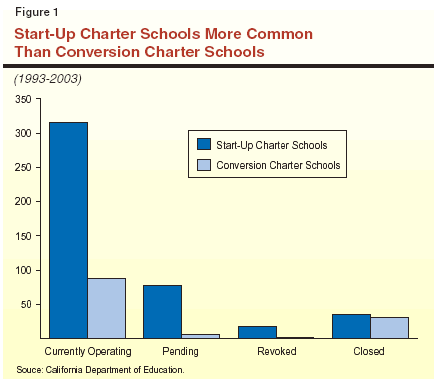
"Start-Up" Charter Schools More Common Than Conversion Charter Schools. In California, charter schools may be newly created as a start-up charter school or else a traditional public school may close and reopen as a "conversion" charter school. Figure 1 shows the number of start-up and conversion charter schools that are (1) currently operating, (2) pending, (3) have closed, or (4) have had their charter revoked. As the figure shows, about four out of every five currently operating charter schools are start-up schools whereas one out of every five is a conversion school.
Conversion Charter Schools Serve More Students Than Start-Up Charter Schools. Although start-up charter schools are more common than conversion charter schools, conversion charter schools actually enroll a greater number of students. Of all charter school students in the elementary grades, 72 percent are enrolled in a conversion charter school whereas 28 percent are enrolled in a start-up school. Of all charter school students in the secondary grades, 46 percent are enrolled in a conversion charter school whereas 54 percent are enrolled in a start-up school. (In 2002-03, charter school enrollment was split about evenly between the elementary and secondary grades.)
Charter Schools Offer Two General Modes of Instruction—Classroom-Based and Nonclassroom-Based. Charter schools provide instruction either primarily in a traditional classroom setting or in a nonclassroom setting. The SDE classifies a charter school as a classroom-based school if at least 80 percent of its instructional time is offered on the school site, with the school site being a facility used principally for classroom instruction. A nonclassroom-based school, in contrast, is one in which more than 20 percent of instructional time is offered in a location different from the primary school site. Nonclassroom-based charter schools tend to rely on individualized, self-paced student learning plans. Nonclass-room-based instruction includes independent study, home study, distance study, computer-based study, and work-study. Some of these types of instruction (for example, independent study) are common in traditional public schools as well as charter schools whereas others (for example, home study) are unique to charter schools.
Approximately One-Third of All Charter Schools Are
Nonclassroom-Based. In 2001-02, SBE classified 118 charter schools, or
approximately one-third of all charter schools, as nonclassroom-based. Start-up charter
schools are much more likely to be
nonclassroom-based than conversion charter schools (57 percent
and 11 percent, respectively). State law
prohibits nonclassroom-based schools from hiring
teachers without state credentials. Additionally,
state law requires SBE to establish general rules
for determining the appropriate funding level for nonclassroom-based charter schools.
The board's regulations specify that funding
determinations are to be based on: (1) the
percentage of total expenditures associated with
teacher salaries and benefits, (2) the percentage of
total expenditures associated with instruction, and
(3) the student-teacher ratio. Nonclassroom-based charter schools that devote a
greater share of their budget to teacher salaries
and instruction and have lower student-teacher
ratios are eligible for higher levels of funding.
Charter School Funding Model Intended to Result in Funding Comparable to Traditional Public Schools. In 1999, the Legislature adopted the current charter school funding model. Prior to this time, charter schools received funding on a program-by-program basis through negotiation with their charter authorizer. Under the current model, charter schools receive funds through the following three funding streams.
This section highlights eight pieces of state legislation that have had an especially strong impact on charter school operations and facilities.
Chapter 781, Statutes of 1992 (SB 1448, Hart)—Authorized the Creation of Charter Schools in California. The Charter Schools Act of 1992 was the original law authorizing the creation of publicly funded schools that could operate independently from school districts and be exempt from existing education laws. The law established a statewide cap of 100 charter schools and a districtwide cap of ten charter schools. The law established petition requirements, designed a two-stage appeals process, and specified certain conditions under which charters could be revoked. It required the qualifications of personnel to be specified in a school's charter, but it did not require staff to hold state credentials. The law also stated that the Superintendent of Public Instruction (SPI) was to make annual apportionments to each charter school, but in practice, charter schools initially negotiated funding with the school district rather than receiving it directly from the state. The original law did not address charter school facility issues.
Chapter 34—Instituted Significant Charter School Reforms. This law increased the statewide cap to 250 charter schools for the 1998-99 school year, with an additional 100 charter schools allowed to open annually thereafter, and eliminated the districtwide cap. It slightly eased (1) petition requirements, (2) the petition submittal process, (3) the appeals process, and (4) the revocation process. Unlike the 1992 law, it also required all core-subject teachers to hold a state credential. Additionally, it clarified that charter schools could receive funding directly from the state. It also required school districts to offer charter schools any unused district facilities at no charge, and it capped the oversight charges school districts could assess charter schools.
Chapter 162, Statutes of 1999 (SB 434, Johnston)—Applied Independent Study Laws to Charter Schools. This law required charter schools that offered independent study to comply with all laws and regulations governing independent study generally. This law also required charter schools to offer a minimum number of instructional minutes equal to that of other public schools, maintain written records of pupil attendance, and release these records for audit and inspection. Additionally, it required charter schools to certify that their students participated annually in the state's testing programs.
Chapter 78, Statutes of 1999 (AB 1115, Strom-Martin)—Created Charter School Funding Model. This law clarified the language regarding funding by expressing legislative intent to provide charter schools with operational funding equal to the total operational funding available to similar public schools serving similar student populations. It also established a funding model that allowed charter schools to receive funds either locally through the school district or directly from the state. The model consisted of three basic components: (1) revenue limit funding, (2) categorical block grant funding, and (3) separate categorical program funding—all of which were designed to yield charter school funding rates that were comparable to those of similar public schools.
Chapter 892—Reduced Funding for Nonclassroom-Based Charter
Schools. This law required SBE to: (1) adopt regulations
governing nonclassroom-based instruction, (2)
develop criteria for determining the amount of funding
to be provided for it, and (3) make specific
funding determinations for individual charter
schools. This law included certain guidelines
regarding funding levels. Specifically, funding for
non-classroom-based charter schools was to be reduced by no more than 10 percent in
2001-02, no less than 20 percent in 2002-03, and no less than 30 percent in 2003-04.
The board, however, retained the discretion, on a case-by-case basis, to adjust funding by
different percentages. The board was to make
funding determinations on a five-year cycle if a
charter school did not make material changes to
its charter and was deemed to be in good standing.
Chapter 1058, Statutes of 2002 (AB 1994, Reyes)—Established Geographic Restrictions and Enhanced County Oversight. This law required, with few specified exceptions, that a charter school consist of a single school site located within the geographic jurisdiction of its chartering school district. If adequate justification was provided, the law, however, allowed for two exceptions. Specifically, a group could receive a countywide charter (to operate at multiple sites throughout that county) or a statewide charter (to operate at multiple sites throughout the state). In either case, a charter school group had to justify the educational benefit of operating programs at multiple sites spanning multiple local jurisdictions. Additionally, the law granted County Offices of Education (COEs) general authority to conduct both fiscal and programmatic oversight of charter schools. The law, for example, allowed COEs to conduct an investigation of a charter school based on parental complaints or fiscal irregularities.
Proposition 39 (November 2000)—Required School Districts to Provide "Reasonably Equivalent" Charter School Facilities. This law, approved by the voters at a statewide election, allowed school districts to pass local school facility bonds with a 55 percent vote instead of a two-thirds vote. In addition, the law required school districts to provide charter schools with reasonably equivalent facilities that were sufficient to accommodate all their classroom-based students. This requirement must be met even if unused facilities are not available and the district would incur costs to provide the facilities. The school district, however, is not required to spend its general discretionary revenues to provide charter school facilities. Instead, the district could use other revenue sources, including state and local bonds. The law also: (1) required that charter facilities be reasonably equivalent to other district facilities, (2) allowed school districts that funded charter school facilities with discretionary revenues to charge the associated charter schools a facility fee, and (3) exempted a school district from providing facilities to charter schools that served fewer than 80 students.
Chapter 935, Statutes of 2002, (AB
14, Goldberg) and Proposition 47 (November 2002)—Created Charter Schools
Facilities Program and Approved Sizeable Bond
Funding. Chapter 935 established a pilot
program—the Charter Schools Facilities
Program—to determine the optimum method for
funding charter school facilities. The law specified
that the State Allocation Board (SAB) was to
approve a set of projects that was "fairly
representative" of: (1) the various geographic regions of
the state; (2) urban, suburban, and rural regions;
(3) large, medium, and small schools; (4) and the various grade levels. While ensuring this
fair representation was achieved, SAB also was required to give preference to charter schools
in overcrowded school districts and low-income areas as well as to charter schools operated
by not-for-profit organizations. This facilities
program was linked with voter approval of Proposition 47, which provided up to $100 million (of
a total of $3.5 billion) for the construction of
new charter schools. On July 2, 2003, SAB
provided preliminary facility apportionments to six
charter schools—committing a total of $97 million
in Proposition 47 bond monies.
In this section, we track the recent growth of charter schools nationwide and in California.
Charter Schools Spread Across Country in 1990s. During the 1990s, legislation allowing for the creation of charter schools was adopted by most state governments. Figure 2 tracks this growth. Today, 40 states as well as the District of Columbia (DC) have charter school laws.
|
Figure 2 Charter School Legislation |
|
|
Year Legislation |
State |
|
1991 |
Minnesota |
|
1992 |
California |
|
1993 |
Colorado Georgia Massachusetts Michigan New Mexico Wisconsin |
|
1994 |
Arizona Hawaii Kansas |
|
1995 |
Alaska Arkansas Delaware Louisiana New Hampshireb Rhode Island Texas Wyomingb |
|
1996c |
Connecticut Florida Illinois New Jersey North Carolina South Carolina |
|
1997 |
Mississippi Nevada Ohio Pennsylvania |
|
1998 |
Idaho Missouri New York Utah Virginia |
|
1999 |
Oklahoma Oregon |
|
2001 |
Indiana |
|
2002 |
Iowa Tennessee |
|
2003 |
Maryland |
|
|
|
|
a
The following ten states currently do not have charter school laws:
Alabama, Kentucky, Maine, Montana, Nebraska, North Dakota, South Dakota,
Vermont, Washington, and West Virginia. |
|
|
b
Indicates states that have charter school laws but no charter
schools currently operating. |
|
|
c
The District of Columbia also adopted charter school legislation
in 1996. |
|
|
Source: Center for Education Reform. |
|
Almost 2,700 Charter Schools Serving More Than 684,000 Students Nationwide. Currently charter schools are operating in 36 states and DC. In 2002-03, almost 2,700 charter schools served more than 684,000 students nationwide. Of these schools, almost 400 were new charter schools that opened in fall 2002. Figure 3 (see next page) shows the number of charter schools for each state and indicates the percentage of all public K-12 students in each state who attend charter schools. The data are provided for 2001-02—the most recent nationwide data compiled by the National Center for Education Statistics. As the figure shows, Arizona is the state with the greatest number of charter schools, followed closely by California. The DC serves the greatest proportion of all public K-12 students in charter schools (almost 10 percent). California serves approximately 2.5 percent of all public K-12 students in charter schools. Numerically, California serves more charter school students than any other state.
|
Figure 3 California Ranks High
Nationally on |
||
|
2001‑02 |
||
|
State |
Number of |
Charter
School Enrollment As Percentage of Total Public School Enrollment |
|
Arizona |
370 |
6.7 |
|
California |
350 |
2.2 |
|
Texas |
243 |
1.1 |
|
Michigan |
204 |
3.8 |
|
Florida |
192 |
1.6 |
|
Wisconsin |
109 |
1.7 |
|
North Carolina |
93 |
1.4 |
|
Colorado |
86 |
3.3 |
|
Ohio |
85 |
1.2 |
|
Pennsylvania |
77 |
1.6 |
|
Minnesota |
77 |
1.2 |
|
New Jersey |
51 |
0.9 |
|
New York |
44 |
�a |
|
Massachusetts |
43 |
1.5 |
|
Georgia |
40 |
1.7 |
|
District of Columbia |
33 |
9.2 |
|
Illinois |
23 |
0.4 |
|
Hawaii |
22 |
1.7 |
|
Oregon |
22 |
0.2 |
|
Missouri |
21 |
0.8 |
|
New Mexico |
20 |
0.8 |
|
Louisiana |
20 |
0.5 |
|
Alaska |
15 |
1.7 |
|
Connecticut |
15 |
0.5 |
|
Kansas |
11 |
0.3 |
|
Delaware |
10 |
3.7 |
|
Idaho |
10 |
0.6 |
|
Nevada |
10 |
0.5 |
|
Oklahoma |
10 |
0.3 |
|
South Carolina |
10 |
0.1 |
|
Utah |
9 |
0.1 |
|
Virginia |
8 |
0.1 |
|
Rhode Island |
6 |
0.5 |
|
Arkansas |
6 |
0.2 |
|
Mississippi |
1 |
0.1 |
|
Indiana |
1 |
�a |
|
Totals |
2,347 |
�a |
|
|
||
|
a
Data not available. |
||
|
Source: U.S. Department of Education, National
Center for Education Statistics. |
||
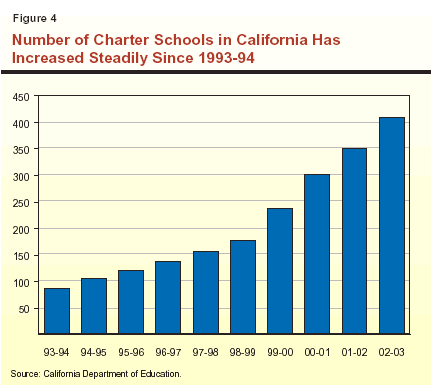
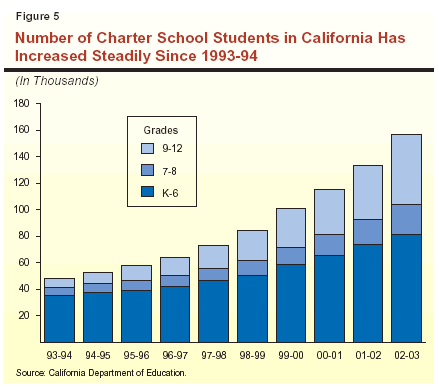
Steady Charter School Growth in California Over Past Ten Years. In California, the number of charter schools and the number of students attending charter schools has increased steadily over the past ten years. Figures 4 and 5 show the total number of charter schools and the total number of charter school students, respectively, in California each school year from 1993-94 through 2002-03. In 1993-94, 86 charter schools located in 23 of California's 58 counties served approximately 48,000 students. Of these students, 73 percent were in grades K-6, 12 percent were in grades 7-8, and 14 percent were in grades 9-12. By comparison, in 2002-03, 409 charter schools located in 45 counties served almost 157,000 students. Thus, over this ten-year period, California experienced average annual growth in charter school enrollment of 14 percent. As Figure 5 shows, during this period, the grade-level composition of charter school students also has changed—with charter schools now serving proportionally fewer K-6 students, slightly more seventh and eighth grade students, and considerably more high school students.
As mentioned earlier, RAND recently released the results of a two-year evaluation of charter schools in California. The evaluation assessed charter schools' effectiveness in using their resources to educate students. To conduct the evaluation, RAND used both primary and secondary data sources. To collect original data, RAND conducted a survey in spring 2002 of all California charter school principals, the principals of similar traditional public schools, and all California charter authorizers. In selecting traditional public schools to survey, RAND matched charter schools with a set of traditional public schools that served students with similar ethnic and socioeconomic characteristics. Thus, RAND attempted to compare charter schools to like schools serving like students. During fall 2002, RAND also visited nine charter schools and all but one of their charter authorizers and interviewed administrators and teachers at each site. Additionally, RAND collected student achievement data from six school districts with a large number of charter schools. These data were longitudinally linked, which permitted RAND to track students' test scores over time, thereby better isolating the independent effect of attending a charter school. To supplement these primary data sources, RAND also tapped traditional secondary data sources—including SDE's data on student demographics and test scores, teacher qualifications, and schools' academic performance.
This section highlights the most important differences and similarities that RAND found between charter schools and traditional public schools serving similar students and between start-up charter schools and conversion charter schools. Specifically, this section reviews RAND's findings regarding:
Charter Schools Show Year-to-Year Achievement Gains Comparable to That of Other Public Schools. As one method for assessing academic performance, RAND compared the average growth rate in charter schools' Academic Performance Index (API) score with that of other public schools. RAND found that, statewide, both charter schools and other public schools improved academic performance between 1999-00 and 2001-02. RAND also found that the average growth in charter schools' API score was not significantly different from that of other public schools. Changing the comparison group and restricting the analysis only to school districts that have at least one charter school, RAND similarly found that the average growth rate in charter schools' API score was not significantly different from neighboring public schools.
Classroom-Based Charter Schools Attain Higher Test Scores Than Nonclassroom-Based Charter Schools. RAND also compared the academic performance of classroom-based charter schools with both nonclassroom-based charter schools and other public schools. It found that classroom-based charter schools tend to attain higher test scores than either nonclassroom-based charter schools or other public schools. Specifically, it found that students in start-up, classroom-based charter schools scored slightly higher in almost every grade and subject than similar students in other public schools. It also found that students in conversion, classroom-based charter schools scored slightly higher in reading than comparable students in other public schools, but they scored slightly lower in mathematics. In contrast, RAND found that students in nonclassroom-based charter schools—whether start-up schools or conversion schools—scored lower in every grade and subject compared to students in other public schools.
Overall, RAND Deems Charter Schools Cost-Effective. Figure 6 highlights many of RAND's other findings relating to the general policies and practices of charter schools. The figure is divided into the following six subsections: (1) student body, (2) academic environment, (3) special education, (4) staffing, (5) finances and facilities, and (6) governance and oversight. Overall, RAND concluded that charter schools are cost-effective—attaining achievement scores comparable to those of other public schools even though they face considerable fiscal and facility challenges. Particularly noticeable, RAND found that charter schools participate in state-funded and federally-funded categorical programs at significantly lower rates than other public schools. RAND also found that charter school teachers and administrators are less experienced, but they feel more involved in decision making and have a greater sense of ownership of their classrooms and school site. Taken together, RAND's findings suggest that charter schools generally are viable, cost-effective reform strategies for improving academic achievement and serving certain students whose families desire additional school options.
|
|
|||
|
Figure 6 RAND Charter School Study�Summary of Findings |
|||
|
Evaluation Component |
RAND�s
Findings |
||
|
Student Body |
|||
|
School
Choice |
�
Black students are more likely, white students are just as
likely, and Asian and Latino students are less likely to choose a
charter school than they are a traditional public school within their
district. |
||
|
Ethnic
Integration |
�
Overall, charter schools are not exacerbating ethnic
segregation. |
||
|
Target
Groups |
�
Charter school principals are more likely to report
focusing their services on specific student populations�such as
low-income students�than matched public school
principals (33 percent and 21 percent, respectively). |
||
|
Student
Admissions |
�
Charter schools� admission policies do not differ
substantially from matched public schools� policies. �
Charter schools are more likely to interview prospective
families, but most schools use these interviews only for informational
or diagnostic purposes. |
||
|
Academic Environment |
|||
|
Instructional
Time |
�
Charter school principals report providing, on average, a longer instructional day than matched public schools. �
Charter school principals report providing approximately
the same amount of instructional time in core subjects as matched public
schools, except they report providing
significantly more instructional time in mathematics in the middle
grades. �
Charter school principals report providing more
instructional time in noncore subjects (such as fine arts and foreign
language) in the elementary grades than principals in matched public
schools. �
Compared to matched public school principals, charter
school principals report that state tests have significantly less
influence on instructional planning and teaching. |
||
|
Specialized
Programs |
�
Bilingual programs are approximately half as likely to be
offered by charter schools than by matched public schools. �
Charter schools offer significantly fewer Advanced
Placement courses (1.3 courses) than matched public schools (7.6
courses). �
Approximately the same percentage of charter school
principals report offering before-and-after
school enrichment programs as matched public school principals. |
||
|
Computer-to-Student
Ratio |
�
No significant difference exists in the
computer-to-student ratio of charter schools and matched public schools.
Both types of schools report about one computer for every four
students. |
||
|
Parent
Involvement |
�
Charter schools are more likely to use school-parent
contracts to clarify a school�s expectations of parental involvement. �
Charter school
principals report higher rates of parent participation in school
activities. �
Parents are equally likely to volunteer in charter schools
as in matched public schools. |
||
|
Behavioral Issues |
�
No significant differences exist between the out-of-school
suspension rates and expulsion rates of charter schools and matched
public schools, but charter schools
report significantly fewer in-school suspensions. �
Few significant differences were reported in student
behavior at charter schools and matched public schools. |
||
|
Special Education |
|||
|
Students
With |
�
The proportion of special education students with IEPs
differs only slightly between charter schools (7.6 percent)
and matched public schools (8.9 percent). �
Start-up charter schools, however, report serving a
significantly smaller proportion of special education students (5.5 percent)
than conversion charter schools (10 percent). |
||
|
Students
Identified as |
�
The proportion of special education students identified as
severely disabled differs only slightly between charter schools (1.3 percent)
and matched public schools (1.1 percent). �
Start-up charter schools, however, report serving a
significantly smaller proportion of severely disabled students (0.4 percent)
than conversion charter schools (2.3 percent). |
||
|
Target
Group |
�
Fewer charter school principals report focusing their
services on special education students (7.6 percent) compared with
matched public school principals (17 percent). |
||
|
Mode of Instruction |
�
Charter schools are more likely to mainstream special
education students (39 percent) than matched public schools (19 percent).
�
Start-up charter schools are most likely to mainstream
special education students (64 percent). �
Charter schools are less likely to serve special education
students in pull-out programs (37 percent) than matched public
schools (61 percent). |
||
|
Special
Education Staff |
�
The proportion of special education aides to total staff
did not differ significantly between
charter schools and matched public schools (approximately 10 percent). �
Significant differences, however, exist in the proportion
of special education staff between start-up charter schools (2 percent)
and conversion charter schools (16 percent). |
||
|
Control
and Liability for Special Education
Services |
�
Charter schools report having less control over and less
liability for special education than other areas of school operations. |
||
|
Staffing |
|||
|
Teachers
With |
�
Teachers in start-up charter schools are significantly
less likely to have a full credential (67 percent) than teachers in
conversion charter schools (88 percent) and matched public schools
(88 percent). �
Teachers in start-up charter schools are significantly
more likely to serve on an emergency permit (27 percent) than
teachers in conversion charter schools (16 percent) and matched
public school teachers (10 percent). |
||
|
Teachers� Subject |
�
Almost all elementary school teachers in charter schools
and matched public schools have relevant subject matter authorizations. �
Secondary school teachers in charter schools, however, are
significantly less likely to have relevant subject matter authorizations
than teachers in matched public schools. |
||
|
Teachers�
Level of |
�
Charter school teachers are, on average, less experienced
than teachers in matched public schools (10 years and 14 years of
experience, respectively). �
Teachers in start-up charter schools are, on average, less
experienced than teachers in conversion charter schools (8.7 years and
11 years of experience, respectively). |
||
|
Teachers�
Salaries and |
�
Charter school principals are significantly less likely to
report using a salary schedule to determine teacher salaries (78 percent
compared to all matched public school principals). �
Charter school principals are significantly less likely to
report engaging in collective bargaining agreements with a teachers�
union (32 percent) than matched public school principals (83 percent).
|
||
|
Teachers�
Professional |
�
Charter school teachers participate in informal
professional development activities, such as coaching programs and peer
collaboration, at higher rates than teachers in matched public schools. �
Principals and teachers at all nine case-study charter
schools report strong emphasis on professional development, especially
activities such as mentoring and collaboration. |
||
|
Teachers�
Control Over |
�
Teachers at all charter case-study schools stated that
they played an important role in school decision making. �
Some teachers in schools that had been converted from
traditional public schools felt they were treated with more respect
after conversion. |
||
|
Principals With |
�
Charter school principals are significantly less likely to
have a teaching credential (86 percent) than matched public school
principals (99 percent) and significantly less likely to have an
administrative credential (61 percent and 97 percent,
respectively). |
||
|
Principals�
Previous |
�
Charter school principals are significantly less likely to
have served as principals or vice principals before accepting their
current assignment (40 percent) than matched public school
principals (73 percent). �
Charter school principals are significantly more likely to
have served in teaching positions before accepting their current
administrative assignment (22 percent) than matched public school
principals (13 percent). �
Charter school principals are significantly more likely to
have come from a nonteaching or nonadministrative occupation outside the
field of education (10 percent
compared to less than 1 percent of matched public school
principals). |
||
|
Principals�
Years of |
�
Charter school principals report shorter tenures at their
current schools (3.1 years) than principals of matched public
schools compared (4.4 years). �
Charter school principals report less total experience in
school administration (9.1 years) than matched public school principals
(12 years). |
||
|
Principals� Control Over |
�
Charter school principals report having greater overall
control of decision making than matched public school principals. �
A majority of charter school principals report they have
full control over major decisions�including those related to student
disciplinary policies, curriculum, budgetary expenses, hiring and
dismissal, and staff salaries and benefits. |
||
|
Working
Days |
�
Charter school teachers and principals report working, on
average, five more days per year than teachers and principals in matched
public schools. |
||
|
Finances and Facilities |
|||
|
Participation
in |
�
Compared to matched public school principals, charter
school principals report significantly lower participation in eight
relatively large federal and state categorical programs�including
Title I, K-3 Class Size Reduction, and Supplemental Instruction. �
Start-up charter schools are significantly less likely to
participate in categorical programs than either conversion charter
schools or matched public schools. �
Almost half of start-up charter school principals agree or
strongly agree with the statement: �Our school has given up pursuing
certain categorical funds because they are too complex.� |
||
|
Categorical
Block Grant Funding Rates |
�
Block grant funding rates for charter schools have
declined over time due to (1) the removal of programs from the
block grant, (2) the defunding of programs initially included in the
block grant, and (3) funding reductions experienced by many programs
remaining in the block grant. |
||
|
Private
Funding |
�
Charter schools receive substantially more private funding
per student ($433) than matched public schools ($83). �
The extent to which these private funds are one time or
used only for facilities is unclear. |
||
|
Expenditures |
�
Start-up charter schools and conversion schools report
spending about the same amount per student ($6,168 and $6,366,
respectively). �
Classroom-based charter schools report spending almost
$2,000 more per student than nonclassroom-based
charter schools ($6,926 and $4,973, respectively). |
||
|
Facility Acquisition and |
�
More than 90 percent of principals at conversion
charter schools report that their facilities are provided by a district
at no cost or only nominal cost. Less than 25 percent of principals
at start-up charter schools report obtaining facilities in this manner. �
The majority of start-up charter schools lease facilities
from a commercial site or privately rent/own their facilities. Less than
10 percent of conversion charter schools report funding facilities
in these ways. �
Almost two-thirds of charter school principals and more
than one-third of charter authorizers agree or strongly agree that they
are struggling with financing capital expenditures. |
||
|
Governance and Oversight |
|||
|
Legal
Liability |
�
Approximately 67 percent of charter schools report
having memoranda of understanding (MOU) with their charter authorizers.
(An MOU is a separate document from the charter that clarifies the
responsibilities and liabilities of the charter school and the charter authorizer.) |
||
|
Control Over |
�
Both charter authorizers and charter school principals
report that charter schools are more autonomous than matched public
schools. |
||
|
Information
Charter |
�
The most common types of information charter authorizers
collect from charter schools are financial reports, student attendance
data, student achievement scores, and school schedules. �
The least common types of information charter authorizers
collect from charter schools are student disciplinary actions, student
transfer data, student grades, and parent satisfaction data. |
||
|
Reasons
for Intervening in Charter School Activities |
�
Charter authorizers� most common reasons for intervening
in charter schools� activities are (1) complaints from parents
and (2) financial irregularities. |
||
|
Oversight
Activities |
�
The most common form of intervention is some form of
investigation of the charter school (including site visits and requests
for additional records). |
||
|
|
|||
|
Source: RAND Education, Charter School
Operations and Performance (2003). |
|||
|
|
|||
As detailed above, RAND's evaluation provides considerable insight into the current strengths and weaknesses of charter schools in California. Although charter schools in general are making similar academic gains and attaining similar academic scores, RAND's findings suggest that some weaknesses exist relating to charter school funding and oversight. In this section, we focus on the following four charter school issues: (1) the annual growth cap on charter schools, (2) the charter school funding model, (3) the general system of charter school oversight, and (4) oversight fees. For each of these issues, we describe existing policies and make recommendations for improving them.
As mentioned in the first part of this report, the Charter Schools Act of 1992 capped the total number of charter schools that could operate in California at 100, with a districtwide cap of ten charter schools. In 1992, charter schools were new creations that had yet to be tested and evaluated, and the statewide cap was intended as a safety precaution against the uncontrolled growth of these experimental entities. The districtwide cap was intended to prevent a small set of very large school districts from establishing so many charter schools that the statewide cap was reached before smaller school districts had the opportunity to create their own charter schools. The districtwide cap therefore helped to promote the creation of charter schools across an array of both small and large school districts. The districtwide cap also ensured that no single school district would need to oversee and monitor a large number of charter schools.
In 1998, reform legislation modified these original caps. Specifically, the new law increased the statewide cap to 250 charter schools for the 1998-99 school year, allowing 100 additional charter schools to open each year thereafter. It also entirely eliminated the districtwide cap. (The shaded box on page 21 shows the number of allowable charter schools in each of the 39 states that has charter school laws.)
The Number of Charter Schools That States Allow Varies WidelyThe number of charter schools that individual states allow to operate within their borders ranges from zero to unlimited, as shown in Figure 7. Currently, ten states do not permit any charter schools. Of the 40 states that do allow charter schools:
|
||||||||||||||||||||||||||||||||||||||||||||||||||||||||||||||||
We recommend the Legislature remove the cap on the annual growth of charter schools because the original rationale for the cap is no longer applicable.
Existing law requires the LAO to review the annual growth cap for charter schools and recommend whether to expand or reduce it. Although capping the total number of charter schools that could operate in the state was appropriate when the performance of charter schools was unknown, the environment today is considerably different, and we recommend repealing the cap.
Cap No Longer Needed. Charter schools remain neither new (they have operated in California for ten years) nor untested (the state has conducted two comprehensive charter school evaluations). Both statewide evaluations concluded that charter schools were viable educational reforms. Neither evaluation uncovered any alarming finding to warrant slower growth or continuation of the growth cap. Indeed, as discussed in detail earlier in this report, RAND's recent evaluation concluded that charter schools were attaining achievement results comparable to those of other public schools despite facing considerable fiscal and facility challenges. As a result, we are not aware of any analytical basis for continuing to cap the annual growth in charter schools. Therefore, we recommend the Legislature remove the cap on the annual growth of charter schools.
The Charter Schools Act of 1992 specified that a charter school was to receive state funding comparable to other public schools located within the same district and serving a similar student population. Specifically, a charter school was to receive comparable revenue limit funding, categorical funding, and special education funding. To a large extent, the charter school funding model developed in 1999 simply formalized the intent of the original 1992 law by establishing specific funding mechanisms intended to yield comparable funding rates.
Trend Toward Decreasing Flexibility and Increasing Regulation. Despite legislative intent to provide charter schools with comparable state funding using a simple funding stream with few strings attached, charter school finance has become increasingly complex and opaque since the enactment of the 1999 funding model. The trend most incompatible with the original intent of charter schools is the increasing number of categorical programs for which charter schools must apply separately. As discussed in "Part I" of this report, charter schools receive categorical funding in one of two ways. Some categorical programs are included in the charter school categorical block grant and associated funding is allocated directly to charter schools. In contrast, some categorical programs are excluded from the block grant and, to receive funding for them, charter schools must apply separately for each program. The trend toward having charter schools apply separately for more and more categorical programs is resulting in increasing regulation and less programmatic and fiscal flexibility. This trend also appears contrary to the underlying rationale for establishing charter schools—that is, to exempt certain schools from most state regulation in exchange for local accountability.
Number of Programs in Block Grant for 2003-04 at All-Time Low. Figure 8 shows the number of K-12 education programs included and excluded from the charter school categorical block grant each year from 2000-01 through 2003-04. When enacted in 1998, the block grant included 33 programs. As Figure 8 shows, this number grew to 45 programs in 2000-01 but since has been declining noticeably. In 2003-04, the number of programs included in the block grant will be at an all-time low of 28 programs.
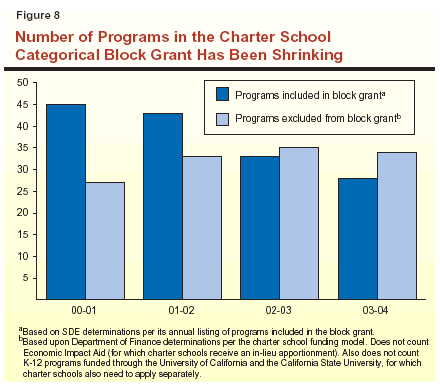
Number of Programs Excluded From Categorical Block
Grant Has Grown Noticeably. In contrast, the
number of programs excluded from the block grant
has increased noticeably over recent years. Originally, the
block grant excluded
18 categorical programs. Charter schools were precluded on a de
facto basis from accessing funding associated with three of these
programs. This was because funding for these
particular programs—adult education, adults in
correctional facilities, and COE fiscal oversight—did not
flow directly to school districts for K-12
purposes. Charter schools could apply for funding
associated with the remaining 15 programs, but
they had to apply separately for each program.
These 15 programs included some of the largest categorical programs, such as special
education, K-3 Class Size Reduction, supplemental
instruction, Home-to-School Transportation, Staff Development Buy-Out Days, and
deferred maintenance. As Figure 8 shows, by
2003-04, the list of categorical programs excluded
from the block grant had grown to 34 programs. Of these programs, charter schools were
precluded on a de facto basis from applying to
three programs, but they could apply separately to
the remaining 31 programs. These programs continued to include the largest of the
categorical programs and had notable new additions, such
as instructional materials and school
accountability programs.
Categorical Block Grant Funding as Proportion of Total Available Categorical Funding Also at All-Time Low. Not only has the number of programs excluded from the block grant increased and the number included decreased, the programs that remain in the block grant are representing a smaller and smaller share of total available categorical funding. In 2000-01, the 45 programs included in the block grant were associated with a total of $3 billion, or 27 percent of all available categorical funding in that year. This means that charter schools were able to access directly through the block grant 27 percent of all available categorical funds. To access the remaining 73 percent of categorical funds, charter schools had to apply separately and meet all of the associated programmatic requirements. Since 2000-01, the share of categorical funding charter schools have been able to access directly has decreased each year—reaching an all-time low of 15 percent in 2003-04 (see Figure 9).
|
Figure 9 Block Grant Funding
Shrinking as |
|||||
|
(Dollars in Billions) |
|||||
|
|
2000‑01 |
2001‑02 |
2002‑03 |
2003‑04 |
Average
Annual Change |
|
Funding |
|
|
|
|
|
|
K-12 programs in block grant |
$2.95 |
$2.82 |
$1.84 |
$1.63 |
-18% |
|
K-12 programs excluded from block grant |
7.89 |
9.93 |
9.92 |
9.19 |
5 |
|
Totals |
$10.84 |
$12.76 |
$11.76 |
$10.82 |
0% |
|
Block-grant funding as percentage of total |
27% |
22% |
16% |
15% |
� |
Total Level of Funding Associated With Programs in Block Grant Also at All-Time
Low. Not only has the share of available funding
been reduced, the actual level of available
funding also has declined. Between 2000-01 and 2003-04, total categorical funding associated with programs in the charter school block
grant declined by $1.3 billion—a 45 percent
decline. This decline cannot be fully attributed to
the state's general fiscal situation because total categorical funding remained essentially
constant over the same period. Similarly, from
2000-01 through 2003-04, funding associated with programs in the block grant declined by
an average annual rate of 18 percent compared
to essentially no change for all K-12 categorical programs.
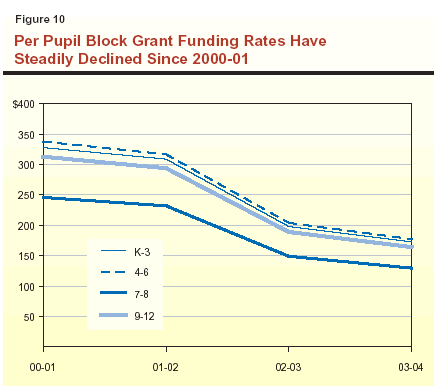
Per Pupil Block Grant Funding Rates Have Declined Each Year Since 2000-01. The decline in the level of available funding associated with programs in the block grant has yielded reductions in the underlying per pupil block grant funding rates. Figure 10 tracks these per pupil funding rates from 2000-01 through 2003-04. As the figure shows, per pupil funding rates for each of the four grade spans peaked in 2000-01 and have since declined every year. As with aggregate funding, the annual declines in per pupil funding rates have been substantial. For example, the per pupil funding rate for grades 9-12 dropped from a high of $313 in 2000-01 to a low of $164 in 2003-04.
We recommend the Legislature shift 14 currently excluded programs into the general charter school block grant, shift 10 currently excluded programs into the disadvantaged-student component of the block grant, and make the associated cost-neutral adjustments to the underlying per pupil funding rates. We further recommend the Legislature: (1) list all categorical programs requiring charter schools to apply separately in charter school law, (2) list all categorical programs for which charter schools are prohibited from applying in charter school law, and (3) modify these two lists, as needed, when categorical programs are newly established. Finally, we recommend the Legislature require the Department of Finance (DOF) to calculate and publicly release block grant growth rates each January, May, and upon final passage of the annual budget act.
Given the trends identified above, we recommend the Legislature undertake a general restructuring of the charter school categorical block grant. This restructuring would simplify the block grant structure and address the current discrepancy in average daily attendance (ADA) funding rates, thereby better meeting the legislative intent of the block grant. It also would enhance the timeliness and accessibility of charter school funding calculations, thereby allowing policymakers to better understand, oversee, and ensure accuracy in budgeting.
Shift 14 Currently Excluded Programs Into General Block Grant. Of the 34 categorical programs excluded from the block grant in 2003-04, we recommend 14 programs be transferred to the general block grant (see Figure 11). Given the legislative intent of the block grant, we think the defining criterion for whether a categorical program should be included in the block grant is whether it serves students, teachers, or administrators in a typical public K-12 school. Other public K-12 schools are able to access funding associated with all 14 programs identified in the top section of Figure 11, so we do not think sufficient justification exists for excluding them from the general block grant. (As shown in the last section of Figure 11, we recommend the Legislature continue to exclude ten programs from the block grant. Funding for four of these programs—such as adults in correctional facilities—do not flow directly to typical public K-12 schools serving charter-school-equivalent students. Each of the remaining six programs is of a distinct, special nature and we recommend the Legislature continue to allow charter schools to apply separately for them.)
|
Figure 11 Restructuring the Charter
School |
|
Of the 34 programs currently excluded from the
charter school categorical block grant, we recommend the Legislature: |
|
Move the Following 14 Programs Into the General Block
Grant |
|
�
After School Programs |
|
�
Core Supplemental Instruction |
|
�
Deferred Maintenance |
|
�
Home-to-School Transportation |
|
�
Instructional Materials |
|
�
K-3 Class Size Reduction |
|
�
Mathematics and Reading Professional Development |
|
�
Principal Training |
|
�
Public School Library Materials |
|
�
Regional Occupational Programs and Centers |
|
�
Staff Development Day Buy-Out |
|
�
Teacher-Incentive
Programs (Intern, Preintern, and Paraprofessional programs) |
|
Move the Following Ten Programs Into the |
|
�
California School Age Families Education |
|
�
English Language Learners Student Assistance |
|
�
Gang Risk Intervention Program |
|
�
Mandatory Supplemental Instruction |
|
�
National Board Certification for Teachers Working in
Low-Performing Schools |
|
�
Public School
Accountability Programs (Immediate Intervention/Underperforming Schools,
Low-Performing Schools, and Corrective Actions) |
|
�
Remedial Supplemental Instruction |
|
�
Targeted Instructional Improvement Block Grant |
|
Keep the Following Ten Programs Outside of the Block
Grant |
|
Allow charter schools to apply separately for
following six programs: |
|
�
California School Information Services |
|
�
Charter School Facility Grant Program |
|
�
Child Care |
|
�
Mandates |
|
�
Pupil Testing |
|
�
Special Education |
|
Prohibit
charter schools from receiving separate funding for following four
programs: |
|
�
Adult Education |
|
�
Adults in Correctional Facilities |
|
�
California Technology Assistance Project and Statewide
Education Technology Services |
|
�
County Fiscal Oversight |
|
|
|
a
Currently, this component provides funding in lieu of Economic
Impact Aid. |
We further note that the basic objective of the block grant is to enable charter schools to receive discretionary funding through a simple administrative process—being held accountable for meeting the educational objectives delineated in their charter. This is why charter schools are allowed to use block grant funding at their discretion. We also think this fiscal flexibility is important given the lack of rigorous, empirical cost-benefit analyses comparing specific categorical programs. A more inclusive block-grant structure would enhance schools' ability to assess their needs and make important trade-offs—such as between investing in teacher quality and reducing class size.
Shift Ten Currently Excluded Programs Into Disadvantaged-Student Component of Block Grant. As noted above, the block grant has a special disadvantaged-student component in which charter schools receive supplemental funding for certain students in lieu of receiving Economic Impact Aid. We recommend the Legislature shift ten currently excluded programs into the disadvantaged-student component of the block grant (see second section of Figure 11) because all these programs are associated with serving disadvantaged students. We recommend that total funding continue to be based on a count of disadvantaged students enrolled in charter schools. (Students are considered disadvantaged if they participate in a federal free or reduced-price meal program or are classified as English Language Learners. A student who meets both criteria is counted twice.) This consolidation would increase the amount of funding charter schools would receive for disadvantaged students without increasing administrative burdens or adding new fiscal complexities. Moreover, it would respond to one of the core legislative objectives of charter schools—to enhance and expand services for disadvantaged students.
Adjust Per Pupil Funding Rates in Cost-Neutral Manner. Shifting these 24 programs into the block grant would result in charter schools being able to access more categorical funding, which in turn would increase per pupil block grant funding rates. This would thereby address the current discrepancy in state funding between charter schools and other public schools that RAND identified. Including additional programs in the block grant, however, raises the total amount needed to fund the block grant. To manage the restructuring in a cost-neutral manner, we recommend the Legislature shift some funding currently associated with each categorical program into the block grant. Specifically, as charter school ADA is approximately 2.5 percent of total public school ADA, we recommend the Legislature shift about 2.5 percent of funding associated with currently excluded categorical programs into the block grant. Additionally, some grade-span adjustments would need to be calculated as some of the categorical programs that would be moved into the block grant, such as K-3 Class Size Reduction and Regional Occupational Programs, are grade specific.
Require All Programs Excluded From Block Grant to Be Identified in Charter School Law. Currently, block grant calculations are extremely opaque because statute does not contain a comprehensive list of programs either excluded from or included in the block grant. Thus, each year, DOF uses its knowledge of and judgment about the statutes associated with the state's categorical programs to determine which programs should be excluded from the block grant. Unsurprisingly, growing controversy has emerged regarding which programs are to be excluded. For example, in 2002-03, DOF decided to exclude the Teaching As A Priority program from the block grant even though statute does not require charter schools to apply separately for this program. Technically, therefore, it should have been included. Similarly, in 2003-04, DOF decided, for the first time, to exclude three other longstanding categorical programs, even though statute does not require charter schools to apply separately for them.
To reduce this kind of confusion and controversy, we recommend the Legislature codify in a single section (specifically, in Education Code Section 47634 [b]), all programs that are excluded from the charter school block grant. This section should specify programs for which charter schools must apply separately as well as programs for which charter schools are prohibited from receiving funding. This section also should state explicitly that all programs not specifically excluded are to be included in the categorical block grant. Finally, we recommend the Legislature adopt a new statutory provision requiring all newly established categorical programs that are to be excluded from the block grant to be specified in this code section. Together, these actions would help generate a common understanding of excluded programs and make block grant calculations less controversial and confusing.
Require DOF to Release and Update Funding Model During Budget Process. Currently, DOF estimates the charter school funding model once a year—approximately 30 days after the enactment of the budget act. It does not prepare the model in January or May. This means policymakers and the public school community do not have access to estimates of charter school funding rates until after the budget has been signed. Moreover, even once DOF has determined the final charter school funding rates, it often does not share its underlying model with the public. Additionally, no systematic process is in place for correcting any potential technical budgeting errors. For these reasons, we recommend the Legislature include a statutory provision requiring DOF to estimate per pupil block grant funding rates three times each budget season—at the release of the Governor's January budget proposal, the Governor's May Revision, and 30 days after enactment of the budget. We also recommend the Legislature require: (1) DOF to publicly release the underlying charter school funding model each time it estimates these funding rates and (2) SDE to post the model on its website. This formalized process for publicizing charter school information would help policymakers more easily track changes in charter school funding and would clarify expectations for the charter school community.
In sum, the trend in charter school finance over the last several years has been
toward increasing complexity and regulation. A
major component of this trend has been the
increasing number of categorical programs that are
excluded from the charter school block grant. These programs include some of the largest
K-12 programs, and charter schools may access associated funding only if they apply
separately to each of the programs and adhere to all
their regulations. The block grant also is
representing less and less of total available categorical
funding and is not providing charter schools with operational funding comparable to that of
other public schools serving similar students—the
basic intent of charter school finance. To counter these trends, we recommend a general
restructuring of the charter school block grant.
This restructuring would move a total of 24
categorical programs into the block grant and
rebench per pupil funding rates. We further
recommend a more systematic process for releasing
charter school funding calculations that would
provide policymakers and the charter school
community more information in a more timely manner.
In addition to funding, oversight and accountability have been perennial issues of legislative concern. Much of this concern has arisen as a result of specific instances of wrongdoing. In particular, over the last decade, some charter schools and charter authorizers have engaged in inappropriate fiscal practices and/or have lacked the prerequisite fiscal acumen needed to manage school sites. Regarding charter school practices, RAND's evaluation found that, since their inception: (1) about 4 percent of all charter schools have closed or had their charters revoked, and (2) a common reason charter authorizers cite for revoking charters is fiscal mismanagement. Similarly, the BSA report uncovered fiscal irregularities in the accounting and reporting practices of four large charter authorizers.
These instances of wrongdoing have prompted the Legislature to take actions intended to promote more meaningful oversight and a stronger system of state and local accountability. Below, we discuss these actions.
State Institutes Charter School Reporting Requirements. Given concerns with fiscal mismanagement, and the corollary desire to improve the quality and regularity of the fiscal information charter schools provide to their overseers, the state recently established two specific charter school reporting requirements. Chapter 1058 requires each charter school to approve an annual statement of all receipts and expenditures for the preceding fiscal year and submit the statement to its charter authorizer. Additionally, Chapter 892 now requires each charter school, on an annual basis, to prepare and submit to its charter authorizer: (1) a preliminary budget, (2) an interim financial report, (3) a second interim report, and (4) a final unaudited report.
State Gives COEs and SPI Special Investigative Powers. In addition to routine reporting requirements, the state has strengthened oversight capabilities by providing counties and the state with special investigative powers. Specifically, current law requires charter schools to respond promptly to all reasonable inquiries made by their charter authorizer, COE, or the SPI. Additionally, current law gives both charter authorizers and COEs the authority to monitor and conduct investigations of charter schools located within their jurisdictions.
State Enacts New Provisions Clarifying Charter Authorizers'
Responsibilities. In addition to improving charter school oversight,
the state has focused over the last several years
on developing a stronger system of charter school accountability. To this end, the state
recently codified charter authorizers' basic
responsibilities. Specifically, charter school law now
requires each charter authorizer, on behalf of
each charter school under its authority, to:
(1) identify at least one charter school staff member as a primary contact person, (2)
visit each school at least annually, (3) ensure
that each school complies with all statutory
reporting requirements, (4) monitor the fiscal condition
of each school, and (5) provide timely
notification to SDE if a school will cease its operations or
its charter is to be renewed or revoked. These specific requirements were
intended to ensure that charter authorizers would be aware of
their responsibilities and could be held legally liable
for not exercising them.
State Entrusts SBE With Ultimate Revocation Power. In addition to requiring charter authorizers to undertake certain responsibilities, the state has given SBE the authority to revoke charters. The original 1992 law only allowed a charter authorizer to revoke a charter. Chapter 34 modified the original law to allow SBE to act as a final judge, revoking a charter if it finds fiscal mismanagement, illegal behavior, or a "departure from measurably successful practices." Thus, SBE now has the authority to intervene directly to revoke charters and close charter schools.
Although the state's actions over the last ten years have strengthened charter school oversight and accountability, issues remain relating to charter authorizers. Currently, California essentially has a single-authorizer system, which requires a charter school group, in most instances, to obtain authorization from its local school district. Except on appeal or in other special instances, alternative authorizer options simply are not available. Two basic problems are inherent in single-authorizer systems: (1) some authorizers lack the capacity to conduct meaningful oversight and yet they remain obligated to assume authorizer responsibilities, and (2) a general lack of competition among authorizers results in inefficiencies that might increase costs and lower the overall quality of oversight efforts. Below, we discuss these problems.
Some Charter Authorizers Lack Capacity. The current single-authorizer system has no "opt-out" provision whereby certain types of school districts can decide not to become a charter authorizer. For example, school districts with very limited staff or extreme fiscal difficulties have no legal recourse to opt out of the charter authorizing process. The inability of school districts to opt out of charter authorizing and the inability of charter schools to pursue alternative authorizers are particularly troubling in California. This is because more than two-thirds of charter authorizers in California have chartered only a single charter school. Many authorizers, therefore, tend to be inexperienced in conducting rigorous oversight. The local cost of oversight also is likely to be high because many authorizers must construct an oversight system essentially from scratch.
Lack of Competition Might Result in Inefficiencies. Given the lack of alternative authorizers, a charter group that is interested in opening a school in a certain area must accept a local school district's terms—even if these terms are inappropriate or burdensome. As discussed above, the 2002 BSA report did find instances of inappropriate fiscal practices across four large charter authorizers. In particular, the BSA report found that these authorizers could justify neither the oversight fees they charged charter schools nor the mandate-cost claims they submitted to the State Controller.
Lack of Competition Might Reduce Quality of Oversight. Some school districts might be particularly receptive or unreceptive to charter schools. In either case, these authorizers are unlikely to conduct appropriate, meaningful oversight. For example, unreceptive school districts might make charter authorization or renewal unnecessarily onerous. Alternatively, especially receptive school districts, such as those facing local facility shortages, might be overly friendly to charter schools—thinking these schools might be an inexpensive means for accommodating additional students. Whereas unreceptive authorizers might conduct inappropriately rigorous oversight, overly friendly authorizers might be inappropriately lax in their oversight—particularly if they have a vested interest in maintaining charter schools in their area.
We recommend the Legislature adopt a three-pronged strategy for overcoming the weaknesses of California's single-authorizer system. Specifically, we recommend the Legislature modify charter school law by: (1) permitting school districts to opt out of charter authorizing, (2) allowing for multiple authorizers, and (3) creating safeguards against potential misconduct.
We believe the weaknesses and perverse incentives inherent in the current oversight system could be addressed in large part by taking the following three steps.
Provide Opt-Out Option. We recommend the Legislature allow school districts to opt out of charter authorizing. Specifically, if a school district believes it lacks the infrastructure or expertise to assess charter documents and conduct meaningful oversight, then we recommend the Legislature allow the school district to opt out of the authorizing process. This opt-out option would ensure that a school district would not find itself in the awkward position of overseeing a school when it realistically did not have the capacity to conduct meaningful oversight.
Allow for Multiple Authorizers. We also recommend the Legislature modify existing charter school law to allow multiple types of organizations to authorize charter schools. For instance, authorizers could include SBE, school districts, COEs, accredited colleges and universities, and nonprofit organizations that can meet certain criteria discussed below. (Many other states currently allow multiple authorizers—see shaded box.) A multiple-authorizer system would address the perverse incentives that currently weaken oversight efforts. For example, if interested in locating within a very small school district, a charter group could seek authorization from a nearby university or a COE—either of which is likely to be better positioned than the small school district to conduct appropriate petition review and oversight. A multiple-authorizer system also would promote competition among authorizers. This competition is particularly important because it would generate efficiencies, potentially lowering costs and substantially reducing the likelihood of excessive overhead fees and other inappropriate charter conditions. Competition among authorizers also would be likely to improve the quality of oversight and technical assistance available to interested charter school groups. Furthermore, a multiple-authorizer system might promote valuable and educationally beneficial partnerships between K-12 schools and teacher education programs, higher education more generally, and nonprofit community groups.
Multiple-Authorizer Systems Already Exist in Several StatesIf California were to establish a multiple-authorizer system, it would join the ranks of several other states that already have established these types of systems. Currently, seven states—Indiana, Michigan, Minnesota, Missouri, New York, Ohio, and Wisconsin—have multiple-authorizer systems. In addition to local school boards (and, for some, the state board of education), these seven states allow public universities, private universities, community colleges, technical colleges, mayors, and/or nonprofit educational organizations to approve charter schools. Each state has a slightly different set of allowable charter authorizers. For example, Michigan allows local school boards, joint school boards, community colleges, and public state universities to authorize charter schools whereas Ohio allows local school boards, joint school boards, the state board of education, nonprofit education organizations, a special county education center, and the University of Toledo to authorize charter schools. |
Establish Minimum Criteria for Authorizers. To promote stronger accountability, we recommend the Legislature direct SDE to develop basic criteria that organizations must meet to become charter authorizers. The SDE could then be directed to submit these criteria back to the Legislature in the following legislative session for review and codification. (At a minimum, the criteria should include an understanding of contracts and fiscal management as well as school assessment and accountability.) These codified criteria would provide the state the means by which to remove authorizing power from a particular entity without having to institute a complex licensing or regulatory process for approving charter authorizers. To further enhance oversight, we recommend the Legislature review these criteria after the first five years of implementation and make any necessary changes.
Create Safeguards. Allowing for multiple authorizers generates two special concerns: (1) charter schools could select only the most lenient authorizers that promised them the greatest autonomy, and (2) charter authorizers that were not elected by popular local vote could conduct poor oversight without facing appropriate repercussions. To address these concerns, we recommend the Legislature adopt two special safeguards.
Make Two Corollary Changes. Two additional policy changes would need to be made in tandem with the policy changes recommended above.
In sum, the state has taken several actions over the last decade to strengthen charter school oversight and accountability, but some problems remain. Most importantly, some charter authorizers continue to have either little incentive or little ability to conduct meaningful oversight. To address these lingering oversight problems, we recommend the Legislature employ a three-pronged strategy that would permit school districts to opt out of charter authorizing, allow for multiple authorizers, and create safeguards against potential authorizer misconduct.
As with the state's general system of charter school oversight, some improvements could be made to the state's specific policies regarding charter school oversight fees. Currently, charter school law allows a charter authorizer to charge for the actual cost of oversight but caps the total charge that may be assessed depending on a charter school's facility arrangements. Specifically, if a charter school is using rent-free district facilities, then a charter authorizer's oversight fee is capped at 3 percent of the charter school's total revenue. By comparison, if a charter school is renting nondistrict facilities, a charter authorizer's oversight fee may not exceed 1 percent of the charter school's total revenue. These existing fee policies have three basic problems, which we discuss below.
Facility Fees and Oversight Fees Inappropriately Linked. Current law combines facility fees with oversight fees even though these two types of fees are intended to fund quite different services. Whereas the facility fee is intended to help a school district pay maintenance costs for buildings it has provided to charter schools, the oversight fee is intended to help a school district pay for such activities as reviewing charter petitions, evaluating charter school reports, responding to complaints from charter school parents, investigating charter school fiscal irregularities, and visiting charter school sites. Combining the two fees reduces the ability to track actual costs and makes fiscal accountability unnecessarily difficult.
Current Oversight Fee Not Linked to Appropriate Underlying Cost Variables. Current law also does not link allowable oversight fees with appropriate underlying cost variables. For example, although charter authorizers currently may charge higher oversight fees to charter schools using rent-free facilities, these schools actually might be located closer to the district office and be less costly to monitor than charter schools located further away and renting nondistrict facilities. Moreover, oversight fees are likely to vary according to important variables other than facility arrangements—such as the distance of the charter school from the charter authorizer, the type of instruction offered by the charter school, the enrollment at the charter school, or the level of experience of the charter school operators. Existing policies, however, do not account for these other factors.
Charter Authorizers Might Double Charge the State. Currently, charter authorizers may both charge charter schools an oversight fee and file mandate claims for oversight costs. Moreover, current law does not delineate the types of activities that may be covered with direct charter school oversight fees versus mandate reimbursement claims to the state. As noted in the recent BSA report, this system has the peculiar danger of allowing charter authorizers to double charge the state.
We recommend the Legislature amend charter school law to: (1) delineate more clearly between allowable facility fees and oversight fees, (2) cap facility fees and oversight fees at 2 percent and 1 percent, respectively, of a charter school's total revenues, and (3) eliminate the mandate-claims process for oversight costs. Under a multiple-authorizer system, the mandate-claims process could be eliminated because charter authorizing would no longer be a state mandate.
Specifically, we recommend the Legislature modify charter school law in the following ways.
Distinguish More Clearly Between Facility Fees and Oversight Fees. Specifically, we recommend the Legislature clarify that facility fees are to cover maintenance costs and are distinct from oversight fees, which are to cover actual charter school monitoring and oversight activities. Distinguishing between these two types of fees is particularly important in a multiple-authorizer system in which the facility owner (a school district) may be different from the charter authorizer (for example, a university). We further recommend the Legislature specify major monitoring activities in statute—making explicit that oversight fees are intended to cover costs associated with petition reviews, annual assessments of fiscal and academic performance, and charter-renewal determinations.
Cap Facility Fee at 2 Percent of Charter School's Total Revenue. Regarding facility fees, we recommend the Legislature cap the fee a school district may levy at 2 percent of a charter school's total revenue. This is consistent with current law and is a reasonable estimation of the amount schools need to maintain their facilities. Although current estimates and practices suggest that the 2 percent cap is reasonable, we recommend the Legislature periodically review the cap to determine if an adjustment is needed. We recommend the cap be kept aligned with the facility requirements for other public schools.
Cap Oversight Fee at 1 Percent of Charter School's Total Revenue. Regarding oversight fees, we recommend the Legislature cap the fee a charter authorizer may levy at 1 percent of a charter school's total revenue. A 1 percent cap would be consistent with current law and practice. Given existing ambiguity regarding actual oversight costs, we further recommend, however, that the Legislature periodically reassess the oversight cap to determine if an adjustment is needed. Although capping oversight fees is particularly important in a single-authorizer system, it is less important in a multiple-authorizer system. Until a multiple-authorizer system is well-developed, however, we recommend the cap be maintained. We further recommend the Legislature encourage groups to stipulate agreed-upon oversight fees either in their charter or in an associated MOU.
Eliminate Mandate Claims for Oversight Costs. We recommend the Legislature disallow a charter authorizer from filing mandate reimbursement claims with the state for oversight costs. Under a system of multiple authorizers, no school district is required to be an authorizer. Those school districts, COEs, universities, and nonprofit organizations that choose to be charter authorizers would be doing so voluntarily. Hence, charter authorizing and associated oversight responsibilities become akin to a voluntary-participation program in which a specified funding rate (up to 1 percent of a charter school's total revenue) could be offered in exchange for charter authorizers undertaking specified responsibilities (such as annual fiscal and programmatic reviews).
In sum, existing charter school fee policies are problematic in several ways. Most importantly, existing fee policies inappropriately link facility fees with oversight fees, are not cost-based, and risk double charging the state for oversight costs. To address these concerns, we recommend the Legislature create distinct facility and oversight fee policies, cap fee charges, and disallow mandate claims for charter school oversight activities.
Charter schools are now in their eleventh year of operation in California. Two statewide evaluations of charter schools in California have concluded that they are meeting original legislative intent—expanding families' choices, encouraging parental involvement, increasing teacher satisfaction, and raising academic achievement, particularly for certain groups of disadvantaged students. Despite these strengths, some challenges remain regarding the funding and oversight of charter schools. Most importantly, RAND found that, despite legislative intent, charter schools are not receiving state funding comparable to other public schools serving similar students. RAND also concluded that California's oversight system was still in developmental stages and could benefit from additional information about charter school and charter authorizer practices and performance.
In response to RAND's findings, we recommend the Legislature take a number of steps, particularly in the areas of charter school funding and oversight. Specifically, we recommend the Legislature:
Taken together, these reforms would be a significant step forward in improving charter school funding and oversight in California.
This report was prepared by Jennifer Kuhn, and
reviewed by Rob Manwaring. The Legislative Analyst's Office (LAO) is a nonpartisan office
which provides fiscal and policy information and advice to the
Legislature. To request publications call (916) 445-4656. This report and others, as well as an E-mail
subscription service, are available on the LAO's Internet site at
www.lao.ca.gov. The LAO is located at 925 L Street, Suite 1000,
Sacramento, CA 95814.
Acknowledgments
LAO Publications
Return to LAO Home Page