
The Legislature was faced with addressing an enormous two-year General Fund budget shortfall in developing the state's spending plan for 2003-04. Using the administration's "baseline" revenue and expenditure totals, this two-year cumulative shortfall was estimated at about $38 billion. Although the shortfall was closer to $30 billion by our own accounting (see shaded box, next page), the gap was huge by either standard, accounting for well over one-third of annual General Fund spending. The administration's projected shortfall was the basis for estimating the amount of budgetary actions that would be needed to bring the 2003-04 budget into balance.
During the extremely strong boom period of the late 1990s, when both the economy outperformed expectations and stock market-related activity soared, unexpectedly large gains in state revenues occurred. The Governor and Legislature fully allocated these revenues to numerous purposes, including increases in education funding, expansions in health care coverage, and tax relief. Shortly thereafter, however, the economy significantly slowed and the stock market bubble burst, causing revenues to fall dramatically in 2001-02. Because the state failed to scale back spending or augment revenues commensurately, it proved unable to fully come to grips in either 2001-02 or 2002-03 with the large operating shortfalls that emerged. It is the compounding effect of these annual operating shortfalls that was responsible for the huge cumulative budget shortfall confronting the state in 2003-04.
Annual Operating Shortfalls. As shown in the top of Figure 1, annual General Fund revenues and expenditures were roughly in balance in 2000-01. However, following the economic downturn and stock market decline, revenues plunged by over $12 billion the following year, and remained depressed in 2002-03. Despite the significant budget-balancing actions that were undertaken in both 2001-02 and 2002-03, the General Fund experienced huge operating shortfalls of over $11 billion in both of these years. The persistence of these shortfalls reflected continued weakness in the economy and associated state revenues, as well as smaller-than-anticipated savings from the budget actions that had previously been taken, particularly in 2002-03.
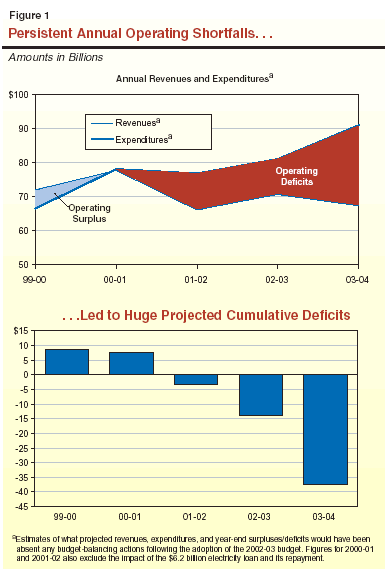
The figure also shows that the operating shortfall would have more
than doubled to $23 billion in 2003-04, had no further budget-balancing
actions been taken following the adoption of the 2002-03 budget. This
projected deterioration was primarily related to the fact that many of
the budget solutions adopted in 2001-02 and 2002-03 were one-time or
limited-term in nature. Examples include the deferral of debt-service
payments, borrowings from special transportation funds, and
securitization of tobacco settlement receipts. The expiration of savings from these
actions alone would have created a large shortfall in 2003-04 under
even favorable economic circumstances. As it turned out, however,
persistent weakness in the economy only served to aggravate the budgetary
imbalance facing policymakers in 2003-04.
Cumulative Budget Shortfalls Resulted. The successive years of annual operating shortfalls resulted in a major projected cumulative budget gap by the close of 2003-04. Absent any corrective actions after the 2002-03 budget was enacted in September 2002, the cumulative shortfall would have grown from $3.5 billion in 2001-02 to $14 billion in 2002-03, and to $38 billion in 2003-04.
The adopted 2003-04 budget package addresses the projected cumulative shortfall through a variety of actions, which are summarized in Figure 2. These include:
|
Figure 2 Major Actions Taken to
Close 2003-04 |
||||
|
(In Billions) |
||||
|
|
|
2002-03 |
2003-04 |
Two-Year
Total |
|
Loans/Borrowing: |
|
|
|
|
|
Deficit
financing bond |
$10.7 |
� |
$10.7 |
|
|
Pension
obligation bonda |
� |
$1.9 |
1.9 |
|
|
Other |
0.1 |
3.6 |
3.7 |
|
|
Subtotals |
($10.8) |
($5.5) |
($16.3) |
|
|
Program Savings |
$0.9 |
$8.3 |
$9.2 |
|
|
New/Accelerated Revenues: |
|
|
|
|
|
Tobacco
bondb |
� |
$2.0 |
$2.0 |
|
|
Other |
$0.3 |
2.2 |
2.5 |
|
|
Subtotals |
($0.3) |
($4.2) |
($4.5) |
|
|
Shifts to Other Funds |
|
|
|
|
|
New
federal funds |
$0.3 |
$1.8 |
$2.2 |
|
|
Other |
0.7 |
1.2 |
1.9 |
|
|
Subtotals |
($1.0) |
($3.1) |
($4.1) |
|
|
VLF Tax Increase |
� |
$3.4 |
$3.4 |
|
|
Deferrals |
$1.1 |
$1.0 |
$2.0 |
|
|
Totals |
$14.1 |
$25.3 |
$39.4 |
|
|
|
||||
|
a
In September 2003, the state's attempt to obtain court validation
for this bond was unsuccessful in Superior Court. |
||||
|
b
In September 2003, the sale of this bond generated net proceeds
of $2.26 billion, or $260 million more than assumed in the budget. |
||||
|
Detail may not total due to rounding. |
||||
As shown in Figure 2, the sum of these solutions is $39.4 billion, or $1.2 billion more than the administration's $38.2 billion projected budget shortfall. Since the administration's definition of the budget shortfall had already included $1 billion to fund a reserve, the additional $1.2 billion in solutions results in a projected cumulative reserve of $2.2 billion at the close of 2003-04.
Although the 2003-04 budget does include significant amounts of ongoing actions, the majority of savings adopted are one-time or limited-term in nature. Significant one-time or limited-term actions include the $16 billion in borrowing, the $2 billion tobacco securitization bond sale, the $930 million in savings from the Medi-Cal accounting change, and the deferral of $856 million in transportation spending.
Although these actions did help to eliminate the 2003-04 budget
shortfall, their one-time or limited-term nature means that they did not
address
the ongoing mismatch between revenues and expenditures that has
existed since 2001-02. In fact, many of the actions will have the effect
of increasing out-year obligations. For example, the annual
debt-service payments on the deficit financing bond will be about $2.5 billion
beginning in 2004-05, assuming that repayment occurs over a roughly
five-year period as proposed.
The expiration of one-time savings and the added out-year costs for debt service will combine to produce a sizable operating shortfall in 2004-05 of slightly more than $10 billion. Taking into account the projected current-year reserve ($2.2 billion), this means that the cumulative deficit at the close of 2004-05 would be roughly $8 billion, absent further corrective actions.
The state spending plan for 2003-04 authorizes total state expenditures from all funds of $100.9 billion. As indicated in Figure 1, this total includes budgetary spending of $93.5 billion, reflecting $71.1 billion from the General Fund and $22.3 billion from special funds. In addition, spending from selected bond funds totals $7.5 billion. These bond-fund expenditures reflect the use of bond proceeds on capital outlay projects in a given year. The General Fund costs of these outlays, however, involve the associated ongoing principal and interest payments that must be made until the bonds are retired; thus, for budgetary scoring purposes, these costs show up as General Fund debt-service expenditures.
|
Figure 1 The
2003-04 Budget Package |
|||||
|
(Dollars in Millions) |
|||||
|
Fund Type |
Actual |
Estimated |
Enacted |
Change
From 2002-03 |
|
|
Amount |
Percent |
||||
|
General Fund |
$76,752 |
$78,142 |
$71,137 |
-$7,005 |
-9.0% |
|
Special funds |
19,448 |
19,163 |
22,314 |
3,151 |
16.4 |
|
Budget Totals |
$96,200 |
$97,305 |
$93,451 |
-$3,854 |
-4.0% |
|
Selected bond funds |
3,020 |
14,491 |
7,469 |
-7,022 |
-48.5 |
|
Totals |
$99,220 |
$111,795 |
$100,919 |
-$10,876 |
-9.7% |
The amount of 2003-04 budgetary spending compared to 2002-03 represents a net reduction of $3.9 billion (4 percent)—a $7 billion (9 percent) decline for the General Fund, partly offset by a $3.2 billion (16 percent) increase for special funds.
Figure 2 summarizes the estimated General Fund condition for 2002-03 and 2003-04 that results from the adopted spending plan and related legislation.
2002-03. Figure 2 shows that expenditures ($78.1 billion) exceeded revenues and transfers ($70.9 billion) by slightly over $7.2 billion in 2002-03. When combined with a negative carry-in balance of $2 billion and year-end encumbrances of $1.4 billion, this operating shortfall would have produced a cumulative year-end deficit of $10.7 billion at the close of the fiscal year. This deficit, however, was taken "off book" and thus eliminated for budgetary scoring purposes by the issuance of a $10.7 billion deficit financing bond, leaving the year-end reserve at zero.
|
Figure 2 The 2003-04 Budget Package |
|||
|
(Dollars in Millions) |
|||
|
Fund Type |
2002-03 |
2003-04 |
Percent |
|
Prior-year fund balance |
-$1,983 |
$1,402 |
|
|
Revenues and transfers |
70,852 |
73,353 |
3.5% |
|
Deficit Financing Bond |
10,675 |
� |
|
|
Total
resources available |
$79,544 |
$74,755 |
|
|
Expenditures |
78,142 |
71,137 |
-9.0% |
|
Ending fund balance |
$1,402 |
$3,618 |
|
|
Encumbrances |
1,402 |
1,402 |
|
|
Reserve |
� |
$2,216 |
|
2003-04. Figure 2 also shows that revenues in the current year are projected to be $73.4 billion, or $2.2 billion more than the expenditure total of $71.1 billion. This results in a planned reserve of $2.2 billion, which is equivalent to slightly over 3 percent of General Fund spending during the year.
Most areas of General Fund spending are declining markedly in 2003-04. As shown in Figure 3, spending for K-12 education is down 0.5 percent, spending for health is down 1.5 percent, and the higher education segments will experience declines ranging from 8 percent to 17 percent.
|
Figure 3 The 2003-04 Budget Package |
|||||
|
(Dollars in Millions) |
|||||
|
Fund Type |
Actual |
Estimated
2002-03 |
Enacted
2003-04 |
Change
From |
|
|
Amount |
Percent |
||||
|
K-12 Education |
$29,923 |
$29,469 |
$29,317 |
-$152 |
-0.5% |
|
Higher Education |
|
|
|
|
|
|
CCC |
2,851 |
2,891 |
2,403 |
-488 |
-16.9 |
|
UC |
3,371 |
3,191 |
2,928 |
-263 |
-8.2 |
|
CSU |
2,687 |
2,707 |
2,492 |
-215 |
-7.9 |
|
Other |
736 |
755 |
856 |
101 |
13.3 |
|
Health |
13,530 |
14,266 |
14,049 |
-217 |
-1.5 |
|
Social Services |
8,290 |
8,860 |
9,033 |
172 |
1.9 |
|
Criminal Justice |
7,867 |
7,868 |
6,668 |
-1,201 |
-15.3 |
|
VLF offset |
3,558 |
4,014 |
� |
-4,014 |
� |
|
All other |
3,938 |
4,120 |
3,391 |
-729 |
-17.7 |
|
Totals |
$76,752 |
$78,142 |
$71,137 |
-$7,005 |
-9.0% |
Regarding these decreases, however, it is important to note that while General Fund spending is down sharply, total support for most programs is at or above prior-year levels. For example, the decline in health spending is more than accounted for by the Medi-Cal accounting shift from an accrual basis to a cash basis and the increased federal funds for Medi-Cal. Likewise, the drop in General Fund support for higher education and criminal justice spending is largely offset by higher fees, while the major decline in "all other" spending is related to the issuance of pension bonds in lieu of General Fund contributions to the Public Employees' Retirement System. Absent these special factors, overall program spending in the 2003-04 budget is roughly similar to the prior year's level. Nevertheless, after accounting for caseload, inflation, and other factors affecting costs, 2003-04 spending is well below the level that would support baseline spending requirements (that is, spending levels that would have been required based on laws in effect in 2002-03). Thus, in real terms, the budget has somewhat declined.
In this section, we highlight the major developments in the evolution of the 2003-04 budget, beginning with the Governor's proposed mid-year adjustments in December 2002 and ending in August 2003, when the budget was signed into law.
In our November 2002 report, California's Fiscal Outlook, we estimated that the state faced a cumulative year-end General Fund shortfall of $21 billion in 2003-04. On December 6, the Governor released a list of proposed mid-year adjustments totaling $3.4 billion in 2002-03 and $6.8 billion in 2003-04, and called on the Legislature to enact these savings as an initial step toward addressing the state's enormous budget problem. The majority of these proposed mid-year savings were related to across-the-board cuts to K-14 education programs, the elimination of social services cost-of-living adjustments (COLAs) , and various reductions in Medi-Cal.
In January, the Governor proposed a 2003-04 General Fund budget which incorporated his proposed 2002-03 mid-year savings discussed above, as well as numerous other actions to cover a shortfall that the administration estimated to be $34.6 billion. This plan attempted, over an 18-month period, to both (1) deal with the full magnitude of the budget shortfall and (2) eliminate the ongoing structural imbalance between annual revenues and expenditures (so that a deficit would not automatically re-emerge in 2004-05). The January plan included $5.5 billion in 2002-03 savings as well as $29 billion in 2003-04 savings.
Some of the plan's major features included the following:
In the months following the release of the January budget, the Legislature enacted various savings provisions totaling about $3.3 billion for 2002-03 and $3 billion for 2003-04. These mid-year savings actions—which were about $2.2 billion less in 2002-03 than the $5.5 billion requested by the administration—included many of the reversions, cuts, and funding redirections proposed by the Governor in December. In K-12 education, however, the Legislature replaced the program reductions proposed by the Governor with a deferral of cash payments to school districts from late 2002-03 into early 2003-04, creating one-time savings. The Legislature also rejected administration proposals involving the elimination of VLF backfill payments to localities and the reduction in health care expenditures.
In the May Revision, the administration asserted that the budget
problem had increased from $34 billion to $38 billion, or about $4 billion.
This reflected a number of relatively modest technical adjustments to
projected revenues and expenditures, which together added a net of about
$1 billion to the projected shortfall. In addition, the administration
withdrew
the plan for a second tobacco bond sale (which had been assumed as
part of the 2002-03 budget) in favor of a much larger deficit financing
bond, and reflected this policy change as an increase in the size of the
budget problem. The remaining $1 billion of the budget's deterioration
reflected an increase in Proposition 98 spending.
In the May Revision, the administration's basic approach to solving the budget shortfall shifted dramatically. Instead of attempting to fully solve the budget problem in an 18-month period, the May Revision adopted a multiyear approach that relied much more on borrowing and relatively less on near-term spending reductions than did the January proposal. Specifically, the May Revision made the following major modifications to the January spending plan:
Following about two months of negotiations and unsuccessful votes on several alternative budget proposals, the Senate reached an agreement on a budget plan in late July. The budget bill was passed by the Senate on July 28, and by the Assembly on July 31. It was signed by the Governor on August 2, following a modest number of line-item vetoes.
Key Features of the Budget. The budget that was adopted contains many of the features of the May Revision proposal, but differs from the Governor's proposal in several significant ways. For example:
2004-05 Savings. The budget package includes language stating the Legislature's intent that the administration not include certain funding adjustments in developing the 2004-05 budget. These include funding for: (1) University of California (UC) and California State University (CSU) salary increases not already approved and enrollment growth; (2) discretionary price adjustments to state, UC, and CSU operations; (3) local mandate reimbursements; (4) direct appropriations for capital outlay in excess of $50 million; and (5) Proposition 98 spending in excess of the minimum guarantee. In excluding these items, the Legislature has already "built in" savings from a traditional baseline budget in 2004-05. This is significant because the estimated $8 billion shortfall in 2004-05 already assumes the above spending reductions relative to current-service levels.
More detailed descriptions of the budget's key programmatic features are included in "Chapter 4."
Background. Article XIII B of the State Constitution places limits on the appropriation of taxes for the state and each of its local entities. Certain appropriations, however, such as for capital outlay and subventions to local governments, are specifically exempted from the state's limit. As modified by Proposition 111 in 1990, Article XIII B requires that any revenues in excess of the limit that are received over a two-year period be split evenly between taxpayer rebates and increased school spending.
State's Position Relative to Its Limit. As a result of the sharp decline in revenues over the past two years, the level of state spending is now well below the spending limit. Specifically, based on the revenue and expenditure estimates incorporated in the 2003-04 budget, state appropriations were $16.9 billion below the limit in 2002-03 and are expected to be $13.2 billion below the limit in 2003-04.
In addition to the 2003-04 Budget Act, the budget package includes a number of related measures enacted to implement and carry out the budget's provisions. Figure 4 lists these bills.
|
Figure 4 2003-04 Budget-Related
Legislation |
|||
|
|
|||
|
|
|||
|
Bill
Number |
Chapter |
Author |
Subject |
|
AB 7x |
13x |
Oropeza |
Deficit bond |
|
AB 296 |
757 |
Oropeza |
State and local government |
|
AB 1266 |
573 |
Budget Committee |
Education�various policy provisions |
|
AB 1485 |
773 |
Firebaugh |
Education�Federal Reading First program |
|
AB 1747 |
240 |
Budget Committee |
Omnibus resources bill |
|
AB 1748a |
� |
Budget Committee |
Resources: Proposition 40 and Proposition 50 |
|
AB 1750 |
223 |
Budget Committee |
Transportation: Proposition 42 |
|
AB 1751 |
224 |
Budget Committee |
Transportation: Proposition 42 |
|
AB 1752 |
225 |
Budget Committee |
Omnibus social services bill |
|
AB 1753 |
226 |
Budget Committee |
Habilitation services |
|
AB 1754 |
227 |
Budget Committee |
Omnibus education bill |
|
AB 1756 |
228 |
Budget Committee |
Omnibus general government bill |
|
AB 1757 |
229 |
Budget Committee |
Technology, Trade, and Commerce Agency; OCJPb |
|
AB 1758 |
158 |
Budget Committee |
Corrections |
|
AB 1759 |
159 |
Budget Committee |
Courts |
|
AB 1762 |
230 |
Budget Committee |
Omnibus health bill |
|
AB 1763 |
161 |
Budget Committee |
Proposition 99 |
|
AB 1766 |
162 |
Budget Committee |
Property tax swap |
|
AB 1768 |
231 |
Budget Committee |
Vehicle license fees |
|
SB 857 |
601 |
Speier |
Medi-Cal: providers |
|
SB 1045 |
260 |
Budget Committee |
Redevelopment funds |
|
SB 1049 |
741 |
Budget Committee |
Omnibus resources fee bill |
|
SB 1055 |
719 |
Budget Committee |
Motor Vehicle Account fees |
|
|
|||
|
a
Enacted by the Legislature but vetoed by the Governor. |
|||
|
b
Office of Criminal Justice Planning. |
|||
The Governor and Legislature considered, but did not adopt,
proposals for various tax increases to help address the budget problem. Aside
from the triggered increase in the vehicle license fee, the 2003-04 budget
contains no new taxes. However, it does assume new revenues from
tribal gaming compacts, the securitization of tobacco settlement revenues,
and various loans and transfers from special funds. Also of note is that
the state's manufacturers' investment credit (MIC) will sunset as of
January 1, 2004.
The state has signed compacts with more than 60 Indian tribes related to gaming on tribal lands. Currently, pursuant to these compacts, tribes contribute over $100 million annually to state (non-General Fund) accounts for specified uses. The budget assumes that, as a result of the renegotiation of existing compacts and the signing of new compacts, Indian gaming tribes will contribute an additional $680 million in annual revenues—all accruing to the General Fund.
The Legislature approved three new compacts in 2003—Chapter 790, (SB 411, Ducheny) and Chapter 802, (SB 930, Ducheny)—which have provisions requiring some future payments to the General Fund. To date, the Legislature has not been presented with any renegotiated compacts from existing gaming tribes.
The 2002-03 budget package authorized the sale of bonds backed by the state's future rights to its flow of tobacco settlement revenues (TSRs) over roughly the next 25 years. Under the provision of the 1998 Master Settlement Agreement between certain large tobacco companies and most states, California will receive TSRs annually in perpetuity, including an estimated $10-plus billion over the next 25 years.
The 2002-03 budget package authorized the state to essentially convert this future TSR stream into a one-time, up-front payment of $4.5 billion. In return, those investors who pay the $4.5 billion to the state will be repaid over time, with interest, from the TSRs when they are actually received.
The state sold the first of its two tobacco-backed bonds in February 2003, raising $2.5 billion in net proceeds to the General Fund. In the May Revision to the 2003-04 budget, the Governor canceled a planned second sale, relying instead on a deficit financing bond to cover the 2002-03 budget deficit. However, the second bond sale was reaffirmed in the final 2003-04 budget package, along with a provision that authorized General Fund backing for the debt repayment in addition to the pledged TSRs. This General Fund backing was added to enhance the marketability of the bonds. In September, the Treasurer sold the second tobacco bond, raising net proceeds of $2.262 billion for the General Fund—$262 million more than anticipated in the 2003-04 budget package.
The 2003-04 budget package includes $1.8 billion in transfers and loans from special funds. About $1 billion of this total represents pension fund contributions from special fund-supported agencies that is scheduled to be replaced in 2003-04 by pension obligation bond proceeds. The remaining $800 million is made up of loans and transfers from numerous special funds, including the California Teleconnect Fund, the Beverage Recycling Fund, and the Employment Development Contingent Fund.
Since 1994, qualified manufacturing firms have benefited from the MIC, based on their expenditures for qualified capital equipment. The MIC is available to firms with either corporation tax or personal income tax liabilities. The MIC was originally adopted by the Legislature out of concerns about the health of the state's economy (and, in particular, its severe declines in manufacturing employment).
Under current statute, the MIC is scheduled to sunset in any year in
which the number of California manufacturing jobs (excluding aerospace) at
the start of the previous year does not exceed by 100,000 the number of
such jobs that existed on January 1, 1994. There is no provision in current
statute that would reactivate the MIC in the event that, in subsequent
years, the job threshold is met. In March 2003, the Employment
Development
Department released figures indicating that the state's
manufacturing employment as of January 1, 2003, was less than the January 1, 1994
jobs figure. Accordingly, the MIC is scheduled to sunset effective January 1, 2004.
Although there are currently bills pending in the Legislature to
extend the MIC's sunset date, eliminate its jobs requirement, or ensure the
MIC's continuation through other means, none of this legislation has been
approved. Attempts to incorporate the continuation of the MIC in the
2003-04 budget agreement similarly failed.
The General Fund revenue gain from the MIC's sunset is projected to be $40 million in 2003-04 (a partial-year effect), $195 million in 2004-05, and eventually about $400 million annually.
The budget package includes $45.7 billion in Proposition 98 spending in 2003-04 for K-14 education. This represents an increase of $1.8 billion, or 4 percent, from the revised 2002-03 spending level. By comparison, the package reflects a reduction of around $800 million, or 1.7 percent, from the appropriation level of the 2002-03 Budget Act. Figure 1 summarizes for the two fiscal years the effect of the budget package on K-12 schools, community colleges, and other affected agencies. Between 2002-03 and 2003-04, $1.1 billion of the $1.8 billion growth in Proposition 98 funding is funded by increased local property tax revenues (resulting from a combination of strong local property tax growth and a one-time transfer of property tax revenues from redevelopment agencies to schools).
|
Figure 1 Proposition 98 Budget
Summary |
|||
|
2002‑03 and 2003‑04 |
|||
|
|
2002-03
Budget Package |
2003-04 |
|
|
As
Enacted |
Revised |
||
|
K-12 Proposition 98 |
|
|
|
|
General Fund |
$28.6 |
$26.5 |
$27.6 |
|
Local property taxes |
12.9 |
12.6 |
13.6 |
|
Subtotals,
K-12 |
($41.6) |
($39.2) |
($41.3) |
|
Average Daily Attendance (ADA) |
5,880,576 |
5,911,519 |
5,990,495 |
|
Amount per ADA (in dollars) |
$7,067 |
$6,624 |
$6,887 |
|
California Community
Colleges |
|
|
|
|
General Fund |
$2.8 |
$2.6 |
$2.2 |
|
Local property taxes |
2.0 |
2.0 |
2.1 |
|
Subtotals,
Community Colleges |
($4.8) |
($4.6) |
($4.4) |
|
Other Agencies |
$0.1 |
$0.1 |
$0.1 |
|
Totals,
Proposition 98 |
$46.5 |
$43.9 |
$45.7 |
|
General Fund |
$31.6 |
$29.3 |
$30.0 |
|
Local property taxes |
14.9 |
14.6 |
15.7 |
Spending in 2002-03. Proposition 98 spending for 2002-03 was
reduced by a total of $2.6 billion as a result of actions taken in the First
Extraordinary Session of 2003—Chapter 4x (SB 18x, Chesbro) and Chapter 10x
(SB 28x, Committee on Budget and Fiscal Review)—and Chapter 26,
Statutes of 2003 (SB 1040, Committee on Budget and Fiscal Review).
Because the Proposition 98 reductions lowered the Proposition 98 base for
future years, the Legislature's mid-year actions allowed the state to save a
commensurate amount annually for 2003-04 and beyond.
Figure 2 shows how the Legislature reduced Proposition 98
spending through a combination of funding deferrals ($1.3 billion), K-12
funding reductions ($460 million), funding source shifts ($734 million), and
community college funding reductions ($168 million). Most of the actions
taken were one-time savings, leaving the decisions about ongoing
reductions for the 2003-04 budget discussion. This was especially true for K-12,
for which only a couple hundred million of the $2.5 billion in reductions
were ongoing. In contrast, most of the $168 million community college
reduction was ongoing.
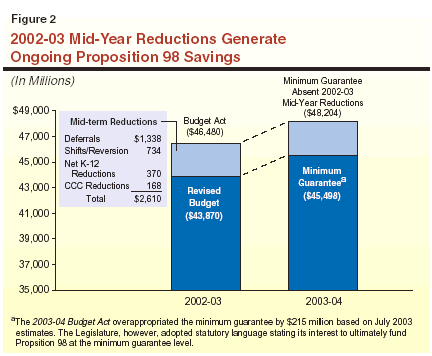
Figure 2 also shows what Proposition 98 spending would have been for 2003-04 if the Legislature had not enacted mid-year 2002-03 reductions. If the 2002-03 Budget Act Proposition 98 funding level had not been reduced, the 2003-04 minimum guarantee would have been $48.2 billion instead of $45.5 billion. Thus, the ongoing impact of the combined reductions taken in 2002-03 resulted in lowering Proposition 98 funding by around $2.7 billion for 2003-04 and beyond. Additionally, Chapter 10x also eliminated a recent requirement in statute that the state fully restore the Proposition 98 "maintenance factor" in 2003-04, which would have cost the state $3.4 billion for K-14 programs above the 2003-04 Budget Act level.
Reductions in 2002-03 left the 2002-03 Proposition 98 spending level slightly below the Proposition 98 minimum guarantee. As a result, the state may owe a slight settle-up obligation depending on the final level of 2002-03 General Fund revenues.
As shown in Figure 1, spending on 2003-04 K-12 Proposition 98 declined by $300 million compared to the 2002-03 Budget Act. This net change consists of increased funding for deferrals, enrollment growth, and increased retirement costs totaling $1.65 billion, offset by numerous funding reductions totaling $1.95 billion.
The revised 2002-03 budget yields a K-12 per-pupil funding level of $6,624. The 2003-04 budget results in per-pupil funding of $6,887, an increase of $263, or 4 percent, above the 2002-03 level. The level of growth in Proposition 98 spending per pupil, however, is distorted because expenses were deferred from one fiscal year to another (discussed in detail below). Figure 3 displays the impact that the deferrals have on the growth of per-pupil spending. Adjusting for the deferrals, per-pupil spending decreased by $36 per pupil, or -0.5 percent, over the 2002-03 level.
|
Figure 3 K-12 Proposition 98
Spending Per Pupil |
|||
|
2001‑02 Through 2003‑04 |
|||
|
|
2001‑02 |
2002‑03 |
2003‑04 |
|
Budgeted Funding |
|
|
|
|
Dollar per ADAa |
$6,608 |
$6,624 |
$6,887 |
|
Percent growth |
� |
0.2% |
4.0% |
|
Programmatic Funding |
|
|
|
|
Dollar per ADA |
$6,768 |
$6,788 |
$6,752 |
|
Percent growth |
� |
0.3% |
-0.5% |
|
|
|||
|
a
Average Daily Attendance. |
|||
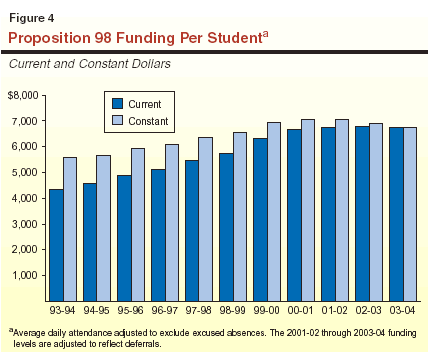
Figure 4 displays K-12 per-pupil funding amounts
from 1993-94 through 2003-04. After adjusting for deferrals, the effects of
inflation, and changes in attendance accounting, per-pupil funding
increased $1,161, or 21 percent, over the period. Most of the growth in
adjusted dollars per pupil occurred in the late 1990s, and adjusted per-pupil
spending has actually fallen $175 per pupil, or 2.5 percent, since 1999-00.
When the Legislature adopted the 2002-03 Budget
Act, it appropriated at the Proposition 98 minimum guarantee level based on a projection
of moderate General Fund revenue growth. When that revenue growth
did not materialize, there was a significant decline in the minimum
guaran
tee. As mentioned above, the Legislature took action in three
separate bills to lower the Proposition 98 spending level to the minimum
guarantee. Figure 5 summarizes the major mid-year 2002-03 K-12 funding
reductions. The figure shows that deferrals and other one-time actions
account for most of the reductions. The only major ongoing K-12
reduction was the elimination of a Proposition 98 reserve created when the
Governor vetoed spending when signing the 2002-03 Budget
Act.
|
Figure 5 Major Mid-Year
2002‑03 K-12 Funding Reductions |
|
|
(In Millions) |
|
|
Purpose |
Amount |
|
Defer principal apportionment |
$1,087 |
|
Proposition 98 Reversion Account swap |
605 |
|
Eliminate Proposition 98 reserve |
132 |
|
Defer state mandated programs |
122 |
|
Reduce one-time instructional materials |
103 |
|
Defer targeted instructional improvement grants |
80 |
|
Child care federal fund swap |
78 |
|
Public School Accountability Act timing adjustment |
76 |
|
Defer staff development buyout |
49 |
The net reduction in K-12 funding in 2003-04 from the 2002-03 Budget Act is approximately $300 million. This net change consists of increased funding for deferrals, enrollment growth, and increased retirement costs totaling $1.65 billion, offset by numerous funding reductions totaling $1.95 billion (see Figure 6).
|
Figure 6 Major K-12 Funding Changes |
|
|
2003‑04 |
|
|
Purpose |
Amount |
|
Net deferrals |
$965 |
|
Revenue limit growth |
504 |
|
PERSa offset reduction |
459 |
|
Revenue limit deficit |
-350 |
|
Instructional materials |
-220 |
|
Public School Accountability Act |
-164 |
|
Child care |
-130 |
|
Deferred maintenance |
-129 |
|
Mandates |
-125 |
|
|
|
|
a Public Employees� Retirement System. |
|
Major funding changes include:
Chapter 227 provides school districts with three budget flexibility
tools to help them mitigate the impact of the proposed funding
reductions. Two of the flexibility tools can be used for whatever purpose local
school
districts determine—including offsetting reductions to their revenue
limit funding resulting from the district's share of the $350 million
revenue limit reduction. Specifically:
Districts Can Access Categorical Ending Balances. Chapter 227 allows school districts to access up to 100 percent of categorical fund reserves for 2003-04 (except capital outlay, sinking funds, federal funds, Targeted Instructional Improvement Grants, Economic Impact Aid, special education, instructional materials, and accountability programs). The measure, however, restricts the use of any redirected categorical reserve funding to backfill a district's share of the $350 million reduction to revenue limits. There is some legal uncertainty about whether a district's use of either of the aforementioned flexibility options (reserves for economic uncertainty and lowered maintenance match requirements) limit a district's ability to redirect categorical reserves.
The budget package expresses legislative intent to guide future Proposition 98 appropriations. First, Chapter 228, Statutes of 2003 (AB 1756, Committee on Budget), states legislative intent not to provide Proposition 98 funding in excess of the minimum guarantee in 2003-04 or 2004-05. Based on current economic forecasts, the Legislature would need to reduce 2003-04 spending by $215 million to meet this goal for 2003-04. Second, Chapter 227 states that the first priority for increases in Proposition 98 funding is to restore approximately $900 million in deficit factor related to COLA and revenue limit reductions. Further, Chapter 227 states the intent of the Legislature to pay off some of the deferrals (discussed below) when the state provides additional Proposition 98 funds to meet maintenance factor requirements.
Because of the state's recent budget problems, the Legislature has opted to defer significant K-14 program costs to subsequent fiscal years rather than make additional spending cuts. The result has been a growing balance on the state's education credit card. The 2003-04 budget package begins to reduce the balances on the education credit card. Figure 7 shows that the state ended 2002-03 with approximately $3 billion of outstanding Proposition 98 liabilities. The 2003-04 budget package reduces these liabilities by $310 million—to $2.7 billion—by the end of 2003-04. The reduction represents the net impact of (1) paying off $810 million in K-12 categorical program deferrals, (2) incurring new liabilities by deferring community colleges payments ($200 million), and (3) not providing funding for reimbursement of additional education mandate costs ($300 million) in 2003-04. Chapter 228 states the intent of the Legislature to defer funding for K-12 mandate reimbursements again in 2004-05.
|
Figure 7 Legislature Reduces
Balance on the |
||
|
(In Millions) |
||
|
|
2002‑03 |
2003‑04 |
|
Deferrals |
|
|
|
Principal apportionment�K-12 |
$1,089 |
$1,089 |
|
K-12 categoricals |
810 |
� |
|
Mandate reimbursements |
860 |
1,160 |
|
California Community Colleges |
� |
200 |
|
Prior Year Settle-Up Obligations |
$250 |
$250 |
|
Totals |
$3,009 |
$2,699 |
The budget provides a total of $10.7 billion in General Fund and
local property tax support for higher education in 2003-04. (This amount
includes a $200 million "loan" for community colleges, discussed in
more detail below.) As shown in Figure 8, this is
$402 million,
or 3.6 percent, less than the amount provided in 2002-03.
|
Figure 8 Higher Education Budget
Summary |
||||
|
(Dollars in Millions) |
||||
|
|
|
Change
From Revised 2002‑03 |
||
|
2003‑04 |
Amount |
Percent |
Percent |
|
|
University of California |
$2,902.1 |
-$247.9 |
-7.9% |
-1.6% |
|
California State University |
$2,492.0 |
-$214.9 |
-7.9% |
-1.7% |
|
California Community Colleges |
$4,576.0 |
-$18.0 |
-0.4% |
1.6% |
|
General Fundb |
(2,470.5) |
(-150.8) |
(-5.8) |
� |
|
Property taxes |
(2,105.5) |
(132.8) |
(6.7) |
� |
|
Student Aid Commission |
$682.9 |
$81.7 |
13.6% |
� |
|
California
Postsecondary |
$2.2 |
$0.1 |
4.6% |
� |
|
Hastings College of the Law |
$11.4 |
-$3.0 |
-21.1% |
4.4% |
|
Totals, Higher Education |
$10,666.7 |
-$402.1 |
-3.6% |
0.5% |
|
|
||||
|
a
Reflects percent change after reductions are partially backfilled
with new fee revenue. Does not include fee revenue which UC and CSU
divert to campus-based financial aid. |
||||
|
b Adjusted to reflect costs that are "deferred" to later fiscal years. |
||||
All three segments of higher education imposed student fee increases for 2003-04. Figure 9 shows the change in resident undergraduate fees from 2002-03 to 2003-04. As the figure shows, the University of California (UC) and the California State University (CSU) increased their student fees by 30 percent, whereas the California Community Colleges (CCC) increased their student fees by 64 percent. The higher fees will provide additional revenue to partially backfill General Fund reductions. When this new fee revenue is counted, total higher education funding actually increases by $58 million, or 0.5 percent, from the revised 2002-03 level. We note that this reflects the net year-over-year change in higher education funding, which involves funding increases in some areas (such as enrollment) and decreases in others (such as outreach). Below, we discuss major augmentations and reductions in the budget for higher education.
|
Figure 9 Resident Undergraduate
Fees |
||||
|
(Mandatory Systemwide Fees for Full-Time Students) |
||||
|
|
|
|
Change From 2002-03a |
|
|
2002‑03a |
2003‑04 |
Amount |
Percent |
|
|
UC |
$3,834 |
$4,984 |
$1,150 |
30% |
|
CSU |
1,572 |
2,046 |
474 |
30 |
|
CCC |
330 |
540 |
210 |
64 |
|
|
||||
|
a Reflects full-year impact of mid-year fee increase. |
||||
The 2003-04 budget includes no funding for cost-of-living increases at any of the higher education segments. The budget does include funding to increase enrollment for the entire public higher education system by 2.8 percent. However, related legislation expresses the Legislature's intent to fund neither enrollment growth nor cost-of-living increases in 2004-05.
The budget provides $2.9 billion in General Fund support for UC in 2003-04. This is $248 million, or 7.9 percent, less than was provided in the prior year. However, most of this amount ($196 million) will be backfilled by increased student fee revenue, for a net reduction of $52 million, or 1.6 percent.
This net reduction results from both augmentations and reductions. Major General Fund augmentations include:
Major General Fund reductions include:
In addition to these formal budget actions, the budget also assumes that UC's institutional financial aid programs will receive a total of $352 million. This is $125 million, or 55 percent, more than provided under the 2002-03 Budget Act. The augmentation is a result of UC's decision to set aside for institutional aid one-third of all additional student fee revenue it expects to collect in 2003-04. The UC has full discretion in allocating these aid monies. It indicates that these monies will be used to assist students with family incomes of up to $90,000.
The budget provides $2.5 billion in General Fund support for CSU in 2003-04. This is $215 million, or 7.9 percent, less than was provided in the prior year. However, most of this reduction ($169 million) is offset by increased student fee revenue, for a net reduction of $46 million, or 1.7 percent, from the prior year.
This net reduction results from both augmentations and reductions. The budget provides CSU with a $151 million augmentation to serve 22,881 additional FTE students (a 7.1 percent increase). This augmentation was proposed by the Governor in January, and supported by the Legislature in the enacted budget. However, CSU has indicated that it intends to increase funded enrollment by only 4.3 percent. This is because CSU plans to use some enrollment growth funding to help "backfill" unallocated reductions in its budget.
Major General Fund reductions include:
In addition to these formal budget actions, the budget also assumes CSU's institutional financial aid programs will receive a total of $208 million in 2003-04. This is $86 million, or 70 percent, more than provided under the 2002-03 Budget Act. The augmentation is a result of CSU's decision to set aside for institutional aid one-third of all additional student fee revenue it expects to collect in 2003-04. The CSU has full discretion in allocating these institutional aid monies.
The budget appropriates $2.3 billion in General Fund support for CCC in 2003-04. In addition, the budget also provides $200 million in General Fund support in 2003-04 loaned from the next fiscal year. When other fund sources, including student fees and property taxes are considered, CCC's total funding increases about 1.6 percent from 2002-03 to 2003-04. As noted in the section on Proposition 98, CCC's 2002-03 Proposition 98 funding was reduced by $168 million as part of the mid-year budget actions.
Major features of CCC's budget include:
In addition, the 2003-04 budget package makes the following changes affecting CCC's budget:
The budget provides $683 million in General Fund support for SAC. This is $82 million, or 14 percent, more than 2002-03 expenditures. Of the total appropriation, $652 million is for Cal Grant programs; $30 million is for the Assumption Program of Loans for Education; and the remainder is for three very small, specialized financial aid programs. The budget raises Cal Grant awards for UC and CSU students to cover anticipated fee increases and maintains all other award amounts at their 2002-03 levels.
The budget includes General Fund support of $1.9 million for CPEC. This is $237,000, or 11 percent, less than the 2002-03 revised budget. It is $1.7 million, or 48 percent, less than actual 2001-02 expenditures. Although the Governor's May Revision proposed to consolidate CPEC with SAC, the Legislature rejected this proposal, leaving CPEC as a separate state agency. However, pending legislation (AB 655, Liu) would merge CPEC, SAC, and possibly other state agencies.
The 2003-04 budget plan provides $14.8 billion from the General Fund (including capital outlay spending) for health services, an increase of about $414 million or 2.8 percent above the revised level of spending for the prior fiscal year. When the General Fund amounts are reduced primarily to reflect receipt of federal fiscal relief funds, health program expenditures for 2003-04 drop below those for 2002-03 by about $200 million. Several significant aspects of the budget package are discussed below.
Figure 10 summarizes the changes in expenditures between 2002-03 and 2003-04 for major health programs. (The 2002-03 budget totals shown for Medi-Cal, the Department of Developmental Services (DDS), and the Department of Alcohol and Drug Programs (DADP) have been modified for purposes of comparison with 2003-04 figures to exclude one-time federal fiscal relief funds received by the state.) Figure 11 provides a summary of some of the most significant actions adopted in the budget plan to address the state's fiscal difficulties.
|
Figure 10 Health Services Programs |
||||
|
(Dollars in Millions) |
||||
|
|
|
|
Change |
|
|
|
2002‑03 |
2003‑04 |
Amount |
Percent |
|
Medi-Cal (local assistance only)a |
$10,885 |
$10,522 |
-$363 |
-3.3% |
|
Department of Developmental Servicesa |
1,900 |
2,113 |
213 |
11.3 |
|
Department of Mental Health |
846 |
872 |
26 |
3.1 |
|
Healthy Families Program |
26 |
294 |
268 |
1,030.8 |
|
Department of Alcohol and Drug |
238 |
235 |
-3 |
-1.3 |
|
Emergency Medical Services Authority |
28 |
11 |
-17 |
-60.7 |
|
All other health services |
683 |
706 |
23 |
3.4 |
|
Subtotals |
($14,606) |
($14,354) |
($414) |
(2.8%) |
|
Less miscellaneous adjustmentsb |
-$340 |
-$704 |
-$364 |
107.1% |
|
Totals |
$14,266 |
$14,049 |
-$217 |
-1.5% |
|
|
||||
|
a Program amounts for 2002-03 do not reflect impact of federal fiscal relief. |
||||
|
b Total for 2002-03 is federal fiscal relief only. Total for 2003-04 includes federal fiscal relief and several other adjustments. Federal fiscal relief over 2002‑03 and 2003‑04 for the DHS portion of the Medi-Cal budget totals $891 million. |
||||
|
Figure 11 Major General Fund
Reductions in State Health Programs |
||
|
(In Millions) |
||
|
|
Change
From |
|
|
Medi-Cal |
|
|
|
Shift accounting method from accrual to cash basis |
$930 |
|
|
Federal fiscal relief from change in cost-sharing (two-year total) |
891 |
|
|
Assume savings from ensuring timely annual redeterminations |
194 |
|
|
Reduce selected provider rates by 5 percent |
115 |
|
|
Enact various reductions in dental benefits |
50 |
|
|
Impose quality assurance fee on managed care plans |
38 |
|
|
Increase effort to collect outstanding pharmaceutical rebates |
35 |
|
|
Require semiannual status reporting for adults |
21 |
|
|
Increase antifraud efforts |
20 |
|
|
Impose quality improvement fee for intermediate care nursing beds |
15 |
|
|
Public Health Programs |
|
|
|
Discontinue allocations for trauma care centers |
$20 |
|
|
Reduce prostate cancer treatment program |
15 |
|
|
Reduce DHS cancer research grant program |
9 |
|
|
Assume savings from an anticipated increase in drug rebates |
9 |
|
|
Department of Developmental Services |
|
|
|
Freeze rates paid to certain community service providers |
$26 |
|
|
Adjust caseload ratios for service coordinators |
14 |
|
|
Reduce purchase of services funds |
10 |
|
|
Department of Mental Health |
|
|
|
Reduce mental health managed care by 5 percent |
$12 |
|
|
Reduce Early Mental Health Initiative grants |
5 |
|
|
Department of Alcohol and Drug Programs |
|
|
|
Reduce discretionary allocations to counties |
$12 |
|
The 2003-04 enacted budget provides about $10.5 billion from the General Fund ($28.7 billion all funds) for Medi-Cal local assistance expenditures (medical services and county administrative costs). Under the plan, General Fund spending for Medi-Cal local assistance decreases by about $363 million or 3.3 percent.
The budget reflects both increases in Medi-Cal expenditures for various purposes and expenditure reductions. The overall net decrease in Medi-Cal spending is due primarily to the inclusion in the spending plan of a program accounting change (discussed further below) that reduces program costs on a one-time basis by $930 million. Were it not for this budget change, the Medi-Cal budget would have grown by more than $570 million or about 5.2 percent compared to the revised level of spending in the prior year.
Governor's Major Budget Reductions Rejected or Modified. The budget plan adopted by the Legislature rejected or significantly modified a number of the Governor's proposals for major reductions in Medi-Cal eligibility, provider rates, and optional services for beneficiaries. For example, proposals to scale back the past expansion of coverage for adults in working poor families and for the aged and disabled were not included in the final spending plan. A proposal to drop selected optional services for beneficiaries, such as durable medical equipment, was rejected, although dental benefits were reduced, but not eliminated through cost-containment actions.
The budget imposes a 5 percent rate reduction primarily for physicians, pharmacies, and managed care plans effective January 1, 2004 that would achieve General Fund savings of about $115 million in 2003-04 and $245 million in 2004-05. In effect, the action modifies and narrows an administration proposal that originally called for a 15 percent reduction in rates that would also have affected nursing homes. Under the final budget plan, nursing homes will receive some modest rate increases in 2003-04 rather than rate reductions. Hospitals, certain community clinics, and some other specific services also are excluded from the 5 percent provider rate reduction. Except for these exclusions, managed care plans are also subject to the provider rate reductions.
Accounting Shift. The budget plan achieves one-time savings of $930 million in 2003-04 by shifting the budgeting for Medi-Cal benefits from an accrual to a cash basis of accounting. This means that funding would no longer be appropriated to pay for services based upon the date when a medical service was rendered, but according to when the bill for a medical service was paid. The state in effect shifted expenditures for some services that would otherwise have been paid for out of the 2003-04 budget appropriation into the budget for the following fiscal year.
Change in Federal Share of Costs. The Department of Health Services' (DHS) portion of the Medi-Cal budget reflects the receipt by the state of about $890 million in additional federal funds over the 2002-03 and 2003-04 state fiscal years from a temporary increase in the federal share of support for the program. This increase in federal funds allowed an offsetting reduction in the General Fund budget for Medi-Cal.
Quality Improvement Fees. The budget plan proposes to increase payments to Medi-Cal managed care plans under a new financial mechanism by which the plans would be charged a "quality improvement fee" that would enable the state to draw down additional federal Medicaid matching funds. Most of the additional funds generated in this way were to have been passed through to the health plans with some of the additional federal funds gained through this mechanism retained by the state General Fund to help achieve an estimated net savings of $38 million in the Medi-Cal Program. In September, we were advised by DHS that the proposal was being withdrawn because it was unlikely to receive federal approval.
A similar fee mechanism, termed a "quality assurance fee," was adopted in the budget plan to provide some additional funds to certain nursing homes that receive reimbursement under the Medi-Cal Program and specialize in providing an intermediate level of care for persons with developmental disabilities. The budget plan assumes this change will generate net savings to the state General Fund of about $15 million. This proposal was expected to receive federal approval.
Tighter Eligibility Procedures. The spending plan also assumes $194 million in General Fund savings from reduced caseloads by ensuring that county workers complete redeterminations of Medi-Cal eligibility in a more timely manner. In addition, the budget plan assumes about $21 million in savings due to the enactment of a semiannual reporting process to verify Medi-Cal eligibility of adult beneficiaries. This action was in lieu of an administration proposal to reestablish quarterly status reporting for these beneficiaries.
Increased Antifraud Efforts. The budget plan scaled back an
administration proposal to add 315 positions to increase departmental staffing
for various expanded antifraud efforts. The revised approach approved
161.5 positions and focused generally on those activities that are anticipated
to
produce the highest initial savings to the General Fund.
These activities include expanding and strengthening the enrollment process for Medi-Cal providers, new procedures to more carefully screen provider claims before checks are issued to them, and more timely replacement of identification cards provided to Medi-Cal beneficiaries. In addition, a strategic plan based on statistically valid data is to be developed to determine the most effective and efficient areas to target with additional antifraud resources.
Drug and Medical Supply Cost Containment. The Legislature agreed to a number of other specific proposals proposed by the administration to slow the growth in the cost of Medi-Cal benefits through changes in the way it purchases drugs and other medical items. In accordance with the budget plan, changes are to be made in the way the state purchases antihemophiliac blood factors, durable medical equipment, hearing aids and accessories, pharmaceuticals, and laboratory services.
To help curb fast-rising drug costs, the budget plan provides for increased efforts to collect outstanding rebates on drug purchases owed to the state and to accelerate efforts to conduct special reviews of certain categories of drugs to see which ones are most clinically effective as well as cost-effective. Also, DHS was authorized to impose limits on the number of laboratory tests that could be claimed by a provider without obtaining prior authorization from the state.
Disease Management. The budget plan includes $374,000 (all funds) to begin a disease management program to improve patient outcomes and quality of life, and reduce costs for some Medi-Cal enrollees. While the budget plan does not assume savings from start-up of this activity in the budget year, it is expected to result in significant state savings in future years.
Further Savings in 2004-05. The budget plan includes several measures intended to slow the growth of Medi-Cal next year. Cost-of-living increases for nursing homes would be suspended in order to save an estimated $64 million and rates paid for inpatient hospital care would be limited to save an additional $70 million during 2004-05.
AIDS Drug Assistance Program
(ADAP). The budget plan does not include a proposal offered by the administration to increase
copayments
for some participants in ADAP, which assists individuals with HIV
to obtain prescription drugs. The budget plan assumes about $9 million
in program savings will be realized through an increase in state rebates
on the purchase of pharmaceuticals.
Emergency Services. The spending plan does not include an administration proposal to consolidate the Emergency Medical Services Authority within DHS. It does accept an administration proposal not to continue support allocations to trauma care centers, for a General Fund savings of $20 million.
Cancer Programs. The budget plan modifies an administration proposal to eliminate the remaining $12.5 million for a cancer research program by instead reducing the annual funding level by about $9 million. The budget plan also reduces a $20 million per-year treatment program for individuals with prostate cancer by $15 million.
The budget plan provides about $294 million from the General Fund ($954 million all funds) for local assistance under the Healthy Families Program during 2003-04. This reflects an overall increase of about $258 million (all funds) or 37 percent in annual spending for the program. General Fund spending for Healthy Families local assistance would increase by about $268 million. This reflects an assumption in the budget plan that all remaining tobacco settlement revenues received by the state would be securitized during 2003-04 and thus would no longer be available specifically for support of the program.
In addition to caseload growth, the budget plan anticipates an additional $154 million in county and federal funds to implement a new program to support local health insurance initiatives for children. The budget plan also reflects a decision of the Legislature to continue funding for the Rural Health Demonstration Project program through a redirection of funding available under Proposition 99, a 1988 measure increasing cigarette taxes to fund various health and resources programs.
Finally, the budget plan assumes that the rates paid to health plans would be limited to achieve about $9.6 million in savings in 2004-05.
The budget provides $2.1 billion from the General Fund ($3.4 billion all funds) for services to individuals with developmental disabilities in developmental centers and Regional Centers (including capital outlay spending). Under the spending plan, General Fund support for DDS would increase by about $213 million, or 11 percent, over the revised prior-year level of spending.
Community Programs. The 2003-04 budget includes a total of $1.7 billion from the General Fund ($2.6 billion all funds) for community services for persons with developmental disabilities, an increase in General Fund resources of about $200 million over the prior fiscal year.
In enacting this budget plan, the Legislature rejected an administration proposal to save about $100 million in 2003-04 by establishing statewide standards for the purchase of services, but did adopt various substitute cost-containment actions. These actions included limiting the rates paid to certain providers (for estimated General Fund savings of about $26 million), adjusting caseload ratios for service coordinators (about $14 million General Fund savings), and an unallocated reduction to purchases of services by Regional Centers (for assumed General Fund savings of $10 million).
The budget plan includes the development of a financing system requiring copayments by some families of children with developmental disabilities. The copayments would be implemented beginning in 2004-05. An administration proposal to shift habilitation services from the Department of Rehabilitation to DDS' Regional Centers was adopted but modified to delay the change until 2004-05.
Developmental Centers. The budget provides a total of about $377 million from the General Fund for operation of the developmental centers (almost $700 million all funds excluding capital outlay), an increase in General Fund resources of about $14 million over the prior fiscal year. Most of the spending increase relates to the imposition of the quality assurance fee for intermediate care nursing beds (one of the Medi-Cal Program changes discussed above). The Legislature also accepted an administration proposal to initiate the closure of the Agnews Developmental Center.
The budget provides about $872 million from the General Fund
($2.3 billion all funds) for mental health services provided in state hospitals
and in various community programs. This amounts to about a $26 million,
or
3.1 percent, increase in General Fund support over the revised
prior-year level of spending for mental health programs.
Community Programs. The 2003-04 budget includes about $320 million from the General Fund ($1.5 billion all funds) for local assistance for the mentally ill, about a 1.7 percent decrease in General Fund support compared to the revised prior-year level of spending.
The budget provides a $60 million increase in expenditures for mental health services for children under the Early and Periodic Screening, Diagnosis and Treatment program. The Legislature approved about a $12 million reduction in funding for mental health managed care plans and reduced the Early Mental Health Initiative by $5 million—in both cases approving lesser cuts than those initially proposed by the administration. The Legislature also shifted $69 million in costs for a state-mandated program for local mental health services for special education students to federal special education funding.
State Hospitals. The budget provides a total of about $500 million from the General Fund for state hospital operations (about $640 million all funds). The $28 million, or 6 percent, increase in General Fund resources was due primarily to adjustments for growth in caseload and operating expenses.
The budget provides about $235 million from the General Fund ($586 million all funds) for drug and alcohol treatment programs, about the same amount as the revised level of expenditures estimated for the prior fiscal year. This budget total includes $120 million appropriated under Proposition 36, a voter-approved initiative that expanded treatment programs for offenders convicted of a nonviolent drug possession offense. The budget plan includes an administration proposal for an approximate $12 million reduction in General Fund support for discretionary county allocations for treatment programs. The spending plan also reflects the enactment of a legislative proposal to restructure and expand drug courts, partly with an augmentation to DADP of $2.3 million, in order to achieve an estimated $9.6 million in savings on state prison operations.
The 2003-04 budget increases General Fund support for social services programs by $461 million (5.2 percent) to a total of $9.4 billion (excluding one-time federal fiscal relief funds). After adjusting for the receipt of the federal fiscal relief funds, expenditures for social services increased by $172 million (1.9 percent) in 2003-04, as shown in Figure 12.
|
Figure 12 Social Services Programs |
||||
|
(Dollars in Millions) |
||||
|
|
2002-03 |
2003-04 |
Amount |
Percent |
|
SSI/SSP |
$3,031 |
$3,380 |
$349 |
11.5% |
|
CalWORKs |
2,107 |
2,070 |
-37 |
-1.7 |
|
IHSS |
1,122 |
1,269 |
147 |
13.1 |
|
Children's Services/Foster Care/Adoptions Assistance |
1,352 |
1,377 |
25 |
1.9 |
|
Department of Child Support Services |
462 |
469 |
7 |
1.5 |
|
County administration/automation |
415 |
423 |
8 |
2.0 |
|
Other social services programs |
410 |
371 |
-39 |
-9.5 |
|
Subtotals |
($8,898) |
($9,359) |
($461) |
(5.2%) |
|
Federal fiscal relief fundsa |
-$38 |
-$326 |
-$289 |
762.1% |
|
Totals |
$8,860 |
$9,033 |
$172 |
1.9% |
|
|
||||
|
a Includes FMAP relief of $14.7 million in 2002-03 and $50.2 million in 2003-04 in IHSS. Also includes additional general federal fiscal relief of $23.2 million in 2002-03 for the June 2003 SSI/SSP COLA, $61.4 million in 2003-04 for IHSS, and $214.9 million for SSI/SSP. |
||||
Figure 12 summarizes the changes in General Fund spending by major program. In brief, substantial increases in Supplemental Security Income/State Supplementary Program (SSI/SSP) ($349 million) and In-Home Supportive Services (IHSS) ($147 million) were partially offset by reductions in California Work Opportunity and Responsibility to Kids (CalWORKs) (-$37 million) and other social services expenditures (-$39 million). Although underlying expenditure growth in social services was $461 million, spending would have increased by an additional $275 million had the Legislature not made significant reductions, reforms, and cost shifts in comparison to previous statutory requirements. Figure 13 lists the $275 million in net program reductions.
|
Figure 13 Major Changes�Social
Services Programs |
|
|
(In Millions) |
|
|
Department/Program |
Change
From |
|
Department of Social Services (DSS)�SSI/SSP |
|
|
Suspends January 2004 COLA |
-$104.0 |
|
DSS�CalWORKs |
|
|
Replaces General Fund with Employment Training Funds |
-$26.4 |
|
No COLA due to elimination of vehicle license fee relief |
� |
|
Redirects TANF funds to Child Welfare Services |
-11.0 |
|
DSS�Licensing |
|
|
Increases licensing fees (revenues) |
-$10.2 |
|
Reduces licensing inspection visits |
-5.3 |
|
DSS�Food Stamps |
|
|
Provides transitional Food Stamps benefits |
$1.6 |
|
Department of Child Support Services |
|
|
Allocates 25 percent of automation penalty to counties |
-$52.1 |
|
Adopts various reforms to increase collections and incentives |
-42.3 |
|
Increases funding to establish medical support orders (net savings) |
-5.2 |
|
Department of Rehabilitation |
|
|
Deletes statutory provider rate adjustment |
-$9.7 |
|
Reduces provider rates in Work Activity and Supported Employment Programs |
-4.2 |
|
Department of Community Services and Development |
|
|
Eliminates Naturalization Services Program |
-$2.9 |
|
Eliminates Mentoring Program |
-1.0 |
|
Department of Aging |
|
|
Reduces funding for Senior Companion Program |
-$1.5 |
|
Eliminates funding for Foster Grandparent Program |
-1.1 |
The adopted budget includes $3.4 billion from the General Fund for the program, which is an increase of almost 12 percent.
Grant Payments. The overall increase in SSI/SSP expenditures is mostly attributable to the June 2003 COLA, resulting in General Fund costs of $281 million in 2003-04. The budget suspends the January 2004 state COLA for a savings of $104 million in 2003-04 and full-year savings of $213 million in 2004-05. The budget does pass along the federal COLA which is applied only to the federal SSI portion of the grant. Figure 14 shows that the June 2003 COLA increased the maximum grant for an individual by $21 (2.8 percent); the federal COLA in January 2004 will increase grants by another $12 (1.5 percent). Figure 14 also shows similar percentage increases in the maximum monthly grant for couples receiving SSI/SSP.
|
Figure 14 SSI/SSP Grant Levels |
|||
|
(Maximum Monthly Grants) |
|||
|
|
2003 |
2004 |
|
|
January |
Junea |
January |
|
|
Individuals |
|
|
|
|
SSI |
$552 |
$552 |
$564 |
|
SSP |
205 |
226 |
226 |
|
Totals |
$757 |
$778 |
$790 |
|
|
|
|
|
|
Couples |
|
|
|
|
SSI |
$829 |
$829 |
$846 |
|
SSP |
515 |
553 |
553 |
|
Totals |
$1,344 |
$1,382 |
$1,399 |
|
|
|||
|
a
June COLA will be implemented in October 2003, but payments will
be retroactive to June 2003. |
|||
The budget includes $2.1 billion from the General Fund in the Department of Social Services (DSS) budget for the CalWORKs program in 2003-04, which is a decrease of about 1.7 percent compared to the prior year.
June and October 2003 COLAs. The budget provides funding for the June 2003 COLA, resulting in combined General Fund/Temporary Assistance for Needy Families (TANF) costs of $126 million in 2003-04. Pursuant to current law, the October 2003 COLA is contingent upon continuation of vehicle license fee relief. Because this fee relief has been eliminated, there is no October COLA (which would have cost $91 million in TANF funds in 2003-04 and resulted in General Fund costs of $121 million in 2004-05).
The June 2003 COLA raised the maximum grant for a family of three in high-cost counties by $25 to a total of $704. In low-cost counties, the maximum grant increased by $24 to a total of $671.
Other Changes Result in Savings. Budget legislation increases the appropriation from the Employment Training Fund for support of the CalWORKs program from $30 million in 2002-03 to $56.4 million in 2003-04. This transfer results in General Fund savings of $26.4 million in CalWORKs compared to the prior year, with a corresponding reduction in funds available for Employment Training Panel programs. Finally, the budget shifts $11 million in TANF funds to offset General Fund costs in Child Welfare Services.
The budget increases General Fund support for the IHSS program by $147 million (13 percent) to a total of almost $1.3 billion. The spending growth is attributable to increases in caseload and workload ($81 million) and the full-year costs associated with provider wage increases which were granted by counties during the 2002-03 fiscal year ($47 million). Because revenue growth in 2003-04 was less than 5 percent, there is no "triggering" of increased state participation in hourly wages paid to certain providers.
The budget provides a combined total of $1.4 billion from the General Fund for Foster Care, Child Welfare Services, and Adoptions. This is an increase of $25 million (1.9 percent) compared to 2002-03. This increase is the net result of a reduction in Foster Care due to continuing caseload declines and increases in Adoptions Assistance and Child Welfare Services.
Inflation Adjustments. Due to the continuing weakness in the General Fund condition, the budget for 2003-04 follows the practice of 2002-03 of not providing a discretionary COLA for Foster Care or the Adoptions Assistance program. The budget also follows the 2002-03 practice of not providing inflationary adjustments to cover county administrative cost increases for Foster Care or Child Welfare Services.
The budget provides a total of $35.3 million from the General Fund for Community Care Licensing. This is a decrease of 28 percent ($9.8 million) compared to 2002-03.
Reduction in Licensing Inspection Visits. With the exception of certain facilities, the budget (1) eliminates the requirement that licensed facilities be visited annually or triennially and (2) generally limits "regular" inspections to a random sample of 10 percent of all licensed facilities. The reduction in annual visits results in a $5.3 million General Fund savings.
Fee Increases for Licensing. The budget (1) increases licensing fees for adult and residential facilities by 25 percent, (2) doubles the fees for child care facilities, and (3) establishes a new "per home" fee to be paid by foster family agencies. Community Care Licensing fees have not been increased since 1992. These new fee increases result in additional revenues of $7.4 million.
Suspension of Fee Exemption. The budget suspends for one year the fingerprint fee exemptions for providers working in facilities serving six or less individuals. These providers will now have to pay the one-time cost for fingerprinting ($24 for fingerprint processing and an additional $16 for live scan fingerprint imaging), as do providers working in larger facilities. This suspension results in a General Fund savings of $2.8 million.
The budget includes $469 million in General Fund support for the DCSS, an increase of $7 million (1.5 percent) compared to 2002-03.
Collections Reform Package. The budget includes a series of reforms that result in increased revenues of $42 million. These reforms include reducing the amount of default support orders; establishing a compromise payment program for parents owing back child support; and requiring local child support agencies to verify income and, when necessary, seek appropriate support order modifications. Implementation costs of $2.5 million are more than offset by (1) an estimated $39.2 million increase in revenues from higher collections and (2) an estimated $5.6 million increase in federal performance incentives.
County Share of Federal Automation Penalty. The budget establishes a 25 percent county share of the child support federal automation penalty. Although prior law apportioned automation penalties to counties, the state had absorbed such penalty costs through discretionary annual budget act appropriations. For 2003-04, counties will pay $52.1 million of projected penalty costs resulting in an identical increase in General Fund revenues.
Increased Medical Support Order Enforcements. The budget provides $1 million from the General Fund for DCSS to increase its efforts to establish medical support orders. The projected increase in medical support orders results in estimated Medi-Cal savings of $6.2 million (for a net savings of $5.2 million).
For 2003-04, General Fund support for EDD is $21.6 million, a reduction of $1.3 million (5.9 percent) compared to 2002-03.
Federal Funds Reserved for Automation Improvements. The Job Creation and Worker Assistance Act of 2002 (Public Law 107-147) authorized the distribution of $8 billion in federal Reed Act funds to the states. In April 2002, California received $936.9 million in these funds. Chapter 4xxx, Statutes of 2002 (SB2xxx, Alarcón), set aside $600 million in Reed Act funds for payment of unemployment insurance benefits. Also, Reed Act funds have been used to offset General Fund costs in the job services program and unemployment insurance administration. Budget bill language in Item 7100-001-0871 sets aside $85 million in Reed Act funds for the purpose of (1) redesigning the unemployment insurance continued claims system, (2) improving service levels at the unemployment insurance call centers, and (3) preventing and detecting fraud within the unemployment insurance system. These funds are available for expenditure until June 30, 2007.
The budget eliminates the Naturalization Services Program and the Mentoring Program, both operated by the Department of Community Services and Development, for a combined General Fund savings of $3.9 million. The budget also reduces programs in the Department of Aging by $2.6 million.
The budget package contains $8.9 billion (all funds) for judicial and criminal justice programs, including $7.5 billion from the General Fund. The total amount is a decrease of $326 million, or 3.5 percent, from 2002-03 expenditures. The General Fund total represents a decrease of $348 million, or 4.4 percent, relative to 2002-03 expenditures.
Subsequent to enactment of the budget, the administration notified the Legislature that federal fiscal relief funds were being allocated to reduce General Fund expenditures for the California Department of Corrections (CDC). As a result, overall judicial and criminal justice expenditures decline by $1.2 billion, or 15 percent, between 2002-03 and 2003-04.
Figure 15 shows the changes in expenditures in some of the major judicial and criminal justice budgets. Below, we highlight the major changes in these budgets.
|
Figure 15 Judicial and Criminal
Justice Budget Summary |
||||
|
(Dollars in Millions) |
||||
|
|
|
|
Change |
|
|
Program/Department |
2002-03 |
2003-04 |
Amount |
Percent |
|
Trial Court Funding |
$1,092 |
$1,034 |
-$58 |
-5.3% |
|
Department of Corrections |
5,200 |
5,143 |
-57 |
-1.1 |
|
Department of Youth Authority |
366 |
344 |
-22 |
-6.0 |
|
Citizens� Option for Public Safety |
116 |
100 |
-16 |
-13.8 |
|
Juvenile Justice Grants |
116 |
100 |
-16 |
-13.8 |
|
Other corrections programs |
978 |
799 |
-179 |
-18.3 |
|
Subtotals |
($7,868) |
($7,520) |
(-$348) |
(-4.4%) |
|
Federal fiscal relief funds |
� |
-$852a |
-$852 |
� |
|
Totals |
$7,868 |
$6,668 |
-$1,200 |
-15.3% |
|
|
||||
|
a
This amount of federal funds will be allocated to the Department
of Corrections, thereby reducing General Fund costs by a like amount. |
||||
The budget includes $2.2 billion for support of trial courts. This amount includes $1 billion from the General Fund; $475 million transferred from counties to the state; and $678 million in fine, penalty, and court fee revenues. The General Fund amount is $58 million, or 5.3 percent, lower than 2002-03 expenditures. The overall decrease reflects reduced spending for court operations and increased fees to cover costs that would otherwise accrue to the General Fund. These are discussed below in more detail.
Court Operations Reductions. The budget as enacted includes a reduction of approximately $95 million to the court operations budget. Based on discussions with court budget staff, these reductions will be achieved through a variety of approaches, including hiring freezes, voluntary furloughs, and reduced expenditures for some aspects of court security.
In lieu of the administration's proposal to allow the courts to competitively contract for court security, the Legislature adopted legislation establishing a court security workgroup to develop and implement policies to reduce and contain growth in court security costs. This is projected to result in a savings of $11 million in 2003-04.
New and Increased Court Fees. The budget offsets General Fund spending for the courts by approximately $150 million by enacting a variety of new and increased court fees. (This amount also includes existing fees which will be transferred from the counties to the courts.) Figure 16 shows the prior and new/increased court fees and the projected increased revenues associated with them.
|
Figure 16 New and Increased Court
Fees |
|||
|
|
Fees |
Increased |
|
|
Prior |
New/Increased |
||
|
Trial Court |
|
|
|
|
New Court Security Feea |
� |
$20 |
$40.2 |
|
Undesignated Feesb |
� |
� |
31.0 |
|
New Continuance Fee |
� |
100 |
26.3 |
|
New Complex Case Fee |
� |
500 |
12.3 |
|
New Court Reporter Feec |
� |
25 |
16.3 |
|
Limited Jurisdiction Filing Fee |
$90 |
185 |
11.7 |
|
Graduated Probate Feed |
185 |
185‑3,500 |
7.3 |
|
Small Claims Fee |
35 |
60 |
2.4 |
|
Trial Motion Fee |
23 |
33 |
1.2 |
|
Summary Judgment Motion Fee |
100 |
150 |
0.8 |
|
Judicial |
|
|
|
|
Appellate Filing Fee |
$265 |
$420 |
$1.5 |
|
Transcript Fee |
100 |
270 |
0.4 |
|
Supreme Court Filing Fee |
265 |
420 |
0.3 |
|
Totals |
� |
� |
$151.7 |
|
|
|||
|
a From January 1, 2004 to June 30, 2004, this fee will increase to either $30 or $40 depending on the case type. |
|||
|
b These are existing fees that will be transferred from the counties to the courts. |
|||
|
c
This is a new $25 fee for hearings that are less than one hour.
Currently, courts have a half- and |
|||
|
d
Fee varies depending on the value of the estate. |
|||
State Court Facilities Construction Fund Loan. The State Court Facilities Construction Fund was established to support the costs associated with transferring responsibility for court facilities from the counties to the state, including the cost of maintaining existing court facilities as well as constructing new court facilities. The budget transfers $80 million from the State Court Facilities Construction Fund to the Trial Court Trust Fund, thereby reducing General Fund costs by a like amount. The budget requires repayment to the construction fund no later than January 1, 2006.
The budget contains $5.1 billion from the General Fund for support of CDC, a decrease of $57 million, or 1 percent, below the revised 2002-03 level. This overall reduction reflects spending increases (for inmate population growth, for example) as well as spending decreases.
The Legislature made reductions totaling more than $160 million. Most of this amount—approximately $125 million—would be achieved through administrative policy changes aimed at reducing the inmate population and parolee recidivism. Examples of such policy changes include restructuring the delivery of education programs to maximize the credits that eligible inmates could earn, expanding prerelease planning services for parolees, and implementing community-based sanctions for nonserious and nonviolent parole violators.
Other reductions include $13 million from more efficient delivery of
inmate health care services, $10 million from closure of the Northern
California Women's Facility, $9 million from delaying the opening of the
Delano II prison, and $5 million from delaying the implementation of
500 substance abuse treatment beds.
Federal Funds for Incarceration and Supervision of Undocumented Felons. The budget also assumes that the state will receive $134 million in federal funds to offset the state's costs of supervising undocumented felons in CDC and the Department of the Youth Authority. This is about $50 million more than received in 2002-03. The federal funds are counted as offsets to state expenditures.
The budget provides $344 million from the General Fund for support
of the Youth Authority, a 6 percent reduction in comparison to 2002-03.
The decrease primarily results from a projected decline in the ward
popula
tion. As a result of the shrinking ward population, the Legislature
closed the Karl Holton Youth Correctional Center in Stockton, as well as
the male portion of the Ventura facility for 2003-04 savings of
approximately $3.6 million. The budget also adjusts for inflation the fees that
counties pay to send juveniles to the Youth Authority, which is projected to
result in General Fund savings of $6 million.
Citizens' Option for Public Safety (COPS) Program. The budget includes $100 million to continue the COPS program, a decrease of $16.3 million from the amount provided in 2002-03. The program provides discretionary funding on a per capita basis, for local police departments and sheriffs for front line law enforcement (with a minimum guarantee of $100,000), sheriffs for jail services, and district attorneys for prosecution.
High Technology Crime Programs. The budget eliminated $18.5 million for grants to local law enforcement agencies for technology equipment purchases. However, it continues to provide $10.2 million for the High Technology Theft, Apprehension, and Prosecution program, and $3.3 million for the High Technology Identity Theft program.
War on Methamphetamine. The budget includes $9.5 million for local law enforcement in the Central Valley for antimethamphetamine activities. This is a reduction of $5.5 million from the 2002-03 funding level.
Rural and Small County Law Enforcement Program. The budget eliminated $18.5 million for the Rural and Small County Law Enforcement program, which provided discretionary funds to supplement local law enforcement resources.
Office of Criminal Justice Planning (OCJP). The budget phases-out OCJP by providing the office with funding for the first half of 2003-04 and assigning its programs to other state departments for the second half of 2003-04.
Juvenile Justice Grants. The budget provides $100 million, a reduction of $16.3 million compared to the prior-year level. These funds go to county level juvenile justice coordinating councils to support locally identified needs related to juvenile crime.
The 2003-04 budget provides total expenditures of $6.5 billion from state special funds and federal funds for Caltrans. This is a 4.6 percent reduction in comparison to the 2002-03 expenditure level. The decrease is primarily due to lower anticipated expenditures for transportation capital outlay. The budget provides approximately $5.6 billion for highway transportation expenditures, including $1.6 billion for capital outlay, $1.2 billion for capital outlay support, $1.9 billion for local assistance, and $784 million for highway maintenance. The budget also provides $267 million for Caltrans' mass transportation program and $476 million for the transportation planning program and departmental administration.
The primary state funding source for Caltrans is the State Highway Account (SHA), which will fund $2.4 billion of Caltrans' expenditures in 2003-04. The major sources of revenue into the SHA are state gas taxes and truck weight fees. Several factors, including loans to other funds, increased capital outlay expenditures, and an unexpected decrease in truck weight fee revenues, have combined to drastically reduce the SHA balance in the past few years.
Truck Weight Fee Increases to Achieve Revenue Neutrality. The manner in which truck weight fees are calculated was changed by legislation in 2000. This change was intended to leave SHA weight fee revenue at the same level it would have achieved if no change had been made. However, weight fee revenues after the change were significantly below projections. As part of the 2003-04 budget package, Chapter 719, Statutes of 2003 (SB 1055, Committee on Budget and Fiscal Review), raises weight fees on certain trucks by 20 percent over current levels beginning January 1, 2004. This increase is intended to counteract the previous decrease in weight fee revenue and achieve "revenue neutrality." It is projected to increase weight fee revenue into the SHA by $38 million in 2003-04 and by $78 million in 2004-05. Chapter 719 allows weight fees to increase further, up to 33 percent over current levels, in 2004-05 if total weight fee revenues in 2003-04 are below a specified amount. A 33 percent increase would raise SHA revenues by $125 million in 2004-05.
In addition to funding the state's transportation programs, the 2003-04 budget provides for the use of transportation funds to aid the General Fund condition in a number of ways.
Proposition 42 Partially Suspended; Bulk of Revenue to Be Transferred Later. Under Proposition 42, approved by voters in March 2002, revenue from the sales tax on gasoline that previously went to the General Fund is to be transferred into the Transportation Investment Fund (TIF) for transportation purposes, beginning in 2003-04. Instead, the 2003-04 budget transfers to TIF only a portion of the Proposition 42 revenue—$289 million, and retains the remaining $856 million in the General Fund. This amount will be transferred with interest for transportation purposes by June 30, 2009. Of the $289 million transfer to TIF:
Repayment of Transportation Loans. The 2003-04 budget also provides for the repayment from the General Fund to the SHA of a $173 million loan made in 2001-02. However, the budget defers $500 million in loan repayment from the General Fund to the TCRF that was scheduled for 2003-04. Under current law, this loan will be repaid by June 30, 2006.
Figure 17 summarizes the transportation loans, transfers, and repayments between the General Fund and various transportation funds, including the actions taken in the 2003-04 budget.
|
Figure 17 Transportation
Loans/Transfers and Repaymentsa |
||||||
|
(In Millions) |
||||||
|
|
To
General Fundb |
|
To TCRFc
|
|||
|
Year |
From SHA |
From TCRF |
From TIF |
|
From SHA |
From PTA |
|
2000-01 |
� |
� |
� |
|
$2 |
� |
|
2001-02 |
$173 |
$238 |
� |
|
41 |
$180 |
|
2002-03 |
-173 |
1,145 |
� |
|
534 |
95 |
|
2003-04 |
� |
� |
$856 |
|
-100 |
� |
|
2004-05 |
� |
� |
� |
|
� |
� |
|
2005-06 |
� |
-1,383 |
� |
|
� |
� |
|
2006-07 |
� |
� |
� |
|
-477 |
� |
|
2007-08 |
� |
� |
� |
|
� |
-275 |
|
2008-09 |
� |
� |
-856d |
|
� |
� |
|
|
||||||
|
|
||||||
|
SHA
= State Highway Account; TCRF = Traffic Congestion Relief Fund; |
||||||
|
a
Amounts do not include interest. |
||||||
|
b
Positive numbers are amounts payable to the General Fund,
negative numbers are payable from the General Fund. |
||||||
|
c
Positive numbers are amounts payable to TCRF, negative
numbers are payable from TCRF. |
||||||
|
d
Repayment will be made to the Transportation Deferred Investment
Fund. |
||||||
Public Transportation Account (PTA) "Spillover" Kept in General Fund. The budget retains in the General Fund up to $87 million in spillover revenue that otherwise would accrue to the PTA. Any excess spillover revenue will accrue to the PTA.
The 2003-04 budget provides about $1.2 billion to fund the CHP, about the same level as in 2002-03. Of this amount, Motor Vehicle Account (MVA) support totals about $1.1 billion.
With regard to the DMV, the budget provides $683 million in departmental support, about the same level as in 2002-03. Of this amount, $361 million will come from the MVA.
Budget Increases MVA Fees. In order to address a significant shortfall in the MVA and fund CHP and DMV in 2003-04, the budget increases a number of MVA fees beginning in 2004. Fees to be increased include fees for driver licenses, identification cards, and vehicle registration. The fee increases are projected to generate about $194 million in additional revenue in 2003-04 and $395 million annually thereafter, as shown in Figure 18. Specifically, the fee increases include the following:
|
Figure 18 Motor Vehicle Account
Revenue Increases |
||
|
(In Millions) |
||
|
Program |
2003-04 |
Annual Ongoing |
|
Higher vehicle registration fees |
$136 |
$271 |
|
Higher driver license fees |
33 |
72 |
|
Increased identification card fees for nonseniors |
9 |
19 |
|
Standardized transaction fees |
15 |
31 |
|
Enactment of Business Partner Automation fee |
1 |
2 |
|
Totals |
$194 |
$395 |
The 2003-04 budget provides about $5.5 billion from various fund sources for natural resources and environmental programs administered by the Resources and California Environmental Protection Agencies, respectively. This is a reduction of about $1.5 billion, or 21 percent, when compared to 2002-03 expenditures. This reduction is mainly the result of a decrease of $1.2 billion in bond fund expenditures for park and water projects. In addition, the budget reflects a General Fund reduction of about $457 million. Some of this reduction reflects significant one-time General Fund expenditures in the 2002-03 budget for local flood control and fire suppression, as well as various program reductions in the budget year, which are discussed below. However, not all of the General Fund savings reflect program reductions, as over $175 million of funding has been shifted from the General Fund to other fund sources, namely fee-based special funds and bond funds.
Figures 19 and 20 compare expenditure totals for resources and environmental protection programs in 2002-03 and 2003-04. As the figures show, the largest reductions in these programs are generally in local assistance and capital outlay due to a reduction in available bond funds.
|
Figure 19 Resources Programs:
Expenditures and Funding |
||||
|
2002-03 and 2003-04 |
||||
|
Expenditures |
|
|
Change |
|
|
2002-03 |
2003-04 |
Amount |
Percent |
|
|
State operations |
$2,756.4 |
$2,660.7 |
-$95.7 |
-3.5% |
|
Local assistance |
1,234.6 |
794.8 |
-439.8 |
-35.6 |
|
Capital outlay |
1,403.8 |
734.2 |
-669.6 |
-47.7 |
|
Totals |
$5,394.8 |
$4,189.7 |
-$1,205.1 |
-22.3% |
|
Funding |
|
|
|
|
|
General Fund |
$1,243.4 |
$864.7 |
-$378.7 |
-30.5% |
|
Special funds |
1,207.6 |
1,357.4 |
149.8 |
12.4 |
|
Bond funds |
2,734.4 |
1,783.9 |
-950.5 |
-34.8 |
|
Federal funds |
209.4 |
183.7 |
-25.7 |
-12.3 |
|
Totals |
$5,394.8 |
$4,189.7 |
-$1,205.1 |
-22.3% |
|
Figure 20 Environmental Protection
Programs: |
||||
|
2002-03 and 2003-04 |
||||
|
Expenditures |
|
|
Change |
|
|
2002-03 |
2003-04 |
Amount |
Percent |
|
|
State operations |
$885.3 |
$856.6 |
-$28.7 |
-3.2% |
|
Local assistance |
685.5 |
434.6 |
-250.9 |
-36.6 |
|
Capital outlay |
2.4 |
0.9 |
-1.5 |
-62.5 |
|
Totals |
$1,573.2 |
$1,292.1 |
-$281.1 |
-17.9% |
|
Funding |
|
|
|
|
|
General Fund |
$174.2 |
$97.3 |
-$76.9 |
-44.1% |
|
Special funds |
654.2 |
706.9 |
52.7 |
8.1 |
|
Bond funds |
577.0 |
326.1 |
-250.9 |
-43.5 |
|
Federal funds |
167.8 |
161.8 |
-6.0 |
-3.6 |
|
Totals |
$1,573.2 |
$1,292.1 |
-$281.1 |
-17.9% |
The following sections summarize the major features of the 2003-04 budget for natural resources and environmental protection programs. We also include a summary of energy and telecommunications-related spending highlights, including programs both within and outside the Resources Agency.
Resources and environmental protection programs assisted in the state's overall budget solution through: (1) shifting a number of General Fund costs to fee-based special funds or bond funds, (2) making loans and transfers from special funds to the General Fund, and (3) adopting General Fund program reductions. We discuss each of these components of the budget solution in the sections that follow.
The 2003-04 budget for several resources and environmental protection programs relies more heavily than in previous years on revenues from new fees and increases in existing fees. These new fees and fee increases result in General Fund savings of about $115 million in 2003-04, relative to prior-year expenditures. In addition to these enacted fee changes, the 2003-04 Budget Act assumed other fee changes requiring the enactment of subsequent legislation that did not occur. This includes new fees for timber harvest plan review and pesticide fee increases. As a consequence, the timber harvest review program faces a funding shortfall compared to the level of program expenditures anticipated in the budget act. Similarly, the pesticide regulatory program faces a funding shortfall, but this will likely not arise until 2004-05.
Figure 21 details the General Fund savings resulting from the enacted new fees and increases in existing fees.
|
Figure 21 Resources and
Environmental Protection Fees |
|
|
2003-04 |
|
|
Fees |
General Fund Savings |
|
Fire protection (new fee) |
$50.0 |
|
Water quality (increased fee) |
20.4 |
|
Air quality (increased fee) |
14.4 |
|
Dam safety (increased fee) |
4.7 |
|
Water rights (new fee) |
3.6 |
|
Fishing and hunting (increased fee) |
2.0 |
|
Total |
$115.1 |
Highlights of significant enacted fee changes include the following:
The budget includes a number of funding shifts from the General Fund to Proposition 50 bond funds, totaling about $63 million. These include shifts from the General Fund to Proposition 50 bond funds of about $35 million for the CALFED Bay-Delta Program, $22 million to support the Habitat Conservation Fund, and $6.4 million for the Drought Panel Recommendations Program under the DWR.
The budget includes about $431 million in loans and transfers to the General Fund from various resources-related special funds, as shown in Figure 22.
|
Figure 22 Resources-Related Loans
and Transfers |
|
|
2003-04 |
|
|
Loans to General Fund |
|
|
Various beverage container recycling funds |
$182.3 |
|
Teleconnect Fund |
150.0 |
|
Various integrated waste management accounts |
23.7 |
|
Public Interest Research, Development and
Demonstration Fund |
20.0 |
|
Underground Storage Tank Cleanup Fund |
3.2 |
|
Total |
$379.2 |
|
Transfers to General Fund |
|
|
Colorado River Management Account |
$38.8 |
|
Energy Resources Programs Account |
9.4 |
|
Other energy funds |
3.5 |
|
Total |
$51.7 |
|
Total of Loans and Transfers |
$430.9 |
The budget includes various General Fund program reductions (that is, reductions in General Fund support for programs that have not been replaced with other funding sources, such as fees or bond funds). Significant General Fund program reductions are highlighted in Figure 23.
|
Figure 23 Significant General Fund |
|
|
2003-04 |
|
|
|
|
|
Fish and Game (various) |
$11.0 |
|
Parks and Recreation administration |
9.0a |
|
California Conservation Corps (various) |
8.5 |
|
Water planning and flood management |
3.7 |
|
Water rights regulation |
3.3 |
|
Air monitoring and compliance |
2.0 |
|
Secretary for Resources |
1.5 |
|
Secretary for Environmental Protection |
1.2b |
|
|
|
|
a
Reflecting
efficiencies from an administrative reorganization. |
|
|
b
Includes closing of permit assistance centers. |
|
We now summarize other spending highlights, first making special note of expenditures from Proposition 40 and Proposition 50 bond funds.
|
Figure 24 Proposition 40 Bond
Expenditures |
|
|
2003-04 |
|
|
Program Area |
Budgeted Expenditures |
|
Local parks |
$486 |
|
Cultural and historical endowment |
129 |
|
State Conservancies�acquisition, development, restoration |
85 |
|
Wildlife Conservation Board�acquisition, development, restoration |
79 |
|
State Parks�acquisition, development, deferred maintenance |
24 |
|
Air pollution reduction |
23 |
|
Grants to local conservation corps |
4 |
|
Urban forestry grants |
1 |
|
Total |
$831 |
The $831 million expenditure amount for 2003-04 would have been slightly higher had the Governor not vetoed AB 1748 (Oropeza) that appropriated $7.9 million from Proposition 40 for the river parkways program.
|
Figure 25 Proposition 50 Bond
Expenditures |
|
|
2003-04 |
|
|
Program Area |
Budgeted Expenditures |
|
Wildlife Conservation Board�acquisitions, development, restoration |
$388.2 |
|
CALFED Bay-Delta Program |
349.3 |
|
Safe drinking water grants and loans |
102.1 |
|
Integrated regional water management grants |
91.2 |
|
State conservancies�acquisition, development, restoration |
47.4 |
|
Water quality improvement |
47.2 |
|
Desalination and other contaminant removal projects |
36.9 |
|
Coastal water quality protection and restoration |
25.4 |
|
Colorado river canal lining |
19.0 |
|
Water security |
10.3 |
|
Overall administration and coordination |
2.0 |
|
Total |
$1,118.8 |
The $1.1 billion expenditure amount for 2003-04 would have been slightly higher had the Governor not vetoed AB 1748 that appropriated $32.4 million from Proposition 50 to fund river parkways and acquisitions in the Sierra Nevada Cascade region.
The enacted budget approves the Governor's proposals to increase, through COLAs, license, exam, and registration fees, in order to fully cover the cost of administering these respective program activities.
The enacted budget also reflects a change in the mill assessment on the sale of pesticides—the funding source for a majority of the department's activities and assistance to the CACs—but at a level different than proposed by the Governor. The Governor's proposal, which intended to eliminate the department's General Fund support, gave flexibility to the department to set a mill rate beginning July 1, 2003 that would cover the cost of the department's programs, not to exceed 27 mills ($0.027 per dollar of pesticide sales). However, legislation enacted subsequent to the budget act sets a fixed mill assessment of 17.5 mills until December 31, 2003, and up to 21 mills thereafter. In order to fill what would otherwise be a funding gap in 2003-04 due to the approved mill rate, the budget includes a $5 million General Fund backfill and anticipates use of $2.5 million of special fund reserves. These backfills are one-time in nature and therefore leave a projected budget gap of approximately $7.5 million in 2004-05.
The budget totals for CEC also include about $17 million for the power plant siting program, most of the funding for which will come from utility ratepayers. The budget includes the enactment of a new fee on power plant developers that, when fully operational in 2004-05, is intended to provide roughly 50 percent of the funding for the siting program. However, only $615,000 is expected to be collected from this new fee in 2003-04.
The budget package includes $2.2 billion for capital outlay (excluding highways and transit), as shown in Figure 26 (see next page). About 93 percent of total funding is from bonds (either general obligation or lease-revenue bonds).
|
|
Figure 26 2003-04 Capital Outlay
Programs |
|
|||||
|
|
(In Thousands) |
|
|||||
|
|
Department |
Bonds |
General |
Special |
Federal |
Total |
|
|
|
Legislative, Judicial, and Executive |
|
|||||
|
|
Emergency Services |
� |
$235 |
� |
� |
$235 |
|
|
|
Board of Equalization |
� |
134 |
� |
� |
134 |
|
|
|
State and Consumer Affairs |
|
|||||
|
|
General Services |
$219,278 |
� |
� |
� |
$219,278 |
|
|
|
Business, Transportation and Housing |
|
|||||
|
|
Transportation |
� |
� |
$200 |
� |
$200 |
|
|
|
Highway Patrol |
� |
� |
3,089 |
� |
3,089 |
|
|
|
Motor Vehicles |
� |
� |
19,563 |
� |
19,563 |
|
|
|
Resources |
|
|||||
|
|
Conservation Corps |
$36,216 |
� |
� |
� |
$36,216 |
|
|
|
Tahoe Conservancy |
8,517 |
� |
$483 |
� |
9,000 |
|
|
|
Forestry and Fire Protection |
33,221 |
$491 |
� |
� |
33,712 |
|
|
|
Fish and Game |
664 |
� |
1,205 |
$1,230 |
3,099 |
|
|
|
Wildlife Conservation Board |
66,620 |
� |
500 |
� |
67,120 |
|
|
|
Boating and Waterways |
� |
� |
8,659 |
� |
8,659 |
|
|
|
Coastal Conservancy |
69,387 |
� |
5,700 |
2,000 |
77,087 |
|
|
|
Parks and Recreation |
83,187 |
� |
54,636 |
3,700 |
141,523 |
|
|
|
Santa Monica Mountains |
21,500 |
� |
77 |
� |
21,577 |
|
|
|
San Gabriel/Lower Los Angeles Rivers and Mountains |
16,900 |
� |
� |
� |
16,900 |
|
|
|
Baldwin Hills |
7,200 |
� |
� |
� |
7,200 |
|
|
|
Coachella Valley Mountains |
8,000 |
� |
� |
� |
8,000 |
|
|
|
Water Resources |
� |
3,646 |
� |
� |
3,646 |
|
|
|
Health and Human Services |
|
|||||
|
|
Developmental Services |
$63,319 |
� |
� |
� |
$63,319 |
|
|
|
Mental Health |
60,297 |
$325 |
� |
� |
60,622 |
|
|
|
Youth and Adult Corrections |
|
|||||
|
|
Corrections |
$285,838 |
� |
� |
� |
$285,838 |
|
|
|
Youth Authority |
� |
$2,750 |
� |
� |
2,750 |
|
|
|
Education |
|
|||||
|
|
Department of Education |
$5,600 |
� |
� |
� |
$5,600 |
|
|
|
University of Californiaa |
323,745 |
� |
� |
� |
323,745 |
|
|
|
California State University |
199,736 |
� |
� |
� |
199,736 |
|
|
|
Community Colleges |
531,914 |
� |
� |
� |
531,914 |
|
|
|
General
Government |
|
|||||
|
|
Food and Agriculture |
$10,961 |
� |
� |
� |
$10,961 |
|
|
|
Military |
� |
$14,674 |
� |
$18,146 |
32,820 |
|
|
|
Veterans Home |
� |
399 |
� |
� |
399 |
|
|
|
Unallocated |
� |
1,000 |
� |
� |
1,000 |
|
|
|
Totals |
$2,052,070 |
$23,654 |
$94,112 |
$25,076 |
$2,194,912 |
|
|
a Includes Hastings College of the Law. |
|||||||
|
|
|
|
|||||
State Capital Outlay. Some of the major state capital outlay projects and programs funded in the budget package include:
The budget assumes $1.1 billion ($585 million General Fund) in reduced state employee compensation costs. This is equivalent to about a 10 percent decrease in employee salaries. These savings would come from a combination of renegotiated contracts with employee unions and/or the elimination of up to 16,000 positions. As described in Figure 27, the Legislature has approved 14 new agreements which are expected to result in $185 million ($67 million General Fund) in savings in 2003-04.
|
Figure 27 Major Provisions of
Recently Approved |
|
The Legislature has approved administration-negotiated agreements for 14 of the state�s 21 bargaining units to defer scheduled July 1, 2003 salary increases, in exchange for additional benefits. (The largest group which has not come to a new agreement is bargaining unit 6 which represents corrections employees.) |
|
In particular, the administration agreed to (1) pay 80 percent of health insurance costs effective January 1, 2004, (2) allow employees to accrue one additional vacation day per month (approximately equivalent to the deferred 5 percent salary increase for most employees), and (3) in some cases, continue the suspension of employees� retirement contributions to maintain take-home pay at current levels. |
|
The Department of Personnel Administration estimates that these provisions will generate net savings of $185 million ($67 million General Fund) in 2003‑04. |
In addition, the budget does not provide funding for departments to pay annual retirement costs to the Public Employees' Retirement System. Instead, the budget package authorizes the issuance of $1.9 billion in pension obligation bonds to pay the state's contributions (General Fund and special funds) in 2003-04. These bonds would be paid off over five years. (A recent Superior Court decision ruled that the state cannot sell these bonds without voter approval.)
The budget also reduces a payment to the State Teachers' Retirement System supplemental benefit program by $500 million on a one-time basis. This program protects retirees' benefits from the effects of inflation. Budget-related legislation provides that the funds will be repaid if they are necessary to maintain retirees' benefits.
The budget provides $660 million from the General Fund for the state portion of retirees' health and dental insurance premiums. This is an $84 million (15 percent) increase over 2002-03 spending, due largely to premium increases for health insurance. Although these costs are initially paid entirely from the General Fund, the state recovers a portion of these costs (about 33 percent) from special funds through pro rata charges.
Workers' Compensation. The budget shifts the costs for administering the workers' compensation system to an assessment on workers' compensation insurance policies (or claims paid by self-insured employers). Historically, the assessment has provided 20 percent of the funding for the system, with the General Fund providing the remaining funding. This change results in General Fund savings of $60 million in 2003-04 and more than $80 million in subsequent years. The budget also saves $23 million by shifting General Fund costs for the uninsured employers and subsequent injury programs to assessments. In addition, the budget assumes $50 million ($30 million General Fund) in savings from reduced state employees' workers' compensation claims due to recently enacted workers' compensation reform legislation.
Enhanced Budget Powers for Administration. The budget and related legislation give new powers to the administration to reduce and alter appropriations during the 2003-04 year. A revised deficiency (Control Section 27.00) process allows the administration to transfer monies between funds to avoid budget deficiencies. In those cases where deficiencies remain, the process establishes new procedures for legislative review. In addition, budget legislation gives the administration broad authority to make changes to a department's budget in order "to ensure the integrity of the 2003-04 budget."
State Contracting. The budget assumes $100 million ($50 million General Fund) in savings from reduced state contract costs. The budget and related legislation give the Department of General Services new powers to achieve these savings.
Technology, Trade, and Commerce Agency. The budget eliminates the Technology, Trade, and Commerce Agency effective January 1, 2004. The elimination of the agency and many of its programs will save $38 million in General Fund spending in comparison to 2002-03 funding. Among those programs for which funding is eliminated are Film California First, which subsidizes film production costs, and the state's 12 foreign trade offices. Several programs will be retained and transferred to other offices in state government:
Housing. The budget retains most funding for the state's housing programs. The plan provides $40 million in savings by switching the funding source for housing projects from the General Fund to Proposition 46 housing bond funds. This action would not affect scheduled bond allocations until at least 2006-07.
Data Centers. Budget legislation requires the development of a plan to consolidate the Health and Human Services Agency Data Center with the Stephen P. Teale Data Center by July 1, 2004. This action is expected to begin generating savings in 2004-05.
Arts Council. The budget reduces General Fund spending for the Arts Council to $1 million. The department received $20 million in 2002-03.
The VLF Increases and the Backfill Ends. As a component of the budget solution, the budget agreement incorporates an increase in the VLF and the elimination of related General Fund backfill payments to local governments. The budget assumes an increase in the VLF from the prior rate of 0.65 percent to 2 percent beginning October 1, 2003. As a component of the VLF reductions that were enacted in 1998, current law provides that the state backfill the difference between the lower VLF rate and the 2 percent rate, unless the state has "insufficient moneys" with which to make such payments. (This provision holds local governments harmless for any changes in the VLF rate.)
In June 2003, the Department of Finance made a determination that the state had insufficient moneys to provide any backfill to local governments, and as a result of this determination, the backfill ended in June 2003 (except for certain payments, see below) and the VLF returned to the 2 percent level in October 2003. This action will reduce General Fund expenditures during 2003-04 by an estimated $4.2 billion.
Local Government VLF Losses. During the period between the cessation of the General Fund backfill and the subsequent increase in the VLF rate, local governments received only revenues generated by the 0.65 percent VLF rate (with no General Fund backfill). The loss in local government revenue due to the lag time between the elimination of the backfill and the increase in the VLF is estimated to be approximately $834 million in 2003-04. In addition, local governments experienced a reduction in 2002-03 revenues during the month of June of approximately $128 million. Thus, the total amount of local government revenue losses during the gap period is estimated to be $962 million. The revenue loss is to be considered a "loan" to the state General Fund by local governments, with the budget agreement specifying that the loan will be repaid by August 2006. It is unclear, however, whether the loan provision applies only to the $834 million or the entire $962 million shortfall.
Local Government Hardship Cases. As part of the budget agreement, $40 million has been set aside for local governments that would experience fiscal hardship because of the loss of VLF funds during the gap period. Hardship circumstances could include: (1) a pledge of VLF revenues for debt service on outstanding securities, (2) reliance on the VLF for more than 37 percent of general revenue, and (3) a newly incorporated city entitled to VLF allocations. The determination of hardship is to be made by the Department of Finance.
Due to the special circumstances relating to the issuance of Orange County's financial recovery bonds and the state's prior commitment regarding the county's VLF payments, the Controller has made backfill payments of approximately $25 million to Orange County through September 2003. Any payments made to local governments under the hardship provisions—including payments to Orange County—would reduce the amount of the local government loan to the state.
Realignment Programs Will Be Made Whole. Currently, approximately one-quarter of VLF revenue is earmarked for the support of programs realigned to local governments in the early 1990s. The remaining revenue (referred to as "base VLF") is sent to local governments as general purpose funds. Under the budget plan, the percentage of revenues restricted to realignment programs will increase during 2003-04 such that the realignment programs will be held harmless due to the revenue reduction during the gap period. As a result of this shift, city and county general purpose revenues will bear the entire revenue reduction generated by the gap period.
A key feature of the 2003-04 budget package was the method devised to finance the deficit financing bonds. The state enacted a three-step approach—commonly referred to as the triple flip—that provides a dedicated funding source for the deficit bonds.
The retirement of the bonds is dependent on revenues received by the state, but is expected to occur over roughly five years. The swap of sales taxes for property taxes ends after the deficit financing bonds are repaid.
Similar to last year's budget, the 2003-04 budget package does not include funding to reimburse local governments for state-mandated local programs. We estimate that these deferred reimbursements total over $1 billion, including $700 million for deficient prior-year mandate claims, $144 million for newly identified mandates, and about $200 million for local governments to implement ongoing mandates in 2003-04. Chapter 228 declares the Legislature's intent to postpone payment of these mandate claims again in the 2004-05 budget.
The 2003-04 budget includes provisions that suspend local government obligations to implement 37 mandates during the fiscal year and eliminate the associated state fiscal liability for these mandates in the current year. While the Legislature has suspended many of these mandates annually for over a decade, 17 mandates were suspended for the first time in the 2003-04 budget plan. These 17 "newly suspended" mandates include provisions of state law requiring local agencies to report information relating to local investment policies and "Megan's Law," as well as requirements extending the time animal adoption agencies must hold stray animals prior to euthanasia.
In his January budget plan, the Governor proposed shifting to K-14 school and community college districts about $250 million of redevelopment agency property taxes in 2003-04—and increasing the amount of this property tax shift significantly over time. State education expenses for K-14 districts would decrease on a dollar-for-dollar basis.
Instead of enacting the administration's ongoing property tax shift,
the budget package shifts, on a one-time basis, $135 million of property
taxes from redevelopment agencies to schools. This tax shift equates to
rough
ly a 6 percent reduction in redevelopment agency property tax
revenues in 2003-04.
As discussed elsewhere in this report, the budget package reduces state support for a variety of local and state-local programs including: local streets and roads as a result of the partial suspension of Proposition 42 ($187 million); local public libraries ($15.8 million); and local law enforcement under COPS ($16.3 million), Juvenile Justice Challenge ($16.3 million), and High Technology ($18.5 million) grant programs. The budget also establishes a 25 percent county share for the child support federal automation penalty ($52.1 million).