
January 14, 2003
On January 10, the Governor released a plan for addressing his projected $34.6 billion General Fund budget shortfall. Although this shortfall estimate and the level of required solutions is somewhat overstated, the problem is still enormous. The Governor has proposed a comprehensive plan for addressing the state's fiscal problems. The Legislature faces a formidable task in carefully evaluating the plan's individual elements and the many important policy issues it raises. It is also important that the Legislature take early and decisive action to get the state's fiscal house in order.
The Governor's 2003-04 budget proposal lays out a comprehensive strategy for dealing with both California's near-term massive General Fund budget shortfall and the state's longer term structural budgetary imbalance. It does so through major tax increases—which are used to finance the realignment of various health and social services program responsibilities to local governments—as well as deep spending cuts in most program areas; major reductions in local government subventions; and a variety of other loans, funding shifts, and borrowing.
Although the administration has somewhat overstated both the size of the problem and the level of required solutions, its budget sets forth an ambitious plan for dealing with the enormous fiscal problem facing the state. In evaluating and acting on the budget proposals, the Legislature will be confronted with making fundamental decisions about the scope of government services; how these services are distributed among the citizenry; and what the nature, amount, and mix of taxes in California should be. And, it will need to act quickly in order to avoid a further deterioration in the state's fiscal situation.
The budget proposes total state spending in 2003-04 of $89.2 billion (excluding
expenditures of federal funds and bond funds). This
represents a decrease of 5.7 percent. General
Fund spending is projected to fall from $75.5 billion
in the current year to $62.8 billion in the
budget year, while special funds spending will rise
from $19.2 billion in 2002-03 to $26.5 billion in
2003-04. These totals reflect the proposed $8.2 billion realignment program and
elimination of the current vehicle license fee
(VLF) backfill to localities, as discussed below.
Figure 1 shows the General Fund's condition under the budget's assumptions and proposals. It indicates that:
|
Figure 1 Governor�s Budget |
||||
|
(Dollars in Millions) |
||||
|
|
Proposed
for 2003-04 |
|||
|
|
2001-02 |
2002-03 |
Amount |
Percent |
|
Prior-year fund balance |
$2,380 |
-$2,133 |
-$4,451 |
|
|
Revenues and transfers |
72,239 |
73,144 |
69,153 |
-5.5% |
|
Total
resources available |
$74,618 |
$71,010 |
$64,702 |
|
|
Expenditures |
$76,752 |
$75,461 |
$62,769 |
-16.8% |
|
Ending fund balance |
-2,133 |
-4,451 |
1,933 |
|
|
Encumbrances |
$1,402 |
$1,402 |
$1,402 |
|
|
Reserve |
-$3,535 |
-$5,853 |
$531 |
|
The administration has identified a budget problem of $34.6 billion in 2003-04 (see next section for a discussion of the size of the budget shortfall). Using for the moment its definition of the budget problem and the corresponding size of the budget's solutions, Figure 2 allocates the budgetary solutions proposed by the Governor among major categories, and shows the distribution of savings between the current year and the budget year. It indicates that, of the total solutions, roughly 40 percent are related to program reductions; slightly less than one-fourth are related to new taxes that fund realignment; about one-sixth are related to a shift of local government resources to the state; and the remaining one-fifth is split between fund shifts, transfers/other revenues, and loans/borrowing.
|
|
||||||||||
|
Figure 2 Allocation of Governor�s
Proposed |
||||||||||
|
(Dollars in Billions) |
||||||||||
|
|
2002-03 |
|
2003-04 |
Two-Year
Total |
||||||
|
December |
Additional
January |
Total |
|
December |
Additional
January |
Total |
||||
|
Program savings |
$2.0 |
$0.6 |
$2.7 |
$6.6 |
$4.4 |
$11.0 |
$13.7 |
|||
|
Realignment taxes |
� |
� |
� |
� |
8.2 |
8.2 |
8.2 |
|||
|
Shifts to local government |
� |
1.8 |
1.8 |
� |
3.3 |
3.3 |
5.1 |
|||
|
Other fund shifts |
0.7 |
0.2 |
0.8 |
0.8 |
0.6 |
1.4 |
2.2 |
|||
|
Transfers/other revenues |
0.7 |
-0.5 |
0.2 |
0.7 |
1.2 |
1.9 |
2.1 |
|||
|
Loans/borrowinga |
� |
� |
� |
� |
3.3 |
3.3 |
3.3 |
|||
|
Totals |
$3.4 |
$2.1 |
$5.5 |
$8.1 |
$20.9 |
$29.1 |
$34.6 |
|||
|
|
||||||||||
|
Detail
may not total due to rounding. |
||||||||||
|
a
The Loans/borrowing category includes $25 million in 2002-03. |
||||||||||
|
|
||||||||||
Based on our review, we believe that the budget contains approximately $13.7 billion
in program savings. This includes the $2.7 billion
in current-year reductions (mostly in K-14 Proposition 98 spending) and $11 billion in savings
in 2003-04. The budget identifies major proposed reductions in all areas of the budget
except criminal justice. It includes major reductions in
K-12 and community college funding; large cuts affecting Medi-Cal services, eligibility,
and provider rate reimbursements; and steep declines in California Work Opportunity
and Responsibility to Kids (CalWORKs) and Supplemental Security Income/State
Supplementary Program (SSI/SSP) grant levels. The budget
also proposes to suspend transfers to
transportation funds in 2003-04.
Savings Overstated. As we note in the next section, the budget overstates both baseline costs and budget program savings in numerous areas of the budget. Adopting our definition of baseline costs would reduce both the size of the budget problem and the value of program savings shown in Figure 2 by approximately $4 billion. This would reduce the proportion of the total solution due to program savings to roughly one-third, with the other components' shares increasing commensurately.
The budget would raise a net of $8.2 billion in new taxes to fund the shift of a like amount of health and social services responsibilities to local governments. The tax increases consist of (1) a 1 percent increase in the sales and use tax (SUT), (2) the imposition of 10 percent and 11 percent personal income tax (PIT) marginal rates on the earnings of high-income taxpayers, and (3) a $1.10 per-pack increase in the state cigarette tax rate. These added taxes would support the shift of approximately $8.2 billion in health and social services related expenditures (an additional $0.1 billion of new revenues would go to compensate state special funds for their associated loss in cigarette tax revenues).
Aside from the realignment proposal (which balances new expenditure responsibilities with new resources), the budget shifts $5.1 billion in resources away from local governments in order to produce General Fund savings. Key components include (1) the elimination of about three-fourths of the subventions to backfill the VLF revenue losses sustained by localities when the VLF rate was reduced, (2) a shift of redevelopment-related funds from local governments to schools, and (3) the elimination of open-space subventions and booking fee reimbursements. These amounts do not include the non-Proposition 98 mandate deferrals, which we are classifying as loans/borrowing.
These total $2.2 billion and include (1) student fee increases in all three of the higher education segments, (2) other fee increases for trial courts and various resources programs, (3) use of federal funds to support some child-care costs, and (4) the shift of capital outlay expenditures from direct appropriations to bond funds.
These account for $2.1 billion in revenues. The major component is $1.5 billion in new revenues associated with tribal gaming pacts, which are up for renegotiation in March 2003. This category also includes about $95 million in General Fund revenues from tax proposals involving the eligibility for the investment tax credit and taxation of regulated investment companies.
This category accounts for $3.3 billion of total solutions. The largest components are the deferral of local government and education mandates, and the deferral of contribution costs to the state's pension funds (either through loans from the funds or the issuance of some sort of pension obligation bonds).
In November, we projected in our Fiscal Outlook report that the 2003-04 cumulative budget shortfall facing the state would be $21.1 billion, absent corrective actions. In the 2003-04 Governor's Budget, however, the budget problem is estimated to be a much larger $34.6 billion—a difference of $13.5 billion. This has resulted in many questions about why the estimates are so different, and which one most accurately depicts the volume of spending cuts, revenue enhancements, and other actions that will be needed to address the problem.
The significant gap between these two estimates reflects two principal factors:
Regarding the first factor above—of the $8 billion of forecasting differences between the proposed budget and our November estimate—about $6.5 billion relates to the administration's lower revenue forecast for the period 2001-02 through 2003-04. Most of this is due to differing assumptions about the economic outlook, projections of capital gains and stock-option income, and cash collections data available at the time each forecast was made. The other $1.5 billion appears, based on our initial review, related to the administration's higher estimate of current-year and budget-year caseload-related costs in such areas as education, Medi-Cal, CalWORKs, criminal justice, and fire suppression.
What Will Our Revised Forecast Show? When the administration developed its budget forecast, it had more up-to-date information about such things as revenue and caseload trends. Unfortunately, these trends have adversely affected the budget outlook. Thus, when we update our own gap estimate next month, we anticipate that it will show the budget problem to have worsened relative to our November estimate of $21.1 billion—probably by over $5 billion. This reflects a potential $4 billion deterioration in revenues from our previous estimate, leaving us roughly $2.5 billion above the budget's estimate for the current and budget years combined. In addition, based on our preliminary assessment of workload and other factors affecting spending, we believe it may be appropriate to add as much as $1 billion to our spending estimate. Thus, taken together, these two factors would increase our estimate of the budget shortfall to the $26-plus billion range.
As noted above, the remainder of the difference between our November shortfall estimate and the January budget's—about $5.5 billion—is largely definitional. In many cases, this involves things that the administration would like to fund but reflect neither current law nor current practice. These include:
In summary, the real differences between the two agencies' estimates consist of about $2.5 billion in revenues and roughly $500 million in expenditures. If our projections are realized, this would imply that the scope of budget solutions needed to address the 2003-04 shortfall would be $3 billion less than proposed by the administration.
The remaining $5.5 billion difference between our respective estimates, however, do not have any implications for the amount of real solutions that must be achieved. Instead, they result in differences in the scoring of the size of the problem and the corresponding size of the budget solutions that are embedded in the budget's proposed expenditure levels.
In Any Event, Timely Action Still Critical. Despite the differences as to the true magnitude of the problem at hand, its precise magnitude does not change one very important factor—namely, regardless of which baseline is used, it is extremely important that the Legislature take timely and meaningful action to address the budget shortfall, which by any standard, is extremely daunting, and will only get worse if left unaddressed.
As shown in Figure 3, most program areas would experience major General Fund reductions in 2003-04 under the Governor's proposals. It should be noted that the major declines in state spending shown for health and social services reflect both the realignment proposal and deep program-specific cuts. The Governor's specific proposals in individual program areas are discussed in detail later in this brief.
|
|
|||||
|
Figure 3 General Fund Spending |
|||||
|
(Dollars in Millions) |
|||||
|
|
Actual
2001-02 |
Estimated
2002-03 |
Proposed
for |
||
|
Amount |
Percent
Change |
||||
|
Education Programs |
|
|
|
|
|
|
K-12
Proposition 98 |
$26,755 |
$26,373 |
$26,320 |
-0.2% |
|
|
Community
Colleges Proposition 98 |
2,577 |
2,525 |
1,906 |
-24.5 |
|
|
UC/CSU |
6,058 |
5,894 |
5,622 |
-4.6 |
|
|
Other |
4,178 |
3,721 |
2,052 |
-44.9 |
|
|
Health and Social Services Programs |
|
|
|
||
|
Medi-Cal |
$10,005 |
$10,844 |
$7,147 |
-34.1% |
|
|
CalWORKs |
2,016 |
2,082 |
1,604 |
-23.0 |
|
|
SSI/SSP |
2,793 |
3,013 |
2,317 |
-23.1 |
|
|
Other |
7,006 |
7,090 |
4,079 |
-42.5 |
|
|
Youth and Adult Corrections |
$5,641 |
$5,674 |
$5,639 |
-0.6% |
|
|
All Other |
$9,722 |
$8,246 |
$6,085 |
-26.2% |
|
|
Totals |
$76,752 |
$75,461 |
$62,769 |
-16.8% |
|
|
|
|||||
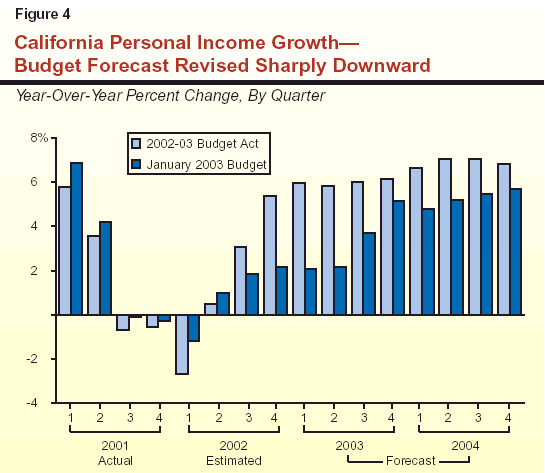
The budget's projections reflect the ongoing weakness in both U.S. business investment and foreign demand, and their impacts on California's high-tech industries. It assumes that economic growth in the state will remain sluggish through much of 2003, before accelerating to a more moderate pace in 2004. Specifically, it projects California personal income—a key determinant of the state's revenue performance—will grow by only 3.3 percent in 2003, before accelerating to a more moderate pace of 5.3 percent in 2004. As indicated in Figure 4, these projected income increases are well below those anticipated when the 2002-03 budget was enacted last September. This is a key factor behind the downward adjustment to the administration's revenue forecast.
Forecast Is on Conservative Side. The administration's economic forecast for California is significantly below our November projections, as well as those of most other economic forecasts made in late 2002. The one exception is University of California, Los Angeles, which has an outlook similar to the administration's. The budget's conservative forecast is primarily related to its assumption that the rebound in business capital spending on high-tech goods and services will begin in early 2004, or about one-half year later than assumed by most other forecasts.
Revenue Outlook. The
administration projects that General Fund revenues will
grow from $72.2 billion in 2001-02 to $73.1 billion
in 2002-03, before falling to $69.2 billion in
2003-04. Numerous policy-related factors are embedded in
these figures, including the one-time law changes accompanying the
2002-03 budget involving tobacco securitization, suspension of
the teachers' tax credit, withholding on stock options and certain
real estate transactions, and one-time loans and transfers. The
2003-04 revenue estimates include $1.5 billion
in new revenues related to tribal gaming receipts, and $326 million in
one-time transfers and loans. After adjusting for
these factors, underlying revenues are projected
to increase by just 1.4 percent in 2002-03
and 2 percent in 2003-04.
Comparison to the November LAO Forecast. After adjusting for the newly proposed tax law changes, the administration's revenue forecast is below our November projections by $883 million in the prior year, about $2.1 billion in the current year, and roughly $3.5 billion in 2003-04—for a three-year total of about $6.5 billion. This reduced estimate reflects (1) more current data on prior-year actuals, (2) differing assumptions about stock options, and (3) the administration's more conservative estimates regarding future economic growth in California.
LAO's Current Assessment. Based on updated information on soft prior-year actual revenues, weak year-end 2002 tax collections, and continued economic softness, it is likely that we will revise our own revenue outlook downward next month—by roughly $4 billion. This downward revision, however, would still leave us about $2.5 billion above the administration's revenue forecast, reflecting our continued belief that California's economic recovery will accelerate in the second half of 2003, or about six months earlier than assumed by the administration.
As indicated previously, as part of the administration's plan to restructure certain state and local programs, additional PIT, SUT, and cigarette taxes have been proposed. The revenue generated from the additional taxes—estimated to be an aggregate of $8.3 billion on an annual basis—will be used to fund program responsibilities to be transferred from the state to localities.
New High-Income PIT Marginal Brackets. The administration is proposing new PIT marginal tax brackets of 10 percent and 11 percent for high-income taxpayers. For joint filers, the 10 percent rate would affect taxpayers with taxable incomes of over $272,000, and the 11 percent bracket would affect those with taxable incomes of greater than $544,000. (The income thresholds would be one-half of these amounts for single filers.) The administration estimates that these new brackets will generate additional revenues of $2.6 billion in 2003-04.
SUT Rate Increase. The budget proposes that the current SUT rate be increased by one cent for realignment purposes. The administration estimates that the revenues deriving from such an increase would be approximately $4.6 billion in 2003-04.
Cigarette Tax Rate Increase. The budget proposes that the tax rate on cigarettes be increased by $1.10 per pack. Currently, cigarettes are taxed at the rate of $0.87 per pack. Thus, the proposal would more than double the existing tax rate. The revenue raised would be an estimated $1.2 billion annually. Of this amount, roughly $100 million would be used to backfill the revenue decreases in Proposition 10 and Proposition 99 funds that would occur due to decreased cigarette consumption stemming from the price increases the higher tax rate would induce.
In addition to the realignment-related tax proposals, the budget includes several changes that would increase General Fund revenues by $95 million in 2003-04, and by increasing amounts thereafter. These include provisions that would (1) prohibit banks from utilizing Regulated Investment Companies to avoid California income taxes, (2) clarify income reporting requirements for certain multi-national businesses, (3) clarify the industries that are eligible for the manufacturers' investment tax credit (MIC), and (4) extend the MIC past 2003. Under existing law, the MIC would likely expire in 2004, since manufacturing job growth between January 1994 and January 2003 will likely be less than the 100,000 required in statute to keep the program in effect.
The budget proposes a major realignment of state, county, and court program funding responsibilities. Under this plan, the state shifts responsibility to counties for roughly $8 billion of health, child care, and social services programs—and reduces by $300 million state General Fund support for trial courts.
To offset these fiscal changes, the budget raises a net $8.2 billion from increased PIT, SUT, and cigarette taxes and provides this funding to counties and the courts. Similar to the state-county realignment enacted in 1991, the administration does not include these new revenues in its calculation of Proposition 98's minimum funding guarantee.
Figure 5 summarizes the realignment proposal and the increased county program costs associated with it.
|
Figure 5 Realigned Programs |
||
|
(Dollars in Millions) |
||
|
Program |
Proposed Responsibility |
Cost |
|
Health Programs |
|
|
|
Medi-Cal
benefits |
15 percenta |
$1,620 |
|
Medi-Cal
long-term care |
100 percenta |
1,400 |
|
Substance
abuse treatment programs and drug courts |
100 percent share of costs |
230 |
|
Integrated
Services For Homeless and Children's System of Care |
100 percent share of costs |
75 |
|
Public
health programs |
100 percent share of costs for |
68 |
|
Subtotal |
|
($3,393) |
|
Social Services Programs |
|
|
|
In-Home
Supportive Services and |
100 percenta |
$1,171 |
|
Child
Welfare Services |
100 percenta |
610 |
|
CalWORKS
(administration and |
50 percent share of costs |
547 |
|
Foster
care grants and administration |
100 percenta |
494 |
|
Food
stamp administration |
100 percenta |
268 |
|
Adoption
assistance |
100 percenta |
217 |
|
Programs
for Immigrants |
100 percenta |
110 |
|
Adult
protective services |
100 percenta |
61 |
|
Kin
GAP |
100 percenta |
19 |
|
Subtotal |
|
($3,496) |
|
Other |
|
|
|
Child
care |
Full cost of most SDE subsidized |
$968 |
|
Court
security |
Funding source change. No change |
300 |
|
Subtotal |
|
($1,267) |
|
Total |
|
$8,154 |
|
|
||
|
Detail may not total due to rounding. |
||
|
a
Share of nonfederal costs. |
||
The 1991 realignment plan enacted by the Legislature was largely a successful experiment in the state-county relationship. Most notably, the increased program flexibility and reliable funding stream provided under the 1991 plan allowed counties to develop innovative and less costly approaches to providing mental health services.
Our review of the administration's current proposal indicates that it could serve as a reasonable starting point for the Legislature to discuss the desirability of expanding realignment. We note, however, that the budget proposal is primarily a conceptual sketch. Significant work will be needed to "fill in the details." This work will need to occur on an expedited basis if the state is to realize a full year of program cost savings, as anticipated in the budget plan.
The realignment plan would benefit from a program-by-program review by the Legislature and the active participation by counties in this discussion. Issues meriting review include:
Figure 6 summarizes the budget's proposed Proposition 98 allocations for K-12 schools and community colleges. It shows a total of $44.1 billion in 2003-04, an increase of $182 million, or 0.4 percent, over the Governor's current-year estimate. This low growth rate is due to the Governor's realignment proposal, which would move $879 million in child care funding out of Proposition 98 and to counties. Adjusting for this factor, there is over $1 billion in additional Proposition 98 resources in 2003-04. The budget allocates almost $1.5 billion in new resources to K-12 schools, and reduces community colleges by $442 million.
|
|
|||||
|
Figure 6 Overview of Proposition 98
Funding |
|||||
|
(Dollars in Millions) |
|||||
|
|
2002‑03 |
|
Change
From |
||
|
Budget
Act |
Mid-Year
Revision |
Proposed
2003‑04 |
Amount |
Percent |
|
|
K-12 Proposition 98 |
|
|
|
|
|
|
State General Fund |
$28,735.4 |
$26,372.7 |
$26,319.8 |
-$52.9 |
-0.2% |
|
Local property tax revenue |
12,911.9 |
13,033.1 |
13,709.8 |
676.8 |
5.2 |
|
Subtotalsa |
$41,647.3 |
$39,405.8 |
$40,029.7 |
$623.9 |
1.6% |
|
CCC Proposition 98 |
|
|
|
|
|
|
State General Fund |
$2,824.7 |
$2,524.9 |
$1,905.7 |
-$619.3 |
-24.5% |
|
Local property tax revenue |
2,007.6 |
1,980.2 |
2,157.8 |
177.6 |
9.0 |
|
Subtotalsa |
$4,832.3 |
$4,505.2 |
$4,063.5 |
-$441.7 |
-9.8% |
|
Total Proposition 98 |
|
|
|
|
|
|
State General Fund |
$31,560.2 |
$28,897.6 |
$28,225.5b |
-$672.2b |
-2.3% |
|
Local property tax revenue |
14,919.5 |
15,013.3 |
15,867.7 |
854.4 |
5.7 |
|
Totalsa |
$46,479.6 |
$43,910.9 |
$44,093.1b |
$182.2b |
0.4% |
|
|
|||||
|
a Totals may not add due to rounding.
|
|||||
|
b
The Governor rebenches the Proposition 98 minimum guarantee
downward by $879 million to reflect the realignment of CalWORKs
child care programs and funding to counties. |
|||||
|
|
|||||
It is important to note that proposed 2003-04 spending is coming off a significantly reduced current-year base. As Figure 6 indicates, the current-year estimate is $2.6 billion, or 5.5 percent less than the amount in the 2002-03 Budget Act.
$1.5 Billion Across-the-Board Reduction in 2002-03. The Governor proposes a total of $2.2 billion in current-year reductions from the total adopted in the 2002-03 Budget Act. These include $1.5 billion in across-the-board cuts, $438 million in one-time fund shifts to the Proposition 98 reversion account, and $343 million in specific cuts. The across-the-board cuts reduce funding for most categorical programs by 10.8 percent, and reduce total revenue limit funding by 2.15 percent. The Governor proposes to continue these across-the-board cuts into 2003-04.
Concerns Regarding Current-Year K-12
Reductions. School districts are well into
the current fiscal year, having budgeted existing core programs on the assumed receipt of
the above funds. It will be difficult for school
districts to absorb a reduction of this size this
late in the school year, especially since the Governor's proposal would require
school districts to continue to meet all of the
program requirements of each of the categorical
programs. For example, while the proposal would reduce
K-3 class size reduction funding by
$180 million, school districts would still have to meet the
20 to 1 student-to-teacher requirement of the program. In our December report,
Analysis of the Mid-Year Budget Proposal, we
identified many alternative possibilities for
current-year General Fund savings in K-12 education
which eliminate program requirements along with reducing funding.
New Resources in 2003-04 Backfill One-Time Reductions and
Deferrals. Figure 7 shows the use of increased Proposition 98 funding
for K-12 education in 2003-04. Much of the increase in K-12 Proposition 98 spending in
2003-04 is to (1) fund programs deferred from 2002-03 that must be built back into the
base ($1.3 billion) and (2) restore funding for
programs paid for in 2002-03 with
Proposition 98 reversion account funds ($438 million).
In addition, the budget provides a
$321 million growth for revenue limits, based on
projected statewide attendance growth of 1 percent.
With the exception of special education, no
categorical programs receive statutory growth. No programs are provided a cost-of-living
adjustment (COLA). The budget provides
$250 million for equalization, a $47 million augmentation
to the amount required by Chapter 1167,
Statutes of 2002 (AB 2781, Oropeza).
The increases above are offset in part by funding "freed-up" because $931 million in deferrals provided in 2002-03 to cover 2001-02 costs are not needed in 2003-04. Also, the Governor (1) reduces rewards, sanctions, and intervention costs ($154 million) from the state's accountability system; (2) eliminates instructional materials funding ($146 million) which was provided in 2002-03 on a one-time basis; and (3) uses federal funding for special education ($115 million) to offset state General Fund costs.
$5.1 Billion Categorical Program Consolidation. The budget proposes to consolidate 64 categorical programs into a $5.1 billion block grant for the general purposes of professional development, instructional materials, technology, specialized and targeted instructional programs, school safety, and student services. The administration proposes to eliminate most of the programs' statutory requirements, and allow school districts significant flexibility with the use of these funds. We believe that providing greater flexibility to school districts through program consolidation is heading in the right direction. While we have technical concerns with the Governor's categorical reform proposal, we are supportive of the concept.
Changes to General Fund Revenues or Realignment Would Affect Proposition 98. The minimum funding requirement for Proposition 98 programs in 2003-04 is sensitive to changes in General Fund revenues. If General Fund revenues grow either because of a quicker economic recovery or new revenue enhancements, generally over half of the new revenues would be required to be spent on Proposition 98 programs (absent suspension of the guarantee). Based on the administration's forecast, this relationship between Proposition 98 expenditures would continue until General Fund revenues increased by slightly over $7 billion, at which point the Proposition 98 "maintenance factor" would be fully restored, and all additional revenues could be used for any purpose.
With regard to realignment, the Governor's proposal would "rebench" the Proposition 98 minimum guarantee downward by $879 million. If the Legislature chooses not to support the inclusion of child care in realignment, the minimum guarantee and General Fund costs would both increase by $879 million.
Current-Year Proposals. The Governor's proposal reduces CCC's current-year Proposition 98 General Fund appropriations by $300 million as compared to the 2002-03 Budget Act. This amount includes a 3.66 percent across-the-board reduction to General Fund apportionments, a 10.8 percent across-the-board reduction to categorical programs, and an $80 million reduction in funding for concurrent enrollment. The proposal also does not backfill an estimated $33.3 million shortfall in local property taxes.
Budget-Year Proposals. The Governor's proposal reduces CCC's Proposition 98 General Fund appropriations by $619 million from the revised current-year level. About half of this amount reflects the net impact of a proposed fee increase from $11 to $24 per unit. (Specifically, the additional fee revenue would offset $149.1 million in General Fund support. Anticipated attrition from the fee increase would reduce enrollment by 5.7 percent, thus saving an additional $216 million.) Another $134 million in General Fund savings is due to additional local property taxes. Finally, the Governor's proposal would reduce selected categorical programs by $212 million.
UC and CSU. For the current year, the Governor proposes allocated and unallocated reductions totaling $74.3 million at UC. His proposal includes a $59.6 million unallocated reduction at CSU. The segments enacted fee increases for spring 2003 that will backfill $19 million of the General Fund reduction at UC and about $20 million for CSU.
For 2003-04, the Governor's proposal reduces General Fund support for UC and CSU by 4.2 percent and 4.5 percent, respectively, from revised current-year levels. However, the Governor assumes a significant increase in student fee revenue due to an additional 25 percent hike in educational fees for most students. Because of this additional fee revenue, total funding for UC and CSU would increase by 4.1 percent and 1.2 percent, respectively.
The Governor's proposal provides funding for a 6.9 percent increase in budgeted enrollment at UC and 7.3 percent at CSU in 2003-04. This compares with an estimated 1.4 percent increase in college age population.
Medi-Cal. In addition to the Governor's realignment proposal, which results in a savings of $3 billion in the Medi-Cal program the spending plan also reflects a number of significant program cuts. These include a 15 percent reduction in provider rates primarily affecting physicians and nursing homes; the elimination of certain optional services for adults, such as dental care and optometry; rollbacks of expansions of coverage to the working poor and aged and disabled; and tightening of program eligibility rules through reinstatement of quarterly status reports for adult beneficiaries and new steps to direct counties to expedite the disenrollment of an estimated 560,000 ineligible Medi-Cal recipients. The Governor's budget also would establish a new tax on intermediate care facilities for the developmentally disabled as a mechanism to draw down additional federal support. Further savings from antifraud activities are also assumed in the spending plan.
Partly offsetting these proposed reductions are a number of significant caseload and cost increases, including the addition of funding for compliance with a court order that requires that persons terminated from the federal SSI/SSP program be kept on the Medi-Cal rolls and for a shift of children from the Children's Health and Disability Prevention (CHDP) program to Medi-Cal.
Healthy Families. The Governor's budget plan postpones until July 2006 expansion of this program to eligible parents. Also, the Rural Health Demonstration Project would be ended.
Other Health Programs. As noted earlier, the budget shifts a number of other health programs, including support for clinics, indigent care, substance abuse, and mental health services, to counties through realignment. The spending plan assumes a significant decrease in the budget for the CHDP program as a result of efforts to shift participants to Medi-Cal and Healthy Families coverage. Significant reductions are proposed in a variety of public health programs, including establishment of copayments for AIDS patients, reforms in operation of the genetically handicapped persons program, and reductions in support for certain health research activities.
A major increase in General Fund support would be provided for mental health services for Medi-Cal children. In contrast, the budget plan proposes to achieve significant General Fund savings by establishing statewide standards for the purchase of services for the developmentally disabled, shifting more support for Regional Centers to federal funds, and establishing fees for some parents of children receiving services.
In addition to the Governor's realignment proposal, which results in savings of $3.5 billion in social services programs, the budget achieves significant savings and cost avoidance through grant reductions and suspension of statutory COLAs. For SSI/SSP, the Governor proposes to delete the June 2003 and January 2004 state COLAs, resulting in combined cost avoidance of $328 million in 2003-04. The budget achieves savings of $662 million by reducing SSI/SSP grants by 6.2 percent down to the federal maintenance of effort (MOE) level, effective July 1, 2003. The budget proposes similar COLA suspensions and a grant reduction in the CalWORKs program. These grant changes, however, result in federal Temporary Assistance to Needy Families (TANF) fund savings of about $430 million, due to the federal TANF MOE requirement. Finally, the budget achieves new revenues of $52 million from counties by requiring counties to share in 25 percent of the cost of the federal penalty for not completing a statewide automated child support system.
The budget proposes a less than 1 percent reduction in General Fund expenditures for all of corrections. This consists of General Fund increases in some program areas and General Fund reductions in other areas. For example, this is largely because the California Department of Corrections (CDC) would actually experience a $53 million increase in its General Fund budget in 2003-04. This increase in CDC's budget is due to augmentations for increases in the inmate population ($101 million) and workers' compensation costs ($115 million). Major CDC reductions include proposals to reduce spending for inmate academic and vocational programs ($46 million), and conversion of the Northern California Women's Facility in Stockton to a facility for male inmates ($10 million).
In contrast, the budget proposes a 27 percent reduction in General Fund expenditures for the courts. This is accomplished by shifting $366 million in General Fund costs to new revenues generated as part of the Governor's realignment proposal, and other court user fees. The budget also proposes unallocated reductions of $116 million and $17.7 million to the trial courts and Judicial Council, respectively. Finally, the Governor's budget proposes to reduce court expenditures by $37 million by replacing some court reporter staff with electronic reporting technology. The budget does not provide funding for negotiated salary increases for court employees or increased county charges.
The budget proposes the following actions in the area of transportation in order to provide savings to the General Fund. Specifically, it proposes to:
As originally established in 2000, the TCRF received $2 billion from the General Fund in 2000-01, including $1.6 billion to fund 141 specific transportation projects. The budget proposals described above will suspend funding for the TCRP in 2003-04. Correspondingly, the budget proposes to reduce staff support for the program by 1,214 personnel-years.
State Highway Account. The budget is also proposing to take several steps to address a projected year-end shortfall in the State Highway Account (SHA) of about $170 million for 2002-03 and $630 million for 2003-04. Specifically, the budget proposes to reduce the current-year loan from the SHA to the TCRF by $307 million (from $474 million to $167 million) and reduce SHA funding for local streets and roads in 2002-03 by about $90 million. For 2003-04, the budget proposes to reduce the Department of Transportation's (Caltrans') expenditures by $317 million.
The shortfall is the result of a number of factors. First, the state is receiving lower-than-expected federal funds in the current year. Second, in recent years, Caltrans has used extensively "advanced construction" to carry out transportation projects. With advanced construction, state funds are used to construct transportation projects based on planned federal reimbursements in future years. Third, revenues from truck weight fee revenues are lower than projected since the implementation of Chapter 861, Statutes of 2000 (SB 2084, Polanco). Chapter 861 changed the way weight fees are imposed. Although Chapter 861 was intended to be revenue neutral, experience to date shows a decline in revenue collected.
Motor Vehicle Account. The Motor Vehicle Account (MVA) funds primarily the California Highway Patrol (CHP) and the Department of Motor Vehicles (DMV). Even though the budget proposes no growth in the support for DMV and CHP for 2003-04, the MVA is projected to have a significant deficit in 2003-04, absent corrective actions. This is due mainly to (1) significantly higher expenditures including state retirement contributions and health insurance costs, and (2) the lack of federal reimbursements totaling about $117 million through the current year for antiterrorist security activities. In order to address the projected shortfall, the budget proposes to increase a number of fees, including vehicle registration, driver license, identification card, and various transaction fees. For 2003-04, the budget projects these increases to generate about $163 million.
In addition, the budget proposes to shift the funding of certain CHP activities to new sources. In particular, the budget proposes to increase the state emergency telephone number (911) surcharge as well as impose a new surcharge on all intrastate telephone calls in order to fund CHP's costs of responding to 911 calls, performing search and rescue activities, and providing protective services to state employees and facilities. The budget projects that these surcharges would generate $72 million for these activities in 2003-04.
Eliminate Retirement Contributions. The Governor's budget proposes to borrow the funding necessary to make the state's annual retirement contributions in 2003-04. This proposal would provide roughly $1.6 billion in 2003-04 General Fund savings by eliminating the appropriations for the Public Employees' Retirement System (PERS, $1.2 billion) and the State Teachers' Retirement System (STRS, $0.4 billion). The administration has yet to propose a specific borrowing plan but suggests either using bonds or securing loans from PERS and STRS. These reductions are in addition to the Governor's mid-year proposal to reduce the appropriation to the STRS supplemental benefit program (which protects retirees' benefits from the effects of inflation) by $500 million.
Employee Compensation Reduction. The proposed budget includes the savings from the mid-year proposal to reduce General Fund employee compensation costs by $470 million in the budget year. This proposal is the equivalent of an 8 percent reduction in salary costs. The administration proposes to achieve these savings initially by negotiating such a reduction with employee unions through the collective bargaining process.
The state has signed compacts with 61 Indian tribes related to gaming on tribal lands. Currently, pursuant to these compacts, tribes contribute over $100 million annually to state accounts. These funds are then allocated to nongaming tribes and various other purposes. As part of compact renegotiations scheduled for March 2003, the administration proposes to have compact tribes (possibly including new participating tribes) contribute $1.5 billion in annual revenues to the General Fund. This revenue proposal depends on the state successfully negotiating such a payment with the tribes.
VLF Backfill. In addition to the
realignment plan described previously, the budget includes
a variety of proposals affecting local
governments. Most notably, the budget eliminates the
VLF backfill, beginning February 2003. As part of
the 1998 VLF tax cut legislation, the state supplemented VLF revenues to eliminate any
adverse local fiscal impact from the tax cut. The
budget eliminates the backfill funding, reducing city
and county revenues by $1.3 billion in the
current year, and $3 billion in 2003-04. The loss of
this backfill funding would affect local
governments differently. We estimate that as a percentage
of city and county general fund revenues in
2003-04, the revenue loss would range between 5 percent and 25 percent.
Other Proposals. The budget's other proposals that would affect local governments include:
Given the enormity of the budget problem and the large number of major solutions included in the Governor's proposal, the Legislature will be faced with many important policy issues as it considers the 2003-04 budget. Among the more important of these are the following:
How Do the Proposal's Spending Priorities Square With the Legislature's? In general, the budget's deepest cuts are in local government, K-12 education, Medi-Cal, CalWORKs, and SSI/SSP. At the other extreme, only modest reductions are included for criminal justice programs, most higher education and certain social services programs being proposed for realignment. The spending plan generally reflects the Governor's stated priorities in the areas of education, children's health, and public safety. Even if the Legislature has similar priorities, it may still want to consider whether—at least at the margin—any reallocation of such spending is merited. An example would be whether or not to reallocate some spending toward certain programs receiving the deepest reductions under the Governor's proposal.
Is the General Nature, Overall Amount, and Distribution of Tax Increases Appropriate? Roughly one-fourth to one-third of the Governor's proposed budget solutions are related to increased taxes (depending on how the budget problem is defined—discussed earlier). The basic questions in this area include:
Can Local Government Realistically Absorb a $5 billion Funding Reduction? The Governor's proposals to eliminate the VLF backfill and transfer redevelopment funds to schools would have a significant adverse impact on city and county services. This raises such issues as whether the Legislature should increase the VLF rate itself and/or provide localities with other options for raising revenues.
What About Mandates? For the second year in a row, this budget would defer state payments for local government mandate claims. The accumulated liability for such claims now exceeds $1 billion. This raises such issues for the Legislature as whether the state consider eliminating or modifying some of these mandates.
Does The Governor's Realignment Proposal Make Sense? For many years, our office has advocated a realignment of state and local responsibilities for various programs. However, we also have stressed that any such transfers of responsibility should be made for the purpose of maximizing program effectiveness and taking advantage of fiscal incentives, as opposed to realigning simply for the purpose of alleviating state-level budget problems. The Legislature will need to identify those program areas where realignment truly makes sense in its own right.
What Are the Long-Term Budgetary Implications? While we have not yet had the time to fully evaluate the fiscal impacts of the Governor's plan over time, our initial review suggests that, if fully implemented, it would address the state's current multibillion dollar long-term structural imbalance. As the Legislature considers modifications and alternatives to the Governor's proposal, it will be important that it try to avoid diminishing the long-term fiscal benefits that are inherent in the current proposal.
The single most important piece of advice that we can offer the Legislature at this point is to act early and decisively on this budget. Regardless of the estimates used to define the budget shortfall, the state clearly faces an enormous problem in getting its fiscal house in order. We therefore recommend that the Legislature (1) act early, (2) put everything "on the table" including both program reductions and taxes, and (3) adopt solutions that are both real and ongoing.
| Acknowledgments
This report was prepared by Dave Vasche and Brad Williams, with the assistance of many others throughout the office. The Legislative Analyst's Office (LAO) is a nonpartisan office which provides fiscal and policy information and advice to the Legislature. |
LAO Publications
To request publications call (916) 445-4656. This report and others, as well as an E-mail subscription service, are available on the LAO's Internet site at www.lao.ca.gov. The LAO is located at 925 L Street, Suite 1000, Sacramento, CA 95814. |