
February 2003
Assembly Constitutional Amendment 11, which will appear on the March 2004 statewide ballot, would establish the California Twenty-First Century Infrastructure Investment Fund. The fund, supported by transfers from the General Fund, would provide a dedicated financing source for state and local infrastructure projects. In this primer, we provide background on state capital outlay planning and funding, explain how the measure works, and attempt to give a sense of the measure's potential fiscal impact.
Infrastructure funding has become an increasingly important issue for the Legislature. The state faces a significant challenge in addressing both the deficiencies of an aging public infrastructure and the need for new infrastructure to sustain a growing economy and population. To effectively meet this challenge, the state needs a well-defined process for planning, budgeting, and financing necessary infrastructure improvements.
Assembly Constitutional Amendment 11 (ACA 11, Richman), which will appear on the March 2004 statewide ballot, would establish the California Twenty-First Century Infrastructure Investment Fund (Infrastructure Fund) to provide a dedicated fund source for capital outlay. The measure requires that moneys in the Infrastructure Fund be allocated by the Legislature for capital outlay purposes, of which 50 percent would be for state-owned infrastructure and 50 percent would be for local government infrastructure (excluding school districts and community college districts).
Should the voters pass ACA 11, the measure could have a major impact on the way the state funds its infrastructure. In this primer, we provide the following:
Assembly Constitutional Amendment 11 would commit a percentage of the General Fund to pay for state and local infrastructure projects. In order to fully understand what the measure attempts to achieve, it is important to have knowledge of the infrastructure the state has funded, how it plans for infrastructure, and how it currently funds infrastructure projects.
The state has hundreds of billions of dollars invested in infrastructure. In addition to funding capital development to support various departmental missions, the state has also historically provided funds for local infrastructure in the areas of K-12 school construction, community college construction, local streets and roads, local parks, wastewater treatment, flood control, and jails. Figure 1 shows the major areas of state infrastructure.
As the state's population continues to increase, the need for investment in new capital facilities will grow commensurately. Compounding the challenge will be the need to renovate and replace existing facilities in order that they can continue to serve their purposes.
|
Figure 1 Major State Infrastructure |
|
|
Program
Area |
Major
State Infrastructure |
|
Water Resources |
�
32 lakes and reservoirs �
17 pumping plants �
3 pumping-generating plants �
5 hydro-electric power plants � 660 miles of canals and pipelines � 1,595 miles of levees and 55 flood control structures in the Central Valley
|
|
Transportation |
�
50,000 lane miles of highways �
9 toll bridges �
11 million square feet of Department of Transportation
offices and shops �
209 Department of Motor Vehicles offices �
138 California Highway Patrol offices
|
|
Higher Education |
� 192 primary and satellite campuses of higher education, including 10,000 buildings containing 138 million square feet of facilities space
|
|
Natural Resources |
�
266 park units containing 1.4 million acres and 3,000 miles of trails �
238 forest fire stations and 13 air attack bases � 21 agricultural inspection stations
|
|
Criminal Justice |
�
33 prisons and 38 correctional conservation camps �
11 youthful offender institutions � 12 crime laboratories
|
|
Health Services |
�
4 mental health hospitals comprising over 4 million square
feet of facilities and 2,300 acres �
5 developmental centers compromising over 5 million square
feet of facilities and over 2,000 acres � 2 public health laboratory facilities
|
|
General state |
�
8.5 million square feet of state-owned office space �
16.6 million
square feet of leased office space |
The California Infrastructure Planning Act—Chapter 606, Statutes of 1999 (AB 1473, Hertzberg)—requires the Governor to annually submit to the Legislature a statewide five-year infrastructure plan along with a proposal for its funding. The plan is intended to provide the Legislature with a comprehensive picture of the state's long-term infrastructure needs. The first plan was submitted to the Legislature in June 2002. Figure 2 summarizes the basic information that must be included in the annual plan.
|
Figure 2 Basic Requirements of the |
|
�
Identify: |
|
�
New and renovated infrastructure requested by state
agencies. |
|
�
Aggregate funding for infrastructure in the State
Transportation Improvement Program. |
|
�
Infrastructure needs for K-12 public schools. |
|
�
�Instructional� infrastructure needs for higher
education segments. |
|
�
Total cost of providing the infrastructure identified. |
|
�
Provide
a Funding Proposal for the Infrastructure Identified. |
|
� If proposal does not fund all infrastructure identified�it must identify criteria used to select projects. |
|
�
If proposal requires new state debt�it must show impact
on state�s overall debt status. |
Highway construction and renovation is the only state infrastructure program that has reliable and dedicated revenue sources (state gas taxes and federal funds). Most other infrastructure programs, however, require either direct General Fund appropriations or bond appropriations whose related debt service is repaid from the General Fund (this covers both general obligation and lease-revenue bonds). Figure 3 shows recent history on state capital outlay spending from these two sources. (The figure excludes spending on transportation and K-12 schools.) It shows that very little infrastructure spending is supported from direct appropriations—an annual average of 0.2 percent of total General Fund spending over the period shown. More spending has been supported from bonds, averaging $1.2 billion a year or about 2 percent of total General Fund spending for the period shown.
|
Figure 3 General Fund Supported |
||
|
(In Millions) |
||
|
Fiscal
Year |
Direct
General Fund Expenditures |
Expenditures
From General Fund Bondsb |
|
1990-91 |
$9 |
$1,028 |
|
1991-92 |
35 |
850 |
|
1992-93 |
� |
1,002 |
|
1993-94 |
� |
1,514 |
|
1994-95 |
11 |
678 |
|
1995-96 |
33 |
761 |
|
1996-97 |
62 |
793 |
|
1997-98 |
56 |
584 |
|
1998-99 |
169 |
730 |
|
1999-00 |
244 |
772 |
|
2000-01 |
511 |
1,157 |
|
2001-02 |
284 |
1,325 |
|
2002-03 (estimated) |
169 |
4,095 |
|
2003-04 (proposed) |
74 |
2,980 |
|
Totals |
$1,657 |
$18,269 |
|
|
||
|
a
Figure excludes capital spending for K-12 public schools and
special fund supported capital outlay (including transportation-related
programs). |
||
|
b
Includes both general obligation and lease-revenue bonds. |
||
Given this financing situation, there is really no stable funding source year-in and year-out for most state infrastructure projects. Those programs which typically have been funded through general obligation bonds must wait to see if a bond authorization is placed on the ballot and then wait further to see if voters approve the measure. (Some state projects use lease-revenue bonds, which do not need voter approval.) Many state facilities, however, are not funded from bonds. As a result, there have been little or no funds routinely available for projects to, for example, upgrade or replace various facilities in the state hospitals, developmental centers, and prisons. This, in turn, has contributed to an under investment in certain components of the state's infrastructure.
Assembly Constitutional Amendment 11 would increase the amount of General Fund revenue committed to pay-as-you-go capital outlay projects. According to the measure, the creation of the Infrastructure Fund is intended to assure continual capital outlay funding to address ongoing infrastructure needs. Assembly Constitutional Amendment 11 specifies that the Infrastructure Fund be allocated by the Legislature for capital outlay purposes, of which 50 percent would be for state-owned infrastructure and 50 percent would be for local government infrastructure (excluding school and community college districts). Figure 4 summarizes the main provisions of the measure.
|
Figure 4 Basic Provisions of ACA 11 |
|
Purpose |
|
�
Establishes the California Twenty-First Century
Infrastructure Investment Fund (Infrastructure Fund). |
|
�
Commits a percentage of the General Fund for
�pay-as-you-go� infrastructure projects. |
|
Scheduled Transfers to the Infrastructure Fund |
|
�
Transfers 1 percent of General Fund revenue to the
Infrastructure Fund beginning with the 2006-07 fiscal year. |
|
�
Gradually increases the amount of General Fund committed
to the Infrastructure Fund. |
|
�
Delays scheduled increases when General Fund revenue
growth slows. |
|
�
Caps annual General Fund transfers to the Infrastructure
Fund at 3 percent of General Fund revenues. |
|
General Fund Revenue Triggers |
|
�
Some trigger mechanisms reduce transfers to the
Infrastructure Fund during periods when General Fund revenue growth
slows. |
|
�
Other trigger mechanisms eliminate transfers to the
Infrastructure Fund if General Fund revenues decline. |
|
Special Adjustments |
|
�
School Funding�Reduces transfer amount when the
percentage growth in the Proposition 98 guarantee exceeds the percentage
growth in General Fund revenues. |
|
�
Bond Debt Service�Caps the Infrastructure Fund transfer
to the difference between 7.5 percent and the percentage of General Fund
revenue devoted to prior-year debt payments for infrastructure-related
bonds. |
While the goal of committing a portion of General Fund revenue annually to capital outlay projects is a simple one, ACA 11 contains a number of relatively complicated provisions that can change the annual amount of General Fund revenue transferred to the Infrastructure Fund.
Beginning with the 2006-07 fiscal year, ACA 11 would transfer 1 percent of General Fund revenue to the Infrastructure Fund. The amount of the transfer is scheduled to increase by 0.3 percent annually until reaching a maximum of 3 percent of General Fund revenues in 2013-14 (see Figure 5).
|
Figure 5 Scheduled General Fund
Revenue |
|
|
Fiscal Year |
Percentage
of General Fund |
|
2006-07 |
1.0% |
|
2007-08 |
1.3 |
|
2008-09 |
1.6 |
|
2009-10 |
1.9 |
|
2010-11 |
2.2 |
|
2011-12 |
2.5 |
|
2012-13 |
2.8 |
|
2013-14 |
3.0 (maximum
rate) |
Also, ACA 11 specifies that the annual amount to be transferred to the Infrastructure Fund will be made in four installments: August 1 (or 30 days after enactment of the budget), November 1, February 1, and May 31.
Assembly Constitutional Amendment 11 contains provisions to slow and accelerate the annual amount to be transferred to the Infrastructure Fund depending on the condition of the General Fund. For example, in response to the possibility of revenue growth, ACA 11 specifies that the initial transfer in 2006-07 can only occur if General Fund revenue for that year increases by at least 4 percent in real terms (that is, after adjusting for inflation) over the prior year, as determined by the Department of Finance (DOF). (If the recent inflation rate of about 3 percent a year were to persist, that means revenues would have to grow by at least 7 percent for the transfer to occur.) In subsequent fiscal years, the scheduled 0.3 percent increases in the annual transfer to the Infrastructure Fund also would occur only if General Fund revenues were projected to grow by 4 percent (in real terms). Conversely, to take advantage of periods of strong revenue growth, the schedule would be accelerated by an additional year, or another 0.3 percent, when General Fund revenues increase by 8 percent or more after adjusting for inflation.
By limiting the annual growth of the Infrastructure Fund transfer, the measure attempts
to minimize the impact on other state programs. Although the transfer schedule set forth in
ACA 11 envisions transferring 3 percent of General Fund revenues to the
Infrastructure Fund in the 2013-14 fiscal year, it would
likely take several more years to reach this
maximum 3 percent transfer. This is due not only to
the provisions discussed above, but also to
various adjustments triggered by fluctuations in
General Fund revenue growth, to which we now turn.
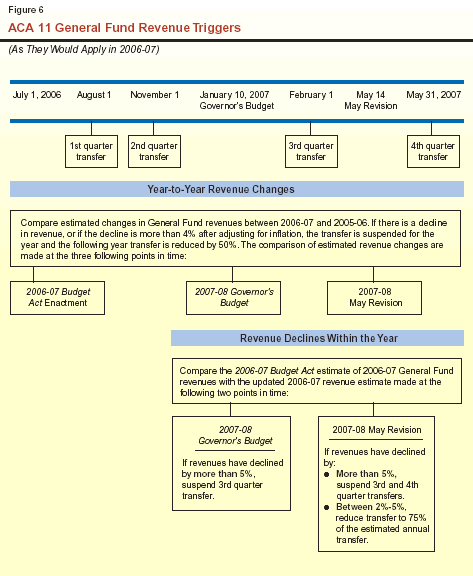
The measure contains a variety of adjustments or triggers that would reduce or eliminate the transfer to the Infrastructure Fund when General Fund revenue performance is less than estimated. These adjustments would ensure that, during difficult budgetary times, infrastructure funding shares in the pain of reduced resources. These adjustments, which are based on estimates by the DOF, fall into two categories that are summarized in Figure 6.
The first set of adjustments is based on changes in General Fund revenues from the prior year. Specifically, if there is a dollar decrease in estimated General Fund revenues, or a decrease of more than 4 percent after adjusting for inflation, ACA 11 requires that any transfer to the Infrastructure Fund be suspended for that year. In addition, when there is such a suspension, any scheduled transfer for the subsequent year is reduced by half. Declining General Fund revenues usually mean the state is experiencing a difficult budget situation. That may explain why the measure includes this two-tiered reduction to the Infrastructure Fund.
This set of adjustments compares estimated General Fund revenue at the time the budget is enacted with subsequent estimates made for that same fiscal year. Specifically:
The adjustment for revenue declines within a fiscal year is more modest than the year-to-year adjustments. This seems reasonable, however, as the state may not be in as difficult a budget problem. For example, if estimated revenue growth at the start of the fiscal year was 10 percent, a 5 percent decline (as estimated later in the year) still would mean the state was experiencing revenue growth.
Assembly Constitutional Amendment 11 contains two special adjustments that could result in reductions in the annual revenue transferred to the Infrastructure Fund. These special adjustments are independent of the transfer adjustments to General Fund revenue discussed earlier.
Assembly Constitutional Amendment 11 specifies that if the percentage growth in the Proposition 98 guarantee exceeds the percentage growth in General Fund revenues, the transfer amount pursuant to ACA 11 will be reduced. The measure provides that the amount of the reduction will be one-half of the difference between the current-year Proposition 98 requirement and the past-year Proposition 98 required amount, adjusted for the percentage growth in General Fund revenues from the prior year. This calculation would result in a specific dollar amount that would reduce an otherwise-required transfer to the Infrastructure Fund. Moreover, ACA 11 states that this reduction can only occur if no other triggered reductions or adjustments are in effect that year.
Generally, this trigger would occur only when school attendance is growing faster than the California population. Given that attendance is projected to grow more slowly than the state's population for many years, it does not appear that this provision would soon be a factor.
Assembly Constitutional Amendment 11 contains a provision limiting the percentage of revenues transferred to the Infrastructure Fund to the difference between 7.5 percent and the percentage of General Fund revenue devoted to prior-year debt payments for infrastructure-related bonds. For example, when the scheduled maximum transfer of 3 percent is achieved, this provision would require a reduction in the 3 percent transfer rate in years when the debt service ratio exceeded 4.5 percent.
While the debt service ratio is currently below that level, a variety of factors—sale of recently approved general obligation bonds, passage of measures on the March 2004 ballot, and current revenue performance—could result in a debt service ratio in the 6 percent range by 2006-07, the first year ACA 11 would be in effect.
As noted earlier, the state supports infrastructure spending through direct General Fund spending and through debt service payments on bonds. A possible rationale of the ACA 11 debt service provision is that it may serve a role similar to other ACA 11 triggers. It would protect existing programs by reducing the General Fund commitment to direct capital outlay appropriations when bond debt payments increase significantly.
Given all of the various triggers and schedule adjustments intended to protect other General Fund programs, a reasonable question is: How much General Fund money would ACA 11 actually transfer into the Infrastructure Fund each year? Due to the many ACA 11 adjustments and the number of economic and fiscal variables that would have to be forecast, it is not possible to give specific estimates of future transfers into the Infrastructure Fund. We have, however, attempted to illustrate the potential fiscal effect of ACA 11 by examining the impacts if it had been in effect over the recent past.
In Figure 7 we have applied the actual changes in General Fund revenue and other ACA 11 factors for the 20-year period 1982-83 through 2001-02. The figure provides a very general example of how the various triggers and adjustments in ACA 11 would have played out over that time period. The figure shows, for instance, increasing transfers of General Fund revenue to the Infrastructure Fund (growing from $113 million in the second year of the period to $2.4 billion at the end of the period). It also shows that such transfers would generally occur more often than not.
|
Figure 7 Illustration of the Fiscal
Impact of ACA 11 |
||||||||
|
(Dollars in Millions) |
||||||||
|
Fiscal
Year |
Nominal
General Fund (GF) Change |
Actual
Real GF Change |
GF
Revenue: Final Change Book |
ACA
11 Transfer Rate |
Prior-Year
Debt Service Ratio |
Initial
ACA 11 Transfer Amount |
Suspended
Paymentsa |
Final
Transfer |
|
1982-83 |
-1.0% |
-3.2% |
$20,704 |
� |
1.0% |
� |
� |
� |
|
1983-84 |
11.5 |
7.7 |
22,530 |
1.0% |
1.2 |
$225 |
-$113 |
$113 |
|
1984-85 |
11.1 |
5.9 |
25,795 |
1.3 |
1.4 |
335 |
� |
335 |
|
1985-86 |
5.8 |
1.7 |
28,107 |
1.3 |
1.5 |
365 |
� |
365 |
|
1986-87 |
9.9 |
6.5 |
30,944 |
1.6 |
1.6 |
495 |
� |
495 |
|
1987-88 |
2.5 |
-1.6 |
33,104 |
1.6 |
1.7 |
530 |
-133 |
397 |
|
1988-89 |
10.8 |
5.6 |
35,929 |
1.9 |
1.6 |
683 |
� |
683 |
|
1989-90 |
8.0 |
2.8 |
39,801 |
1.9 |
1.5 |
756 |
� |
756 |
|
1990-91 |
4.0 |
-1.2 |
40,345 |
� |
1.8 |
�b |
� |
� |
|
1991-92 |
26.7 |
22.3 |
45,601 |
2.5 |
2.5 |
1,140 |
-855 |
285 |
|
1992-93 |
3.3 |
� |
42,723 |
� |
3.1 |
�b |
� |
� |
|
1993-94 |
-0.7 |
-2.4 |
40,070 |
� |
3.9 |
� |
� |
� |
|
1994-95 |
9.8 |
7.9 |
41,364 |
2.8 |
4.1 |
1,158 |
-579 |
579 |
|
1995-96 |
1.8 |
0.3 |
42,771 |
1.9c |
5.6 |
813 |
� |
813 |
|
1996-97 |
3.7 |
1.3 |
47,573 |
1.9c |
5.6 |
904 |
� |
904 |
|
1997-98 |
6.6 |
4.5 |
52,396 |
2.6c |
4.9 |
1,467 |
� |
1,467 |
|
1998-99 |
5.1 |
2.5 |
57,304 |
3.0 |
4.4 |
1,719 |
� |
1,719 |
|
1999-00 |
7.5 |
4.3 |
62,602 |
3.0 |
4.1 |
1,878 |
� |
1,878 |
|
2000-01 |
13.1 |
8.3 |
80,043 |
3.0 |
4.0 |
2,401 |
� |
2,401 |
|
2001-02 |
-20.2 |
-22.4 |
67,186 |
� |
3.4 |
� |
� |
� |
|
|
||||||||
|
a
Reflects suspended May payment in 1987-88 and suspended February
and May payments in 1991-92 (-$285 million). Transfers in 1983-84, |
||||||||
|
b
While there is nominal General Fund Growth at the outset of
1990-91 and 1992-93, transfers are suspended due to later estimates of
year-to-year declines in General Fund revenue. |
||||||||
|
c
In 1995-96 and 1996-97, the transfer is reduced from 2.8
percent to 1.9 percent because of the debt service provision. In
1997-98, the transfer rate is reduced from 3.0 percent to 2.6 percent
for the same reason. |
||||||||
Figure 7 indicates that the transfers to the Infrastructure Fund can fluctuate significantly from year to year (for example, going from $756 million in 1989-90 to zero the following year). These fluctuations are primarily the result of the various triggers in ACA 11 which are based on changes in General Fund revenue. For example, there are five years in which there is no transfer of General Fund revenue to the Infrastructure Fund because of the year-to-year adjustment factor. In three of these years (1982-83, 1993-94, and 2001-02), the suspension occurs at the beginning of the fiscal year and in the other two years (1990-91 and 1992-93), the suspension is triggered later in the year. Additionally, there are three years (1985-86, 1987-88, and 1989-90) in which the scheduled 0.3 percent increase in the annual transfer is delayed because General Fund revenue did not grow by at least 4 percent (in real terms), and there is one year (1991-92) in which it is accelerated because General Fund revenue grew by at least 8 percent.
With respect to the bond debt service special adjustment described earlier, there are three years (1995-96, 1996-97, and 1997-98) when the scheduled revenue transfer to the Infrastructure Fund is reduced because the prior-year bond debt service percentage and the amount scheduled for transfer exceeded the 7.5 percent cap set by ACA 11. (We would note that the figure does not show any adjustments related to Proposition 98. As stated earlier, it is unlikely that school attendance will grow faster than the California population for many years, therefore, it does not appear that this provision would be a factor in the near future.)
In summary, Figure 7 suggests that ACA 11 would likely result in General Fund revenue transfers to the Infrastructure Fund. It also shows that the various triggers and adjustments in ACA 11 do work to protect other General Fund programs by reducing transfers to the Infrastructure Fund when General Fund revenues slow or decline.
Passage of ACA 11 would raise a number of issues related to how the state currently plans and finances its infrastructure. Below, is a brief discussion of some of these issues.
Impact on Capital Outlay Planning and Budgeting. As we have described above, passage of ACA 11 would provide a reliable and significant source of funds for state infrastructure needs. This could serve to greatly enhance the five-year infrastructure planning process established by Chapter 606. With a steadier funding source for new projects, the plan might be viewed as the means by which the state's highest priority projects are identified and funded.
The Infrastructure Fund and the Financing "Mix." The existence of the Infrastructure Fund would allow the Legislature to fund more capital outlay as pay-as-you-go projects. As noted above, this would bring greater certainty to the state's infrastructure planning and budgeting processes. With greater pay-as-you-go resources, the Legislature could lessen its reliance on bond financing. To the extent it did so, it would reduce overall infrastructure costs, as bond-funded projects are more costly than pay-as-you-go projects because of interest payments and financing costs. The Infrastructure Fund could also be used to change the way the state funds individual projects. For example, the Infrastructure Fund could pay for the preconstruction phases (preliminary plans and working drawings) of a project to avoid having to pay for bond-related interim financing costs, and the construction phase of the project could be funded later using general obligation or lease-revenue bonds.
Managing Resources in the Infrastructure Fund. Assembly Constitutional Amendment 11 would present the Legislature with options as to how it chooses to allocate monies from the Infrastructure Fund. For example, the Legislature could choose to fully fund (that is, provide funding for all phases of projects—including construction) as many projects as monies in the Infrastructure Fund would allow in a given year. Alternatively, in an effort to start as many projects as possible, it could choose to provide initial funding for a far greater number of projects. The Legislature could also choose to hold back a portion of the Infrastructure Fund each year to establish a reserve for use in those years when there is little or no transfer of General Fund revenue to the Infrastructure Fund.
Allocating Local Government's Share of the Infrastructure Fund. Assembly Constitutional Amendment 11 requires that half of the Infrastructure Fund be allocated for local government infrastructure, excluding school districts and community college districts. The measure requires subsequent legislation to set forth the approach and method to be used in the annual allocation of these funds. Accordingly, if ACA 11 is approved by the voters, the Legislature will need to establish how the Infrastructure Fund will be allocated for local infrastructure projects. For instance, the Legislature could decide that the Infrastructure Fund should be limited to funding new local government projects that serve regional purposes (such as parks, open space acquisitions, and flood control projects), or it could decide to use these funds as a substitute fund source for current local assistance programs involving infrastructure. Alternatively, the Legislature could opt to provide a portion of the funds to locals on a per capita basis (that is, not project-specific spending). In any case, passage of ACA 11 would compel a reconsideration of basic state and local infrastructure funding responsibilities.
Assembly Constitutional Amendment No. 11—A resolution to propose to the people of the State of California an amendment to the Constitution of the State, by adding Article XVI A thereto, relating to infrastructure finance.
WHEREAS, An investment in California's infrastructure is an investment in California's future because the quality of life in California depends on the quality of our children's education and on the condition of the state's transportation network, water system, parks, natural resources, and other infrastructure; and
WHEREAS, California's infrastructure is critically under-funded; and
WHEREAS, California has often used bonds to pay for infrastructure investments, but bonds alone cannot address the magnitude of California's infrastructure investment deficit; and
WHEREAS, According to the Legislative Analyst's 1998 report, Overhauling the State's Infrastructure Planning and Financing Process, the state needs to take two main steps to provide a more stable funding source for our infrastructure needs: dedicate a given level of General Fund resources for infrastructure, and reserve a proportion of the General Fund for current year capital outlay; and
WHEREAS, In the 1960s, when California created the nation's finest education and transportation systems, the state routinely committed 7 to 10 times more of the General Fund to capital outlay than today; and
WHEREAS, Establishing a California Twenty-First Century Infrastructure Investment Fund and slowly increasing the amount of the General Fund committed to capital outlay is an appropriate method of assuring continual capital outlay to address infrastructure needs; and
WHEREAS, By limiting the annual growth of the infrastructure fund to a small percentage of annual General Fund growth, Article XVI A will protect education, child care, and other necessary services during periods of economic recession; and
WHEREAS, The purpose of subdivision (b) of Section 2 of Article XVI A is to ensure that funding for infrastructure projects is not at the expense of funding of other vital programs and to protect existing vital programs in the event of an economic recession; now, therefore, be it Resolved by the Assembly, the Senate concurring, That the Legislature of the State of California at its 2001-02 Regular Session commencing on the fourth day of December 2000, two-thirds of the membership of each house concurring, hereby proposes to the people of the State of California that the Constitution of the State be amended by adding Article XVI A thereto, to read:
ARTICLE XVI A
INFRASTRUCTURE INVESTMENT FUND
SECTION 1. The California Twenty-First Century Infrastructure Investment Fund is hereby established in the State Treasury for the purpose of funding capital outlay expenses. The Department of Finance shall prepare an annual plan to expend these funds, unless the Governor directs another state agency to prepare the plan.
SEC. 2. As used in this article:
(a) "Department of Finance" means the Department of Finance or a successor agency.
(b) "General Fund revenues" excludes transfers from other funds into the General Fund and transfers from the General Fund into other funds.
(c) "Infrastructure fund" means the California Twenty-First Century Infrastructure Investment Fund.
(d) "Made for purposes of the current fiscal year Budget Act as determined by the Department of Finance" means General Fund revenues contained in the Final Budget Summary published by the Department of Finance for the current fiscal year.
SEC. 3. (a) Commencing in the 2006-07 fiscal year, and in every fiscal year thereafter, the Controller shall make the following transfers from the General Fund to the infrastructure fund:
(1) During the 2006-07 fiscal year, a sum equal to 1 percent of the total amount of General Fund revenues as estimated by the Department of Finance for purposes of the Budget Act for that fiscal year.
(2) During the 2007-08 fiscal year, a sum equal to 1.3 percent of the total amount of General Fund revenues as estimated by the Department of Finance for purposes of the Budget Act for that fiscal year.
(3) During the 2008-09 fiscal year, a sum equal to 1.6 percent of the total amount of General Fund revenues as estimated by the Department of Finance for purposes of the Budget Act for that fiscal year.
(4) During the 2009-10 fiscal year. a sum equal to 1.9 percent of the total amount of General Fund revenues as estimated by the Department of Finance for purposes of the Budget Act for that fiscal year.
(5) During the 2010-11 fiscal year, a sum equal to 2.2 percent of the total amount of General Fund revenues as estimated by the Department of Finance for purposes of the Budget Act for that fiscal year.
(6) During the 2011-12 fiscal year, a sum equal to 2.5 percent of the total amount of General Fund revenues as estimated by the Department of Finance for purposes of the Budget Act for that fiscal year.
(7) During the 2012-13 fiscal year, a sum equal to 2.8 percent of the total amount of General Fund revenues as estimated by the Department of Finance for purposes of the Budget Act for that fiscal year.
(8) During the 2013-14 fiscal year, and every fiscal year thereafter, a sum equal to 3 percent of the total amount of General Fund revenues as estimated by the Department of Finance for purposes of the Budget Act for the applicable fiscal year.
(b) Notwithstanding subdivision (a), if the total General Fund revenues for a fiscal year are estimated by the Department of Finance to not increase by at least 4 percent, after adjusting for inflation, compared to the revenues for the prior fiscal year, the increase in the percentage amount to be transferred in the budget year, as otherwise specified in paragraphs (2) to (8), inclusive, of subdivision (a) shall be delayed by one fiscal year.
(c) Notwithstanding subdivision (a), if the total General Fund revenues for a fiscal year are estimated by the Department of Finance to increase by at least 8 percent, after adjusting for inflation, compared to the revenues for the prior fiscal year, the increase in the percentage amount to be transferred in the budget year, as otherwise specified in paragraphs (2) to (8), inclusive, of subdivision (a) shall be accelerated by one fiscal year from the schedule in subdivision (a).
(d) Notwithstanding paragraph (1) of subdivision (a), the initial annual transfer to the infrastructure fund shall not occur until General Fund revenues for a fiscal year are estimated by the Department of Finance to increase by at least 4 percent, after adjusting for inflation, compared to the revenues for the prior fiscal year.
(e) Notwithstanding subdivision (a), in a fiscal year in which both of the conditions specified in subparagraphs (A) and (B) of paragraph (1) apply, the transfer pursuant to this section shall be reduced by an amount determined pursuant to paragraph (2):
(1) (A) The percentage growth in the amount required to be applied for the support of school districts and community college districts pursuant to Section 8 of Article XVI is greater than the percentage growth in General Fund revenues.
(B) The transfer specified pursuant to this section is not otherwise reduced pursuant to subdivision (b) or (f) or pursuant to subdivision (b) or (c) of Section 4.
(2) (A) Determine the amount required to be applied for the support of school districts and community college districts pursuant to Section 8 of Article XVI for the current fiscal year based on the estimate contained in the Governor's May Revision proposal for that fiscal year.
(B) Determine an amount equal to the amount required to be applied for the support of school districts and community college districts pursuant to Section 8 of Article XVI for the prior fiscal year multiplied by the percentage growth in General Fund revenues from the prior to the current fiscal year based on the estimate contained in the Governor's May Revision proposal for the current fiscal year.
(C) Subtract the amount determined pursuant to subparagraph (B) from the amount determined pursuant to subparagraph (A) and multiply that difference by 0.5.
(f) Notwithstanding subdivision (a), the percentage of General Fund revenues transferred to the infrastructure fund in any fiscal year may not exceed the difference between 7.5 percent of estimated General Fund revenues for that fiscal year less the percentage of General Fund revenues for the prior fiscal year that were used to make debt payments in the prior fiscal year on general obligation bonds of the State and lease-revenue bonds issued by the State Public Works Board.
(g) The annual amount transferred to the infrastructure fund, as required pursuant to subdivision (a), shall be reduced by an amount equal to the sales tax revenue in each fiscal year that is redirected to the Traffic Congestion Relief and Safe School Bus Trust Fund pursuant to Proposition 51 if that measure was approved by the voters in November 2002.
SEC. 4. (a) The annual transfer from the General Fund to the infrastructure fund, as provided for by this article, shall be made over four time periods in the fiscal year as follows;
(1) The first transfer shall be made on August 1, or 30 days after enactment of the budget, whichever is later, and shall be in the amount of 25 percent of the total transfer for the fiscal year based on revenue assumptions made for purposes of the Budget Act, as determined by the Department of Finance.
(2) The second transfer shall be made on November 1, and shall be in the same amount as the first transfer,
(3) The third transfer shall be made on February 1, and the amount shall be the difference between 75 percent of the total required transfer for the current fiscal year, based on the adjusted revenue estimate for the current fiscal year according to the Governor's Budget proposal for the following fiscal year, and the total amount of the first and second transfers.
(4) The fourth transfer shall be made on May 31, and the amount shall be based on the difference between the total required transfer for the current fiscal year based on the adjusted revenue estimate for the current fiscal year according to the Governor's May Revision proposal for the following fiscal year and the total amount previously transferred.
(b) (1) If the updated revenue estimate for the current fiscal year, as contained in the Governor's Budget proposal for the next fiscal year, is more than 5 percent below the revenue assumptions made for purposes of the current fiscal year Budget Act as determined by the Department of Finance, the February 1 transfer shall be suspended until no sooner than May 31.
(2) If the updated revenue estimate for the current fiscal year, as contained in the Governor's May Revision proposal for the next fiscal year, is more than 5 percent below the revenue assumptions made for purposes of the current fiscal year Budget Act as determined by the Department of Finance, the February 1 transfer and the May 31 transfer shall be suspended for that fiscal year. If the February 1 transfer had already been made because revenue estimates at that time did not show a 5 percent or greater decline, that amount shall be credited toward the transfer for the next fiscal year.
(3) If the revenue estimate for the current fiscal year, as contained in the Governor's May Revision proposal for the next fiscal year, is between 2 percent and 5 percent below the revenue assumptions made for purposes of the current fiscal year Budget Act, as determined by the Department of Finance, the total transfer for that fiscal year shall be only 75 percent of what it would otherwise be if revenues had not declined from the original estimate.
(4) If the revenue estimate for the current fiscal year, as contained in the Governor's May Revision proposal for the next fiscal year, is between zero and 2 percent below the revenue assumptions made for purposes of the current fiscal year Budget Act as determined by the Department of Finance, the total transfer amount for that fiscal year shall be 100 percent of that required under Section 3, and the fourth transfer on May 31 shall include the balance needed to fulfill the transfer requirement.
(c) If there is a year-to-year revenue decline on the basis that revenues in a fiscal year, as estimated either for purposes of the Budget Act at the beginning of the fiscal year, the following January in the Governor's Budget, or the following May in the Governor's May Revision, are estimated to be either less than the actual revenues in the prior fiscal year or more than 4 percent below actual revenues in the prior fiscal year after adjusting for inflation, both of the following shall occur:
(1) The transfer shall be suspended for that year. If the year'to-year decline in revenues is based on January or May revenue estimates, any transfers already made in August, November, and February of that fiscal year shall be credited toward transfer requirements for the following fiscal year. However, if the transfer is suspended in any fiscal year, the transfer in the following fiscal year shall be only one-half of the amount otherwise required based on the percentages specified in Section 3. That transfer requirement shall include amounts credited from transfers made in the prior fiscal year pursuant to this paragraph prior to any suspension occurring.
(2) Any unencumbered funds in the infrastructure fund that are allocated only to the State, and are subject to appropriation, may be loaned interest-free to the General Fund, either in the fiscal year that the transfer is suspended or in the following fiscal year, provided that these loans do not result in the delay of any previously funded projects. SEC. 5. The funds transferred to the infrastructure fund in each fiscal year shall be allocated by the Legislature in the following fiscal year for capital outlay purposes, as follows: (a) Fifty percent for acquisition, construction, rehabilitation, modernization, or renovation of infrastructure that is owned, or is to be acquired by, the State.
(b) Fifty percent for acquisition, construction, rehabilitation, modernization, or renovation of infrastructure, including, but not limited to, streets, roads, highways, transportation, water, parks, and open space, that is owned, or is to be acquired by, local governments. including cities, counties, a city and county, and special districts, but not school districts or community college districts. The Legislature shall provide by law a method for the annual allocation of these funds to local governments for their use on projects that meet the requirements of this section.
SEC. 6. Neither transfers to, nor allocations from, the infrastructure fund shall in any manner affect the calculations otherwise made pursuant to Section 8 or Section 8.5 of Article XVI.
SEC. 7. For purposes of this article, appropriations from the infrastructure fund pursuant to this article constitute appropriations for qualified capital outlay projects for purposes of Section 9 of Article XIII B.
| Acknowledgments
This report was prepared by Stephen Lehmanand reviewed by Mac Taylor. The Legislative Analyst's Office (LAO) is a nonpartisan office which provides fiscal and policy information and advice to the Legislature. |
LAO Publications
To request publications call (916) 445-4656. This report and others, as well as an E-mail subscription service, are available on the LAO's Internet site at www.lao.ca.gov. The LAO is located at 925 L Street, Suite 1000, Sacramento, CA 95814. |